2017 International Conference on Computer Science and Application Engineering (CSAE 2017) ISBN: 978-1-60595-505-6
Composite Service-Oriented Minimum Privacy Disclosure Method
Changbo Ke1*, Zhiqiu Huang2 and Linyun Liu3
1
School of Computer Science & Technology and School of Software, Nanjing University of Posts and Telecommunications, 210066 Nanjing, China
2
College of Computer Science and Technology, Nanjing University of Aeronautics and Astronautics, 210066 Nanjing, China
3
Department of E-Commerce, Nanjing Audit University, 210066 Nanjing, China
ABSTRACT
Service composition has become a main application to satisfy user functional requirements. To assure user privacy information not being disclosed, using the user minimum privacy data set when providing application, is a research focus of privacy enhancement technology in the process of service composition. In this paper, first, we describe and discrete the continuous privacy data. Second, through privacy sensitive analysis and service availability analysis, we obtain the minimum privacy disclosure data set to protect user privacy information. In the end, we prove the feasibility and correctness of our method with case study.
INTRODUCTION
Privacy as a non-functional property, is proposed as a human right in the beginning[1][2]. With the fast development of information technology, the extension of privacy is also enlarged. Privacy enhancement technology is more important in the field of software and internet. With the wide spread of social internet, the enlarged software scale, complexity and the wide application of mobile intelligent terminal, user requires higher software capability and reliability. Besides functional property, non-functional property, such as privacy security, has play a major role in the assessment of software quality[3]. Therefore, how to assure the consistency between user privacy requirement and software model, the correctness of model evolvement and the privacy strategy satisfiability in the runtime of software, has become a research difficulty in the composite service[4][5].
user privacy data may easily be disclosed by the composite service participants if the composite service evolves. For example, Google was sued by users in America because of its new unified privacy policy implemented from Mar. 1st, 2012. In Europe the implementation of this new privacy policy had been investigated by European Union and postponed. In 2016, at Times Warner, an American cable company, approximately 320,000 customers’ private data were hacked. Yahoo declared that at least 500 million user accounts were hacked including user name, Email address, telephone number, birth day and code.
For instance, user A wants to buy an article of clothes on Amazon. First, A must tell Amazon his name, phone number, address, and other private information including credit card number if A chooses to pay for it online. In addition, Amazon must transmit this information to a shipper to deliver the clothes. In such a process, the private data of user A can be encrypted in the process of storage and transmission. However, it must be decrypted when it is transmitted to the shipper. Under this condition, to solve issues such as “Minimum Privacy Disclosure” becomes very important.
Based on the above instance analysis, in this paper, we propose a method for Minimum Privacy Disclosure. The main innovations are as follows.
(1) We propose a method to describe and discrete the continuous privacy data. (2) We analyze privacy sensitivity and service availability.
(3) We obtain the minimum privacy disclosure data set to protect user privacy information.
On service computing, research on privacy enhancement technology is currently at the stage of concept modeling. For instance, Anupam Datta, a Carnegie Mellon University professor, proposed a logic reasoning method to protect privacy data, considering the life cycle of software development[14]. Orienting service composite process evolvement, Qun Ni in Purdue University proposed a role-based privacy aware model[15].
The rest of our paper is organized as follows: Section 2 presents the privacy disclosure analysis and checking method, including the method of privacy data discretization analysis and description, privacy sensitivity degree and service availability metric. Section 3 presents a case study. Section 4 introduces related works. Section 5 concludes our work and describes future work.
MINIMUM PRIVACY DISCLOSURE ANALYSIS AND DETECTION
By mapping using knowledge domain ontology, we can learn relationships among privacy attributes, and then describe them with an ontology tree. According to the user requirements and the hierarchy structure, we classify the privacy data into two types: discrete privacy data and continuous privacy data.
Minimum Privacy Disclosure Analysis
Definition 1Privacy data Disclosure Chain. According to sensitive degree, user
,
i j
pd pd DC
, and pdi pdj , then DC is disclosure chain. The number of
elements in partial order set dc is the length of disclosure chain.
Definition 2 Discrete Privacy Data/Continuity Privacy Data. Discrete privacy
data means that, among the privacy data set, the combination of any privacy data will not lead to user privacy information disclosure. It can be represented as
( i), j
DP pd pd pd dc, wherei j, 1 dcDC. Continuous privacy data means that, among the privacy data set, a combination of two privacy data items can cause the exposure of user privacy information. It can be represented as
( i), j
CP pd pd pd dc, where i j r, , 1.
Definition 3 KP (Key Privacy Data). We define the privacy items that can
assure that user identity is key privacy data. In a privacy data set, there are certain privacy data whose combination with any other privacy data is continuous; we call this type of privacy data KP. These data can be presented as KP pd pd( i),pdkdc, where i1,n k 1and ik. The privacy items that cannot assure the user’s identity is defined as Non-Key Privacy Data, which is the opposite of Key Privacy Data. It can be presented as nkp kp, where nkpNKPkpKP.
Definition 4 DPC (Composition Discrete Privacy Data Chain). The chain that
consists of the discrete privacy data set is called the composition discrete privacy data chain. It must satisfy either condition below.
(1) In the discrete privacy data set, any combination between discrete privacy data and continuous privacy data (or discrete privacy data) cannot lead to continuous privacy data. In other words,
dp dp( i),cpi cp
dp dp( i),dpi cp
, where cpikp .Usually, we call such a discrete privacy data chain an external-combination discrete privacy data chain E-DPC.
(2) Suppose that the chain length is a and a combination of the set that consists of the privacy data chain and key privacy data can elicit continuous privacy data, while random elements in the set together with the key privacy data cannot elicit continuous
privacy data. This arrangement can be presented
as
{dp dp1, 2...dpk},kpcp
dp dp( i),kp cp
, whereka. Such a discrete datachain is called an internal-combination discrete privacy data chain I-DPC.
Axiom 1 Disclosure chain DC must contain one or more key privacy data KP, namely, kp dckp.
Proof: According to the definition of key privacy data KP, we know that
( i), k
kp pd pd pd dc . Then pd pd( i)dc , namely kpdc. Therefore,
kp dckp .
According to definition 2, continuous privacy data must include a disclosure chain, or contain one or more key privacy data.
Continuous privacy data can be protected by decomposing them into discrete privacy data. Because CP must include a disclosure chain, we can decompose the parent data with I-DPC in the disclosure chain into E-DPC.
the chain in I-DPC, and substituting the former disclosure chain to a non-disclosure chain.
For CP contain one or more key privacy data, we first traverse the privacy ontology tree when we set the key privacy data to be the root node. If there is no child node for the key privacy data, we check the privacy data set, search for the disclosure chain and decompose it.
If there is a child node for the key privacy data, we decompose the existing disclosure chains according to the following steps.
First, searching the privacy ontology tree when setting the key privacy data KP as the root node to determine the child node set. Second, forming the child node set in the internal discrete data chain I-DPC. Third, using the internal discrete data chain I-DPC as a substitute for the privacy data KP. Fourth, deleting the data outside the chain in the internal discrete data chain and substituting the former disclosure chain with a non-disclosure chain.
Minimum Privacy Disclosure detection
Definition 5 Privacy Sensitivity Degree. Privacy sensitivity degree is user’s sensitive to personal privacy data. Suppose ps
ps0,ps1, ,psn1
is user’s privacy data chain. Privacy sensitivity degree can be represented as sv
sv sv0, 1, ,svn1
, where svi represents the sensitivity degree of pi, 1 i n. There are two conditions for user’s privacy sensitivity degree:(1) If user has clarified privacy requirement, the privacy sensitivity degree is defined as a random real number among interval [0,1], where 0 means the weakest sensitivity degree, and 1 means the strongest sensitivity degree.
(2) If user does not have clarified privacy requirement, the privacy sensitivity degree can obtained through recursion formula, according to the probability of using privacy data. The recursion formula is as following,
( 0)
( ) ( 1)
( 1) 1 ( 2)
n
f n n
f n m k n
(1)
In which m is the probability of using privacy data, is coefficient and k is constant.
Axiom 1 Suppose the user privacy data is assorted in an ascending order according
to the privacy sensitivity degree, namely
0 1 1
1 1 ... 1
n
sv sv sv , and privacy data is
decomposable. When select those privacy data which its sensitivity degree is no more than user required, then the privacy data set, which is sequentially selected, must be the optimum data set that satisfying user privacy requirement.
(1, ,1, r,0, ,0)
X x , 0xr1
If X is not the optimum solution that satisfying user privacy requirement, and
0 1 1
( , , k, , n )
Y y y y y is the optimum solution, which make
1 1 0 0 1 1 n n i i i i i i y x sv sv
,suppose kis the minimum subscript that makes yk xk, then there must be yk xk.
We explain from the following three aspects, if kr, since xk 1, yk xk, therefore,
k k
y x .
(2) If k r, then xk is the maximum subset that the decomposed privacy data which sequentially numbered as k can be joined in the privacy data set satisfying user
requirement. therefore, it is impossible that yk xk. Since yk xk, therefore, yk xk. (3) If kr, since xi 0, r i n, if yk 0, then the privacy data set must do not
satisfy user privacy requirement.
From the above three aspects, we can get that yk xk.
Suppose yk is substituted in the Y(y y0, 1 ,y yk, k1, ,yn1) by xk , then new privacy data set Z
z z1, 2,... ,z zk k1...,zn1
are obtained. Noted that before substitution,i i i
z y x, 0 i k 1, while after substitution, zk xk. To assure Z satisfying user
privacy requirement, the equation
1
1
( )
n
i i k k
i k
y z z y
makes sense.Since
1 1 1
0 0 0
1 1 1 ( )
n n n
i i i i
i i i
i i i
z y y z
sv sv sv
10
1 ( ) 1
n
i k k
i k
i
y y z
sv sv
1 11 ( )
n i i i i k y z sv
1 0 1 n i i i y sv
Therefore, X ( , ,x x0 1 ,xn1), 0 xi 1, 0 i n, is the optimum privacy data set that satisfying user privacy requirement.
Definition 6 Service Availability Privacy Data Set. Service Availability Privacy
Data Set is defined as a minimum privacy data set that allowing service to provide user application. The privacy data set can be constructed with a state space tree. Suppose
1, 2, ,
A A A An
p p p p is the user privacy data set, W
w w1, 2,,w3,...wn
is the corresponding availability metric value of each user privacy information, in which the value is set by service provider, and Wis an ascending sequence, namely,wi wi1 , and
1, 2, 3,..., n
X x x x x is the state of service availability set, in which xi
1,0 . Theconstraint conditions of state space tree are defined as
1 1
0
k n
i i i
i i k
w x w m
, and1
0
k
i i k
i
w x w m
, where M is the sum of the corresponding availability metric value, foreach user private information in the minimum privacy data set that allowing service to provide user application. The node of state tree can be expressed as a triple form,
namely, in which
1
0
k
i i k
i
r w x w
, 1 1 0 k ni i i
i i k
s w x w
. When1
0
k
i i k
i
w x w m
, thewhen
1
0
k
i i k
i
w x w m
, the optimum solution for service availability privacy data set can be obtained.The algorithm to solve the service availability privacy data set is as following:
void Service-Availability (float s, int k, floatr, int*x, float m, float* w) {
x[k] = 1; if (s+w[k] = m){
for (int j=0; j<=k; j++)cout<<x[j]<<"; cout<<end1;
}
else if (s+w[k]+w[k+1]<=m)
SubOfPrivacy(s+w[k], k+1, r-w[k], x, m, w); if ((s+r-w[k]>=m)&&(s+w[k+1]<=m)){ x[k]=0;
SubOfPrivacy(s, k+1, r-w[k], x, m, w); }
}
void SubOfPrivacy(int*x, int n, float m, float* w) {
float r = 0;
for(int i=0; i<n; i++) r=r+w[i]; if(r>=m && w[0]<=m) {
SubOfPrivacy(0, 0, r, x, m, w); }
}
The initial condition of Algorithm SubOfPrivacy ( ) is s0,
1
0
n
i i
i
r w x m
, ando
w m . Although k n 1 is not tested, we can know that, according to the precondition of recursive algorithm, when at the level of k n 1, there is swn1m, and s r m, rwn1, therefore swn1m. Or else, if one condition is false, then will not enter to the level of k n 1. Therefore the function will terminate as long as assuring the initial condition of the Algorithm SubOfPrivacy ( ) is true.
Definition 7 Privacy data- Service satisfiability PS-A (P Sensitivity- Availability). The
satisfiability between the privacy data and service can be measured, by computing the intersection between the privacy data set that satisfying user privacy requirement and the privacy data set that allowing service to provide user application, namely,
1, 2, ,
1, 2, ,
S A S A s s sn A A An
P P P p p p p p p . There are four intersection results.
(1) The intersection is an availability set, namely, PS A PS PA
pA1,pA2, ,pAn
. It represents that PS PA, and the privacy data set satisfying the input and precondition of the service, meaning the service is available.(2) The intersection is a sensitivity privacy data set, namely,
1, 2, ,
S A S A s s sn
P P P p p p . It represents that PS PA, and the privacy data set does not satisfy the input and precondition of the service, meaning the service is not available. Under this circumstance, the elements can be decomposed in the sensitivity privacy data set, and started intersection again.
S A
P P . This privacy data set does not satisfy the input and precondition of the service, meaning the service is not available. Under this circumstance, the elements can be decomposed in the complementary set of intersection, and started intersection again. (4) The intersection is a null set, namely, PS A PS PA . This privacy data set does not satisfy the input and precondition of the service, meaning the service is not available.
CASE STUDY
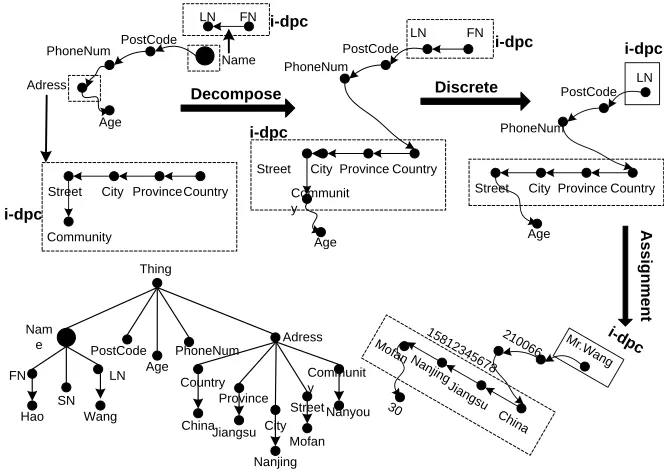
Suppose the input and precondition of all service participants that collected by service composer is user’s Name, Address, Phone Number, Postcode, Age and so on. User Hao Wang set personal privacy data Name, Address and Phone Number as disclosure chain, and Name as key privacy data. The privacy data set composed of input and pre-conditions requested by the service provider is continuous privacy data. We can protect user privacy data through the following steps:
Thing
Nam
e PostCode PhoneNum Adress
FN SN LN Country Province City Street Communit y Age Hao Wang China Jiangsu Nanjing Mofan Nanyou i-dpc i-dpc Name FN LN PostCode PhoneNum Adress Age Country Province City Street Community i-dpc FN LN i-dpc Country Province City Street Communit y PostCode PhoneNum Age i-dpc LN Country Province City Street PostCode PhoneNum Age i-dpc Mr.W ang China Jian gsu Nanjing
[image:7.612.139.471.288.526.2]Mofan 158123 210066 45678 30 Decompose Discrete A s s ig n m e n t
Figure 1. Privacy Data Discomposing Process.
Step 1, Construct privacy ontology tree according to the relationship among privacy data, as shown in lower left corner of Figure 1;
Step 2, Through matching obtain the corresponding privacy data Name, Address and Phone Number of the disclosure chain in continuous privacy data. Traversing the privacy ontology tree, we can find that Name has the child node of FirstName, SecondName and LastName, and Address has the child node of Country, Province, City, Street and Community. The Detailed work can be referred to our previous research paper[3], which is not illustrated in Figure 1;
Step 4, Discretize the newly formed privacy data chain. Namely, delete the rear privacy data in the internal discrete data chain and turn the continuous data chain into a discrete data chain;
Step 5: Assign a value to the privacy data in the discrete data chain to get an instance of the discrete privacy data chain. Such a process can also be deemed as the User behavior for sending a privacy data set to the service provider, namely:
Name (HAO WANG); Street (MOFAN); City (NANJING); Province (JIANGSU); Country (CHINA); PhoneNumber (+86-123456789); Postcode (210033); Age (30);
According to the defined user disclosure chain and key privacy data, the final obtained privacy data chain satisfy user privacy requirement.
Suppose that we obtain the corresponding sensitivity degree value of discretized privacy data through formula 1 in definition 5 as follows, (LN, Postcode, PhoneNum, Street, City, Province, Country, Age) = (0.3, 0.2, 0.8, 0.22, 0.18, 0.1, 0.03, 0.6). We assort the privacy data in an ascending order according to sensitivity degree, therefore the assortment is (Country, Province, City, Postcode, Street, LN, Age, PhoneNum).
The corresponding service availability measured value is (LN, Postcode, PhoneNum, Street, City, Province, Country, Age) = (0.4, 0.1, 0.9, 0.6, 0.5, 0.2, 0.15, 0.13), M=2.4. By constructing the state tree according to the constraint condition in definition 6, we obtain the minimum service availability privacy data set (PhoneNum, LN, Street, City).
Client each time select a privacy data with minimum sensitivity degree, to compute the intersection with the minimum service availability privacy data set, namely,
Country
PhoneNum,LN,Street,City
Province
PhoneNum,LN,Street,City
City
PhoneNum,LN,Street,City
City
Postcode
PhoneNum,LN,Street,City
Street
PhoneNum,LN,Street,City
Street
LN PhoneNum,LN,Street,City
LN
Age
PhoneNum,LN,Street,City
PhoneNum
PhoneNum,LN,Street,City
PhoneNum
Then client compute a union set of the results of intersection. Therefore obtain the
minimum privacy data set that satisfying user requirement
City,Street, LN, PhoneNum
.
City
Street
LN
PhoneNum
City,Street, LN, PhoneNum
.
RELATED WORKS
Description and Modeling of Privacy Requirement
practices, detect conflicting requirements and to trace data flows within and across specifications. Bahri L et al. [19] explored the available literature on web services privacy during transactions, identified 20 works that address privacy related problems in web services consumption, and proposed evaluation framework.
Analysis and Verification of Privacy Requirement
Oltramari A et al. [20] introduce PrivOnto, a semantic framework to represent annotated privacy policies, represent issues identified as critical to users and/or legal experts. Wei She et al. [21] focused on access control validation at composition time, which may be used to control the service providers accessing the user's private data. Tout H, Mourad A et al. [22] took advantage of both the Unified Modeling Language (UML) and the Aspect-Oriented Paradigm (AOP) to enforce Business Process Execution Language (BPEL) security policies. Changbo Ke et al. [23] propose a privacy data decomposition and discretization method for SaaS services. Changbo Ke et al. [24] propose a private data disclosure checking method that can be applied to the collaboration interaction process.
Matching and Negotiation of Privacy Policy
Changbo Ke et al. [25] defined user and service provider privacy policies based on analysis of current privacy rules and proposed a privacy policy automatic matching method. Wei Zhiqiang et al. [26] researched private data protection policies in the application of pervasive computing, and checked the inconsistency among policies. Changbo Ke et al. [27] proposed a privacy negotiation method between the user and the service provider in cloud computing to achieve the privacy requirement. Tbahriti S E et al. [28] presented a negotiation protocol pointing to the inconsistency of user and service provider privacy policies and also put forward a privacy system in which a privacy policy based on P3P can be defined.
CONCLUSIONS
We describe the privacy data and discrete the continuous privacy data. Through privacy sensitive analysis and service availability analysis, we obtain the minimum privacy disclosure data set. So as to prevent user privacy disclosure. Future work will focus on privacy extensions in service level agreements in order to support the monitoring of service composition.
ACKNOWLEDGEMENT
Jiangsu province Postdoctoral Science Foundation Funded Project (Project No. 1601198C).
REFERENCES
1. Altman I. 1975. “The environment and social behavior, privacy, personal space, territory, and crowding,” J.ERIC,1975:156.
2. Warren, Samuel D., and Louis D. Brandeis. 1890. “The right to privacy,” J. Harvard law review,
pp.193-220.
3. Chou, David C. 2015. “Cloud computing: A value creation model,” J. Computer Standards & Interfaces, 38: 72-77.
4. Jiang, Wei, Songlin Hu, and Zhiyong Liu. 2014. “Top k query for qos-aware automatic service composition,” J. IEEE Transactions on Services Computin, 7(4): 681-695.
5. Ke, Changbo, and Zhiqiu Huang. 2012. “Self-adaptive semantic web service matching method,” J. Knowledge-Based Systems, 35 (2012): 41-48.
6. FanJiang, Yong-Yi, and Yang Syu. 2014. “Semantic-based automatic service composition with functional and non-functional requirements in design time: A genetic algorithm approach,” J. Information and Software Technology, 56 (3): 352-373.
7. Ziegeldorf, Jan Henrik, Oscar Garcia Morchon, and Klaus Wehrle. 2014. “Privacy in the Internet of Things: threats and challenges,” J. Security and Communication Networks, 7 (12): 2728-2742. 8. Pearson, Siani. 2009. “Taking account of privacy when designing cloud computing services,” C.
Proceedings of the 2009 ICSE Workshop on Software Engineering Challenges of Cloud Computing, IEEE Computer Society, pp. 44-52.
9. P Pearson, S. and Charlesworth, A. 2009. “Accountability as a way forward for privacy protection in the cloud,” In IEEE International Conference on Cloud Computing, Berlin, Heidelberg Springer, pp. 131-144.
10. Takabi, Hassan, James BD Joshi, and Gail-Joon Ahn. 2010. “Security and privacy challenges in cloud computing environments,” J. IEEE Security & Privacy, 8 (6): 24-31.
11. Armbrust M, Fox A and Griffith R, et al. 2010. “A view of cloud computing,” J. Communications of the ACM, 53(4): 50-58.
12. Fox, A., Griffith, R. and Joseph, A., et al. 2009. “Above the clouds: A Berkeley view of cloud computing,” Dept. Electrical Eng. and Comput. Sciences, University of California, Berkeley, Rep. UCB/EECS, 28(13), 2009.
13. Armbrust, M., Fox, A., and Griffith, R., Joseph, A. D., et al. 2010. “A view of cloud computing,” J. Communications of the ACM, 53(4):50-58.
14. Datta, A., Franklin, J., Garg, D., Jia, L., and Kaynar, D. 2011. “On adversary models and compositional security,” J. IEEE Security & Privacy, 9(3): 26-32.
15. Ni Q., Bertino E., and Lobo J., et al. 2010. “Privacy-aware role-based access control,” J. ACM Transactions on Information and System Security, 13(3): 24.
16. Tang B., Sandhu R., and Li Q. 2015. “Multi‐tenancy authorization models for collaborative cloud services,” J. Concurrency and Computation: Practice and Experience, 27(11): 2851-2868.
17. Omoronyia I. 2016. “Reasoning with imprecise privacy preferences,” C. Proceedings of the 2016 24th ACM SIGSOFT International Symposium on Foundations of Software Engineering. ACM, 2016: 952-955.
18. Smullen, D., and Breaux, T. D. 2016. “Modeling, analyzing, and consistency checking privacy requirements using eddy,” C. In Proceedings of the Symposium and Bootcamp on the Science of Security, pp. 118-120.
19. Bahri L., Carminati B. and Ferrari E. 2017. “Privacy in web services transactions: a tale of more than a decade of work,” J. IEEE Transactions on Services Computing, 2017.
20. Oltramari A., Piraviperumal D. and Schaub F., et al. 2016. “PrivOnto: A semantic framework for the analysis of privacy policies,” J. Semantic Web, 2016: 1-19.
21. Wei She, I-Ling Yen and Bhavani Thuraisingham, et al. 2013. “Security-aware Service Composition with Fine-grained Information Flow Control,” J. IEEE Transactions on services computing, 6(3): 330-343.
IEEE Computer Society, pp.120-127.
23. Ke C., Huang Z. and Xiao F., et al. 2017. “Privacy Data Decomposition and Discretization Method for SaaS Services,” J. Mathematical Problems in Engineering, 2017: 1-11.
24. Ke, Changbo, Zhiqiu Huang and Xiaohui Cheng. 2017. “Privacy Disclosure Checking Method Applied on Collaboration Interactions among SaaS Services,” J. IEEE Access, 5: 15080-15092. 25. Changbo Ke, Huang Zhiqiu and Li Weiwei, et al. 2014. “Service Outsourcing Character Oriented
Privacy Conflict Detection Method in Cloud Computing,” J. Journal of Applied Mathematics, 2014:1-11.
26. Wei, Z. Q., Kang, M. J., Jia, D. N., Yin, B., and Zhou, W. 2010. “Research on privacy-protection policy for pervasive computing,” J. Chinese Journal of Computers, 33(1):128-138.
27. Chang bo Ke, Huang Zhiqiu, and Tang Mei. 2013. “Supporting negotiation mechanism privacy authority method in cloud computing,” J. Knowledge-Based Systems, 51: 48-59.