2017 2nd International Conference on Information Technology and Industrial Automation (ICITIA 2017) ISBN: 978-1-60595-469-1
Review for GGD Intelligent Mining
Technology
Tao Wu, Yunpeng Zhang, Ming Chen, Shiyan Yan,
Xiaowei Yang and Yuan Xiong
ABSTRACT
Miners’ casualties and environmental disruption keep troubling mining industry while the ultimate prospect in mining industry to develop efficient and eco-friendly intelligent mining technology remains. The breakthrough of exploration technology and directional well technology provides new opportunities under the assistance of giant computer technology. This paper elaborates a new workflow of intelligent mining based on GGD (Geology; Geophysics; Drilling) technology. Meanwhile, it points the key technologies for realization procedures including the development of giant drilling and exploitation equipment and backfilling facilities. Most significantly, the application of GGD technology would bring about profound revolution in the design and manufacturing of mining equipment industry.
INTRODUCTION
Mineral resources are the guarantee of economic growth and indispensable items of citizens’ common lives. However, newsletters reporting severe security and environmental problems caused by traditional mining are extremely frequent all over the world.
As is known to all, traditional mining is mainly driven by transmission. The implementation of mining engineering needs to develop professional mines in which the underground operations should be conducted. Especially when deep mining is conducted, the geological environment underground becomes more complicated _______________________
Tao Wu, Yunpeng Zhang, Ming Chen, Shiyan Yan, Xiaowei Yang, Yuan Xiong.Faculty of
while present technological conditions can’t meet the requirements of deep mining, which greatly increase the possibilities of all kinds of accidents. Moreover, even if diverse techniques have been developed to realize mining in layers which have different rock properties and geological structures, incidents such as mine collapses, floods, explosions, fire within the mine, breakpoints and so on still occur frequently. These accidents keep threatening miners’ lives and companies’ safe production while causing millions of dollars’ loss every year. Meanwhile, the condition in mine is extremely dark and narrow together with a huge density of miners coupled with the ever-changing operating spots, under which situation the possibility of operational errors would greatly increase. In general, both technological defects and man-made errors lead to frequent accidents in mining engineering.
Environmental problems can usually be divided into two areas: the damage of surface vegetation and pollution of underground water. Usually, traditional mining has the features of small scale mines and a large number of exploitation spots. Once encounter windy weather, a clear majority of mining scene would be dominated by numerous sand and dust, which would lead to dust flying phenomenon and harm the environment seriously. Due to technical constraints, a large amount of waste water has been produced during the mining process. In most situations, mining enterprises choose to dig out precipitation pit or directly discharge them into the river under the temptation of interests. Once the waste water wasn’t treated properly, the quantity of sediment in river would sharply increase in a short time, which would cause the uplift of river bed and threaten the security of riverway.
Mining industry would no longer stop its own steps no matter what kind of potential secure and environmental risks it might take, considering the mineral resources are the guarantee of economic growth and citizens’ daily lives. Moreover, since the economic growth is becoming the theme of the world, nations all over the world are looking for new possibilities to develop the economy. Traditional mining methods at the cost of miners’ security and environmental pollution will no longer exist. Meanwhile, shallow mineral resources are becoming more and more scarce and faced with different levels of resource crisis[1]. According to the resource situation, deep mining would be the only way to keep economy thriving. Inevitably, to exploit deep mineral resources, intelligence is an indispensable segment to the giant machine because traditional mining would result in much more casualties and tremendous damage to the environment. Thus, it is evident that intelligence is the undeniable direction of mining industry. So, there comes the question: what kind of mining can be defined as intelligent mining? Here is the definition: Intelligent mining is a kind of mining technique which combines digital exploitation, intelligent equipment, tele-control of mining process, informatization of message delivering and operating management to ensure miners’ safety, efficiency, economy and environment protected[2].
competition has risen among nations all over the world. In the 1980s, Canadian company Noranda developed several intelligent mining equipments mainly included automated mining trunk and Load-Haul-Dump facilities to meet the standard of automated hard-rock mining, which can be considered as the first attempt of automated and intelligent mining[3]. Since then, the developments of intelligent mining go through many breakthroughs. In 1996, three companies, Dyno, INCO and Tamrock started a cooperative development of Mining Automated Project (MAP) to adapt complex geological environment and increase the efficiency of mining[4].
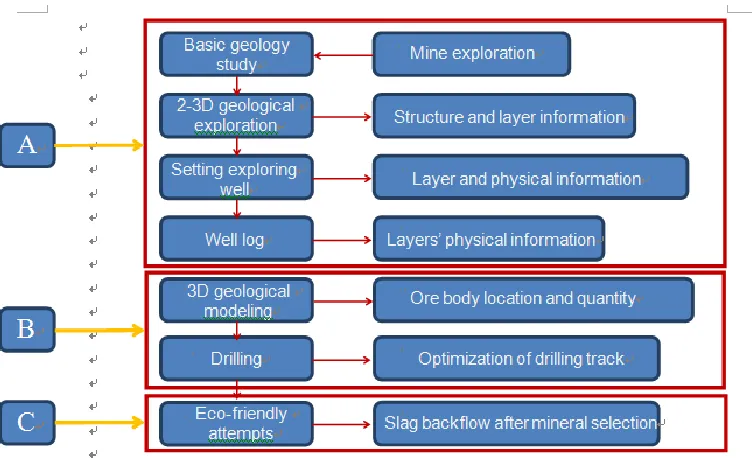
However, present intelligent mining technologies mostly focus on the exploitation of minerals instead of realizing automated procedures from ore body detection to exploitation and slag backfilling. This essay will introduce a new intelligent mining technology—GGD(Geology; Geophysics; Drilling) technology which attaches great importance on environment and intelligence of integration of exploring, mining and slag backflow.
CONCEPT AND WORKFLOWS OF GGD TECHNOLOGY
Nowadays, with the significant progress made in giant computer technology, it is a new trend to make full use of modern spatial analysis, data mining, knowledge digging, virtual reality and its visualization, multi-media and scientific computing technology to provide new ideas for simulation, process analysis, mineral resource assessment, mine planning, development design, production safety and decision management[5]. Currently, in the case of individual technology, such as the advanced geological exploration technology, three-dimensional visualization technology, drilling and directional drilling technology, hydraulic mining all have mature industrial applications to a large degree[6]-[14].
Figure 1. Flowchart of intelligent mining of deep solid mineral resources based on GGD.
THE KEY TECHNOLOGIES REALIZING GGD INTELLIGENT MINING
Geological Exploration and Geophysics Technology
Geological exploration is the basic theory and practice of mineral exploration. In recent years, due to the emergence of multitudinous Metallogenic theory, such as Fluid Metallogenic Theory, Multi-trend extrapolation prediction theory and Neural Network Theory, it’s a novel idea to predict mineralization and in turn enrich the theoretical framework of metallogenic prediction[15]. Meanwhile, with the integration and innovation of diverse metallogenic theories, a variety of forecasting and evaluation methods have been developed, which have ideal predicting results under complicated geological conditions[16]-[17].
data processing and increases the accuracy of metallogenic prediction. Most importantly, it’s a profound progress that promotes geological exploration to the direction of informatization and intelligence[18]-[19].
The technology can also help determine the priority mining that has the most economical value through geological and geophysical techniques, which can accurately describe the occurrence and scale of underground mineral deposits.
Three-Dimensional Geological Modeling
Three-dimensional geological modeling is a kind of visualization technology which takes advantage of geology, logging, geophysical data and interpretation of the results & conceptual model to generate three-dimensional quantitative stochastic model. Since Simon W. Houlding firstly put forward the concept of three-dimensional geological modeling, numerous successful applications have been utilized in the development of petroleum, solid mine, underground city space and many other areas with the integration of computer calculation and program algorithm. The technology of three-dimensional geological modeling combines primary drilling data and basic geological research together to delineate the 3D space distribution of ore body, calculate the quantity and realize the fine comparison of detailed layer information and geological structure. In present mining industry, numerous software for three-dimensional reservoir and geological ore modeling has been widely applied. For instance, Petrel by Schlumberger, SKUA-GoCad by Paradigm and Arcgis by Esri all have mature application in mining industry. Moreover, Minex-Pitopt, Micromine, Survcad, Minescape, CRYStAL, Geostart, GtPSS/H, Geocomp, Suiypac2000, Surpac, whitle3D all have certain application in different areas. Petrel has a great reputation in petroleum industry because its outstanding ability of visualization and geological interpretation & analysis. In the field of geophysical information, Arcgis is the absolute mainstream software causing its strong capabilities of map production, spatial data management, spatial analysis and spatial information integration. Based on the comprehensive utilization of three-dimensional model, the research and engineering staff can adjust the development plan at any time according to the geological model, so as to provide detailed design for the following directional well.
Drilling and Mining Technology
GEO-STEERING TECHNOLOGY
signals. Considering its compatibility, the algorithm would surely have great application prospects[22]-[23]. Electromagnetic wave transmission drilling technology has also made several great progress including rising the depth of measurement to 4,420km. US Scientific Drilling Company developed a drill gyroscope tester (gyro-measurement while drilling, gMWD) through encapsulating the aerospace precision gyro orientation device in the MWD instrument. By the end of 2007, gMWD had been successfully applied in hundreds of multi-branch wells in the United States and played an important role in wells which need precise orientation or docking particularly. Moreover, US researchers developed a downhole drilling diagnostic system (diagnostics-while-drilling, DWD). The system can link downhole layer formation and drilling conditions to ground data in real time to optimize drilling parameters and borehole trajectories, guide drilling operations, adapt downhole complicated conditions, improve drilling speed and get the maximize drilling efficiency. Modern LWD technology and the improvement of logging technology allow us to successfully find target layers while entering layer data automatically to make technical assurance for subsequent mining constructions and intelligent mining.
DRILLING DESIGN
HYDRAULIC MINING TECHNOLOGY
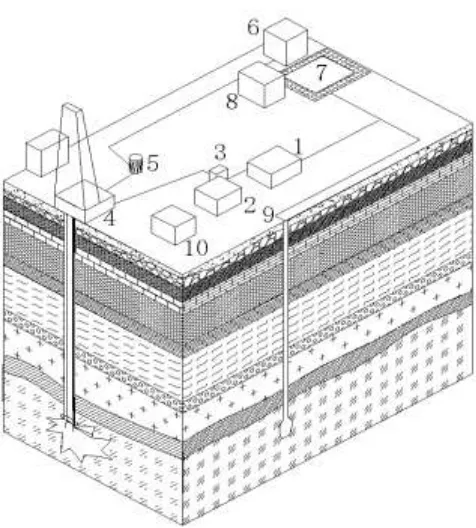
[image:7.612.173.411.329.593.2]Hydraulic mining technology is a new mining method based on drilling technology and hydraulic principles. Since the middle of the nineteenth century in North America, the first water jet was used to mine non-consolidated deposits[24]. With the promotion of hydraulic mining technology, a large number of jet tools have greatly facilitated the researches of water jets. In 1980s, the developments of Abrasive jet, cavitation jet, gas jet and self-jet even bring water jet into a new stage. The application of hydraulic mining technology can ensure the drilling process efficiently and eco-friendly especially in mining deep mineral deposits. Through the establishment of mathematical models, automatic slurry lifting technology based on gas reverse circulation principles is developed, which tactfully maintains the relationship among the pressure differences, the wind pressure and the sinking depth of the mixer to improve the efficiency of slurry lifting. Figure 2 illustrates the hydraulic mining process.
Figure 2. Drilling hydraulic mining process.
1. Water pump station; 2. Compressor station; 3. Dispensing station; 4. Mining drilling; 5. Air exclusion device; 6. Sampling pulp device; 7. Settling pond; 8. Ore warehouse;
CONCLUSIONS
(1) Intelligent drilling and mining technology for deep solid mineral resources based on GGD is an integrated intelligent mining program, which is the coordination of three-dimensional geological modeling technology, Geo-steering, gas lift reverse circulation mining technology (slurry lifting technology) and slag backfilling technology. The application of new mining technology can solve the following questions: ① Underground vegetation damage and environmental pollution problems during development;② Safe production of tunnels;③ Cost optimization issues.
(2) The idea of intelligent drilling of deep solid mineral resources provides a new drilling equipment design and manufacturing ideas for the relevant enterprises, which is a great leap toward the intelligence and standardization of mining industry under the call of industrial 4.0 era. The emergence of intelligent drilling and mining technology have injected new vitality for the gradual aging mining industry by pointing out the direction for the future development of mining industry. GGD mining technology is bound to bring a new round of technological revolution and accelerate the upgrading of traditional mining industry.
REFERENCES
1. Lv Guxian, Zheng Dayu, Zhu Yusheng, et al. Investigation and Evaluation of Potential Resources of Crisis and Mineral Resources. Geological Survey report of China Geological Survey Bureau, 200110200104, 121~124.
2. Gu Desheng. Intelligent mining touches the future of mining. Mining Equipment, 2014(01): 24-26.
3. Scoble M. Progress of Canada mine automation: from digital mine to full mine automation[J] . CIM Bulletin, 1995(5): 30-36.
4. Wu Lixin, Wang Yun-jia, et al. Thirdly study on digital mine: serve for mine safety and intellimine with support from IoT. Journal Of China Coal Society, 2012(3): 357-365.
5. Guo Chao, Some key problems of deep mining in metal mines [J]. China New Technologies and products, 2009(06).
6. Wu Lixin, et al. Thirdly study on digital mine: serve for mine safety and intellimine with support from IoT [J]. Journal Of China Coal Society, 2013(03).
7. Cui Yingxiao, Application of 3D Visualization Technology Based on Unity3D Engine in Coal Seismic Prospecting [J]. Coal Geology of China, 2014(04).
8. Zhao Xueshe, Present status and development tendency of high efficient roadway driving technology in coal mine [J], Coal Science And Technology, 2007(04).
9. Jiang Dawei, Research on application and development of new technology of intelligent Drilling [J], Science and Technology Innovation Herald, 2015(06).
10. Fu Chun, Yan Enfeng. New Mining Technology - Drilling Hydraulic Mining Technology.Mining and Metallurgical Engineering, 2004, 24(4):7-8.
11. Tang Lin, Tang Chuanlin, Zhang Fenghua. Drilling Hydraulic Mining Technology of Underground Mine and Its Application. Chinese Journal of Underground Space and Engineering, 2006,2(4):662-665.
13. Song Ming-chun, Cui Shu-xue, Yang Zhi-li, Jiang Hong-li,Yang Cheng-hai, Jiao Xiu-mei.Great progress and profound significance of deep exploration in JiaoJia gold mine, Shandong province[J]. Geology and Prospecting, 2008,(1):1-8.
14. Liu Hong. Mine Conditions and Ore-Searching Prospect in Jincheng Gold Ore Deposit in Luoshan County, Henan province[J]. Geology and Prospecting,2013,49(2):265-273.
15. Wu Chu-guo, Duan Yao-feng, Shu Zhi, Method of geological prospecting theory[J], Land and Resource Information, No.9 of 2013.
16. Ye Tian-lan. Prediction Technology of Solid Mineral Resources[M]. Beijing: China Land Publishing House, 2004, p1-9.
17. Zhu Yu-sheng, et al. Metallogenic forecasting theory and method[J]. Geological Review, 2000. NO.10, p25-29.
18. Wang Shi-cheng. New Advances in Theory and Methodology of Comprehensive Information Mineral Prediction[J]. Geological Bulletin of China, No.10 of 2010, p1399-1403.
19. Ye Tian-lan, Xiao Ke-yan, Yan Guang-sheng. Study on Comprehensive Geological Information Forecasting Technology for Mineral Deposit Model[J]. Geoscience Frontiers, No.5 of 2007, p11-19.
20. SU Yinao, Geosteering drilling technology and its development in China[J]. Petroleum Exploration And Development, 2005.
21. M.I. Epov, V.N. Glinskikh, K.V.S ukhorukova, M.N. Nikitenko, V.N. Eremin, Forward modeling and inversion of LWD induction data,Russian Geology and Geophysics 56, 2014,
(2015)1194-1200.
22. Steven F, Adriano C. The use of multilateral well designs for improved recovery in heavy oil reservoirs[R] .SPE 112638, 2008.
23. Schlumberger Limited. Drilling industry articles[ EB/OL] .[ 2009-04-30] .http :// www .slb.com/ content/services/ re source s/ articles/ drilling .asp ?)