2016 International Conference on Computational Modeling, Simulation and Applied Mathematics (CMSAM 2016) ISBN: 978-1-60595-385-4
Design and Implementation of Non-stop Toll Collection System for
Parking Lot Based on Mobile Intelligent Terminal
Jun-peng ZHANG
1, Zhi-gang WEN
1and Ke-gang SUN
21School of Electronic Engineering, Beijing University of Posts and Telecommunications, Beijing,
China
2
Xiaomi Communication Technology Co. Ltd., Beijing, China
Keywords: Toll collection system, Mobile intelligent terminal, Intelligent parking lot.
Abstract. This paper firstly discusses the low efficiency of current toll collection ways, then leads to a non-stop toll collection system and describes its architecture, after that the paper introduces the non-stop toll collection system in detail, and shows how the reliability and robustness of this system is ensured. Also, the test cases are showed, from which we can draw conclusion that this toll collection system can apparently improve the efficiency of current intelligent parking lot systems.
Introduction
With the development of economy and society, private cars are more common in citizens’ lives. The problem of difficulty and inefficiency of parking has been aggravated by the increase of private cars. In order to ease the situation and improve the travel experience of citizens, the research and application of intelligent parking lots plays a vital role [1].
At present, the technical means of license plate recognition, automatic calculation of fee and parking detection have been widely used by intelligent parking lots [2], which have improved the efficiency of parking to a certain extent. But the predominant means of toll collection is still by cash. Apart from artificial toll collection, payment through parking meter and IC card are two other common ways of charging [3]. But all these traditional means of toll collection do have some malpractices to some extent, which not just leads to the comfortlessness of drives due to its inconvenience but also causes traffic jams at toll gates which wastes drivers’ time and severely affects the efficiency of parking.
Based on the problems mentioned above, this article designs and implements a non-stop toll collection system. Drivers only need to install an APP based on mobile intelligent terminals which connects drivers’ accounts with parking lot systems, the APP automatically charges parking fee when cars leave and can enormously increase efficiency.
Architecture Design of the System
providing APP clients with data and for data access to parking lot management systems. Those interfaces are implemented in HTTP. The topmost layer is APP for users. Users use the third party payment platform provided by APP to pay for the fee and thus the function of non-stop-charge is guaranteed.
APP for users
APP Server System
Parking Lot Management
System
Hardware Devices
parking lot 1 parking lot 2 parking lot n user interface
user n user 2
user 1
··· ···
APP server system
camera barrier gate vehicle detector
camera barrier gate vehicle detector
camera barrier gate vehicle detector
···
Figure 1. Architecture of the toll collection system.
Work Process
Registration and Plate Binding
Users should register a personal APP account at first before getting the service of automatic toll collection. For the reason that the APP account gets involved with personal fund, users are only allowed to register by their telephone numbers. In that way, we can timely contact with the user if there are some important issues, thus the safety of the personal account can be assured. The plate is the crucial charging certificate of the parking lots, so users should bind their car plate to their personal account. Users will get a parking credit amount after finishing the work mentioned above. If the remaining balance in the account can’t afford to pay for the parking fee, the system will automatically pay for the fee using the parking credit, which ensures the non-stop toll collection procedure.
System Workflow when a Car Enters the Parking Lot
Figure 2. System working process when a car enters the parking lot. Send license plate number
Notify if APP is at wok User Interface
Enter parking lot
License plate and vehicle type
recognition
Parking period Barrier gate up
APP Sever System
New parking record
Find the user and record
Pop up the enter bill interface Parking Lot
After registration and plate binding procedure, the service provided by this system is ready. Figure 2 shows the process when a user drives his car and enters the parking lot. When the vehicle comes close to the entrance of the parking lot, the vehicle detector will be triggered and the camera will capture the information of the vehicle. The parking lot management system will get the information of car type and car plate number and establishing a new record for the vehicle entered just now, and then, the parking managing system sends this record message to the APP server system. After receiving the information, the APP server system finds the correct personal account and record the parking message according to the information from the management system. The APP server system will then judge weather the user is now using the APP on a terminal, if the result is true, the APP server system will send a range of message including the name of the parking lot, car plate number, entrance time, charging standard and so on to the APP, helping the user to know more detail about parking. But if the certain user is now offline, the server system won’t disturb the user, but the non-stop payment function is still available. After all these procedures, the user finishes entering the parking lot, parking lot management system and APP server have done a corresponding record.
System Workflow when a Car Leaves the Parking Lot
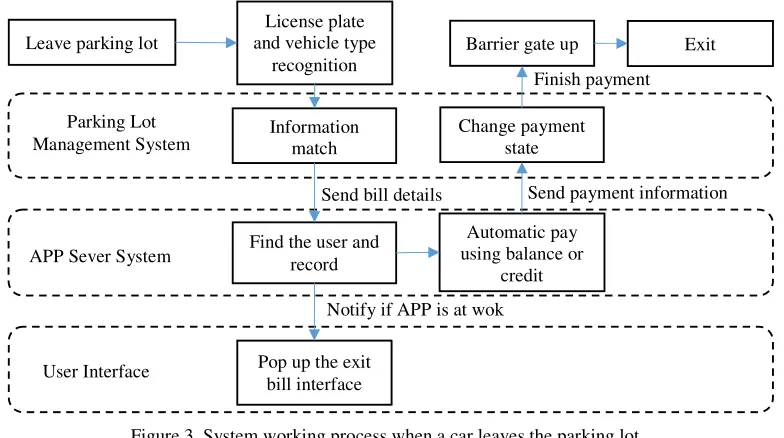
[image:3.612.112.504.443.662.2]When the vehicle is leaving the parking lot, the detect process of camera and the record process of parking lot management system and APP server are almost the same as entering. The difference is that this time the bill details from the management system includes parking time and fee. After figuring out the correct user, the APP server system will automatically deduct the parking fee from the balance or parking credit and send back the payment information to the parking managing system. Also, the APP server will notify the user if APP is now at work. Once the managing system receives the message, it will update the payment status and open the barrier gate to let the vehicle leave. As a result, the automatic payment function eliminating the need for users to stop the vehicle and manually pay for the parking fee by cash or a card, and realizing the core function of the system—non-stopping toll collection. If the user pays for the parking fee by credit last time, he needs to repay the parking fee through APP and thus recovers the credit amount in time in order not to affect the automatic payment service for the next time. The repayment can be finished through the third party payment platform. The leaving process is shown in Figure 3.
Figure 3. System working process when a car leaves the parking lot. Other Convenient Features of this APP
In addition to automatically charging parking fee and popping up the parking ticket which is mentioned above, the APP in this system also provides users with a series of convenient features, specifically summarized as follows:
Finish payment
Send payment information
Notify if APP is at wok Send bill details
User Interface Leave parking lot
License plate and vehicle type
recognition
Exit Barrier gate up
Parking Lot Management System
APP Sever System
Information match
Find the user and record
Pop up the exit bill interface
Automatic pay using balance or
credit Change payment
Parking lot information available. Users can use APP to query the parking lot information near the destination before a trip, the information includes charging standard and the remaining parking spaces. For the closed parking lot, the vacant space amount can be obtained simply by counting when vehicles enter and leave the parking lot. [4] Therefore, the remaining spaces information is sure to be effective.
Car navigation. APP uses the third-party map interface to provide users with navigation features, which is convenient for the users to drive to the destination.
Account recharge. To ensure that the users’ accounts have enough money to pay for the parking fees, users can choose to recharge some money in advance.
Historical records and orders of parking. APP will record the history of parking and recharging and display them in lists, which are convenient for users to check the parking services in the past.
Reliability and Robustness
In order to provide long-term stable service, ensure the effectiveness of the toll collection system and prevent the users from leaking to pay the parking fees, the system has taken some effective measures in terms of reliability and robustness.
Device Identification
The APP users can use different devices to log in and different users can use the same device to log in, in order to ensure the APP server can push the ticket of entering and the ticket of exiting to the correct user and the correct device, it is necessary to allocate an unique identification for each intelligent terminal devices, the identification can be represented as client ID.
If an application based on Android or iOS operating system enables the push service, the system will automatically allocate a string that uniquely identifies the terminal when the APP is opened. The string consists of 32 letters or numbers, which can be used as client ID. Every time the user log in the APP, the unique sequence number will be sent to the server, the database in the server will update the relationship between phone number and client ID. The phone number identifies the user and the client ID identifies the user device. In this way, we can ensure that the server will push the ticket of entering and ticket of exiting to the device that is last used, thus the effectiveness of pushing ticket service is ensured. Interaction process between users and the APP server system is shown in Figure 4.
Figure 4. Interaction between APP and its server when log in. Reliability Assurance of Charging Mechanism
In most cases, the system can provide users with a non-stop toll collection service, but in order to ensure the normal profit of the APP operators and the parking lot, when the user’s remaining balance cannot pay for the parking fee or the user has a debt in the credit, which is caused by forgetting to repay for the parking fee last time, the system will stop providing users with non-stop toll collection service. In this case, users need to manually pay for the parking fee at the exit with APP or other methods supported by the parking lot before leaving. Besides the two circumstances mentioned above, the non-stop toll collection service can be always ensured by automatic payment through the users’ balance account or credit account, or both, which is shown in Figure 5. Therefore, to ensure the quality of APP users’ parking service, we come up with two reasonable proposals for the users.
Send client ID
User Interface APP Sever System
Verify phone number and
password
Correct, record phone
number
Login successful
Record client ID
First, after obtaining a non-stop charging service by using the credit to pay for the parking fee, users should pay for the credit debt in the APP before the next time parking their cars.Second, for the users who may pay for a large sum of parking fee, it is recommended to recharge in the APP before the users fetch their cars, an enough amount of the account balance and credit can ensure a non-stop payment for a big parking fee bill.
Figure 5. APP server system’s charging mechanism. Security
Due to the openness of the Internet environment, nowadays network security issues are attracting more and more attention. In this system, the communication between the APP server system and the APP, between the APP server and the parking lot management system are all based on HTTP, if we do not take some encryption processing upon HTTP based communication, dissemination of all these messages in plain text will bring the risk of eavesdropping, tampering and pretending.
In order to ensure the security of the system, prevent it from harmful attacks by third parties, the system adopted SSL/TLS protocol. The SSL/TLS protocol, an encryption technology, was developed by Netscape for secure data transmission between web servers in 1994 [5]. Its basic idea is public key cryptography, which means the client asks for public key from the server, and then uses the public key to encrypt information, while the server uses its private key to decrypt after receiving the cipher text. The following three subtitles show the procedures of SSL/TLS protocol:
(1) The client asks for public key from the server and confirms it; (2) The two sides negotiate and create session key;
(3) The two sides use a session key to encrypt communication.
The first two steps are called “handshake”, after the handshake, the client and the server start an encrypted communication through HTTP. A unique session key is needed for each session, which is used to encrypt information. As the session key uses symmetric encryption, the calculation speed is very fast. And also, the server’s public key is used only to encrypt the session key itself, thus
Y
N
Y
N
Y
N
Credit account in arrear? Start
Bill details from parking lot management system
Find the user
Balance > fee?
Balance + credit >fee?
Automatic pay using remaining balance
Balance first, the rest using credit account
Manual pay using APP or other ways
Finish payment, barrier gate up
improves the performance of time-consuming encryption algorithm, which can ensure the communication speed while providing a more secure condition.
The APP is also equipped with payment and map interface, both come from third party. In order to use the API from the third party, an API Key is required for authorization [6]. An API Key is a unique mark consists of 32 characters that the API provider distributes to the programmer when registering for using the API service. When an APP user requests for the service from a certain API, the API Key will be checked. The third party platform will response only if the API Key is correct. Then the user can get service from this platform, i.e. car navigation and payment. In this way, the API Key can protect the security of the APP’s third party platform service to some extent.
Implementation Effects Test
We designed a series of test cases to detect the effects of our system, especially focus on the APP server system’s processing speed towards toll collection, and the parking lot system’s response speed after it receives the payment complete information from the APP server.
Car Entering Parking Lot Test
Figure 6. Message 1 transmit to APP server system. Figure 7. Message 1 transmit to APP client. When a car enters a parking lot, the camera firstly gathers information about the car, and then sends the information to the parking lot management system, which in turn sends these messages to the APP server system. Finally the APP server sends the information to the APP client. In one test, the information the parking lot management system sent to the APP server system is shown in Figure 6. The message contained license plate number, parking lot number and time of admission to the parking lot; the information sent to APP from its server is shown in Figure 7, which contains the parking lot name, address, charging standard and etc. the data format for the APP client is JSON format.
[image:6.612.90.519.505.609.2]Car Leaving Parking Lot Test
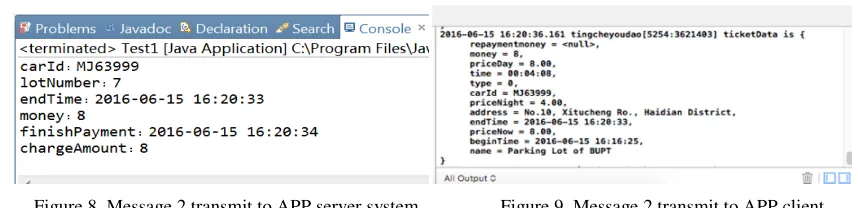
plate number and the time received the payment complete notification was only about one second. Figure 9 shows the information the APP client received when the car was leaving the parking lot. Both Figure 7 and Figure 9 show that the time interval between the time the car entered or left the parking lot and the time the APP client was informed was just around 3~4 seconds.
[image:7.612.112.500.257.311.2]We made plenty of tests and got multiple sets of data, especially focused on the time interval between the time the management system confirmed the license plate number and the time the system received the payment complete notification, which is just the time interval discussed in Figure 8.One of 10 sets of data is given in Table 1. From the table we can see that through plenty of tests, it costs about only one second between the license plate number is recognized and automatic payment complete. In a real parking lot, the camera starts detecting once a car is in the range of vehicle detector, so the automatic toll collection can be surely completed before the car is approaching the barrier gate as long as the car is at a low speed when passing through the parking lot exit. That is to say, the effectiveness of this automatic toll collection system is ensured.
Table 1. Time interval detection between two notifications.
Camera response time 14:33:34 14:40:46 14:57:05 15:21:30 15:34:50 Finish payment time 14:33:35 14:40:47 14:57:05 15:21:31 15:34:51 Camera response time 15:45:22 15:48:16 15:56:44 16:46:20 16:50:03 Finish payment time 15:45:23 15:48:18 15:56:45 16:46:20 16:50:04
Summary
In order to solve the problem of the inefficient way of charging parking fee, which usually happens at the exit of a parking lot, a non-stop toll payment system is designed and implemented in this paper. The cooperation between the APP client, the APP server and the parking lot management system can make automatic payment come true when a car leaves the parking lot. The tests given in the paper certify that this non-stop toll collection system is practical and can effectively alleviate the current parking problem of low efficiency. But how the business model will be like, and who can be the most suitable operator of this APP are not discussed in this paper.
Acknowledgement
This research was financially supported by the National Development and Reform Commission (NDRC) Project (2014-2328), National Great Science Specific Project (Grants No. 2014ZX03002002, 2015ZX03002005) and National Natural Science Foundation of China (Grants No. NSFC-61471067).
References
[1] Wang J, Gebara S, Sun Z, et al. IPLMS: An intelligent parking lot management system[C]// Systems, Applications and Technology Conference. IEEE, 2015:1207-12.
[2] Sirithinaphong T, Chamnongthai K. The recognition of car license plate for automatic parking system[C]// International Symposium on Signal Processing and ITS Applications. 1999:455-457 vol. 1. [3] Shanker, S, Mahmud, S.M. An intelligent architecture for metropolitan area parking control and toll collection[C]// Intelligent Vehicles Symposium, 2005. Proceedings. IEEE. 2005:723-728. [4] Huang C C, Dai Y S, Wang S J. A surface-based vacant space detection for an intelligent parking lot[C]// International Conference on ITS Telecommunications. 2012:284-288.
[5] Kim S M, Goo Y H, Kim M S, et al. A method for service identification of SSL/TLS encrypted traffic with the relation of session ID and Server IP[C]// Network Operations and Management Symposium. IEEE, 2015.