2017 2nd International Conference on Computer Science and Technology (CST 2017) ISBN: 978-1-60595-461-5
A Fairness Oriented Consistency Control Method in
Distributed Virtual Environment Systems
Wei ZHANG
1,a*and Hang-jun ZHOU
21 College of Computer, National University of Defense Technology, Changsha, China
2 Department of Information Management, Hunan College of Finance and Economics,
Changsha, China
*Corresponding author
Keywords: DVE systems, Fairness, Consistency control method.
Abstract. The distributed virtual environment (DVE) system needs to adopt the consistency control method to maintain the state consistency of each node. Existing consistency control methods mainly consider how to increase the consistency of the whole system with a small overhead, and often neglect the important role of fairness in the virtual environment system. In fact, in many DVE systems, the fairness of all users in the virtual world plays an important role in the usability of the system. In this paper, we propose a new fairness-oriented consistency control method, which ensures the fairness of each node in terms of inconsistency degree by adjusting the ahead deviation time of each node, thus improving the usability of the system. Experimental results show that our method can significantly improve the fairness of the distributed virtual environment system.
Introduction
Distributed virtual environment system [1] is a kind of virtual reality system based on distributed simulation technology [2] [3] and network technology. It supports military training, online gaming, and distance education by building a virtual world that allows users to interact with each other in real time. The consistency problem is one of the most important problems in the distributed virtual environment system. There are a large number of geographically distributed users in the system, so keeping the virtual world in different nodes have a consistent view and the users can perceive a consistent state of various objects are of crucial to ensure system usability. In addition, the fairness of the system is also an important factor to determine the sense of reality of system, especially in military training, online games and other competitive virtual environment. The unfairness will lead to a result that competition results can not reflect the user or the player's real strength, which makes the simulation results untrusted, thus hampering the system usability.
The rest of this paper is organized as follows: Section 2 introduces the related work on consistency control and fairness control. Section 3 gives a formal description of the problem. Section 4 introduces the proposed fairness-oriented consistency control method, Section 5 describes our experimental process and results, and finally, Section 6 summarizes the paper.
Related Work
The consistency control method of DVE system can be divided into the event order based consistency control method and the time stamp based consistency control method. The event order based consistency control method is to control the running process of each node according to the relation among the events. The most widely used methods in this category are causal order consistency control methods based on the happened-before causality relation [4], such as the causal order consistency control method based on one-dimension vector clock [5], the causal order consistency control method based on two-dimension vector clock [6] for unicast and multicast systems, critical causal order consistency control method [7] and so on. The basic idea of the methods in this category is to identify the key causal relations in the event order and to ensure that this type of relation in the system can be maintained at all nodes. In addition, there is a kind of sequential consistency control method, also known as total order consistency control method, which is to ensure the sequence of all events at all nodes as the goal, such as the distributed event delivery method proposed in [8], the dynamic consistency control strategy switching method proposed in [9], etc. This kind of methods can control the relation of all events to ensure the consistency of the state of each node in the system.
The time stamp based consistency control method is a technique to maintain the system consistency by precisely controlling the generation and processing time of each event and the time advancement process of each node., such as the local lag method proposed in [10], the delay consistency control method proposed in [11], the predictive time management technique proposed in [12]. Due to the more accurate management of the execution time of events, this method can provide better system consistency, but the overall control overhead and time cost are a little large.
The above-mentioned consistency control methods usually do not consider the fairness factor in the system. In fact, the fairness is a key issue that affects the sense of reality and immersion of the system. In [13], the authors propose a message control method for C/S structure DVE system, which can ensure the fairness of each node effectively. In [14], the authors propose a definition of unfairness based on usability space in DVE system, and proves that the distributed server architecture can improve the fairness of the system effectively. In [15], the authors propose a fairness control method based on responsiveness satisfaction, which can effectively improve the fairness of each node in terms of response capacity.
System Model
Distributed virtual environment system usually consists of multiple nodes connected to each other. These nodes achieve interaction through the event or message delivery between nodes. In this paper, we use V={v1,v2,,vn} to represent the set of all nodes in the system, and E={ , , , }e e1 2 em to represent the set of all events. For a given event
i
receive the event. We use ( )tg ei represents the time the event was generated. ( )tx ei represents the time at which the event is set for processing. If vb∈R e( )i , tr eb( )i represents the time the node receives the event. If vb =g e( )i or vb∈R e( )i , te eb( )i represents the time at which the event is actually executed on node vb.
To ensure the state consistency of each node in the system, it is necessary to process the event at the same time point in each node, which is to satisfy the following absolute timestamp consistency constraint.
Constraint 1 Absolute timestamp consistency constraint
; , ( ) { ( )} ( ) ( ) ( ) i m n i i m i n i i
e E v v R e g e te e te e tx e
∀ ∈ ∈ ∪ = =
(1) According to constraint 1, a node cannot process the event immediately after it generates the event. Instead, it has to wait for a period of time to ensure that the event can be processed simultaneously after transferring the event to other nodes through the network. In addition, the delay time of a node cannot exceed the response time of the node. The reason is after initiating an action in the virtual world, the user needs to be given a feedback within a short time. If the response time is too long, the user's interactive experience will be greatly affected. Therefore, the following constraint should be satisfied.
Constraint 2 Response time constraint
; ( ) ( ) ( )
i m i i i m
e E v g e tx e tg e rt
∀ ∈ = − ≤ (2) In the above definition, rtm represents the response time of node vm. In order to guarantee the responsiveness of the system, the delay time of the event cannot be set to exceed the response time of the user. In this case, there may be an event which reaches the target node after the scheduled processing time, thus violating the previous constraint 1. Here we define the inconsistency degree of an event as:
Definition 1 Event inconsistency degree
0 ( ) ( )
( )
( ) ( ) ( ) ( )
m i i
m i
m i i m i i
tr e tx e ic e
te e tx e tr e tx e
≤ = − > ,
, (3)
Then we define the inconsistency degree of a node as the mean of the inconsistency degree of all its received events.
Definition 2 Node inconsistency degree
, ( ) ( ) / { , ( )}
i m i
m e v R e m i i m i IC ic e e v R e
∀ =
=
∀ = (4)The inconsistency degree of a node represents how real the user can feel about the virtual world. If the inconsistency degree is high, it indicates that a large number of events are not processed at the expected time, and the operation of the node in the virtual world is affected seriously. Therefore, from a fairness point of view, we need to minimize the difference of inconsistency degree of different nodes. Therefore, we give the following definition of system unfairness.
Definition 3 System Unfairness var ( )
i
i v V UF IC
∀ ∈
= (5)
system consistency constraint and the response time constraint are satisfied. In the next section, we will present our fairness-oriented consistency control method.
Fairness Oriented Consistency Control Method
In our previous work, an asynchronous clock model [16] was proposed to fine-tune the simulation time of each node to improve the consistency of the system by redistributing the time resources of the system. In the asynchronous clock model, each node is given a deviation time and runs on its relative timeline respectively. In this paper, we define a new ahead deviation time, which means the simulation time that is ahead of the wall clock time a little. We use tw to represent the wall clock time, ti to represent the simulation time of node vi, then we can define the ahead deviation time as:
Definition 4 Ahead deviation time
:
i i i w
v
V d
t
t
∀ ∈
= −
(6) In the case that deviation time exists, both the ahead deviation time of the sending node and the ahead deviation time of the receiving node will affect the event reception time, we can use the following formula to calculate the event reception time.Definition 5 Event reception time formula
; ( ); ( ) ( ) ( )
i m i n i n i i m n mn
e E v g e v R e tr e tg e d d cd
[image:4.612.163.455.461.668.2]∀ ∈ = ∈ = − + + (7) In the definition, cdmnrepresents the message communication delay between vm andvn. According to definition 5, if the ahead deviation time of a node is increased, the inconsistency degree of the message it sent will be reduced, and the inconsistency degree of the message it received will be increased, thus reducing the inconsistency degree of the neighbor nodes and increasing its own inconsistency degree. Conversely, reducing the ahead deviation time of a node will reduce its inconsistency degree and increases the inconsistency degree of its neighbors.
Figure 1. Fairness adjustment method.
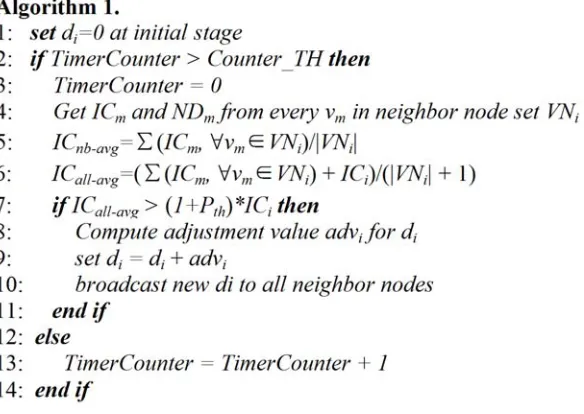
fairness and reduce the total inconsistency degree of the system at the same time. The overall process is shown in Figure 1.
We design a distributed fairness adjustment method, which adjusts the inconsistency degree between nodes dynamically in the running period. As shown in Figure 1, we divide the entire running process of the system into multiple periods and run the algorithm at the end of each period to optimize the fairness. In the process of adjustment, the node first obtains the information about its neighbor nodes, including the inconsistency degree ICm and the node degree information NDm in the last period.
Then, the node compares its own inconsistency degree ICi with the average
inconsistency degree of all neighbors including itself ICall-avg. If its inconsistency
degree is lower than the average inconsistency degree by a preset percentage Pth, then it
indicates the current fairness is poor and an adjustment process should be started. The node will compute an adjustment value for the ahead deviation time, which is calculated as follows.
Definition 6 Adjustment value for the ahead deviation time
( ) / 2 ( / )
m i
i i nb avg v VN m i
adv = IC −IC − ×
∀ ∈ ND VN (8)From the definition, we can see the adjustment value is equal to the difference between the node's inconsistency degree and the inconsistency degree of all neighbor nodes divided by the average node degree of the neighbor nodes. The node increases its ahead deviation time by this adjustment value, thereby increasing its own inconsistency degree while reducing the inconsistency degree of all its neighbors. Because its original inconsistency degree is lower than the average value, so the process will improve the fairness of the whole system. In the next section, we will discuss the simulation results of the proposed method.
Experimental Results
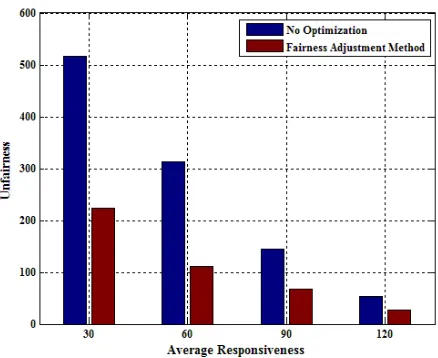
To test the effectiveness of this method, we designed a DVE simulation system, to simulate the behavior of multiple nodes in a single node. We put 1,000 nodes in this simulation system and set the node degree of each node to 5-10. We use the long tail distribution to construct the inter-node delay. The average delay is set to 100ms, and the average response time requirement of nodes is set between 30ms and 120ms. For the parameter Pth in the algorithm, we set it to 20%. We run this system for 10,000-time
steps and run the fairness adjustment method described in this paper every 100-time step, and then we compare it with the process without fairness adjustment. The result is shown in Figure 2.
Figure 2. Comparison results of different methods.
Conclusions
Consistency and fairness are both important factors affecting system usability in DVE systems. However, the existing consistency control methods often neglect the fairness factor of each node in the system, which makes them difficult to meet the functional requirements of competitive virtual environment system. Therefore, in this paper, we propose a fairness-oriented consistency control method, which can adjust the inconsistency distribution among nodes and improve the system overall fairness on the basis of maintaining the consistent state of each node in the system, thereby improving the system usability. Some experiments are conducted and shown to prove the effectiveness of the proposed method.
Acknowledgement
The work described in this paper was supported by the National Natural Science Foundation of China (Grant No. 61303187).
References
[1] Stytz, M. R. Distributed virtual environments[J]. IEEE Computer Graphics and Applications, 1996, 16(3): 19-31.
[2] Tang, Y. H., Zhang, B. D., Wu, J. J., et al. Parallel architecture and optimization for discrete-event simulation of spike neural networks[J]. Science China-Technological Sciences, 2013, 56(2), pp. 509-517.
[3] Hou, B., Yao, Y., Wang, B., et al. Modeling and simulation of large-scale social networks using parallel discrete event simulation[J]. Simulation-Transactions of The Society for Modeling and Simulation International, 2013, 89(10), pp. 1173-1183. [4] Lamport, L. Time, clocks, and the ordering of events in a distributed system[J]. Communications of the ACM, 1978, 21(7): 558-565.
[6] Raynal, M., Schiper, A., Toueg, S. The causal ordering abstraction and a simple way to implement it[J]. Information processing letters, 1991, 39(6): 343-350.
[7] Zhou, S., Cai, W., Turner, S. J., et al. Critical causal order of events in distributed virtual environments[J]. ACM Transactions on Multimedia Computing, Communications, and Applications (TOMM), 2007, 3(3): 15.
[8] Zhou, H., Zhang, W., Peng, Y., et al. A distributed approach to consistent order delivery of concurrent events in asynchronous DVEs[C]. 2010 2nd International Conference on Education Technology and Computer. IEEE, 2010, 4: V4-95-V4-98. [9] Défago, X., Schiper, A., Urbán, P. Total order broadcast and multicast algorithms: Taxonomy and survey[J]. ACM Computing Surveys (CSUR), 2004, 36(4): 372-421. [10] Mauve, M., Vogel, J., Hilt, V., et al. Local-lag and timewarp: providing consistency for replicated continuous applications[J]. IEEE transactions on Multimedia, 2004, 6(1): 47-57.
[11] Qin, X. Delayed consistency model for distributed interactive systems with real-time continuous media[J]. Journal of Software, 2002, 13(6): 1029-1039.
[12] Roberts, D. J., Sharkey, P. M., Sandoz, P. D. A real-time, predictive architecture for distributed virtual reality[C]. Proc. 1st ACM Siggraph Workshop Simulation & Interaction in Virtual Environments, Des Moines, Iowa. 1995.
[13] Lin, Y. J., Guo, K., Paul, S. Sync-MS: Synchronized messaging service for real-time multi-player distributed games[C]. Network Protocols, 2002. Proceedings. 10th IEEE International Conference on. IEEE, 2002: 155-164.
[14] Brun, J., Safaei, F., Boustead, P. Fairness and playability in online multiplayer games[J]. 2006.