Mahmood, Qazafi, Thabtah, Fadi Abdeljaber and McCluskey, T.L.
Looking at the class associative classification training algorithm
Original Citation
Mahmood, Qazafi, Thabtah, Fadi Abdeljaber and McCluskey, T.L. (2007) Looking at the class
associative classification training algorithm. In: Proceedings of Computing and Engineering Annual
Researchers' Conference 2007: CEARC’07. University of Huddersfield, Huddersfield, pp. 19.
This version is available at http://eprints.hud.ac.uk/id/eprint/3705/
The University Repository is a digital collection of the research output of the
University, available on Open Access. Copyright and Moral Rights for the items
on this site are retained by the individual author and/or other copyright owners.
Users may access full items free of charge; copies of full text items generally
can be reproduced, displayed or performed and given to third parties in any
format or medium for personal research or study, educational or notforprofit
purposes without prior permission or charge, provided:
•
The authors, title and full bibliographic details is credited in any copy;
•
A hyperlink and/or URL is included for the original metadata page; and
•
The content is not changed in any way.
For more information, including our policy and submission procedure, please
contact the Repository Team at: [email protected].
LOOKING AT THE CLASS ASSSOCIATIVE CLASSIFICATION
ALGORITHM
Q. Mahmood1, F. Thabtah1 and L.McCluskey1
1 University of Huddersfield, Queensgate, Huddersfield HD1 3DH, UK
ABSTRACT
Associative classification (AC) is a branch in data mining that utilises association rule discovery methods in classification problems. In this paper, we propose a new training method called Looking at the Class (LC), which can be adapted by any rule-based AC algorithm. Unlike the traditional Classification based on Association rule (CBA) training method, which joins disjoint itemsets regardless of their class labels, our method joins only itemsets with similar class labels during the training phase. This prevents the accumulation of too many unnecessary mergings during the learning step, and consequently results in huge saving in computational time and memory.
Keywords:
Associative Classification, Classification, Data Mining, Itemset, Training Phase1. INTRODUCTION
Information science is developing very rapidly and resulting in a significant increase in data warehousing. The computer hardware storage capabilities have grown by leaps and bounds in recent years, which have contributed to the large amount of information storage in almost all fields of life. Due to the wide variety of data being captured, efficient management and quick retrieval of information is very important for decision making. Data mining is the science of extracting meaningful information from these large data warehouses (Witten and Frank, 2000). Data mining and knowledge discovery techniques have been applied to several areas including, market analysis, industrial retail, decision support and financial analysis. Knowledge Discovery from Databases (KDD) (Fayyad, et al., 1998) involves data mining as one of its main phases to discover useful patterns. Other phases in KDD are data selection, data cleansing, data reduction, pattern evaluation and visualisation of discovered information (Elmasri and Navathe, 1999).
Two common data mining tasks are classification rule mining and association rule mining (ARM). The task of ARM can be defined according to (Agrawal, 1993) as follows: Let D be a
database of sales transactions, and I = {i1, i2, …, im} be a set of binary literals called items. A transaction T in D contains a set of non empty items called an itemset, such that T⊆I.
Definition: The support of an itemset is defined as the proportion of transactions in D that contain
that itemset.
Definition: An association rule is an expression
X
→
Y
, where X, Y⊆I andX
∩
Y
=
θ
.Definition: The confidence of an association rule is defined as the probability that a transaction contains Y given that it contains X, and given as support (X∪Y)/support(X).
Given a transactional database D, the association rule problem is to find all rules that have
supports and confidences greater than certain user-specified thresholds, denoted by minimum support (MinSupp) and minimum confidence (MinConf), respectively. In ARM, the ultimate aim is the discovery of the most significant associations between the items in a transactional data set (Agrawal and Srikant, 1994). This process involves primarily the discovery of so called frequent itemsets, i.e. itemsets that occurred in the transactional data set above MinSupp and MinConf. The discovered association rules represent useful information presented in the transactional data set that relates to item relationships and trends. These rules are very useful and can help in making necessary planning decisions such as item shelving (Agarwal et al., 1993).
tends to discover only a small set of rules in order to build a model (classifier), which is then used to forecast the class labels of previously unseen data sets as accurately as possible. On the other hand, the main goal of ARM is to discover correlations between items in a transactional data set. In other words, the search for rules in classification is directed to the class attribute, whereas, the search for association rules are not directed to any specific attribute.
AC is a branch in data mining that combine’s classification and association rule mining. In other words, it utilises association rule discovery methods in classification data sets. Many AC algorithms have been proposed in the last few years, i.e. (Liu et al., 1998, Li et al., 2001, Thabtah et al., 2004, Thabtah, et al., 2005), and produced highly competitive experimental results with respect to classification accuracy if compared with that of traditional classification approaches such as decision trees (Quinlan, 1993), probabilistic (Duda and Hart, 1973) and rule induction (Cohen, 1995).
The rule generation phase is the common first step in most AC algorithms, and the number of rules generated in this phase might be very large especially when the data set is massive or dense. The ultimate aim of introducing our new Looking at Class (LC) training approach is to focus on the processing time taken to generate the rules. In all AC algorithms, the process of rule generation combines disjoint itemsets irrespective of their class labels. For example, if two itemsets have uncommon class labels, the majority of AC methods join them in the rule discovery step. We argue in this paper that if we only merge itemsets with common class labels, this may significantly reduce the costs associated with processing time and memory usage.
This paper is organised as follows: Section 2 defines the AC problem and discusses some of its related works. In Section 3, we present our training algorithm and explain it using an example. Section 4 is devoted to the experimental results and finally we conclude this paper in Section 5.
2. ASSOCIATIVE CLASSIFICATION PROBLEM AND RELATED WORK
(Thabtah, et al., 2005) defined the AC problem as: Let a training data set T has m distinct
attributes A1, A2, … , Am and C is a list of class labels. The number of rows in T is denoted |T|.
Attributes could be categorical (meaning they take a value from a finite set of possible values) or continuous (where they are real or integer). In the case of categorical attributes, all possible values are mapped to a set of positive integers. For continuous attributes, a discretisation method is first used to transform these attributes into categorical ones.
Definition 1: An item can be described as an attribute name Ai and its value ai, denoted (Ai, ai).
Definition 2: The jthrow or a training object in T can be described as a list of items (Aj1, aj1), …,
(Ajk, ajk), plus a class denoted by cj.
Definition 3: An itemset can be described as a set of disjoint attribute values contained in a
training object, denoted < (Ai1, ai1), …, (Aik, aik)>.
Definition 4: A ruleitem r is of the form <cond, c>, where condition cond is an itemset and cεC is
a class.
Definition 5: The actual occurrence (actoccr) of a ruleitemrinT is the number of rows in T that
match r’s itemset.
Definition 6: The support count (suppcount) of ruleitem r = <cond, c>is the number of rows in T
that matches r’s itemset, and belongs to a class c.
Definition 7: The occurrence (occitm) of an itemset I in T is the number of rows in T that match I.
Definition 8: An itemset i passes the minimum support (minsupp) threshold if (occitm(i)/|T|) ≥
minsupp. Such an itemset is called frequent itemset.
Definition 9: A ruleitemr passes the minsupp threshold if, suppcount(r)/ |T| ≥minsupp. Such a ruleitem is said to be a frequent ruleitem.
Definition 10: A ruleitemr passes the minimum confidence (minconf) threshold if suppcount(r) /
actoccr(r) ≥minconf.
Definition 11: An associative rule is represented in the form: , where the antecedent is an itemset and the consequent is a class.
The problem of AC is to discover a subset of rules with significant supports and high confidences. This subset is then used to build an automated classifier that could be used to predict the classes of previously unseen data. It should be noted that MinSupp and MinConf terms in ARM are different than those defined in AC since classes are not considered in ARM, only itemsets occurrences are used for the computation of support and confidence.
Classification Based on Associations (CBA) was presented by (Liu et al., 1998) and it uses Apriori candidate generation method (Agrawal and Srikant, 1994) for the rule discovery step. CBA operates in three steps, where in step 1, it discretises continuous attributes before mining starts. In step 2, all frequent ruleitems which pass the MinSupp threshold are found, finally a subset of these that have high confidence are chosen to form the classifier in step3. Due to a problem of generating many rules for the dominant classes or few and sometime no rules for the minority classes, CBA (2) has introduced by (Liu et al. 1999), which uses multiple support thresholds for
each class based on class frequency in the training data set. Experiment results have shown that CBA (2) outperforms CBA and C4.5 in terms of accuracy.
Classification based on Multiple Association Rules (CMAR) adopts the FP-growth ARM algorithm (Han et al., 2000) for discovering the rules and constructs an FP-tree to mine large databases efficiently (Li et al., 2001). It consists of two phases, rule generation and classification. It adopts a FP- growth algorithm to scan the training data to find the complete set of rules that meet certain support and confidence thresholds. The frequent attributes found in the first scan are sorted in a descending order, i.e. F-list. Then it scans the training data set again to construct an FP-tree. For each tuple in the training data set, attribute values appearing in the F-list are extracted and sorted according to their ordering in the F-list. Experimental results have shown that CMAR is faster than CBA and more accurate than CBA and C4.5. The main drawback documented in CMAR is the need of large memory resources for its training phase.
Classification based on Predictive Association Rules (CPAR) is a greedy method proposed by (Yin and Han, 2003). The algorithm inherits the basic idea of FOIL in rule generation (Cohen, 1995) and integrates it with the features of AC. Multi-class Classification based on Association Rule (MCAR) is the first AC algorithm that used a vertical mining layout approach (Zaki et al., 1997) for finding rules. As it uses vertical layout, the rule discovery method is achieved through simple intersections of the itemsets Tid-lists, where a Tid-list contains the item’s transaction identification numbers rather than their actual values. The MCAR algorithm consists of two main phases: rules generation and a classifier builder. In the first phase, the training data set is scanned once to discover the potential rules of size one, and then MCAR intersects the potential rules Tid-lists of size one to find potential rules of size two and so forth. In the second phase, the rules created are used to build a classifier by considering their effectiveness on the training data set. Potential rules that cover a certain number of training objects will be kept in the final classifier. Experimental results have shown that MCAR achieves 2-4% higher accuracy than C4.5, and CBA.
3. THE PROPOSED RULE DISCOVERY ALGORITHM
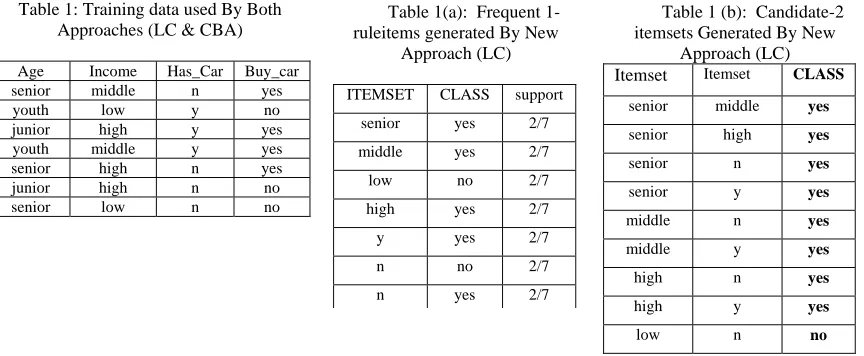
Since CBA adopts Apriori candidate generation method in its rule discovery step, the discovery of frequent itemsets is accomplished by levels wise search, where in the first level, CBA counts the support of itemsets of length one (1-itemsets), and determines whether or not they are frequent. Then, in each subsequent level, the procedure starts with itemsets found to be frequent in the previous level and merges them, regardless of their class labels, in order to produce candidate itemsets in the current level. Our idea is to improve the merging of the disjoint frequent itemsets in the CBA training phase at each level by looking at itemsets class labels. If both itemsets are associated with the same class, join them, otherwise don’t join them.
In the training phase of CBA (Liu et al., 1998) and CBA (2)( Liu et al., 1999), we noticed after the initial iteration that the merging of itemsets of size K in order to produce itemsets of size K+1,
is done without considering the class labels of these itemsets and thus, wasting a considerable amount of CPU time. We aimed to decrease the computational time during the frequent itemsets discovery phase of CBA by considering the class labels of any frequent itemset pairs prior to merging. For instance, if A and B are two itemsets found at iteration 1, our approach considers merging itemsets A and B only if A and B share a common class. This may improve the search process by reducing the number of mergings during each iteration and consequently reduce the computational time significantly, especially for large and dense data sets.
We can summarise the LC algorithm as follows:
1. Scans the database to find candidate 1- itemsets, which are then pruned using the support threshold to generate frequent 1- itemsets
2. Candidate 1- ruleitems of the form < Ai Æ c>, where Ai represents an itemset and
‘c’ a class label, are formed by scanning the database again.
3. Frequent 1 – ruleitems are generated, those are ruleitems which pass the MinSupp threshold. It should be noted that there may be more than one class associated with an itemset, in this case we consider the highest frequency class associated with that itemset.
4. Frequent 1-ruleitems are used for the generation of candidate 2-ruleitems, with the consideration of common class labels. In other words, only 1-ruleitems with common class labels are joined to form candidate 2-ruleitems.
5. The process is repeated at each iteration until all the frequent ruleitem are formed. 6. After all ruleitems are found, we generate them as rules and rank them based on
confidence, support and rule length.
Table 1: Training data used By Both Approaches (LC & CBA)
Age Income Has_Car Buy_car
senior middle n yes
youth low y no
junior high y yes
youth middle y yes
senior high n yes
junior high n no
senior low n no
Table 1(a): Frequent 1-ruleitems generated By New
Approach (LC)
ITEMSET CLASS support
senior yes 2/7
middle yes 2/7
low no 2/7
high yes 2/7
y yes 2/7
n no 2/7
n yes 2/7
Table 1 (b): Candidate-2 itemsets Generated By New
Approach (LC) Itemset Itemset CLASS
senior middle yes
senior high yes
senior n yes
senior y yes
middle n yes
middle y yes
high n yes
high y yes
low n no
Table 2 (a): Candidate-2 itemsets generated by CBA using frequent 1- itemsets in the previous
iteration
ITEMSET ITEMSET ITEMSET ITEMSET
senior middle junior middle
senior high junior high
senior low junior low
senior y junior y
senior n junior n
youth middle middle y
youth high middle n
youth low low y
youth y low n
youth n high y
high n
Table 2: Frequent 1-itemsets produced
by CBA
ITEMSET support
senior 3/7
junior 2/7
youth 2/7
middle 2/7
low 2/7
high 3/7
y 2/7
[image:6.612.87.519.115.293.2]School of Computing and Engineering Researchers’ Conference, University of Huddersfield, Dec 2007
[image:7.612.75.539.126.386.2]
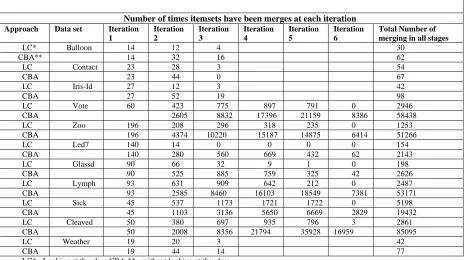
Table 3: The number of merging difference of all iterations of both approaches
COMPARISON OF THE NUMBER OF MERGING AT EACH STAGE(CYCLE) FOR CBA AND OR APPROACH
Number of times itemsets have been merges at each iteration
Approach Data set Iteration 1
Iteration 2
Iteration 3
Iteration 4
Iteration 5
Iteration 6
Total Number of merging in all stages
LC* Balloon 14 12 4 30
CBA** 14 32 16 62
LC Contact 23 28 3 54
CBA 23 44 0 67
LC Iris-Id 27 12 3 42
CBA 27 52 19 98
LC Vote 60 423 775 897 791 0 2946
CBA 2605 8832 17396 21159 8386 58438
LC Zoo 196 208 296 318 235 0 1253
CBA 196 4374 10220 15187 14875 6414 51266
LC Led7 140 14 0 0 0 0 154
CBA 140 280 560 669 432 62 2143
LC Glassd 90 66 32 9 1 0 198
CBA 90 525 885 759 325 42 2626
LC Lymph 93 631 909 642 212 0 2487
CBA 93 2585 8460 16103 18549 7381 53171
LC Sick 45 537 1173 1721 1722 0 5198
CBA 45 1103 3136 5650 6669 2829 19432
LC Cleaved 50 380 697 935 796 3 2861
CBA 50 2008 8356 21794 35928 16959 85095
LC Weather 19 20 3 42
CBA 19 44 14 77
LC*= Looking at the class CBA **= without looking at the class
4. EXPERIMENTAL RESULTS
Experiments on different data sets from UCI data collection (Merz and Murphy, 1996) were conducted. The experiments have been performed using visual C++.net implementations for both the CBA training step and our proposed algorithm on a 1 GHz processor machine with 256MB memory. We compared between our rule learning algorithm and CBA rule generation method (Agrawal and Srikant, 1994) with reference to CPU time, memory usage and more importantly the number of times itemsets are merged in the training phase in each method. The MinSupp and MinConf used in the experiments were set to 5% and 40%, respectively as in (Thabtah, at al., 2004; Thabtah, et al., 2005).
The ultimate aim of the experiments is to compute the number of times itemsets have been joined (merged) during each iteration in both CBA and our proposed method. We would like also to investigate whether reducing the number of merging during the training phase has an impact on processing time and memory usage (paged memory, physical memory and virtual memory). It should be noted that we are only investigating the training phase (learning the rules) and not the classification step (building a classifier). In other words, only the rule generation phase is experimented in this paper.
Furthermore, it is notable from Table 3 that the differences in the number of joinings between LC and CBA in the later iterations of large data sets like “Lymph” and “Zoo” are significant. This is because the number of itemsets available before any merging in the latter iterations is often larger that of the early iterations. For instance in the “Lymph” data set, the number of times itemsets have been merged using CBA are 2585, 8460, 16103, 18549, and 7381 for iterations, 2,3,4,5,6, respectively. Whereas, LC significantly drops the number of times itemsets have been merged during the same iterations to 631, 909, 642, 212, and 0, respectively. In general and according to Table 3, our approach saves many unnecessary itemsets merging for most data sets, which therefore should reduce the processing time and memory usage.
The processing time for both approaches is recorded and presented in Table 4. As an example, for “Lymph” data set, the execution time has reduced from 320080 ms in the CBA approach to 26007 ms in the LC, a significant difference of 91%. It should be noted that the values in iterations 3, 4 5, and 6 of the “Led7” data set for LC algorithm are zero’s in Table 3 due to the fact that “Led7” data set has several different classes. In other words, after iteration 2, the remaining itemsets have different class labels which explain the zero value, and consequently lead to a large saving of 88% with reference to processing time.
It is obvious from the numbers displayed in Table 4 that the proposed algorithm saves a large amount of processing time if compared to CBA. This is because LC avoids unnecessary merging of itemsets that have uncommon class labels in iterations that follow the initial iteration. This eventually reduces the search and consequently decreases CPU time and memory usage. The processing time results of our approach on the ten data sets are consistently better than the CBA approach with the exception of the “Sick” data set. After analyzing the “Sick” data set, it turns out that it contains only two classes and the frequency of one class is much higher than the other one. In fact, almost all the itemsets in this data set are associated with the dominant class “negative”,
which means that the majority of the itemsets that survived the MinSupp threshold at iteration 1 are associated with an identical class. Further, since our approach looks at the class labels while merging itemsets, it will consume longer time than the CBA rule generation phase, which merges itemsets without the need to look at class labels. This explains the high CPU time and higher memory results for LC on this particular data set over that of CBA.
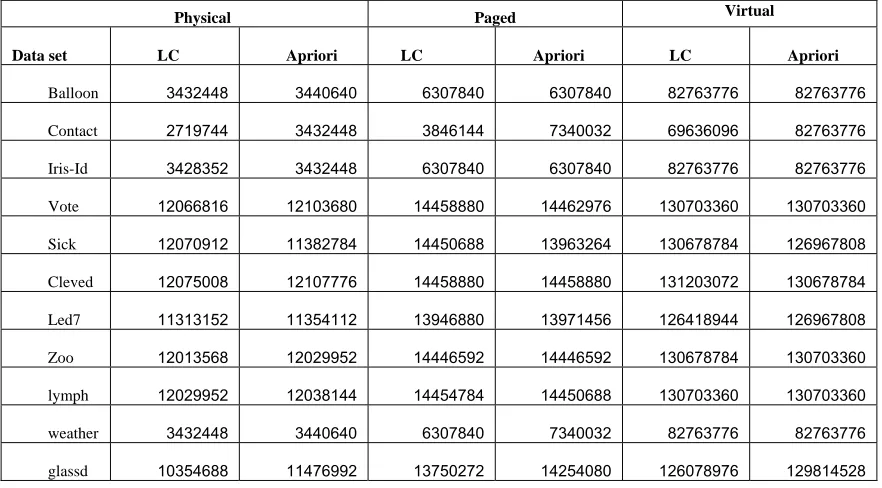
Table 5 shows the memory usage in terms of physical, paged and virtual for both the approaches during the training phase. The memory usage of LC in terms of physical, paged and virtual is also less for all the data sets except “Sick” than CBA because of the facts described above.
5. CONCLUSIONS
Table 4: Execution Time (milliseconds)
Data set LC CBA Difference (%)
Balloon 140 992 85.8871
Contact 160 241 33.60996
Iris-Id 181 190 4.736842
Vote 244612 770828 68.26633
Sick 1316453 550765 -139.023
Cleved 359146 1009219 64.41347
Led7 8052 68999 88.33027
Zoo 20229 164697 87.71744
lymph 26007 320080 91.87484
weather 140 151 7.284768
glassd 1271 3054 58.38245
Table 5: Physical Memory Usage (bytes) and paged memory virtual memory
Physical Paged Virtual
Data set LC Apriori LC Apriori LC Apriori
Balloon 3432448 3440640 6307840 6307840 82763776 82763776
Contact 2719744 3432448 3846144 7340032 69636096 82763776
Iris-Id 3428352 3432448 6307840 6307840 82763776 82763776
Vote 12066816 12103680 14458880 14462976 130703360 130703360
Sick 12070912 11382784 14450688 13963264 130678784 126967808
Cleved 12075008 12107776 14458880 14458880 131203072 130678784
Led7 11313152 11354112 13946880 13971456 126418944 126967808
Zoo 12013568 12029952 14446592 14446592 130678784 130703360
lymph 12029952 12038144 14454784 14450688 130703360 130703360
weather 3432448 3440640 6307840 7340032 82763776 82763776
glassd 10354688 11476992 13750272 14254080 126078976 129814528
REFERENCES
1. Agrawal, R., Amielinski, T., and Swami, A. (1993) Mining association rule between sets of items in large databases. Proceedings of the ACM SIGMOD International Conference on Management of Data, (pp. 207-216). Washington, DC.
2. Agrawal, R., and Srikant, R. (1994) Fast algorithms for mining association rule. Proceedings of the 20th International Conference on Very Large Data Bases (pp. 487-499). Santiago, Chile.
3. Cohen, W. (1995) Fast effective rule induction. Proceedings of the 12th Internaional Conference on Machine Learning, (pp. 115-123). CA, USA.
5. Elmasri, R., Navathe, S. (1999) Fundamentals of database systems, Fourth Edition, Addison-Wesley.
6. Fayyad, U., Piatetsky-Shapiro, G., Smith, G., and Uthurusamy, R. (1998) Advances in knowledge discovery and data mining. AAAI Press, 1998.
7. Han, J., Pei, J., and Yin, Y. (2000) Mining frequent patterns without candidate generation.
Proceedings of the 2000 ACM SIGMOD International Conference on Management of Data, (pp.
1-12). Dallas, Texas.
8. Li, W., Han, J., and Pei, J. (2001) CMAR: Accurate and efficient classification based on multiple-class association rule. Proceedings of theICDM’01 (pp. 369-376). San Jose, CA.
9. Liu, B., Hsu, W., and Ma, Y. (1999) Mining association rules with multiple minimum supports.
Proceedings of the fifth ACM SIGKDD International Conference on Knowledge Discovery and Data Mining, (pp.337-341). San Diego, California.
10. Liu, B., Hsu, W., and Ma, Y. (1998) Integrating classification and association rule mining.
Proceedings of theKDD, (pp. 80-86). New York, NY.
11. Merz, C., and Murphy, P. (1996) UCI repository of machine learning databases. Irvine, CA, University of California, Department of Information and Computer Science.
12. Quinlan, J. (1993) C4.5: Programs for machine learning. San Mateo, CA: Morgan Kaufmann. 13. Thabtah, F., Cowling, P., and Peng, Y. (2005x2) MCAR: Multi-class classification based on
association rule approach. Proceeding of the 3rd IEEE International Conference on Computer Systems and Applications (pp. 1-7).Cairo, Egypt.
14. Thabtah, F., Cowling, P., and Peng, Y. (2004x1) MMAC: A new multi-class, multi-label associative classification approach. Proceedings of the Fourth IEEE International Conference on Data Mining (ICDM ’04), (pp. 217-224). Brighton, UK. (Nominated for the Best paper award).
15. Witten, I., and Frank, E. (2000) Data mining: practical machine learning tools and techniques with Java implementations. San Francisco: Morgan Kaufmann.
16. Yin, X., and Han, J. (2003) CPAR: Classification based on predictive association rule.
Proceedings of the SDM (pp. 369-376). San Francisco, CA.