llr~
TECHNJ[CAL
C
INFORMATION
EXCHANGE
I nternational Business Machines Corporation
IBM 1401 TAPE IOCS ADVANCED NOTES
Tom Scharf
IBM Corp ..
D. P. Customer Education
Gladengvn. 3B, Etterstad
Oslo, Norway
FOR IBM INTERNAL USE ONLY
This paper is in the author's original form.
The objective in providing this copy is to
keep you informed in your field of interest.
Please do not distribute this paper to persons
outside the Company.
Distributed by
DPD Program Information Department
IBM Corporation
112 East Post Road
White Plains, New York
TIE 5-0057
February
17, 1965
34
pages
TO
~
17 - 5
0$7
TITLE: IBM 1401 TAPE IOCS ADVANCED NOTES
AUTHOR: TOM SCHARF
DATE JANUARY 12., 1965.
DIREC T INQUIRIES TO : TOM SCHARF
IBM D. P. CUSTOMER EDUCATION
GLADENGVN. 3B, ETTERSTAD,
OSLO, NORWAY.
ABSTRACT: THIS PAPER IS THE RESULT OF EXPERIENCE WITH
THIS PARTICULAR SYSTEM SINCE ITS ANNOUNCEMENT.
THE APPROACH IS TO TAKE EACH DTF - example
WLRADDR - , EACH DIOCS STATEMENT AND EACH
MACRO INSTRUCTION AND EXPLAIN IN DETAIL ITS
IMPORTANCE IN THE TOTAL PROGRAM STRUCTURE.
AN EXPLANATION IS GIVEN OF HOW THE COMPILER
HANDLES EACH PARAMETER AND WHICH RESULTS
EACH PARAMETER HAS, FOR EXAMPLE ON THE DTF
TABLE OR THE DTF ROUTINE. COMMON ERRORS
AND MISUNDERSTANDINGS ARE TAKEN UP IN LIGHT
OF THESE FACTS AND CERTAIN EVALUATIONS ARE
MADE AS TO THE ADVISABILITY OF USING OR NOT
USING CERTAIN PARAMETERS. THE PAPER WAS
ORIGINALLY WRITTEN AS AN INSTRUCTOR
BACK-GROUND FOR ORDINARY IOCS COURSES AND FOR'
DIRECT USE ON AN ADVANCED IOCS COURSE.
INTRODUCTION
These notes are designed to help programmers and others who desire a
deeper knowledge of this IOCS system. This can then be used as the basis
for self-study or for a short course in advanced IOCS.
A sound understanding of the facts contained in this paper will help
pro-grammers to avoid common errors and misunderstandings as well as to
.better be able to analyze errors correctly and more quickly when they occur.
The notes are based on the author's own experience with several different
non-overlap systems and purposely exclude areas which the author does not
have extensive experience in such as overlap and printer DTF's.
It is the authors conviction that senior programmers, systems engineers
and others who have responsibility for solving special problems with and
for teaching this system will profit greatly by a detailed study of the IOCS
- it is, after all, only one program with some minor variations but it is
used in virtually all programs of many installations and problems come up
every day which can much more quickly be solved through a detailed
know-ledge of the system.
This principle is valid for nn st programming systems to-day but since no
programmer "has time" (read "makes time" or "takes time") then they
lose time and money in the long run.
In preparation at present writing is an english translation of a table constructed
(in NOl'wegian) giving an explanation of virtually every single symbolic label
found in non-overlap IOCS, DIOCS and DTF routines. This is of course a
very useful analysis tool and has been in wide use for several years here
in Norway.
-Table of Contents (cont. )
TABLE OF CONTENTS
PAGE SUBJECT
22 The Macros
PAGE SUBJECT 1. Get
23 l. Cont'.
The DTF Entries 24 2. Put
1. DTF File Name 25 3. Open
2. Filetype 26 4. Close
3. Chandrive 5. FEORL
4. Alttape 27
6.
ReIse5. Recform 28 7. RDLIN
2 6. Sizerec
7. Blocksize
3 8. IOAREAS
4
9.
Typelabel10. Checklabel
11.
EOFADDR5 12. WLRADDR
6 12. Cont.
7 12. Cont.
8 13. Workarea
14. Indexreg 15. Varbuild
9 16. Rewind
17.
Totals10
17.
Cont.II 18. Header
18. DTF Table for a Typical File
12 19. Reelseq
20. Serialnum 21. Padding
13 21. Cont.
14 22. Modepar
23. EX AD DR
15 23. Cont.
16 The DIOCS Entries
1. DIOCS 2. DIOCSORG 3. IODEVICES 4. Tapeuse 5. Features
17
6.
Labeldef18
6.
Cont.19 7. Counts
8. Altdrive 9. Exits 10. RWDOPTION
20
11.
Readerror21 11. Cont.
iii
1.
2.
3.
4.
5.
THE DTF E!\TRIES
DTF File name
Should preferably contain the word FILE (example: INFILE,
FILEAB) to avoid confusion when OPEN, GET, PUT and other
macros are used.
Is used by IOCS as the symbolic label on the first instruction in
the corresponding DTF routine.
FILETYPE
For TAPE files. INPUT or OUTPUT must be specified since
these parameters are decisive for correct compilation.
An error here ruins the whole DTF.
This information will also be reflected on the DTF table at
FILE-NAME-2 by a one-position code which is tested by DIOCS routines.
R=tape input, W=tape output, 1= reader, 4= punch, 2=printer.
CHANDRIVE
Any drive number from 0 to 9 is valid.
Two files may have the same number if they are not OPEN at the
same time.
The result of the entry here is that it is placed on the DTF table
at FILENAME-3 (primarily for flip-flop use) and in the model I/O
instruction on the four-line table at J11KOON.
These two locations can easily be patched to modify drive number.
ALTTAPE
Any digit 0-9 is valid.
Only result is that this entry is placed in the DTF table at
loca-tion FILENAME-4 which is normally blank.
This location is tested at end of reel (IEOR on trailer) and
swapped with the position at FILENAME-3 (which is used to
deter-mine drive number.
RECFORM
If neither VARIABLE or FIXED is specified then FIXED will be assumed.
- I - (cont.)
The DTF Entries (cont. )
6.
If neither BLOCKED nor UNBLOCKED are specified then UN-BLOCKED is assumed.
i. e. This line is theoretically unnecessary for fixed unblocked
files but is very strongly recommended as fully filled out as this
strengthens documentation greatly and eliminates error
possibi-lities. It costs virtually nothing!
This line is only used for tape and is extremely important - an
error here is "fatal" - it ruins the whole DTF because major
variations in the DTF routine as based on this line.
SIZEREC
Note the purpose of this entry is to give the IOCS routines
infor-mation on the size of the data record - NB including possible
record marks.
For fixed blocked records it is used for
a) increasing an internal accumulator ( }:t 2QOON) which starts
at 000 for the first data record and increases by the record
length as given in SIZEREC for each GET or PUT until the
block is ended as signaled by a BCE test for a groupmark in
the next potential data record. A two-address SBR
instruc-tion is used to increase the count.
b) Ensuring correct padding-record length.
For fixed unblocked files this parameter is used to check
record length (if WLRADDR).
For other files the author is not aware of any use lOCS makes
of this constant.
Errors during the first GET or during the CLOSE process
are often caused when SIZEREC does not correspond to the
DA used as lOAREA and the DA group mark is therefore not
positioned "correctly" causing loops stopped only by core
boundary.
7. BLOCKSIZE
Only for blocked filesj total IOAREA DA length not including groupmark
desired.
Used by IOCS:
a) For fixed blocked records is used to calculate the values of
The DTF Entries (cont. )
-
- -
--
- -
- -
- - - -
-
--
-
- -
-
-
--
-
-
---
-
-
-
- -
-
-.- -
-
-
-
-
- --
--
-8. b)
c)
}:t ZQ and 114Q operands, these are not instructions. llZQ
is actually an internal accumulator used to keep track of which
data record in the block is the current one and ']:lZQ is used
to update a possible INDEXREG between each GET or PUT.
l'.4Q is a constant used to reset ~ ZQ after a WRL condition so that the next GET will read a new block. The operand
value of the initial states of J::{ ZQ and ):{4Q are determined
by setting them to (BLOCKSIZE - SIZEREC) and letting the
autocoder assembler calculate this difference. The reason
for this is that the first GET after OPEN will thus be forced to
read in a new tape block when l1ZQ is like this.
At EOF J1ZQ will stand at "BLOCKSIZE" (so will INDEXREG
if one is assigned) thus it is necessary to reset ;:tZQ with the
aid of a RELSE if the file is to be re-opened!
For variable blocked output with V ARBUILD this parameter
is used to determine potential block size irrespective of actual
DA size.
For all blocked files this parameter is used to check record
length (WLRADDR must be specified for this check).
IOAREAS
This is the area which will serve as input or output directly from
tape.
This parameter is a typical substitution type parameter which is
placed directly into several instruction operands in the DTF routine
any valid address form will do but any indexing used will be negated
( +
X 0).This is then usually a DA address as it is the first position of the
input area which is needed. The DA must always have a group mark
- on most file forms, this is a vital prerequisite to proper IOCS
functioning.
The group mark is used to stop I/O operations but also to test for
a full block (F /B) and stop move-record instructions when work areas
are used (F
jul.
It is possible for a careful programmer to patch - change this
para-meter if it is forgotten or in error.
- 3 - (cont. )
The DTF Entries ( cont.)
9.
10.
11.
TYPELABEL and
CHECKLABEL
The result of this entry is restricted to a one position code On the
DTF table at FILENAME-5 and it is combined with the result of the
CHECKLABEL entry to produce the code which is tested by the
general label routine in DIOCS (moved then for DIOCS use to
IOCPSV -4) to determine the extent of label reading, writing and
checking necessary.
The codes are:
Blank
Z
Standard - check all from input or check old output
header.
Standard - no checking of any part header or trailer.
Standard-check IDENT and block count (on trailer).
No labels.
Non-standard.
A very important point to be noted here is that this code cannot be
changed at will to any of the others unless the correct routines are
present in the DIOCS.
For complete code flexibility it would be necessary to specify
MIXED and CHECK in DIOCS LABELDEF. For example it is not
possible to specify STANDARD in DIOCS and then change this code
in the DTF table to blank in order to eliminate label reading. This
does not work because all DTF's are assumed (STANDARD in
LABELDEF) to have standard labels thus no test is made at all for
blank in this position. Similarly it is impossible to specify complete
checking by changing A to 1 if LABELDEF only has IDENT
speci-fied. The routines simply don't exist!
However it is possible to specify "downward" for example no
checking (A) instead of full checking (l) or no labels (bl) instead of
standard (1, A or J) if MIXED is specified. simply by patching.
EOFADDR
The use IOCS compiler makes of this is simply to create a 3 position
address constant on the corresponding DTF table (at FILENAME-7).
12.
This area on the DTF table is normally a three position blank for
output files.
Any correction or change may be made to the three-position
con-stant by patching. No other changes are necessary. A missing
EOFADDR is thus very easy to correct without recompilation.
Any symbolic or actual address may b e used subject to the usual
rules for unsigned DCW address constants.
Thus an actual address must be specified in 3-position code (999
or N43 ) indexing is possible.
This address constant is moved up to the general D
rocs
routinesto a BOOO instruction at
-Ji
2KOO 1 (not IOCRCL whichdeter-mines if it is EOF or EOR before branding to EOFADDR).
An EOF ADDR accidentally specified for an output file is
disre-garded and no recompilation is necessary.
WLRADDR
This line is alvays optional however experience has shown that it
is abs31utely necessary on all input files (except variable unblocked
where no check is possible) due to the possibility among many
other things of electronic malfUnction.
The check is carried out by a compare against a calculated
con-stant as compared to the B-register after the RT operation (=GM+l,
stored in IOC TBR).
Any group marks brought into the input area are automatically
erased before branch to the WLRADDR.
The lOCS is conditioned to read a completely new block when the
next GET order is given.
Aside from the obvious and very common WLR reason - incorrectly
generated test data, WLR can corne because of the following:
a) Very large "noise" records (over 12 pos.) generated during
backspace rewrite and skip and blank tape routines because
of imperfect positioning of R/W heads.
- 5 - (cont. )
The DTF entries (cont. )
b)
c)
d)
The 1401 internally can skip a character cycle or take an
extra cycle during tape reading or writing thus extending or
contracting the record.
Wrong tape mounted or wrong tape on wrong drive.
A previous program has inadvertantly written wrong length
records due to a groupmark word mark accidentally appearing
in the output area (esp. when using common I/O areas).
The standard WLR routine which is generated individually for each
DTF routine and costs about 38 positions in core) tests in 151iluifll~
whether or not the record length is exactly correct or not Is t i f c
e--lse@!itu (jn t b 8 som hi) sed: I1m~"@ IIISeiS) the grol1pw ark
lift-.];8 l011iiaHo; tesis,yful. I!owev~-tftis bas proved to be a ]Cery sorioue
It is psss-hlp to eke I Eol too 10115 tape lee Ids by a tittle a~
~i5Qgr?DlmiDgo. An extra groupmark wordrnark must be placed back
each IOAREA DA groupmark:
IOAREA
GM
• Ql
DA
DA
'2Dd *b
QElI
cw
01!J'f'
lutLOVtlf
2xlOO.'
.~
'~I)G-c6dihg l:cte.ii,j
ga
ClI_1 A 118 tou-luiig fec6r~s II HlThE
Rest!Ol e
eM
£01 t!mi,;{.. !pee Itt iust.
Since the lOCS will automatically clear the GM at GM when a too-long
WLR occurs we must restore this in our WLR error routine:
MLCWA
MLCWA (chaining & half-chaining is possible
here)
If the WLR routine is to be general then this GM restore could
The DTF Entries (cont. )
be carried out before the CW GM-l instruction above in a
subrou-tine created for the GET. If this is even more generally desired then the address of the group marks can be found by using the fact
that the 3-position field IOCTBR contains the address of the
IRG-created groupmark plus one. If this is a too-long record then IOCTBR
contains GM+I, however, if it is a too-short record then any other
address in the IOAREA is possible, so be careful. A special symbol
such as (12-4-8) placed after the GM could be used as a basis
for establishing which case (too-long or too-short) had occurred.
This information would enable the general routine to restore the GM
if necessary and also give valuable information about the type of
WLR which could be printed or typed or used to determine what type
of recovery procedures are worth trying.
What kind of a WLR routine should be written? IBM leaves this up
to the user.
a)
b)
c)
d)
e)
A macro can be written for this purpose to standardize the
routines.
An early version of IOCS branclm to WLRADDR from the BU
instruction thus it was pO,ssible to generalize for all WLR and
return to the IOCS as for a convertional SBR subroutine.
This is changed and SBR use will not work now.
A new GET will read in a new block;however a good WLR
routine could try to backspace 10 or more times before giving
up (the tape unit will be found in all cases in location IOCTRW+3.
Thus: MLNS IOCTRW+3,
*
+ 4BSP 0
can be used in a general routine.
In any case at least a halt and preferably a clear message
giving tape unit (IOCTRW+3!) should be given before proceeding
to a new GET.
Some attempt to identify the block should be made so that an
investigation of the output can help determine if the record really
was a "noise record". It will not be possible to get this in-formation from a workarea (not filled) or an indexed IOAREA
- 7 - (cont. )
The DTF Entries (cont.)
13.
(not correctly indexed at this point). The best bet is to, for
example, take the first 80 absolute (non-indexed+xO) positions
of the IOAREA and print or punch them. The IOAREA can be
picked up for all cases at IOCTRW+6 for use in a general
subroutine.
WORKAREA
The conception behind this entry is that one and only one workarea
is used by an I/O FILE so why not let IOCS do the moving. The
inclusion of this entry produces an MRCM (MCM) instruction in the
DTF routine which simply moves a data record between IOAREA
and WORKAREA. We must provide the recordmarks for this for
blocked records.
INDEXREG cannot be used together with this for the same DTF
because INDEXREG says "I want to process in the IOAREA without
IOCS moving the record to a workarea." An area param.eter in a
GET for a file where WORKAREA is specified will not work for
essentially the same reason. It will not be treated as an error
-it will just simply not have any effect on data moving because no
DTF routine coding has been included (as it normally will be when
WORKAREA, INDEXREG, VARBUILD are absent.) to test the GET
instruction to see if any record-moving is specified.
If desired, patching of the operand of the MCM instruction in the
DTF routine can safely be carried out in order to correct the workarea
specificat~on.
14. INDEXREG
Is only available for fixed blocked records and is most commonly
used on input.
An invalid specification here has far-reaching effects on the DTF
routine and a recompile is the best thing here.
WORKAREA, VARBUILD or a GET-PUT area specification may not
be used at the same time as INDEXREG for reasons noted under
"WORKAREA'~ however records handled in this manner can be easily
moved by the programmer down to a workarea. This is commonly
The DTF Entries (cant.)
15.
done to save processing time by avoiding the move for records not
to be extensively processed.
Use of WORKAREA is the simplest alternative (and the safest),
however we are forced to consider INDEXREG use because it saves
processing time when total references to the indexed area are so
few that the additional time needed for all indexing calculations
(1401 hardware) pro record does not exceed the time needed to move
the record. This factor can easily result in for example
i
hoursaved daily for a file updating run which takes 3 or 4 hours a day.
Note especially that variable blocked records cannot be handled on
the 1401 tape IOCS by INDEXREG they must be moved to work area.
The reason for this might have something to do with the lack of
MRCWM (~ove record with wordmarks) instruction as on 1410/7010.
If any reader has an application where substantial time savings
will result from being able to index V /B records in input then I can
console him that it is possible to "cheat" by specifying variable/
unblocked to IOCS.lletting each GET get a whole block and deblocking
by relatively siInple Inanual coding.
The author has constructed and sucessfully used a Inacro "NOGET"
expressly for this purpose. ReInember one detail for variable
un-blocked records IOCS will change the IRG-generated GM to a
record Inark during the GET, in case you try to test that to deterInine
last data record.
VARBUILD
This is str'aightforwardly described in the Inanual. The usual error
is using Xl which is not allowed as this is internally used
siInul-taneously by IOCS during PUT (but is of course otherwise freely
available to the user).
The VARBUILD rythm is
a) Give the size you want the processor to allocate for the next
record to the varbuild operand.
b) PUT ,FILE. The IOCS now determines if the previously put records must be written out to Inake room for the new one or
not. In any case the varbuild operand will then re'ceive froIn
IOCS the exact address (left-most) where the new record can
be placed. The user can then Inove his record in using this
inforInation. For exaInple
-8-()., (cont. )
The DTF Entries (cant. )
16.
17.
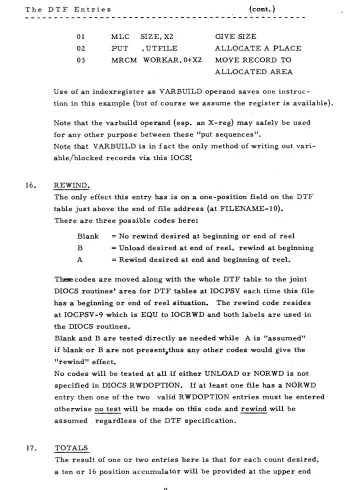
01 MLC SIZE, X2
02 PUT ,UTFILE
03 MRCM WORKAR,0+X2
GIVE SIZE
.i\.~LLOCATE A PLACE
MOVE RECORD TO
ALLOCA TED AREA
Use of an indexregister as V ARBUILD operand saves one
instruc-tion in this exaInple (but of course we assume the register is available).
Note that the varbuild operand (esp. an X-reg) may safely be used
for any other purpose between these "put sequences".
Note that VARBUILD is in f act the only method of writing out
vari-able/blocked records via this IOCS~
REWIND.
The only effect this entry has is on a one-position field on the DTF
table just above the end of file address (at FILENAME-IO).
There are three possible codes here:
Blank
B
A
=
No rewind desired at beginning or end of reel=
Unload desired at end of reel, rewind at beginning=
Rewind desired at end and beginning of reel.These codes are Inoved along with the whole DTF table to the joint
DIOCS routines' area for DTF tables at IOCPSV each time this file
has a beginning or end of reel situation. The rewind code resides
at IOCPSV-9 which is EQU to IOCRWD and both labels are used in
the DIOCS routines.
Blank and B are tested directly as needed while A is "assumed"
if blank or B are not present,thus any other codes would give the
"rewind" effect.
No codes will be tested at all if either UNLOAD or NORWD is not specified in DIOCS R WDOPTION. If at least one file has a NOR WD
entry then one of the two valid RWDOPTION entries must be entered
otherwise ~ will be made on this code and rewind will be
assuIned regardless of the DTF specification.
TOTALS
The result of one or two entries here is that for each count desired,
a ten or 16 position accuInulator will be provided at the upper end
[image:8.792.410.756.64.554.2]-The DTF Entries (cont. )
of the DTF table immediately adjacent to the
*
which in fact is usedas a signal to determine wehter or not there are more fields to be
handled by the DIOCS routines after all other fields except hash and
record fields are handled in the IOCENT routine which initializes
a DTF table for use by the general DIOCS routines.
The field J17 JOON is the field used for record counts. This can be
referred to directly (f. ex. 1\7 J002 for the first DTF) where
know-ledge of record count is desireable for example in order to limit file
size on a reel to be sorted. No zone bits ever exist in this field.
117KOON is the label of the 16 position accumulator provided for hash
totals although only the right hand 10 positions are used in the label
and thus authomatic overflow is "lost".
In addition to the 10 position fields an A (add) instruction will be
created at an appropriate place in the DTF routine to take these
totals.
Note that a WM will be desireable to delimit hash fields less than
ten positons. This field which must have a WM is in the workarea
defined in the DTF if one is defined there; otherwise the wordm.ark must
come in the IOAREA DA even if a warkarea is named in the GET or PUT macro~ The reason is logical; the DTF has no knowledge
whatsoever of GET ar PUT use~
It should be more obvious here why variable/blocked records ~
be read into a work area.
If the user neglects to make corresponding entries for HASH and
RECORD in the DIOCS COUNTS fields then a specification in the
DTF is useless for label procedures but can certainly be used for
other purposes as mentioned above. The DIOCS has no knowledge of
what HASH and RECORD totals are specified in the DTF's and
vice-versa.
Note especially that hash totals in the DTF are not given by the word
HASH as in COUNTS but are the relative position of the right-most
position in the field to be hash-accumul ated. This information is
used as address adjustment in the add instruction only and can thus
easily be corrected by patching.
- 10 -
(coat. )
The DTF Entries (cont. )
18.
LABEL USED
HEADER
The only practical use of this entry is to give the 10 pOSe header
IDENT when an input file is only to be tested on IDENT and to give
the IDENT and retention cycle desired for output files.
There is no practical sense in giving retention cycle and creation
date for input files since these data are invariably provided via
a RDLIN card when they are to be used.
Parameter 1 (the IDENT) will be placed on the DTF table
immedi-ately above the
%
constant which is the signal that label information follows. It is rather important that this parameter be always 10 positions since the constant will be generated incorrectly otherwiseand ruin the IOCS processing.
The second parameter on output files will be placed in the three
position field which is located three fields above the IDENT.
A picture is a good idea here.
Here is a typical DTF table:
IN DIOCS
*
DTF TABLE FOR A TYPICAL FILEIeCHSH
IeCRCT IeCCRD ISCRCY IeCSEQ reCSER IeCIDT
IeCBLK IeCRWD IeCEeF
JeCPSV-4 IeCPSV-3 IeCPSV -2
DCW
@*@
END OF TABLE MARKJl7KOO2 DCW :#=,16 FOR HASH -TOTAL (only 1010wer pOSe used) Jl7J002 DCW :#' 1 0 FOR RECORD COUNT
DCW
#5
CREATION DATE DCW @075@ RETENTION CYCLE DCW @001@ REEL NUMBER DCW @2010<@ FILE SERIAL NUMBER DCW <!'KUNDEFL20l@ FILE IDENTDCW
@%@
BEGINNIN G-o F-LA BE L-DA T A MARK(Indication of which exits are used can come here)
-DCW &000000 BLOCK COUNT, LEFT HAND 5 POS. DCW @ B@ REWIND CODE (UNLOAD)
DCW EeF@EOFADDRADRCONSTANT DCW
@
PADDING CHARACTER DCW @ 1 @ CHECK LABEL (ALL)DCW @ @ POSSIBLE ALTERNATE TAPE ur-;-IT DCW @ 3~ MAIN TAPE UNIT
DCW
€
R@ INDICATES FILE TYPE R== tape input DCWe
Me> INDICATES MODE (MOVE OR LOAD)The next position is the first in the DTF routine and it has the same
label as the DTF FILENAME.
A study of this table is very important for an understanding of
The DTF Entries (cont. )
19.
20.
21.
IOCS. It should be obvious that the constants we give in the DTF
go directly to this table in many cases and since the standard autocoder
macro substitution system is used by IOCS also then an incorrect
specification of the length of a field (for ex. 3 instead of 003 for
retention cycle) would give a too-little constant and give undesired
results at object time. To put it another way - if you get a funny
looking label - check this table!
Parameter sequence is extremely important here - note especially
the difference between input and output file specification!
REELSEQ
Generally this is rather useless - the author has never seen it used
and cannot think of any good excuse to use it either.
The effect of course is an initial modification of the normally
gene-rated @001@ DCW on the label table.
SERlALNUM
Any five position field can be specified here but the user must
deter-mine his own system.
A useful system might be to always place the five position program
-IDENT (col. 76-80 of autocoder cards) here so that tapes give an
indication as to the program which produced them!
PADDING
The effect of the single position (usually "9") inserted here is simply
to replace the normally blank position assigned as padding character
on the DTF table.
This entry will most certainly not determine whether the padding
routine will be carried out. Padding with whichever character is on
the DTF table will always be carried out if necessary at CLOSE or
FEORL on FIXED/BLOCKED OUTPUT FILES.
At that time this character is picked up from the table by the DTF
padding routine at
II
3PooN.The padding procedure is worth mentioning.
The padding character is moved by a loop in the padding routine
from the next-to-last character in the record and one by one towards
12
-The DTF Entries (cont. )
the left end of the record then for all remaining records to be padded
in the block an MCM (MRCM) is executed in order to "copy" this
padding until the end of block is reached as indicated by the
pre-sence of a Groupmark (see routine
n
INOON).The most common failures at this point then are due to:
a) Error in SIZEREC or DA length specification.
b) No record mark at end of padding record; this usually occurs
during testing of programs with so little test data that a full
output block has not been created yet, this results in a process
as the MCM destroys its own future A-field (esp. GM-WM)
because the last data records lack record marks.
c)
Missing Groupmark at end of DA.Worthy of note is that present 1401 tape COBOL which USes
IOCS will always pad with blanks unless the user via a patch to the
DTF table(or ENTER AUTOCODER to change the table) changes the
padding character.
Of course the user must always test for padding on input files which
can contain padding.
A popular misconception is that to "save time" we can branch directly
to the EOF routine. This must be forbidden as it is not compatible
with IOCS because if we branch directly to the EO:r routine ~fter dis-coverlng a paddlng record: a) Labels will never be checked (trailer),
b) Padding can come at the end of ~ block if FEORL or RELSE
has been used in the program producing the tape - and if it
does not use them now, it might at any future time be changed
(for example to cut down reel size for sort input),
c} Padding will not necessarily come at all if the block is full!
The only correct programming is that every GET have an immediately
following padding test which always brandEs to the GET again if we find
padding. The use of a GET subroutine so that this is not "forgotten"
is to be recommended.
Generally 9 sh~uld always be used for padding unless special
circum-stances dictate otherwise but retnember - even if fixed/blocked files
are used padding might not come at all.
-The DTF Entries (cont. )
22.
23.
Padding records should always be generated in test input for fixed
blocked files!
Be careful to test a big enough field so that you can be absolutely
sure that the record is padding. BCE testing is strongly
discou-raged. Remember that input data can be in error!
MODEPAR
Not normally used because MOVE mode which is most common is
assumed when nothing is specified.
Result of this entry comes on the lowest position of the DTF table
and in the model I/O instruction in the DTF routine under
l!
lKOONtable.
EXmADDR
Exits are at most installations never or hardly ever used although
some will of course use them in every program because of special
label procedures.
The author has very little practical experience with exits and would
prefer therefore not to discuss .them at length.
An interesting point here however can be mentioned.
If it is considered necessary to use exits then their effect can often
be achieved by macro instructions or autocoder coding which ORG
INTO laCS routines and patch in exits symbolically. In one case the
author constructed a macro to do just this so that labels were
auto-matically displayed on a console typewriter for every open. Since
a macro cannot refer to another macro's
It
labels {and DIOCS is amacro} and no IOCXXX labels were where we needed them it was
necessary to tack our own private label into an existing DIOCS
in-struction. This has succeeded very well and been in use for over
two years but is certainly "dangerous" because we have no guarantee
that the system will work after each new modification level! Of
course the label must be added to existing model statements and we must
~ add or subtract from the model statements since each updating
of laCS is completely dependent on the expected sequence numbering
of each model statement after the immediately preceding update.
- 14 - (cont. )
The DTF Entries {cont.}
The use of one or more of these statements in the DTF will produce
eight different DCW constants, one for each potential exit. a
*
indicates the exit is not used for this file while lack of an
*
indi-cates that
a)
b)
the exit is to be activated when this file is handled,
instead of the
*.
the 3 position address which the exit is to branch to is included in its place.These are included. if at all, just below the
'10
sign on the DTFtable.
Example: exit one (EXIADDR) is specified as EXITl.
DCW
DCW
DCW
DCW
DCW
DCW
DCW
DCW
DCW
@'10@
EXITI
@*@
@~@
~@
€.e?
e'.@
~*@
@.@
address constant
indicates exit 2 not used
exit 8 is not used in this particular
DTF.
No exit can be activated if it is not specified as being used in the
DIOCS EXITS entry.
-THE Dloes ENTRIES
I. DIOeS This word must come as the third (or 2nd if no JOB card) card of a compilc~.tion. That is1no intervening comments cards are allowed. Generally speaking no other cards except DIOeS, DTF, JOB and eTL should be used before the last DTF is finished.
2. DIOeSORG The effect of this entry is simply to change the (333) normal ORG ahead of laCS coding to the operand specified here. This feature is rarely used in actual practice.
3. IODEVleES The point of this entry is to give information to the macro-processor that we expect to have DTF's in this program for the named devices (Tape, Printer etc.) and that therefore certain routines and instructions must be included in the DIOeS routines, especially to separate the tape files (with label handling) from unit record files. '
The ext~a coding generated by superfluous use of U/R para-meter specification is minimal (a few BeE tests to avoid label routines). The use of the parameter TAPE is however extremely important as it is decisive for all tape model statements.
It is a common misconception that we should specify U/R (Reader. Printer, Punch) when we have them on the 1401 or use them in the program but this is not at all the case. The deciding factor is do we have DTF's for these devices -parameter sequence is quite irrelevant here.
4. T APEUSE The primary function of this entry is to reduce the DIOeS coding gene,rated and to reduce the processing time for certain routines a little.
There will be no adverse effects other than those mentioned above if this is not specified when only input or output files are present. However if this is in~orrectly specified then a recompilation is demanded since this has far reaching effects on the routines generated.
About 155 positions can be saved by using this entry.
5. FEATURES The point here is that features such as overlap, release and print storage which the user desires used by I/O devices which are specified in one or more DTFis can be specified here. This will ensure that maximum use is made of these features.
16
-5. cont. It is never necessary to specify any of these features if the user does not want to. This can be desirable when no meaningful time savings can be achieved since I/O volume is low and the user prefers to save the core space which will be used by the additional routines.
The overlap feature has a very great effect on the compilation of tape programs, being virtually a whole new laCS, if this feature is never used (When overlap is not ,installed on a 1401) considerable compile time improvement can be made by cutting out all the model statements in the IOCS which are especially for overlap. This process is separately described in laCS program library writeups and should normally be done.
RELEASE should normally be specified for card reader or punch files of any volume (lets say several hundred cards or more) unless the slight additional core (over 100 pOSe including a work area) required is mor~ desperately needed elsewhere.
Note that a card reader which is to use the release equipment will require that a work area be used. This can be recommended in any 'case as a great convenience since a DA with wordmarks cannot be written for positions I to 80. If release equipment is installed then, this can only be utilized effectively by laCS specification.
DIoes routines are only affected slightly by these parameters in order to ensure "release"before tape I/O operations are performed. The main effeCt is that the respective DTF routines for U /R are increased to include coding. The "release" function will automatically be performed where necessary by all laCS routines. However, user coding must also take this into account and before any lengthy operations are performed.
B 'IoeRDX (release the reader)
and/or
B IoePNX (release the punch)
must be included. Failure to do this at the appropriate points will stop the rnach~e and the card in que stion will fall in the norn'lal pocket. '
The position of the I register will indicate the point at which the programmer must place the branch-to-release instruction (Which, by the way) is an SBR-type subroutine}.
6. LABELDEF This important entry is one which new IOCS students have greatest difficulty understanding.
It is only necessa,ry if some tape files have any kind of labels.
It determines which routines are to be included in the DIOeS for use as, specified in the individual DTF or by the RDLIN macro.
-6. cont. To simplify we can say that the following specification (we disregard TM as unimportant)
MIXED, CHECK, RDLIN
is the most general case. Any other specification limits the extent of the possible DTF specifications and is (like "Tapeuse") primarily an attempt to reduce the coding to be included in the DIOCS routine.
MIXED means that DTF files can have STANDARD, NON-STANDARD labels or none at all - and that the DTF table can at any time easily be patched to change that status.
If we instead of MIXED specify STANDARD then we have said that ali tape files will always have standard labels and the user will find that it is very difficult indeed to patch lOGS so that a file may be temporarily read or written without labels.
The additional coding generated by MIXED is very modest being essentially some few BCE tests. So it is generally worthwhile to use this - it can for example simplify testing.
CHECK will allow all possible combinations of label checking as determined by the DTF table entry including no check at all.
Whereas IDENT eliminates the possibility that any file will be checked completely regardless of the DTF specification. whereas only about 50 positions would be saved.
Standard (or MIXED) and CHECK specification require about 1000 extra positions to give complete label handling, as opposed to not using lables at all or prograrn.m.ing for them individually.
RDLIN specification will lead to the inclusion of a 174 position SBR-type subroutine called IOCRDLwhich is used exclusively by RDLIN macros. This fact is useful since the routine is easy to overlay after use to win core positions (ORG IOCRDL).
If CHECK is to be used in any DTF, then RDLIN is virtually manditory in order to change the creation date in the DTF table for correct comparison with the input header. Another consequence of RDLIN use is that RDLIN cards must be made for every file written with standard labels. It is most expedient to punch RDLIN cards automatically. At one installation the author constructed a macro "PURDL" which automatically patched laCS and ensured RDLIN card production. Another device which is very simple is to utilize the fact that after OPEN on an input file, all the required information is in label form at the label I/O area named IOCSLB, which is accessable to the programmer.
For example: OPEN OUTFIL
SW 121
MLC IOCSLB+39, 150
MLC ~RDLIN@ 1/2 CHAIN P
CS 180 OPTIONAL
SS 8 OPTIONAL
This is cheap and ea:Yl~n.? a macro is readily constructed.
7. COUNTS These parameters will include the coding needed by the DIOCS routine to handle the count fields found in DT F' sand to check and produce these counts on trailer labels. About 217 positions are required if both are specified and about 187 positions if only ~ is specified.
This entry does nothing but give the possibility for hash or record totals; the actual use they are put to depends entirely on the DTF specifications. If no DTF has courits then these routines only take up space but do no harm.
8. ALTDRIVE If included, this parameter includes 29 positions extra in the DIOCS routines which primarily test the alternate drive unit space on the DTF table (FILENAME-4) for a file at end of reel and shift the drive number (if it isn It blank) with the drive indicated in the main drive position (FILENAME- 3), and ensure that the I/O instruction receives this new drive number.
If the altdrive space on the DTF table is blank, then this will have no effect. In other words, if altdrive has been specified in the DIOGS, then flip-flop unit changing can be entirely con-trolled by patching or programming changes to the single position on the DTF table (for example by control card or sense switch choice).
9. EXITS When specified, routines for testing the DTF table just below the
'10
sign for indication of which exits are desired, are in-cluded as well as coding at the exit points in the DIOGS label routines in order to allow branch to the addresses given for each particular exit on the DTF table.Core requirement for this specification is 70 positions (DTF table test routine) plus 9 extra positions for each exit named. These 9 are used for the exit itself. In addition the following number of positions for the exit as indicated must be included:
Exits 1-2-4-5-7-8
3
6
11 positions
39 positions
25 positions
for example exits 1 and 3 require altogether 138 positions.
10. R WDOPTION If UNLOAD is included, then extra coding will be included so that any DTF specifying UNLOAD on the DTF table will be tested and unload will be performed instead of the normal rewind. NOR WD option will also be tested.
-10. cont. If NORWD is specified, then tests will be made for NORWD option in the DTF table but otherwise, rewind will be assumed_ UNLOAD is not taken into consideration by IOCS.
UNLOAD requires 40 additional positions while NOR WIND (or NORWD it makes no difference since only the first three letters are tested) requires only 16 additional positions.
11. READERROR This entry describes what procedures are to be carried out when a "permanent" tape error is discovered. This means that the normal tape error routines have given up hope. If
nothing is specified, BYPASS is assumed. That is, the record (the whole tape--record, not just a data record) will be bypassed without any processing and a new record will be read before control is returned to the userM
Before this stage is reached, the IOCS HALT 3050 will appear and the operator can press start to continue trying. If after ten further attempts reading is not successful, then the read-error options (if any) will be executed.
If CLEAN is inserted as it should be if space allows (104 positions), then the tape will be packspacedD times and read forward ~ before a new read is attempted. This brings the area oftape in question back to a vacuum cleaner on the tape statiDn which will attempt to clean the tape.
If this however does not succeed, the other options will be tried. Clean is recommended in addition to all other possible parameters.
-PROCESS, can be specified so that the tape record will be handled regardless. This option does not cost any core posi-tions, but just changes a branch instruction.
Process is generally better than the bypass option because many errors are so insignificant that it is better to process the records after noting where the error occurs (if possible) to check the output later. If the controls built into the program are good enough, there is less danger here than there is when a record is simply hopped over!
A dump tape option is used by many customers but I think this is a rather expensive use of a tape unit since the actual error rate is very low. Let us say this situation under namal circumstances should not occur for more than a few records a ymr_ If it does occur often enough to justify a dump tape, then something is radically wrong at your installation!
11. cont. In the authoM> opinion all options offered are rather poor. At one installation which had a 1407 console typewriter, the author constructed a macro instruction RDERR which all programmers use which automatically gives operator in-structions to allow dump (the rotary and I/O switch must be changed so that a re-read will read in the record without correcting the parity, replacing error positions by}f{) :1£ of the entire error record on the console with exact error indication. This is a great advantage because if the record is then processed (this can be determined by the programmer or the operator), then the results should be predictable since we know which symbols are in error.
This dump with parity error identification cannot be achieved on a printer because the printer has no indication for incorrect parity.
In addition no extra unit such as a dump tape is needed. Extra tapes are better used as flip-flop for example.
:1£ The error positons are in core as even parity characters
but is typed as}t( •
-1. GET
THE MACROS
GET provides us with a data record (logical record) from an input file. It does this by branching to the DTF routine for that file which actually provides the record for us and if necessary utilizes the joint routines in the DIOCS to read in new tape blocks to replenish the supply of data records which the DTF routine utilizes.
Let's look at a typical GET macro's generated coding:
01 GET INFILE, WORKI
02 SBR IOCUXT+3tIOJ009 STORE ADDRESS OF NEXT INST AFTER THE GET MACRO
03 B INFILE BRANCH TO THE DTF FILE ROUTINE
04 DSA WORKI ADDRESS OF RECEIVING AREA
05 DCW @,.N08J DUMMY (CAN BE SKIP/SPACE INST)
06 DCW @.I$@,I DUMMY (CAN BE PARAMETER
4 SKIP/SPACE CONSTANT)
07trOJ009 EQU *+1 EQU TO ESTABLISH A LABEL WHICH CAN BE USED AS EXIT FROM THE MACRO
This sequence is so common and simple that it is well worth learning - not least to aid in changes and corrections by patching.
IOCUXT is an instruction which looks like this
IOCUXT B 0
and is simply used as a general exit from GET, PUT and certain other routines (very useful in coreprint analysis). so the first instruction in the macro uses a two operand SBR to store an address constant in this branch instruction. One of several advantages of this technique is that it is independent of the DTF itself since the IOCUXT is in the DIOCS.
The next instruction 03 is a branch to whatever is written as the first parameter of the GET macro. Without any checking what-"S'OeVer this branch is attempted. Of course parameter 1 is supposed to be the DTF FILE NAME and that name is given as symbolic label for the first instruction in the DTF routine. In other words we tell the macro where to branch to. If we don It write the filename correctly in the macro we will still get a branch to our first parameter even if it is for example an input area or non-existent (undefined). The main point is that we can easily correct any error by a patch or an "alter" during a re-assembly with alterations without laCS regeneration (see auto-coder operating procedures).
22
-1. cont. The GET (and all ot her IOCS macros) are in fact "ordinary" macros which have no other connection or knowledge of laCS than the file name which, for the macro is simply a parameter which it uses as a label.
This lack of communication between the GET macro and the DTF and DIOCS routines is one of the main reasons that this particular lOCS system cannot do more "work" directly in the GET sequence as the 1410 and 1401 (DISK) laCS do. These systems use a different type macro system which allows information to be stored from one macro to the next - for example from DIOCS to DTF to GET. The result is that the processing time in this particular laCS system is relatively high. There is much more branching back and forth than is necessary in these other systems.
The fourth line (04) is normally a dummy entry, a $, but if an area parameter is specified (that is if parameter 2 which
should be a receiving area) then a DSA line comes which produces an address constant. Note that since this is a DSA -actual addresses can be used such as 1 or 1234.
The DTF routine uses the information now stored in IOCUXT to find out where the macro, which referred to it, is. Then the routine finds this parameter, if the DTF has not specified INDEXREG or WORKAREA. -
-The parameter is placed in the B-operand of an MCM instruction which is not executed if the parameter is $, but which otherwise moves the I/O area data record to the area we have named as our second parameter - even if we have named a file by accident. This of course ruins the whole DTF routine. Anything other than $ which is named in the second parameter will cause an attempted move !
A full discussion of GET should actually include a detailed description of how the DTF file routine functions. However, that is much too great a problem to take up at this point. Suffice to say that any student of IOCS should be able to "read" some DTF routines and interpret their functions and methods at the autocoder level. Program flow charts for the DTF routines will of course be found in the IOCS writeups.
-2. PUT ;..row that we know the GET macro it can suffice to say that the principles are exactly the same as for the GET macro, the principal difference being that the order of the parameters 1
and 2 are reversed. Thus parameter 2 will be placed in the branch instruction and parameter one will be the DSA constant.
Now it is easy to see that
PUT UTFILE
will not work correctly since parameter two is not present and parameter one is a file name instead of an area name.
PUT , UTFILE
is required if parameter one is missing.
It would be simple to rewrite the PUT macro so that a one-parameter put would regard that one one-parameter as the file name and thus eliminate a very common error. However since this was not done by the designers of IOCS, we must assume that the intention was to force the programmer to document the fact that the other parameter was intentionally left out.
This error is in any case simple to correct without a full IOCS regeneration as we mentioned under GET.
24
-3. OPEN OPEN
B
NOP
INFILE
IOCOPN
INFILE-17
Macro
Branch to open routine
Label information is at position INFILE-17
The above is the coding generated.
The parameters named in the macros are assumed to be valid file name s.
All DTF's are built up in such a manner that the address of the filename (= first position in the DTF routine) minus 17 positions is the lower section of the DTF table. This is where open routines can find label information and information about exits.
The main reason the second line is generated with a NOP is that the SBR instruction at IOCOPN stores the return address (in IOCQUT - also a very useful point to examine coreprints).
If a plain address constant had been used, then the return to the instructions following would have to be accomplished by some form of address adjustment. The use of NOP then is a cheap way of eliminating this difficulty.
From this explanation the reader should now be able via patching and alter to add, take away and change OPEN macros in a very straightforward manner.
As the reader can confirm, the first instruction of the DTF routine is (for example)
INFILE B IOCUXT
which obviously means that a GET or PUT can get nothing done since any attempt to B INFILE just branches to the exit without getting/putting any records.
What this means is that the file is not open. One of the things done by the open routine is to change this B IOCUXT to
INFILE NOP IOCUXT
Thus the path is open to the rest of the DTF routine and we say the file is "OPEN". CLOSE of course restores the B.
From this discussion the reader should now be able to examine a core print or to test any file by a BCE instruction to see if it is OPENed or CLOSEd. This is very useful in error analysis and end-of-file routines. The author has constructed a pair of simple macros to make this easy to remember. One example should suffice,
BCLOS BCE BOPEN BCE
END, INFILE MACRO
END, INFILE, B GENERATED CODING CONTIN, OUTFIL MACRO
CONTIN, OUTFIL, N GEN
-4. CLOSE CLOSE macro is constructed in the same manner as OPEN.
CLOSE
B
NOP
INFILE IOCLOZ INFILE-17
and so therefore easy to patch and change.
CLOSE (and OPEN) can be traced on a core print by examination of the branch instruction at IOCOUT which is a B 000 instruction similar to IOCUXT. The address at IOCOUT will give information about which OPEN or CLOSE was attempted last. IOCOUT is used by other routines internally in the DIOCS as well as the FEORL macro.
In particular IOCOUT is used by the end of reel routine, so if
the program has failed after EOR but before close. then exact information on which DTFroutine is concerned will be in this branch instruction.
One important point about CLOSE which is commonly misunder-stood is that close does not check the trailer label on a tape input file. When the tapemark is read the trailer is read and checked to the extent specified and then tested for EOR or EOF.
If it is end of file (EOF) then the users end-of-file routine (EOFADDR) is executed. It is however the function of the CLOSE macro to ~ the tape at end-of-file.
Generally speaking CLOSE should be executed for input files immediately upon EOF. This gives a "free· switch as described under OPEN and prevents a variety of errors.
~ for an output file will
a) write out last block, with padding if necessary
b) write tape mark, trailer label, tape mark if standard labels c} rewind, unload the tape (as specified).
5. FEORL This is not very commonly used but one important use can be mentioned as an example. Output reels which are to be sorted must not be filled up over the length of normal work tapes even
if the output reel happens to be extra long. This is known as exceeding maximum file size (MFS).
By counting records the programmer can force the end-of-reel at the correct point using FEORL (MFS can be calculated manually or by the sort program.) thus ensuring a correct sort.
26
-6. RELSE The only practical use the author has put this macro to has been re-initialization of internal DTF routine accumulators when a reel is to be re-read. This is especially important on fixed blocked files since the OPEN does not initialize the blocking accumulators which are left at a useless value at EOF.
A typical sequence might be
OP OPEN GET CLosE RELSE B
F F F F OP
RE-INITIALIZE TO BLOCK START POINT RE-OPEN
The main effect of the relse is that
1120
accumulator is reset to1140
constants value. This can of course be done by an MLC instruction.The file does not have to be open in order to use RELSE since relse skips over the first two instructions in the DTF routine -especially the B/NOP switch.
-7. RDLIN
RDLIN coding generated is similar to OPEN and '":LOSE.
RDLIN
B
NOP
FILE
IOCRDL
FILE-17
IOCRDL is a 174 position SBR-type subroutine which essentially
a)
b)
c)
reads a card
confirms that it is RDLIN (in col. 16-20)
moves its data to corresponding areas in the DTF
table for the file named
The important point is that no check is made to determine that
the RDLIN card information goes to the correct file. So the
sequence which the operator places the RDLIN cards in can be
critical especially if the RDLIN cards are used for output files.
In addition note that the RDLIN cards do no label checking etc.
whatsoever they only change the entries in the DTF table
-label writing and checking is carried out as if no RDLIN card
was read.
A
point which causes unexpected difficulties is that the IOCRDL
subroutine will execute
CS ·80
Thu.s the read area is cleared of any word marks set in a
"housekeeping" routine in the read area. This is one of the
many reasons the author recommends that programmers avoid
using the read area directly.
RDLIN can of course be used at any time a change in label
information is desired and the use of RDLIN can of course be
controlled with a sense switch. The principal use however is
to change the creation date specification before the DTF table
is compared to an input header for full checking.
Of course since creation date must be changed then all other
information must also be correctly contained in the RDLIN card
-no blanks can be used to indicate "-no- change".