Mapping Functions in Myoelectric Controlled
Interfaces for Human Robotic Systems
Kotipalli Manasa1, Muthakani Narendra Babu2 1,2
Department of ECE, Nalanda Institute of Engineering and Technology
Abstract: The current fields of advanced prostheses, exoskeletons, and robotic operation, myoelectric controlled interfaces have become recent research area. These recent researches focus on improving initial performance of the user by either training a decoding function for a specific user or by implementing “intuitive” mapping functions as decoders. There are however limits in both approaches while former being subjective specific, and the latter task specific. This paper proposes an anomaly on the myoelectric interfaces by embedding the human to act as controller to operate the system.
The studies also show that human subjects are able to control an artificial system with more efficiency by learning the usage of abstract mapping functions between myoelectric activity and control actions for every specific task. The method efficacy is tested by using two different control tasks and four different abstract mappings relating upper limb muscle activity to control actions for those tasks. This suggests that new muscle synergies are developed and refined relative to the mapping used by the control task, so that maximum performance can be achieved by learning a constant, arbitrary mapping function rather than dynamic subject- or task-specific functions. Furthermore the results also imply that the method may extend to the neural control of any device or robot, without limitations in human-related counterparts.
Index Terms: Electromyography, human-robot interaction, motor learning, myoelectric control, real-time systems.
I. INTRODUCTION
In recent days myoelectric controlled interfaces have become a major research area due to their various applications. Due to recent advances in EEG and EMG signal’s analysis and processing the researchers are able to research on reliable access to brain and muscle activity thereby developing a connection between electromechanical systems and humans by developing prosthetics[1]. This technology offers hope to help amputees regain independence and humans to perform tasks beyond their physical capabilities [5]– [7], and robotic devices and machines to be teleoperated with precision [8]–[13]. The challenge in myoelectric interfaces lies in using neural signals as commands for operating desired application. Many decoding algorithms have been developed using machine learning techniques, but these currently suffer from subject specificity and require intense training phases before any real-time application is feasible [14]–[17]. Other approaches have implemented simple decoders meant to be instinctive for users to control simple commands, but these intuitive mappings lack task specificity. In both cases, the decoders are designed to maximize the initial performance of the user, which does not take advantage of a human’s natural ability to form inverse models of space [20], [21], optimize control strategies [22], [23] and learn new muscle synergies [24] while completing precise physical tasks. Thus, these approaches do not necessarily provide a foundation for maximal performance over time. Before presenting the novelty of the proposed technique, it is useful to give the definitions of two concepts that will be frequently used in the paper.
Control task: task executed by subject using the myoelectric interface, implying both the device to be controlled (e.g., a robot hand) as well as its possible functions (e.g., open/close fingers etc.);
Mapping function: mathematical function that maps myoelectric activity to control actions for the task, e.g., a function that will translate myoelectric signals to opening the fingers of a robot hand.
A new theory has been proposed by mapping functions between neural activity and control actions. This paper shows performance of user for myoelectric interfaces and arbitrary mapping functions which were neither designed for the subject nor the task. A user-specific decoder is not required for myoelectric interfaces, as arbitrary mapping functions can be learned without need for intuitive mappings. It can even be proved that muscle synergies developed from certain mapping function can be saved for performing new tasks.
of all trials then provides information about the influence of previous trials on performance and reveals a transfer of learning significantly dependent on the previous use of a given mapping function.
II. RELATED WORK
Decoding neural signals has been the main research focus for improving performance of myoelectric controlled interfaces since their first implementation in the 1970s.Since that time, many algorithms have been developed to train a decoder specifically for a given user. Machine learning techniques are used to develop a specific decoder based on a set of training data. Classification techniques are commonly used for a discrete set of commands. For continuous commands, black-box modeling and regression methods are most common. However, studies by Ajiboye et al. have suggested that only a sparse set of natural muscle synergies are user-independent and form a low-level basis for muscle control. Héliot et al. assume a model of the brain to convert firing neurons to common center to reach out tasks. The algorithm consists of a decoding function, inverse model, and feedback controller. This model simulates how the brain modifies neural signals based on output error in order to develop the inverse model of the decoding function. The simulation confirms that the system is able to update the inverse model in order to minimize the error.
Two decoders, classified as intuitive and nonintuitive, decode EMG signal amplitude from eight muscles to generate a 2-D cursor position. The intuitive decoder maps six of the eight muscles to a vector along the 2-D plane that is most consistent with the action on the limb when the muscle contracts. The nonintuitive decoder maps six of eight muscles randomly along equally spaced vectors in the 2-D plane. Subjects are able to learn the decoders in both experiments, with performance trends best fit by exponential decay. Additionally, the results show that the intuitive decoder helps subjects achieve better performance initially, but the nonintuitive decoder has a steeper learning rate that made performance for both decoders almost equal after 192 trials. The first task is a standard cursor control task, similar to the second uses similar mapping function, but with removed redundancies such that each muscle operates individual fingers of a robotic hand. The mapping function is intentionally made non intuitive to users in order to emphasize a steeper learning curve. The results show similar performance trends when given visual feedback for both cursor control and hand control, indicating that subjects are able to learn separate models to effectively reach the goal in both tasks. This previous research has established that humans are capable of forming inverse models for various decoders when presented with closed loop feedback. Although intuitive decoders give better initial performance, other decoders with worse initial performance are capable of higher learning rates. This suggests that humans while learning to perform a task with a novel control space, tend to explore the full space in order to form a complete inverse model. DeRugy et al. indicate limitations for discovering this inverse model when dealing with biomechanically dependent muscles. They show that habitual synergies between biomechanically dependent muscle groups controlling wrist forces make exploration of novel control spaces and corresponding new synergy formation difficult. Conversely, Nazarpour et al. demonstrate that the use of biomechanically independent and antagonistic muscles removes this restriction and allows formation of new synergies while exploring the full task space. The study presented in this paper expands this work of understanding human motor learning by investigating the performance impact of previously learned mappings on new control tasks and interfaces using antagonistic and biomechanically independent sets of muscles to ensure proper exploration of the task space can be performed while learning.
III. METHODS
A. Experimental Setup
The experiments performed in this study are designed to evaluate the effect of new control tasks with common mapping functions on human motor learning. In the experiment, wireless surface EMG electrodes (Delsys Trigno Wireless, Delsys Inc.) obtain EMG signals from four upper limb muscles of a human subject. A multifunction data acquisition card (DAQ) (USB-6343X, National Instruments) acquires and digitizes the signals for input to a custom application running on a personal computer (PC). The EMG signals are processed in real time and converted to control variables for a given task via a mapping function, and the effect is displayed to the subject for online closed-loop visual feedback. The program is written in C++ using OpenGL API [38] for the graphical display.
B. Control Tasks
Task 2 consists of two rectangular objects, with a straight line bisecting one edge of each object to provide orientation, as shown inFig.1.Thegoalof the task is to control the red object by resizing and orienting it to match the stationary green one. Similarly to Task 1, there are eight possible combinations of size-orientation for the green object. Each combination maps along the control axes (see SectionIII-C)equivalently to the target locations in Task 1. Those eight targets are similarly grouped to four target areas equivalent to the four quadrants of a circle.
Fig. 1. Experimental setup including EMG system, DAQ, and the visual interface (top). Two tasks the subjects were asked to control using their EMG signals (bottom).
C. Mapping Functions
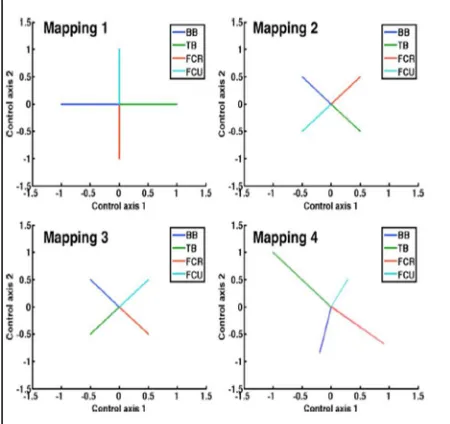
Myoelectric signals are obtained from four different muscles of the arm which are namely: 1) Biceps Brachii (BB); 2) Triceps Brachii (TB); 3) Flexor Carpi Radialis (FCR); and 4) Extensor Carpi Ulnaris (ECU). Following the findings from [24] that muscle synergies were quickly developed between both antagonistic and biomechanically independent muscles, and [29] that habitual synergies between biomechanically dependent muscles are difficult to alter, these four muscles were specifically chosen as two pairs of antagonistic muscles (BB/TB and FCR/ECU) which are biomechanically independent in order to enhance the potential for new synergies. The signals are sampled at 1 kHz frequency by the DAQ. The raw EMG signals undergo a preprocessing stage that is commonly used in the field of electromyography in order to compute the linear envelope of the signal [35]. The linear envelope performs full-wave rectification of the raw signals and then passes them through a low pass filter (second-order Butterworth, cutoff frequency of 8 Hz). The smoothed signal provides a reliable input signal to the mapping function for each trial.
Fig. 2. Mapping of input EMG amplitudes to two output control axes using the four mappings functions defined in.
change in size of the rectangle. An activation threshold of 0.02 mV was set for each of the muscles, so as to make sure that there is no control output when the subject is resting. The mapping function was designed to be the most intuitive for the subjects, according to [27]. Each set of antagonistic muscles (BB-TB and FCR-ECU) maps to only one of the two control axes required for the task. The mapping functions and were designed such that a combination of two muscles was required to command along one control axis direction. The mapping function is a random matrix with arbitrary weights given to each muscle, normalized with zero mean so that there is no output at rest.
It should be noted that the subject’s arm is not constrained, and muscular volume contraction (MVC) is not used to normalize the EMG signals, which differs from most other relevant studies [24], [27]–[29]. Instead of using position control with respect to MVC, subjects are free to move their arm into any configuration to fully explore each mapping and minimize the effect of potential biomechanical constraints in a given configuration. It is hypothesized that with this freedom in forming the inverse model, subjects can learn to respond and adjust appropriately to a un normalized output when performing velocity control. Also by ignoring MVC, trends in performance over multiple days are inclusive of the performance-diminishing impact of intra subject variability caused by sensor placement, and conclusions are robust to these sensitivities.
IV. RESULTS
At the end of the experiments, qualitative assessment showed that all subjects considered Task 1 to be easier than Task 2 and found some mapping functions easier than others. However, none were aware that both tasks required the same input responses, though some noticed that a few of the trials required similar muscle activity to move the virtual objects. Quantitative evaluation of learning and performance is done in three steps.
Confirm that learning occurred in the trials for each target area.
Quantify the effectiveness of prior learning transfer to subsequent trials.
Evaluate the overall performance of subjects when presented with each mapping function.
A. Learning
The foremost step is to identify how well subjects learn to perform the given task successfully. For this, each target area of each trial is plotted chronologically according to the specific set of targets used in the trial. Following results from prior work [27], the general trend of learning is expected to follow an exponential
decay, where initially the time required to successfully performing any task is high and it decreases exponentially towards a final steady-state value. For that reason, the data from each trial is fit to an exponential curve and the time constant of the curve gives the learning rate. The higher the time constant is the more the learning rate.
B. Learning Transfer
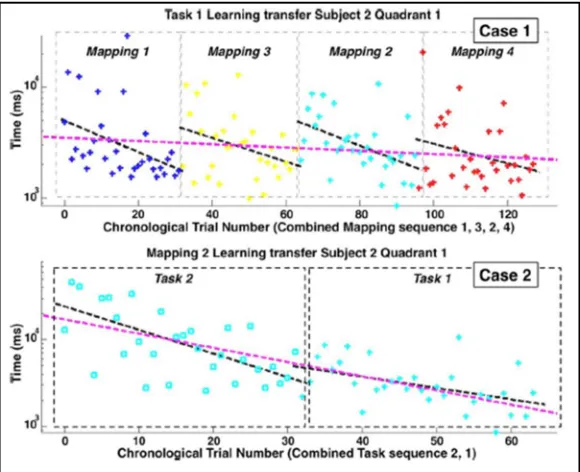
The next main aspect is to compare how well learning is transferred across mapping functions for each control task (Case 1) and across control tasks for each mapping function (Case 2). This is to identify whether the subject is learning to interact with each individual control task better irrespective of the different mapping functions, or whether the subject is learning to understand the controls of each individual mapping function irrespective of the control tasks. For a representative subject, two plots are generated to evaluate learning transfer (see Fig. 4). The first plot (Case 1) contains the time plots in log scale, stacked side by side in the order in which a single task was performed, for each of the command sets (mapping functions).
The second plot (Case 2) contains the time plot in log scale, stacked side by side in the order in which a single command set (mapping function) was used, for each of the tasks. The important thing to observe in these figures is how smooth the transition occurs between the learning curve of one experiment to that of the next one in both cases. In order to quantify the smooth transition factor, a transition index is generated for each of the plots. In this manner, two indicators are combined.
1) Root mean squared error (RMSE) between the straight lines fitted over the entire data (includes the respective trials stacked side by side) and the straight line fitted over each individual trial, as shown in Fig. 4. The lower the value the better each individual line fits the overall line.
interfaces is therefore more dependent on a familiar mapping function than a familiar task. These results imply that a constant mapping function is better than one that is implemented for or adapts to specific tasks, and mapping functions may be generalized to new tasks while maintaining subject performance from prior training.
Fig. 4. Example learning transfer plots to evaluate the transition index. Top plot shows poor transfer in Case 1, while the bottom plot shows better transfer in Case 2. This is consistent with the quantitative results from the transition index.
C. Overall Performance
Due to the significance of consistent mapping functions on learning transfer (Case 2), overall performance evaluation is quantified with a performance score incorporating learning transfer, learning rate, and end performance specifically for each mapping function. Each of these three quantities are deemed important components for evaluating how well users can interact with a given mapping function. Then, this score can be compared with initial performance, or intuitiveness of a mapping function, which is given by the start point of the best fit line for the first trial using the specified mapping. This can be visualized in Fig. 4, bottom plot. The intuitiveness is measured by the left-most point on the black line (the initial performance on the first trial). The learning rate is measured by the slope of the magenta line (best fit over all trials). The performance score is measured by equally weighting end performance, learning rate, and transition index. Learning rate and transition index are considered because it is important that a mapping function should be quickly learned and easily transferred to new tasks in a dynamic environment
V. CONCLUSION
This paper investigates the role of mapping functions in myoelectric controlled interfaces. It is shown that subjects are not only able to learn the inverse model of arbitrary mapping functions, but more importantly are capable of generalizing this model to enhance performance on new control tasks containing similar mapping functions. Performance is determined to be more dependent on familiarity with a given mapping function
decoder is not required, as long as the subject can learn a mapping function between the neural activity and the task commands and 2) it demonstrates that subjects do not only learn those mappings between their actions and the control task, but they can retain this ability and generalize it to different control tasks. These two findings support the idea of the human embedded control of devices using myoelectric interfaces, which can result in a paradigm shift in the research field of neuron prosthetics. More specifically, we have shown that humans can be trained to control different tasks by using their muscular
activity directly to the control axes of the tasks (i.e., embedded control). The implications of this method are vast, since it means that humans are able to control any device, without the latter being anthropomorphic or resembling any of the human counterparts. Instead of training decoders for specific humans, humans can be trained for specific decoders, which may then generalize to a myriad of myoelectric interfaces. Tackling these problems of user specificity and extensive decoder training that cannot generalize to new tasks opens new avenues and capabilities for the intelligent control of neuron prostheses.
VI. ACKNOWLEDGEMENT
We K.Manasa and Narendra Babu are very much thankful to your college for the continuous availability of all resources. We would like to thank the publishers, researchers for making their resources material available and also extend a heartfelt gratitude to friends and family members.
REFERENCES
[1] J. R. Wolpaw, N. Birbaumer, D. J. McFarland, G. Pfurtscheller, and T. M. Vaughan, “Brain-computer interfaces for communication and control,” Clin. Neurophysiol., vol. 113, no. 6, pp. 767–791, Jun. 2002.
[2] O. Fukuda, T. Tsuji, M. Kaneko, and A. Otsuka, “A human-assisting manipulator teleoperated by EMG signals and arm motions,” IEEE Trans. Robot. Automat., vol. 19, no. 2, pp. 210–222, Apr. 2003.
[3] S. Bitzer and P. van der Smagt, “Learning EMG control of a robotic hand: Towards active prostheses,” in Proc. IEEE Int. Conf. Robot and Automat. ICRA, May 2006, pp. 2819–2823.
[4] L. Lucas, M. DiCicco, and Y. Matsuoka, “An EMG-controlled hand exoskeleton for natural pinching,” J. Robot. Mechatron., vol. 16, no. 5, Oct. 2004. [5] P.Artemiadis and K. J. Kyriakopoulos, “EMG-based position and force estimates in coupled human-robot systems: Towards EMG controlled exoskeletons,” in
Experimental Robotics, O. Khatib, V. Kumar, andG. J. Pappas, Eds. Berlin, Germany: Springer, 2009, vol. 54, Springer Tracts in Advanced Robotics, pp. 241– 250.
[6] C. Zhu,S.Shimazu,M. Yoshioka, andT. Nishikawa, “Power assistance for human elbow motion support using minimal EMG signals with admittance control,” in Proc. Int. Conf. Mechatron. Automat. (ICMA), Aug. 2011, pp. 276–281.
[7] J. Vogel, C. Castellini, and P. van der Smagt, “EMG-based teleoperation and manipulation with the DLR LWR-III,” in Proc. IEEE/RSJ Int. Conf. Intelligent Robots and Syst. (IROS), Sep. 2011, pp. 672–678.
[8] P. K. Artemiadis and K. J. Kyriakopoulos, “A switching regime model for the EMG-based control of a robot arm,” IEEE Trans. Syst. Man, Cybern., Part B: Cybern., vol. 41, no. 1, pp. 53–63, Feb. 2011.
[9] P. K. Artemiadis and K. J. Kyriakopoulos, “EMG-based teleoperation of a robot armin planar catchingmovements using ARMAX model and trajectory monitoring techniques,” in Proc. IEEE Int. Conf. Robotics Automat., 2006, pp. 3244–3249.
[10] M. S. Erkilinc and F. Sahin, “Camera control with EMG signals using principal component analysis and support vector machines,” in Proc. IEEE Int. Syst. Conf. (SysCon), Apr. 2011, pp. 417–421.
[11] P. K. Artemiadis and K. J. Kyriakopoulos, “Teleoperation of a robot manipulator using EMG signals and a position tracker,” in Proc. IEEE/RSJ Int. Conf. Intelligent Robots Syst., Aug. 2005, pp. 1003–1008.
[12] U. Sahin and F. Sahin, “Pattern recognition with surface EMG signal based wavelet transformation,” in Proc. IEEE Syst., Man, Cybern. Conf. (SMC), pp. 295– 300.
[13] F. Orabona, C. Castellini, B. Caputo, A. Fiorilla, and G. Sandini, “Model adaptation with least-squares SVM for adaptive hand prosthetics,” in Proc. IEEE Int. Conf. Robot. Automat., May 2009, pp.2897–2903.
[14] C. Cipriani, F. Zaccone, S. Micera, and M. Carrozza, “On the shared control of an EMG-controlled prosthetic hand: Analysis of user-prosthesis interaction,” IEEE Trans. Robot., vol. 24, no. 1, pp. 170–184, Feb. 2008.