Deblurring of Noisy or Blurred Image by Using
Kernel Estimation Algorithm
Joseph Anandaraj.S
1, R.Deepa
2, C.Helen prema
32PG Student- M.Tech. VLSI Design & Embedded System Engineering
1,3
Assistant Professor
Dept. Electronics and Communication Engineering Dr.M.G.R. Educational and Research Institute, University
Maduravoyal, Chennai, Tamil Nadu, India.
Abstract: This paper presents, taking the photos under dim lighting conditions using a hand-held camera becomes blurry or noisy. If the camera is set to a long exposure time, the image is blurred due to camera shake. While, the image will be dark and noisy if it is taken with a short exposure time with a high camera gain. By combining the both information extracted from both blurred and noisy images, this paper shows how to produce a high quality image that cannot be obtained by simply denoising the noisy image or deblurring the blurred image alone. The aim of is image deblurring with the help of the noisy image. First, both images are used to estimate an accurate blur kernel from a single blurred image. Second, by using both images, a residual deconvolution is proposed to reduce ringing artifacts inherent to image convolution. Third, the remaining ringing artifacts in smooth image regions are further suppressed by a gain-controlled deconvolution process. We demonstrate the effectiveness of our approach using a number of indoor and outdoor images taken by hand-held cameras in low lighting environments with some applications.
Keywords: Matlab, deconvolution, kernel estimation algorithm, deblurring and denoising process, iterative method.
I. INTRODUCTION
Capturing satisfactory images under low light conditions using a hand-held camera can be a frustrating experience. Often the taken images are blurry or noisy. The brightness of the image can be increased in three ways are shutter, aperture and ISO settings. First, reducing the shutter speed (the reciprocal of the focal length of the lens, in the unit of seconds) as well as safe shutter speed. But with a safe shutter speed and camera shake will result a blurred image. Second, the aperture should be large. A large aperture will reduce the depth of field. Moreover, the range of apertures in a consumer-level camera is very limited. Third, the ISO range should be high. However, the high ISO image is very noisy due to the amplification of noise as the
camera’s gain increases. For taking a sharp image in a dim
lighting environment, the best settings are: safe shutter speed, the largest aperture, and the highest ISO. Even with this combination, the captured image may still be dark and very noisy. To avoid that, flash is using in the camera. But unfortunately the flash introduces artifacts such as shadows and secularities. On the other hand, the flash is not effective for distant objects.
In this paper, a novel approach to produce a high quality image by combining two degraded images. One is a blurred image which is taken with a slow shutter speed and low ISO
settings. With enough light, it has the correct color, intensity and a high Signal-Noise Ratio (SNR),though it is blurry due to camera shake. Another one is an under exposed and noisy image with a high ISO settings and a fast shutter speed. It is sharp but very noisy due to high camera gain and insufficient exposure. The colors of this image can also partially lost due to low contrast.
Recovering a high quality image from a very noisy image is not a easy task; because fine image details and textures are concealed in noise. The process of denoising cannot separate signals from noise completely. While, deblurring from a single blurred image is such a challenging blind deconvolution problem - both blur kernel estimation and image deconvolution is highly under-constrained. Moreover, unpleasant artifacts (e.g., Ringing) from image deconvolution are occurs even when using a perfect kernel in the reconstructed image.
accurate initial kernel can be recovered from the blurred image by exploiting the large scale, sharp image structures in the noisy image. The proposed kernel estimation algorithm is able to handle larger kernels than those recovered by using a single
blurred image. To reduce the “ringing” artifacts from the image
deconvolution, by residual deconvolution approach. A gain-controlled deconvolution is for suppress the ringing artifacts in smooth image regions. All three steps - kernel estimation, residual deconvolution, and gain controlled deconvolution are takes the information of both images. The final reconstructed image is sharper than the blurred image and clearer than the noisy image.
II. PREVIOUS WORKS
2.1 Deblurring of single image:
Image deblurring can be categorized into two types are blind deconvolution and non-blind deconvolution. It is more difficult since the blur kernel is unknown. A literature view on image deblurring can be as demonstrated in the real kernel caused by camera shake is complex, beyond a simple parametric form (e.g., single one direction motion or a Gaussian) assumed in previous approaches natural image statistics together with a sophisticated variation Bayes inference algorithm are used to estimate the kernel. The image is then reconstructed using a standard non-blind deconvolution algorithm. Very nice results are obtains when the kernel is small (e.g. 30×30 pixels of fewer). Kernel estimation for a large blur is, however, inaccurate and unreliable using a single image. Even with a known kernel, non-blind deconvolution is still under-constrained. Reconstruction
artifacts, e.g., “ringing” effects or color speckles, are inevitable
because of high frequency loss in the blurred image. The errors due to sensor noise and quantization of the image/kernel are also amplified in the deconvolution process.
For example, more iteration in the Richardson-Lucy (RL) algorithm [H. Richardson 1972] will result in more
“ringing” artifacts. We present an adaptively accelerated Lucy -Richardson (AALR) method for the restoration of an image from its blurred and noisy version. The conventional Lucy-Richardson (LR) method is nonlinear and therefore its convergence is very slow. The LR method by using an exponent on the correction ratio of LR. This exponent is computed adaptively in each iteration, using first-order derivatives of the deblurred image from previous two iterations. Upon using this exponent, the AALR improves speed at the first stages and ensures stability at later stages of iteration. An expression for the estimation of the acceleration step size in AALR method is
derived. The super resolution and noise amplification characteristics of the proposed method are investigated analytically. Our proposed AALR method shows better results in terms of low root mean square error (RMSE) and higher signal-to-noise ratio (SNR), in approximately 43% less iteration than those required for LR method. Moreover, AALR method followed by wavelet-domain denoising yields a better result than the recently published state of-the-art methods. In our approach, we significantly reduce the artifacts in a non-blind deconvolution by taking advantage of the noisy image.
Recently, spatially variant kernel estimation has also been proposed in [Bardsley et al. 2006]. In [Levin 2006], the image is segmented into several layers with different kernels. The kernel in each layer is uni-directional and the layer motion velocity is constant. Hardware based solutions to reduce image blur include lens stabilization and sensor stabilization. Both techniques physically move an element of the lens, or the sensor, to counter balance the camera shake. Typically, the captured image can be as sharp as if it were taken with a shutter speed 2-3 stops faster.
2.2 Denoising of single image:
Using two images for image deblurring or enhancement has been exploited. This paper shows the superiorities of our approach in image quality compared with previous two-image approaches. These approaches are also practical despite that requires two images. We have found that the motion between two a blurred/noisy image, when taken in a quick succession, is mainly a translation. This is significant because the kernel estimation is independent of the translation, which only results in an offset of the kernel in computer graphics. Other approaches include anisotropic diffusion [Perona and Malik 1990], PDE-based methods [Rudin et al.1992; Tschumperle and Deriche 2005], fields of experts [Roth and Black 2005], and nonlocal methods [Buades et al. 2005].
2.3 Deblurring and denoising of multiple images:
Deblurring and denoising can benefit from multiple images. Images with different blurring directions [Bascle et al. 1996; Rav-Acha and Peleg 2000; Rav-Acha and Peleg 2005] can be used for kernel estimation. In [Liu and Gamal 2001], a CMOS sensor can capture multiple high-speed frames within a normal exposure time. The pixel with motion replaced with the pixel in one of the high-speed frames. Raskar et al. [2006]
where the colors of the blurred image are transferred into the noisy image without kernel estimation process. The work most related to this approach is [Lim and Silverstein 2006] and [Lu Yuan and Jian Sun 2007] are also makes use of a short exposure image to help estimate the kernel and deconvolution. However, our proposed technique can obtain much accurate kernel and produce almost artifact-free image by a de-ringing approach in deconvolution.
III. PROBLEM FORMULATION
We take a pair of images are a blurred image B with a slow shutter speed and low ISO and a noisy image N with high shutter speed and high ISO. The noisy image is usually underexposed and has a very low SNR since camera noise is dependent on the image intensity level [Liu et al. 2006]. Moreover, the noise in the high ISO image is also larger than that in the low ISO image since the noise is amplified by camera gain. But the noisy image is sharp because we are using the fast shutter speed that is above the safe shutter speed. Pre-multiplying the noisy image by a ratio to compensate for the exposure difference between the blurred and noisy images
ISO.B.Tb / ISO.N.tN
wheret is the exposure time. We perform the multiplication in irradiance space then go back to image space if the camera response curve [Debevec and Malik 1997] is known. Otherwise, a gamma (=2.0) curve is used as an approximation.
3.1 PROCESS:
The block diagram of the process of kernel estimation is shown in fig.1:
Fig. 1 Block diagram of kernel estimation algorithm
The goal is to reconstruct a high quality image I using the input images B and N
B = I⊗K, (1)
where K is the blur kernel and ⊗ is the convolution operator .For the noisy image N, we compute a denoised image ND [Portilla et al.2003] . ND loses some fine details in the denoising process, but preserves the large scale, sharp structures. We represent the lost detail layer as a residual imageI:
I = ND +I, (2)
Our first important observation is that the denoised image ND is very good initial approximation to I for the purpose of kernel estimation from Equation (1). The residual image I is relatively small with respect to ND. The power spectrum of the image I mainly lies in the denoised image ND. Moreover, the large scale, sharp image structures in ND make important contributions for the kernel estimation. As will be shown in our experiments on synthetic and real
images, accurate kernels can be obtained using B and ND in non-blind convolution. Once K is estimated, we can again use Equation (1) to non-blindly deconvolute I, which unfortunately will have significant artifacts, e.g, ringing effects. Instead of recovering I directly, we propose to first recover the residual image I from the blurred image B. By combining Equations (1) and (2), the residual image can be reconstructed from a residual deconvolution:
B =I⊗K, (3)
whereB = B−ND⊗K is a residual blurred image.
Our second observation is that the ringing artifacts from residual deconvolution ofI (Equation (3)) are smaller than those from deconvolution of I (Equation (1)) because B has a much smaller magnitude than B after being offset by
ND⊗K, (4)
The denoised image ND also provides a crucial gain signal to control the deconvolution process so that we can suppress ringing artifacts, especially in smooth image regions. We propose a deconvolution algorithm to further reduce ringing artifacts. The above three steps - kernel estimation, residual ringing approach using a gain-controlled deconvolution, and de-ringing - are iterated to refine the estimated blur kernel K and the deconvolute image I.
IV. KERNEL ESTIMATION ALGORITHM
In this section, we show that a simple constrained least-squares optimization is able to produce a very good initial kernel.
4.1 Iterative kernel estimation:
The goal of kernel estimation is to find the blur kernel K from with the initialization
In vector-matrix form, it is b = Ak, where b and k are the vector forms of B and K, and A is the matrix form of I. The kernel k can be computed in the linear least-squares sense. To stabilize the solution, we use Tikhonov regularization method with a positive scalarby solving
mink ||Ak−b||2+2||k||2.
But a real blur kernel has to be non-negative and preserve energy, so the optimal kernel is obtained from the following optimization system flowchart as shown in fig.2:
Y
N
Fig.2 Flowchart of an kernel estimation algorithm
The solution is given by (ATA+2I)k=AT b in closed-form if
there are no other constraints on the kernel k. However, some
fine details are inevitably suppressed by gain-controlled RL. Fortunately, we are able to add fine scale image details for the residual RL result I using the following approach.
min k ||Ak−b||2+2||k||2 ; ki≥0 andiki = 1.
We adopt the Landweber method [Engl et al. 2000] to iteratively update as follows.
1. Initialize k0 =, the delta function.
2. Update kn+1= kn+(AT b−(ATA+2I)kn). 3. Set kin+1=0 if kin+1<0 and Kin+1=kin+1/i kin+1
is a scalar that controls the convergence. The iteration
stops when the change between two steps are sufficiently small. We typically runabout 20 to 30 iterations by setting= 1.0. The algorithm is fast using FFT, taking about 8 to 12 seconds for a 64×64 kernel and a 800×600 image.
4.2 Maximum thresholding in large scale space:
The above iterative algorithm can be implemented in scale space to make the solution to overcome the local minimal. A straightforward method is to use the kernel estimated at the current level to initialize the next finer level. However, we have found that such initialization is insufficient to control noise in the kernel estimation. The noise or errors at coarse levels may be propagated and amplified to fine levels. To suppress noise in the estimate of the kernel, the global shape of the kernel at a fine level to be similar to the shape at its coarser level. To achieve this, we propose a hysteresis thresholding [Canny 1986] in scale space. At each level, a kernel mask M is defined by thresholding the kernel values, Mi = 1 if ki > tkmax, where t is a threshold and kmax is the maximum of all kernel values. We compute two masks Mlow and Mhigh by setting two thresholds tlow and thigh. Mlow is larger and contains Mhigh. After kernel estimation, we set all elements of Kl outside the mask Mhigh to zero to reduce the noise at level l. Then, at the next finer level l +1, we set all elements of Kl+1 outside the up-sampled mask of Mlow to zero to further reduce noise. This hysteresis thresholding is performed from coarse to fine. The pyramids are constructed using a down sampling factor of 1/√2 until the kernel size at the coarsest level reaches 9×9. We typically choose tlow = 0.03, and thigh = 0.05.
V. IMPLEMENTATION DETAILS
5.1 Image acquisition:
In practice, it requires one image be taken soon after another, to minimize misalignment between two images. It has two options to capture such image pairs very quickly. Initially, choosing a noisy an deblurred image fig.3(a); First, two
Initialize β̂(0)=0
Measurement z(k)
Calculate X̂
Calculate Ẑ(K)
Given {z(j); j=1,….,m}
Calculate β̂*l+1
|m(β̂l*)| <ε?
successive shots with different camera settings are triggered by a laptop computer connected to the camera. This frees the user from changing camera settings between two shots. Second, using exposure bracketing built in many DSLR cameras. In this mode, two successive shots can be taken with different shutter speeds by pressing the shutter only once.
Using these two options, the time interval between two shots can be very small, typically only 1/5second which is a small fraction of typical shutter speed (> 1 second)of the blurred image. The motion between two such shots is mainly a small translation if we assume that the blurred image can be modeled by a single blur kernel, i.e., the dominant motion is translation. Because the translation only results in an offset of the kernel, it is unnecessary to align two images. It can also manually change the camera settings between two shots. In this case, we have found that the dominant motions between two shots are translation and in-plane rotation. To correct in-plane rotation, we simply draw two corresponding lines in the blurred/noisy images. In the blurred image, the line can be specified along a straight object boundary or by connecting two corner features. The noisy image is rotated around its image center such that two lines are virtually parallel. If an advanced exposure bracketing allowing more controls is built to future cameras, this manual alignment will become unnecessary.
5.2 Image denoising:
For the noisy image N, we apply a wavelet-based denoising algorithm [Portillaetal. 2003] with Matlab code . The algorithm is one of the state-of-art techniques and comparable to several commercial denoising software. It also experimented with bilateral filtering but found that it is hard to achieve a good balance between removing noise and preserving details, even with careful parameter tuning is clearly shown in fig.3(b).
VI. SIMULATION RESULTS
This approach to a variety of blurred/noisy image pairs in low lighting environments using a compact camera (Canon S60,5M pixels) and a DSLR camera (Canon 20D, 8M pixels).
6.1 Comparison:
Comparing this approach with denoising [Portillaetal. 2003], and standard RL algorithm. Figure 8, from left to right, shows a blurred image, noisy image (enhanced), denoised image, standard RL result (using our estimated kernel), and this result. It tunes the noise parameter (standard deviation) in the denoising algorithm to achieve a best visual balance between
noise removal and detail preservation with denoised results. Because the noise image is scaled up from a very dark, low contrast image, partial color information is also lost. This approach recovers correct colors through image deblurring and standard RL deconvolution results which exhibit the unpleasant ringing facts with denoised image in fig.3(c).
Fig.3(a) Original image as noised and blurred
Fig.3(b) Image denoised by a filter
Fig.3(c) Blurred image for the process of deblurring
[image:6.612.319.518.523.630.2]6. 2 Large noise:
A blurred or noisy pair captured by the compact camera then the noisy image has very strong noises. The estimated initial kernel and the refined kernel by the iterative optimization. There fined kernel has a sharper and sparser shape than the initial one.
6.3 Large kernel
Compared with the state-of-art single image kernel estimation approach [Fergus et al. 2006] in which the largest kernel is 30 pixels, this approach using an image pair significantly extends the degree of blur that can be handled.
Fig. 4 Graph for the estimated output
6.4 Low noise and kernel
In a moderately dim lighting environment, the captured input images have small noise and blur. This is a typical case
assumed in Jia’s approach [2004] which is a color transfer based
algorithm. The third and fourth columns are color transferred result [Jiaet al. 2004] and histogram equalization result from the blurred image to the denoised image. The colors cannot be accurately transferred, because both approaches use global mappings. The shutter speeds and ISO settings are able to reduce exposure time (shutter speed × ISO) by about 10 stops. Therefore, the final deblurred and denoised image is estimated as shown in fig.3(d).
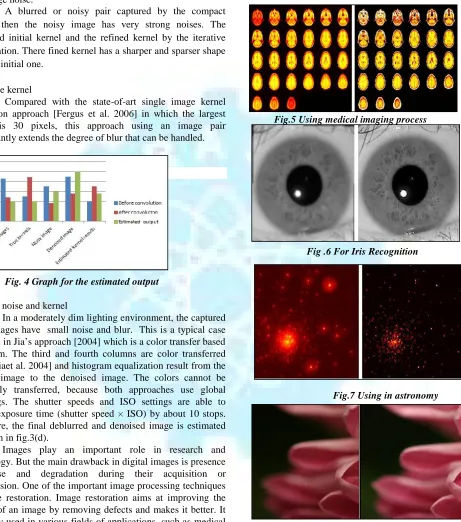
[image:7.612.74.535.105.627.2]Images play an important role in research and technology. But the main drawback in digital images is presence of noise and degradation during their acquisition or transmission. One of the important image processing techniques is image restoration. Image restoration aims at improving the quality of an image by removing defects and makes it better. It is widely used in various fields of applications, such as medical imaging, astronomical imaging, remote sensing and some commercial purposes are shown in fig. (5),(6),(7) and (8).
Fig.5 Using medical imaging process
Fig .6 For Iris Recognition
Fig.7 Using in astronomy
VII. CONCLUSION
This paper proposed an image deblurring approach using a pair of blurred/noisy images. This approach takes advantage of both images to produce a high quality reconstructed image. By formulating the image deblurring problem using two images, it has developed an iterative deconvolution algorithm which can estimate a very good initial kernel and significantly reduce deconvolution artifacts. No special hardware is required. This proposed approach uses off-the-shelf, hand-held cameras.
Limitations remain in approach, however, shares the common limitation of most image deblurring techniques are assuming a single, invariant blur kernel. For spatial-variant kernel, it is possible to locally estimate kernels for different parts of the image and blend deconvolution results. Most significantly, this approach requires two images; the ability to capture such pairs will eventually move into the camera firmware, thereby making two-shot capture easier and faster.
In the future, planning to extend our approach to other image deblurring applications, such as deblurring video sequences, or out-of-focus deblurring. Our techniques can also be applied in a hybrid image system [Ben-Ezra and Nayar 2003] or combined with coded exposure photography [Raskar et al. 2006].
REFERENCES
[1] Li Xu, Shicheng Zheng Jiaya Jia,The Chinese University of Hong Kong; Unnatural L0 Sparse Representation for Natural Image Deblurring.
[2] Lin Zhong, Sunghyun Cho, Dimitris Metaxas, Sylvain Paris, Jue Wang,Rutgers University; Handling Noise in Single Image Deblurring using Directional Filters.
[3] Esmaeil Faramarzi, Member, IEEE, Dinesh Rajan, Senior Member, IEEE,and Marc P. Christensen, Senior Member, IEEE; Unified Blind Method for Multi-Image Super-Resolution and Single/Multi-Image Blur Deconvolution. [4] Lu Yuan, Jian Sun, Long Quan,The Hong Kong University
of Science and Technology 2Microsoft Research Asia; Image deblurring with blurred/noisy image pairs
[5] Jiaya Jia, Department of Computer Science and Engineering, The Chinese University of Hong Kong; Single Image Motion Deblurring Using Transparency.
[6] James G.Nagy, Katrina palmer, Lissa perrone; Iterative methods for image deblurring.