Design and Analysis of Multi Leaf Springs Using
Composite Materials
Ganesh.K1, Gembiram.M2, Elayaraja.R3, Saravanan.R4, Murali.K5
1234
UG Student Department ofMechanical Engineering,
5
Asst.Professor Department of Mechanical Engineering,
University College of Engineering, Arni, Thatchur-623326 TamilNadu, India
Abstract— Weight reduction has been the main/primary focus of automobile manufactures. The automobile industries have shown interests in replacement of steel springs with composite leaf springs due to high strength to weight ratio. The objective of this paper is to compare the load carrying capacity, stiffness and weight savings of composite leaf spring with that of steel leaf spring. This work is carried out on multi leaf of commercial vehicle. Mathematical calculations are carried out for design the multi leaf spring. The materials of the leaf springs are SAE 9260 and Glass fiber reinforced epoxy to be taken for comparative study. A Finite element approach for analysis of a multi leaf springs using Ansys software is carried out. The leaf spring model is generated by using Pro/E and imported in Ansys. Harmonic analysis for vibration due to road irregularities and static analysis for gross vehicle mass load analysis are carried out for both materials, and comparative behaviors are observed such as stress and deflection of the multi leaf spring.
Key Words—Multi leaf springs, Steel Leaf Springs, Composite Leaf Springs, Harmonic analysis, Static analysis, Pro/E, Ansys.
1. INTRODUTION
Composite materials are the one of the main applications of the aerospace, automobiles and marine Industries. Because of their less weight, good stiffness and less corrosive properties. Weight reduction is one of the major factors of that one. It results in less fuel consumption; economize maintenance of vehicle and optimum utilization of natural resources. The suspension leaf spring is one of the potential items for weight reduction in automobile as it accounts for ten to twenty percent of the unspring weight. This helps in
achieving the vehicle with improve good riding qualities. As we know that springs, are designed for absorb and store energy after it releases slowly. Hence, the strain energy of the material becomes a major factor in designing the springs. The conventional steel leaf spring is replaced with composite material, because of their more elastic strain energy storage
capacity, good strength to weight ratio, good riding properties and, density good modulus of elasticity.
1.2 LITERATUREREVIEW
leaf spring is found to have 67.35% lesser stress, 64.95% higher stiffness and 126.98% higher natural frequency than that of existing steel leaf spring. A weight reduction of 76.4% is achieved by using optimized composite leaf spring.
U.S.RAMAKANTH et.al. (2013)project work is carried out on multi leaf springs having nine leaves used by a commercial vehicle. A Finite element approach for analysis of a multi leaf springs using Ansys software is carried out. The model is generated using solid works and imported in Ansys. The material of the leaf springs is 65Si7 (SUP9), composite leaf springs and hybrid leaf springs. Fatigue analysis of leaf springs is carried out for steel leaf springs, and Static analysis for steel leaf springs, composite leaf springs and hybrid leaf springs.
Under the same static load conditions the stresses in leaf springs are found with great difference. Stresses in composite leaf springs is found out to be less as compared to the conventional steel leaf springs, also a new combination of steel and composite leaf springs (hybrid leaf springs) are given the same static loading and is found to have values of stresses in between that of steel and composite leaf springs.
Bhushan B. Deshmukhet.al. (2011)Weight reduction can be achieved primarily by the introduction of better material, design optimization and better manufacturing processes. The introduction of FRP material has made it possible to reduce the weight of spring without any reduction on load carrying capacity. The achievement of weight reduction with adequate improvement of mechanical properties has made composite a very good replacement material for conventional steel. Selection of material is based on cost and strength of material. The composite materials have more elastic strain energy storage capacity and high strength to weight ratio as compared with those of steel, so multi-leaf steel springs are being replaced by mono-leaf composite springs. The paper gives the brief look on the suitability of composite leaf spring on vehicles and their advantages. The objective of the present work is design, analysis and fabrication of mono composite leaf spring. The design constraints are stress and deflections. The finite element analysis is done using ANSYS software. The attempt has been made to fabricate the FRP leaf spring economically than that of conventional leaf spring.
1.3 LEAF SPRING
Leaf springs are also known as flat springs or carriage springs .Leaf spring is an elastic body, whose functions to distort when load applied and to recover its original shape, after load is
removed. Applications of leaf springs are as follows to cushion, absorb or control energy due to either Shock or vibration as in automobiles. The leaf springs supposed to carry loads, brake torque, driving torque. The leaf springs used are single or multi leaf springs are there. Today leaf springs are still used in commercial vehicles such as cars, vans and trucks, and railway carriages. For heavy vehicles, they have the advantage of spreading the load more widely over the vehicle's chassis. The main importance of leaf spring is to carry bump loads (i.e. due to road irregularities), supports the chassis weight, controls axle damping, controls braking forces, and to provide better suspension. Leaf springs are designed in two ways:
1. Mono Leaf Spring 2. Multi Leaf Spring
The Multi Leaf Spring is made up of several steel plates of different length stacked together, while mono-Leaf spring is made up of single steel plate.During normal operation, the spring compressestoabsorb Road shock. The leaf spring bends and slide on each other allowing suspensionmovement. Leaf springs Can serve locating and to some extent damping as well as springing functions. The leaf spring absorbs the Vertical vibrations and impacts due to road irregularities by means of vibrations in the spring deflection So that the potential energy is stored in spring as strain energy and then released slowly.
1.4 COMPOSITE MATERIALS
results to better vibration energy absorption within the material and results in reduced transmission of noise and vibration to neighboring structures. High damping capacity of composite materials can be beneficial in many aerospace, automotive applications in which noise, vibration, strength and hardness is a critical issue for passenger comfort. Among the other environmental factors that may cause degradation in some of the mechanical properties of some polymeric matrix composites are elevated temperatures, corrosive fluids, and ultraviolet rays. In many metal matrix composites, oxidation of the matrix well as adverse chemical reaction between fibers and matrix are of great concern at high temperature applications.
2. MATERIALS SELECTION
The material used for leaf springs is usually a plain carbon steel having 0.90 to 1.0% carbon. The leaves are heat treated after the forming process. The heat treatment of spring steel produces greater strength and therefore greater load capacity, greater range of deflection andbetter fatigue properties. According to Indian standards, the recommended materials are:
A. For automobiles: 50 Cr 1, 50 Cr 1 V 23, and 55 Si 2 Mn 90 all used in hardened and tempered state.
B.for rail road springs: C 55 (water-hardened), C 75 (oil-hardened), and 40 Si 2 Mn 90 and 55 Si 2 Mn 90).In this project focused on automobile leaf spring, so we select SILICOMANGANESE material for design the leaf spring and another hand fiber reinforced composite selected for weight reduction point of view.
2.1. SILICON-MANGANESESteel (SAE 9260)
Silicon increases the strength without a serious loss of ductility. It also adds scale resistance. These steels are generally heat treated to specific properties. Manganese is one of the least expensive means of increasing harden ability at a given carbon content. It can also enhance machinability in the presence of sulfur. Chemical composition in weight percentage is C-0.6%, Si-1.65% and Mn-0.85%.
2.2. Glass fiber reinforced epoxy (GFRE)
Epoxy-based composites have environmental, production, and cost advantages over other resin systems. Epoxies also allow shorter cure cycles, increased durability, and improved surface finish. Prepare operations further reduce processing time over wet lay-up systems. As turbine blades pass 60 meters, infusion techniques become more prevalent; the traditional resin transfer
molding injection time is too long as compared to the resin set-up time, limiting laminate thickness. Injection forces resin through a thicker ply stack, thus depositing the resin where in the laminate structure before gelatin occurs. Specialized epoxy resins have been developed to customize lifetimes and viscosity.
3. SPECIFICATION OF MULTI LEAF SPRING
Table.1 shown various parameters of leaf spring
S.NO PARAMETER VALUE
1. Total length of the spring (Eye
to Eye)
1020mm
2. No. of full length leave (Master Leaf) (nf)
1
3. No. of gradual leaves (ng) 4
4. Thickness of leaf 10mm
5. Width of leaf spring 80mm
6. Maximum load given on spring(w)
3065.625N
7. Young’s Modulus of leaf spring 2x10³N/mm²
4. FINITE ELEMENTANALYSIS
Finite element structural analysis is a method of predicting the behavior of a real structure under specified load and displacement conditions. The finite element modeling is generalization of the displacement or matrix method of structural analysis to two and three-dimensional problems and three -dimensional problems. The basic concept of FEM that structure to be analyzed is considered to be an assemblage of
discrete pieces called “elements” that are connected together at a
5. ANALYSIS OF STEEL,COMPOSITE LEAF SPRING ANSYS can be used for all levels of analysis,from basic stressing to full non-linear dynamic analysis.
[image:5.612.7.546.274.677.2]5.1. Structural AnalysisStructural analysis is probably the most common application of the finite Element method. The term structural (or structure) implies not only civil engineering structures such as Bridges and buildings, but also naval, aeronautical, and mechanical structures such as ship hulls, aircraft bodies, and machine housings, as well as mechanical components such as leaf springs, machine parts, and tools.
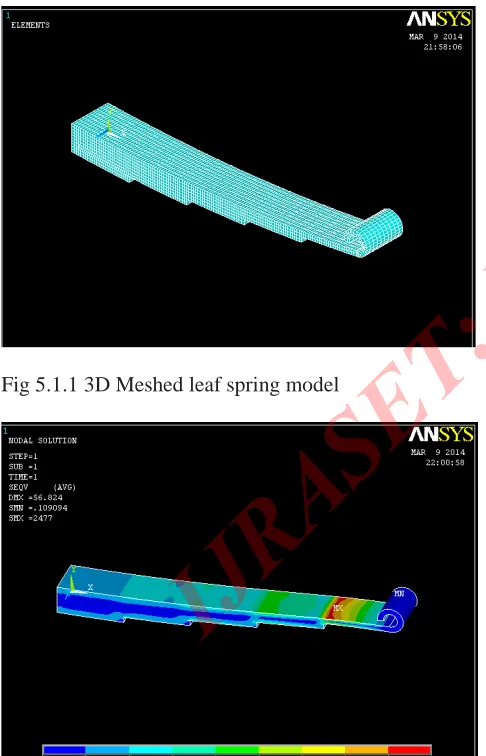
Fig 5.1.1 3D Meshed leaf spring model
Fig 5.1.2 Stress in SAE 9260 Leaf spring
Fig 5.1.3 Strain in SAE 9260 Leaf spring
[image:5.612.16.259.287.665.2]Fig 5.1.5 Strain in Fiber Glass Reinforced Epoxy Leaf spring
Table 2 Structural analysis results of Leaf spring
Structural Analysis Results
Results SAE 9260 Leaf
spring
Glass Fiber Reinforced Epoxy Leaf
spring Max Stress in
N/mm²
2477 2364
Max strain 0.012389 0.010552
5.2. Harmonic analysis
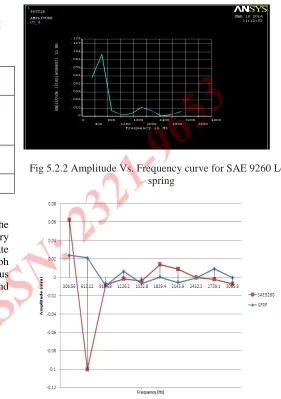
[image:6.612.20.262.438.604.2]Harmonic response analysis is a technique used to determine the steady-state response of a linear structure to loads that vary sinusoid ally (harmonically) with time. The idea is to calculate the structure's response at several frequencies and obtain a graph of some response quantity (usually displacements) versus frequency. "Peak" responses are then identified on the graph and stresses reviewed at those peak frequencies.
Fig 5.2.1 Amplitude Vs. Frequency curve for Glass Fiber Reinforced Epoxy Leaf spring
Fig 5.2.2 Amplitude Vs. Frequency curve for SAE 9260 Leaf spring
Fig 5.2.3 Amplitude Vs. Frequency Comparison graph for Leaf springs
6.CONCLUATION
fiber glass reinforced epoxy has a lower deformation, stress and strain compare with SAE 9260. Deformation reduces up to 14.6%, stress reduced up to 4.67% and strain reduced up to 16.01%. Reducing the deformation, stress and strain make leaf spring life longer against loads.
ACKNOWLEDGMENT
The authors would like to express their deep gratitude to Mr.K. Murali Teaching fellows Department of Mechanical Engineering, University College of Engineering, Arni for technical support.
7.REFERENCES
1. H.A.Al-Qureshi,”Automobile leaf spring from
composite materials”, Journal of Material Processing
Technology 118 (2001) 58-61.
2. Senthil Kumar, Sabapathy Vijayarangan,” Analytical
and experimental studies on fatigue life prediction of
steeland composite multi-leaf springs for light
passenger vehicles using life data analysis”, Journal of
Material Processing Technology (2001).
3. Daugherty.R.L,” Composite leaf springs in heavy truck
applications”, International conference on composite
material proceedings of japan US conference, Tokyo
1981:pp 529-538
4. G.Harinath Gowd, Venugopal Gowd ”static analysis of
leaf springs”, VOL 4 8th aug-2012 IJEST
5. Shiva Shankar and Vijayarangan,”Mono composite leaf
springs for light weight vehicle design, End joint,
analysis and testing”, Material science Vol 12 Nov 3
2006.
6. Nikolas Philipson and Modelan A B“Leaf spring
modeling”, science park S E 22307,lund Sweden
7. I.Rajendran, S.Vijayarangan, “optimal design of
composite leaf springs using genetic algorithm,”
Computer and Structure 79 (2001) 1121-1129
8. Hou J.P Cherrualt J Y,”evolution of the eye-end design
of a composite leaf spring for heavy axle loads,”
composite structure, 28,351-358(2006)
9. M.L.Agarwal, V.P.Agarwal,”A stress approach model
for prediction of fatigue life by shot peening of EN45
steel spring”, International Journal of Fatigue 28
(2006) 1845-1853.
10. Yu.W.J, Kinm.H.C,”Double Tapered FRP Beam from
Automotive suspension leaf springs”, Composite