Technology (IJRASET)
©IJRASET: All Rights are Reserved
374
Content-Based Image Retrieval using HSV and
Hadamard DWT
Deshbir Singh1, Sandeep Kaur2 1,2
Department of Electronics & Communication Engineering, GVIET, Ramnagar, Banur, Punjab, India
Abstract- With the development of the Internet, and the availability of image capturing devices such as digital cameras, image scanners, the size of digital image collection is increasing rapidly. For this purpose, many general purpose image retrieval systems have been developed. In CBIR, images are indexed by their visual content. Content based image retrieval consists of three parts: feature extraction, indexing and retrieval part. The techniques which are used to extract features of an image are called feature extraction techniques. The choice of features plays an important role in image retrieval. Some of the features used are color, texture and shape. Combination of these features provides better performance than single feature. Here we are extracting color and texture features with the proposed method consists of HMMD (Hue Min Max Difference) color plane and HDWT (Hadamard Discrete Wavelet Transform) techniques. It is proved in research work that HMMD HDWT reduced the size of feature vectors, storage space and gives high performance than intensity-Haar, RGB-Haar and RGB-HDWT.
Keywords – CBIR, HDWT, HMMD, RGB – HDWT and RGB - Haar.
I. INTRODUCTION
Image retrieval on the basis of image features, textures and color has become one of the most researched areas in the field of computer vision. The major utilization of all the techniques used to retrieve images based on content relies on how well the features are being extracted. With advances in feature extraction methods, the field is getting more and more sophisticated. Given an image database, we are interested in finding relevant images for a given query image. The “relevant” images are
visually and semantically similar to the query image. Traditionally, retrieval was done by utilizing meta-data associated with the image. This meta-data includes image name, textual description associated with the image, time at which the picture was taken etc. But in a large image database, manually assigning labels/tags for each image is impossible. Further the meta-data associated with the image may be noisy, leading to incorrect retrieval. This motivates the use of content based retrieval systems.
For the retrieval system to be scalable, the main challenge is to find a representation for the image which
Is robust to geometric transformations Consumes less memory per image
Requires less computation for computing similarity between two images
The first property is required for robust image retrieval. The second property is necessary for storing the image representation of the entire database in RAM of the computer, to avoid costly disc accesses. The third property is necessary for online retrieval. Whenever a new image is added to the database we must able to quickly compute the distance of the new image with other images in the database. Recently presented approach known as VLAD and this proposed approach has ability to satisfy the several properties and it is appropriate for huge image database.
Technology (IJRASET)
[image:3.612.108.488.58.442.2]©IJRASET: All Rights are Reserved
375
Figure 1.1: An abstract Framework for CBIR
In off-line feature extraction, the system extracts visual options like color, shape, texture, and abstraction info etc of every image within the info and stores them during a completely different info at intervals the system known as feature info. The scale of the feature information is incredibly little as compared to the image information.
In on-line image retrieval, the user will submit a question example so as to retrieve the required pictures. Future step is that the similarity lives. The space between the feature vector of the question image and therefore the feature information is calculated in terms of the distances. Finally, the system ranks the photographs so returns the results that square measure most kind of like the question image. The user can even offers the feedback whether or not he's glad with the results or not and this mechanism is termed connectedness feedback.
II.LITERATUREREVIEW
Amanatiadis, A., et al.(2011): In[1] "Evaluation of shape descriptors for shape-based image retrieval." author proposed an evaluation of MPEG-7 size descriptors the effectiveness of Fourier descriptors and Zernike moments that was confirmed with experimental conclusion. In the scale space curvature descriptor performs the evaluated size and shape descriptors when it has compared with the Core Experiment of MPEG-7. In these spectral transforms and descriptors based moments, like FD and Zernike moments are proved to the good choices for normal shape applications
Technology (IJRASET)
©IJRASET: All Rights are Reserved
376
dictionaries are expressed from an each object. There are some similarities in b/w different images which are calculated by the comparing with an each couple of dictionaries.
Guang-Hai Liu, Jing-YuYang (2012): In[3] authors proposed a method color difference histograms which count the consistent color distinctionamong two points over distinct backgrounds with regard to colors and edge orientations in L*a*b* color space.Experimental results demonstrate that it is more effective than MPEG-7 edge histogram descriptors, color auto correlograms and multi-texton histograms.
Harshada Anand Khutwad, Prof.Mr.RavindraJinaDatta Vaidya (2013): In [4] author proposed the color is mostly extensive used visual for image retrieval. The 3D color values make its decrementation potentiality higher to the one dimensional gray color values of picture. The mean 1st order, the variance second order and skewness is a third order color moments that must have proved to be effective and efficient in displaying color distributions of pictures. Texture is an intuitive and vastly used but there has no specific definition.
Jun Yue, Zhenbo Li , Lu Liu , and Zetian Fu(2011) :- In [5] author proposed the common feature of low-level including reflecting texture, color, salient and shape points in picture. Due to the effectiveness, robustness, low storage merit advantages and implementation simplicity. Color contains the most effective and useful feature or all CBIR systems take colors. CIE or HSV Lab and LUV gaps are used to display color combination of RGB space. Normally, the division of color was displayed by color formed and histograms in the images’ of feature vectors.
Lin, Chuen-Horng, Rong-Tai Chen, and Yung-Kuan Chan (2009) :- In [6] Author proposed that a better picture recognition effect that can be get with multiple features used, but this is not true. However, all features are not useful for picture recognition. But Ill characteristics are interfering into signals that create a drop in color recognition rate, specifically it effects on the ill features that effective ones. The features can be useful to manage the retrieval of picture with huge featured area. Although, all individual ill characteristics can be searched into distinct cartoon images, image data, texture images, natural images, gray texture images, colorized and categorized images.
Liu, Guang-Hai, et al. (2011) :- In [7] Author proposed that human visual attention can increase with a process of interactions competing among neurons that choose a few elements of suppresses and attention of irrelevant materials. The close relationships are human attention system and down-level visual characteristics, and however the search to use the visual mechanism for picture retrieval is a crucial now challenging problem. In order to release the features through simulating texture, visual procedures and shape features, integrate color and image color of layout information as entire for picture retrieval.
Liu, Guang-Hai, and Jing-Yu Yang (2013):- In [8] author proposed that neuron biological and psychophysical studies indicate that human visibility system is more responsive to edge orientation and color. It describes the uniform of color difference b/w edge and colors orientations wrap on rich type of visual data and information. It is more helpful information and works as a vital role in picture understanding and analysis.
ManimalaSingha, K.Hemachandran (2012): In [9] authors described a process of getting specific images from a huge collection of DB on the basis of color, texture features. This method defines the Wavelet Based Color Histogram Image Retrieval technique. The color and texture features are expressed through color histogram and wavelet transformation and combination of some powerful features for translation and scaling of objects in a picture. It has demonstrated a fast retrieval method on a WANG picture database including 1000 general color images.More so, some other computational tips are effectively decreased with the usage of Wavelet transformation.
Murala, Subrahmanyam, R. P. Maheshwari, and R. Balasubramanian (2012):- In [10] author proposed that texture analysis has become more useful and broadly used in pattern recognition and computer vision software applications causing its potential in exploring the prominent characteristics. The performance enhancement can be attained by calculating the thresholds while using genetic algorithm for CBIR application. It is a branch of texture optimization and analysis that has been attracted wide attention from the industries has used the discrete transform for texture classification.
Technology (IJRASET)
©IJRASET: All Rights are Reserved
377
III. EXPERIMENTANDRESULT
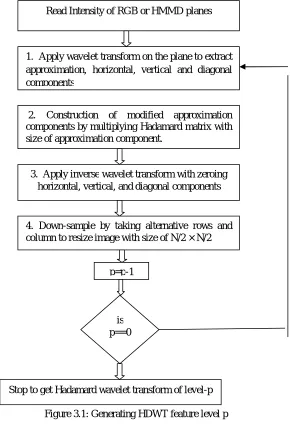
[image:5.612.165.455.118.546.2]The Hadamard distinct wave remodel methodology is employed for feature extraction and is enforced in MATLAB. The steps area unit shown within the Figure 3.1 below.
Figure 3.1: Generating HDWT feature level p
In figure 3.1, the generated feature vectors of dataset pictures is that the application HDWT for level one level four and store the approximation element as feature vectors for every image.
A. Explanation of the Algorithm
The authors have combined Hadamard remodel beside distinct wave remodel (HDWT) to extract the feel options of every image. The flow chart of the HDWT methodology has been diagrammatic in Fig. 3.1 and therefore the steps area unit diagrammatic as delineate by Farsi and Mohamedzadeh (2013) :
1) Once reading the RGB planes, we have a tendency to apply DWT on every RGB and plane, individually with size of N × N to get approximation (low–low), horizontal (low–high), vertical (high–low) and diagonal (high–high) elements. we have a tendency to use approximation elements for consecutive step as a result of wave remodel analyses the signal at varied frequency bands and offers higher frequency resolution and lower time resolution at lower frequencies.
2) The previous stage provides four sets of coefficients referred to as approximation coefficients cA1, horizontal coefficients, vertical coefficients and diagonal coefficients, cH1, cV1, and cD1 severally.
Read Intensity of RGB or HMMD planes
1. Apply wavelet transform on the plane to extract approximation, horizontal, vertical and diagonal components
2. Construction of modified approximation components by multiplying Hadamard matrix with size of approximation component.
3. Apply inverse wavelet transform with zeroing horizontal, vertical, and diagonal components
4. Down-sample by taking alternative rows and column to resize image with size of N/2 × N/2
p=p-1
is p==0
Technology (IJRASET)
©IJRASET: All Rights are Reserved
378
3) Getting the modified approximation elements by multiplying approximation elements and Hadamard matrix with size of approximation element.
4) Getting the modified plane from step three by applying inverse wave remodel with modified approximation elements, zeroing
horizontal, vertical and diagonal elements. a brand new image is built by victimization inverse wave whereas some data disappears due to removing horizontal, vertical and diagonal elements.
5) To require different rows and columns by down-sampling the output of step three with size of N/2 × N/2.
6) To construct HDWT feature of level p by repetition steps 3–4, ‘p’ times on every plane.
7) Victimization approximation elements of level p leading to step three as HDWT feature of level p.
B. Observations And Discussion
To evaluate the operating of HDWT methodology, the implementation has been tired MATLAB R2013a with the image dataset being one thousand images Corel dataset. The result for the HDWT victimization RGB color house model is bestowed Fig 3.2.The first image in Fig four.4 is that the question image and remaining area unit the retrieved pictures from the information. Out of all the retrieved pictures, one will observe that the primary image retrieved is same because the question image. This can be obvious case wherever the question image is additionally gift within the information wherever the simplest match is with identical image.
Figure 3.2: Retrieved images of elephant using HDWT features based on Query Image
The primary image retrieved is same because the question image. This shows the effectiveness of the method which can then be quantified in terms of Precision and Recall and the results can be mentioned in the form of graphs and a comparison result or graph can be displayed.
Figure 3.3: Retrieved Images of bus with one image being out of the class of the query image
Technology (IJRASET)
©IJRASET: All Rights are Reserved
379
[image:7.612.165.448.109.257.2]graph can be displayed.
Figure 3.4: Results for retrieved image of flower using HDWT Feature
The primary image retrieved is same because the question image. This shows the effectiveness of the method which can then be quantified in terms of Precision and Recall and the results can be mentioned in the form of graphs and a comparison result or graph can be displayed.
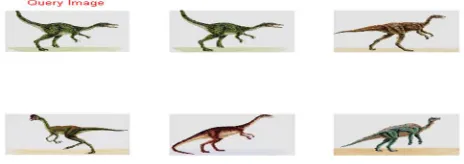
Figure 3.5: Results for dinosaur image query using HDWT Feature
The primary image retrieved is same because the question image. This shows the effectiveness of the method which can then be quantified in terms of Precision and Recall and the results can be mentioned in the form of graphs and a comparison result or graph can be displayed.
Performance analysis of HSV-HDWT feature extraction is done on the basis of the performance metrics: precision, recall. These metrics when used tells us about the performance of the content based image retrieval. The metrics are explained in next section.
C. Performance Metrics
The following performance metrics are considered in analyzing the performance of content-based image retrieval
1) Precision: Precision is used for evaluation of most CBIR systems. Precision is the fraction of returned images that are relevant to the query image. If we denote T as the set of returned images and R as the set of all images relevant to the query image, then precision is given by:
Precision = |T∩R| / |T|
2) Recall: Recall is the fraction of returned relevant images with respect to the total number of relevant images in the dataset.
Recall = |T∩R| / |R|
[image:7.612.190.422.354.436.2]Technology (IJRASET)
©IJRASET: All Rights are Reserved
380
the query image and the feature vectors stored in the dataset using Euclidian distance. Sort the images according to distances with the smallest distance first. The number of images returned is six in number fixed by the code.
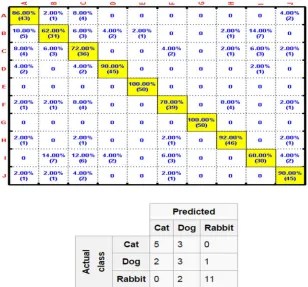
The retrieved pictures in the results show that the photographs are relevant to the specified or the question image. The performance metrics in terms of confusion matrix has been planned for the one thousand image Corel dataset that shows that there's a scope of improvement within the existing algorithmic program. The results show a brand new methodology is needed so as to enhance the relevance of the retrieved pictures. The projected work is meant for the development within the retrieval method on the grounds of each quantitative and qualitative information.
Figure 3.6: Confusion Matrix for the Query Images Using Proposed Method
[image:8.612.143.451.171.458.2]The retrieved pictures in the results show that the photographs are relevant to the specified or the question image. The performance metrics in terms of confusion matrix has been planned for the one thousand images.
Technology (IJRASET)
©IJRASET: All Rights are Reserved
381
The following performance metrics are considered in analyzing the performance of content-based image retrieval. Precision and Recall both is used for evaluation of most CBIR systems.
IV. CONCLUSION & FUTURE SCOPE
CBIR is an exigent method of capturing relevant images from a large storage space. Although this area has been investigated for decades, no technique has achieved the accuracy of human visual perception in distinguishing images. Whatever the size and content of the image database is, a human being can easily recognize images of same category. Several approach for extracting feature has been produced to the task of image retrieval. Further, it is proved that by combining different features, the performance can be increased. We have performed performance evaluation of RGB hadamard discrete wavelet transform with COREL database for determining the classification rate .It is observed that RGB HDWT is giving desired results. Further, it is seen that in some cases there will be irrelevant images with the result of query image in some cases these irrelevant images are totally different from query image on basis of color and shape. Still, this is not the required image and hence there is a scope of improvement in the existing algorithm future work consists of using some other color space or improved texture extraction technique.
Although the method provides an efficient retrieval of images, the computation time for the whole process is on a bit higher side. Therefore, the future work will be focused on reducing the processing time for the feature extraction so that the complete process is fast enough for real time application.
REFERENCES
[1] Alaa E Abdel-Hakim and Aly A Farag.Csift: A sift descriptor with color invariant characteristics. In IEEE Computer Society Conference on Computer Vision and Pattern Recognition, volume 2, pages 1978–1983. IEEE, 2006.
[2] Alex Krizhevsky, Ilya Sutskever, and Geoff Hinton.Imagenet classification with deep convolutional neural networks.In Advances in Neural Information Processing Systems 25, pages 1106–1114, 2012.
[3] Amanatiadis, A., et al. "Evaluation of shape descriptors for shape-based image retrieval." Image Processing, IET 5.5 (2011): 493-499.
[4] Bastian Leibe Kristen Grauman. Visual object recognition. In Thomas Dietterich Ronald Brachman, editor, Synthesis Lectures on Artificial Intelligence
and Machine Learning. Morgan and Claypool Publishers, 2009.
[5] Cerra, Daniele, and Mihai Datcu. "A fast compression-based similarity measure with applications to content-based image retrieval." Journal of Visual
Communication and Image Representation 23.2 (2012): 293-302.
[6] David G Lowe. Distinctive image features from scale-invariant keypoints. Internationaljournal of computer vision, 60(2):91–110, 2004.
[7] Guang-Hai Liu, Jing-YuYang, “Content-based image retrieval using color difference histogram”, in Journal of Pattern Recognition, 2012, Page(s).188-198.
[8] HarshadaAnandKhutwad, Prof.Mr.RavindraJinaDatta Vaidya. “CONTENT BASED IMAGE RETRIEVAL”, in International Journal of Image Processing and Vision Sciences, Volume 2, 2013, page(s).19-24.
[9] Hassan Farsi, SajadMohamadzadeh, “Colour and texture feature-based image retrieval byusing Hadamard matrix in discrete wavelet transform”, in IET Image Processing, Volume 7, Issue 3, 2013,Page(s).212-218.