5
VIII
August 2017
Performance Evaluation of the QoS for VoIP using
Different CODECS
Aiman Ahmed Abu Samra
CE Department, Islamic University of Gaza (IUG), Gaza, Palestine
Abstract: Voice over Internet Protocol (VoIP) service is growing very fast and supported by many applications. Its interactive nature makes it very attractive service. VoIP requires a precise level of quality to be utilized. Quality of Service (QoS) is determined by factors like jitter, traffic sent, traffic received and end-to-end delay. In this paper, we study the performance of different scheduling schemes, like: FIFO, PQ, and WFQ for different codec formats. The implementation of the schemes was carried out using OPNET. VoIP service is deployed using the internet implementing the Resource Reservation Protocol (RSVP). The paper discusses the results through a number of figures for the jitter, end-to-end delay and the traffic sent and received. Figures show the different scheduling schemes PQ, WFQ and FIFO with different codec formats, G.711, G.729A and G.723.15 codec formats.
Keywords: VoIP; delay; jitter; OPNET; QoS
I. INTRODUCTION
Nowadays, very huge amounts of voice traffic are transferred between millions of people across the world using different social media applications. Using VoIP over the Internet connection, we should be aware about the quality of the VoIP service. VoIP service requires a precise level of quality to be utilized. The end user perception of the quality is determined by subjective testing as a function of the network impairments such as delay, jitter, packet loss, and blocking probability. The amount of impairment introduced by a packet network depends on the particular QoS mechanism implemented [1] Quality of Service (QoS) is determined by factors like the delay the packet delay variation (jitter), and the data loss rate [2]. The greatest technical problem in supporting multimedia services over IP is that real-time traffic must reach its destination within a preset time interval (delay) and with some tolerance of the delay variation (jitter). This is difficult because the original UDP/IP operates on a best-effort basis and permits dropping of packets on the way to a destination [3]. The simulation model was done using OPNET Modeler [4] [5]. OPNET has gained considerable popularity in academia as it is being offered free of charge to academic institutions. That has given OPNET an edge over DES NS2 in both market place and academia [6]. In this paper, we studied the performance of the most popular scheduling schemes, like: First-In First-Out (FIFO), priority Queuing (PQ), and Weighted Fair Queuing (WFQ). A comparison is carried out between different codecs (G.711, G.729A and G.723.15) which are the most appropriate to improve QoS for VoIP. The rest of the paper is organized as follows. Section II presents a typical WAN network topology that uses RSVP protocol to be used as a case study for deploying VoIP service. Section III describes the VoIP service and its parameters. Section IV presents the OPNET-based simulation approach for deploying VoIP service. Section V describes the results and analysis of the simulation study. Then section VI conclusion.
II.VOICEOVERINTERNETPROTOCOL(VOIP)
Quality of Service Parameters used in VOIP include: Jitter, end-to-end delay, and sent and received traffic. We introduce the CODECs and several kinds of the quality of voice, such as Priority Queuing (PQ), Weighted Fair Queuing (WFQ) and Resource Reservation Protocol (RSVP) which can be used in OPNET package.
A. Jitter
B. End-To-End delay
End-To-End delay is the time interval in which a packets travels from one node to another node. VoIP is very sensitive to delay; thus, it must be controlled and managed. As mentioned previously, it is inefficient to wait for all packets arriving in an organized order; therefore, some packets may be dropped if they don’t arrive in time and this can cause short periods of silence in the audio stream and causing bad VoIP quality. Ideally, the delay constraint for VoIP packets is not above 80ms [6].
C. Resource Reservation Protocol
The Integrated Services(IntServ) architecture model (RFC 1633, June 1994) was motivated by the needs of real-time applications such as remote video, multimedia conferencing. IntServ provide some control over the end-to-end packet delays in order to meet the VoIP requirements. In RSVP, the source transmits a Path message along the routed path to the destination to collect information about the QoS viability of the routers along that path [8].
D. CODECs
A CODEC is an algorithm used to encode and decode the voice stream. Since the voice stream is analog, it needs to be digitized so it can be transmitted over the Internet. Once it reaches the other end it needs to be decoded to restore the analog stream. There are a variety of different ways this encoding and decoding can be done. Three popular CODECs are used and discussed in this paper. The CODECs are G.711, G729A and GSM. CODEC uses different algorithms to compress and decompress the voice stream and each CODEC will contribute a processing delay to the overall end-to-end delay [9].
III. THENETWORKMODEL
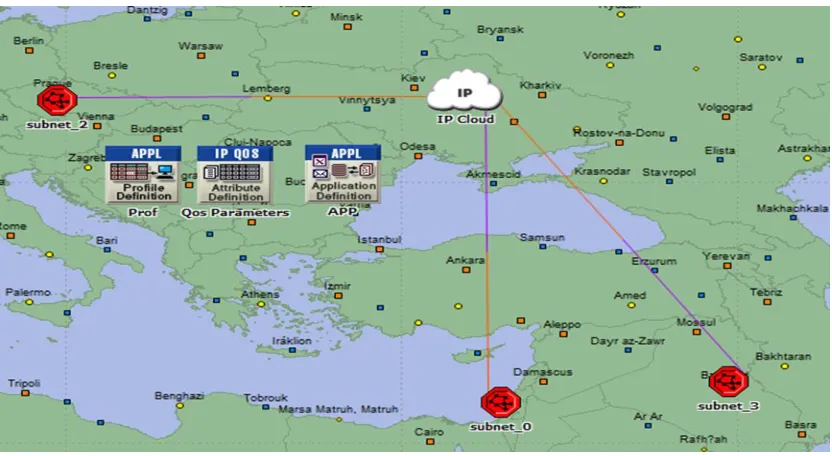
[image:3.612.106.522.348.576.2]The network model of the VoIP WAN is shown in Fig. 1. Subnet 0 and subnet 3 could be two institutions that use the VoIP servers in subnet 2. Subnet model for subnet 0 and subnet 2 consists of a LAN connected to a switch and then to a router.
Figure 1. The network models.
IV. THESIMULATION
many parameters to be measured, like the jitter, the traffic sent, the traffic received and the end-to-end delay. A curve was derived by the OPNET simulator for each scheme for all parameters.
V.RESULTSANDANALYSIS A. Jitter
The maximum acceptable value of jitter is 50 msec [12]. The jitter values for all codecs are neglected. For G.723 it is less than 2.5 msec for G.711 it is less than 1 msec and for G.723.15 it is less than 0.4 msec.
B. End-to-End Delay
Figures 2, 3 and 4 show the end-to-end delay values for the scheduling schemes FIFO, PQ and WFQ for the three tested codecs G.711, G.729A and G.723.15
Figure 2. End-To-End delay for G.711 codec
Figure 3. End-To-End delay for G.729A codec
The maximum acceptable value of end-to-end delay is 150 msec [12]. Table 1 summarizes the results of end-to-end delay. We notice that the results for PQ is acceptable for all of the three tested codecs.
TABLE I. End-To-End delay in msec
CODEC/Scheme FIFO scheme PQ scheme WFQ scheme
G.711 0.606 0.078 2.76
G.729A 0.148 0.079 1.52
G.723 1.5 0.853 0.115 5.34
C. Sent and Received Traffic
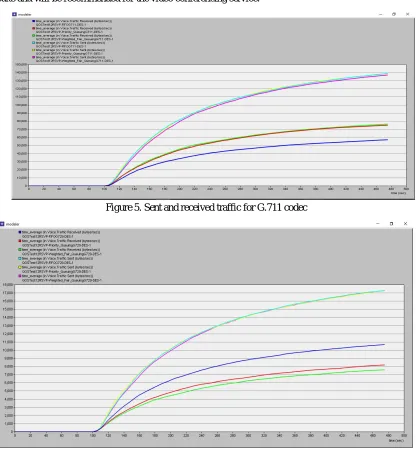
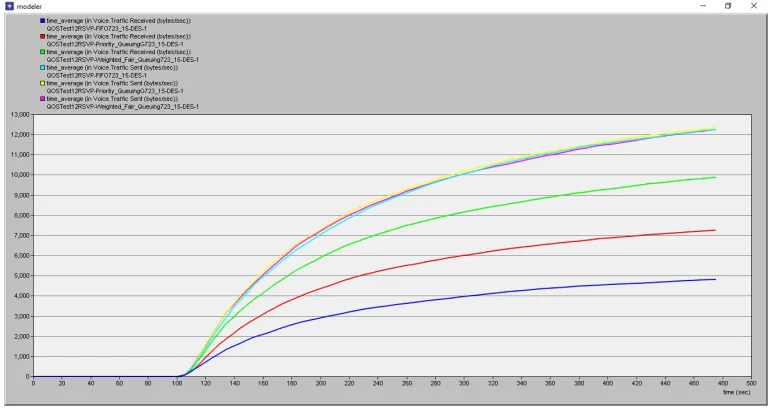
From figure 5, 6 and 7 we find the following for all three scheduling schemes for the three tested codecs G.711, G.729A and G.723.15 The results of the sent and receive traffic are similar for G.711 but FIFIO scheme little falls behind others. The results of the sent and receive traffic are similar for G.729A but FIFIO scheme little precedes The results of the sent and receive traffic are not similar for G.723 but WFQ scheme precedes and FIFIO scheme falls behind others From the results in the table we can conclude that PQ scheme has the best results and will be recommended for the video conferencing service.
Figure 5. Sent and received traffic for G.711 codec
[image:5.612.113.516.281.472.2]Figure 7. Sent and received traffic for G.723 codec
VI. CONCLUSION
In this paper, simulative investigations, using OPNET Modeler, have been done for with different CODECs. Investigations have been done in terms of important Quality of Service parameters like jitter, packet end to end delay and sent and received traffic. Based on the simulation results, the jitter values in all cases are neglected. Wireless End-To-End delay is acceptable for the PQ with all tested CODECs. Sent and receive traffic also was analyzed in the paper.
REFERENCES
[1] Kun I. Park, Ph.D. The MITRE Corporation USA, "QOS IN PACKET NETWORKS", Springer 2005
[2] BUR GOODE, Voice Over Internet Protocol (VoIP), Invited Paper, Proceedings of the IEEE ( Volume: 90, Issue: 9, Sep 2002 ), Page(s): 1495 – 1517I. S. Jacobs and C. P. Bean, “Fine particles, thin films and exchange anisotropy,” in Magnetism, vol. III, G. T. Rado and H. Suhl, Eds. New York: Academic, 1963, pp. 271–350.
[3] BUR GOODE, IMPLEMENTING VOICE OVER IP, 2003 by John Wiley & Sons, Inc.
[4] OPNET Technologies, OPNET Modeler Product Documentation Release 11.0, OPNET Modeler, 2005 Y. Yorozu, M. Hirano, K. Oka, and Y. Tagawa, “Electron spectroscopy studies on magneto-optical media and plastic substrate interface,” IEEE Transl. J. Magn. Japan, vol. 2, pp. 740–741, August 1987 [Digests 9th Annual Conf. Magnetics Japan, p. 301, 1982].
[5] https://www.riverbed.com/gb/products/steelcentral/opnet.html?redirect=opnet
[6] Salah, Khaled, and A. Alkhoraidly. "An OPNET‐based simulation approach for deploying VoIP." International Journal of Network Management 16.3 (2006): 159-183.
[7] Zheng, Li, Liren Zhang, and Dong Xu. "Characteristics of network delay and delay jitter and its effect on voice over IP (VoIP)." Communications, 2001. ICC 2001. IEEE International Conference on. Vol. 1. IEEE, 2001.
[8] https://www.cisco.com/c/en/us/products/ios-nx-os-software/resource-reservation-protocol-rsvp/index.html
[9] ITU-T P.830, “Subjective performance assessment of telephone-band and wideband digital codecs,” 1996. [10] https://tools.ietf.org/html/rfc2205
[11] http://www.cisco.com/c/en/us/products/ios-nx-os-software/resource-reservation-protocol-rsvp/index.html