SPECIEL ISSUE ON EDUCATIONAL EVALUATION & RESEARCH ISSN 2278-8808, SJIF 6.177
MAR-APRIL 2017, VOL- 4/31 www.srjis.com Page 103
INDICATORS FOR THE CONSTRUCTIVISM APPROACH
Mrs. Mamata M. Pawar
1&
Dr. MeghaUplane
2(Page 103-111) 1M. Phill, Department Of Education and
Extension Savtribai Phule Pune University
2
Associate Professor, Dept. of Education and Extension,
Savtribai Phule Pune University
According to constructivist theory evaluation should as far as possible diagnostic in nature. Constructivism -group learning, understanding, problem solving teaching approach, facilitates teaching & proximal development. In evolution of evaluation process various methods and techniques are developed. Indicator development play important role in implementation of constructivism approach. It is the basic evaluation tool. Indicators like physical indicators, social indicators, cognitive indicators and organization indicators are developed. Learning indicators facilitate strategies to learner’s progress continuously with a focus on curriculum expectation. -+This paper focuses on physical and cognitive indicators which are based on instructional model. The learning activities are designed for students to construct their knowledge over time through prior knowledge, own experiences and observations. These activities improved their analytical and critical thinking. In constructivism, evaluation and assessment can be done on all above points along with continuous instructional process. All this teaching learing process indicators play important role in continuously evaluation. making examination more flexible and without burden .
Introduction-In the Educational focused on the four main priorities of education policies have been Access
Equity, Quality and Governance. Various educational surveys indicate that learning
achievement of children in various subject of elementary stage is not up to expected level.
Continuous observation of the child learning is an essential component of a teaching learning
process. It gives a teacher an idea that as a facilitator what are necessary requirements to
enhance the teaching learning process. Teacher adopts several parameter through which
assesses continuously learning progress of the child. These parameters are taken as learning
indicators that enable the teacher to indentify learning gap. Hence the researchers develop
indicators for the status study of implementation of constructivism approach.
Scholarly Research Journal's is licensed Based on a work at www.srjis.com
ABSTRACTSRJIS IMPACT FACTOR SJIF 2016: 6.177
Date of Issue Release: 04/05/2017,
SPECIEL ISSUE ON EDUCATIONAL EVALUATION & RESEARCH ISSN 2278-8808, SJIF 6.177
MAR-APRIL 2017, VOL- 4/31 www.srjis.com Page 104
Objectives:-
1) To develop indicator for this status study of implementation of constructivism approach.
2) To find out the present status of implementation of constructivism approach.
3) To analyses the strength and weakness of implementation of constructivism
approach.
Research Question:-
1) What is present status by using 5E model and 5 components of
constructivism in constructivist approach in teaching of Science?
2) What are the strengths in implementing constructivist approach in the teaching of Science?
3) What are the weaknesses in implementing of constructivist approach in the teaching of
Science?
Sample & sampling:-
In the present research sample selection is simple random lottery
method.
District
Medium of School
Number and Types of School management
Class 1st to 7th Std.
Science Teacher
Pune only Marathi medium school
Zillah parishad 799
Corporation school 425
1st to 7th Std. school Total -1224
Teacher teaching 6th std.
10% (80) 10% (43) 10% (123)
123
Tools:-
1) Development of Indicator. Researcher focus on Physical and cognitive indicators
Views in planning of development of indicators.
Indicator Development
Physical
social Cognitive organization
Indicators indicatorsindicatorsindicators
With the use of developed indicators following tools are developed.2) Observation
Checklist. 3) Teacher Questionnaire by this tools collected data.
Actual Reserch procedure
–
In the Reserch procedure finalized according to the objective
Learning Indicator Development in objective-I
Tools Develope on the basis of Learning Indicator ie observation checklist and Teacher
SPECIEL ISSUE ON EDUCATIONAL EVALUATION & RESEARCH ISSN 2278-8808, SJIF 6.177
MAR-APRIL 2017, VOL- 4/31 www.srjis.com Page 105
Class was clean tidy full of sunlight and verification.Class decoration was proportion permissible.
Seating arrangement for students’ fair discussion was proper and suitable. Seating arrangement was motivation for team work and spacious so that everyone can work freely.
52.5
28.3
40 34.1
45
29.17
12.5
20.8 22.5
0.8 4.11
16.67
[image:3.595.83.501.92.675.2]0 1.6 1.6
Table - II - Class Environment was suitable for
constructivism
Excellent Very good Good Fair Never
Analysis and Interpretation of data is done. Conclusion are taken on graph and percentage in
Objective III .
Data analysis:-
39.5 40.8 42.5
44.17 44 42.5
37.5
30
27.5
38.3
35
29.17
22.5 20.8 24.1
15.1
12.5
24.1 22.5
8.3
5.8
2.5
8.3
4.17
0 0 0 0 0 0
School Environment is
clean neat tidy and quit.
Enough facilities are provided by school as per
their requirement.
Time table was flexible opportunity was planning
the games as per necessities.
In all human units in the school students
centered, attitude was observed or
noted.
Motivational environment provided from
their seniors.
Assistance is provided solve
the teacher problems while
[image:3.595.81.511.133.397.2]evaluating.
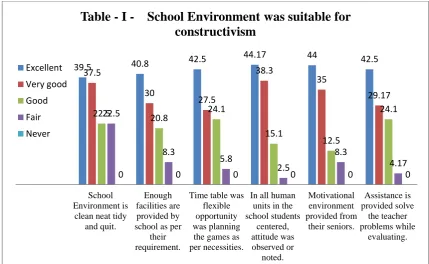
Table - I - School Environment was suitable for
constructivism
Excellent
Very good
Good
SPECIEL ISSUE ON EDUCATIONAL EVALUATION & RESEARCH ISSN 2278-8808, SJIF 6.177
MAR-APRIL 2017, VOL- 4/31 www.srjis.com Page 106
Students are doing activities in a
group or individually. Students are trying to search themselves the answers as per the subject. Students are succeeded in correlating previous knowledge they hare through the activity. Students ask his queries him selves to
search. Students present hypothesis and possibilities Students have done some activities to check the hypothesis Students are present hypothesis and act for checking themselves. Students select proper teaching aids and equipments. 27
14 13.5
9.1
6.61
4.11 4.11 4.1 28.3 36 33 37.1 33 37.5 33.31 29.1
9.1 10 10
12 13.3 13.8 14.1
18.3
0 0 0 2.5
9.1 8.6
4.1
1.6
Explore
Excellent Very good Good Fair Never
Students participated by themselves
in the given activity. The curiosity produced among the students through the given activity. The students self motivated by thinking that they them selves should search any thing curiosity or should be participated themselves in the activity. Students himself ask the question to others. Students collect the pre
experiences through the selected activity. Students answer the question asked by the
teacher.
Students participate in the discussion as per its pre
experience.
Students associate his
post experience with the New
imagination.
20.8 21.6 22.5
10.8 15
28.3
20 26 25 23.3 30.8
35.8
19.1
30.8 33 32 46.6 50.8
40 42.5
60
39 39 36
6.45 3.33 5.83 10.8 5.8
1.1
8.3
3
0.8 0.8 0.8 0 0 0 0 0.8
Engage - IV
Excellent
Very good
Good
Fair
SPECIEL ISSUE ON EDUCATIONAL EVALUATION & RESEARCH ISSN 2278-8808, SJIF 6.177
MAR-APRIL 2017, VOL- 4/31 www.srjis.com Page 107
5.1 5.8 5.8 5
10.8 9.1
7.5 34.1
30.8 30.8
27.5
39.1
27.5
21.6 50.8
38.3
34.1
40 40 42.5
27.5
10
20.8 21.1 25
10
15
20
0
4.1 2.5 2.5
0
5.83 9.1
Students are present their idea in front of
others.
Students are present the concepts of the
understood.
Students are present information in proper patter of report in a form of written or
oral.
Students are present their imagination through pictures, drawing and
graph.
Students use the mathematical operation for
the data analysis.
Students are analysis scientific data through tabular form, chart, and
graph.
Students are interpreting scientific data.
Explain
Excellent Very good Good Fair Never
Efforts of the students using knowledge they achieved in new circumstances is
successes.
Students try to correlate the
achieved knowledge with the daily routine
life.
Students make the utilization of
achieved knowledge at
other places.
14.1 15
8.3
33.3 34.1 38
41 45.1
54
12.1
5.8 8.3
0 0 1.6
Expand
SPECIEL ISSUE ON EDUCATIONAL EVALUATION & RESEARCH ISSN 2278-8808, SJIF 6.177
MAR-APRIL 2017, VOL- 4/31 www.srjis.com Page 108
Physical
indicators Strength Weaknesses
School Environment
School environment for constructivism is very supportive, flexible.
The schools in which students centric attitude is noted in the human units.
The schools provided assistance to solve a problem.
The school having
motivational environment provided by seniors. In this the percentage proportion of the excellent schools are maximum.
School environment for constructivism is very supportive, flexible.
The schools in which students centric attitude is noted in the human units.
The schools provided assistance to solve a problem.
The school having motivational environment provided by seniors. In this the percentage proportion of the excellent schools are maximum. But percentage proportion below 50.
Class
Environment
Class was clean neat and tidy ventilation and sufficient sunlight.
Class decoration was proportion permissible.
Schools having suitable decoration in classes for the students to perform activity and matching with itIn this percentage proportion of the excellent schools are maximum never schools are minimum percentage of.
Class decoration was proportion permissible (1.6%).
Setting arrangement for students can work freely was proper and suitable (1.6%) In this percentage proportion of never schools areminimum.
5 E
instructional
model base Strength Weaknesses
Engage The students participated by The students participated by Selection of
the evaluation tool as per objectives.
Selection of multifold tools made for
the evaluation.
Teacher asked different types of question,
like open ended and some based on process.
Teacher noticed of individual difference while taking
feedback.
Teacher done observation of group works and maintains
record.
Teacher keeps the observation
record of group work. 25
15 17
25.1
21 25
26
37.1 38
28.3 27 27
44.1 44.1
40
33.3
43
34
3.33 2.5 3.33
10 8.3
2.5
1.6 1.6 2.5 3.33 1.66
11.6
Evaluation
SPECIEL ISSUE ON EDUCATIONAL EVALUATION & RESEARCH ISSN 2278-8808, SJIF 6.177
MAR-APRIL 2017, VOL- 4/31 www.srjis.com Page 109
themselves give activity
The students are curiosity produced among the students through the given activity. The students self motivated by
thinking that they themselves should search anything curiosity or should be participated themselves in the activity. The students’ associate his post
experience with the new imagination.
The students himself ask the question to others.
The students collect the pre experience through the selected activity.
The students answer the question asked by the teacher, The students participate in the discussion as per its pre experience.
themselves give activity.
The students are curiosity produced among the students through the given activity and the students’ associate his post experience with the new imagination.
Explore The student are doing activities in a group or individually. The students are trying to search
them self the answer as per the subject.
The students a success in correlating previous knowledge through the activity
The students a asked questions themselves to search.
The students are present hypothesis and a possibility. The students a done some
activities to check the hypothesis.
The students’ present hypothesis and act for checking them. The students are select proper
teaching aids and equipment’s The students implement activity
and different programs to connect the relation between previous knowledge and the now knowledge produce.
The students a asked questions themselves to search (2.5%). The students are present
hypothesis and a possibility (9.1%).
The students a done some activities to check the hypothesis (8.6%).
The students’ present hypothesis and act for checking them (4.1%). The students are select proper teaching aids and equipments (1.6%)
Explain The students is present their idea in front of others.
The students’ use the mathematic operations for the data analysis.
The students are present the concept of he understood. The students are present
information in proper pattern
The students are present the concept of he understood (4.1%). The students are present
information in proper pattern of report in a form of written or oral (2.5%).
SPECIEL ISSUE ON EDUCATIONAL EVALUATION & RESEARCH ISSN 2278-8808, SJIF 6.177
MAR-APRIL 2017, VOL- 4/31 www.srjis.com Page 110
of report in a form of written or oral.
The students are present their imagination through pictures, drawing and graph.
The students are analysis scientific data through tabular form graph, figure, and picture.
The students and interpret scientific data.
The students are analysis scientific data through tabular form graph, figure, and picture (5.83%).
The students and interpret scientific data (9.1%)
Expand The students make the utilization of achieved knowledge at other places. The efforts of students using
knowledge they achieved in new circumstances is successes.
The students try to correlate the achieved knowledge with the daily routine life.
The students ask the thought motivational questions to inspect high thinking process in the learning process of students ask different examples of daily routine life, organizes discussions.
The students make the utilization of achieved knowledge at other places (1.6%)
Evaluation Selection of the evaluation tool as per objectives.
The schools in which selection and utilization of evaluation. The teacher asked different
types of question, like open ended and some based on process.
The teacher noticed of individual difference while taking feedback.
The teacher done observation of group works and maintains record.
The teacher keeps the observation record of group work
Selection of the evaluation tool as per objectives (1.6.%).
Selection of multifold tools made for the evaluation (1.6.%).
Teacher asked different types of question like open ended and some based on process (2.5.%). Teacher noticed of individual
difference while taking feedback (3.33%).
Teacher done observation of group works and maintains record (1.66.%) %)
Benefit of learning indicator inevalution of constructivism approach
Indicator help teacher focusing on children’s progression on a learning continuum
SPECIEL ISSUE ON EDUCATIONAL EVALUATION & RESEARCH ISSN 2278-8808, SJIF 6.177
MAR-APRIL 2017, VOL- 4/31 www.srjis.com Page 111
Indicator Providing simple guiding points for parents, children and others for
understanding the learning by every child.
Indicator helpDeveloping a framework for monitoring, learning and reporting the
progress of all children.
Learning Indicatorare expected to provide evidences of learning and other changes takes
place in child behavior.
Conclusion:-
Quality improvement in education encompasses all round development of learners.
Education system needs to ensure the enabling conditions to allow each child to learn and
progress. This requires multiple approaches in curriculum and effective transaction in
enabling an environment. RTE Act 2009 emphasizes on CCE to help teacher to develop
and understanding on the learning progression of individual child identified the learning
gaps and bridge them timely to facilitate their growth and development in a fearless and
free enironment for implementation of CCE.Indicators play an important role in evalution
byCCE constructvism approach in teaching learning process .
References
AGASTYA international foundation and Infosis foundation (2013) training program on constructivism in hands on science teaching.
National Curriculum framework (2005) NCERT. Bybee R.W.(2002) BSCS 5E instructional model.
Bybee R.W. jay 1065. A Gardner A, scotter P.V. powell JC westbrook A etal (2006). The BSCS 5E instructional model origins effectiveness and applications Colorado springs BSCS.
Stromen, E.F. & Lincoln, B (1992) Constructivism, Technology and the future of classroom learning The Journal of Turkish Science Education 3, issue 2, PP 36-48.
http://linkspringer.com/article www.eresearch.org
www.memletics.com