ISSN: 1992-8645 www.jatit.org E-ISSN: 1817-3195
BROADCAST BY FLOODING IMPROVEMENT IN IEEE
802.11S BASED WIRELESS MESH NETWORKS
1
YOUSSEF SAADI, 2BOUCHAIB NASSEREDDINE, 3SOUFIANE JOUNAIDI and 4ABDELKRIM HAQIQ.
Computer, Networks, Mobility and Modeling laboratory Department of Mathematics and Computer
FST, Hassan 1st University, Settat, Morocco. 4
e-NGN Research Group, Africa and Middle East
E-mail: [email protected], [email protected] , [email protected],
4
ABSTRACT
Network wide broadcasting in IEEE 802.11s based wireless mesh network provides a considerable amount of broadcast traffic that may lead to the broadcast storm problem and consequently degrade the network performance. Contention, collisions and redundancy are features of the broadcast storm problem that may hinder the transmission of unicast data packet if not a carefully designed scheme for managing broadcast traffic is adopted. In this paper, we develop and enhance our approach, namely Control of Broadcast Forwarding (CBF), which is a self-pruning method using 2-hop neighborhood knowledge to make decision on forwarding or filtering the received broadcast messages. We perform a deeply investigation including a comparison between CBF and the most suitable broadcasting techniques for wireless mesh networks according to various simulation environments. Simulations results reveal that CBF achieves comparatively better performance in term of average end to end delay and reachability. The only cost brought by CBF is a slightly increase in overhead and consequently in the number of retransmitting nodes.
Keywords: Wireless Mesh Network, IEEE 802.11s, Flooding, Broadcasting Protocols, Broadcast Storm
1. INTRODUCTION
Wireless mesh networks (WMNs) based IEEE 802.11s [19] are the next step of the evolution of Wireless Local Area Networks (WLANs), providing ubiquitous high bandwidth access for users. Unlike IEEE 802.11 WLANs [5], wireless mesh networks are self-organized, self-configured, self-healing and self-discovering. They are a special type of MANETs where power and mobility are not critical constraints. A WMN tends to extend the coverage area of WLANs by associating a set of wireless routers together to form a kind of backbone which aims to transport data between end-users and wired entry points.
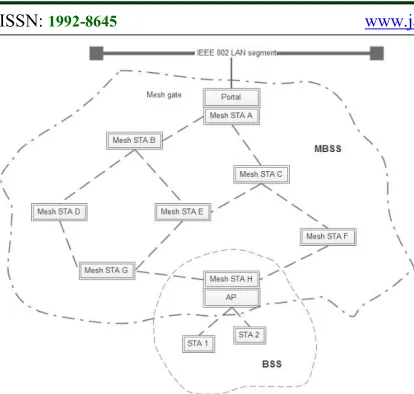
A WMN based IEEE 802.11s is a hybrid mesh network combining the ad hoc and the infrastructure planes [Figure 1]. The former consists of several wireless routers that forward data from and to the infrastructure plane. The later consists of a set of access points interconnecting stations to provide access for end users.
Actually, as shown in Figure 1, IEEE 802.11s define many types of WMN devices:
Stations (STA): which presents any device that have an IEEE 802.11-conformant medium access control (MAC) and physical layer (PHY) interface to the wireless medium (WM).
Access Point (AP): any entity that has station (STA) functionality and provides access to the distribution services (DS), via the WM for its associated STAs.
Mesh Stations (mesh STAs): they are wireless routers that have mesh capabilities. They forward data frames on the behalf of other mesh STAs according to IEEE 802.11s standard. They constitute a wireless mesh BSS (MBSS) among them (referred to as mesh in the following).
ISSN: 1992-8645 www.jatit.org E-ISSN: 1817-3195
Figure 1: Architecture of IEEE 802.11s Based Wireless Mesh Network.
Like any multi-hop wireless network, WMNs suffer strongly from broadcasting operation. Broadcasting aims to propagate a message to reach all network nodes. This can be achieved via flooding that is a network wide broadcasting where some nodes act as relays.
Simple flooding [4, 8] is the trivial way to perform broadcasting over a multi-hop wireless network. It requires from each node receiving the broadcast message for the first time to retransmit it again after a small random period (JITTER).
The simple flooding is costly and can lead to serious problems referred as the broadcast storm problem [17], especially in wireless networks based IEEE 802.11.
Actually, broadcasting by flooding in a wireless network based CSMA/CA brings the drawbacks below:
Contention: after receiving the same broadcast message, some neighbors decide to retransmit it at closed times. Theses transmissions will contend with each other on channel access.
Redundant retransmissions: a node decides to rebroadcast a message to its neighbors while they have already received the message.
Collision: collisions are more likely to occur due to the lack of CTS/RTS dialogue, the absence of collision detection and the deficiency backoff mechanism.
These problems become increasingly likely in an IEEE 802.11s based wireless mesh network. Indeed, flooding is strongly used in routing, particularly by HWPM [6] which is the default path
selection protocol in such network. The network control, routing, and topology maintenance rely heavily on layer-2 broadcasting presenting the backhaul (mesh) as a single broadcast domain that may face a considerable amount of broadcast traffic initiated by many broadcast-based applications of wired networks which are bridged to the mesh via mesh gateways. The address resolution protocol (ARP), the spanning-tree protocol (STP), and Dynamic Host Configuration Protocol (DHCP) are broadcast-based applications examples. Also, the WMN ad hoc and infrastructure planes may share the same channel and overlap their coverage area.
These features result in a considerable augmentation of broadcast traffic which significantly hinders the transmission and routing of unicast data [11] thereby degrading the network performance.
Several studies have been focused on designing broadcasting techniques to mitigate the broadcast storm problem. They were originally modelled for mobile ad hoc networks (MANETs) and must be revised for wireless mesh networks which characterized by low mobility and non-power constraint.
Previous methods delay the retransmission of received broadcast packets for a Random Assessment Delay (RAD) which allow nodes sufficient time to receive redundant packets and ascertain whether a retransmission is needed or not. The RAD may prevent collisions by differentiating time of retransmissions.
Actually, the RAD deployment may cause serious problems in CSMA/CA based wireless networks. The backoff mechanism is triggered whenever contention occurs by delaying randomly the retransmissions. This delay may be added to the RAD resulting on much more delays which may affect the packet runtime cost.
These works neglect saving the routing information. They influence the routing process by forcing the use of non-optimal paths for certain destinations.
Hence, in our approach, namely Control of Broadcast Forwarding (CBF), we addressed these problems by abandoning the RAD deployment and by processing packets according to their types. Data packets are managed differently from routing packets.
ISSN: 1992-8645 www.jatit.org E-ISSN: 1817-3195 comparison with the most suitable flooding
protocols.
The rest of the paper is organized as follows:
Section 2 presents the selected broadcasting techniques for wireless mesh networks. Section 3 introduces CBF approach while section 4 present the simulation model and obtained results. Section 5 concludes this paper.
2. BACKGROUND
2.1 Broadcasting Techniques
As mentioned earlier, the simplest flooding protocol is blind flooding in which each node on receiving a broadcast packet for the first time schedules a retransmission after a random delay. Duplicates are discarded immediately according to packet ID or packet sequence number information element. In a network of n nodes, the scheme costs n retransmissions. Blind flooding achieves better reachability because all nodes participate in the flooding process, however it generates a lot of redundant packets which lead to the broadcast storm problem. Due to its simplicity Blind Flooding is widely deployed in many broadcast-based application and in many unicast routing protocols like AODV [15], DSR [2] and HWMP the default routing protocol for IEEE 802.11s based WMNs.
Several mechanisms were proposed in the past especially for MANETs to mitigate the broadcasting problems. They can be classified into two major classes:
• Schemes involving the use of neighborhood knowledge to prune or rebroadcast the received broadcast message. We distinguish two variants [9] :
o Self-pruning methods where each node decides itself to prune or not the received broadcast packet.
o Dominant pruning methods
where only a subset of nodes will be selected to perform the broadcasting operation.
• Schemes involving rebroadcast delaying to take sufficient time before deciding on filtering or forwarding the broadcast packet. The delay period is called Random Assessment Delay (RAD) in which the receiving node
performs several observations before taking the convenient decision.
Below are listed the most suitable protocols for the broadcasting operation:
In [13], an efficient broadcast dominant pruning protocol for MANETs (AHBP) is defined. The algorithm selects only a subset of nodes, namely Broadcast Relay Gateways (BRGs), which will rebroadcast the flooded packet. The BRGs constitute a connected dominating set and can achieve a high reliability. AHBP reduces significantly the redundant retransmissions and saves the network bandwidth. It can be applied in static networks to provide efficient broadcast service. Wireless mesh networks is then a convenient field for AHBP application.
The authors in [14] defined a self-pruning method called scalable broadcast algorithm (SBA) that uses 2-hop neighborhood knowledge to prune redundant rebroadcasts. The protocol requires 2-hop hello messages exchange to take decision on broadcasting or not the received broadcast packets. Each node, whenever it has uncovered neighbors by the sender transmission, schedules a retransmission after a RAD in which it learns about covered neighbors from received duplicate packets. After RAD expiration, if the receiving node still has uncovered neighbors then the broadcast message will be forwarded otherwise discarded.
Authors in [17] define a probabilistic based scheme named Counter-based scheme protocol (CBB) that uses a counter c keeping track of how much the same broadcast message was received. If the c value exceeds a threshold value C then retransmission of the same message will be cancelled.
Dynamic probabilistic algorithm presented in [22] requires from each node to rebroadcast a flooding packet with a probability P after a random delay RAD. The probability P is adjusted according to the neighboring nodes density and the number of duplicated received broadcast packets.
ISSN: 1992-8645 www.jatit.org E-ISSN: 1817-3195 number redundant packets. However, the only cost
involved is the end to end delay.
Williams and T. Camp in [20] have classified the broadcast techniques into several categories and tried to simulate a subset of each category to pinpoint specific features to network conditions like congestion, mobility and density. The results demonstrate that methods using a random access delay (RAD) for rescheduling the retransmissions suffer from congestive networks. Also, it has been observed that the mobility afflicts the neighbors’ knowledge methods while probabilistic-based algorithms are disturbed by increasing network density.
Thus, protocols based neighborhood knowledge seems to be the most adapted for WMNs due to their lower mobility.
2.2 Related Works
The authors in [10] examined six broadcast algorithms in IEEE 802.11s based WMNs using a real-world testbed. Results reveal that delay-based algorithms are reliable due to their reduced collision probability, while the probabilistic-based algorithms are not because the cumulative probability of retransmission decreases significantly with the scaling. Also, it was estimated that the Dominant Pruning algorithm is best suited for wireless mesh networks because of its run-time gateway selection.
Other studies [1, 12, 16, 21, and 18] were developed on wireless mesh networks but remain divergent from real existing WMN implementations.
3. CBF APPROACH
Our scheme, namely Control of Broadcast Forwarding (CBF), is a self-pruning method requiring 2-hop neighborhood knowledge to achieve decision on retransmitting or filtering (discarding) the received broadcast packet for the first time. Duplicates are discarded immediately according to packet ID.
CBF is a cross layer protocol that manage packets according to their type. Data packet are processed differently from routing ones. The purpose is to save the routing information while reducing redundant messages.
CBF is a straightforward scheme where the forwarding decision is taken on the fly upon the neighborhood information. The CBF explanation is detailed as follows:
CBF uses the following notations and assumptions:
E is the estimated maximum number of uncovered neighbors as demonstrated in [7]. It is a threshold value that will be used to define a node as a center node or not. A center node is one with the most uncovered neighbors by the sender transmission. If a node has a number of uncovered neighbors greater than E then it assumes itself as a center node. Center nodes transmit immediately the received broadcast message after a small customized jitter JT.
E= 0.6 * [number of sender’s neighbors] (1)
JT is the jitter used to differentiate the retransmissions performed by receiving covered nodes. JT ensures that nodes with most uncovered neighbors transmit first. It is a function of D.
D is the node’s degree and it expresses the number of uncovered neighbors by the sender transmission. It pinpoints neighboring nodes which have not yet received the broadcast message initiated by the sender node. D must be greater than E to assume that a node is a center node. Actually,
If D>2 and D>E the node is estimated a center one. Else it is not. In our proposal, a center node must have at least 3 uncovered neighbors.
Sender node is the one that initiates or forwards a broadcast message.
T is the timer used for overhearing an incoming transmission from a neighboring node. Actually,
T = one estimated broadcast message transmission time + extra time related to concurrent transmissions (2)
Thus, on receiving a broadcast packet each node performs the following operations:
It checks the sender neighbors list and compare it with its own. If all of its one hop neighbors are covered by this transmission the packet is then discarded, otherwise it checks the packet type:
If it is a routing packet then the packet is forwarded, else if it is a data broadcast message then:
The receiving node computes its degree D and compare it with the threshold estimation E.
ISSN: 1992-8645 www.jatit.org E-ISSN: 1817-3195 Look for one or a set of center neighboring nodes
that may cover all its immediate uncovered neighbors. If so, then the packet is discarded, otherwise:
It looks for a neighbor, namely A, that may cover its uncovered neighbors. If such node exists then the receiving node sets a timer T according to the estimated transmission time of the received broadcast message. Within the T period if the receiving node overhears a transmission from A it will then discard the message otherwise the packet is rebroadcasted.
CBF assumes that nodes which have the more uncovered neighbors transmit first.
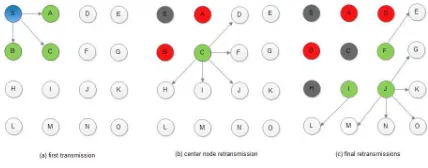
[image:5.612.88.302.410.494.2]An example of CBF operation is shown in [Figure 2]:
In this example, the mesh STA S broadcasts a message that will be received by its immediate neighbors A, B and C.
We assume here that nodes can only reach their closed neighbors.
On checking the sender’s neighbors list, A, B and C will know about the existence of uncovered neighbors by S transmission.
Figure 2: Example of CBF Operation
The uncovered neighbors of B are nodes {H, I}, so its degree is 2.
The uncovered neighbors of A are nodes {D, F}, so its degree is 2.
The uncovered neighbors of C are nodes {D, F, J, I, and H}, so its degree is 5.
S has 3 neighbors so the estimated threshold value is E= 0.6*3=1.8.
C’s degree is 5 which is greater than 2 and E. So, C is a center node and its retransmission will cover uncovered neighbors of both A and B. Thus, C will rebroadcast the message while A and B will discard it.
After C’s transmission, nodes D, F, J, I and H will receive the message. The E value become:
E= 0.6*8=4.8. Since C has 8 neighbors.
Node J is center node with D=5 which is greater than E. it will retransmit the message after a jitter JT. F will also retransmit the message until it is not a center node and its uncovered neighbors E, G and K may not be covered by one of its covered neighbors A, D, I or J.
Node D will find that a covered node F can cover its uncovered neighbors E and G. Thus, it will set a timer T and wait for a transmission from F. if it overhears such transmission it will then discard the packet.
Same thing as F which will perform a rebroadcast to reach L and achieve CBF wide broadcasting.
In this example, 4 retransmissions were required to achieve the broadcasting operation in a network sized of 16 nodes. In comparison with Blind Flooding scheme there is a reduction of 11 unnecessary retransmissions.
According to our differentiating scheme, after C’s retransmission, J will transmit first followed in a correlated times by nodes F and I.
4. SIMULATIONS AND RESULTS
We selected AHBP and PFS to evaluate CBF. The protocols listed above are neighborhood knowledge and more adapted to be applied in IEEE 802.11s based WMNs.
4.1 Simulation Model
We used NS2 [3] (version 2.34) to simulate and evaluate the broadcasting protocols.
A MAC layer compliant IEEE 802.11g is chosen. RTS/CTS/ACK exchange was disabled since we are concerned only by broadcast packets.
Nodes were placed randomly in a flat area of 1500m*500m to demonstrate that CBF is not topology dependent.
Flooded packets were sized of 64 bytes payload.
The hello interval is 1.2s for all the studied protocols.
Every second a set of node is chosen randomly to flood broadcast packets. The set determines the simulation flooding rate.
The table [Table 1] summaries the common simulation parameters used in all simulations.
ISSN: 1992-8645 www.jatit.org E-ISSN: 1817-3195 Reachability: which determines the delivery
ratio of a flooding message. For example if we have a network sized of 30 nodes and a node flooded a message then if the flooded message was received by only 20 nodes the reachability becomes 20/29, so 68,96%. A relibale broadcasting protocol must achieve 100% of reachability.
Average End to End Delay: it is the period between the time the source node sends a flooding message until its reception by the last node in the network.
Overhead: pinpoints the amount of sent bytes by all nodes together per flooding.
[image:6.612.314.521.70.279.2]Saved rebroadcast: which means the average number of retransmitting nodes per flooding.
Table 1:Common Simulations Parameters
MAC layer IEEE 802.11g
Transmission rate 54Mb
Basic rate 10Mb
Flooding message payload 64bytes
Hello interval 1.2s
Transmission range 300m
Simulation time 100s
4.2 Scalability Scenario
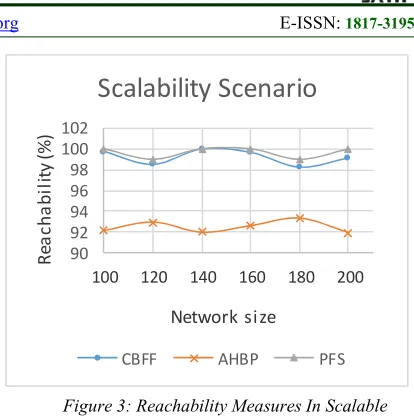
In this scenario, we vary the network size from 100 nodes to 200 nodes. The flooding rate was fixed to 2 packets/s and the nodes were static. The obtained simulation results are illustrated below:
90 92 94 96 98 100 102
100 120 140 160 180 200
R
e
a
c
h
a
b
il
it
y
(
%
)
Network si ze
Scalability Scenario
[image:6.612.85.304.303.489.2]CBFF AHBP PFS
Figure 3: Reachability Measures In Scalable Networks
ISSN: 1992-8645 www.jatit.org E-ISSN: 1817-3195
0 0,002 0,004 0,006 0,008 0,01
100 120 140 160 180 200 220
A
v
e
ra
g
e
E
n
d
t
o
E
n
d
D
e
la
y
(
s
)
Network size
Scalability Scenario
[image:7.612.96.324.71.278.2]CBFF AHBP PFS
Figure 4: Average End to End Delay Measures In Scalable Networks
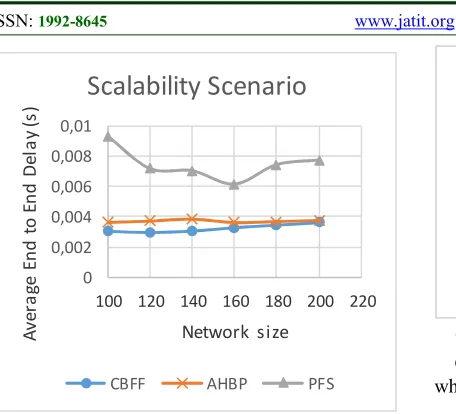
[image:7.612.131.523.73.250.2]The average end to end delay [Figure 4] is much improved by CBF. Actually, CBF can take retransmission decision very fast without a RAD as well as AHBP. PFS provides higher delays than both AHBP and PFS. The PFS’s RAD is deterministic but remains very costly. AHBP, also provides small end to end delays, slightly higher than CBF. The reason is the AHBP’s JITTER which is a fixed value. In CBF, the jitter is function of uncovered neighbors of the receiving node which allow center nodes to retransmit faster than others and then to achieve decreased delays.
Figure 5: Number Of Retransmitting Nodes In Scalable Networks
[image:7.612.315.523.433.623.2]As shown in figure 5, CBF and AHBP generate higher overhead due exactly to 2-hop hello messages and the number of retransmitting nodes. In return, PFS achieves less overhead due to its deployment of one hop hello message exchange operation. Smaller packets are then expected to be broadcasted in comparison between CBF and AHBP.
Figure 6: Overhead Measures In Scalable Networks
CBF generates more retransmissions than AHBP which affect the overhead [Figure 6].
The number of retransmissions is much larger in the case of PFS because of the inaccurate neighborhood information due to collisions which leads to the generation of more retransmissions.
Obviously, the end to end delay, the overhead and the number of retransmissions increase with scaling. The reachability is kept uniform.
4.3 Congestion Scenario
In this simulations, we vary the flooding rate from 3 packets/s to 30 packets/s. the network size was fixed to 100 static nodes.
Figure 7: Reahability Measures In Congested Networks
[image:7.612.92.296.463.611.2]ISSN: 1992-8645 www.jatit.org E-ISSN: 1817-3195 packets loss and then a reduced reachability. The
reason why PFS performs better is the less overhead it generates in comparison with CBF and AHBP.
[image:8.612.309.524.90.274.2]CBF achieves acceptable reachability closed to that of PFS. The reason is that CBF as PFS are not affected by collisions. Collisions are managed at MAC layer according to the IEEE 802.11 standard and using a JITTER differentiating the closed transmissions according to nodes degrees.
Figure 8: Average End To End Delay Measures In Congested Networks
As illustrated in Figure 8, PFS shows an increased average end to end delay in comparison with CBF and AHBP which demonstrate good delays.
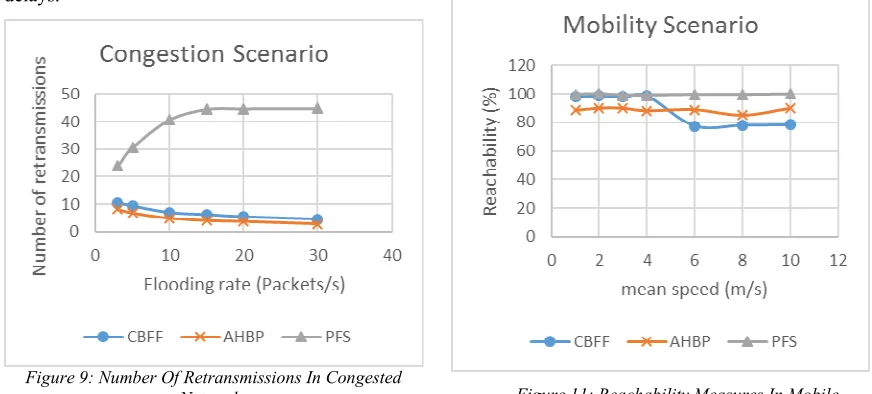
Figure 9: Number Of Retransmissions In Congested Networks
The number of transmitting node is much more reduced by CBF and AHBP in comparison with PFS. Even the number of retransmitting nodes is great, the PFS’s overhead is minimum in comparison with AHBP and CBF. This is because
[image:8.612.89.302.210.388.2]PFS deploys small hello messages [Figures 9 and 10].
Figure 10: Overhead Measures In Congested Networks
4.4 Mobility Scenario
Mobility is not a critical constraint in WMN based IEEE 802.11s. However, we perform the simulations in such environment to pinpoint CBF limits and to meet the future challenges.
In this scenario, we used the Random Waypoint mobility model and we vary the mean speed of each node from 1m/s to 10m/s. Values over 10m/s are expected to reflect mobility for VANETs which is not our purpose. The networks size was 100 nodes and the flooding rate was fixed to 2 packets/s.
[image:8.612.88.524.449.646.2] [image:8.612.93.322.458.650.2]ISSN: 1992-8645 www.jatit.org E-ISSN: 1817-3195
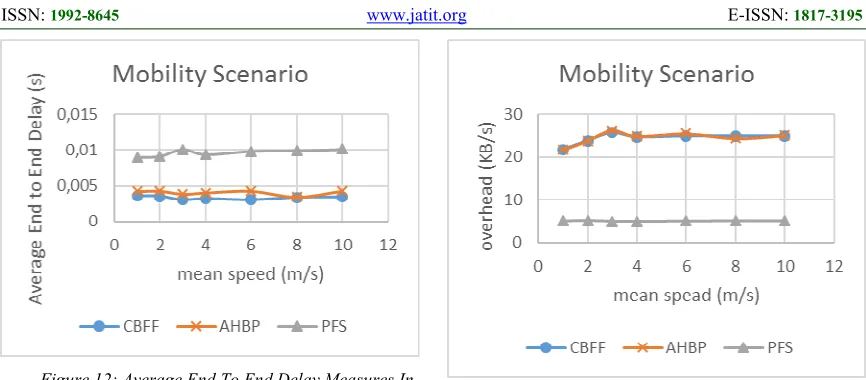
Figure 12: Average End To End Delay Measures In Mobile Networks
In figure 11, we observe that CBF performs good reachability when mobility is low till the mean speed of 4m/s. however, when the speed increases the CBF’s reachability decreases significantly. PFS shows uniform and high delivery ratio even the speeds become fast. AHBP also keeps a good reachability with mobility. Actually, the rapid change of topology influence the good decision of considering a node as a center or not.
Obviously, this may lead to increased overhead and less saved rebroadcast [Figures 13 and 14].
[image:9.612.88.302.472.641.2]Figure 12 illustrates the good average end to end delay provided by both CBF and AHBP. PFS also performs an acceptable delay.
Figure 13: Number Of Retransmissions In Mobile Networks
Figure 14: Overhead Measures In Mobile Networks
5. CONCLUSION
In this paper, we have introduced an enhanced method to control the broadcast flooding in wireless mesh networks based IEEE 802.11s. Our scheme, namely CBF, is a self-pruning method that aims to achieve network wide broadcasting while reducing redundant packets. We performed several simulations in various environments to valid our approach in comparison with some of the most suitable protocols for wireless mesh networks, namely, AHBP and PFS. The results show that CBF may compete with them. Actually, CBF performs well in both static and congested networks. It shows good reachability and average end to end delay in comparison with PFS and AHBP. A slightly increased overhead and number of retransmitting nodes is the cost involved by our approach. CBF can be a good solution to deal with broadcast traffic that requires small delays like video streaming for example. PFS is better in almost all scenarios but it induces high delays which is unacceptable for real time flows.
In a network with low mobility, which is the case of IEEE 802.11s networks, CBF achieves good performances.
Future works target the deployment of a framework that will combine between CBF and various broadcasting methods to deal accordingly with various types of flows.
REFRENCES:
[1] C.T. Chou, A. Misra, J. Qadir, Low-latency broadcast in multirate wireless mesh networks, IEEE Journal on Selected Areas in Communications 24 (2006) 2081–2091. [2] B. J. David, A. M David, "Dynamic Source
ISSN: 1992-8645 www.jatit.org E-ISSN: 1817-3195 chapter 5, pages 153–181. Kluwer Academic
Publishers, 1996.
[3] K. Fall, K. Varadhan. "The NS Manual ″. Vint Project, UC Berkeley, LBL, DARPA, USC/ISI, and Xerox PARC. April 14, 2002.
[4] C. Ho, K. Obraczka, G. Tsudik, K. Viswanath, Flooding for reliable multicast in multihop ad hoc networks, in: Proceedings of the International Workshop on Discrete Algorithms and Methods for Mobile Computing and Communications (DIALM), ACM, 1999, pp. 64–71.
[5] IEEE 802.11 Standard Working Group, Draft Standard for Information Technology – Telecommunications and Information Exchange Between Systems – LAN/MAN Specific requirements Part 11: Wireless LAN Medium Access Control (MAC) and Physical Layer (PHY) Specifications, IEEE P802.11-REVma/D9.0, January 2007.
[6] IEEE 802.11s Task Group HWMP Specification doc.: IEEE 802.11-06/1778r1 November 2006.
[7] M. Jacobsson, C. Guo, I.G.M.M. Niemegeers, A flooding protocol for manets with self-pruning and priorited retransmissions, in: International Workshop on Localized Communication and Topology Protocols for Ad hoc Networks (LOCAN), Washington DC, USA, 2005.
[8] J. Jetcheva, Y. Hu, D. Maltz and D. Johnson. A Simple Protocol for Multicast and Broadcast in Mobile Ad hoc Networks. Internet Draft, draft- ietf-manet-simple-mbcast-01.txt, 2001.
[9] H. Lim and C. Kim, Flooding for Wireless Ad-Hoc Networks, in Computer Communications vol. 24, no. 3-4, pp. 353-363, 2011.
[10]Ying-Dar Lin, Shun-Lee Chang, Shi-Hung Tao, Jui-Hung Yeh: Realizing and benchmarking broadcast algorithms in wireless mesh networks. Computer Communications 34(10): 1169-1181 (2011).
[11]W. Lou, J. Wu, Toward broadcast reliability in mobile ad hoc networks with double coverage, IEEE Transactions on Mobile Computing 6 (2007) 148–163.
[12]H.L. Nguyen, U.T. Nguyen, Minimum interference channel assignment for multicast in multi-radio wireless mesh networks, in: Proceedings of International Wireless Communications and Mobile Computing Conference (IWCMC ’08), 2008, pp. 626–631.
[13]Wei Peng, Xicheng Lu, Ahbp: An efficient broadcast protocol for mobile ad hoc networks, Journal of Science and Technology - Beijing, China, 2002.
[14]Wei Peng, Xi-Cheng Wu, On the reduction of broadcast redundancy in mobile ad hoc networks, In The Sixth Annual International Conference on Mobile Computing and Networking (MobiCom 2000), Boston, USA, August 6-11, 2000.
[15]C.E. Perkins, E.M. Belding-Royer, S.R. Das, Ad hoc on-demand distance vector (aodv) routing, IETF RFC3561, July 2003.
[16]M. Song, J.Wang, Q. Hao, Broadcasting protocols for multi-radio multichannel and multi-rate mesh networks, in: Proceedings of the IEEE International Conference on Communications (ICC ’07), 2007, pp. 3604– 3609.
[17]Y.-C. Tseng, S.-Y. Ni, Y.-S. Chen, J.-P. Sheu, The broadcast storm problem in a mobile ad hoc network, Wireless Networks 8 (2/3) (2002) 153–167.
[18]T.Wang, X. Du,W. Cheng, Z. Yang,W. Liu, A fast broadcast tree construction in multi-rate wireless mesh networks, in: Proceedings of the IEEE International Conference on Communications (ICC ’07), 2007, pp. 1722– 1727.
[19]X. Wang and A.O. Lim, IEEE 802.11s wireless mesh networks: Framework and challenges, Ad Hoc Networks 6 (2008) 970– 984.
[20]Brad Williams, Tracy Camp, Comparison of broadcasting techniques for mobile ad hoc networks, In The Third ACM International Symposium on Mobile Ad Hoc Networking and Computing (MobiHoc 2002), Lausanne, Switzerland, June 9-11, 2002.
[21]Q. Xin, Y. Zhang, Optimal fault-tolerant broadcasting in wireless mesh networks, in: Proceedings of the International Conference on High Performance Switching and Routing (HSPR), IEEE Press, 2008, pp. 151–157. [22]Q. Zhang, D.P. Agrawal, Dynamic
ISSN: 1992-8645 www.jatit.org E-ISSN: 1817-3195 [23]Saadi, Y.; Nassereddine, B.; Bennani, S.;
Maach, A., "An adaptive approach to control broadcast traffic in wireless mesh networks based IEEE 802.11s," Complex Systems (ICCS), 2012 International Conference on , vol., no., pp.1,7, 5-6 Nov. 2012 doi: 10.1109/ICoCS.2012.6458512
[24]Saadi, Y.; Nassereddine, B.; Haqiq, A., "CBF evaluation through simulation," Next Generation Networks and Services (NGNS), 2014 Fifth International Conference on , vol., no., pp.182,186, 28-30 May 2014 doi: 10.1109/NGNS.2014.6990250