ISSN: 1992-8645 www.jatit.org E-ISSN: 1817-3195
196
AN EFFICIENT HYBRID TREE BASED ROUTING
ALGORITHM FOR AD-HOC NETWORK
KADAMBRI AGARWAL1, SACHIN KUMAR2, A.K. SHARMA3
1
Research Scholar, UTU Dehradun, India
2
Ajay Kumar Garg Engineering College Ghaziabad, India
3
Ex Professor, YMCA Faridabad, India
ABSTRACT
Ad-hoc network can be outlined as network with none infrastructure. Route discovery is nice concern in Ad-hoc Network as topology changes dynamically. Several routing algorithmic rule exists in literature, which might be classified as Proactive, Reactive and Hybrid. Proactive algorithms ceaselessly notice the route e.g. OLSR. Reactive (on demand) solely notice the route once demanded e.g. AODV, DSR, DSDV. Hybrid uses the options of each proactive and reactive e.g. ZRP. We propose hybrid approach that shows best result among in the class.
Keywords: Ad-hoc Network, AODV, DSDV, DSR, Throughput
1. INTRODUCTION:
An ad-hoc network is represented as native space Network that is assembled as quick because the devices connect. Ad-hoc network doesn't accept base station to manage the flow of messages to each node within the network. The nodes of individual network advancing information packets to and from one another. Ad-hoc may be a mode of communication that allows machines to speak directly while not router with one another.
An effective routing algorithmic program is needed from source to destination deliver.
Following classification of routing algorithmic program is recommended.
Proactive Routing:
The approach utilized in proactive routing is distance vector routing. It works on maintain the tables of Routing with messages update as in an exceedingly fixes nodes. If there is a low modification in topology, it reflects to heap of updates once there is no communication.
Reactive Routing:
This approach works on the idea of flooding, once a node receives any message initial time, it forwards this message to any or all the neighbor nodes and there is a flooding of information in whole network.
Hybrid Routing:
This algorithmic program uses the mixture of proactive and reactive algorithmic program. We have a tendency to propose work in this class.
2. RELATED WORK
ISSN: 1992-8645 www.jatit.org E-ISSN: 1817-3195
197 Many researchers analyze the various routing protocols [1,2,3,4,5,6,7] for MANETs environments by various experiments. Their work is to compare the protocol of AODV routing with various approaches with different parameters and various scenarios of network to find out the efficient behavior of all these protocols. On the other hand, they concentrated on simulation aspects. The results of their findings or investigations show that AODV routing is much suitable for MANETs dynamic environment. They also founds the disadvantages of AODV routing as overheads is high, in large network it consumes high energy and many of these protocols uses process of flooding which results the requirement of modification. To overcome the problem and to cut down the ratio of energy consumption of network and to enhance the stability of link under MANETs high dynamic environment author comes with the EEAODR which is routing algorithm of energy efficient on demand. The proposed methodology upgrades the working systems of traditional AODV steering plan and paying consideration on keep up parity energy load among network hubs to expands the stability of network. In same modifying so as to bear the technique of establishment of route of existing AODV directing protocol, a novel vitality effective directing methodology has introduced.
In [8], authors have presented another changed adaptation of ordinary AODV steering convention, name as EAODV. The expected methodology gets the QOS of constant VoIP in remote specially appointed systems by expending the unexploited a portion of system. The reproduced results have demonstrated the effectiveness of EAODV convention over the approach of traditional routing. In same bearing to enhance the execution of customary AODV routing protocol, crisp methodology has been proposed in [9], named A-SAODV (Adaptive A-SAODV). The methodology tunes the conduct of SAODV by counting separating systems. In [10], authors have proposed a neighbor trust based upgraded directing calculation to improve the recitation of steering in environment of MANETs. The methodology changed the course ask for bundle of ordinary AODV adding so as to steer an additional field which stores neighbor trust esteem. For the broadcasting of packet, proposed methodology has utilized the most extreme trust estimation of neighbor, accordingly it not just keep the hub's energy by pass up avoidable broadcast control data additionally improve the steering recitation regarding data transfer capacity (utilization of
channel), which is vital if there should be an occurrence of MANET. A few of different methodologies [11-13] have too proposed in course to trim down the issues of routing in MANETs. On the other hand, subsequent to the time of systems there are different studies and inquires about held in endeavor to propose more productive routing protocols and they improve the directing recitation on the base of distinctive parameters however the greater part of the past work manages the issue of discovering and keeping up right courses to the destination amid versatility and evolving topology. Furthermore, major of proposed methodologies has spine steering way that builds the overhead and expend more data transfer capacity and hubs power in correspondence, diverse terrains pose separate difficulties to routing in high element environment of MANETs. In MANETs the Issues of available directing conventions can be speak to in point as
• The available routing protocols are successful just at the point when population of node is small.
• The proactive steering conventions will be overpowered by the fast topology changes and even neglect to join amid the directing data trade stage
• Algorithms of reactive routing are fail to find a complete path because of frequent partion of network.
3. PROPOSED PROTOCOL
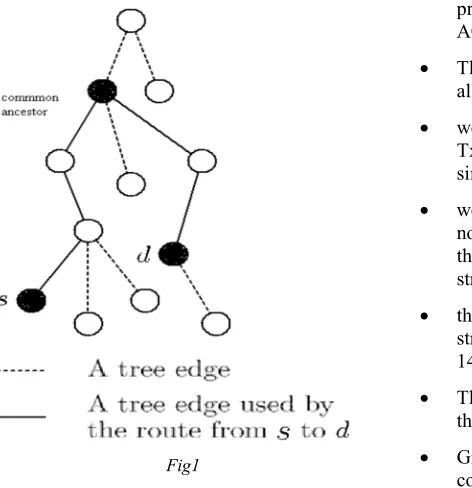
In this paper, we have a tendency to investigate the economical root between source (s) and destination (d) whenever the spanning tree exists between all mobile nodes of hybrid network. The projected approach is heuristic to work out the trail between s and d. every node is maintaining the list of its antecedent and descendent to implement heuristic explore for route discovery.
ISSN: 1992-8645 www.jatit.org E-ISSN: 1817-3195
198 • Once a tree is constructed, it doesn't waste any
messages on path looking.
• The protocol avoids flooding the complete network
• The quantity of efforts to seek out a path between 2 nodes depends on its quality
• The length of the routing path between any 2 nodes p and Q monotonically improves with its utilization. If the trail is employed typically enough
Note that the price of finding such route on a tree edges is comparatively tiny. the quantity of messages sent is linear with the length of path. As we all know from our empirical study, once a path is simply used little range of times, spanning tree involves a way smaller communication overhead than DSR. However, because the frequency of exploitation the trail will increase DSR becomes higher. This may be explained by the very fact that DSR pays a high worth for locating the shortest path between a supply s and destination d, despite the frequency within which the trail are going to be used. But once this path is found, all messages between all messages between s and d routed on this path, whose value is bottom .On the opposite hand, Spanning tree spends little or no overhead on finding route ways. Thus, DSR has Associate in Nursing initial high value and a little gradual value, whereas spanning tree features a zero initial value and a high gradual value.
Fig1
4. SIMULATION RESULTS
[image:3.612.103.339.483.727.2]A. No. of Nodes Vs Throughput
Fig 2: No of Nodes Vs Throughput
It is outlined because the total variety of packets delivered over the overall simulation time. The turnout comparison shows that the 3 algorithms performance margins area unit terribly shut underneath traffic load of fifty and a hundred nodes in Manet situation and have massive margins once variety of nodes will increase to a hundred. Mathematically,it may be outlined as:
Throughput=N/1000, Where N is that the variety of bits received with success by all destinations.
• This graph indicates the turnout values for various variety of nodes.
• we tend to area unit scrutiny the projected protocol HTBRP with the present protocol AODV, DSR and DSDV
• The turnout outcome is nice once compare with all different protocol
• we tend to obtained the transmission vary of TxRange and also the carrier-sensing vary by similar approaches.
• we tend to mounted the routing table of every node and set the gap between serial nodes with the assistance of Tree primarily based structure.
• the information sources area unit UDP traffic streams with mounted packet size of 1460bytes.
• The simulation throughputs match closely with the experimental measure
ISSN: 1992-8645 www.jatit.org E-ISSN: 1817-3195
199
[image:4.612.168.509.67.309.2]B. No of nodes Vs Delay
Fig 3: No of Nodes Vs Delay
The average time it takes an information packet to succeed in the destination. This includes all potential delays caused by buffering, throughout, route discovery latency, queuing at the interface queue. This metric is calculated by subtracting time at that initial packet was transmitted by supply from time at that initial information packet arrived to destination. Mathematically, it will be outlined as:
Avg. EED=S/N
Where S is that the add of the time spent to deliver packets for every destination, and N is that the range of packets received by the all destination nodes.
• This graph indicates the Delay values for various ranges of nodes.
• we have a tendency to area unit examination the planned protocol HTBRP with the prevailing protocol AODV, DSR and DSDV
• The Delay outcome is nice once compare with all different protocol
• We have a tendency to live the result of modification in range of nodes on packet delay.
• Every experiment is dead for 10ms.
• Delay from initial transmission of packet from supply till packet is received at destination.
• We are able to speculate that the rationale is within the indisputable fact that tiny frame size leads to larger range of frames, that successively leads to additional dequeue tries and additional collisions and backoffs.
• Tree based mostly Structure is employed to scale back the delay with avoiding the waiting time
• Graph demonstrates the on top of purpose by activity pure network delay (which excludes delay at the buffer).
• The buffer delay is that the major think about inflicting packet delay, whereas network delay is that the minor issue.
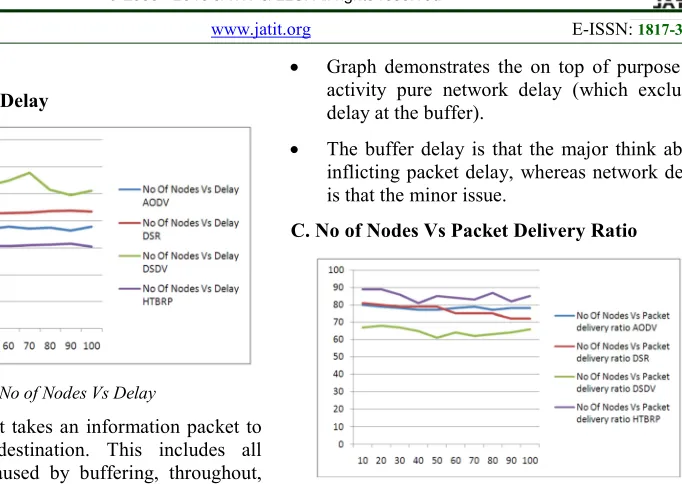
C. No of Nodes Vs Packet Delivery Ratio
Fig 4 : No of Nodes Vs Packet delivery Ratio
Packet delivery ratio is outlined because the ratio of information packets received by the destinations to those generated by the sources. Mathematically, it is often outlined as:
PDR= S1÷ S2
Where, S1 is that the add of information packets received by the every destination and S2 is that the add of information packets generated by the every source.
• This graph indicates the PDR values for various ranges of nodes.
• we tend to ar comparison the projected protocol HTBRP with the prevailing protocol AODV, DSR and DSDV
• The PDR outcome is nice once compare with all alternative protocol
• Graphs show the fraction of information packets that ar with success delivered throughout simulations time versus the amount of nodes.
• Performance of the DSDV is reducing frequently whereas the PDR is increasing within the case of DSR and AODV.
• HTBRP is best among the 3 protocols.
ISSN: 1992-8645 www.jatit.org E-ISSN: 1817-3195
200
Fig 5: Number of nodes Vs Energy Consumption
We formulate the matter of Energy in an exceedingly mobile unintended network as a rate distortion problem and supply the energy as perform of the quality parameters. During this paper, we have a tendency to specialize in the routing table length that every node needs to maintain.
Basic energy in an exceedingly network would be to point the supply and destination address in an exceedingly packet. For a network of n nodes this could scale like O(log(n)) bits per packet, and this energy can not be avoided. Thus, every packet encompasses a supply range and a destination range that is enclosed in it.
• This graph indicates the energy consumption values for various ranges of nodes.
• We have a tendency to square measure scrutiny the planned protocol HTBRP with the present protocol AODV, DSR and DSDV
• The Energy consumption outcome is sweet once compare with all alternative protocol
• We have well-tried that the energy scaling which will be achieved by an advert hoc network depends critically on the per-node routing info. We offer a certain trade off between the per-node routing table size and the per-node overhead as a perform of the supply destination distance. we have a tendency to additionally give a theme that achieves this trade off.
E. Time Vs Throughput
Fig 6 Time Vs Throughput
• Throughput (output) of network is that the average rate of palmy message delivery over a line.
• This information could also be delivered over a physical or logical link, or suffer an explicit network node. The output is typically measured in bits per second (bit/s or bps), and generally in information packets per second or information packets per interval.
• The system output or combination output is that the add of the info rates that area unit delivered to all or any terminals in a very network.
• The output will be analyzed mathematically by suggests that of queuing theory, wherever the load in packets per quantity is denoted arrival rate λ, and therefore the output in packets per quantity is denoted departure rate μ.
• output is basically similar to digital information measure consumption.
• This graph indicates the output values for various times.
• we have a tendency to area unit scrutiny the planned protocol HTBRP with the prevailing protocol AODV, DSR and DSDV
ISSN: 1992-8645 www.jatit.org E-ISSN: 1817-3195
201
F. Time Vs Delay
Fig 7 Time Vs Delay
This is the average time delay for knowledge packets from the supply node to the destination node. to search out out the end-to-end delay the distinction of packet sent and received time was hold on then dividing the entire time distinction over the entire range of packet received gave the typical end-to-end delay for the received packets. The performance is best once packet end-to-end delay is low.
• This graph indicates the Delay values for various times.
• we tend to ar examination the projected protocol HTBRP with the present protocol AODV, DSR and DSDV
• The Delay outcome is sweet once compare with all alternative protocol
• we tend to live the impact of amendment in range of nodes on packet delay.
• every experiment is dead for 10ms.
• Delay from initial transmission of packet from supply till packet is received at destination.
• we are able to speculate that the explanation is within the proven fact that little frame size ends up in larger range of frames, that
successively ends up in a lot of dequeue makes an attempt and a lot of collisions and backoffs.
• Tree primarily based
F. Time Vs Packet Delivery Ratio
Fig 8 Time Vs Packet Delivery Ratio
• This graph indicates the PDR values for various times.
• We have a tendency to square measure comparison the planned protocol HTBRP with the prevailing protocol AODV, DSR and DSDV
• The PDR outcome is high once compare with all alternative protocol
• Graphs show the fraction of knowledge packets that square measure with success delivered throughout simulations time versus the time.
• Performance of the DSDV is reducing frequently whereas the PDR is increasing within the case of DSR and AODV.
G. Time Vs Energy Consumption
Fig 9 Time Vs Energy Consumption
• This graph indicates the energy consumption values for various times.
• We have a tendency to ar examination the projected protocol HTBRP with the present protocol AODV, DSR and DSDV
ISSN: 1992-8645 www.jatit.org E-ISSN: 1817-3195
202
5. CONCLUSION
In proposed Protocol HTBRP, we tend to investigate the economical root between s and d whenever the spanning tree exists between all mobile nodes of hybrid network. The proposed approach is intelligent i.e. heuristic approach to work out path between s and d. To implement heuristic hunt for route discovery every node is maintaining the list of its antecedent and descendent. Results of our propose approach square measure compared with AODV, DSR and DSDV. It shows our approach is better than from these 3.
REFERENCES:
[1] Eman S. Alwadiyeh, Ala’ F A Aburumman “ Interference-Aware Multipath Routing Protocols For Mobile Ad Hoc Networks” 13th Annual IEEE Workshop on Wireless Local Networks, 2013.
[2] MENG Limin, SONG Wenbo* “Routing Protocol Based on Grover’s Searching Algorithm for Mobile Ad-hoc Networks” Network Technology And Application, China Communications , March 2013
[3] Wei-Liang Shen, Chung-Shiuan Chen “Autonomous Mobile Mesh Networks” IEEE Transactions On Mobile Computing, Vol. 13, No. 2, February 2014.
[4] Wei Liu and Ming Yu “AASR: Authenticated Anonymous Secure Routing for MANETs in Adversarial Environments” IEEE Transactions On Vehicular Technology, Vol. 63, No. 9, November 2014.
[5] B. Ramakrishnan, Dr. R. S. Rajesh, R. S. Shaji “CBVANET: A Cluster Based Vehicular Adhoc Network Model for Simple Highway Communication” Int. J. Advanced Networking and Applications Volume: 02, Issue: 04, Pages: 755-761 (2011)
[6] Mohammad Al-Rabayah and Robert Malaney “A New Scalable Hybrid Routing Protocol for VANETs” IEEE Transactions on Vehicular Technology, Vol. 61, No. 6, July 2012
[7] Parul Aggarwal, Himanshu Aggarwal “ Comparative Analysis of Routing Protocols in Mobile Ad-Hoc Networks (MANETs)” International Journal of Computer Applications (0975 – 8887) Volume 95– No.4, June 2014 [8] HuiYao Zhang, Marek E. Bialkowski “An
Extended AODV Protocol for VoIP Application in Mobile Ad Hoc Network” ECTI Transactions on Electrical Eng., Electronics,
and Communications Vol.7, No.2 August 2009.
[9] Alekha Kumar Mishra, Bibhu Dutta Sahoo “A Modified Adaptive-Saodv Prototype For Performance Enhancement in MANET”, International Journal of Computer Applications in Engineering, Technology and Sciences, Volume 1 : Issue 2 April – September 2009, Page: 443-447
[10] S.Neelakandan, J.Gokul Anand “Trust Based Optimal Routing in MANET's”, Proceedings of IEEE conference ICETECT, September 2011 [11] Scott Linfoot, Haitham Y. Adarbah, Bassel
Arafeh, and Alistair Duffy “Impact of Physical and Virtual Carrier Sensing on the Route Discovery Mechanism in Noisy MANETs” IEEE Transactions on Consumer Electronics, Vol. 59, No. 3, August 2013
[12] LI Xut, LIU Tianjiaot, LIU Yingt, TANG Van “Optimized Multicast Routing Algorithm Based on Tree Structure in MANETs” Network Technology and Applications, China Communications· February 2014