WRL
Technical Note TN-14
Improving
Direct-Mapped Cache
Perfor-mance by the Addition
of a Small
Fully-Associative Cache and
Prefetch Buffers
was founded by Digital Equipment Corporation in 1982. Our focus is computer science research relevant to the design and application of high performance scientific computers. We test our ideas by designing, building, and using real systems. The systems we build are research prototypes; they are not intended to become products.
There is a second research laboratory located in Palo Alto, the Systems Research Cen-ter (SRC). Other Digital research groups are located in Paris (PRL) and in Cambridge, Massachusetts (CRL).
Our research is directed towards mainstream high-performance computer systems. Our prototypes are intended to foreshadow the future computing environments used by many Digital customers. The long-term goal of WRL is to aid and accelerate the development of high-performance uni- and multi-processors. The research projects within WRL will address various aspects of high-performance computing.
We believe that significant advances in computer systems do not come from any single technological advance. Technologies, both hardware and software, do not all advance at the same pace. System design is the art of composing systems which use each level of technology in an appropriate balance. A major advance in overall system performance will require reexamination of all aspects of the system.
We do work in the design, fabrication and packaging of hardware; language processing and scaling issues in system software design; and the exploration of new applications areas that are opening up with the advent of higher performance systems. Researchers at WRL cooperate closely and move freely among the various levels of system design. This allows us to explore a wide range of tradeoffs to meet system goals.
We publish the results of our work in a variety of journals, conferences, research reports, and technical notes. This document is a technical note. We use this form for rapid distribution of technical material. Usually this represents research in progress. Research reports are normally accounts of completed research and may include material from earlier technical notes.
Research reports and technical notes may be ordered from us. You may mail your order to:
Technical Report Distribution DEC Western Research Laboratory, WRL-2 250 University Avenue Palo Alto, California 94301 USA
Reports and notes may also be ordered by electronic mail. Use one of the following addresses:
Digital E-net: JOVE::WRL-TECHREPORTS
Internet: [email protected]
UUCP: decpa!wrl-techreports
the Addition of a Small Fully-Associative Cache
and Prefetch Buffers
Norman P. Jouppi
March, 1990
Projections of computer technology forecast processors with peak perfor-mance of 1,000 MIPS in the relatively near future. These processors could easily lose half or more of their performance in the memory hierarchy if the hierarchy design is based on conventional caching techniques. This paper presents hardware techniques to improve the performance of caches.
Miss caching places a small fully-associative cache between a cache and its
refill path. Misses in the cache that hit in the miss cache have only a one cycle miss penalty, as opposed to a many cycle miss penalty without the miss cache. Small miss caches of 2 to 5 entries are shown to be very effective in removing mapping conflict misses in first-level direct-mapped caches.
Victim caching is an improvement to miss caching that loads the small
fully-associative cache with the victim of a miss and not the requested line. Small victim caches of 1 to 5 entries are even more effective at removing con-flict misses than miss caching.
Stream buffers prefetch cache lines starting at a cache miss address. The
prefetched data is placed in the buffer and not in the cache. Stream buffers are useful in removing capacity and compulsory cache misses, as well as some instruction cache conflict misses. Stream buffers are more effective than previously investigated prefetch techniques at using the next slower level in the memory hierarchy when it is pipelined. An extension to the basic stream buffer, called multi-way stream buffers, is introduced. Multi-way stream buffers are useful for prefetching along multiple intertwined data ref-erence streams.
Together, victim caches and stream buffers reduce the miss rate of the first level in the cache hierarchy by a factor of two to three on a set of six large benchmarks.
performance of advanced processors. Table 1 lists some cache miss times and the effect of a miss on machine performance. Over the last decade, cycle time has been decreasing much faster than main memory access time. The average number of machine cycles per instruction has also been decreasing dramatically, especially when the transition from CISC machines to RISC machines is included. These two effects are multiplicative and result in tremendous increases in miss cost. For example, a cache miss on a VAX 11/780 only costs 60% of the average instruc-tion execuinstruc-tion. Thus even if every instrucinstruc-tion had a cache miss, the machine performance would slow down by only 60%! However, if a RISC machine like the WRL Titan [11] has a miss, the cost is almost ten instruction times. Moreover, these trends seem to be continuing, especially the increasing ratio of memory access time to machine cycle time. In the future a cache miss all the way to main memory on a superscalar machine executing two instructions per cycle could cost well over 100 instruction times! Even with careful application of well-known cache design tech-niques, machines with main memory latencies of over 100 instruction times can easily lose over half of their potential performance to the memory hierarchy. This makes both hardware and software research on advanced memory hierarchies increasingly important.
Machine cycles cycle mem miss miss
per time time cost cost
instr (ns) (ns) (cycles) (instr)
---VAX11/780 10.0 200 1200 6 .6
WRL Titan 1.4 45 540 12 8.6
? 0.5 4 280 70 140.0
---Table 1: The increasing cost of cache misses
2. Baseline Design
Figure 1 shows the range of configurations of interest in this study. The CPU, floating-point unit, memory management unit (e.g., TLB), and first level instruction and data caches are on the same chip or on a single high-speed module built with an advanced packaging technology. (We will refer to the central processor as a single chip in the remainder of the paper, but chip or module is implied.) The cycle time off this chip is 3 to 8 times longer than the instruction issue rate (i.e., 3 to 8 instructions can issue in one off-chip clock cycle). This is obtained either by having a very fast on-chip clock (e.g., superpipelining [9]), by issuing many instructions per cycle (e.g., superscalar or VLIW), and/or by using higher speed technologies for the processor chip than for the rest of the system (e.g., GaAs vs. BiCMOS).
The expected size of the on-chip caches varies with the implementation technology for the processor, but higher-speed technologies generally result in smaller on-chip caches. For ex-ample, quite large on-chip caches should be feasible in CMOS but only small caches are feasible in the near term for GaAs or bipolar processors. Thus, although GaAs and bipolar are faster, the higher miss rate from their smaller caches tends to decrease the actual system performance ratio between GaAs or bipolar machines and dense CMOS machines to less than the ratio between their gate speeds. In all cases the first-level caches are assumed to be direct-mapped, since this results in the fastest effective access time [7]. Line sizes in the on-chip caches are most likely in the range of 16B to 32B. The data cache may be either write-through or write-back, but this paper does not examine those tradeoffs.
Address
L1 D - cache 4-32KB L1 I - cache
4-32KB
Address
DataIn DataOut
Main memory interleaved >= 16-way DataOut DataIn
2nd-level cache (mixed) 512KB-16MB, 128-256B lines 8-12ns latch to latch
FPU MMU
CPU
L2 cache access: 16 - 30 ns
Instruction issue rate: 250 - 1000 MIPS (every 1 - 4 ns)
Main memory access:
160 - 320 ns 512MB - 4 GB
Access time ratio of approx. 70 - 160X Access time
ratio of approx. 7 - 16X
Access time ratio of approx. 10X
Figure 1: Baseline design
caches. For caches of this size access times of 16 to 30ns are likely. This yields an access time for the cache of 4 to 30 instruction times. The relative speed of the processor as compared to the access time of the cache implies that the second-level cache must be pipelined in order for it to provide sufficient bandwidth. For example, consider the case where the first-level cache is a write-through cache. Since stores typically occur at an average rate of 1 in every 6 or 7 instruc-tions, an unpipelined external cache would not have even enough bandwidth to handle the store traffic for access times greater than seven instruction times. Caches have been pipelined in mainframes for a number of years [8, 13], but this is a recent development for workstations. Recently cache chips with ECL I/O’s and registers or latches on their inputs and outputs have appeared; these are ideal for pipelined caches. The number of pipeline stages in a second-level cache access could be 2 or 3 depending on whether the pipestage going from the processor chip to the cache chips and the pipestage returning from the cache chips to the processor are full or half pipestages.
In order to provide sufficient memory for a processor of this speed (e.g., several megabytes per MIP), main memory should be in the range of 512MB to 4GB. This means that even if 16Mb DRAMs are used that it will contain roughly a thousand DRAMs. The main memory system probably will take about ten times longer for an access than the second-level cache. This access time is easily dominated by the time required to fan out address and data signals among a thousand DRAMs spread over many cards. Thus even with the advent of faster DRAMs, the access time for main memory may stay roughly the same. The relatively large access time for main memory in turn requires that second-level cache line sizes of 128 or 256B are needed. As a counter example, consider the case where only 16B are returned after 320ns. This is a bus bandwidth of 50MB/sec. Since a 10 MIP processor with this bus bandwidth would be bus-bandwidth limited in copying from one memory location to another [12], little extra performance would be obtained by the use of a 100 to 1,000 MIP processor. This is an important considera-tion in the system performance of a processor.
Several observations are in order on the baseline system. First, the memory hierarchy of the system is actually quite similar to that of a machine like the VAX 11/780 [3, 4], only each level in the hierarchy has moved one step closer to the CPU. For example, the 8KB board-level cache in the 780 has moved on-chip. The 512KB to 16MB main memory on early VAX models has become the board-level cache. Just as in the 780’s main memory, the incoming transfer size is large (128-256B here vs. 512B pages in the VAX). The main memory in this system is of similar size to the disk subsystems of the early 780’s and performs similar functions such as paging and file system caching.
The actual parameters assumed for our baseline system are 1,000 MIPS peak instruction issue rate, separate 4KB first-level instruction and data caches with 16B lines, and a 1MB second-level cache with 128B lines. The miss penalties are assumed to be 24 instruction times for the first level and 320 instruction times for the second level. The characteristics of the test programs used in this study are given in Table 2. These benchmarks are reasonably long in comparison with most traces in use today, however the effects of multiprocessing have not been modeled in this work. The first-level cache miss rates of these programs running on the baseline system configuration are given in Table 3.
program dynamic data total program
name instr. refs. refs. type
---ccom 31.5M 14.0M 45.5M C compiler
grr 134.2M 59.2M 193.4M PC board CAD tool
yacc 51.0M 16.7M 67.7M Unix utility
met 99.4M 50.3M 149.7M PC board CAD tool
linpack 144.8M 40.7M 185.5M numeric, 100x100
liver 23.6M 7.4M 31.0M LFK (numeric loops)
---total 484.5M 188.3M 672.8M
Table 2: Test program characteristics
program baseline miss rate
name instr. data
---ccom 0.096 0.120
grr 0.061 0.062
yacc 0.028 0.040
met 0.017 0.039
linpack 0.000 0.144
liver 0.000 0.273
---Table 3: Baseline system first-level cache miss rates
performance lost in the memory hierarchy. For example, the difference between the top dotted line and the bottom dotted line gives the performance lost due to first-level data cache misses. As can be seen in Figure 2, most benchmarks lose over half of their potential performance in first level cache misses. Only relatively small amounts of performance are lost to second-level cache misses. This is primarily due to the large second-level cache size in comparison to the size of the programs executed. Longer traces [2] of larger programs exhibit significant numbers of second-level cache misses. Since the test suite used in this paper is too small for significant second-second-level cache activity, second-level cache misses will not be investigated in detail, but will be left to future work.
1 2 3 4 5 6 Benchmark
0 1000
100 200 300 400 500 600 700 800 900
Performance usage (MIPS)
ccom grr yacc met linpack liver
Lost due to L2 misses
Lost due to L1 D-cache misses
Lost due to L1 I-cache misses
Program instruction execution
Figure 2: Baseline design performance
3. Reducing Conflict Misses: Miss Caching and Victim Caching
Misses in caches can be classified into four categories: conflict, compulsory, capacity [7], and coherence. Conflict misses are misses that would not occur if the cache was fully-associative and had LRU replacement. Compulsory misses are misses required in any cache organization because they are the first references to an instruction or piece of data. Capacity misses occur when the cache size is not sufficient to hold data between references. Coherence misses are misses that occur as a result of invalidation to preserve multiprocessor cache consistency.
1 2 3 4 5 6 Benchmark
0 100
10 20 30 40 50 60 70 80 90
Percentage of Misses due to Conflicts
ccom grr yacc met linpack liver
[image:10.612.64.360.80.362.2]Key: L1 D-cache misses L1 I-cache misses
Figure 3: Percentage of conflict misses, 4K I and D caches, 16B lines
3.1. Miss Caching
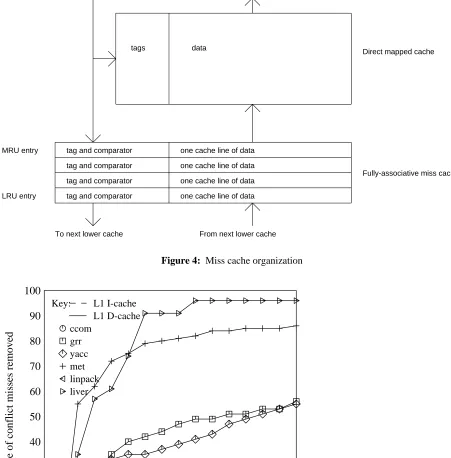
We can add associativity to a direct-mapped cache by placing a small miss cache on-chip between a first-level cache and the access port to the second-level cache (Figure 4). A miss cache is a small fully-associative cache containing on the order of two to five cache lines of data. When a miss occurs, data is returned not only to the direct-mapped cache, but also to the miss cache under it, where it replaces the least recently used item. Each time the upper cache is probed, the miss cache is probed as well. If a miss occurs in the upper cache but the address hits in the miss cache, then the direct-mapped cache can be reloaded in the next cycle from the miss cache. This replaces a long off-chip miss penalty with a short one-cycle on-chip miss. This arrangement satisfies the requirement that the critical path is not worsened, since the miss cache itself is not in the normal critical path of processor execution.
To processor
tag and comparator From processor
To next lower cache From next lower cache one cache line of data
one cache line of data
one cache line of data
one cache line of data tag and comparator
tag and comparator tag and comparator
Direct mapped cache
MRU entry
LRU entry
Fully-associative miss cache data
[image:11.612.92.543.98.556.2]tags
Figure 4: Miss cache organization
0 1 2 3 4 5 6 7 8 9 10 11 12 13 14 15 Number of entries in miss cache
0 100
10 20 30 40 50 60 70 80 90
Percentage of conflict misses removed
Key: ccom grr yacc met linpack liver
[image:11.612.102.395.376.669.2]L1 I-cache L1 D-cache
Figure 5: Conflict misses removed by miss caching
map to the same line, alternating references to different strings will always miss in the cache. In this case a miss cache of only two entries would remove all of the conflict misses. Obviously this is another extreme of performance and the results in Figure 5 show a range of performance based on the program involved. Nevertheless, for 4KB data caches a miss cache of only 2
*
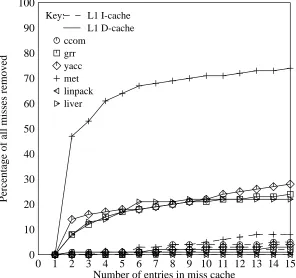
entries can remove 25% percent of the data cache conflict misses on average, or 13% of the data cache misses overall (see Figure 6). If the miss cache is increased to 4 entries, 36% percent of the conflict misses can be removed, or 18% of the data cache misses overall. After four entries the improvement from additional miss cache entries is minor, only increasing to a 25% overall reduction in data cache misses if 15 entries are provided.
0 1 2 3 4 5 6 7 8 9 10 11 12 13 14 15 Number of entries in miss cache
0 100
10 20 30 40 50 60 70 80 90
Percentage of all misses removed
Key: ccom grr yacc met linpack liver
[image:12.612.62.358.216.494.2]L1 I-cache L1 D-cache
Figure 6: Overall cache misses removed by miss caching
Since doubling the data cache size results in a 32% reduction in misses (over this set of benchmarks when increasing data cache size from 4K to 8K), each additional line in the first level cache reduces the number of misses by approximately 0.13%. Although the miss cache requires more area per bit of storage than lines in the data cache, each line in a two line miss cache effects a 50 times larger marginal improvement in the miss rate, so this should more than cover any differences in layout size.
*Throughout this paper the average reduction in miss rates is used as a metric. This is computed by calculating
Comparing Figure 5 and Figure 3, we see that the higher the percentage of misses due to conflicts, the more effective the miss cache is at eliminating them. For example, in Figure 3 met has by far the highest ratio of conflict misses to total data cache misses. Similarly, grr and yacc also have greater than average percentages of conflict misses, and the miss cache helps these programs significantly as well. linpack and ccom have the lowest percentage of conflict misses, and the miss cache removes the lowest percentage of conflict misses from these programs. This results from the fact that if a program has a large percentage of data conflict misses then they must be clustered to some extent because of their overall density. This does not prevent programs with a small number of conflict misses such as liver from benefiting from a miss cache, but it seems that as the percentage of conflict misses increases, the percentage of these misses removable by a miss cache increases.
3.2. Victim Caching
Consider a system with a direct-mapped cache and a miss cache. When a miss occurs, data is loaded into both the miss cache and the direct-mapped cache. In a sense, this duplication of data wastes storage space in the miss cache. The number of duplicate items in the miss cache can range from one (in the case where all items in the miss cache map to the same line in the direct-mapped cache) to all of the entries (in the case where a series of misses occur which do not hit in the miss cache).
To make better use of the miss cache we can use a different replacement algorithm for the small fully-associative cache [5]. Instead of loading the requested data into the miss cache on a miss, we can load the fully-associative cache with the victim line from the direct-mapped cache instead. We call this victim caching (see Figure 7). With victim caching, no data line appears both in the direct-mapped cache and the victim cache. This follows from the fact that the victim cache is loaded only with items thrown out from the direct-mapped cache. In the case of a miss in the direct-mapped cache that hits in the victim cache, the contents of the direct-mapped cache line and the matching victim cache line are swapped.
Depending on the reference stream, victim caching can either be a small or significant im-provement over miss caching. The magnitude of this benefit depends on the amount of duplica-tion in the miss cache. Victim caching is always an improvement over miss caching.
As an example, consider an instruction reference stream that calls a small procedure in its inner loop that conflicts with the loop body. If the total number of conflicting lines between the procedure and loop body were larger than the miss cache, the miss cache would be of no value since misses at the beginning of the loop would be flushed out by later misses before execution returned to the beginning of the loop. If a victim cache is used instead, however, the number of conflicts in the loop that can be captured is doubled compared to that stored by a miss cache. This is because one set of conflicting instructions lives in the direct-mapped cache, while the other lives in the victim cache. As execution proceeds around the loop and through the proce-dure call these items trade places.
tags data Direct mapped cache
one cache line of data one cache line of data one cache line of data one cache line of data tag
Fully-associative victim cache Data from
next lower cache
comparator comparator tag
tag comparator
comparator tag
MRU entry LRU entry
Data to processor
Address from processor
[image:14.612.56.454.61.346.2]Address to next lower cache
Figure 7: Victim cache organization
0 1 2 3 4 5 6 7 8 9 10 11 12 13 14 15 Number of entries in victim cache
0 100
10 20 30 40 50 60 70 80 90
Percentage of conflict misses removed
Key: ccom grr yacc met linpack liver
L1 I-cache L1 D-cache
Figure 8: Conflict misses removed by victim caching
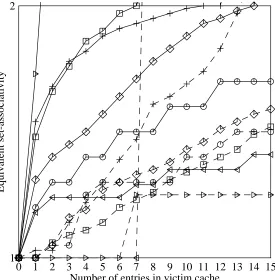
[image:14.612.64.359.373.669.2]a one-entry victim cache provides about 50% of the benefit of 2-way set-associativity for liver,
met, and grr. In fact, a direct-mapped cache with a 2-entry victim cache performs better than a
2-way set associative cache on liver. The dashed line for linpack instruction references at a victim cache size of seven results from the fact that a 2-way set-associative instruction cache performs slightly worse for linpack than a direct-mapped cache, and a direct-mapped cache with an 8-entry victim cache performs slightly better than a direct-mapped cache alone.
0 1 2 3 4 5 6 7 8 9 10 11 12 13 14 15 Number of entries in victim cache
1 2
[image:15.612.101.376.171.451.2]Equivalent set-associativity
Figure 9: Equivalent set-associativity provided by victim caching
0 1 2 3 4 5 6 7 8 9 10 11 12 13 14 15 Number of entries in victim cache
0 100
10 20 30 40 50 60 70 80 90
Percentage of all misses removed
Key: ccom grr yacc met linpack liver
[image:16.612.64.360.81.369.2]L1 I-cache L1 D-cache
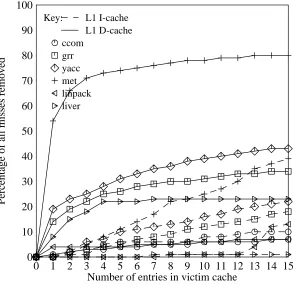
Figure 10: Overall cache misses removed by victim caching
3.3. The Effect of Direct-Mapped Cache Size on Victim Cache Performance
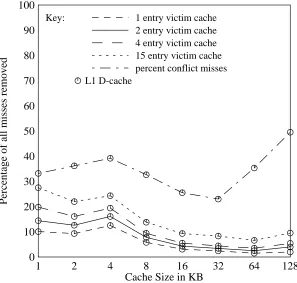
Figure 11 shows the performance of 1, 2, 4, and 15 entry victim caches when backing up direct-mapped data caches of varying sizes. In general smaller direct-mapped caches benefit the most from the addition of a victim cache. Also shown for reference is the total percentage of conflict misses for each cache size. There are two factors to victim cache performance versus direct-mapped cache size. First, as the direct-mapped cache increases in size, the relative size of the victim cache becomes smaller. Since the direct-mapped cache gets larger but keeps the same line size (16B), the likelihood of a tight mapping conflict which would be easily removed by victim caching is reduced. Second, the percentage of conflict misses decreases slightly from 1KB to 32KB. As we have seen previously, as the percentage of conflict misses decreases, the percentage of these misses removed by the victim cache decreases. The first effect dominates, however, since as the percentage of conflict misses increases with very large caches (as in [7]), the victim cache performance only improves slightly.
3.4. The Effect of Line Size on Victim Cache Performance
1 2 4 8 16 32 64 128 Cache Size in KB
0 100
10 20 30 40 50 60 70 80 90
Percentage of all misses removed
[image:17.612.98.395.81.364.2]Key: 1 entry victim cache 2 entry victim cache 4 entry victim cache 15 entry victim cache percent conflict misses L1 D-cache
Figure 11: Victim cache performance with varying direct-mapped data cache size
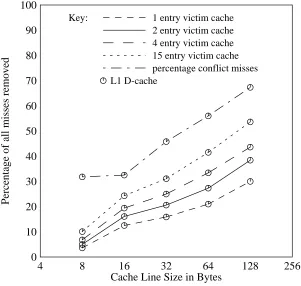
entries is cut in half when the line size doubles) the performance of the victim cache still im-proves or at least breaks even when line sizes increase.
3.5. Victim Caches and Second-Level Caches
As the size of a cache increases, a larger percentage of its misses are due to conflict and com-pulsory misses and fewer are due to capacity misses. (Unless of course the cache is larger than the entire program, in which case only compulsory misses remain.) Thus victim caches might be expected to be useful for second-level caches as well. Since the number of conflict misses in-creases with increasing line sizes, the large line sizes of second-level caches would also tend to increase the potential usefulness of victim caches.
One interesting aspect of victim caches is that they violate inclusion properties [1] in cache hierarchies. However, the line size of the second level cache in the baseline design is 8 to 16 times larger than the first-level cache line sizes, so this violates inclusion as well.
Note that a first-level victim cache can contain many lines that conflict not only at the first level but also at the second level. Thus, using a first-level victim cache can also reduce the number of conflict misses at the second level. In investigating victim caches for second-level caches, both configurations with and without first-level victim caches will need to be considered.
4 8 16 32 64 128 256 Cache Line Size in Bytes
0 100
10 20 30 40 50 60 70 80 90
Percentage of all misses removed
[image:18.612.60.361.81.367.2]Key: 1 entry victim cache 2 entry victim cache 4 entry victim cache 15 entry victim cache percentage conflict misses L1 D-cache
Figure 12: Victim cache performance with varying data cache line size
3.6. Miss Caches, Victim Caches, and Error Correction
Another important use for miss caches, especially on-chip at the first-level, is in yield en-hancement and fault tolerance. If parity is kept on all instruction and data cache bytes, and the data cache is write-though, then cache parity errors can be handled as misses. If the refill path bypasses the cache, then this scheme can also allow chips with hard errors to be used. (In fact with byte parity, up to 1/9 of all bits in the cache could be faulty as long as there were at most one bad bit per byte.) Unfortunately, without miss caches if the inner loop of linpack (i.e., saxpy) happens to land on a line with a defect or if a frequently used structure variable is on a defective line, the performance of the system can be severely degraded (e.g., by greater than a factor of four on some code segments). Moreover the performance degradation would vary from chip to chip seemingly at random depending on defect location. This would limit the potential yield enhancement to the engineering development phase of a project. However, with the ad-dition of miss caches, the penalty on a defect-induced parity miss is only one cycle, which would have a much smaller impact on machine performance than an off-chip miss. Thus, as long as the number of defects was small enough to be handled by the miss cache, chips with hard defects could be used in production systems. If miss caches are used to improve system performance in the presence of fabrication defects, then instruction miss caches and even miss caches with only one entry would be useful.
and not the victim. Thus it acts like a victim cache for normal misses and a miss cache for parity misses. With this minor modification the benefits of miss caches for error-recovery and the better performance of victim caching can be combined.
4. Reducing Capacity and Compulsory Misses
Compulsory misses are misses required in any cache organization because they are the first references to a piece of data. Capacity misses occur when the cache size is not sufficient to hold data between references. One way of reducing the number of capacity and compulsory misses is to use prefetch techniques such as longer cache line sizes or prefetching methods [14, 6]. However, line sizes can not be made arbitrarily large without increasing the miss rate and greatly increasing the amount of data to be transferred. In this section we investigate techniques to reduce capacity and compulsory misses while mitigating traditional problems with long lines and excessive prefetching.
4.1. Reducing Capacity and Compulsory Misses with Long Lines
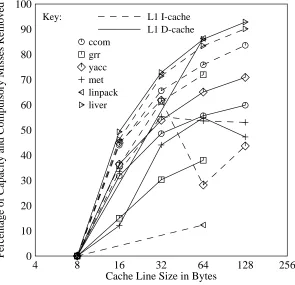
If conflict misses did not exist, caches with much larger line sizes would be appropriate. Figure 13 shows the reduction in compulsory and capacity misses with increasing line size, com-pared to a baseline design with 8B lines. In general, all benchmarks have reduced miss rates as the line size is increased, although yacc has anomalous instruction cache behavior at 64B line sizes.
4 8 16 32 64 128 256
Cache Line Size in Bytes 0
100
10 20 30 40 50 60 70 80 90
Percentage of Capacity and Compulsory Misses Removed
Key:
ccom grr yacc met linpack liver
[image:19.612.101.396.388.673.2]L1 I-cache L1 D-cache
Figure 13: Effect of increasing line size on capacity and compulsory misses
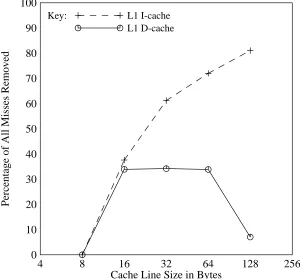
line size but the data cache performance peaks at a modest line size and decreases for further increases in line size beyond that. This is a well known effect and is due to differences in spatial locality between instruction and data references. For example, when a procedure is called, many instructions within a given extent will be executed. However, data references tend to be much more scattered, especially in programs that are not based on unit-stride array access. Thus the long line sizes are much more beneficial to quasi-sequential instruction access patterns than the more highly distributed data references.
4 8 16 32 64 128 256
Cache Line Size in Bytes 0
100
10 20 30 40 50 60 70 80 90
Percentage of All Misses Removed
Key: L1 I-cache
[image:20.612.60.360.188.467.2]L1 D-cache
Figure 14: Effect of increasing line size on overall miss rate
Although curves of average performance such as Figure 14 appear to roll off fairly smoothly, the performance for individual programs can be quite different. Figure 15 shows that the data cache line size providing the best performance actually varies from 16B to 128B, depending on the program. Moreover, within this range programs can have dramatically different perfor-mance. For example, liver has about half the number of data cache misses at a line size of 128B as compared to 16B, but met has about three times the number of misses at 128B as compared to 16B. Similarly the performance of yacc degrades precipitously at line sizes above 16B. This shows one problem with large line sizes: different programs have dramatically different perfor-mance. For programs with long sequential reference patterns, relatively long lines would be useful, but for programs with more diffuse references shorter lines would be best. Taking it a step further, even within a given program the optimal line size is different for the different references that a program makes.
4 8 16 32 64 128 256 512 Cache Line Size in Bytes
-30 100
-20 -10 0 10 20 30 40 50 60 70 80 90
Percentage of D-cache Misses Removed
Key:
ccom grr yacc met linpack liver
[image:21.612.102.396.80.367.2]L1 D-cache
Figure 15: Effect of increasing data cache line size on each benchmark
are frequent, miss caches should allow us to take better advantage of longer cache line sizes. Figure 16 shows the average effectiveness of increasing line size in configurations with and without miss caches. By adding a miss cache more benefits can be derived from a given increase in line size, as well increasing the line size at which the minimum miss rate occurs. This effect can be quite significant: increasing the line size from 16B to 32B with a 4-entry miss cache decreases the miss rate by 36.3%, but only decreases it by 0.5% on average when increasing the line size without a miss cache. Table 4 shows the minimum miss rate for each benchmark with and without miss caches. Benchmarks with minimum miss rate line sizes that are not powers of two have equal miss rates at the next larger and smaller powers of two. The geometric mean over the six benchmarks of the line size giving the lowest miss rate increases from 46B to 92B with the addition of a 4-entry miss cache. The minimum line size giving the best performance on any of the six benchmarks also increases from 16B to 32B with the addition of a 4-entry miss cache.
Figure 17 shows the detailed behavior of most of the programs. The performance of systems with 8B lines are all normalized to zero, independent of the size of their miss cache (if any). This removes the reduction in misses simply due to miss caching from the comparison of the effects of longer cache lines. Thus the actual performance of systems with miss caches at 16B lines are all better than systems without miss caches.
4 8 16 32 64 128 256 Cache Line Size in Bytes
0 100
10 20 30 40 50 60 70 80 90
Percentage of D-cache Misses Removed
[image:22.612.63.357.81.371.2]Key: with 4-entry miss cache with 2-entry miss cache without miss cache
Figure 16: Effect of increasing data cache line size with miss caches
miss cache | line size with minimum miss rate | geom | |
entries | ccom grr yacc met liver | mean | min |
---+---+---+---+
4 | 256 96 64 32 128 | 92 | 32 |
2 | 128 64 128 32 128 | 84 | 32 |
0 | 128 48 16 32 64 | 46 | 16 |
---+---+---+---+
Table 4: Line sizes with minimum miss rates by program
at line sizes above 16B is completely eliminated even with miss caches with as few as two entries. The performance of met is a little more subtle. A system with a miss cache, although always performing better than a system without a miss cache, does not benefit as much on met from an increase in line size. Thus the number of additional misses removed with longer lines when using miss caches for met is lower than when not using a miss cache for line sizes in the range of 16B to 64B. However the absolute miss rate (not shown) is still lower when using the miss caches. At line sizes of 128B, adding a miss cache with four entries can turn a 100% increase in miss rate for met into only a 22% increase in miss rate, although a two entry miss cache has little effect. This benchmark is the primary reason why the average performance of two-entry and four-entry miss caches in Figure 16 diverge at a line size of 128B.
4 8 16 32 64 128 256 512 Cache Line Size in Bytes
-30 100
-20 -10 0 10 20 30 40 50 60 70 80 90
Percentage of D-cache Misses Removed
Key:
ccom grr linpack liver
[image:23.612.105.395.82.363.2]with 4-entry miss cache with 2-entry miss cache without miss cache
Figure 17: Benchmark-specific performance with increasing data cache line size
4 8 16 32 64 128 256 512
Cache Line Size in Bytes -30
100
-20 -10 0 10 20 30 40 50 60 70 80 90
Percentage of D-cache Misses Removed
Key:
yacc met
[image:23.612.105.394.400.686.2]with 4-entry miss cache with 2-entry miss cache without miss cache
Figure 18: yacc and met performance with increasing data cache line size
4.2. Reducing Capacity and Compulsory Misses with Prefetch Techniques
Longer line sizes suffer from the disadvantage of providing a fixed transfer size for different programs and access patterns. Prefetch techniques are interesting because they can be more adaptive to the actual access patterns of the program. This is especially important for improving the performance on long quasi-sequential access patterns such as instruction streams or unit-stride array accesses.
A detailed analysis of three prefetch algorithms has appeared in [14]. Prefetch always
prefetches after every reference. Needless to say this is impractical in our base system since many level-one cache accesses can take place in the time required to initiate a single level-two cache reference. This is especially true in machines that fetch multiple instructions per cycle from an instruction cache and can concurrently perform a load or store per cycle to a data cache.
Prefetch on miss and tagged prefetch are more promising techniques. On a miss prefetch on miss always fetches the next line as well. It can cut the number of misses for a purely sequential
reference stream in half. Tagged prefetch can do even better. In this technique each block has a tag bit associated with it. When a block is prefetched, its tag bit is set to zero. Each time a block is used its tag bit is set to one. When a block undergoes a zero to one transition its successor block is prefetched. This can reduce the number of misses in a purely sequential reference stream to zero, if fetching is fast enough. Unfortunately the large latencies in the base system can make this impossible. Consider Figure 19, which gives the amount of time (in instruction issues) until a prefetched line is required during the execution of ccom. Not surprisingly, since the line size is four instructions, prefetched lines must be received within four instruction-times to keep up with the machine on uncached straight-line code. Because the base system second-level cache takes many cycles to access, and the machine may actually issue many instructions per cycle, tagged prefetch may only have a one-cycle-out-of-many head start on providing the required instructions.
4.2.1. Stream Buffers
What we really need to do is to start the prefetch before a tag transition can take place. We can do this with a mechanism called a stream buffer (Figure 20). A stream buffer consists of a series of entries, each consisting of a tag, an available bit, and a data line.
When a miss occurs, the stream buffer begins prefetching successive lines starting at the miss target. As each prefetch request is sent out, the tag for the address is entered into the stream buffer, and the available bit is set to false. When the prefetch data returns it is placed in the entry with its tag and the available bit is set to true. Note that lines after the line requested on the miss are placed in the buffer and not in the cache. This avoids polluting the cache with data that may never be needed.
0 2 4 6 8 10 12 14 16 18 20 22 24 26 Instructions until prefetch returns
0 100
20 40 60 80
Percent of misses removed
ccom I-cache prefetch, 16B lines
Key:
prefetch on miss
tagged prefetch
[image:25.612.99.396.68.376.2]prefetch always
Figure 19: Limited time for prefetch
When a line is moved from a stream buffer to the cache, the entries in the stream buffer can shift up by one and a new successive address is fetched. The pipelined interface to the second level allows the buffer to be filled at the maximum bandwidth of the second level cache, and many cache lines can be in the process of being fetched simultaneously. For example, assume the latency to refill a 16B line on a instruction cache miss is 12 cycles. Consider a memory interface that is pipelined and can accept a new line request every 4 cycles. A four-entry stream buffer can provide 4B instructions at a rate of one per cycle by having three requests outstanding at all times. Thus during sequential instruction execution long latency cache misses will not oc-cur. This is in contrast to the performance of tagged prefetch on purely sequential reference streams where only one line is being prefetched at a time. In that case sequential instructions will only be supplied at a bandwidth equal to one instruction every three cycles (i.e., 12 cycle latency / 4 instructions per line).
Figure 21 shows the performance of a four-entry instruction stream buffer backing a 4KB instruction cache and a data stream buffer backing a 4KB data cache, each with 16B lines. The graph gives the cumulative number of misses removed based on the number of lines that the buffer is allowed to prefetch after the original miss. (In practice the stream buffer would prob-ably be allowed to fetch until the end of a virtual memory page or a second-level cache line. The major reason for plotting stream buffer performance as a function of prefetch length is to get a better idea of how far streams continue on average.) Most instruction references break the purely sequential access pattern by the time the 6th successive line is fetched, while many data reference patterns end even sooner. The exceptions to this appear to be instruction references for
liver and data references for linpack. liver is probably an anomaly since the 14 loops of the
+1 Tail entry Head entry
tags data Direct mapped cache
From next lower cache From processor To processor
To next lower cache tag and
comparator
tag tag
Stream buffer (FIFO Queue version)
one cache line of data one cache line of data one cache line of data one cache line of data tag a
[image:26.612.58.524.68.367.2]a a a
Figure 20: Sequential stream buffer design
or do excessive branching, which would cause the sequential miss pattern to break. The data reference pattern of linpack can be understood as follows. Remember that the stream buffer is only responsible for providing lines that the cache misses on. The inner loop of linpack (i.e., saxpy) performs an inner product between one row and the other rows of a matrix. The first use of the one row loads it into the cache. After that subsequent misses in the cache (except for mapping conflicts with the first row) consist of subsequent lines of the matrix. Since the matrix is too large to fit in the on-chip cache, the whole matrix is passed through the cache on each iteration. The stream buffer can do this at the maximum bandwidth provided by the second-level cache. Of course one prerequisite for this is that the reference stream is unit-stride or at most skips to every other or every third word. If an array is accessed in the non-unit-stride direction (and the other dimensions have non-trivial extents) then a stream buffer as presented here will be of little benefit.
Figure 22 gives the bandwidth requirements in three typical stream buffer applications. I-stream references for ccom are quite regular (when measured in instructions). On average a new 16B line must be fetched every 4.2 instructions. The spacing between references to the stream buffer increases when the program enters short loops and decreases when the program takes small forward jumps, such as when skipping an else clause. Nevertheless the fetch frequency is quite regular. This data is for a machine with short functional unit latencies, such as the MIPS R2000 or the MultiTitan CPU, so the CPI is quite close to 1 without cache misses.
ver-0 1 2 3 4 5 6 7 8 9 10 11 12 13 14 15 16 Length of stream run
0 100
10 20 30 40 50 60 70 80 90
Cumulative percentage of all misses removed
Key: ccom grr yacc met linpack liver
[image:27.612.96.409.77.692.2]L1 I-cache L1 D-cache
Figure 21: Sequential stream buffer performance
0 2 4 6 8 10 12 14 16
Line sequence number in sequential stream 0
500
100 200 300 400
Instructions until line required (harmonic mean)
Key:
ccom I-stream
ccom D-stream
[image:27.612.104.396.83.374.2]linpack D-stream
Figure 22: Stream buffer bandwidth requirements
instructions. This is larger than one would hope. This version of linpack is rather loose in that it does an integer multiply for addressing calculations for each array element, and the loop is not unrolled. If the loop were unrolled and extensive optimizations were performed the rate of references would increase, but the rate should still be less than that of the instruction stream.
ccom has interesting trimodal performance. If the next successive line is used next after a miss it
is required on average only 5 cycles after the miss. For the next two lines after a miss, succes-sive data lines (16B) are required every 10 instructions on average. The first three lines provide most (82%) of the benefit of the stream buffer. After that successive lines are required at a rate closer to that of linpack, about every 24 instructions on average.
In general, if the backing store can produce data at an average bandwidth of a new word (4B) every cycle, the stream buffer will be able to keep up with successive references. This should suffice for instruction streams, as well as for block copies that are heavily unrolled and use double-precision loads and stores. If this bandwidth is not available, the benefit of instruction stream buffers will be reduced and block copies and other similar operations will be negatively impacted as well. However, bandwidths equaling a new word every 1.5 to 2 cycles will still suffice for many of the data references. Note that these values are for bandwidths, which are much easier to achieve than total latencies such as required by the prefetch schemes in Figure 19.
4.2.2. Multi-Way Stream Buffers
Overall, the stream buffer presented in the previous section could remove 72% of the instruc-tion cache misses, but it could only remove 25% of the data cache misses. One reason for this is that data references tend to consist of interleaved streams of data from different sources. In order to improve the performance of stream buffers for data references, a multi-way stream buffer was simulated (Figure 23). It consists of four stream buffers in parallel. When a miss occurs in the data cache that does not hit in any stream buffer, the stream buffer hit least recently is cleared (i.e., LRU replacement) and it is started fetching at the miss address.
Figure 24 shows the performance of the multi-way stream buffer on our benchmark set. As expected, the performance on the instruction stream remains virtually unchanged. This means that the simpler single stream buffer will suffice for instruction streams. The multi-way stream buffer does significantly improve the performance on the data side, however. Overall, the multi-way stream buffer can remove 43% of the misses for the six programs, almost twice the perfor-mance of the single stream buffer. Although the matrix operations of liver experience the greatest improvement (it changes from 7% to 60% reduction), all of the programs benefit to some extent. Note also that liver makes unit stride accesses to its data structures.
4.2.3. Quasi-Sequential Stream Buffers
In the previous section only one address comparator was provided for the stream buffer. This means that even if the requested line was in the stream buffer, but not in the first location with the comparator, the stream buffer will miss on the reference and its contents will be flushed. One obvious improvement to this scheme is to place a comparator at each location in the stream buffer. Then if a cache line is skipped in a quasi-sequential reference pattern, the stream buffer will still be able to supply the cache line if it has already been fetched.
To next lower cache From next lower cache
Direct mapped cache data To processor tag and com-parator tag tag +1 tag tag +1 tag tag tag and com-parator tag and com-parator tag tag +1 tag tag +1 tag From processor tags tag tag and
com-parator one line of data one line of data one line of data one line of data a a a a a a a
a one line of data one line of data one line of data
one line of data one line of data one line of data one line of data one line of data a a a a a a a
[image:29.612.102.555.84.453.2]a one line of data one line of data one line of data one line of data
Figure 23: Four-way stream buffer design
purely sequential stream buffer, giving a 14% reduction in the number of misses remaining. This is probably due to the quasi-stream buffer’s ability to continue useful fetching when code is skipped, such as when then or else clauses are skipped in if statements. The version simulated had three comparators, so it could skip at most 2 cache lines plus up to 3/4 of a cache line on either side depending on alignment, for a total of 16 to 22 instructions maximum. This compares with only 0 to 6 instructions that may be skipped in a sequential stream buffer (depending on branch alignment) without causing the stream buffer to be flushed.
The extra comparators of a quasi-stream buffer also improve the performance of a four-way data stream buffer. Overall, the four-way quasi-stream buffer can remove 47% of all misses, which is 4% more than the purely sequential four-way stream buffer.
re-0 1 2 3 4 5 6 7 8 9 10 11 12 13 14 15 16 Length of 4-way stream run
0 100
10 20 30 40 50 60 70 80 90
Cumulative percentage of all misses removed
Key: ccom grr yacc met linpack liver
[image:30.612.61.360.80.693.2]L1 I-cache L1 D-cache
Figure 24: Four-way stream buffer performance
0 1 2 3 4 5 6 7 8 9 10 11 12 13 14 15 16 Length of 4-way quasi-stream run
0 100
10 20 30 40 50 60 70 80 90
Cumulative percentage of all misses removed
Key: ccom grr yacc met linpack liver
L1 I-cache L1 D-cache
Figure 25: Quasi-sequential 4-way stream buffer performance
[image:30.612.67.359.82.379.2]compilers to reorganize code and data layouts to maximize the use of stream buffers. If tech-niques to optimize sequentiality of references are successful, the need for extra comparators on stream buffers will be lessened.
4.2.4. Stream Buffer Performance vs. Cache Size
Figure 26 gives the performance of single and 4-way stream buffers with 16B lines as a func-tion of cache size. The instrucfunc-tion stream buffers have remarkably constant performance over a wide range of cache sizes. The data stream buffer performance generally improves as the cache size increases. This is especially true for the single stream buffer, whose performance increases from a 15% reduction in misses for a data cache size of 1KB to a 35% reduction in misses for a data cache size of 128KB. This is probably because as the cache size increases, it can contain data for reference patterns that access several sets of data, or at least all but one of the sets. What misses that remain are more likely to consist of very long single sequential streams. For ex-ample, as the cache size increases the percentage of compulsory misses increase, and these are more likely to be sequential in nature than data conflict or capacity misses.
1 2 4 8 16 32 64 128
Cache Size in KB 0
100
10 20 30 40 50 60 70 80 90
Percentage of all misses removed
Key: single sequential stream buffer 4-way sequential stream buffer L1 I-cache
[image:31.612.98.396.299.588.2]L1 D-cache
Figure 26: Stream buffer performance vs. cache size
4.2.5. Stream Buffer Performance vs. Line Size
stream buffer performance is especially hard hit compared to the multi-way stream buffer be-cause of the increase in conflict misses at large line sizes.
4 8 16 32 64 128 256
Cache Line Size in Bytes 0
100
10 20 30 40 50 60 70 80 90
Percentage of all misses removed
Key: single sequential stream buffer 4-way sequential stream buffer L1 I-cache
[image:32.612.60.363.118.412.2]L1 D-cache
Figure 27: Stream buffer performance vs. line size
The instruction stream buffers perform well even out to 128B line sizes. Both the 4-way and the single stream buffer still remove at least 40% of the misses at 128B line sizes, coming down from an 80% reduction with 8B lines. This is probably due to the large granularity of conflicting instruction reference streams, and the fact that many procedures are more than 128B long.
4.2.6. Comparison to Classical Prefetch Performance
In order to put the performance of stream buffers in perspective, in this section we compare the performance of stream buffers to some prefetch techniques previously studied in the litera-ture. The performance of prefetch on miss, tagged prefetch, and always prefetch on our six benchmarks is presented in Table 5. This data shows the reduction in misses assuming the use of these prefetch techniques with a second-level cache latency of one instruction-issue. Note that this is quite unrealistic since one-instruction issue latency may be less than a machine cycle, and second-level caches typically have a latency of many CPU cycles. Nevertheless, these figures give an upper bound of the performance of these prefetch techniques. The performance of the prefetch algorithms in this study is consistent with data earlier presented in the literature. In [14] reductions in miss rate for a PDP-11 trace on a 8KB mixed cache (only mixed caches were studied) with 16B lines and 8-way set associativity was found to be 27.8% for prefetch on miss, 50.2% for tagged prefetch, and 51.8% for prefetch always.
fetch ccom yacc met grr liver linpack avg ---4KB instr. cache, direct-mapped, 16B lines, 1-instr prefetch latency:
on miss 44.1 42.4 45.2 55.8 47.3 42.8 46.3
tagged 78.6 74.3 65.7 76.1 89.0 77.2 76.8
always 82.0 80.3 62.5 81.8 89.5 84.4 80.1
---4KB data cache, direct-mapped, 16B lines, 1-instr prefetch latency:
on miss 38.2 10.7 14.1 14.5 49.8 75.7 33.8
tagged 39.7 18.0 21.0 14.8 63.1 83.1 40.0
always 39.3 37.2 18.6 11.7 63.1 83.8 42.3
---Table 5: Upper bound on prefetch performance: percent reduction in misses
miss by a wide margin. This is not surprising since for a purely sequential reference stream prefetch on miss will only reduce the number of misses by a factor of two. Both the simple single stream buffer and the quasi-stream buffer perform almost as well as tagged prefetch. As far as traffic is concerned, the stream buffer will fetch more after a miss than tagged prefetch, but it will not start fetching on a tag transition, so a comparison of traffic ratios would be interesting future research. The performance of the stream buffers on the instruction stream is slightly less than prefetch always. This is not surprising, since the performance of always prefetch ap-proximates the percentage of instructions that are not taken branches, and is an upper bound on the reduction of instruction cache misses by sequential prefetching. However, the traffic ratio of the stream buffer approaches should be much closer to that of prefetch on miss or tagged prefetch than to prefetch always.
technique misses eliminated
---for 4KB direct-mapped instruction cache w/ 16B lines:
prefetch on miss (1-instr latency) 46.3
single stream buffer 72.0
quasi-stream buffer (3 comparator) 76.0
tagged prefetch (1-instr latency) 76.8
always prefetch (1-instr latency) 80.1
---for 4KB direct-mapped data cache w/ 16B lines:
single stream buffer 25.0
prefetch on miss (1-instr latency) 33.8
tagged prefetch (1-instr latency) 40.0
always prefetch (1-instr latency) 42.3
4-way stream buffer 43.0
4-way quasi-stream buffer 47.0
---Table 6: Upper bound of prefetch performance vs. stream buffer performance
[image:33.612.112.563.400.607.2]is especially important for data references since the spatial locality of data references is less than that of instruction references, and prefetched data is more likely to be pollution than are prefetched instructions.
Independent of the relative performance of stream buffers and ideal prefetch techniques, the stream buffer approaches are much more feasible to implement. This is because they can take advantage of pipelined memory systems (unlike prefetch on miss or tagged prefetch for sequen-tial reference patterns). They also have lower latency requirements on prefetched data than the other prefetching techniques, since they can start fetching a block before the previous block is used. Finally, at least for instruction stream buffers, the extra hardware required by a stream buffer is often comparable to the additional tag storage required by tagged prefetch.
4.3. Combining Long Lines and Stream Buffers
Long cache lines and stream buffers can be used advantageously together, since the strengths and weaknesses of long lines and stream buffers are complimentary. For example, long lines fetch data that, even if not used immediately, will be around for later use. However, the other side of this advantage is that excessively long lines can pollute a cache. On the other hand, stream buffers do not unnecessarily pollute a cache since they only enter data when it is re-quested on a miss. However, at least one reference to successive data must be made relatively soon, otherwise it will pass out of the stream buffer without being used.
Table 7 gives the performance of various long-line and stream-buffer alternatives for a 4KB instruction cache. The first thing to notice is that all the stream buffer approaches, independent of their line size, outperform all of the longer line size approaches. In fact, the stream buffer approaches outperform a hypothetical machine with a line size that can be set to the best value for each benchmark. The fact that the stream buffers are doing better than this shows that they are actually providing an effective line size that varies on a per reference basis within each program. Also note that the line size used in the stream buffer approaches is not that significant, although it is very significant if a stream buffer is not used. Finally, the quasi-stream buffer capability approximates the performance of purely sequential stream buffers with longer line sizes. Consider for example a quasi-stream buffer than can skip two 16B lines. It will have a "prefetch reach" of between 16 and 22 four-byte instructions depending on alignment. This is a little longer span than a sequential 32B line stream buffer (8 to 15 instructions depending on alignment) and a little shorter than a sequential 64B line stream buffer (16 to 31 instructions). Thus it is not surprising that the performance of the 16B three-comparator quasi-stream buffer is between that of a 32B and a 64B line sequential stream buffer. Given that it is usually easier to make the cache line size equal to the transfer size, and that transfer sizes larger than 16B seem unlikely in the near future (at least for microprocessor-based machines), it seems that the use of quasi-sequential stream buffers with smaller line sizes such as 16B would be the most promising approach for the instruction cache. In particular if a quasi-sequential stream buffer is used, line sizes of greater than 32B have little benefit for 4KB instruction caches.
buff-instr cache configuration misses
(default does not include a miss cache) eliminated
---32B lines 38.0%
64B lines 55.4%
128B lines 69.7%
optimal line size per program 70.0%
16B lines w/ single stream buffer 72.0%
32B lines w/ single stream buffer 75.2%
16B lines w/ quasi-stream buffer 76.0%
64B lines w/ single stream buffer 77.6%
32B lines w/ quasi-stream buffer 80.0%
64B lines w/ quasi-stream buffer 80.2%
---Table 7: Improvements relative to a 16B instruction line size without miss caching
er over an optimal per-program instruction cache line size. This is due to the wider range of localities present in data references. For example, some data reference patterns consist of references that are widely separated from previous data references (e.g., manipulation of com-plex linked data structures), while other reference patterns are sequential for long distances (e.g., unit stride array manipulation). Different instruction reference streams are quite similar by com-parison. Thus it is not surprising that the ability of stream buffers to provide an effective line size that varies on a reference-by-reference basis is more important for data caches than for in-struction caches.
data cache configuration misses
(default does not include a miss cache) eliminated
---64B lines 0.5%
32B lines 1.0%
optimal line size per program 19.2%
16B lines w/ single stream buffer 25.0%
16B lines w/ 4-way stream buffer 43.0%
16B lines w/ 4-way quasi-stream buffer 47.0%
---Table 8: Improvements relative to a 16B data line size without miss caching
Table 9 presents results assuming that longer data cache line sizes are used in conjunction with a four-entry miss cache. The addition of a miss cache improves the performance of the longer data cache line sizes, but they still underperform the stream buffers. This is still true even for a system with a different line size per program.
One obvious way to combine longer lines and stream buffers is to increase the line size up to the smallest line size that gives a minimum miss rate for some program. In our previous ex-amples with a four-line miss cache this is a 32B line since this provides a minimum miss rate for
met. Then stream buffers can be used to effectively provide what amounts to a variable line size
[image:35.612.118.530.399.525.2]data cache configuration misses
(default includes 4-entry miss cache) eliminated
---32B lines 24.0%
16B lines w/ single stream buffer 25.0%
64B lines 31.0%
optimal line size per program 38.0%
16B lines w/ 4-way stream buffer 43.0%
16B lines w/ 4-way quasi-stream buffer 47.0%
64B lines w/ 4-way quasi-stream buffer 48.7%
32B lines w/ 4-way quasi-stream buffer 52.1%
---Table 9: Improvements relative to a 16B data line size and 4-entry miss cache
the line size to 64B with a stream buffer is ineffective even though it reduces the average number of misses in configurations without a stream buffer. This is because the stream buffer will provide the same effect as longer cache lines for those references that need it, but will not have the extra conflict misses associated with longer cache line sizes.
5. Conclusions
Small miss caches (e.g., 2 to 5 entries) have been shown to be effective in reducing data cache conflict misses for direct-mapped caches in range of 1K to 8K bytes. They effectively remove tight conflicts where misses alternate between several addresses that map to the same line in the cache. Miss caches are increasingly beneficial as line sizes increase and the percentage of con-flict misses increases. In general it appears that as the percentage of concon-flict misses increases, the percent of these misses removable by a miss cache also increases, resulting in an even steeper slope for the performance improvement possible by using miss caches.
Victim caches are an improvement to miss caching that saves the victim of the cache miss instead of the target in a small associative cache. Victim caches are even more effective at removing conflict misses than miss caches.
Stream buffers prefetch cache lines after a missed cache line. They store the line until it is requested by a cache miss (if ever) to avoid unnecessary pollution of the cache. They are par-ticularly useful at reducing the number of capacity and compulsory misses. They can take full advantage of the memory bandwidth available in pipelined memory systems for sequential references, unlike previously discussed prefetch techniques such as tagged prefetch or prefetch on miss. Stream buffers can also tolerate longer memory system latencies since they prefetch data much in advance of other prefetch techniques (even prefetch always). Stream buffers can also compensate for instruction conflict misses, since these tend to be relatively sequential in nature as well.
[image:36.612.78.495.68.221.2]The performance improvements due to victim caches and due to stream buffers are relatively orthogonal for data references. Victim caches work well where references alternate between two locations that map to the same line in the cache. They do not prefetch data but only do a better job of keeping data fetched available for use. Stream buffers, however, achieve performance improvements by prefetching data. They do not remove conflict misses unless the conflicts are widely spaced in time, and the cache miss reference stream consists of many sequential accesses. These are precisely the conflict misses not handled well by a victim cache due to its relatively small capacity. Over the set of six benchmarks, on average only 2.5% of 4KB direct-mapped data cache misses that hit in a four-entry victim cache also hit in a four-way stream buffer for
ccom, met, yacc, grr, and liver. In contrast, linpack, due to its sequential data access patterns,
has 50% of the hits in the victim cache also hit in a four-way stream buffer. However only 4% of linpack’s cache misses hit in the victim cache (it benefits least from victim caching among the six benchmarks), so this is still not a significant amount of overlap between stream buffers and victim caching.
1 2 3 4 5 6
Benchmark 0
1000
100 200 300 400 500 600 700 800 900
Performance usage (MIPS)
ccom grr yacc met linpack liver
Lost due to L2 misses
Lost due to L1 D-cache misses
Lost due to L1 I-cache misses
Gained by data victim cache
Gained by data 4-way stream buf
Gained by instr stream buf
[image:37.612.102.403.281.566.2]Base system instruction execution
Figure 28: System performance with victim cache and stream buffers
One way of looking at the performance of victim caching and stream buffers is to consider the effective increase in cache size provided by these techniques. Table 10 gives the increase in cache size required to give the same instruction miss rate as a smaller cache plus a stream buffer. It is possible that by adding a stream buffer the compulsory misses are reduced to an extent that reduces the overall miss rate to a rate lower than that achieved by any cache with a 16B line size. Asterisks in Table 10 denotes situations where this occurs, or at least the miss rate is reduced beyond that of a 128KB cache, the largest size simulated. ccom has a particularly bad instruction cache miss rate, and it has a very large working set, so it benefits the most from instruction stream buffering.
program multiple increase in effective cache size
name 1K 2K 4K 8K 16K 32K 64K
---ccom 26.3X 16.1X 7.0X 6.1X 4.1X 3.5X *
grr 6.0X 3.5X 4.3X 3.4X 1.8X 2.7X 1.7X
yacc 7.5X 4.1X 3.0X 2.8X 1.9X 1.7X *
met 3.2X 1.8X 2.1X 2.9X 1.9X 3.0X 1.9X
linpack 1.7X 1.9X 3.6X * * * *
liver 4.0X 2.0X * * * * *
---* denotes no cache size below 256KB attains as low a miss rate as cache with streambuffer
Table 10: Effective increase in instruction cache size provided by streambuffer with 16B lines
Corresponding equivalent increases in effective data cache size provided by the addition of a 4-entry victim cache and a 4-way stream buffer are given in Table 11. linpack and liver sequen-tially access very large arrays from one end to the other before returning. Thus they have very large effective cache size increases since with stream buffering they have equivalent cache sizes equal to their array sizes. (This assumes the stream buffer can keep up with their data consump-tion, which is true for our baseline system parameters.)
program multiple increase in effective cache size
name 1K 2K 4K 8K 16K 32K 64K
---ccom 6.3X 5.0X 3.9X 3.1X 2.3X 1.8X 1.8X
grr 1.6X 1.5X 1.4X 1.2X 3.8X * *
yacc 1.6X 2.5X 1.7X 1.6X 1.7X 2.1X *
met 1.4X 3.3X 1.2X 1.6X 3.3X 1.8X *
linpack 98.3X 53.6X 30.4X 15.8X * * *
liver 26.0X 16.0X 9.5X 8.4X 6.3X 3.4X 1.9X
[image:38.612.76.503.204.326.2]
---* denotes no cache size below 256KB attains as low a miss rate as cache with 4-way streambuffer and 4-entry victim cache