ISSN: 1992-8645 www.jatit.org E-ISSN: 1817-3195
92
A REVIEW ON TOOLS OF RISK MITIGATION FOR
INFORMATION TECHNOLOGY MANAGEMENT
1
BOKOLO ANTHONY JNR and 2NORAINI CHE PA
1,2
Faculty of Computer Science and Information Technology, University Putra Malaysia, 43400 UPM, Serdang, Selangor, Malaysia.
E-mail: [email protected] and [email protected]
ABSTRACT
Information technology (IT) industries are facing operational. Technical and strategic risks that make IT practitioners miss their planned schedule, time and quality. Hence, there is the need to effectively and efficiently mitigate such risks if staffs want to avoid the above problems. Many studies have been accompanied for viewing the issues from different aspects. However, available IT risk mitigation tools present many weaknesses and above all, they are few. 13 studies related to the risk management and mitigation in IT has been reviewed. The studies have been reviewed based on the review method which is called Systematic Literature Review (SLR). Based on this approach, all previous studies related to this title have been studied systematically. Thus this paper aims to do review existing risk tool from 2000 until 2015. Also, this paper presents the results of the systematic reviews on the number of tools in IT risk mitigation. The findings of this review indicate that existing tools for risk mitigation are not completely effective and efficient in mitigating risk that occurs in IT management. This review identifies existing risk mitigation prototypes tools purpose, functionalities, architecture and limitations. The findings of this review also discuss the purpose, functionalities, architecture, limitations of the existing risk mitigation tool in IT Management.
Keywords: Risk Mitigation, Risk Management, IT Management, IT Risk Tools, Risk Assessment Tools,
Systematic Literature Review.
1. INTRODUCTION
Risk is defined as the chance of certain occurrences adversely affecting IT management objectives [7]. Risks and problems are strongly related. The relationship between risks and problems is similar to the relationship between faults and failures. In order to reduce the risk in information technology, the system modules which have the potentials to cause system problems have to be identified early. Information technology risk is expressed by the potential number of risk that may be caused by a module, as well as the severity and intensity of these risks. Before risk happen, there is a need to model and predict the level of risks contained in IT systems [8]. IT projects are risky adventures. Due to the risk involved IT development projects are difficult to manage and many of them end in failure.
Existing risk mitigation tools and system in IT provide inadequate support to practitioners in information technology, thus information technology projects miss the chance to reach their goals of delivering high quality and
ISSN: 1992-8645 www.jatit.org E-ISSN: 1817-3195
93 knowledge of typical problems, expose the project to a great risk of failure [3]. According to [4] the only way to avoid serious consequences of a risk when it materializes is to identify the risk as early as possible and minimize its impact on the project. Though this advice sounds simple, it may be only realized through a defined set of activities focused on risk mitigation. Altogether, it calls for a definition and elaboration of a systematic and explicit approach to mitigate operational, technical and strategic risk. [6] mentioned that the effectiveness of any IT process may be determined by the degree of data sharing and reuse as well as the available support for decision-making in IT process, such limitations on information availability can prevent practitioners and staff from reaching their full potential.
IT projects can derive huge benefits from the sharing and reuse of historical risk data extracted from past IT process, so that practitioners can adopt consistent and successful risk mitigation strategies. Without the sharing of existing knowledge, implemented mitigation strategies are usually based on managers’ personal knowledge and perceived risk levels. Risk mitigation practices in IT projects aims at early identification and recognition of risks and then actively changes the course of actions to mitigate and reduce the risk via risk identification, risk decision, risk treatment and risk monitoring [6]. Information technology management is a project management process which purpose is to identify potential problems before they occur so that risk-handling activities can be planned and invoked as needed across the life of the software process to mitigate adverse
impacts on achieving objectives [5]. Information technology management may
initially focus simply on risk identification for awareness, and react to the realization of these risks as they occur. The information technology management process area describes an evolution of these specific practices to systematically plan, anticipate, and mitigate risks to proactively minimize their impact on the project [5]. Unfortunately, effective risk mitigation often requires substantial insight into technical risk treatment. Such insight is typically found in persons having extensive experience in a given application domain coupled with a broad understanding of software at large. These experts are almost always in short supply, making it difficult to repeatedly apply their expertise
across many software projects. One method of capturing expert knowledge and making it widely available is through knowledge based tools such as expert systems. Since risk mitigation requires expert knowledge, it is a natural application for knowledge-based approaches [2].
A risk mitigation tool is needed to provide expert assistance during software risk mitigation activities. The knowledge about risk can be useful to users who are not familiar with current software issues. Also interrelationships and consistency rules derived from experts and stored in the tools knowledgebase. IT projects are exposed to various risks and existing risk mitigation tools in such projects is still inadequate as is shown by the percentage of failed, delayed or too expensive projects. The goal of IT management is to deliver, in time and within the budget constraints, a product that meets stakeholders’ needs and expectations, the right mitigation tool aims at early identification and recognition of risks and then actively changes the course of actions to mitigate the risk [3, 4]. The objective of this work is to carry out a comprehensive review of existing risk mitigation tools together with their purposes, functionalities, architecture and limitations. Thus this paper aims to do research of existing risk tool from 2000 until 2015. The structure of this paper is organized as follows: section 2 presents the method applied in this study which is Systematic Literature Review (SLR). Section 3 describes the findings of the review regarding the current risk tools, issues related to these tools and functions the tools supposed to provide. Finally, the study is concluded with the discussion, conclusion and further research section.
2. METHOD OF STUDY
ISSN: 1992-8645 www.jatit.org E-ISSN: 1817-3195
94 Charters [14]. A SLR of any kind is a method of “identifying, evaluating and interpreting all available research relevant to a particular research question or topic area or phenomenon of interest” [15, 16]. We looked at the literature to answer these research questions:
- Question 1: What are the importance of risk mitigation tools in IT?
- Question 2: What are the existing risk tool, purpose, functionalities, architecture, and limitations of the existing risk mitigation tool?
- Question 3: What are the approaches used by existing risk mitigation tools?
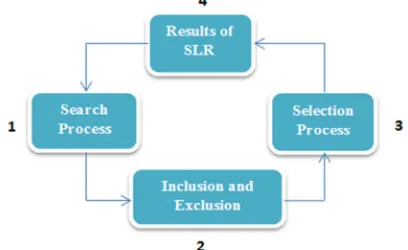
Thus the aim is to synthesize existing evidence in a fair, rigorous, and open manner. After specifying research questions a review protocol is developed; this includes definitions of: (1) the search process, (2) inclusion and exclusion criteria, (3) the selection process and (4) results of SLR
2.1 Search Process
In this review our search identified SLRs addressing risk management, risk assessment, risk mitigation and combining automated and manual searches. We identified peer-reviewed articles published (or available on-line) up to July 2015. Seven search engines and indexing systems plus manual searches of conference proceedings. The search process used seven engines and indexing systems, i.e., ACM Digital library, IEEE Explore, Scopus, Science Direct, Web of Knowledge, Springer- Link and Google Scholar. Search terms used were “Risk assessment” or “Risk management” or “risk tools” or “risk assessment tools” or “risk mitigation tools” or “IT management tools”
2.2 Inclusive and exclusive criteria Articles were included if they reported SLRs or meta-analyses in risk mitigation tools. If they were published in, or submitted to, a conference or journal or were technical reports or book chapters, if the papers were written in English. Articles were excluded if they not described in detail or a structured template is lacking, new and similar study exists and review or evaluation of existing tools for risk mitigation.
2.3 Paper Selection
[image:3.612.93.297.360.485.2]In this SLR papers selection result from the automated and manual searches. The search resulted in the identification of 15 studies reviewed from 19 papers. 11 risk tool studies are been reviewed for further investigation. The sources includes journal and conference proceeding (refer Table 1 and 2).
Table 1: List of Journals
Journals
Journal of Automation ( jautcon)
Journal of Manufacturing Technology Management Information and Software Technology
Journal of Engineering and Advanced Technology (IJEAT) International Journal of Computer, Communication and information Technology (IJCCIT)
Table 2: List of Conferences
Conferences
18th World IMACS / MODSIM Congress
Proceedings of the 2009 Industrial Engineering Research Conference
IEEE Transactions on Software Engineering IEEE International conference
Proc. of 8th International Conference on Advanced Computer Systems
Proceeding of 7th European Conference on Software Quality SACLA ’2009
18th World IMACS / MODSIM Congress
Proceedings of the 2009 Industrial Engineering Research Conference
GEOMUNDUS, Castellon de la Plana Spain
2009 16th Asia-Pacific Software Engineering Conference IEEE 2011 Chinese Control and Decision Conference (CCDC) Sixth IEEE International Conference on Global Software Engineering Workshops
3. SLR FINDINGS
ISSN: 1992-8645 www.jatit.org E-ISSN: 1817-3195
95 tools system architecture using documentation analysis and previous case reviews, the review is based on data collection of existing works on risk mitigation tools. In this review paper, documentation analysis and previous case reviews are used for knowledge acquisition tools to provide an insight about the mitigation tools functions for the researchers. Documentation analysis of this study includes any fact, risk data, causes of business failure, case studies, and firms’ strategies for key decisions in the field of software engineering projects. Analysis and synthesis of existing documentation provide an overview of existing domain knowledge In addition knowledge can be acquired by a review of previous cases [11]. A total of 19 studies discuss SLR relating to risk and risk tools in IT. Citations for the papers and other relevant papers are included in the reference for further reading.
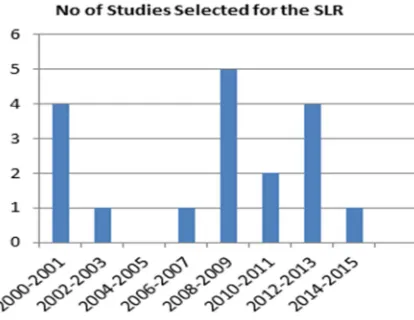
Figure 2 shows that out of the 18 studies, 4 are chosen from 2000-2001, 1 paper is chosen from 2002-2003. No paper was chosen from 2004-2005, only 1 paper is choose from 2006-2007, 5 papers are chosen from 2008-2009, 2 papers are chosen from 2010-2011, 4 papers are chosen from 2012-2013, 1 paper is choose from 2014-2015.
3.1 Importance of Risk Mitigation Tool in Software Management
[image:4.612.93.300.325.485.2]By investigating the three research questions, a broad picture of the literature is gained. To answer (RQ1); what are the importance of risk mitigation tools in IT? 13 literatures were identified in answering RQ1 as shown in Table 3.
Table 3: RQ and references in the SLR
The risk mitigation tools can help in IT management in several ways such as in the identification of critical risk that influence the successful outcome of IT process and enable team members and other decision makers to identify the risks associated with IT process [11, 5, 12, 7, 8, 6, 2]. These tools also provide support for policy and decision makers through effective sharing of knowledge to make reliable decisions under the consideration of risks associated with each phase of key decisions [13, 7, 6]. These tools support risk documentation results on risk mitigation actions, by helping to estimate the probability and magnitude of operational, technical and strategic risks, introduces risk mitigation advice to users and designing appropriate strategic alternatives to mitigate or avoid the unfavourable impacts of risk factors on IT project outcomes [1, 12]. [7] mentioned that mitigation tools supports knowledge that enables the use of organisational knowledge, lessons learnt, captured as well as best practices to minimize risks in IT management. They mention that these tools not only supports the decision-making process of the user, but also aids the knowledge retrieving, storing, sharing and updating management of IT process [7, 6, 2, 4].
Risk mitigation tools provide support for the reuse of knowledge gained from other software projects, which had already managed similar problems [12]. [2] highlighted that these tools provide risk reduction advice as mitigation strategies and also argued that the mitigation tools provide knowledge based which infers simple advice and explanation to team members and caters for risk monitoring, maintaining and communicating among the existing or significant risk factors [11, 13, 2]. Lastly [3] explained that risk mitigation tool support multiple projects at a
Research Questions (RQ)
Paper references
Frequency (studies)
The importance of risk mitigation tools in IT
[11], [5], [12], [7], [8], [6], [2], [13], [1],[4] [3], [4] and [12]
13
Existing risk tool, purpose, functionalities, architecture, and limitations of the existing risk mitigation tool?
[1], [2], [6],[8], [4], [7], [10], [9], [12], [13] and [11]
11
Approaches used by existing risk mitigation tools
[6], [11], [7], [3], [4], [13] [9] and [10]
8
ISSN: 1992-8645 www.jatit.org E-ISSN: 1817-3195
96 time with independent risk identification and assessment processes. They summarize by mentioning that in addition the tool offers various options supporting risk tracking and risk history analysis and access control mechanisms [3]. With reference to the papers reviewed by the researchers relating to risk mitigation tools for software management. Form the total papers 11 different tools were proposed by different researchers. The risk tools are mentioned in the next section.
3.2 Existing Risk Mitigation Tools
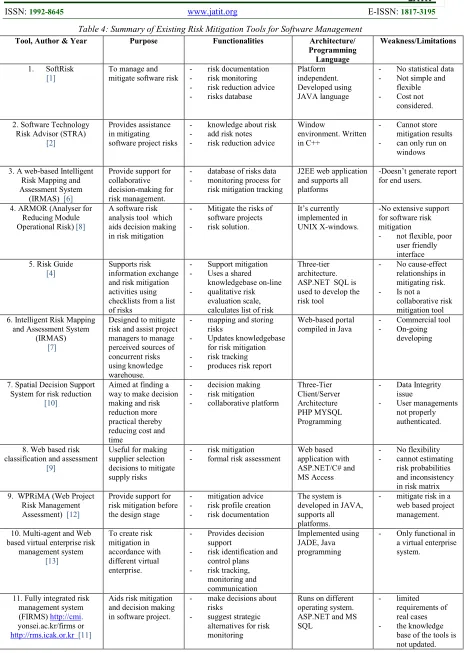
To answer (RQ2); what are the existing risk tool, purpose, functionalities, architecture, and limitations of the existing risk mitigation tool? 11 literatures were identified in answering RQ2 as shown in Table 3. Table 4 summarised the tool. Existing risk mitigation tools in information technology management assist to treat risk in IT. One of these tools is SoftRisk developed by [1] to manage and mitigate software risk. The tools supports risk documentation step. The tool has a graph builder to for risk monitoring task. Assists to estimate the probabilities and magnitudes of software risks by using quantitative data for internal calculations to get increased accuracy and qualitative data for user evaluation to make it easy for the users. The tool introduces risk reduction advice in terms of risk mitigation plan. It provides risks database which saves all important data about identified risk. But the tool does not produce statistical data for statistical operations. [2] proposed a Software Technology Risk Advisor (STRA) that uses a knowledge based tool that provides assistance in identifying and mitigating software project risks to provides knowledge about risk to users who are not familiar with current software issues. It provides a medium for users to add risk notes and Provides risk reduction advice.
[6] developed a web-based Intelligent Risk Mapping and Assessment System (IRMAS) to support collaborative decision-making through the effective sharing of risk information for risk management, the uses database that stores information such as the relative importance of key success factors and lessons learnt/best practices. The information was collected through multiple interviews with domain experts. The tool uses a monitoring process that involves the tracking of risk levels over time as a result of implemented mitigation strategies. [8] proposed a ARMOR (Analyser for Reducing Module
Operational Risk). The tool is a software risk analysis tool which automatically identifies the operational risk of software project, for project management and engineering decisions. The tool measures the risks of software projects, identifies the source of risks and indicates how to mitigate the risk, analyses the identified software risk and provides users with an option to choose any risk solution.
[4] suggest Risk Guide that supports effective information exchange about risks and covers risk identification, risk analysis and risk mitigation activities by supporting management of risk checklists from a list of risks. Once the analysis is completed, the resulting list of the most important risks can be published in a risk assessment report. [7] presented an intelligent Risk Mapping and Assessment System (IRMAS) to identify, prioritize, analyse and assist IT managers to manage perceived sources of concurrent risks. Its unique knowledge warehouse enables the use of organizational knowledge; lessons learnt, captured as well as best practices to mitigate risks. It is designed to be used as a decision support tool for decision-makers. It carts for mitigation of risk via knowledge sharing, decision sharing, process sharing and resources sharing in software projects.
ISSN: 1992-8645 www.jatit.org E-ISSN: 1817-3195
97 pattern based on the risk list in the database. [13] developed a multi-agent and web based virtual enterprise risk management system to create risk mitigation and control in accordance with different virtual enterprise. By using lot of knowledge and rules of expert system for risk mitigation decisions, then generates specific risk mitigation plan for decision-making process. [11] developed a fully integrated risk management system to aid risk mitigation and decision making pertaining to project risk by identifying critical risk factors that influence the successful outcome of the project. The tool assist the project manager to make reliable decisions under the consideration of risks associated with each phase of key decisions. The tool suggests appropriate strategic alternatives to mitigate the unfavourable impacts of risk factors on project outcomes.
3.3 Approach Used By Existing Risk Mitigation Tools
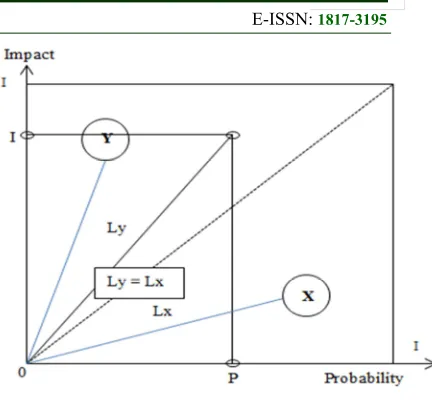
[image:6.612.328.544.72.275.2]To answer (RQ3); what are the approaches used by existing risk mitigation tools? 8 literatures were identified in answering RQ1 as shown in Table 3. Existing tool uses the traditional approach. Risk variables have traditionally been mitigated by two criteria, probability and impact. Probability is used to quantify perceived risk levels. These probability values are collected by interviewing a panel of domain experts and using historical data captured in the form of lessons learnt and best practices [6]. Whereas the impact of each identified risk is derived from the product of the risk’s likelihood and consequence. The likelihood of risk is defined as the relative frequency of risk event occurrence. That is, risk with a certain level of impact brings loss with constant probability. Suppose that the point “X” is high probability-low impact risk, and the point “Y” is low probability-high impact risk. In this case, actually, risk “Y” is recognized as more important than “X” because of its noteworthy impact size. Nevertheless, the risk levels of “X” and “Y” are calculated as the same value in the PI method by not reflecting this difference [11, 7].
Figure 3: Method used by existing tools to mitigate risk
Figure 3 shows the current approach used by existing tools to mitigate risk by using risk graph which measured by the “probability that happen” and “impact by risks in proportion to the degree of actual risk.”
3.3.1 Web Based System Architecture For
Risk Mitigation
ISSN: 1992-8645 www.jatit.org E-ISSN: 1817-3195
[image:7.612.94.295.552.679.2]98 Figure 4: Web based risk mitigation
Figure 2 shows how the web based risk mitigation system is divided into four components, which are distributed geographically, and connected through the network. Access between the components is transparent and has nothing to do with location. Among them, the knowledge server is responsible for the storage and maintenance of data; application server is to complete the services; Web server is responsible for providing a variety of applications to risk mitigation team members through the browser [3, 4, 13]. The web based risk mitigation uses a client server formed on a three-tier distributed application concept and the risk mitigation members are connected via network. The three tiers are highly independent. The system code modules are written individually for each tier. They communicate through program interfaces function calls. As all the server applications for the tiers are developed by the same vendor, no compatibility problems arise [3, 4, 6, 9, 11].
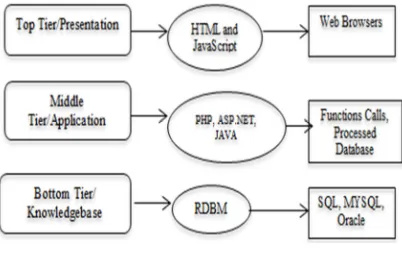
Figure 5: Three tier architecture for risk mitigation
Figure 5 show the three-tier architecture for risk mitigation system or tool. The architecture provides three layers where each layer deals with different level of responsibilities. From figure 5 it can been shown that the composition of the architecture. The top tier or presentation layer is part of the user interface, the Middle tier is the core of the system for business logic and the bottom tier handles the data storage. One of the advantages of this architecture (Three tier architecture) is easier to make changes in database layer without influencing the other layers [10]. The code was written using different programming languages (such as Java, PHP or .NET), but nearly all data types were compatible and the values were automatically converted by the servers [4]. Risk mitigation tools deployed via the web encapsulate of data processing and minimal software requirements for client workstations, possess multi-access and effective communication in distributed teams and easy system maintenance, open user interface and Short time of system development.
4. DISCUSSION
[17] mentioned that risk is the probability of suffering loss while pursuing goals due to factors that are unpredictable or beyond. Risk mitigation is any activity or tactic employed to alleviate the impact or the occurrence of risks associated with challenges or problem. According to [17] mitigating risk is essential to a successful organisation [6], including IT process and projects. The main process of risk mitigation is the identification and selection of appropriate risk mitigation strategies [6]. Risk mitigation in IT is deemed to be more difficult to carryout due to limited knowledge of challenges associated with IT, even by the most experienced IT managers and practitioners. Risk mitigation in IT also needs to be performed in different types of risk, strategic, technical, and operational risk. In strategic and technical risk, risk mitigation is required to aid decision making whether to distribute the project or not. At the operational risk mitigation directly relates to IT processes and normally it is performed by IT manager or IT experts [17, 18, 19].
ISSN: 1992-8645 www.jatit.org E-ISSN: 1817-3195
99 structure form the decision makers and practitioners in the organisation. The technical risk results from rapidly changing working environment and technological problems software, hardware and communication devices [18]. To date there is insufficient tool or software for efficient and effective risk mitigation, using systematic approaches to mitigate risk in information technology management processes [8, 6]. Although many approaches have been proposed to mitigate risks in IT process, none of these approaches attempt to codify knowledge gained from previous software process. Although risk knowledge helps risk mitigating team to identify new unobserved risks, which can be considered as a new process for risk identification [12].
Existing mitigating tools lacked capabilities to support practitioners, experts and IT managers in identifying and mitigate risks in information technology. There are limited risk tools available that can capture and reuse the lessons learnt from previous projects, case studies and best practices, to utilize and share the previous as well as existing knowledge and experience within the companies. Also these tools lacks in assistance to practitioners, experts and IT managers in identifying the gaps, conflicts and propagation of risks [7]. [6] added that the effectiveness of IT risk mitigation is limited due to the degree of data sharing and reuse as well as the available support for decision-making in IT projects as such limitations on information availability prevent proper risk mitigation from reaching its full potential [6]. Lastly existing risk mitigation tools do not support risk documentation, using historical data. These tools don’t have graphic representation, and statistical analysis which can carter for risk management operations. Existing tools also do not provide the user with assistance to estimate the probability and magnitude of risks. These tools do not provide the risk mitigation advice that is a guide to support software project managers in mitigating risk effectively [2, 1]. They do not cover some important aspects (e.g. risk monitoring) effectively, and most of them are not automated.
5. CONCLUSION AND FURTHER
RESEARCH
Risk is defined as the chance of certain occurrences adversely affecting project objectives. Risk mitigation practices in IT
projects aims at early identification and recognition of risks and then actively changes the course of actions to mitigate and reduce the risk via risk identification, risk decision, risk treatment and risk monitoring [6]. IT management is project management process which purpose is to identify potential problems before they occur so that risk-handling activities can be planned and invoked as needed across the life of the IT process to mitigate adverse impacts on achieving objectives [5]. A risk mitigation tool is needed to provide expert assistance during IT risk mitigation activities. The knowledge about risk can be useful to practitioners who are not familiar with current IT issues. Also risk data from experts are stored in the tools knowledgebase.
The findings of this review show that existing risk mitigation tools do not effectively mitigate risks in IT efficiently. The existing tools risk probability and risk impact for mitigating risk. Thus there is a need for a risk mitigation tool which can support the mitigation of operational, technical and strategic risks. Further research will aim at developing a risk tool that can support the mitigation of I operational, technical and strategic risks. This tool will assist decision making policy makers in risk decision, risk treatment and risk monitoring and communication.
ACKNOWLEDGEMENT
We are grateful for the Ministry of Education Malaysia financial support for the project.
REFERENCES
[1] A.K. Ayad and H. Khairuddin, “A model and prototype tool to manage software risks,”
IEEE international conference, 2000, pp.
297-305.
[2] T. Gregory, “Software Technology Risk Advisor,” IEEE international conference, 1995, pp. 179-188.
[3] M. Jakub and G. Janusz, “Software support for collaborative risk management,” proc. of 8th International Conference on Advanced
Computer Systems, October 17-19, 2001,
Mielno, Poland, pp. 1-9.
ISSN: 1992-8645 www.jatit.org E-ISSN: 1817-3195
100
Quality June, 10-12 2002, Helsinki, Finland,
pp. 1-12.
[5] D. John, I. Nhamu and A. Kachepa, “Intelligent Risk Management Tools for Software Development,” SACLA, 2009, 29 June-1 July, Mpekweni Beach Resort, South Africa, pp. 33-40.
[6] Y.B. Khoo, M. Zhou and B. Kayis, “An approach to rapid prototyping for a web-based risk management system,” 18th World
IMACS / MODSIM Congress, Cairns,
Australia 13-17 July 2009, pp. 4305-4311. [7] B. Kayis, M. Zhou, S. Savci, Y.B. Khoo, A.
Ahmed, R. Kusumo, and A. Rispler, “IRMAS – development of a risk management tool for collaborative multi-site, multi-partner new product development projects," Journal of Manufacturing
Technology Management, Vol. 18 No. 4,
2007, pp. 387 – 414.
[8] R. L. Michael, J. Yu, S. Keramidas and S. R. Dalal, “ARMOR: Analyzer for Reducing Module Operational Risk,” IEEE
international conference, 1995, pp. 137-142.
[9] S. H. Rajesh and M. A. Suraj, “Application of Web Based Supplier Risk Assessment for Supplier Selection,” Proceedings of the 2009
Industrial Engineering Research Conference,
pp. 2259-2264.
[10]O. Roya, Z. C. Aye, and M. Jaboyedoff, “Development of a prototype for Spatial Decision Support System in risk, reduction based on open-source web-based platform,”
GEOMUNDUS, 15-16 Nov, 2013 Castellon
de la Plana Spain, 2013, pp. 1-6.
[11]H. H. Seung, D. Y. Kima, H. Kim and W. Jang, “A web-based integrated system for international project risk management,”
Journal of automation, Vol. 9 , No. 26, 2009,
pp. 342 – 356.
[12]A. Thamer, S. Sulaiman and R. A. Salam, “Project Management Using Risk Identification Architecture Pattern (RIAP) Model: A case study on a Web-based application,” 16th Asia-Pacific Software
Engineering Conference, 2009, pp. 449-456.
[13]S. Xianli, M. Huang, and X. Wang, “Web and Multi-agent Based Virtual Enterprise Risk Management System,” IEEE 2011 Chinese Control and Decision Conference
(CCDC), pp. 902-906.
[14]B. Kitchenham and S. Charters. Guidelines for performing systematic literature reviews in software engineering, 2007, pp. 1-100. [15]J. M. Verner, O. P. Brereton, B. A.
Kitchenham, M. Turner and M. Niazi, Risk Mitigation Advice for Global Software Development from Systematic Literature Reviews, School of Computing and Mathematics Keele University Keele,
Staffordshire, ST5 5BG UK, pp. 1-12.
[16]J. M. Verner, O. P. Brereton, B. A. Kitchenham, M. Turner and M. Niazi, Risks and risk mitigation in global software development: A tertiary study, Information
and Software Technology, Vol. 5, No. 6,
2014, pp. 54–78.
[17]I. Nurdiani, R. Jabangwey, D. Smitey, D.Damian, “Risk Identification and Risk Mitigation Instruments for Global Software Development: Systematic Review and Survey Results" 2011 Sixth IEEE International Conference on Global Software
Engineering Workshops, Vol. 5, No. 1, 2011,
pp. 36-40.
[18] M. A. Khan, S. Khan, M. Sadiq, “Systematic Review of Software Risk Assessment and Estimation Models”, International Journal of Engineering and Advanced Technology
(IJEAT) Vol. 1, No. 4, 2012, pp. 298-305.
[19]N. Mittal and V. Bhasin, Software Risk Assessment and Estimation Models-A Review, International Journal of Computer, Communication and Information Technology
ISSN: 1992-8645 www.jatit.org E-ISSN: 1817-3195
[image:10.612.86.552.70.723.2]101
Table 4: Summary of Existing Risk Mitigation Tools for Software Management
Tool, Author & Year Purpose Functionalities Architecture/
Programming Language
Weakness/Limitations
1. SoftRisk
[1]
To manage and mitigate software risk
- risk documentation - risk monitoring - risk reduction advice - risks database
Platform independent. Developed using JAVA language
- No statistical data - Not simple and
flexible - Cost not
considered.
2. Software Technology Risk Advisor (STRA)
[2]
Provides assistance in mitigating software project risks
- knowledge about risk - add risk notes - risk reduction advice
Window
environment. Written in C++
- Cannot store mitigation results - can only run on
windows
3. A web-based Intelligent Risk Mapping and Assessment System
(IRMAS) [6]
Provide support for collaborative decision-making for risk management.
- database of risks data - monitoring process for
risk mitigation tracking
J2EE web application and supports all platforms
-Doesn’t generate report for end users.
4. ARMOR (Analyser for Reducing Module Operational Risk) [8]
A software risk analysis tool which aids decision making in risk mitigation
- Mitigate the risks of software projects - risk solution.
It’s currently implemented in UNIX X-windows.
-No extensive support for software risk mitigation
- not flexible, poor user friendly interface 5. Risk Guide
[4]
Supports risk information exchange and risk mitigation activities using checklists from a list of risks
- Support mitigation - Uses a shared
knowledgebase on-line - qualitative risk
evaluation scale, calculates list of risk
Three-tier architecture. ASP.NET SQL is used to develop the risk tool
- No cause-effect relationships in mitigating risk. - Is not a
collaborative risk mitigation tool 6. Intelligent Risk Mapping
and Assessment System (IRMAS)
[7]
Designed to mitigate risk and assist project managers to manage perceived sources of concurrent risks using knowledge warehouse.
- mapping and storing risks
- Updates knowledgebase for risk mitigation - risk tracking - produces risk report
Web-based portal compiled in Java
- Commercial tool - On-going
developing
7. Spatial Decision Support System for risk reduction
[10]
Aimed at finding a way to make decision making and risk reduction more practical thereby reducing cost and time
- decision making - risk mitigation - collaborative platform
Three-Tier Client/Server Architecture PHP MYSQL Programming
- Data Integrity issue
- User managements not properly authenticated.
8. Web based risk classification and assessment
[9]
Useful for making supplier selection decisions to mitigate supply risks
- risk mitigation - formal risk assessment
Web based application with ASP.NET/C# and MS Access
- No flexibility - cannot estimating
risk probabilities and inconsistency in risk matrix 9. WPRiMA (Web Project
Risk Management Assessment) [12]
Provide support for risk mitigation before the design stage
- mitigation advice - risk profile creation - risk documentation
The system is developed in JAVA, supports all platforms.
- mitigate risk in a web based project management.
10. Multi-agent and Web based virtual enterprise risk
management system
[13]
To create risk mitigation in accordance with different virtual enterprise.
- Provides decision support
- risk identification and control plans - risk tracking, monitoring and communication
Implemented using JADE, Java programming
- Only functional in a virtual enterprise system.
11. Fully integrated risk management system (FIRMS) http://cmi. yonsei.ac.kr/firms or http://rms.icak.or.kr [11]
Aids risk mitigation and decision making in software project.
- make decisions about risks
- suggest strategic alternatives for risk monitoring
Runs on different operating system. ASP.NET and MS SQL
- limited requirements of real cases - the knowledge