c:
RESEARCH, INC.
CRAY COMPUTER SYSTEMS
PASCAL REFERENCE MANUAL
C=1'=li*"
...."
RECORD OF REVISION RESEARCH, INC. PUBLICATION NUMBER SR-0060
Each time this m~nu~1 is r~vised and reprint~d, all changes issued against the previous version are incorporated into the new version and the new version IS assigned an alphabetic level.
Every page chan~ed by a re~rint. with revisio~ has the revision level in the lower righthand corner. Changes to part of a page are noted by ~ change. bar m the margm dm~ctly o~poslte the c~a!1ge. A change bar in the margin opposite the page number indicates that the entire page IS new. If the manual IS rewntten, the revIsion level changes but the manual does not contain change bars.
Reql;lest.s for copies of C~ay Research, Inc. publications should be directed to the Distribution Center and comments about these publications should be directed to:
CRAY RESEARCH, INC. 2520 Pilot Knob Road Suite 310
Mendota Heights, Minnesota 55120
Revision
A
B
Description
September
1983 -Original printing.
September
1984 -This reprint with revision updates the manual
for Pascal release 2.0.
It adds the VALUE definition; the
VIEWING statement; the IMPORTED, EXPORTED, COMMON, and STATIC
variable declarations; the LaC function under pointer types;
the SIZEOF function under DISPOSE; new compiler options; and
new messages.
Material from appendix F in the initial release
is now incorporated in subsection
2.3.Miscellaneous
technical and editorial corrections were also made.
This
manual obsoletes all previous printings.
January
1986 -This reprint with revision updates the manual
for Pascal release
3.0.Release
3.0adds a set of array
processing constructs; automatic vetorization of FOR loops
that comply with Pascal vectorization rules; CPU targeting;
additional debugging and listing options; constant expressions
in constant definitions; the sharing of data in FORTRAN TASK
COMMON blocks; the
132data type; conditional expressions; and
various changes for running under the Cray operating system
UNICOSt.
Changes have been made to the Pascal syntax to
accommodate the changes and additions for this release.
This
reprint also includes miscellaneous technical and editorial
corrections.
This manual obsoletes all previous printings.
t
UNICOS is derived from the AT&T UNIX system; UNIX
is
atrademark of
AT&T Bell Laboratories.
PREFACE
This publication is a reference manual for the Pascal programming
language as implemented by Cray Research, Inc. (CRI). It is not a
tutorial, although i t does illustrate the use of Pascal with frequent examples.
Many books that teach the language are available. The following
publications are frequently used descriptions of Pascal:
Cooper, Douglas.
Standard Pascal User Reference Manual.
NewYork: W. W. Norton.
Grogono, Peter.
Programming in Pascal.
Addison-Wesley, 1978.Jensen, Kathleen and Niklaus Wirth.
Pascal User Manual and
Report.
3rd ed. New York: Springer-Verlag, 1985.Wilson, Ian and Tony Addyman.
A Practical Introduction to Pascal.
MacMillan and Springer-Verlag, 1978.
The book by Wilson and Addyman includes a complete description of the International Standards Organization (ISO) Pascal standard, ISO/DIS
7185. The following CRI publications may also be helpful to the Pascal
programmer:
SR-0011 SR-0012 SD-0061 SR-0113 SM-0114 SR-2011 SR-2013 SR-2014
COS Version 1 Reference Manual Macros and Opdefs Reference Manual Pascal Internal Reference Manual Programmer's Library Reference Manual System Library Reference Manual
UNICOS Commands Reference Manual
CONTENTS
PREFACE . • • • • • . • • • . • • • • • • • • • • • • • . • • • • • i i i
1.
2.
3.
INTRODUCTION • •
1.1 1.2 1.3
EXTENSIONS RESTRICTIONS • CONVENTIONS
USING PASCAL ON A CRAY COMPUTER
2.1
2.2
2.3 2.4
2.5
USING PASCAL UNDER COS
· ·
· · · ·
2.1.1 JCL file
. .
.
·
·
2.1.2 COS PASCAL control statement
· .
.
USING PASCAL UNDER UNICOS
·
· ·
· .
·
2.2.1 UNICOS pascal command line
.
·
COMPILER DIRECTIVES
·
· · ·
.
. .
.
LISTABLE OUTPUT
.
.
· ·
·
· · ·
2.4.1 2.4.2 2.4.3 2.4.4 2.4.5 2.4.6
Page header lines • • • • • . Source statement listings Error messages . • . • • • •
Cross-reference information • . . • • • •
2.4.4.1 Global identifier cross-reference
2.4.4.2 Procedure cross-reference
Procedure and function list
Identifier information • • • •
2.4.6.1 Types and fields.
2.4.6.2 Constants
2.4.6.3 Local variables
2.4.6.4 Nonlocal identifiers.
2.4.7 Pseudo-CAL listing
CPU TARGETING • . . • • • • • • • • • • • • •
PASCAL VOCABULARY
3.1
3.2 3.3
SPECIAL SYMBOLS
3.1.1 Reserved words • • • • • •
3.1.2 Operators • • • • • • •
3.1.3 Delimiters • • • • • • • • •
PREDEFINED IDENTIFIERS • USER-DEFINED IDENTIFIERS •
3. PASCAL VOCABULARY (continued)
3.4 NUMBERS
·
·
·
·
·
·
· · · ·
·
·
· · ·
3-63.5 CHARACTER STRINGS 3-7
3.6 STATEMENT LABELS
·
· ·
· ·
3-73.7 COMMENTS
·
· · · ·
· · ·
3-84. PROGRAM ORGANIZATION
· ·
4-14.1 PROGRAM HEADING
· · · ·
4-24.2 DECLARATIONS SECTION
· · ·
· · · ·
4-34.2.1 Label declarations
·
· · · ·
4-54.2.2 Constant definitions
·
·
· · ·
4-54.2.3 Type definitions
·
·
· ·
·
·
4-74.2.4 Variable declarations
·
·
·
·
4-84.2.4.1 VAR declaration
·
· · ·
4-94.2.4.2 EXPORTED declarations 4-10
4.2.4.3 IMPORTED declaration
·
·
· · ·
· ·
4-114.2.4.4 STATIC declaration
· · ·
·
·
4-124.2.4.5 COMMON declaration
· · · · ·
4-134.2.4.6 TASKVAR declaration
·
·
· ·
4-144.2.4.7 CACHE declaration
· · ·
·
4-154.2.5 Value definitions
·
·
. ·
· ·
· ·
4-174.2.6 Procedure and function declarations
·
·
·
·
4-215. DATA TYPES
. .
·
·
·
·
· ·
·
·
· · · ·
5-15.1 REPRESENTATION OF SCALAR TYPES
·
·
·
·
5-25.2 INTEGER TYPE
·
·
· ·
·
·
·
·
5-25.3 I24 AND 132 TYPES
·
·
· ·
·
·
· ·
·
5-45.4 REAL TYPE
·
·
·
·
·
·
· ·
5-55.5 BOOLEAN TYPE
·
·
·
·
· · ·
·
·
· ·
·
·
5-75.6 CHAR TYPE
·
· ·
· ·
· ·
· ·
·
·
·
·
5-85.7 ENUMERATED TYPES
·
·
·
· ·
·
·
5-95.8 SUB RANGE TYPES
·
·
·
· · ·
5-105.9 ARRAY TYPE
· · ·
·
·
·
·
· ·
·
· ·
·
5-115.9.1 Packed arrays 5-12
5.9.2 Multidimensional arrays
·
· · ·
5-145.9.3 Strings
·
·
·
·
· · · ·
5-155.10 TYPE ALFA
·
·
·
· · ·
·
· · ·
·
5-165.11 RECORD TYPES
· ·
·
· ·
· · ·
·
·
·
5-175.11.1 Variant fields
·
· · · ·
5-185.11.2 Packed records
·
5-195.11.3 Accessing record fields 5-21
5.12 SET TYPES
·
·
·
·
· ·
·
·
· ·
·
5-225.13 FILE TYPES
·
·
·
· ·
5-245.14 POINTER TYPE
· ·
· ·
5-266.
ARRAY PROCESSING
·
· · ·
·
·
·
·
·
· · ·
· ·
· ·
·
·
6-1
6.1
ARRAY EXPRESSIONS - BINARY
ANDUNARY OPERATORS
· · ·
6-1
6.2
REDUCTION FUNCTIONS
· ·
·
·
6-3
6.3
CONSTRUCTED ARRAYS
· ·
·
·
· · ·
·
6-4
6.3.1
Array-valued subscripts
· · · ·
6-5
6.3.2
Slice index specification
· · ·
·
6-5
6.3.3
Array-valued field and pointer accesses
· · · ·
6-7
6.4
ARRAY MERGES
· · ·
·
· · · ·
6-7
6.5
RELATIONAL OPERATORS
·
· ·
· ·
· ·
·
· · ·
6-9
7.
WITH AND VIEWING STATEMENTS
·
·
·
7-1
7.1
WITH STATEMENT
·
·
·
·
·
·
·
7-1
7.2
VIEWING STATEMENT
·
·
·
·
· · ·
·
7-2
8.
ASSIGNMENT STATEMENT AND PROGRAM CONTROL STATEMENTS
· ·
·
·
·
8-1
8.1
COMPOUND STATEMENTS
· ·
·
·
·
·
· ·
8-1
8.2
ASSIGNMENT STATEMENT
· · · ·
8-2
8.2.1
Conditional expressions
·
·
·
·
8-4
8.3
IF STATEMENT
·
· ·
·
·
8-4
8.4
CASE STATEMENT
·
8-6
8.5
GOTO STATEMENT
· ·
·
·
·
· ·
·
· ·
·
·
8-7
8.6
FOR STATEMENT
· · · ·
·
· ·
· ·
8-8
8.7
REPEAT STATEMENT
·
· ·
· · ·
· · ·
·
8-11
8.8
WHILE STATEMENT
· ·
·
·
·
· ·
·
8-11
9.
PROCEDURES AND FUNCTIONS
·
·
· · ·
·
·
·
9-1
9.1
PROCEDURES
· ·
·
·
·
·
· · ·
·
· ·
· · · ·
9-1
9.2
FUNCTIONS
· ·
· ·
·
· ·
·
9-4
9.3
PARAMETERS
·
·
·
·
·
9-5
9.3.1
Value and VAR parameters
·
9-5
9.3.2
Procedure and function parameters
·
·
·
·
9-7
9.3.3
Conformant array parameters
· ·
· ·
9-9
9.4
PROCEDURE AND FUNCTION DIRECTIVES
· ·
·
· ·
9-11
9.4.1
FORWARD directive
· ·
·
·
9-11
9.4.2
EXTERNAL directive
·
·
· ·
9-12
9.4.3
FORTRAN directive
·
· ·
9-13
9.4.4
IMPORTED and EXPORTED directives
·
9-14
9.5
RECURSIVE PROCEDURES AND FUNCTIONS
· ·
·
·
· ·
9-17
9.6
PREDEFINED PROCEDURES AND FUNCTIONS
·
·
·
·
·
· · ·
9-18
10.
INPUT AND OUTPUT
·
· ·
·
·
·
·
10-1
10. INPUT AND OUTPUT (continued)
10.2 BUFFER VARIABLE
·
. .
10.3 GET AND PUT10.4 READ AND WRITE
.
·
10.5 READLN AND WRITELN.
.
10.6 FORMATTING OUTPUT10.7 CONNECT
. .
.
. ·
·
·
· ·
. .
· · · ·
·
·
·
·
· · · ·
.
· ·
· ·
. · ·
.
.
.
10-2 10-2 10-3 10-5 10-7 10-911. DYNAMIC ALLOCATION • • • • • • • • • • • • • • • • • • • • • • 11-1
12. MODULES
13. VECTORIZATION AND OPTIMIZATION.
13.1 VECTORIZATION 13.2 OPTIMIZATION • •
APPENDIX SECTION
A. B. C.
D.
E. F.CHARACTER SET
PREDEFINED FUNCTIONS AND PROCEDURES
COMPILER ERROR MESSAGES
C.1 C.2
LISTING MESSAGES • LOGFILE MESSAGES •
RUN-TIME MESSAGES
PASCAL SYNTAX
E.l E.2
SYNTAX LISTING
INDEX OF SYNTAX COMPONENTS
DEBUG INFORMATION
F.l F.2
D+ DEBUGGING INFORMATION . BP+ DEBUGGING INFORMATION
SR-0060
viii
G. ERRORS NOT REPORTED BY CRAY PASCAL • • • • • • • • • • • • • •
H. IIO PROGRAMMING EXAMPLES • • • . • • • • • • • • • • • • • • •
FIGURES 2-1 4-1 5-1 5-2 5-3 5-4 5-5 5-6 5-7 TABLES 2-1 3-1 5-1 5-2 5-3 5-4 5-5 6-1 A-1 B-1 B-2 INDEX
A Typical Job Dataset
. · · ·
·
· ·
·
·
·
·
Sample Organization of a Pascal Program
·
·
·
· ·
Internal Representation of an Unpacked Array
· ·
·
.
Internal Representation of a Packed Array
·
Internal Representation of a String
·
·
· ·
·
·
Internal Representation of a Packed Record
·
· ·
· .
Internal Representation of an Unpacked Record
· ·
Internal Representation of a Pointer (CRAY X-MP and CRAY-1 Computer System)
Internal Representation
System)
. . .
.
Compiler Options Pascal Operators
.
. .
·
·
· ·
·
·
·
of a Pointer
· ·
· ·
·
·
·
Integer Operations . . • . . . .
Real Number Operations . . . .
Boolean Operations . . . .
Str ing Operations . . . • . . . .
Set Operations • • . . . . . • .
Pascal Reduction Functions . . • .
ASCII Character Set . . • . . . . Predefined Functions and Procedures .
·
· · ·
·
(CRAY-2 Computer
·
· ·
· · ·
·
Extensions to the Predefined Functions and Procedures .
1. INTRODUCTION
Pascal is a high level, general purpose computer language designed in
1970 by Professor Niklaus Wirth of the Federal Institute of Technology at
Zurich, Switzerland.
The language emphasizes the virtues of structure,
simplicity, and portability. Using Pascal, you can implement algorithms
and data structures in a high-level, machine-independent manner without
sacrificing efficiency.
The Cray Pascal Compiler transforms Pascal code into machine language
instructions that execute on CRAY-2, CRAY X-MP, and CRAY-1 Computer
Systems.
The compiler and programs created by it run under the Cray
I
operating systems COS and UNICOS.
I
Cray Pascal complies with the Level 1 requirements of standard ISO/DIS
7185, defined by the International Standards Organization (ISO), with
three restrictions.
The restrictions, as well as Cray Research Inc.
(CRI) extensions to the standard, are described later in this section.
This manual notes all CRI extensions.
Section 2 describes the Pascal invocation statement, which tells the
operating system under which Pascal is operating to load and execute the
compiler.
The compiler can be invoked with the UNICOS command line or
the COS control statement.
The UNICOS Commands Reference Manual
describes UNICOS and its system commands in more detail.
The COS Version
1 Reference Manual describes COS and its control statements in more
detail.
Sections 3 through 13 describe both the standard features of Pascal and
the CRI enhancements.
Section 3 provides general information on the language, including its
notation, vocabulary, and format.
Commenting is also described.
Section 4 explains the organization of the program and defines the syntax
for the PROGRAM heading.
Section 5 describes Pascal data types and the statements associated with
them.
Section 6 describes the constructs that are available for array
processing.
I
I
Section 8 explains program control statements, including the simple assignment statement and more complex compound statements.
Section 9 describes procedures and functions, including how they are invoked and how parameters are passed.
Section 10 explains I/O features available with Pascal.
Section 11 describes dynamic allocation and the associated NEW and DISPOSE statements.
Section 12 describes compile units called modules that can be maintained as library routines and called from Pascal programs or other modules.
Section 13 describes automatic vectorization of FOR loops and the optimization of code by the use of specific parameters on the Pascal invocation statement.
Appendixes give the ASCII character set, describe the predefined procedures and functions available, list both compiler and execution error messages, offer a summary of the syntax for Pascal statements, describe debugging aids, list errors not detected by the compiler, and give examples of I/O features.
1.1 EXTENSIONS
The CRI extensions to the ISO Level 1 Pascal standard include the following:
• ALFA is a predefined type specified as an eight-member packed
array of characters.
• Array processing features allow operations on entire arrays as
follows:
Array expressions Array merges
Array relational operators
Array valued field and pointer accesses Slice index specifications
• BY clause allows you to specify an increment index with FOR loops.
• CACHEt declarations allow definition of common blocks residing
in Local Memory
t Available with CRAY-2 Computer Systems only
I
I
I
• COMMON declarations allow FORTRAN common blocks to share data across compile units.
• Conditional expressions can be used on the right-hand side of an assignment statement.
• Constant declarations allow constant expressions.
• $DEBUG is a predefined constant.
• EXTERNAL and FORTRAN procedure and function directives allow using routines outside of a program.
• 124 is a predefined 24-bit integer data type.
• 132 is a predefined 32-bit integer data type.
• IMPORTED and EXPORTED procedures permit the use of previously compiled modules and FORTRAN or Cray assembly language (CAL) subroutines.
• IMPORTED and EXPORTED declarations allow sharing of variables between compile units.
• MODULE compile units allow you to define Pascal procedures, functions, and data without a PROGRAM module.
• Integers can be expressed in octal notation
• OTHERWISE label specifies the action to take when no other label in a CASE statement is selected.
• Identifiers can include special characters ($ ~ @ ).
• STATIC declarations allow a local variable to keep its value between calls to a routine.
• TASKVARt declarations allow TASK COMMON blocks to be specified.
• The predefined procedure and function list is expanded to include the following:
ARCSIN and ARCCOS calculate the inverse of the sine and cosine.
BAND, BOR, BXOR, and BNOT are bit-string Boolean functions that accept integer arguments and return integers.
I
I
CONNECT associates a COS local dataset or a UNICOS file with a Pascal file.
HALT terminates the execution of a program when encountered.
LaC returns the address of a variable.
LOG calculates the common logarithms.
Reduction functions (ANY, ALL, MAXVAL, MINVAL, PRODUCT, and SUM) reduce array expressions into simple values.
LSHIFT and RSHIFT shift an integer argument left or right by a specified number of places.
SINH, COSH, and TANH are the hyperbolic functions.
SIZEOF gives the size of a dynamic variable.
TAN calculates a tangent.
• VALUE definitions initialize variables at compile time.
• VIEWING statement allows a variable to be used to see different
types.
1.2 RESTRICTIONS
Cray Pascal includes the following restrictions to the ISO Level 1 Pascal
standard.
• The commercial at sign (@) cannot be used as a substitute
character for the circumflex (A), as specified by the standard.
The @
is
implemented as a valid character in an identifier (seesection 3, Pascal Vocabulary).
• The maximum line length for a text file is 140 characters. The
standard does not restrict the line length of a text file.
• Some errors specified by the standard are not detected. Appendix
G, Errors not Reported by Cray Pascal, details these errors.
I
1.3 CONVENTIONS
This manual observes the Backus-Naur Form (BNF) conventions in
representing the language's syntax. Any word not enclosed in quotation
marks is called a
nonterminal symbol.
Each nonterminal symbol in a BNFconstruction is defined in turn; however, BNF descriptions are not
expanded fully in the text. For example, the terminal symbols for letter
and digit are not defined every time an identifier is required in the
syntax. See appendix E, Pascal Syntax, for a complete description of
Pascal syntax.
The following notation is used:
Symbol
xly
"x"
[x]
{x}
( )
Description
Indicates that either x or y is valid
Indicates that x is a literal, or terminal, element to be
entered exactly as specified. The terminal elements
include reserved words and predefined identifiers, such as
PROGRAM in the program heading. (The reserved words and
predefined identifiers are listed in section 3, Pascal
Vocabulary. )
Indicates 0 or 1 occurrence of x is valid
Indicates 0 or more occurrences of x are valid
Indicates a grouping. Parentheses have no syntactic
significance of their own. For example:
id
=
(letterl"$"I"'%"I"@") { letterldigitl"_"I"$"I"'%"I"@" } •Indicates the end of a description
In sample programs and programming examples, uppercase indicates reserved words and predefined identifiers, and lowercase indicates identifiers chosen by you.
This manual uses the conventional Pascal definition rather than the COS definition of the word
file.
A Pascal file is the same thing as a COSblocked dataset or a standard UNICOS file. Pascal does not support
2. USING PASCAL ON A CRAY COMPUTER
The Pascal compiler runs under both Cray operating systems, COS and
UNICOS.
The source file of Pascal statements remains virtually the same
regardless of the operating system.
The main differences between using
Pascal under COS and under UNICOS center around how the compiler is
invoked and how the job is executed, since COS is primarily a batch
operating system and UNICOS is primarily interactive.
2.1
USING PASCAL UNDER COS
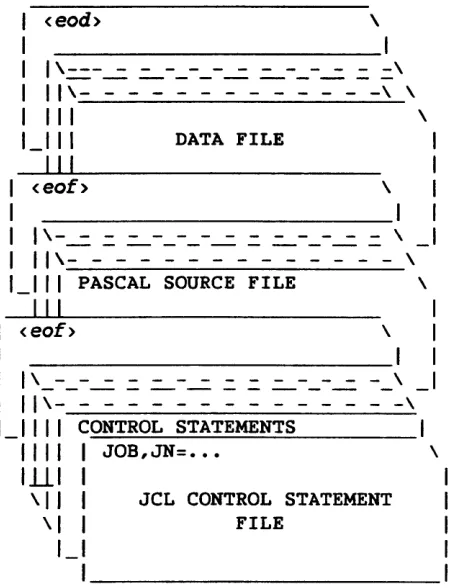
A typical Pascal job on the COS operating system contains the following
files:
•
A job control language (JCL) file of COS control statements
•
A source file of Pascal statements
•
One or more data files (optional)
End-of-file (EOF) indicators divide files from each other.
An
end-of-dataset (EOD) indicator follows the last file.
(The actual
representation of the end-of-fil"e and end-of-dataset indicators depends
on the front-end computer.)
Together these files comprise a job dataset
named $IN by COS.
Figure
2-1shows a COS job dataset with one data file
in card deck format.
The dataset containing the job is typically submitted to the Cray
computer system for processing through a front-end computer.
(The method
of submitting a job depends on the front-end computer.)
A job's output dataset (named $OUT by default) is returned to the
front-end computer when the job completes.
The job's output dataset
includes a program listing (by default), any output created by the job
that is written to file OUTPUTt, and the job's logfile. The COS
Version 1 Reference Manual describes the logfile, which contains a
history of the job and other aspects of running a job on COS.
2.1.1 JCL FILE
I
<eod> \I
I
I 1\==--= =--_-_--= =--_--=
= =\
I
11\-
- - - -\ \
I III \
I_I I I DATA FILE I
III
I
I
<eof> \I
I
I
I
I
1\--=
=
=--_-_--=
=
=--_--=
= \
_I
I
11\- - - \
I_I I I PASCAL SOURCE FILE \
III
I
I
<eof> \I
I I I
I
1\_-_--=
=
=---=
= =
=--_--= - \
_I
I
11\- - - -
- -\
I_I I I I CONTROL STATEMENTS I I I I I I JOB, IN
=. · ·
\
Illl I I
\1 I 1
JCL CONTROL STATEMENTI
\1 I
FILEI
I_I
I
[image:18.612.232.457.63.357.2]1---_1
Figure 2-1. A Typical Job Dataset
A simple Pascal job may contain the following COS control statements in its JCL file:
JOB,JN=TEST. ACCOUNT,AC= PASCAL.
I
SEGLDR,GO.lEaF
The JOB statement is a required statement that defines the job to COS. At the minimum, it must contain a IN parameter to assign the job a name.
The ACCOUNT control statement presents the user's account number, which may be required by a site before access is granted to the system.
I
The PASCAL statement causes the Pascal compiler to be loaded and
executed.
Since no input dataset is specified as a parameter in this
example, the compiler looks for Pascal source statements following the
end-of-file indicator, IEOF.
See the following subsection for a
description of the parameters available on the PASCAL control statement.
The result
ofthe compilation in this example is an executable binary
program.
I
The SEGLDR statement with the GO parameter loads and executes the binary
program.
It also automatically accesses the Pascal run-time library,
$PSCLIB.
I
The COS Version 1 Reference Manual describes these and other control
statements.
2.1.2
COS PASCAL CONTROL STATEMENT
The PASCAL control statement invokes the Pascal compiler under COS.
You
select compiler parameters either explicitly by listing them on the
control statement or implicitly by accepting the default values.
All
parameters are optional and have default values.
The format of the
PASCAL control statement is as follows:
PASCAL[,I=idn]
[,L=ldn] [,B=bdn] [,O=list][,CPU=list].
I=idn
L=ldn
B=bdn
Specifies the dataset containing the Pascal source code.
idn
is the name by which the source code is referenced in
COS.
The default is $IN.
Specifies the dataset to receive the job's list output.
The default for
Idn
is $OUT.
If L=O is specified, all
list output except fatal error messages is suppressed.
Fatal error messages are written to $OUT if L=O.
I
O=list
Specifies compiler options, separated by colons, in effect
at the beginning of the compilation.
Compiler directives
placed inside comments in the Pascal program override the
initial settings.
For more information about compiler
directives, see Compiler Directives later in this section.
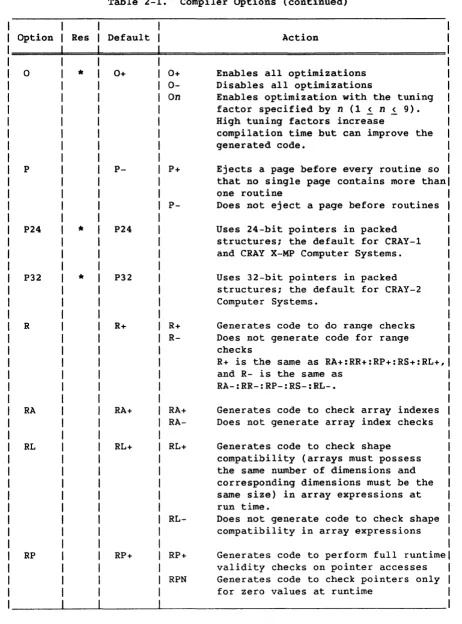
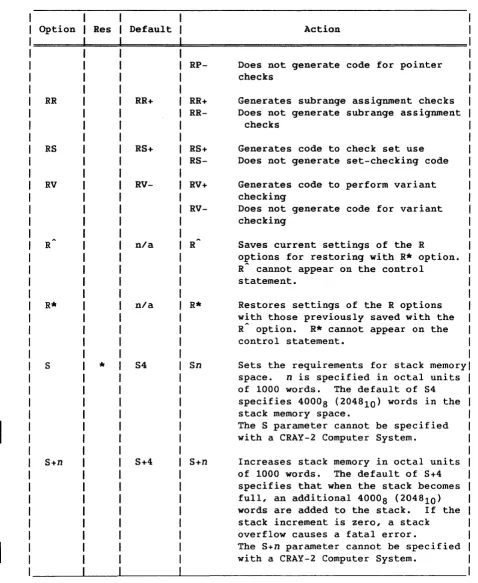
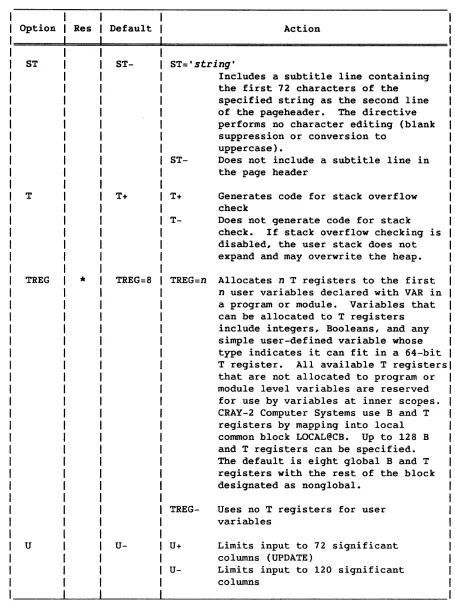
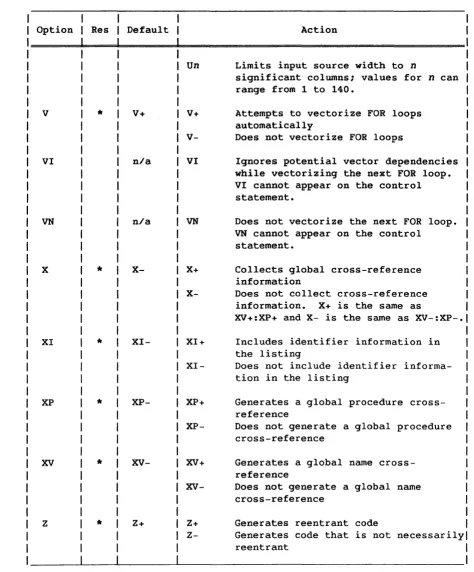
As listed in table 2-1, defaults are as follows:
A-:BP-:BREG=B:BT-:C-:D+:DEBUG-:DMO:H2:H+24:L+:O+
A:P-:P24:R+:RV-:S4:S+4:ST-:T+:TREG=B:U-:V+:X-:Z+
CPU=list
Specifies the characteristics of the Cray Computer System
for which Pascal is to generate code.
The format of the
CPU command is as follows:
SR-0060
CPU = [
primary] { ":"characteristic }
primary
can be one of the following:
Target
Machine Description
CRAY-X4
Generates code for a four-processor
CRAY X-MP
CRAY-X2
Generates code for a dual-processor
CRAY X-MP
CRAY-Xl
Generates code for a single-processor
CRAY X-MP
CRAY-XMP Generates code for a single-processor
CRAY X-MP that also runs on four-processor
and dual processor CRAY X-MPs
CRAY-IM
Generates code for a CRAY-1 Model M
CRAY-lS
Generates code for a CRAY-l Model S
CRAY-IB
Generates code for a CRAY-l Model
BCRAY-IA
Generates code for a CRAY-l Model A
CRAY-l
Generates code for a CRAY-l Model A that
also runs on CRAY-l Models B, S, and M
characteristic
can be one of the following traits:
Trait
---EMA
NOEMA
CIGS
NOCIGS
VPOP
NOVPOP
Description
Causes Pascal to generate 24-bit A register
immediate load instructions, where
necessary, and allows the use of common
blocks larger than 4 million words
Disables the generation of 24-bit A
register immediate load instructions and
disallows the use of common blocks larger
than 4 million words
Enables compressed index and gather/scatter
Disables compressed index and gather/scatter
Enables vector population and parity
Disables vector population and parity
READVL
Enables vector length read instructions
NOREADVL Disables vector length read instructions
MEMSIZE
The format of the MEMSIZE option is as
follows:
BDM
NOBDM
MEMSIZE
=
n [ "K"I
"Mil ] •
MEMSIZE is n
*
1024 words for nK and
n
*
1048576 words for
nM.Enables bidirectional memory
Disables bidirectional memory
The CPU option cannot be specified with a CRAY-2 Computer
System.
For more information about the CPU parameter, see
CPU Targeting later in this section.
2.2 USING PASCAL UNDER UNICOS
Since UNICOS is an interactive operating system, you need not include a
JCL file in with the Pascal source statements as is the case with COS.
In fact, UNICOS does not support multifile datasets.
The source
I
The following commands show how to run a Pascal program on UNICOS. (The
$ is the default UNICOS prompt.)
$ pascal -i test.p $ ld a.o
$ a.out <test. data
The first command invokes the Pascal compiler, which compiles the source statements found in the file test.p and generates an executable file with
the default file name a.o. If test.p is not in the current directory,
you can specify a path name.
The ld command loads the a.o file from the compilation and names i t
a.out. The a.out command, with the data file test. data as input,
executes the binary program.
2.2.1 UNICOS PASCAL COMMAND LINE
The pascal command line invokes the Pascal compiler under UNICOS. You
select compiler parameters either explicitly by listing them on the
command line or implicitly by accepting the default values. All
parameters are optional and have default values. The format of the
pascal command line is as follows:
pascal -i
idn
-1ldn
-bbdn
-0list
-i
idn
Specifies the file containing the Pascal source code. Whenidn
is not a complete path name, the input file defaults-1
ldn
-b
bdn
-0
list
SR-0060
to a working directory. The default is stdin.
Specifies the file receiving the job's list output. If
- l O i s specified, all list output is suppressed. The default is stdout.
Specifies the file rece1v1ng the binary load modules generated by the compiler; the default is a.o.
Specifies compiler options, separated by commas, in effect
at the beginning of the compilation. The compiler options
available under UNICOS are generally the same as the
compiler options available under COS. Table 2-1 notes
differences among CRAY-2, CRAY X-MP, and CRAY-1 Computer Systems and between COS and UNICOS.
Compiler directives placed inside comments in the Pascal
program override the initial settings.
The defaults on a
CRAY-1 or a CRAY X-MP Computer System running UNICOS are as
follows:
A-,BP-,BREG=8,BT-,C-,D+,DMO,L+,O+,P-,
P24,R+,RV+,ST-,T+,TREG=8,U-,V+,X-,Z+
The defaults on a CRAY-2 Computer System are as follows:
A-,BP-,BREG=8,BT-,C-,D+,DMO,L+,O+,P-,
P32,R+,RV+,ST-,T+,TREG=8,U-,V+,X-,Z+
2.3 COMPILER DIRECTIVES
Directives are issued to the Pascal compiler in two ways:
•
As arguments to the
0(options) parameter on the PASCAL control
statement
•
Within comments in the Pascal source code (restricted for some
directives; see introduction to table 2-1)
The format of a comment directive is as follows:
comment-directive =
"(*4" directive {
":"directive } [
..
"'comment ] "*)"
Text following the directive and preceding the symbol that closes the
comment is treated as a comment.
Examples of formats:
1.
In the PASCAL control statement:
PASCAL,O = X+:L+:BREG = 14.
2.
In a comment:
(*4X+:L+:BREG=14 *)
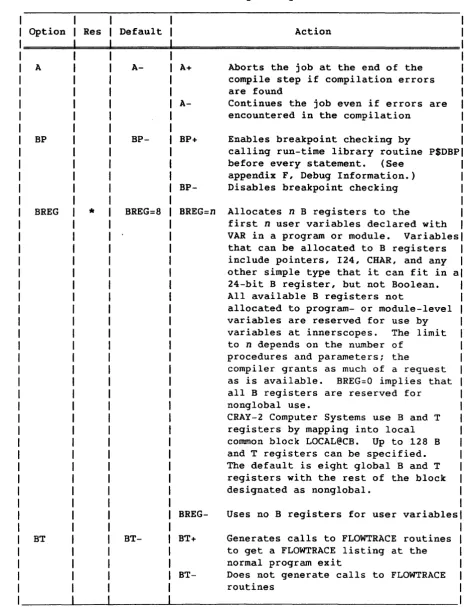
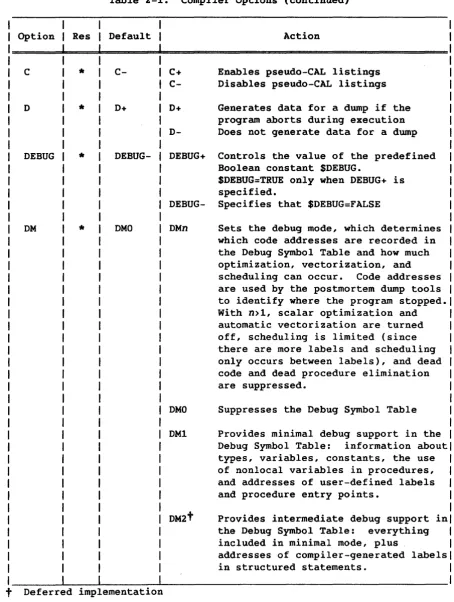
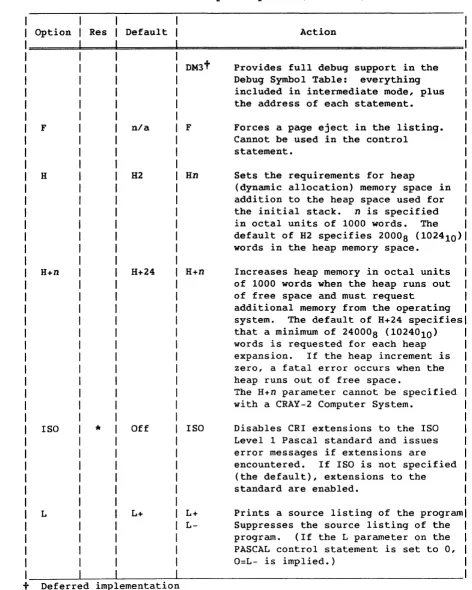
Table 2-1 describes all compiler options.
In general, an option followed
by a plus sign enables that option, and an option followed by a minus
sign disables that option.
Some directives included in source comments
are ignored if they appear after the keywords PROGRAM and MODULE.
Directives and comments following the final period in a compile unit are
attached to the next program or module, if any.
Table 2-1 indicates
Table 2-1. Compiler Options
I
Option Res Default Action I
======~==~======~======================================I
A
A-BP
BP-BREG
*
BREG=8BT
BT-SR-0060
I
A+ Aborts the job at the end of the
I
compile step if compilation errors Iare found I
A- Continues the job even if errors are I encountered in the compilation I
I
BP+ Enables breakpoint checking by I calling run-time library routine P$DBPI before every statement. (See
I
appendix F, Debug Information.) I BP- Disables breakpoint checking I
I
BREG=n Allocates n B registers to the I
BREG-BT+
BT-first n user variables declared with
I
VAR in a program or module. Variables I that can be allocated to B registers I include pointers, 124, CHAR, and any I other simple type that i t can fit in a 24-bit B register, but not Boolean. All available B registers not
allocated to program- or module-level variables are reserved for use by variables at innerscopes. The limit to n depends on the number of
procedures and parameters; the
compiler grants as much of a request as is available. BREG=O implies that all B registers are reserved for nonglobal use.
CRAY-2 Computer Systems use Band T registers by mapping into local common block LOCAL@CB. Up to 128 B and T registers can be specified. The default is eight global Band
T
registers with the rest of the block designated as nonglobal.
Uses no B registers for user variables
Generates calls to FLOWTRACE routines to get a FLOWTRACE listing at the normal program exit
Does not generate calls to FLOWTRACE routines
[image:24.615.76.542.68.676.2]Table 2-1. Compiler Options (continued)
Option Res Default
C
*
C-D
*
0+DEBUG
*
DEBUG-OM
*
DMOt
Deferred imp ementationAction
C+ Enables pseudo-CAL listings
C- Disables pseudo-CAL listings
0+ Generates data for a dump if the
program aborts during execution
0- Does not generate data for a dump
DEBUG + Controls the value of the predefined
Boolean constant $DEBUG.
$DEBUG=TRUE only when DEBUG+ is specified.
DEBUG- Specifies that $DEBUG=FALSE
DMn Sets the debug mode, which determines
which code addresses are recorded in the Debug Symbol Table and how much optimization, vectorization, and
scheduling can occur. Code addresses
are used by the postmortem dump tools to identify where the program stopped. With
n>l,
scalar optimization and automatic vectorization are turned off, scheduling is limited (since there are more labels and schedulingonly
occurs between labels), and dead code and dead procedure elimination are suppressed.DMO
DM1
Suppresses the Debug Symbol Table
Provides minimal debug support in the
Debug Symbol Table: information about
types, variables, constants, the use of nonlocal variables in procedures, and addresses of user-defined labels and procedure entry points.
Provides intermediate debug support in
the Debug Symbol Table: everything
included in minimal mode, plus
[image:25.615.82.537.67.670.2]I
Table 2-1. Compiler Options (continued)
Option Res Default
F n/a
H H2
H+24
ISO
*
OffL L+
F Hn ISO L+ L-Action
Provides full debug support in the
Debug Symbol Table: everything
included in intermediate mode, plus the address of each statement.
Forces a page eject in the listing. Cannot be used in the control
statement.
Sets the requirements for heap
(dynamic allocation) memory space in addition to the heap space used for
the initial stack. n is specified
in octal units of 1000 words. The
default of H2 specifies 20008 (1024 10> words in the heap memory space.
Increases heap memory in octal units of 1000 words when the heap runs out of free space and must request
additional memory from the operating
system. The default of H+24 specifies
that a minimum of 240008 (1024010) words is requested for each heap
expansion. If the heap increment is
zero, a fatal error occurs when the heap runs out of free space.
The H+n parameter cannot be specified
with a CRAY-2 Computer System.
Disables CRI extensions to the ISO Level 1 Pascal standard and issues error messages if extensions are
encountered. If ISO is not specified
(the default), extensions to the standard are enabled.
Prints a source listing of the program
I
Suppresses the source listing of the
I
program. (If the L parameter on the
I
PASCAL control statement is set to 0,
I
O=L- is implied.)
I
______
~----~---~---_I
t
Deferred imp ementation [image:26.613.69.541.67.657.2]Option
Res
a
*
P
P24
*
I
P32
*
R
RA
RL
RP
Table 2-1.
Compiler Options (continued)
Default
0+P-P24
P32
R+
RA+
RL+
RP+
0+D-On
P+
p-R+
R-RA+
RA-RL+
RL-RP+
RPN
Action
Enables all optimizations
Disables all optimizations
Enables optimization with the tuning
factor specified by
n
(1
~n
~9).
High tuning factors increase
compilation time but can improve the
generated code.
Ejects a page before every routine so
that no single page contains more than
one routine
Does not eject a page before routines
Uses 24-bit pointers in packed
structures; the default for CRAY-1
and CRAY X-MP Computer Systems.
Uses 32-bit pointers in packed
structures; the default for CRAY-2
Computer Systems.
Generates code to do range checks
Does not generate code for range
checks
R+ is the same as RA+:RR+:RP+:RS+:RL+,
and R- is the same as
RA-:RR-:RP-:RS-:RL-.
Generates code to check array indexes
Does not generate array index checks
Generates code to check shape
compatibility (arrays must possess
the same number of dimensions and
corresponding dimensions must be the
same size) in array expressions at
run time.
Does not generate code to check shape
compatibility in array expressions
[image:27.613.81.543.64.688.2]Option Res
RR
RS
RV
R*
S
*
I
I
SR-0060
Table 2-1. Compiler Options (continued)
Default RR+ RS+ RV-n/a n/a S4 Action
RP- Does not generate code for pointer
checks RR+ RR-RS+ RS-RV+ RV-R~
R*
SnGenerates subrange assignment checks Does not generate subrange assignment
checks
Generates code to check set use Does not generate set-checking code
Generates code to perform variant checking
Does not generate code for variant checking
Saves current settings of the
R
options for restoring with
R*
option.RA cannot appear on the control statement.
Restores settings of the
R
optionswith those previously saved with the
RA option. R* cannot appear on the
control statement.
Sets the requirements for stack memory
space. n is specified in octal units
of 1000 words. The default of S4 specifies 40008 (204810) words in the stack memory space.
The S parameter cannot be specified with a CRAY-2 Computer System.
Increases stack memory in octal units
of 1000 words. The default of S+4
specifies that when the stack becomes full, an additional 40008 (204810)
words are added to the stack. If the
stack increment is zero, a stack overflow causes a fatal error.
The S+n parameter cannot be specified with a CRAY-2 Computer System.
[image:28.613.67.545.70.653.2]Option
Res
ST
T
TREG
u
Table 2-1.
Compiler Options (continued)
Default
ST-T+TREG=8
U-Action
ST= ,
string'
Includes a subtitle line containing
the first 72 characters of the
specified string as the second line
of the pageheader.
The directive
performs no character editing (blank
suppression or conversion to
uppercase).
ST-
Does not include a subtitle line in
the page header
T+
Generates code for stack overflow
check
T-
Does not generate code for stack
check.
If stack overflow checking is
disabled, the user stack does not
expand and may overwrite the heap.
TREG=n
Allocates n T registers to the first
TREG-u+
n user variables declared with VAR in
a program or module.
Variables that
can be allocated to T registers
include integers, Booleans, and any
simple user-defined variable whose
type indicates it can fit in a 64-bit
T register.
All available T registers
that are not allocated to program or
module level variables are reserved
for use by variables at inner scopes.
CRAY-2 Computer Systems use Band T
registers by mapping into local
common block LOCAL@CB.
Up to 128 B
and T registers can be specified.
The default is eight global Band T
registers with the rest of the block
designated as nonglobal.
Uses no T registers for user
variables
Limits input to 72 significant
columns (UPDATE)
[image:29.612.80.535.73.681.2]Option Res
v
*
VI
VN
x
*
I
XI*
XP
*
xv
z
*
SR-0060
Table 2-1. Compiler Options (continued)
Default V+ n/a n/a X- XI-
XP-
xv-ActionUn Limits input source width to n
significant columns; values for
n
canrange from 1 to 140.
V+
V-VI
VN
Attempts to vectorize FOR loops automatically
Does not vectorize FOR loops
Ignores potential vector dependencies while vectorizing the next FOR loop. VI cannot appear on the control statement.
Does not vectorize the next FOR loop. VN cannot appear on the control
statement.
Collects global cross-reference information
X- Does not collect cross-reference
information. X+ is the same as
XV+:XP+ and X- is the same as XV-:XP-.
XI+
XI-XP+
Includes identifier information in the listing
Does not include identifier informa-tion in the listing
Generates a global procedure cross-reference
XP- Does not generate a global procedure
cross-reference
xv+
Generates a global namecross-reference
xv-
Does not generate a global namecross-reference
z+
z-Generates reentrant code
Generates code that is not necessarily reentrant
[image:30.613.67.541.70.642.2]Examples:
PASCAL,I=PASCJOB,L=LISTPAS,O=A+:D+:X+:P+:U+.
This statement tells the compiler that the source code is in the file PASCJOB. The listing output goes to the file LISTPAS, while the binary output goes to the default file $BLD. The compiler options specified by the 0 parameter prevent the program from executing if a compilation error is discovered, provide debug information for stack walkbacks, enable the cross-reference listing, put a page break at the beginning of every procedure and function, and restrict the input lines to 72 columns. Default values are accepted for the remaining compiler options.
PASCAL,O=ISO:H+24:S+12:V+:Z+.
This statement accepts the default file names for the input dataset, the listing dataset, and the binary dataset. The ISO argument to the
a
parameter disables all extensions provided by CRI. The other compiler options increase the heap memory space by 240008 words, increase the stack size by 120008 words, enable automatic vectorization of FOR loops, and enable the generation of reentrant code.2.4 LISTABLE OUTPUT
Pascal produces a dataset that optionally includes the following:
• Page header lines
• Source statement listing • Error messages
• Program cross-reference
• Procedure and function listing
• Information about identifiers used within a procedure • Pseudo-CAL listing of the program or module
The Pascal invocation statement and compiler directives allow you to control output and specify the receiving dataset. The actual information included in the output dataset is dependent on the combination of
compiler options that are enabled or disabled on the Pascal invocation statement. See table 2-1 for a list of the available options.
Listable output is divided into pages. Under COS, the number of lines per page is controlled by the LPP parameter on the OPTION control
I
2.4.1 PAGE HEADER LINES
Each page of listable output contains a header line that includes the following information:
• The compiler level
• The time and date compilation began
• The name of the program or module
• The name of the procedure or function being processed for the
source statement listing, or the listing title for special listing options
• The global page number
An optional subtitle of up to 72 characters, requested through the ST
compiler option, appears on the line following the page header. The
current values of the compilation options are also written on this line.
2.4.2 SOURCE STATEMENT LISTINGS
The source statement listing is generated when the L+ list option is
selected. The listing is a record of all Pascal statements comprising
the program or module as they are sequentially read and interpreted from
the source input dataset. A line number is listed to the left of each
line identifying its position in the program or module.
The nesting level of a statement appears to the left of the line number.
This number reflects the nesting level at the beginning of the line. The
program body and each procedure or function body begins and ends with a nesting level of zero.
2.4.3 ERROR MESSAGES
Errors encountered during the compilation of a statement are flagged by lines subsequent to that statement, with error codes listed at the end of
the source statement listing. When no listing dataset has been
requested, statements with errors and the corresponding error messages are written to the standard output dataset.
2.4.4 CROSS-REFERENCE INFORMATION
Compiler options X+, XV+, and XP+ provide cross-reference information in
the Pascal listing as follows:
•
XV+ generates a global identifier cross-reference.
•
XP+ generates a global procedure cross-reference.
•
X+ generates a global identifier cross-reference and a global
procedure cross-reference and is the same as specifying XP+:XV+.
2.4.4.1 Global identifier cross-reference
The global identifier cross-reference lists the line numbers in which
each identifier appeared in the program or module along with a code
giving the type of use.
The following codes are used in these references.
Code
Significance
D
Defined or declared
L
Location of label in code
R
Other reference
gR
Referenced label in GOTO statement
wR
WITH statement variable, pointer, or field
S
Set to a new value
pS
Pointer whose referenced variable is changed or passed as a
VAR parameter
vS
Passed as a VAR parameter
Only the first
32characters of an identifier are listed.
The first
16characters of the names of the procedures containing the line numbers
also appear in the cross-reference table.
2.4.4.2
Procedure cross-reference
The procedure cross-reference lists information about the program or
module and each procedure or function in alphabetical order by name.
The
procedure cross-reference includes the following information:
•
The line numbers of the declaration and body
I
•
The number of stack words for this procedure
•
The static nesting level; the number of procedures in which this
procedure is enclosed (a program or module is at level zero)
•
The name of the procedure in which this procedure was declared
•
A list of procedures declared in this procedure
•
A list of procedures called by this procedure
•
A list of procedures that call this procedure
2.4.5 PROCEDURE AND FUNCTION LIST
A list of procedures and functions is provided whenever a source listing,
a procedure cross-reference, a pseudo-CAL listing, or identifier
information is requested.
Procedures and functions are listed in
declaration order with the line number of the declaration.
Each
procedure name is nested according to its static nesting level.
2.4.6
IDENTIFIER INFORMATION
Information about global and local identifiers is written to the listing
when the XI+ compiler option is specified.
This information is broken
apart and st'ored in the following tables for each procedure or function:
•
Types and fields
•
Constants
•
Local variables
•
Nonlocal identifiers
Identifier information for each procedure appears with the procedure
cross-reference.
2.4.6.1 Types and fields
The type table contains the following information about each type defined
in the procedure:
•
The first 32 characters of the name
•
The size in words or bits of a variable of this type
• A list of fields within a record type that includes the following:
The first 32 characters of the field name
The range of words and bits from the record for this field The first 16 characters of the name of the field's type
• A list of constants in an enumerated type with the ordinal value of each constant
2.4.6.2 Constants
The constant table contains the following information about each constant defined in the procedure:
• The first 32 characters of the name • The size of the constant in words • The value of the constant
2.4.6.3 Local variables
The local variable table contains the following information about each variable declared in the procedure:
• The first 32 characters of the name
• The block or storage class; one of the following:
EXPORTED for exported variables PARAM for formal parameters STACK for local stack variables STATIC for static variables
An external name for variables that are imported, in common blocks, or in CACHEt
Static and exported variables are in a load block with the external name of the program or module.
• Address (octal word offset within the stack frame, octal word offset within the load block, or the formal parameter number); no address is given for imported or common variables.
• The register to which a variable is assigned (the register field can be blank)
• The size in words of the variable
• The first 16 characters of the name of the variable's type
I
2.4.6.4 Nonlocal identifiers
The nonlocal identifier table includes an alphabetical listing of all nonlocal identifiers, constants, and types referenced in the procedure along with the names of the procedures in which they were declared or defined.
2.4.7 PSEUDO-CAL LISTING
A pseudo-CAL listing of a Pascal program or module is written to the
listing dataset when the C+ option
is
specified on the invocationstatement. The CAL instructions displayed by the C+ option are
equivalent to the code generated for the program or module after all optimization and scheduling have been performed.
Each statement in the pseudo-CAL listing
is
organized as follows:• Relative address of the CAL instruction
• Octal equivalent of the CAL instruction
• The pseudo-CAL instruction generated
• The first 8 characters of the name of the procedure or function in which the instruction appears
• The line number of the Pascal source statement that generated the
instruction
Symbolic names are used for compiler-generated labels and for externals. Relative addresses are used for static and exported variables and for
literals. Symbolic names are shown added to @MAIN, a local pseudonym for
a load block having the external name of the program or module.
2.5 CPU TARGETINGt
The CPU parameter allows you to specify characteristics of the machine on which the compiled program executes.
The Pascal compiler, by default, assumes that the compiled program executes on the machine on which i t is compiled. The CPU parameter
specifies a target machine that differs from the host machine or disables certain characteristics of the host machine.
t Not available on the CRAY-2 Computer System