ISSN: 1992-8645 www.jatit.org E-ISSN: 1817-3195
IMPLEMENTED OF SUPERVISED TABLE SPIHT
ALGORITHM IN VLSI PROCESSOR FOR IMAGE
TRANSMISSION
1S.HARSHAVARDHAN NAIDU, 2 Dr. K. SIDDAPPA NAIDU
1Assistant Professor-EEE
Vel Tech High Tech Dr. Rangarajan Dr. Sakunthala Engineering College
2Professor & Dean-School of Electrical Engineering
Vel Tech Dr. RR & Dr. SR Technical University
ABSTRACT
Image coding is to represent an image with as few bits as possible while preserving the level of quality and intelligibility required for the given application. In this project we use the Supervised Table Set-Partitioning In Hierarchical Trees (STSPIHT) algorithm. In which the lookup table is supervised for the transmission of images to preserve the brightness and contrast. Approach supports progressive transmission which makes maximum use of all previously transmitted data. With progressive transmission, one can have a rough picture of the image transmitted and access it before the end of the transmission. When this algorithm is implemented in the VLSI processor the number of gate levels is reduced. The processing speed for the transmission is increased by 85% when compared to the existing methods.
Keywords: Refinement Pass, Lookup tables, Significant Pixels, Insignificant Pixels, SPIHT.
1. INTRODUCTION
A digital image is an array of real or complex numbers represented by a finite number of bits. Any image in the form of photograph, transparency or char is digitized and stored as a matrix of binary digit in computer memory. This binary digit in the computer memory is displayed on a high resolution television, monitor or displays. The basic classes of problems and application in image processing is a) image representation and modelling b)Image enhancement c)image restoration d)Image analysis e)Image reconstruction f) Image data compression.
Image data compression is concerned with minimizing the number of bits required to represent an image. Perhaps the simplest and most dramatic form of data compression is the sampling of band limited images, where an infinite number of pixels per unit area is reduced to one sample without any loss of information. Consequently, the number of samples per unit area is infinitely reduced. Application of data compression is primarily in transmission and storage of information. Image transmission applications are mainly applicable in broadcast television, remote sensing, and computer communication. Image storage is required for educational purpose applications and business
documents applications, and medical images that arise in digital radiology, and computer tomography, motion pictures and so on. Application of data compression is also possible in the developments of fast algorithms where the number of operations required to implement an algorithm is reduced by working with the compressed data.
2. DATA AND BANDWIDTH COMPRESSION
The process of converting an analog video signal into a digital signal results in increased bandwidth requirements for transmission. Data compression techniques minimize this cost and sometimes try to reduce the bandwidth for the digital signal below its analog bandwidth requirements. Although digitized information has advantages over its analog form in terms of processing flexibility, random access in storage, higher signal to noise ratio for transmission with the possibility of errorless communication, and so on, and one has to pay the price in terms of this increase in bandwidth.
with new features. To achieve this specific area in image encoding, a new standard developed i.e.., JPEG 2000. This developed standard not only provides rate distortion and image quality performance to existing methods, but also it provides functionalities and features of existing standards, here are some representative features of provided method i.e.., lossy compression and lossless compression, progressive transmission by resolution and by pixel accuracy, embedded lossy coding and lossless coding, and robustness to the region-of-interest coding and the presence of bit-errors. The JPEG2000 is mainly designed fulfil the requirements of a diversity of application like internet, printing, digital scanning, colour facsimile, digital photography, mobile applications, medical image applications, E-commerce, digital library applications and remote sensing applications etc.
The bit and its difference representation bit in video signal or an image is explained in the adaptive power allocation & channel coding optimization technique An offline iterative algorithm is proposed for the transmission of individual bits by optimum combination of power & coding .The optimum combination in this paper to reduce the Mean Square Error (MSE) This optimum combination would provide a better quality of reconstructed image in the simulation result .The bit of significant importance were coded & allocated and transmitted while the bit of less significant will not be sent with coding & allocation By doing this the average per bit. Energy level is Maintained at the same level from the proposed method of combination approach would able to achieve a gain about 3db in this combination approach when reducing the peak to average power ratio the power allocation is outer forms (Mohamed El-Tarhuni, 2010).
The embedded zero tree wavelet (EZW) frame word based image coding executed using the M channel linear phase perfect reconstruction filter banks uniform band maximally decimated LPPRFBS The advantage of LPPRFB is that it provides a finer frequency spectrum partition high energy compaction. The transformation is implemented by block transform supports the parallel Processing application and Region of interest coding decoding can be implemented while implementing the transformation coding in hardware this method boasts the efficient lattice structure .The Minimal number of the delay element in the quantization is based on the delay
element in the quantization lattice coefficients in the EZW coder properties are retained in the proposed system .The retained properties are embedded quantization bit rate error control idempotency and progressive image transmission. (Trac D. Tran,1999).
Using DCT the video coding & image coding is implemented & there difference in the performance is evaluated on equal fooling based the coding for video & image is implemented in our study using wavelet transform for still images the wavelet transform outer performs the discrete cosine transform by 1db in the order of peak signal to noise ratio. The wavelet transform coding is less clear for video coding from the above .Experimentation the compression algorithms of same transform for videos & still images should be evaluated in over system view point .But all existing methods so far spend their efforts over the optimizing the transform .Instead all the importance can be given to the coding system quantization entropy coding (ZixiangXiong, 1999). We can give more importance on the complex interplay among elements of the coding system, quantization, and entropy coding.
Image transmission over deep space channels are realized & analysed using the Joint application layer. The algorithms take jpeg 20000 & encoding techniques such as LDPC codes are protecting the sent images during transmission. In the proposed system of Multi Attribute decision making theory & in terms of Bit error rate acts on the bases of the deep space channel conditions . The proposed method persons the essential informative information's of images which is sent through a deep space network in the proposed method the load is minized in the deep space network form the simulation results the output shows a new area of development in the real systems (Igor Bisio, 2011).
ISSN: 1992-8645 www.jatit.org E-ISSN: 1817-3195
end recognizes that only a part of specie region in the complete image is needed then the progressive Image transmission will reject the transmission at any point of bit stream. The progressive image transmission features are supported by the JPEG 2000 & MPEG standards.
Next the progressive image transmission system is applied in over the wireless channels with combining joint source channel coding space time coding & orthogonal frequency division multiplexing. In coherent detection of receiver making has perfect channel state information by using broadband MIMO fading Model. The BER evaluated with space time coded OFDM based MIMO System .In joint source channel coding is optimization based on local search algorithm and average signal to Noise Ratio SNR is calculated subjected to allotted full transmitted energy for various constellation sizes from this image quality can be Measured. System performance evaluation end to end method to select the using adaptive modulation Method to select the constellation size which each will have image for which each will have an average signal to noise Ratio (SNR) from the simulated result effectives of our proposed adaptive modulation scheme is best compared to existing Method (Srikanth. N, 2012).
The paper proposes the two important application areas in physics They are signal processing & electronics In this particularly they delt with the image signal coding efficient transmission. To consume low storage and identifying the signal information is focused. A low cost LED panel display is used to execute the final result. The first stage of output is discussed in this paper. The output is of an automatic electronic system in which coding transmission data extraction decoding and results were displayed in large size of image / video still frame signals. for updating the Geographical information system(GIS) images like Multi spectral hyper spectral with their image signals to preserve the low bit rate information coding is a major problem. To overcome these problem a oval tree subband coding Method is implemented with acceptable PSNR ratio the hyper spectral signal for surveillance applications with band wise coding approach
is introduced. The proposed system a low to higher bit rate was executed with permit able quality of HVS perception when the algorithm was applied to the 2d “Gold hill” test image signal of urban planning at bigger compression Rate (CR=50) with fairly better window was obtained. In the next approach Morphological & enhancing techniques were innovatively implemented for identifying the face in 2D image signal ( Ajith.Kumarayapa,2010).
of the critical path is 6.32ns (Tsung-Hsi Chiang, 2007).
3. METHODOLOGY
We have presented an algorithm that operates through set partitioning in hierarchical
[image:4.595.90.288.398.480.2]
trees SPIHT and accomplishes completely embedded coding. In SPIHT algorithm the input image is first decomposed into a number of subbands by means of hierarchical wavelet decomposition. For example, the subbands obtained for two-level decomposition. The special orientation trees are nothing other than the subband coefficients are grouped into sets, which efficiently exploit the correlation between the frequency bands. In each spatial orientation tree the coefficients are then progressively coded from the most significant bit-planes (MSB) to the least significant bit-planes (LSB), starting with the coefficients with the highest magnitude and at the lowest pyramid levels. The block diagram of the encoding and decoding is shown as in the Figure 1.sub bands obtained
Figure 1.Block diagram of SPHIT Algorithms for image encoding and decoding
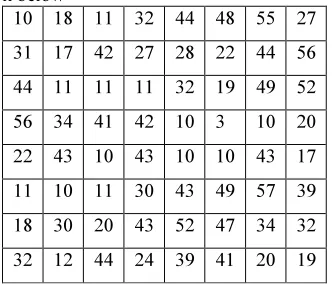
The SPIHT multistage encoding process is explained through an image. In an image initially the highest value of pixel is identified. For example consider a part of 8*8 matrixes in an image as shown below
10 18 11 32 44 48 55 27
31 17 42 27 28 22 44 56
44 11 11 11 32 19 49 52
56 34 41 42 10 3 10 20
22 43 10 43 10 10 43 17
11 10 11 30 43 49 57 39
18 30 20 43 52 47 34 32
32 12 44 24 39 41 20 19
Now in the matrix the highest value of the pixel value is 57.Now let we assume 32 be the x value. Since the highest pixel values is 57 and its near
[image:4.595.107.273.567.709.2]value of 2n is 32 when n=5 and when n=6 the value is 64 and it exceeds the highest value of the pixel value in the matrix and so the x value is fixed to 32.After the initializing the next process it the sorting process. In the sorting process a lookup table of size 8 by 8.Compare each pixel with x and if the value is greater than or equal to x put that position in the look up table as 1 and if the pixel is less than the value put that position as 0.In the similar pattern the table will be updated for each pixel. For each 1 value in the lookup table it will subtract the pixel value with x. Now fix the x value as 16 because the next two to the power of n is 4 and repeat the same up above and lookup tables are formed. In the paper we formed the lookup table for n values of 5,4, 3. For each 1 value in the table compare with x value if the value greater than or equal to the x value refinement register will have a 1 else it will be 0.For remaining pixels in the table it will compare with the modified x value and table will be updated with corresponding results. Then for each new pixel value will be subtracted from x value .The x will be reduced 8 and same procedure will be continued until the required level. These lookup will be transmitted .These transmitted lookup tables will be received at the receiver end and then these values will be merged with the empty lookup tables in the receiver end. Now the process is reversed as in the receiving end with respect to transmitting end.
The above encoding and decoding is done by using the FPGA-ALTERA DE2-cyclone board-II. Altera DE2 board become one of the most widely development FPGA board which is used to development of FPGA design and implementations. The purpose of the Altera DE2 Development and Education board is to provide the ideal vehicle for learning about FPGAs, computer organization, and digital logic. ALTERA DE2 uses the state-of the-art technology in both hardware and CAD tools to expose students and professionals to a wide range of topics.
ISSN: 1992-8645 www.jatit.org E-ISSN: 1817-3195
be provided to conFigure the FPGA to implement in any system design.
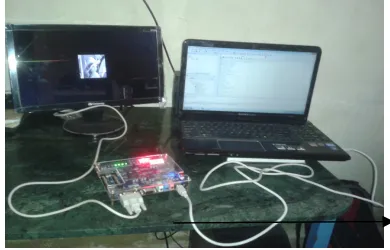
[image:5.595.305.508.160.337.2]The Nios II Embedded Processor and its Software provided with the DE2 board features the Quartus II Web Edition CAD system. Also board includes several features to help designers and professionals experiment such as tutorials and example applications. Traditionally, manufacturers have provided a variety of hardware features and software CAD tools needed to implement designs on these boards to educational FPGA boards, but very little material has been offered which used directly for teaching purposes. Altera's DE2 board is a significant departure from this trend. For simulation purpose the board is interfaced with monitor through VGA card for the display of the image as shown in Figure 2.
Figure 2.Experimental Setup Of Altera For Image Display In Monitor
4. RESULT AND DISCUSSIONS
From the above experimental setup the Lena image, Figure 4 a is processed for the encoding and decoding and the output image is statistically analysed for the brightness and contrast of the image. The brightness and contrast is measured by using the mean and standard deviation of the image. The table with these values are shown below. The Brightness of the output image compared to the input image is reduced during the transmission and where as the contrast has been increased.
Image Mean value
(Brightness)
Standard Deviation (Contrast)
Input Image 109 44
Output Image 106 46
In the Figure 4b the comparison of pixel statics calculated over the image as straight line for the input and output image is shown. From the plot it proves that the pixel values are very close to the
input image. Still the image error can improved when the n values 2 and 1 of lookup tables is also transmitted.
Figure 4. A) Input Image
For a typical 256×256 grayscale image, each entry requires at least 8+8=16 bits of the lists to store the row and column coordinate values. Thus, SPIHT coding needs 2×16×256×256 bits = 256 K bytes memory to store both LIP and LSP lists. For a typical 256×256 gray-scale image, both of each TSP and TIP lists need 256×256 bits, and TST list needs 128×128 bits. Thus, TSIHT coding totally needs 2×256×256+128×128 (bits) = 18 K bytes memory. For a typical 256×256 gray-scale image,Lut for both tsp and tip need 256×256 bits, and due to parallel processing no need of TST table. Thus, proposed coding totally needs 256×256 (bits) = 6 K bytes memory.
Figure 5. B) The Pixels Statistics For The Line Drawn Over The Image
5. CONCLUSION AND FUTURE WORK
[image:5.595.92.287.318.443.2] [image:5.595.305.538.499.629.2]mainly at medical data transmissions. In SPIHT algorithm consumes 256 K Bytes and TSIHT algorithm consumes 256 K Bytes, Our Supervised Table Set-Partitioning In Hierarchical Trees (STSPIHT) algorithm consumes only 6 K bytes. With implementation in Altera DE2 shows low gate count and the processing speed for the transmission is increased by 85% when compared to the existing methods and the future work will be concentrated on mainly reconfigurable algorithm for all images to encode and to decode with low bit rate quality high.
REFRENCES:
[1] Charilaos Christopoulos, Athanassios Skodras and Touradj Ebrahimi “The Jpeg2000 Still Image Coding System:An Overview” IEEE Transactions on Consumer Electronics, Vol. 46, No. 4, pp. 1103-1127, November .
[2] Mohamed El-Tarhuni,Mohamed Hassan and Akram Bin Sediq “A Joint Power Allocation and Adaptive Channel Coding Scheme for Image Transmission over Wireless Channels” International Journal of Computer Networks & Communications (IJCNC), Vol.2, No.3, May 2010.
[3] Trac D. Tran and Truong Q. Nguyen “A Progressive Transmission Image Coder Using Linear Phase Uniform Filterbanks as Block Transforms” Ieee Transactions On Image Processing, Vol. 8, No. 11, November 1999 [4] Zixiang Xiong, Kannan Ramchandran, Michael
T. Orchard, and Ya-Qin Zhang “A Comparative Study of DCT- and Wavelet-Based Image Coding” Ieee Transactions On Circuits And Systems For Video Technology, Vol. 9, No. 5, August 1999
[5] Igor Bisio, and Fabio Lavagetto, Mario Marchese “Application Layer Joint Coding for Image Transmission over Deep Space Channels” IEEE Globecom 2011 proceedings
[6] Srikanth.N, “progressive image transmission
overstcofdm Based mimo systems”
International Conference on Computing and Control Engineering (ICCCE 2012), 12 & 13 April, 2012.
[7] Ajith.Kumarayapa1 Y.A. and W.A.D.T.
Wijesinghe “Low Bit-Rate
Coding/Transmission of Remotely Sensed Larger Image Signals and their useful Information extraction” Proceedings of the Technical Sessions, Institute of Physics – Sri Lanka, 26 (2010) 1-8.
[8] Lisa Kelly, Alan Molloy, Martin Glavin and Fearghal Morgan “ Error Resilient Image Transmission Over a Bluetooth Network”, ISSC 2003, Limerick. July 1-2.
[9] Wei Yu, Zafer Sahinoglu, and Anthony Vetro “Energy Efficient JPEG 2000 Image Transmission over Point-to-Point Wireless Networks” Technical Report, Mitsubishi Electric Research Laboratories, Inc, Tr2003-111, October 1, 2003.
[10]Tsung-Hsi Chiang and Lan-Rong Dung “A VLSI Progressive Coding for Wavelet-based Image Compression” IEEE Transactions on Consumer Electronics, Vol. 53, No. 2, MAY 2007
[11]11) ISO/IEC, JPEG 2000 Committee Draft version 1.0, cd15444-1 edition,Dec. 1999. [12]12) C. Christopoulos, A. Skodras, and T.
Ebrahimi, “The JPEG2000 still image coding system: An overview,” IEEE Transactions on ConsumerElectronics, vol. 46, pp. 1103–1127, Nov. 2000.
[13]13)T. Sikora, “The MPEG-4 video standard verification model,” IEEE Transactions on Circuits and Systems for Video Technology, vol. 7, no. 1, pp. 19–31, Feb. 1997.
[14]14) S.-F. Hsiao, Y.-C. Tai, and K.-H. Chang, “Vlsi design of an efficient embedded zerotree wavelet coder with function of digital watermarking,” IEEE Transactions on Consumer Electronics, vol. 46, no. 7, pp. 628– 636, Aug. 2000.
[15]15) B. Vanhoof, M. Peon, G. Lafruit, J. Bormans, M. Engels, and I. Bolsens, “A scalable architecture for mpeg-4 embedded zero tree coding,” Custom Integrated Circuit Conference, pp. 65–68, 1999.