Journal of Theoretical and Applied Information Technology 10th January 2014. Vol. 59 No.1
© 2005 - 2014 JATIT & LLS. All rights reserved.
ISSN: 1992-8645 www.jatit.org E-ISSN: 1817-3195
15
RECOVERING DESIGN-CODE TRACES: AN ACO BASED
APPROACH
1IMAD BOUTERAA, 2NORA BOUNOUR
1,2
LISCO Laboratory, Badji Mokhtar-Annaba University, P.O. Box 12, 23000 Annaba, Algeria E-mail: [email protected], [email protected]
ABSTRACT
Traceability is a key issue to promoting software development quality and productivity. It was recognized as crucial for several software development and maintenance activities. Despite their importance, traceabil-ity links are often sacrificed during software evolution due to market pressure. In this work we present an approach to recover them between the design and the implementation. Our approach recover traces basing on properties’ similarities, it exploits string edit distance, maximum matching, and Ant Colony Optimiza-tion. Evaluations show promising results of this work.
Keywords: Traceability, Object-Oriented Programming, Software Evolution, Program Understanding,
Software Maintenance, UML, Ant Colony Optimization.
1 INTRODUCTION
Software systems are developed step by step starting from an abstract representation of the sys-tem, arriving to a runnable code ready for deploy-ment. Throughout this process, artifacts are created, modified, and refined into more detailed artifacts. This phased nature of the development leaves traces and traceability among artifacts.
According to IEEE Standard Glossary of Soft-ware Engineering Terminology [1] traceability is defined as:
i. The degree to which a relationship can be es-tablished between two or more products of the development process, especially products hav-ing a predecessor–successor or master– subordinate relationship to one another. ii. The degree to which each element in a soft-ware development product establishes its rea-son for existing.
Traceability links are used in many software development tasks, among them we can find:
i. Change impact analysis: this activity aims to identify witch artifacts are affected by a pro-posed change. When change starts from the code, traceability links help developer to up-date appropriates high-level artifacts. When change starts from abstract artifacts, traceabil-ity links help developers to manage the change and assessing its cost by propagating its impact trough lower levels artifacts.
ii. Requirement Engineering: Many software en-gineering standards (see [2]) emphasize on the need of requirements traceability to be
includ-ed into software development process and treat it as a quality factor towards achieving process improvement. It is the key to locate code areas that implement a given requirement and vali-date that a system meets its requirements. iii. Program comprehension: When maintaining a
legacy system, the first major problem a main-tainer is facing may be the comprehension of software system [3]. Trace links can help in both top-down and bottom-up comprehension. In the former, traces give hints on where to look for beacons that either confirm or refute a hypothesis. In the latter one, traces assist pro-grammers in the assignment of a concept to a chunk of code and in the aggregation of chunks into more abstract concepts.
iv. Rational comprehension: traces help develop-ers to unddevelop-erstand the rationale behind certain design and implementation aspects of a system. Lack of traceability can lead to less maintaina-ble software and to defects due to inconsistencies or omissions. It is one of the top factors causing de-lays in software engineering projects [4]. And it causes the software to deviate from the external quality attributes such as understandability, reusa-bility, and extendibility [5].
However, traceability links are regularly bro-ken and sacrificed during software evolution [6]. This is basically due to them updating cost and the market pressure. Two solutions are envisaged for this problem: reverse engineering, and trace recov-ering.
generated design will be consistent with the code and traces can be saved during the design recovery process. But designs produced by users are usually richer than those extracted automatically, since they include context and high level semantic infor-mation. Therefore it is always better to use human produced designs, and maintain them consistency with the code.
Trace recovering aims to recuperate traces be-tween artifacts. Manual creation of traceability links between requirements and source code is er-ror-prone, time consuming and complex [7], which emphasize the need of automation of this activity.
In this paper we present a similarity based trace recovering approach. Our approach operates on UML class diagram and the source-code expressed in java. It associates every design class to a set of java classes. We believe that the implementation may split and refine a class from the class diagram into several java classes. Thus, the recovered traces are one-to-many rather than one-to-one.
In the rest of this paper we will refer to classes from a Java program as implementation classes. And those form UML class diagram as design
clas-ses. An implementation class is associated to a
de-sign class basing on them properties’ similarities. We distinguish two kinds of properties. Elementary properties (e.g. class name, fields’ names…etc.) and relationship properties (e.g. inheritance, associ-ation… etc.). Similarity computation for the former one is relatively simple; it can be done using string edit distance and a maximum matching algorithm. But with relationship properties we found ourselves in the need of an assumed mapping to compute them. For example, to claim that an implementation class reflects a design class inheritance, we should at least suppose that the implementation class par-ent is the corresponding of the design class parpar-ent. To find the best mapping we use Ant Colony Opti-mization (ACO) [8] [9], a well-known meta-heuristic that showed its effectiveness in analogous problems.
The rest of this paper is organized as flow; in section 2 we briefly present Ant Colony Optimiza-tion since it is a key for this work. Than we present our approach in section 3. And we evaluate it in section 4. After that, we present some related works in section 5. A conclusion and future works are presented in the section 6.
2 ANT COLONY OPTIMIZATION
Ant Colony Optimization (ACO) was intro-duced by Dorigo, Colorni and Maniezzo [8] in
or-der to resolve the Traveling Salesman Problem (TSP). The heuristic was inspired from the behavior of real world ants. Experiments have shown that ants can find the shortest path between a food source and their nest.
Basically, every ant starts by seeking randomly for a food. Once it’s found, the ant returns to the nest while laying down pheromone trail. If other ants find such path of pheromone, they flow it, and they reinforce it in the returning if they found food. Over time, pheromone starts to evaporate, thus re-ducing attraction of some trails. The more time an ant takes to travel a path, the more time pheromone evaporates, and the path becomes less and less at-tractive. A short path gets marched over more fre-quently, and thus the pheromone density becomes higher on shorter paths than longer ones.
Ant System was the first ACO algorithm. It was presented in [8]. To describe its principle, we take as example the traveling salesman problem. In Ant System every ant tries to construct solution at each iteration. A valuable solution for TSP is a tour that visits each city once. The m ants having built a solution in an iteration, update the pheromone val-ues. Pheromone quantity associated to edge linking city i to j, is updated as a flows:
← 1 ∙ ∑Δτ (1)
Where is the evaporation rate, is the num-ber of ants, and Δ is the quantity of pheromone led on edge , by ant :
Δ
/ if ant used edge , ,
0 otherwise,
(2)
Where is a constant, and is the length of the tour constructed by ant .
When ant k is in city i and has so far construct-ed the partial solution , the probability of going to city j is given by:
∙
∑ ∙
∈N
if ∈ N,
0 otherwise,
(3)
Where N is the set of feasible components; that is, edges , where is a city not yet visited by ant . The parameters and control the rela-tive importance of the pheromone versus the heuris-tic information , which is given by:
ೕ
(4)
Where is the distance between cities and
3 RECOVERING TRACES
• ⊆ the set of dependence relation-ships that may exist in UML class diagrams
• ⊆ the set of association
relation-ships that may exist in UML class diagrams
• the set of classes that may exist in java pro-grams
• ! the set of fields that a class " ∈ may have
• $! the set of methods that a class " ∈ may have We define the following applications:
• %: ∪ → ) ∪ ) ! the application
that returns for a given class, all of its fields () is the power set)
• *+,: ∪ → )$ ∪ )$! the application
that returns for a given class, all of its methods
• -./: ∪ → ) ∪ ) the application
that returns for a given class, its supper classes
∈ : ∃ ∈ , , ∈ : inherit directely or indirectly from ifif ∈ ∈
• -./: → ) the application that returns
for a given class, the set of classes on which it de-pends.
∈ : ∃ ∈ , ,
• 0: → ) the application that returns for
a given class, the set of its associated classes. ∈ : ∃ ∈ , ,
• 12: ∪ ∪ ∪ ! ∪ $ ∪ $! → 3 the
appli-cation that returns for a given artifact its name.
• 45: ! → The application that returns for a given field, the class representing its type.
• .: $! → ) The application that returns for
a given method, the set of classes that it uses as a parameter or variable type.
3.2.2 similarity for atomic properties CN, F, and M
Class names have the nature of string in both design and implementation. So we can use string edit distance (see [12]) to compute the similarity between them. Formally we define the similari-ty between a design class ∈ and an implemen-tation class ∈ in term of class name by:
, 1 ||||, (6)
Where : 3 → 6 is the edit distance between two strings.
To compute , the similarity between
∈ and ∈ in term of fields names, we must at first establish a mapping between fields of and fields of . The mapping should minimize the amount of editing distances between attribute names. The mapping is calculated by applying a minimum-matching algorithm (see [13]) in a bipar-tite graph of which nodes are names of fields and edges are weighted by the editing distances
be-tween nodes. We note the weight of the edge connected to node after the application of the minimum-matching. If have no corresponding,
is 1. is given by:
[image:4.612.313.507.597.679.2],
|"#$| ∑∈|| if |"#$| % 0
0 otherwise
(7)
By the same reasoning we put the similarity in term of method names:
,
|&#'(| ∈ !") *+,-#-.|+,-#-| if |&#'(| % 0
0 otherwise
(8)
3.2.3 similarity for relationship properties; I, A, and D
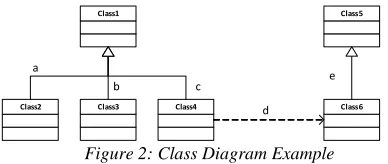
We found ourselves unable to compute such similarities without assuming an existing mapping, i.e. we compute relationship similarities basing on a mapping between design and implementation clas-ses. To describe this situation consider the class diagram illustrated by Figure 2, and suppose that we have in the implementation a class defined as “c4 extends c1”. We can’t deduce a heritance correspondence between Class4 from the class dia-gram and c4 from the code, unless we assume that c1 from the code corresponds to Class1 from the design. So, to decide if there exists a heritance cor-respondence between design and implementation classes, we must at least suppose a mapping be-tween design supper classes and implementation classes.
In the rest of this paper we consider a mapping
2 between a set of design classes ⊂ and a set of implementation classes 8 ⊂ as a set of pairs ∈ 8. A mapping must verify the fol-lowing condition:
, ∈ 2 ∧ ′, ′ ∈ 2 ⟹ < ′ ∧ < ′
In the rest of this paper, for a given mapping
2 we note 2 ∈ the corresponding of
∈ according to 2
Class2
Class1 Class5
Class3 Class4 Class6 a
b c
d e
Figure 2: Class Diagram Example
3.2.3.1 Inheritance similarity
re-Journal of Theoretical and Applied Information Technology 10th January 2014. Vol. 59 No.1
© 2005 - 2014 JATIT & LLS. All rights reserved.
ISSN: 1992-8645 www.jatit.org E-ISSN: 1817-3195
19 flected by its implementing class. All object orient-ed programming languages have inheritance re-served keywords (e.g. “extends” in java). So we can check such similarity by parsing the code.
The inheritance similarity between a design class and an implementation class according to the assumed mapping 2 is given by:
[image:5.612.313.521.540.730.2]", , -, ∑∈,,#
|%&'| if 12#3 % 0
0 otherwise (9)
Where = is the application that returns the set of matched design supper classes. Formally, we define this set by:
;", , -,
<: ∈ 12#3 ∧ -, ∈ 12#3? (10)
And > is the originality inheritance weight from a given design class, it is defined by:
|∈ :∈| (11)
3.2.3.2 Associations similarity
We use the same process to compute the asso-ciation similarity. Generally an assoasso-ciation relation-ship is implemented as a class field. Basing on this principal, we define the association similarity be-tween a design class and an implementation class
according to the assumed mapping 2 by:
(,,-,
∑∈ ,,#
|)(| if @A % 0
0 otherwise (12)
Where = is the application that returns the set of matched design associated classes. Formally, we define this set by:
;(, , -,
<: ∈ @A ∧ -, ∈ ? (13)
%45 returns the set of fields types for a given implementation class, formally it is defined by:
"$BC# ⋃∈BC#E (14)
3.2.3.3 Dependencies similarity
Dependency relationship is described as flows:
“A dependency is a relationship that signifies that a single or a set of model elements requires other model elements for their specification or implemen-tation.” [14]
According to this definition, if a design class 2 depends on another class ?. This must be reflected in the code by a use of the supplier corresponding class (i.e. the corresponding of ?) in the corre-sponding of 2. So, there is two ways to implement a dependency relation; as a type of parameter varia-ble, or as a type of local variable in a method. As-sociation can also be considered as a special kind of dependency, but we ignore this case.
We define the dependence similarity between a design class and an implementation class ac-cording to the assumed mapping 2 by:
, , -,
∑∈,,|%&'|# if 12$3 % 0
0 otherwise (15)
Where = is the application that returns the set of matched suppliers. Formally, we define this set by:
;, , -,
<: ∈ 12$3 ∧ -, ∈ FBC#? (16)
@45 returns the set of used types for a given implementation class, formally it is defined by:
"$BC# ⋃∈!"2#- (17)
3.2.4 mapping construction
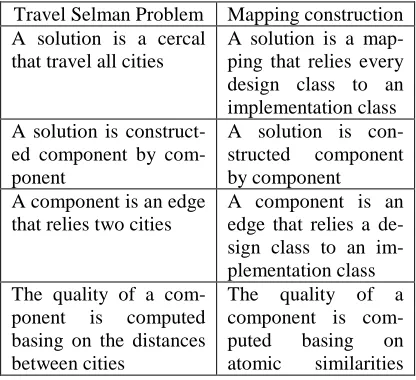
Due to the resemblance between the traveling salesman problem and the construction of a good mapping between design and implementation, we decide to use Ant Colony Optimization [8]. Table 2 summarizes the common points between those two problems.
In order to apply ACO on mapping construc-tion we must define the distance heuristic, and the length of a solution. is computed by combin-ing all atomic similarities, it is given by:
, #⋅,#⋅,#⋅,
#+#∙,-| |.+#∙,-| |.
(18)
>,>, and > are parameters representing
respectively the weights of ,, and . In the denominator we multiply > by A1 C 0||E to eliminate its effect when has no fields. We use the same mechanism to ignore > in the denomina-tor when has no methods.
Table 2: Common Points Between TSP And Mapping Construction
Travel Selman Problem Mapping construction A solution is a cercal
that travel all cities
A solution is a map-ping that relies every design class to an implementation class A solution is
construct-ed component by com-ponent
A solution is con-structed component by component A component is an edge
that relies two cities
A component is an edge that relies a de-sign class to an im-plementation class The quality of a
com-ponent is computed basing on the distances between cities
between the design and the implementa-tion class
The qualities of com-ponents can guide the construction of the best solution
The qualities of com-ponents can guide the construction of the solution
The quality of a solu-tion is computed using qualities of all compo-nents (i.e. distances)
The quality of a solu-tion is computed us-ing qualities of all components (i.e. sim-ilarities)
Once we construct a mapping 2 that maps every design class to an implementation class, we can compute relationship similarities and introduce them in similarity formula. We define the global similarity between a design class and an imple-mentation class , or the score of the trace from to
according to the assumed mapping 2 by:
, ,
⋅ ,⋅ ,, ⋅ ,,⋅ ,,
⋅| | ⋅| |⋅| |
(19) Where >,>, >, and > are parame-ters.
Now we can assess the global quality of the mapping. The quality (length in TSP) of a mapping
2 that maps a set of design classes to a set of implementation classes is given by:
G, -, ∑∈/,,
|0| (20)
After defining all the needed similarities, we can apply ACO meta-heuristic on the problem of mapping construction. In our approach, ants seek for the best mapping by constructing mappings and assessing them qualities. The construction of a mapping is a progressive task; it’s done component by component. A component is pair , ∈ indicating that the design class is implemented in the code as . To construct a mapping between
⊂ and 8 ⊂ , ants flow the algorithm in Fig-ure 3.
1 2 3 4 5 6 7 8 9 10 11
while (stop condition not reached)
-, enmpty set
for each in G
choose a valid corresponding of from L save , into -,
rof
update pheromone basing on -, if (',M#-, N ',M#O#'&,) O#'&, -,
fi end while
Figure 3: Mapping construction algorithm
Where ?+*2 is an initially empty shared variable. The stop condition – in the first line – can be defined as a number of iterations, the stability of the results, or a reaching of predefined threshold by the ?+*2 distance.
A valid corresponding – in the fourth line – for a design class according to a partial mapping 2 is an implementation class that never be used in all ordered pairs belonging to 2. The probability of choosing ∈ 8 as the corresponding of ∈ ac-cording to the partial mapping 2 ∈ P 8 is given by formula 21
P
∙,
∑ ∙,
∈N!, if ∈ NL, -,,
0 otherwise,
(21)
N8, 2 is the set of valid implementing
classes according to the partial mapping 2, it is defined by:
NL, -, < ∈ L: ∀, ∈ -, ⇒ % ? (22)
When the program reaches the seventh line, a valid solution (i.e. a mapping) should be construct-ed. The pheromone updating policy is based on the quality of the solution. We define the new phero-mone value between ∈ and ∈ 8 according to the solution 2 ∈ P 8 by:
1 ∙ S T, -, if , ∈ -,
1 ∙ otherwise,
(23)
Where is the evaporation rate, is a con-stant, is the amount of pheromone that repre-sents the attraction of choosing as the correspond-ing of
3.2.5 trace scoring
From a theoretical perspective, traces exist be-tween every design class and every implementation class. But some are relevant and others aren’t. We score each trace by its relevance degree. The rele-vance degree of a trace is given by formula (19) using the best mapping constructed previously by ACO.
3.3 Trace Filtering
Journal of Theoretical and Applied Information Technology 10th January 2014. Vol. 59 No.1
© 2005 - 2014 JATIT & LLS. All rights reserved.
ISSN: 1992-8645 www.jatit.org E-ISSN: 1817-3195
21 having the greatest distance. The score G of the up-per one is used as a threshold. All traces that trace
having score greater than or equal to G will be considered as accepted traces.
It’s worth noting that our approach may accept for the same design class many corresponding im-plementation classes. Two interpretations are pos-sible for such case, the former is that the design class is refined into many implementation classes; the latter is that the scores are to contiguous for automatic filtering and they require human inter-vention.
4 CASE STUDY
4.1 Subject
We use as subject of our experiment an ATM system. A well-known example in object oriented development. We got the design and the Java im-plementation from [16] it’s a pedagogic example that aims to teach the object oriented paradigm.
[image:7.612.314.520.462.730.2]Due to its pedagogic purpose, the design of our subject fits perfectly with its implementation. So if we take the original versions of the code and the design, we will be able to perfectly recover all trac-es by only using class namtrac-es. To make our subject more realistic, we modify some names in the source code. The modification is basically a translation from English to French. This may accrue in the case where programmers are originally franco-phone. Table 3 represents statistics about the ATM system design and implementation.
Table 3: ATM statistics
Artifact type Occurrence count
Im
p
le
m
en
ta
-ti
o
n
Line of code 2418 Constructors 39
Fields 174
Methods 151
Packages 6
Classes 65
D
es
ig
n
Classes 22
Fields 108
Operations 97 Associations 17 Inheritances 4 Dependencies 17
4.2 Metrics
To measure the quality of results we use the two most frequent and basic measures for
infor-mation retrieval effectiveness, Recall and Precision [17]. Precession measures the fraction of relevance of the returned results to the need information.
Re-call measures the fraction of the relevant results
that are retrieved.
Formally precision and recall are defined as:
[image:7.612.100.290.502.663.2]precision() |/I2+ ∩ 2+", |
|2+", |
recall() |/I2+ ∩ 2+", |
|/I2+ |
4.3 Results
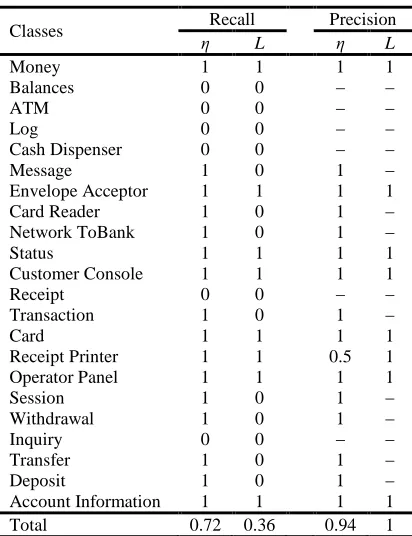
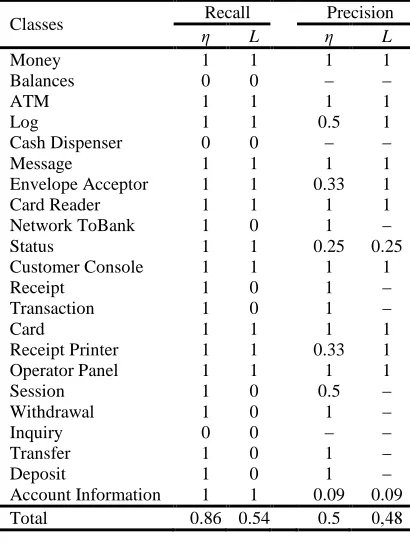
To illustrate the gain that relationships bring, we com-pare the results of our approach with those given by for-mula (18) that combines all atomic similarities. Table 4,
Table 5, and
Table 6 represent respectively the returned re-sults for the predefined thresholds 0.70 and 0.50 and for the automatic threshold. In every one of those tables, Classes column represents the design classes of our subject, It contains all classes that exist in class diagrams of ATM system; η column represents the results assessed by the similaritythat combines all atomic similarities; And L column represents the results returned by our approach.
Table 4: Results For The Threshold 0.70
Classes Recall Precision
η L η L
Money 1 1 1 1
Balances 0 0 − −
ATM 0 0 − −
Log 0 0 − −
Cash Dispenser 0 0 − −
Message 1 0 1 −
Envelope Acceptor 1 1 1 1
Card Reader 1 0 1 −
Network ToBank 1 0 1 −
Status 1 1 1 1
Customer Console 1 1 1 1
Receipt 0 0 − −
Transaction 1 0 1 −
Card 1 1 1 1
Receipt Printer 1 1 0.5 1 Operator Panel 1 1 1 1
Session 1 0 1 −
Withdrawal 1 0 1 −
Inquiry 0 0 − −
Transfer 1 0 1 −
Deposit 1 0 1 −
Table 5: Results For The Threshold 0.50
Classes Recall Precision
η L η L
Money 1 1 1 1
Balances 0 0 − −
ATM 1 1 1 1
Log 1 1 0.5 1
Cash Dispenser 0 0 − −
Message 1 1 1 1
Envelope Acceptor 1 1 0.33 1
Card Reader 1 1 1 1
Network ToBank 1 0 1 −
Status 1 1 0.25 0.25
Customer Console 1 1 1 1
Receipt 1 0 1 −
Transaction 1 0 1 −
Card 1 1 1 1
Receipt Printer 1 1 0.33 1 Operator Panel 1 1 1 1
Session 1 0 0.5 −
Withdrawal 1 0 1 −
Inquiry 0 0 − −
Transfer 1 0 1 −
Deposit 1 0 1 −
[image:8.612.91.297.438.711.2]Account Information 1 1 0.09 0.09 Total 0.86 0.54 0.5 0,48
Table 6: Results For Zhao Threshold
Classes Recall Precision
η L η L
Money 1 1 1 1
Balances 1 1 1 1
ATM 1 1 1 1
Log 1 1 0.5 1
Cash Dispenser 1 1 1 1
Message 1 1 1 1
Envelope Acceptor 1 1 1 1
Card Reader 1 1 1 1
Network ToBank 1 1 1 1
Status 1 1 1 1
Customer Console 1 1 1 1
Receipt 1 1 1 1
Transaction 1 1 1 1
Card 1 1 1 1
Receipt Printer 1 1 1 1 Operator Panel 1 1 1 1
Session 1 1 1 1
Withdrawal 1 1 1 1
Inquiry 1 1 0.16 0.25
Transfer 1 1 1 1
Deposit 1 1 1 1
Account Information 1 1 1 1
Total 1 1 0.78 0.88
4.4 Discussion
From Table 4 we could see that when we use the prede-fined threshold 0.70 method (i.e. the one based on atomic similarities) retrieves more traces than our ap-proach. Our approach seems very weak since it retrieves only 36% of traces. Comparing to witch retrieves 72% of traces we can claim that relationships similarities decrease the quality of results when we use 0.70 as a threshold. This can be interpreted in two ways, i) as a disadvantage of introducing relationship similarities; ii) or as a decreasing of similarities when we consider rela-tionships. According to the second interpretation, we
suppose that we can get better results using smaller threshold and that’s what leads as to results of
Table 5. We will discuss results of this last one after talking about the precision. As Table 4 re-ports, the two considered methods give a high level of precision. Results of η method are 94% precise
and those of our approach are 100% precise. The perfect precision of our approach when we use the threshold 0.70 is not very significant because of its low recall.
In
Table 5 we can see that when we use of thresh-old 0.50 both of methods return a better recall. η
method retrieves 86% of traces and our approach retrieves 54% of traces. Despite the improvement of our approach’s recall (i.e. from 36% to 54%), it remains useless. The least we can say, 54% is in-significant comparing to 86% retrieved by η
meth-od. From the precision point of view, η method
returns also better results than ours. η method is
precise at 50% and our approach is at 48%. But for both methods, returning results precise at almost 50% is not useful as an automated trace recovering technique.
Journal of Theoretical and Applied Information Technology 10th January 2014. Vol. 59 No.1
© 2005 - 2014 JATIT & LLS. All rights reserved.
ISSN: 1992-8645 www.jatit.org E-ISSN: 1817-3195
[image:9.612.303.522.63.321.2]
23 Figure 4: Similarities Between Design Classes And There
Relevant Correspondents
Due to the bad quality that we got when we used common thresholds, we must specify a threshold for each design class. So we use Zhao method to assess the right
thresh-old.
Table 6 represents the gotten results using an automatic threshold assessment. From that table we can see that both of methods got a perfect recall (i.e. 100%). In term of precision, results of our ap-proach are precise at 88%, and those of η method
are at 78%. We could claim that our approach is precise than η method, and relationships help us to
[image:9.612.92.301.74.230.2]eliminate false positive traces. From
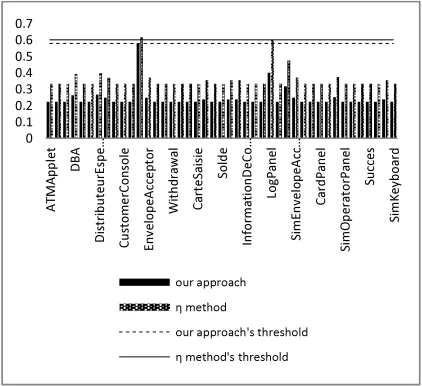
Table 6 we could see that our approach reduce false positives traces in the case of Log and the case of Inquiry. To details the effectiveness of our ap-proach in the case of Inquiry and Log. We drive the histograms of Figure 5 and Figure 6. They represent the traces’ scores and Zhao thresholds respectively for Inquiry and for Log.
Figure 5: Traces' Scores For Inquiry Class
Figure 6: Traces' Scores For Log Class
5 RELATED WORKS
A lot of papers treat the problem of trace re-covering. The iterative nature of software develop-ment breeds lot of kinds of traces. In the literature several works were proposed to recover those traces by focusing on specific kinds. We identify two main categories of trace recovery approaches. Those basing on Information Retrieval (IR) tech-nics, and those how are basing on properties’ simi-larities.
5.1 IR based Approaches
In [18] authorsrecover traces between free text documents and source code. They exploit the idea of language model, i.e. a stochastic model that as-signs a probability value to every string of words taken from a prescribed vocabulary. Language models are estimated from the documents, one for each document or identifiable section. Then they apply Bayesian classification to score the sequence of mnemonics extracted from a selected area of code against the language models. A high score indicates a high probability that a particular se-quence of mnemonics drives from the document or document’s section that generated the language
0 0.2 0.4 0.6 0.8 1 1.2 M oney Bal ances ATM Log Cas h D is p ens er M es sag e En v el ope… Car d Reader N et w or k ToBan k St at u s Cus to m e r… Recei pt Tr ans act ion Car d Recei pt Pr int e r O per at o r Pan e l Ses si o n W it hdr aw al Inqui ry Tr ans fer D epos it Acco unt …
η method our approach
η average our approach average
0 0.05 0.1 0.15 0.2 0.25 0.3 0.35 A T M A p p let D BA D ist rib u teu rE sp ec es C u sto m e rC o n so le E n v elo p eA cc e p to r Wit h d ra w a l C a rt eS a isie S o ld e In fo rm a ti o n D eC o m p te Lo g P a n el S im E n vel o p eA cc ep to r C a rd P a n el S im O p er a to rP a n el S u cc es S im K ey b o a rd our approach η method
our approach's threshold
η method's threshold
0 0.1 0.2 0.3 0.4 0.5 0.6 0.7 A T M A p p let D BA D ist rib u teu rE sp e… C u sto m e rC o n so le E n v elo p eA cc e p to r Wit h d ra w a l C a rt eS a isie S o ld e In fo rm a ti o n D eC o … Lo g P a n el S im E n vel o p eA cc … C a rd P a n el S im O p er a to rP a n el S u cc es S im K ey b o a rd our approach η method
our approach's threshold
[image:9.612.89.300.513.706.2]model. In the context of information retrieval, this approach is classified as a probabilistic approach.
Then Antoniol et al. [19] exploit VSM (Vector Space Model) to recover traceability links between source code and free text. The request for a given class is composed of identifiers belonging to that class. And similarity between the request and the document is computed by cosine.
In [20] authors compare the probabilistic mod-el presented in [18] and the vector space modmod-el presented in [19]. The results show that the former model is mostly better than the latter in term of recall and precision.
De Lucia [21], [22]propose an approach based on LSI (Latent Semantic Indexing) to recover traces between different kinds of artifacts (e.g. require-ment, design, test case, and code). The approach is implemented in a system named ADAMS.
Wang et al. [23]enhance the LSI method to re-cover more relevant traces between high level doc-uments and source code. The paper presents four enhancements: source code clustering, identifier classifying, similarity thesaurus, and hierarchical structure enhancement.
De Lucia et al. [24] propose an approach to help developers to maintain source code identifiers and comments consistent with high-level artifacts. The approach use LSI to assess the similarity be-tween low-level and high-level artifacts. It was im-plemented in an eclipse plug-in named COCONUT. In addition to similarity computation, the tool sug-gests identifiers obtained by extracting n-grams form the high-level documents.
Another IR based approach was proposed in [25]. In that work, authors use semantic relatedness to recover traceability links between free-text doc-uments and source-code. Authors use a Wikipedia-based semantic relatedness measure, namely Ex-plicit Semantic Analysis (ESA) [26] as SR retrieval technique.
Textual and structural information are com-bined in [27] to recover traceability links. Authors use LSI to recover document-to-source traces, and JRipples [28] to recover source-to-source traces. Then they infer document-to-document traces bas-ing on the previous results. Although such a combi-nation increase the recovered links, it has an im-portant disadvantage. False positive links recovered by IR will significantly pollute the results by infer-ring false positive links. To overcome this draw-back, an approach was recently proposed in [29], basically the improvement consists of validating IR recovered links before inferring new ones.
IR based approaches don’t exploit the structur-al aspect of the code and the design. They are rather
adapted to free text. It’s worth noting that those approaches suffer from the same problems of IR, i.e. polysemy (different meanings for the same word) and synonymy (same meaning for different words). The LSI technique was proposed to over-come these failings, but it is unable in front of sit-uations where the artifacts are written using differ-ent lexicons. Which is very probable in software development since several developers gets involved in this task.
5.2 Properties’ Similarities based Approaches Antoniol et al. [30], [31] recover traces be-tween design and code using the edit distance com-putation and the maximum match algorithm. Global similarity between two artifacts is computed basing on the resemblance of their names, their fields names, and their methods names and signatures.
Then Antoniol et al. [32] extend the work in [30] by introducing relationship and dictionnary similarities. This work differs from ours since it uses relationships to check the quality of tractability rather than using them in the construction of traces. In [33] authors asses the similarity between a design artifact and an implementation artifact bas-ing on three kinds of similarities: classifiers names, metric profiles, and packages.
Classes in design and in implementation share lot of properties. Which properties are more rele-vant to trace recovering is the subject of the re-search presented by Antoniol et al. [34]. In that work, different combinations where analyzed. All the gotten results suggest that the best performing combinations are those with an explicit representa-tion of the class name, while very poor performanc-es are associated to methods based on the relations of a class with the other classes.
It is worth noting that this work use relation-ships in a different manner than us. They transform it to a class attributes of type string. If, for example, class A generalizes class B, the attribute
"generaliz-es->B" is attached to class A, and the attribute "ex-tends->A" is attached to class B. This is not the best
way to exploit relationships in trace recovery, since all relationships having the same type will have the same common prefix (e.g “generalize->”), which disturbs the similarity. To illustrate this case, take the example of >pen” and
“generalize->cat”, the similarity between those two strings
basing on edit distance is at 90%, which is far high-er than the reality. Anothhigh-er disadvantage of this method is that the similarity depends only on the names of the classes.
Journal of Theoretical and Applied Information Technology 10th January 2014. Vol. 59 No.1
© 2005 - 2014 JATIT & LLS. All rights reserved.
ISSN: 1992-8645 www.jatit.org E-ISSN: 1817-3195
25 Traceability links helps in terms of quality and productivity. They are generally involved in several activities of software development, and especially in maintenance. But market and delays pressures force developers to sacrifice them. The purpose of this work is to recover traces between design and implementation.
This work describes a similarity based ap-proach to recover traceability links between UML design classes and java classes. The similarity is computed basing on properties resemblance. Two categories of properties are considered: elementary properties and relationship properties. Resemblance for the former is assessed using string edit distance and a maximum matching algorithm. To compute the similarity in term of a relationship property, we must assume a mapping between the design and the code. The mapping is constructed using an ACO algorithm.
The originality of this work consists in the ex-ploitation of relationships. When computing simi-larity in terms of a relationship, we consider the nature of the relationship, and all the property of the class that is at the other end of the relationship. According to the evaluation result, we can see that this approach seems promising. Experimentation shows that, when we use Zhao threshold, relation-ships improve to 10% the precision while keeping the same recall. Evaluation shows also that our ap-proach gives bad results when using a predefined threshold. Thus we strongly recommend the use of Zhao threshold to filter traces.
The case study subject is not large enough to evaluate this work, but the lack of suitable subjects on the internet has forced us to take such a decision. In future work we will extend our approach to cov-er othcov-er programing languages and diagrams. An evaluation on larger subjects is also planned and will be the subject of future works. It is worth not-ing that this work is part of a large change impact analysis project.
REFERENCES:
[1] IEEE Std 610.12, IEEE Standard Glossary of Software Engineering Terminology, (1990) [2] ISO/IEC 12207, Software & Systems
Engineer-ing Standards Committee of the IEEE Com-puter Society, (2008)
[3] Zhao W., Zhang L., Liu Y., Luo J., & Sun J.: Understanding how the requirements are im-plemented in source code. In Software Engi-neering Conference, Tenth Asia-Pacific, (De-cember 2003), pp. 68-77.
[4] Borg M.: IR-based Traceability Recovery as a Plugin–An Industrial Case Study. In Proceed-ings of the Fourth BCS-IRSG conference on Future Directions in Information Access. (2011), pp. 14-17
[5] Shatnawi R., Alzu'bi A.: A Verification of the Correspondence between Design and Imple-mentation Quality Attributes Using a Hierar-chal Quality Model. IAENG International Journal of Computer Science, Vol. 38, No. 3, (2011), pp. 225-233.
[6] Hammad M., Collard M. L., & Maletic J. I.: Automatically identifying changes that impact code-to-design traceability during evolution. Software Quality Journal, Vol. 19, No. 1, (2011), pp. 35-64.
[7] Delater A., Narayan N., & Paech B.: Tracing Requirements and Source Code during Soft-ware Development. In ICSEA 2012, The Sev-enth International Conference on Software Engineering Advances, (2012), pp. 274-282. [8] Dorigo M., Maniezzo V., Colorni A., &
Ma-niezzo V.:Positive feedback as a search strat-egy. (Tech. Rep. 91-016). Milan, Italy: Politecnico di Milano, Dipartimento di Elettronica, (1991).
[9] Colorni A., Dorigo M., & Maniezzo V.: Dis-tributed optimization by ant colonies. In Pro-ceedings of the first European conference on artificial life, (1991), pp. 134-142.
[10]: IBM, “Java naming conventions,” available at http://www.ibm.com/developerworks/library/ ws-tip-namingconv.html (last visited on 24/08/13)
[11]: Oracle, “Code Conventions for the Java Pro-gramming Language,” available at http://www.oracle.com/technetwork/java/code conv-138413.html (last visited on 24/08/13) [12] Gusfield D.: Algorithms on strings, trees and
sequences: computer science and computa-tional biology. Cambridge University Press. (1997)
[13] Cormen T. H., Leiserson C. E., Rivest R. L., & Stein C.: Introduction to algorithms. Third edition. The MIT press. (2001)
[14] OMG Unified Modeling LanguageTM (OMG UML),Superstructure, Version 2.4.1, Date: August 2011
[16]: http://www.math-cs.gordon.edu/courses/cs211/ATMExample/ (last visited on 24/08/13)
[17] Manning C. D., Raghavan P., & Schütze H.: Introduction to information retrieval. Cam-bridge: Cambridge University Press, (2008) [18] Antoniol G., Canfora G., De Lucia A., &
Mer-lo E.: Recovering code to documentation links in OO systems. Reverse Engineering. Pro-ceedings. Sixth Working Conference on., (1999), pp. 136-144.
[19] Antoniol G, Canfora G., Casazza G., et al.: Information retrieval models for recovering traceability links between code and documen-tation. In : Software Maintenance, 2000. Pro-ceedings. International Conference on. IEEE, (2000). pp. 40-49.
[20] Antoniol G., Canfora G., Casazza G., & De Lucia A.: Recovering traceability links be-tween code and documentation. Software En-gineering, IEEE Transactions on, Vol. 28, No. 10 (2002), pp. 970-983.
[21] De Lucia A., Fasano F., Oliveto R., & Tortora G.: Enhancing an artefact management system with traceability recovery features. In Soft-ware Maintenance Proceedings. 20th IEEE In-ternational Conference on, (2004), pp. 306-315.
[22] De Lucia A., Fasano F., Oliveto R., & Tortora G.: Adams re-trace: A traceability recovery tool. In Software Maintenance and Reengi-neering, CSMR 2005. Ninth European Con-ference on, (2005) pp. 32-41.
[23] Wang X., Lai G., & Liu C.: Recovering rela-tionships between documentation and source code based on the characteristics of software engineering. Electronic Notes in Theoretical Computer Science, Vol. 243, (2009), pp. 121-137.
[24] De Lucia A., Di Penta M., & Oliveto R.: Im-proving source code lexicon via traceability and information retrieval. Software Engineer-ing, IEEE Transactions on, Vol. 37, No. 2, (2011), pp. 205-227.
[25] Mahmoud A., Niu N., & Xu S.: A semantic relatedness approach for traceability link re-covery. In Program Comprehension (ICPC), 2012 IEEE 20th International Conference on, (2012, June), pp. 183-192.
[26] Gabrilovich E., & Markovitch S.: Computing Semantic Relatedness Using Wikipedia-based Explicit Semantic Analysis. In IJCAI, 7, (2007, January), pp. 1606-1611.
[27] McMillan C., Poshyvanyk D., & Revelle M.: Combining textual and structural analysis of
software artifacts for traceability link recov-ery. In Traceability in Emerging Forms of Software Engineering, 2009. TEFSE'09. ICSE Workshop on, (2009, May), pp. 41-48. [28]Buckner J., Buchta J., Petrenko M., & Rajlich
V.:. JRipples: A tool for program comprehen-sion during incremental change. In Program Comprehension, 2005. IWPC 2005. Proceed-ings. 13th International Workshop on, (2005, May), pp. 149-152.
[29] Panichella A., McMillan C., Moritz E., Palmi-eri D., Oliveto R., Poshyvanyk D., & De Lu-cia A.: When and how using structural infor-mation to improve IR-based traceability re-covery. In Software Maintenance and Reengi-neering (CSMR), 2013 17th European Con-ference on , (2013, March), pp. 199-208. [30] Antoniol G., Potrich A., Tonella P., & Fiutem
R.: Evolving object oriented design to im-prove code traceability. In. Proceedings. Sev-enth International Workshop on Program Comprehension (1999), pp. 151-160.
[31] Antoniol G., Canfora G., Casazza G., & De Lucia A.: Maintaining traceability links dur-ing object-oriented software evolution. Soft-ware: Practice and Experience, Vol. 31, No. 4, (2001), pp. 331-355.
[32] Antoniol G., Caprile B., Potrich A., & Tonella P.: Design-code traceability for object-oriented systems. Annals of Software Engi-neering, Vol. 9. No. 1-2, (2000): 35-58. [33] Van Opzeeland D. J., Lange C. F., &
Chaudron M. R.: Quantitative techniques for the assessment of correspondence between UML designs and implementations. In 9th ECOOP Workshop on Quantitative Ap-proaches in Object-Oriented Software Engi-neering, (2005)