STRATEGY TO INTEGRATE ACADEMIC DATA
USING WEB SERVICES AND PL SQL
(CASE STUDY TELKOM UNIVERSITY)
1TORA FAHRUDIN
1Computer Engineering, Telkom Applied Science School, Telkom University
E-mail: [email protected]
ABSTRACT
Established in 17 July 2013, Telkom University was formed from various faculties from Telkom Education Foundation, such as Faculty of Engineering (TES), Faculty of Management (TEBS), Faculty of Applied Sciences (TASS) and the Faculty of Creative Industries (TCIS). Each faculty has the Academic Information Systems. When it became a university, problems faced is how to do the integration strategy of academic data from the different data structure and data sources of academic information system at each faculty into one new scheme of University database. The challenge is the old academic system is still running for one semester, which means the data will still moving. Therefore, this study focuses on both strategic and technical concepts to integrate academic data base on that condition. A major strategy is using web services for data interchange and PL SQL Scheduler to process transaction data which still moving. Meanwhile, master data is loaded only once with flat files format. The conclusions obtained from this research are 1) to integrate academic data, logic data needed to be split into master data and transaction data, 2) the strategy for integrate master data are loaded only once with flat files format, meanwhile the transaction data is loaded many times via web services (JSON), 3) transaction data from web services will be loaded and mapping into destination database using JSON PL SQL package which run periodically.
Keywords: Academic Data Integration; Web Services; JSON; PL SQL; DBMS Scheduler
1. INTRODUCTION
According to a decree of the Minister of Education no 270/E/O/2013, 4 institutions under Telkom Education Foundation are allowed to merge as a Telkom University. The four institutions were Telkom Institute of Technology, Telkom Institute of Management, Telkom Polytechnics and Telkom Arts School [1]. Conceptually each institution will be a faculty, so Telkom University has four faculties, which are the Faculty of Engineering (TES), Faculty of Business Management (TEBS), Faculty of Applied Science (TASS) and the Faculty of Creative Industries (TCIS).
Each faculty has had academic information system, respectively. Each academic information system at the faculty has different data structure and application environment. When all institutions merge as Telkom University, data must be integrated, especially academic data. Based on the research of Jihon Chengxiu Zeng and Tang, there are three advantages of integrating data in the context of enterprise-level planning and decision making:
(1) improved managerial information for organization-wide communication;
(2) Improved operational coordination across sub-units or divisions of an organization; and (3) Improved organization-wide strategic planning
and decision making [2]
Data integration is necessary for data to serve as a common language for communication within an organization [2].
The differences in the data environment and data structure of each faculty, the challenge is what strategy to integrate an academic data with the constraint that ongoing transaction should still run and not stopped by integration process.
Figure 1: Data logic concept
Table 1: Different Characteristic of Master Data and Transaction Data
Characteristic
Master Data
Transaction Data
Record Fix Increased
Value
Not
Change Allow change Size of data small Medium to big
Master data integration is performed once at the beginning of integration process. Meanwhile, active transaction data was loaded by scheduler any time periodically. But for non-active transaction data, integration process is performed only once time at the beginning same as master data. Data will be requested from each web services of faculty periodically by PL SQL and DBMS Scheduler and was processed to enter a University Database Scheme.
2. THEORITICAL BACKGROUND
2.1 Data Integration
Data integration is the process of standardization of data definitions and data structures by using common conceptual schema across a collection of data sources [3].
The Advanced Forest Technologies in Canada (AFT, 1997) identified the following factors which must be addressed to integrate data properly. Some of important factor [4]:
• Identification of an optimal subset of the
available data sources for integration
• The formats of the data, the archive systems,
and the data storage and retrieval
• The computational efficiency of the integrated
data sets to achieve the goals of the users
2.2 Web Services
A web service is service that accepts a request and returns data or carries out a processing task [5]. The data returned a normally formatted in
a-machine-readable form [5]. In order to make these web-services available, there must be standards so that everyone knows what information can be requested, how to request it, and what form the response will take [5].
Web Service is an interface which implements business logic [6]. Performance is a one of the major problem in Web Services. [6]. Several standard formats for data document exchanged are JSON and XML. The results of research conducted by Nurzhan Nurseitov from Montana University, find that JSON is significantly faster than XML [7]. Therefore, by considering the speed of JSON, JSON more chosen as a data exchange format then XML.
2.2.2 JSON
JSON = JavaScript Object Notation [8]. JSON is designed to be data exchange language which is human readable and easy for computers to parse and use [8].
Example of JSON format
[{"ROOMID":"1","ROOMNAME":"A1","CAPAC ITY":"40"},{"ROOMID":"2","ROOMNAME":"A2 ","CAPACITY":"20"}]
Above shows that there are 2 pieces of data (in the form of an array) where each data consists of three attributes : RoomID, roomname and capacity.
Figure 2: JSON View from Google Chrome with
JSON Add On View Module
2.3 PL SQL
PL SQL can be used to implement business rules through the creation of stored procedures, functions and packages, triggers to trigger events and add programming logic to execution of SQL commands [9]. PL SQL divided into [10]:
• Stored Program Units (procedures,
functions, and packages)
• Triggers
2.4 DBMS Scheduler
The DBMS_SCHEDULER package provides a collection of scheduling functions and procedures that are callable from any PL/SQL program [11]. Scheduler has 3 important parts:
• Program : what action should be execute • Schedule: when program should be
execute
[image:3.595.86.505.77.398.2]• Jobs : unique name from schedule job
Figure 3: DBMS Scheduler example
2.5 JSON Package
JSON Package is Free package from Jonas Krogsboell and Lewis R Cunningha (2009), that has been released under MIT License which supply package for parsing JSON (decode or encode) on Oracle environments [12].
Figure 4: JSON Package example (ex1.sql) [11]
3. INTEGRATION CONCEPT
3.1 Master Data and Transaction Data on
Academic Environment
Master Data is conceptualized in the core entities of the enterprise [13]. The main characteristics of the data master are:
• Data change slowly
• Many applications or business processes
that refer to the data
• Core element of business processes
While the transaction data, has the opposite characteristics.
Table 2: Grouping of Academic Entities
Entities Master Data
Transaction Data
Student V
Lecturer V
Curriculum V
Rooms V
Shift V
Education Bill V
Faculty V
Study Program V
Student Registration Status V Student Payment V Student Study Card V
Schedules V
Lecturer Presence V Student Presence V Student Test Score V
3.2 Data Integration Strategy
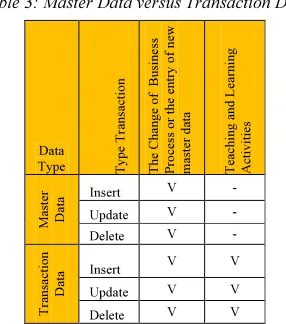
[image:3.595.334.477.465.627.2]The possibility of insert, update and delete between master data and transaction data can be seen in the table below.
Table 3: Master Data versus Transaction Data
Data
Type Typ
e T ra n sa ct io n T h e C h a n g e o f B u si n e ss P ro ce ss o r th e en tr y o f n ew m as te r d at a T ea c h in g a n d L ea rn in g A ct iv it ie s Ma st er D a ta Insert
V -
Update V -
Delete V -
T ra n sa ct io n D at
a Insert V V
Update V V
Delete V V
Table 4: Insert Update and Delete of each Academic Process for one semester (in months)
Academic Process Active Semester
1 2 3 4 5 6 Student Registration Status
Student Payment
Student Study Card
Schedules
Lecturer Presence
Student Presence
Student Test Score U
T
S
U
A
S
[image:4.595.86.294.433.658.2]From the table above, it can be seen that the characteristics of academic transaction data is changing in a semester for each Academic Processes. The implication of the theory of master data and transaction of data is the difference in the strategy of integrating the data. For data that are not moving, the data is loaded only once. While the transaction data that still changing must be loaded by PL SQL Scheduler to process data with JSON data format.
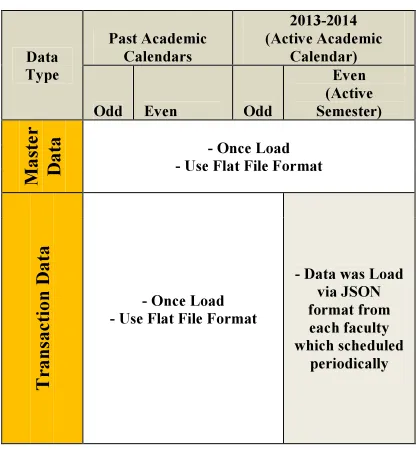
Table 5: The different strategies of Master Data and Transaction Data
Data Type
Past Academic Calendars
2013-2014 (Active Academic
Calendar)
Odd Even Odd
Even (Active Semester)
M
a
s
te
r
D
a
ta - Once Load
- Use Flat File Format
T
r
a
n
s
a
c
tio
n
D
a
t
a
- Once Load - Use Flat File Format
- Data was Load via JSON format from each faculty which scheduled
periodically
Before the integration, it must create a database schema of Telkom University first. Data will be Load and mapped from each faculty to the new database schema of Telkom University.
Figure 5: Data Load and Mapping into Telkom University Schema
3.3 Limitation Study
This research has some limitations and assumptions.
• Study did not discuss details of the
mapping tables from the source database to the destination database
• It is assumed in the transaction data load is
fixed, unchanged after migrate. If the data is already loaded in the faculty was changed, an adjustment at the end of the process is necessary to ensure valid data.
• Assumed no network failure during
integration with PL SQL scheduler is running. If the networks fail, PL SQL can’t process the transaction data that day. So the data need to be adjusting again.
• Accuracy of the data migration results are
not discussed in this paper
4. IMPLEMENTATION RESULT
4.1 Load Data Master
Master data is loaded only one time using Flat File format. Each faculty must export master data on Flat File format. After that, data are mapped into a Telkom University Schema.
4.2 Web Services for Transaction Data
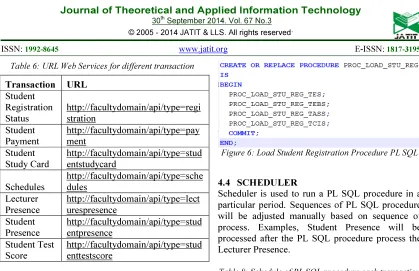
Table 6: URL Web Services for different transaction
Transaction URL
Student Registration Status
http://facultydomain/api/type=regi stration
Student Payment
http://facultydomain/api/type=pay ment
Student Study Card
http://facultydomain/api/type=stud entstudycard
Schedules
http://facultydomain/api/type=sche dules
Lecturer Presence
http://facultydomain/api/type=lect urespresence
Student Presence
http://facultydomain/api/type=stud entpresence
Student Test Score
http://facultydomain/api/type=stud enttestscore
4.3 PL SQL
Transaction data from web services each faculty, were processed by PL SQL scripts which are embedded in Telkom University Database Schema. 2 Package were needed, 1) Package from Jonas Krogsboell and Lewis R Cunningha (2009) for parsing JSON data, 2) UTL_HTTP package to get web page content from Web services.
Table 7: Procedure PL SQL Each Transaction
Transaction Procedure PL SQL
Student Registration
Status PROC_LOAD_STU_REG Student
Payment PROC_LOAD_TRANSACTION Student
Study Card PROC_LOAD_STUDY_CARD Schedules PROC_LOAD_SCHED Lecturer
Presence PROC_LOAD_LEC Student
Presence PROC_LOAD_STU_PRE Student Test
Score PROC_LOAD_STU_SCORE For each PL SQL Procedure, there are four procedures representing each faculty (TES, TEBS, TASS, and TCIS).
Figure 6: Load Student Registration Procedure PL SQL
4.4 SCHEDULER
[image:5.595.87.506.66.337.2]Scheduler is used to run a PL SQL procedure in a particular period. Sequences of PL SQL procedure will be adjusted manually based on sequence of process. Examples, Student Presence will be processed after the PL SQL procedure process the Lecturer Presence.
Table 8: Schedule of PL SQL procedure each transaction
Transaction Loaded Time
Student Registration Status
One Time After Registration Change Schedules Finish Student
Payment
One Time After Registration Change Schedules Finish Student
Study Card
One Time After Registration Change Schedules Finish
Schedules
One Time After Registration Change Schedules Finish Lecturer
Presence Every day at 22:00 Student
Presence Every day at 23:00
Student Test Score
One Time After Final grades Submission Deadline
5. SUMMARY
5.1 Conclusions
The conclusions obtained from this research is 1. To integrate academic data, logic data needed
to be split into master data and transaction data 2. The strategy for integrate master data are
loaded only once with flat files format, meanwhile the transaction data is loaded many times via web services (JSON)
REFRENCES:
[1]http://www.telkomuniversity.ac.id/page/history (accessed on April, 2014)
[2]Zeng, Jihong; Tan, Chengxiu. “Overview of Research and Practices in Information Sharing for Enterprise Resource Planning”. Journal of Applied Business and Economics.
[3]Heimbigner, D. & McLeod, D. (1985). “A
Federated Architecture for Information
Management, ACM Transactions on Office Information Systems”, 3, (3), 253-278.
[4] Research and Practical Experiences in the Use of Multiple Data Sources. www.ctg.albany.edu. (2003). (accessed from http://www.ctg.albany.edu/publications/reports/ multiple_data_sources?chapter=5&PrintVersion =2, on April, 2014)
[5]Hunter, David, et al. (2007). “Beginning XML. 4th Edition”. Indiana: Wiley Publishing, Inc. [6] Raedy, Mohan Ch Ram; Geetha, D Evanglin;
Srinivasa, KG. “Early Performance Prediction Of Web Services”. International Journal on Web Service Computing (IJWSC), Vol. 2, No. 3, September. (2011)
[7]Nurseitov Nurzhan, Paulson Michael, Reynolds Randall, Izurieta Clemente. (2009). “Comparison of JSON and XML Data Interchange Formats: A case study”. Department of Computer Science Montana State University – Bozeman, Montana, USA. [8]JSON. JSON. json.org. http://www.json.org
(accessed on April, 2014)
[9]http://docs.oracle.com/cd/B19306_01/appdev.102 /b14261.pdf (accessed on June, 2014)
[10]http://docs.oracle.com/cd/B19306_01/appdev.10 2/b14251/adfns_packages.htm (accessed on June, 2014)
[11]http://docs.oracle.com/cd/B19306_01/appdev.10 2/b14258/d_sched.htm (accessed on June, 2014) [12]Krogsboll Jonas, Lewis R Cunningham. (2009). “PL / JSON Reference Guide (version 1.0.4) For Oracle 10g and 11g”