Published Online July 2013 in SciRes (http://www.scirp.org/journal/ce) http://dx.doi.org/10.4236/ce.2013.47A2019
Improving Higher Education Student Learning
through a Table of Learning
Richard Lai, Nurazlina Sanusi
Department of Computer Science and Computer Engineering, La Trobe University, Victoria, Australia Email: [email protected], [email protected]
Received May 17th, 2013; revised June 17th, 2013; accepted June 28th, 2013
Copyright © 2013 Richard Lai, Nurazlina Sanusi. This is an open access article distributed under the Creative Commons Attribution License, which permits unrestricted use, distribution, and reproduction in any medium, provided the original work is properly cited.
Web-based or “online” learning commonly known as e-Learning which makes use of internet technolo- gies has been widely used by many education institutions around the globe. Higher education institutions have been using Learning Management system (LMS) as a part of their campus-based and distance teaching. To date, very little research has been carried out to investigate whether the uses of LMS actually contribute to student learning. In this paper, we present a higher education blended teaching method for improving student learning. By blended teaching, we mean the combination of face-to-face teaching and the uses of a LMS for learning, teaching and assessment activities. Student’s learning progress is guided and gauged by Shulman’s (2002) table of learning. The LMS that we use at La Trobe University is Moodle. To demonstrate the usefulness of our method, we also present in this paper the results of apply- ing it to teaching a third year software engineering subject, CSE3MQR (Metrics, Quality and Reliability).
Keywords: Constructive Progressive Alignment; Taxonomy of Learning; Blended Learning; e-Learning; Learning Management System; Student Engagement
Introduction
Web-based or “online” learning commonly known as e- Learning which makes use of internet technologies has been widely used by many education institutions around the globe. e-Learning supports blended learning that offers student the flexibility and accessibility in their learning. Blended learning is a combination of face-to-face and e-Learning practices (Derntl et al., 2005; Garrison et al., 2004). Blended learning in- volves instruction and learning activities occurring both online and in classrooms. The effective uses of educational technolo- gies remain as central issues for both educators and researchers. Computer-assisted assessment or e-Assessment has become important in the online environment. For blended courses, lec- turers have made changes in the ways they assess students’ learning. The principles of assessment in an online learning or blended learning environment remain quite the same as what they are in the traditional teaching; however, there are differ- ences in the way how these principles are implemented.
In the area of Computer Science education, past researches mainly concentrated on developing tools, reporting classroom experiences or scientific evaluations of techniques or technolo- gies applied in the classroom. How Learning Management Sys- tem (LMS) activities could actually contribute to learning have not been well researched into, particularly in relation to online assessment. Assuming that improving learning is the aim, one may ask whether incorporation of information technology in the learning process could lead to better learning experiences and produce better learning outcomes in higher education. In order for these to become realities, we need to conduct research that could underpin the successful delivery of e-Learning.
Research in enhancing student engagement has been mixed. A study by Sheard, Carbone and Hurst (2010) found that lec- turers need to explore new ways of engaging students in their teaching and there is a tool that could assist lecturers to detect the early signs of disinterest. Pears (2010) who proposed a re- search based course in introductory programming course found that the practices promoted student engagement and better learning outcomes. Krause (2008) suggests that there are a va- riety of ways in student engagement in higher education. He identified that to achieve a better learning, it is important for students to actively construct their knowledge based on their own experience. A study was conducted by Reaburn et al. (2009) on examining student engagement with course redesign in the context of aligned curriculum and instruction. They found that the students who learned through the fully online course and had a work-based learning component had a higher engagement.
The most well-known educational taxonomy was developed by Bloom (1956) for cognitive domain. Bloom’s taxonomy is often used by educators to develop and measure goals of learn- ing process. It is based on a hierarchy of learning that moves from simple to complex and concrete to abstract. The hierarchy starts with knowledge and moves to comprehension, applica- tion, analysis, synthesis and evaluation. The levels are cumula- tive; that means a learner needs to master the earlier levels in order to succeed with more complex learning objectives. How- ever, researchers argue that Blooms taxonomy is not simple to use and has limitations to educators.
we mean the combination of face-to-face teaching and the uses of a LMS for learning, teaching and assessment activities. Stu- dent’s learning progress is guided and gauged by Shulman’s (2002) table of learning. The LMS that we use at La Trobe Uni- versity is Moodle. To demonstrate the usefulness of our method, we also present in this paper the results of applying the method to teaching a third year software engineering subject, CSE3 MQR (Metrics, Quality and Reliability).
Shulman’s Table of Learning
Shulman (2002) proposed a taxonomy of learning. He identi- fies a six-stage learning process:
Engagement and Motivation
He contended that learning begins with engagement and mo- tivation. Student engagement is often used to depict students’ willingness to participate in the learning activities, such as at- tending class, submitting required work, and following teach- ers’ directions in class. Engagement in learning is critical to academic achievement because it leads students to have better understanding and knowledge, skills and confidence and it fosters in students a sense of belonging and self-worth. Shul- man also argued that engagement and motivation is an on-going part of the learning process and collaborates with all the later stages of learning.
Knowledge and Understanding
Knowledge is a familiarity with something, which can in- clude facts, information, or descriptions acquired through ex- perience or education. It often refers to the theoretical under- standing of a subject. While knowledge concerns with facts and information; understanding is to do with the real meaning of the facts. One might know something to be true, but he/she does not necessarily understand why it is true and what the impact of that truth is. In contrast to knowledge and information, under- standing implies a form of ownership.
Performance and Action
Acts of understanding are often based on what are in our head. Andrew Jackson says “Take the time to deliberate, but when the time for action arrives, stop thinking and go in.” As students develop an understanding of a subject matter, a com- mon question emerges: “How do I put this knowledge into ac- tion?” In the “Performance and action” stage, knowledge and understanding are put into practice. It is when a student’s knowledge and understanding are tested and when his/her en- gagement is affirmed.
Reflection and Critique
Students are encouraged to develop high-order thinking, meaning that they are able to give further explanation on a sub- ject matter. We sometimes must cease action and reflect on what we have done. When researchers stop their work in order to prepare a paper for publication, they make important discov- eries about how to move forward with the next stage of re- search. We can stimulate and assist each other to pause, reflect, and evaluate our work; and as such we can prepare ourselves better for the next stage of our work. Thus, action with reflec-
tion is likely to produce deeper learning.
Judgment and Design
They are what happens when understanding meets the con- straints and complexities of a world with respect to which we can no longer say “all other things being equal”. For instance, when one designs a home, he/she works within constraints of budget, terrain, and lifestyle of the person for whom it is de- signed. Judgment and Design are a matter of exercising under- standing, as well as applying skills, under a variety of con- straints and contingencies.
Commitment and Identity
We experience commitment as we internalize values, de- velop character, and become people who no longer need to be goaded to behave in ethical, moral, or publicly responsible ways. We also commit ourselves to larger groups, larger com- munities, larger congregations, and professions at large; and by doing so, we make a statement that we take the values and principles of that group seriously enough to make them our own. Commitment and Identity are both moving inward and connecting outward; it is the highest attainment an educated person can achieve.
The Pedagogical Principles behind
Our Teaching Method
The idea of Constructive Alignment (CA) was introduced by Biggs (1996, 1999, 2003) for higher education teaching and learning. He contends that students construct knowledge through relevant and meaningful learning activities. Alignment refers to what a lecturer does to support the appropriate learning activi- ties in order to achieve the intended learning outcomes. Lectur- ers are responsible to facilitate the learning activities of the students and design the assessment tasks which assess students’ intended learning outcomes. Bigg also states that education is about conceptual change which takes place when it is clear to students (and teachers) what is “appropriate”, what the objec- tives are, where all can see where they are supposed to be going. CA is based on the principles of constructivism in learning which states that meaning is personal, it depends on motives, intentions, prior knowledge, etc., and learning is a way of in- teracting with the world.
However, CA does not provide clear guidelines as to: 1) how we should develop or create the teaching and learning activities in order to help students achieve the intended student learning outcomes; and 2) how the activities are to be developed in order to help students learn progressively. Often, students’ learning outcomes are measured towards the end of the teaching period, typically by examination and a big assignment. Assignments and examinations might not be well conceived; students might view them as urgent and resort to plagiarism and outside help; this could become counter-productive.
Trobe University, there are 12 weeks of teaching in one semes- ter. We use a blended teaching method with the use of Moodle. The designs of the teaching and learning activities are centred around Shulman’s first four stages of learning so that we have confidence that students are learning from stage to stage; and consequently, they will increase their learning. We name our method, Constructive Progressive Alignment (CPA). The mean- ings of “Constructive” and “Alignment” remain the same as in the CA context. However, in addition to the expected “Align- ment” activities that a lecturer would put into place when teaching a subject using the CA method, we use the term “Pro- gressive Alignment” to mean that a lecturer also needs to in- clude and design teaching and learning activities that align with the ways how students learn progressively in order to improve student learning.
Moodle
La Trobe has been using Moodle as the LMS for teaching and learning since 2011. Moodle (Modular Object-Oriented Dynamic Learning Environment) is an Open Source Course Management System (CMS), also known as a Learning Man- agement System (LMS) (http://moodle.org). It has become very popular among educators around the world as a tool for creating online dynamic web sites for their students. Moodle aims to give educators good tools to manage and promote learning, but there are many ways to use it. For instances, it has features that allow it to scale to very large deployments and hundreds of thousands of students, yet it can also be used for a primary school or an education hobbyist. Many institutions use it as their platform to conduct fully online courses, while some use it simply to augment face-to-face courses (known as blended learning). Many users love to use the activity modules (such as forums, databases and wikis) to build richly collaborative com- munities of learning around their subject matter (in the social constructionist tradition), while others prefer to use Moodle as a way to deliver content to students and assess learning using assignments or quizzes.
The Subjects Taught
We have applied our method to teaching some software en- gineering subjects. The subjects are: 1) CSE3MQR (Metrics, quality and reliability) in 2011; 2) CSE3MQR (Metrics, quality and reliability) in 2012; and 3) CSE3MQR (Metrics, quality and reliability, CSE3SDM (System Design and Methodology) and CSE5CPE (Communication Protocol Engineering) in 2013.
In this paper, we limit our discussions on our experiences in using the method to teach CSE3MQR in 2011. CSE3MQR is a subject of the Bachelor of Software Engineering (BSE) course. BSE is of four year full-time or equivalent part-time duration and requires the completion of 480 credit points. In the first and second years, students study a fixed combination of subjects in computer science and electronics, together with mathematics, computer systems, physics, and engineering management. A major industry-relevant project must be completed in third year and a research project in fourth year. Graduates of the course are eligible for membership of Engineers Australia.
A third year students has to complete the studies of subjects totaling 120 credit points. CSE3MQR is worth 15 credit points. This subject examines the different attributes of the quality of a piece of software and their meanings. The topics covered in-
clude the use of metrics to improve software quality, different types of metrics, software complexity, size estimation, Goal Question and Metrics (GQM), software reliability concepts, reliability model, reliability estimation, testing issues in the real world, test suite design, testing techniques, management issues in testing, and software release policies.
In 2011, there were 27 students who enrolled in CSE3MQR. Teaching consisted of two one-hour lectures and one two-hour laboratory/tutorial. The assessment consisted of 70% for ex- amination and 30% for course work which comprised assign- ments, laboratories, and tutorial.
Implementing the Method
Stage 1: Engagement and Motivation
Learning begins with student engagement, without which subsequent stages of learning will not succeed well. We wanted to find out students’ learning preferences so that we could align our ways of teaching with students’ learning styles. To obtain such information from the students, we conducted a Moodle online survey amongst them at the start of the semester. The survey was entitled “Approach to Studying MQR” and used a five-point Likert-type scale (with 5 being the most true and 1 being the least true), which indicated the degrees to which the students agreed with a certain study style or behaviour. It was aimed at gaining some ideas about what made the students en- gage in learning and what motivated them to study, based on their past experiences in learning activities.
The survey consisted of 15 questionnaires; some examples were: 1) I prefer a personalized approach to learning and want to have peer learning with my classmates; 2) I am able to do the best when learning the practical aspects of subject; and 3) I like a clearly defined schedule and standards so I know what to do rather than taking independent action. Students indicated their level of agreement by selecting a number within the range from one to five, with five meaning the highest level of agreement. Tables 1 and 2 below summarises the survey results.
The results were then published on Moodle and discussion were held with the students. As such, the following decisions were made together with them: 1) all forms of assessments were to be of e-Assessment tasks and to be submitted via Moo- dle; 2) regular and smaller e-Assessment tasks based on the materials taught were to be given; 3) the assessment tasks were to be of different varieties, e.g., problem solving, essay, re- searching into commercial/industrial issues; 4) the breakdown of marks for each of these e-Assessment tasks were agreed and well understood by the students.
To obtain further feedbacks from them at the start of the se- mester, we briefly explained the ten topics that we had prepared for teaching CSE3MQR and conducted a Moodle survey which enabled them to indicate their levels of interest in each of these ten topics. Further, the survey also consisted of the following two questions: 1) I like to have as many topics as possible to be covered in this course, with the understanding that each of the topics will not be taught in depth; and 2) I like to have a lesser number of topics to be covered but at a greater depth. Students indicate their level of interest/agreement by selecting a number within the range from one to five, with five meaning the highest level of interest/agreement. After analysing the survey data, it was found that the three topics—“Management by metrics”, “Software Testing” and “Reliability”—received the highest
Table 1.
Student responses to statements on study styles.
Statement No of 5’s
1 I am able to do the best when learning the practical aspects of the subject. 17
2 I seek an organized structure, want lessons to be clearly spelled out in step by step order andwant to know the lecturer’sexpectations. 17
3 I keep a sharp focus on technical information and enjoy complex ideas. 14
4 I learn best in a face-to-face learning environment and enjoy discussing the content of lessons with a small group of peers. 13
5 I like to experiment, invent and enjoy analyzing and solving complex problems. 13
6 I like interactions as I am responsive to instructional games than lectures. 8
7 I will only do assignments that will be graded. 8
8 I have a preference for long-term independent projects which I can carry out with minimal lecturer’s help. 6
Table 2.
Student responses to statements on study preferences.
Statement on study preferences No of 5’s
1 I prefer doing e-assignment than doing pen and paper assignment. 16
2 I prefer tasks requiring the operation, construction or materials over ones requiring reading or writing. 15
3 I like a clearly defined schedule and standards so I know what to do rather than taking independent action. 15
4 I am interested in explaining facts using theories and principles rather than just learning them and understanding them. 14
5 I prefer a personalized approach to learning and want to have peer learning with my classmates. 12
6 I enjoy the communication process to be done electronically so I can express my thoughts freely. 11
scores from the students. They also strongly preferred that top- ics were to be taught in depth rather than in breadth.
We sent out weekly Moodle announcements reminding them about e-Assessment deadline, marking criteria, the availability of assessment results, general feedbacks on the assessment tasks, seminars and talks on topics that are relevant to them, what would be taught in the next lecture, and what would be done in the next laboratory/tutorial class. Other teaching activi- ties aiming at increasing student engagement and motivation are listed in Table 3.
Stage 2: Knowledge and Understanding
After students were engaged in learning, it was easier for us to apply the CA principle to contribute to students’ knowledge and understanding, hence achieving the intended learning out- comes. We designed a shorter online multiple choice question quiz which was based on the material just taught during a lec- ture and was to be attempted by the students of the class about 10 minutes before the end of the lecture. After the students had completed a quiz, we closed it on Moodle so that students could see their results immediately. We then explained the answer to each of the multiple choice questions. In this way, students increase their learning by receiving instant feedbacks on their understanding of the materials just taught, having more interac- tions with the lecturer and other students, and clearing any doubts that they might have about the materials just taught.
The smaller weekly e-Assessment tasks were designed to help students reinforce their knowledge and understanding of the materials taught not long ago. These tasks were made available on Moodle a couple of weeks before they were due so
that students could plan their work in advance. In addition, some of the assessment tasks were based on some industrial and commercial issues in order to help them achieve a higher order of learning and understanding and prepare them for work- ing in the real world. Other teaching activities aiming to in- crease the students’ knowledge and understanding are listed in Table 4.
Stage 3: Performance and Action
Once a student understands a subject matter, he/she becomes capable of performance or action which would be reflected in their attitude towards and performance in the e-Assessment tasks. Regular and smaller assessment tasks helped students study more consistently and organise their studies better. The e-Assessment tasks were of various types which consisted of the following: 1) smaller essay questions that were related to industrial issues of MQR and required students to do a bit of research; 2) questions based on the lectures that required stu- dents to demonstrate their knowledge and understanding; 3) peer reviews of the anonymous answers to a chosen task sub- mitted by other students of the class; 4) problem-solving ques- tions that required the applications of a certain theory taught in the class. Each of these tasks helped student perform in differ- ent aspects.
Stage 4: Reflection and Critique
Critical reflection on one’s practice and understanding leads to higher-order thinking. Good dialogue elicits those activities that shape, elaborate and deepen understanding. During each lecture and laboratory class, we asked students questions, help- ing them develop their thinking process, getting them to stay focused in the class, requiring them to be more prepared before coming to the lecture. In the case that their answers were wrong, we gave them the right ones and helped them reflect on why their answers were wrong. Students were encouraged to ask questions during a lecture or a laboratory class. This would help them get the concept right.
The essay e-Assessment type helped them reflect on their learning as they had to construct the answers based on their understanding of the materials taught. Each student had to do an online peer review on other fellow students’ anonymous answer to a question on a commercial/industrial issue. Peer re- view tasks helped them identify which answers were good and which ones were not and they learned how to construct a better answer by learning from others’ good answers. Each student also had to do a 5-minutes presentation on his/her answers to a commercial/industrial issue question. Each student’s presenta- tion was assessed by other students and the lecturer.
Student Learning Experience Survey
We have received an approval from the Ethics committee of La Trobe University to conduct a survey amongst the CSE3 MQR students about their learning experiences. The approval number is FHEC11/R49. A survey form was constructed to find out the learning experiences of the 2011 MQR students. It con- sisted of 21 questions which were based on how the subject was taught according to the CA principle and Shulman’s table of learning. It was divided into four sections: 1) Engagement and motivation; 2) Knowledge and understanding; 3) Performance and action; and 4) Reflection and critiques. The survey form was handed out to the CSE3MQR students during the labora- tory/tutorial class of the last week of the semester. Students were asked to select one of the following against each of the 21 questions:
SA—Strongly Agree (represented by a score of 5);
A—Agree (represented by a score of 4); N—Neutral (represented by a score of 3); D—Disagree (represented by a score of 2);
SD—Strongly Disagree (represented by a score of 1); AS—Average Score.
In order to preserve the integrity of the data and the data col- lection process, the forms were collected by another academic staff (suppose Tom was his name) rather than the lecturer. Tom collected all the forms and put them in an envelope in his office. He then stamped on each of the survey forms a departmental chop with his signature and the date of the signature. When we were ready to do the analysis, we worked only on the signed and stamped survey forms. There were 27 students who en- rolled in CSE3MQR in 2011; and there were 20 students who participated in the survey. The statistical data were used to examine the students’ opinions on the effectiveness of the teaching method with the aim of improving their learning. After the end of the semester, the CSE3MQR students were inter- viewed. The interviews provided a rich source of data regarding student engagement and their learning experiences when studying CSE3MQR. A sample of student interview data from a student appears in Appendix A.
The Survey Results
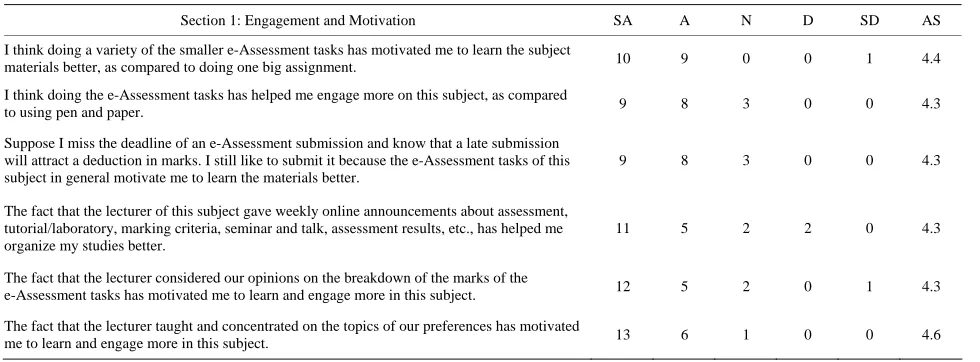
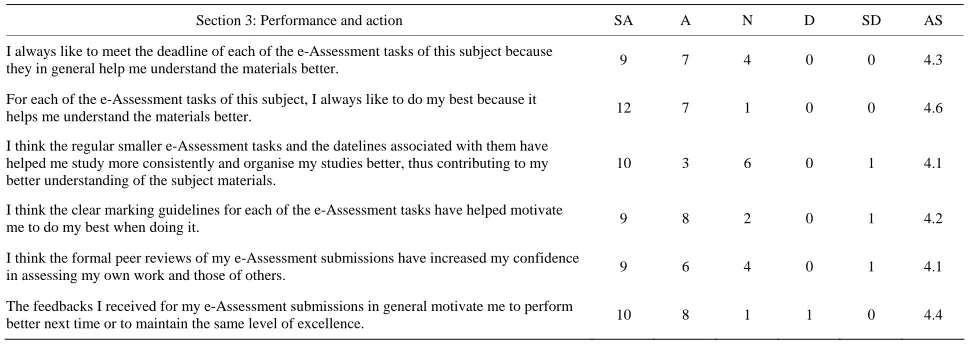
Students’ learning experiences were summarised in Tables 3-6.
Discussion on the Survey Results
Engagement and Motivation
Table 3 indicates that students were engaged if the lecturer taught students’ topic of preferences. This is consistent with a cognitive learning theory—self-regulated (SR) concepts intro- duced by Bandura (1986). In our case, SR refers to the feelings, motivation and willingness of the students to learn as these aspects are important for quality learning (Wang & Newlin, 2002).
Knowledge and Understanding
Table 4 indicates conducting a quiz immediately after a lecture
Table 3.
Summary of students’ responses to questions on the engagement and motivation aspect of their learning.
Section 1: Engagement and Motivation SA A N D SD AS
I think doing a variety of the smaller e-Assessment tasks has motivated me to learn the subject
materials better, as compared to doing one big assignment. 10 9 0 0 1 4.4
I think doing the e-Assessment tasks has helped me engage more on this subject, as compared
to using pen and paper. 9 8 3 0 0 4.3
Suppose I miss the deadline of an e-Assessment submission and know that a late submission will attract a deduction in marks. I still like to submit it because the e-Assessment tasks of this subject in general motivate me to learn the materials better.
9 8 3 0 0 4.3
The fact that the lecturer of this subject gave weekly online announcements about assessment, tutorial/laboratory, marking criteria, seminar and talk, assessment results, etc., has helped me organize my studies better.
11 5 2 2 0 4.3
The fact that the lecturer considered our opinions on the breakdown of the marks of the
e-Assessment tasks has motivated me to learn and engage more in this subject. 12 5 2 0 1 4.3
The fact that the lecturer taught and concentrated on the topics of our preferences has motivated
[image:5.595.56.546.556.737.2]Table 4.
Summary of students’ responses to questions on the knowledge and understanding aspect of their learning.
Section 2: Knowledge and Understanding SA A N D SD AS
The fact that the lecturer gave an online quiz on the subject materials immediately after they
have been taught during a lecture has contributed to my better understanding of them. 15 3 1 0 1 4.6
I think the regular smaller e-Assessment tasks and the deadlines associated with them have
helped me understand the subject materials better. 10 6 2 2 0 4.2
The e-Assessment tasks of this subject in general have contributed to my understanding of the
materials taught. 9 10 0 1 0 4.4
I think the e-Assessment tasks on real-life industrial/commercial issues have contributed to my
higher-order learning and understanding. 9 8 2 0 1 4.2
I think the formal peer reviews of my e-Assessment submissions have contributed to my better
understanding of the subject materials. 8 7 3 1 1 4.0
Table 5.
Summary of students’ responses to questions on the performance and action aspect of their learning.
Section 3: Performance and action SA A N D SD AS
I always like to meet the deadline of each of the e-Assessment tasks of this subject because
they in general help me understand the materials better. 9 7 4 0 0 4.3
For each of the e-Assessment tasks of this subject, I always like to do my best because it
helps me understand the materials better. 12 7 1 0 0 4.6
I think the regular smaller e-Assessment tasks and the datelines associated with them have helped me study more consistently and organise my studies better, thus contributing to my better understanding of the subject materials.
10 3 6 0 1 4.1
I think the clear marking guidelines for each of the e-Assessment tasks have helped motivate
me to do my best when doing it. 9 8 2 0 1 4.2
I think the formal peer reviews of my e-Assessment submissions have increased my confidence
in assessing my own work and those of others. 9 6 4 0 1 4.1
The feedbacks I received for my e-Assessment submissions in general motivate me to perform
[image:6.595.55.545.279.451.2]better next time or to maintain the same level of excellence. 10 8 1 1 0 4.4
Table 6.
Summary of students’ responses to questions on their reflection and critique aspect of learning.
Section 4: Reflections and Critiques SA A N D SD Average
Score
I think the online and presentation reviews of my e-Assessment submissions have increased my
learning due to the interactions involved with the lecturer and other fellow students. 7 8 4 1 0 4.1
I think the e-Assessment essay tasks have helped me reflect on the subject materials and hence
increase my understanding of them. 11 6 3 0 0 4.3
The fact that the lecturer raised questions to students about the subject materials taught during a lecture/ tutorial/laboratory class has helped me reflect on the subject materials and contribute to my better understanding of them due to the increase in the number of interactions.
11 6 2 1 0 4.4
The fact that students can express their opinions or raise questions during a lecture/tutorial class has helped me reflect on the subject materials and contribute to my better understanding of them due to the increase in the number of interactions.
13 4 2 0 1 4.4
enabled students to increase their knowledge and understanding. The survey suggested that peer review did not contribute as much to their learning as it was intended.
Performance and Action
Most students wanted to do their best for each of e-Assess- ment tasks given. Students felt that the e-Assessment tasks helped them perform and understand the subject better. Smaller e-Assessment tasks together with the deadlines and the feed-
back helped them manage and organize their studies better.
Reflections and Critiques
[image:6.595.69.533.485.623.2]Conclusion
CA does not provide clear guidelines as to: 1) how we should develop or create teaching and learning activities in order to help students achieve the intended student learning outcomes, and 2) how the activities should be developed in order to help students learn progressively. In this paper, we have presented a higher education blended teaching method for improving stu- dent learning. By blended teaching, we mean the combination of face-to-face teaching and the uses of a LMS for learning, teaching and assessment activities. We have reported the results of applying the method to teaching a third year subject CSE3 MQR (Metrics, Quality and Reliability).
Our method is called Constructive Progressive Alignment (CPA). The meanings of “Constructive” and “Alignment” re- main the same as in the CA context. However, in addition to the expected “Alignment” activities that a lecturer would put into place when teaching a subject using the CA method, we use the term “Progressive Alignment” to mean that a lecturer needs to include and design teaching and learning activities that align to the ways how students learn progressively in order to improve student learning. The principles of the design of our teaching activities are based on the first four stages of Shulman’s table of learning. As such, we have the confidence that they are pro- gressing in their learning. The survey and interview results indicate that the CPA method does help students improve their learning.
REFERENCES
Bandura, A. (1986). Social foundations of thought and action: A social cognitive theory. Englewood Cliffs, NJ: Prentice Hall.
Biggs, J. (1996). Enhancing teaching through constructive alignment, Higher education, 32, 347-364. doi:10.1007/BF00138871
Biggs, J. (1999). What the student does: Teaching for enhanced learn- ing. Higher Education Research & Development, 18, 57-75. doi:10.1080/0729436990180105
Biggs, J. (2003). Aligning teaching and assessing to course objectives. Teaching and Learning in Higher Education: New Trends and Inno- vations.
Bloom, B. S., & Collaborators (1956). The taxonomy of educational objectives: Cognitive domain. New York: David McKay.
Derntl, M., & Pitrik, R. M. (2005). The role of structure, patterns and people in blended learning. The Internet and Higher Education, 8, 111-130. doi:10.1016/j.iheduc.2005.03.002
Garrison, D. R., & Kanuka, H. (2004). Blended learning: Uncovering its transformative potential in higher education. The Internet and Higher Education, 7, 95-105. doi:10.1016/j.iheduc.2004.02.001 Krause, K.-L., & Coates, H. (2008). Students’ engagement in first year
university. Assessment & Evaluation in Higher Education, 33, 493- 505. doi:10.1080/02602930701698892
Pears, A. N. (2010). Enhancing student engagement in an introductory programming course. Proceedings of the 40th ASEE/IEEE Frontiers in Education Conference.
Reaburn, P., Muldoon, N., & Bookallil, C. (2009). Blended spaces, work based learning and constructive alignment: Impacts on student engagement. Proceedings ASCILITE (pp. 820-830), Auckland, 6-9 December 2009.
Sheard, J., Carbone, J., & Hurst, A. J. (2010). Student engagement in first year of an ICT degree: Staff and student perceptions. Computer Science Education, 20, 1-16. doi:10.1080/08993400903484396 Shulman, L. S. (2002). Making differences: A table of learning. Change,
34, 36-44.
Wang, A. Y., & Newlin, M. H. (2002). Predictors of web-student per- formance: The role of self-efficacy and reasons for taking an on-line class. Computers in Human Behavior, 18, 151-163.
Appendix A: Sample Student Interview Data
Learning Stages Answers to the interview questions from Student A
Engagement and Motivation
Smaller and regular assessment tasks motivated me to learn because it is easier to do assignments that are relevant to the weekly lectures.
Assessment tasks delivered in an online mode motivated me to learn more because they are flexible and easy to access.
I still wanted to submit e-Assessment tasks after the deadlines because I wanted to learn. Weekly online announcements motivated me to learn because I could arrange my study time better. The breakdown of the marks motivated me to learn the subject as I can plan the strategy to get better marks. Teaching the topics of my preferences motivated me to learn because the interesting topics compelled me to come
to class.
Knowledge and Understanding
The online quizzes helped me understand the subject better because I can ask the lecturer for an explanation if my answer was wrong immediately after the results were published on the system.
Regular smaller tasks and deadlines helped me to learn better because I had to study consistently. E-Assessment tasks contributed to my understanding because it is flexible to use and I can find the related
information.
E-Assessment tasks on real-life situations contributed to my high-order thinking skills because it prepared me to face the real world later.
Formal peer-reviews in e-Assessment helped me learn from others because I came to know the different ways and methods of doing the assignments.
Performance and Action
Meeting deadlines helped me understand the subject materials better because I have to do research in doing the tasks. I always like to do my best in doing the e-Assessment tasks because I want to have better grades.
Regular smaller tasks with deadlines helped me perform better in my studies because they made me study consistently.
Clear marking guidelines from the lecturer helped me perform because they guided me to produce better answers. Formal peer review of e-Assessment submissions helped me understand the subject better because I learned how to
identify the good and the bad answers.
Feedbacks on the e-Assessment tasks motivated me to perform better next time because they helped me identify the reasons for my wrong answers.
Reflection and Critiques
The interaction during presentations increased learning because I can shared information with others.
Essay tasks helped me reflect on my learning because to answer the questions I need to construct answers from my understanding of the lecture notes and other reading materials.
The question raised by the lecturer during a class helped me understand the lecture better because he could make me stay focused.