Munich Personal RePEc Archive
Estimates of the Sticky-Information
Phillips Curve for the USA with the
General to Specific Method
Paradiso, Antonio and Rao, B. Bhaskara and Ventura, Marco
12 February 2011
1990 words
Estimates of the Sticky-Information Phillips Curve
for the USA with the General to Specific Method
Antonio Paradiso [email protected]
Department of Economics
University of Rome La Sapienza, Rome (Italy)
B. Bhaskara Rao
School of Economics and Finance
University of Western Sydney, Sydney (Australia)
Marco Ventura
ISTAT, Italian National Institute of Statistics, Rome (Italy)
Abstract
This paper tests for the time series properties of the variables in the sticky information Phillips
curve and estimates it for the US with the general to specific method (GETS). Our results show that
the estimates of the stickiness parameter range from 0.25 to 0.42.
Keywords: Sticky information Phillips curve, General to specific method, Stickiness parameter.
1. Introduction
Recent empirical papers on the Phillips curves have ignored the time series properties of the
variables and used classical estimation methods. However, tests show that all or at least one
variable (usually the rate of inflation) are nonstationary. Therefore, classical estimation methods
give spurious results and their inferences are unreliable. It is necessary, therefore, to estimate the
Phillips curve and its variants viz., the new Keynesian and sticky information Phillips curves with
appropriate estimation methods where all or some variables are nonstationary. This paper estimate
the sticky information Phillips curve (SIPC) for the USA for 1978Q1 to 2010Q4 with the general to
specific method (GETS). Section 2 discusses specification and estimation issues. Empirical results
are in Section 3 and Section 4 concludes.
2. Specification and Estimation
With a calibrated model Mankiw and Reis (2003) showed that SIPC explains stylised facts of
inflation better than the new Keynesian Phillips curve (NKPC). Subsequently, Carroll (2003), Khan
and Zhu (2006) used classical methods to estimate SIPC for the USA. Pickering (2004) has also
estimated SIPCs with the classical methods for some OECD countries. However, unit root tests
show that the rate of inflation contains a unit root, but the stationarity properties of the proxies for
the driving force of inflation (e.g., share of wages and output gap etc.,) depend on how they are
measured. However, since both the level and changes of these driving force appear in the SIPC,
both I(1) and I(0) variables will be present and it should be estimated with an appropriate method.
Two such popular methods are the bounds test of Pesaran and Shin (1999) and the general to
specific approach (GETS) of the London School of Economics (LSE), of which David Hendry is
the most ardent exponent.1 For reasons explained later we use GETS to estimate the US SIPC. We
follow Pickering and Khan and Zhu and specify SIPC as:
1
0
1
1
j
t t t j t t
j
y
E
y
(1)1
where rate of inflation, yGAP and Eexpected value.The rationale underlying equation (1)
is explained in Mankiw and Reis (2003) and Carroll (2003). Basically it is assumed that firms take
time to assimilate information to form expectations. While proportion firms are efficient and use
the current information to form expectations, the rest of (1)proportion need different lengths of
time to use the available information.
We assume rational expectations and, as in Pickering (2004), the forecast in period t – j
improves the forecast in period t – j – 1 according to some random innovation. This implies
1 1
,
t j t t j t t
E
E
where t 1
represents the forecast error due to new information inperiod t – 1 which was unavailable in the previous period. With rational expectations, SIPC in (1)
reduces to:
1 1
1
t
y
tE
t tE
ty
tu
t
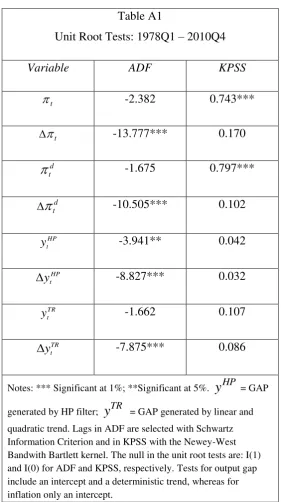
(2)Unit root tests in the following section show that while inflation contains a unit root, results
on yand y,measured here with the output GAP, are ambiguous.
3. Empirical Results
We measure inflation with both CPI and GDP deflator and ywith GAP i.e., deviation of GDP from
its linear-quadratic trend and also with its HP filtered value. Unit root test results for these variables
are in the appendix and show that the SIPC in (2) contains both I(1) and I(0) variables.For
estimating relationships with a mixed order of variables, Pesaran and Shin’s (1999) bounds test is
popular in the applied work. However, it has some limitations. The computed test statistics for
cointegration may fall into a substantial inconclusive range and the critical values are given for
samples of 500 and above. Therefore, their finite sample properties are not known.
An alternative is the general to specific method (GETS). In GETS dynamics is an empirical
issue because economic theory is mainly concerned with establishing equilibrium relationships
between the levels of the variables and silent on dynamics. Therefore, dynamics is estimated in a
way consistent with the underlying data generation process (DGP). The theory behind the
relationship is used to specify the long run equilibrium part of the specification in the levels of the
variables and lagged changes in the variables are used to capture the short run dynamics. If the
the level variables in the long run part should be I(0). Therefore, GETS specifications with level
variables and their changes are I(0) because changes of variables are generally I(0) and GETS
specifications can be estimated with the classical methods. Equation (2) can be rewritten as a
GETS equation and the term
E
t1y
t enters into the short runin the following way:
1 1 1
1 1 1 2 2 1t t
y
tE
t tE
ty
t tE
t t
(3)where
= loading parameter,
/ 1
, and
is expected to be1 .
We firstly estimate equation (3) with all the changes in the other variables to capture the
underlying DGP. If some changes are not statistically significant we drop them to obtain a final
parsimonious dynamic equation.
For forecasts of the variables we follow Carroll (2003) and use the survey data of
Professional Forecaster of the Federal Reserve Bank of Philadelphia. Two impulse dummy
variables DUM06Q4 and DUM08Q4 are added to capture the effects of a steep decline in energy
prices and the financial crisis; see data appendix.
To conserve space Table 1 and 2 show only the results with GAP, computed with HP
filtered values of GDP. Other results are available upon request. Table 1 shows results for SIPC
with CPI-Inflation. Estimates with three lagged changes in the variables are in column (1). Since the
change in the lagged inflation rate (t1) is insignificant it is dropped and the reestimate is in
column (2). All the summary statistics show that these are satisfactory, except for some
autocorrelation at higher lags, and the Wald test that 1is not rejected. Estimates with the
constraint that 1 are in column (3) and are similar to those in (2) except for the intercept and a
small decrease in the estimate of the stickiness parameter , from 0.402 to 0.325. These results
imply that the acceleration hypothesis is valid and about 32% to 40% of firms use current
Table 1: GETS estimates of CPI inflation (1978Q1 – 2010Q4)
1 1 1
1 1 1 2 2 1t t
y
tE
t tE
ty
t tE
t t
Intercept 0.445
(0.321) 0.576 (0.308)* 0.169 (0.156)
-0.702 (0.186)*** -0.513 (0.126)*** -0.553 (0.124)***
0.509 (0.179)*** 0.640 (0.237)*** 0.528 (0.201)***
0.904 (0.120)*** 0.791 (0.156)*** 1
0.887 (0.400)** 0.948 (0.399)** 1.095 (0.390)*** 1
0.172 (0.125) - - 2
-0.570 (0.167)*** -0.409 (0.119)*** -0.453 (0.116)***DUM06Q4 -5.761
(1.766)***
-5.801
(1.772)***
-5.745
(1.781)***
DUM08Q4 -13.405
(1.832)*** -13.534 (1.836)*** -13.393 (1.844)*** 2
R
0.729 0.728 0.725LM Serial corr. Test
LM(2) LM(4) (Prob. Value) 0.674 0.049 0.427 0.042 0.275 0.035 Wald Test
0: 1
H
(Prob. Value)
0.426 0.182 -
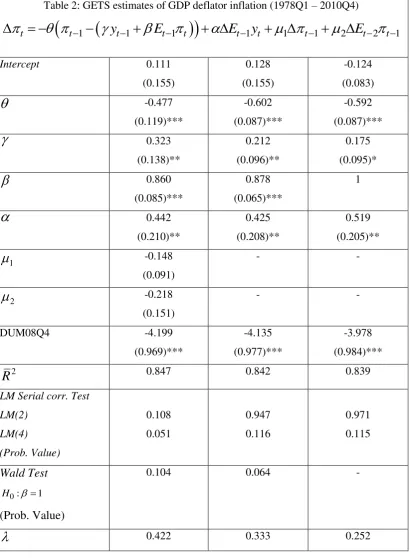
Table 2 shows results when inflation is measured with GDP deflator and these are also
impressive. Unlike Table 1 there is no trace of autocorrelation. Furthermore, the coefficients of the
changes in the lagged inflation and its expected value are insignificant and are dropped from the
[image:7.595.96.507.176.735.2]estimates in column (2). This made very little change.
Table 2: GETS estimates of GDP deflator inflation (1978Q1 – 2010Q4)
1 1 1
1 1 1 2 2 1t t
y
tE
t tE
ty
t tE
t t
Intercept 0.111
(0.155) 0.128 (0.155) -0.124 (0.083)
-0.477 (0.119)*** -0.602 (0.087)*** -0.592 (0.087)***
0.323 (0.138)** 0.212 (0.096)** 0.175 (0.095)*
0.860 (0.085)*** 0.878 (0.065)*** 1
0.442 (0.210)** 0.425 (0.208)** 0.519 (0.205)** 1
-0.148 (0.091) - - 2
-0.218 (0.151) - -DUM08Q4 -4.199
(0.969)*** -4.135 (0.977)*** -3.978 (0.984)*** 2
R
0.847 0.842 0.839LM Serial corr. Test
LM(2) LM(4) (Prob. Value) 0.108 0.051 0.947 0.116 0.971 0.115 Wald Test
0: 1
H
(Prob. Value)
0.104 0.064 -
However, the Wald test that 1 holds at a slightly lower level of significance. Estimates
with the constraint that 1are in column (3) and imply that 0.252. This is almost the same as its assumed value in Mankiw and Reis (2003) and close to its estimate of 0.27 in Carroll (2003).
However, estimates of this parameter are more sensitive compared to those in Table 1. These
estimates also imply that the acceleration hypothesis is valid and the long run US Phillips curve is
vertical although 42% to 25% of firms use current information on the expected rate of inflation
efficiently.
4. Conclusions
This paper estimated the SIPC for the USA with an appropriate valid method when both I(1) and
I(0) variables are present in a relationship. Inferences based on our estimates are more reliable than
other estimates with the classical methods. Our estimates imply that the US Phillips curve is vertical
in the long run and between 40% and 25% of firms use information on the expected values
Data Appendix
Definitions and Data Source: 1978Q1 – 2010Q4
Variable Definition Source
Percent change from previous quarter at annual rates of Consumer Price Index (seasonally adjusted) or the GDP deflator (seasonally adjusted) and denoted below and in Table 1A as
.
d
Federal Reserve Economic Data (FRED).
1
t t
E Forecasts for the CPI Inflation, percent change from previous quarter at annual rates (Seasonally adjusted). The series begins in 1981Q3. For period 1978Q1 – 1981Q2 we use forecasts data of GDP Price Deflator Inflation (the two series in 1980s are very similar).
Survey of Professional Forecaster, Federal Reserve Bank of Philadelphia (SPF).
1
d t t
E Forecasts for the GDP deflator Inflation, percent
change from previous quarter at annual rates of CPI (Seasonally adjusted).
SPF
y Real output gap using the Hodrick-Prescott filter
with a smoothing parameter of 1600 (yHP).
Real output gap using linear and quadratic trend (yTR).
FRED
1
t t
E y Forecasts for the real GDP (Seasonally adjusted). SPF
DUM06Q4 This dummy is one in this quarter and zero in other periods. It captures the drop (-32% from previous quarter at annual rates) in energy prices caused by a drop in oil prices (-47% from previous quarter at annual rates).
-
DUM08Q4 This is a similar dummy to capture the peak effects of the financial crisis (Lehman Brothers, Merrill Lynch, Fannie Mae, Freddie Mac, etc.).
Unit Root Tests
Table A1
Unit Root Tests: 1978Q1 – 2010Q4
Variable ADF KPSS
t
-2.382 0.743***
t
-13.777*** 0.170
d t
-1.675 0.797***d t
-10.505*** 0.102
HP t
y -3.941** 0.042
HP t
y
-8.827*** 0.032
TR t
y -1.662 0.107
TR t
y
-7.875*** 0.086
Notes: *** Significant at 1%; **Significant at 5%.
y
HP = GAPReferences
Carroll, C. D. (2003) Macroeconomic expectations of households and professional forecasters,
Quarterly Journal of Economics, 118, 269-298.
Khan, H. and Zhu, Z. (2006) Estimates of the sticky-information Phillips Curve for the United
States, Journal of Money, Credit, and Banking, 38, 195-207.
Mankiw, N. G. and Reis, R. (2003) Sticky information: A model of monetary nonneutrality and
structural slumps. In Knowledge, Information and Expectations in Modern Macroeconomics: In
Honour of Edmund S. Phelps, edited by P. Aghion, R. Friedman, J. Stiglitz, and M. Woodford,
Princeton University Press.
Pickering, A. (2004) Sticky information and the Phillips Curve – A tale of two forecasts,
Manuscript, University of Bristol.
Pesaran, H. M., and Shin, Y. (1999) Autoregressive distributed lag modelling approach to
cointegration analysis, Chapter 11, in: Storm, S. (ed.), Econometrics and Economic Theory in the
20th Century: The Ragnar Frisch Centennial Symposium, Cambridge University Press.
Rao, B. B. (2007) Estimating short and long-run relationships: a guide for the applied economist,