Renormalized Coordinate Stretching: A Generalization of
Shoot and Fit with Application to Stellar Structure
Peter D. Usher
Department of Astronomy and Astrophysics, The Pennsylvania State University, University Park, USA Email: [email protected]
Received July 16, 2013; revised August 15, 2013; accepted August 23, 2013
Copyright © 2013 Peter D. Usher. This is an open access article distributed under the Creative Commons Attribution License, which permits unrestricted use, distribution, and reproduction in any medium, provided the original work is properly cited.
ABSTRACT
The standard shooting and fitting algorithm for non-linear two-point boundary value problems derives from conven- tional coordinate perturbation theory. We generalize the algorithm using the renormalized perturbation theory of strained coordinates. This allows for the introduction of an arbitrary function, which may be chosen to improve nu- merical convergence. An application to a problem in stellar structure exemplifies the algorithm and shows that, when used in conjunction with the standard procedure, it has superior convergence compared to the standard one alone.
Keywords: Singular Non-Linear Boundary Value Problems; Renormalized Coordinate Stretching; Poincaré-Lighthill Perturbation Theory; Numerical Analysis; Stellar Structure
1. Introduction
Consider the two-point boundary value problem gov- erned by a non-linear system of k ordinary differential equations:
d , dx x
y
f y (1)
with k boundary conditions distributed at each end of the domain in x. Such cases may be solved numerically by varying the unknown conditions at each boundary and integrating each trial to a common fitting point, whence differences between the trial runs provide linearly inde- pendent functions by which to calculate corrections to the initial guesses [1-3]. This method of shoot and fit is based on conventional perturbation theory, which ex- pands the dependent variables:
x 0
x 1
x y y y , (2) where y1
x is a correction to y0
x . The method of strained coordinates was first introduced by Lindstedt (1882) and other astronomers and now known as the Poincaré-Lighthill (PL) or Poincaré-Lighthill-Kuo me- thod [4-8]. It is well-known that the PL method was de- signed originally for systems d dy xf y
, ;x
that de- pend critically on a small parameter , in order to ren- der analytic series solutions uniformly convergent. How- ever, we apply it here to problems like Equation (1) whose formulation is formally independent of a smallparameter and for which standard coordinate perturbation methods are applicable. We use the adaptation in its re- normalized form [9,10], which Dai [11] considers to be one of five important improvements in PL theory. Thus, we distinguish between standard and renormalized PL theory.
Section 2 shows the utility of the renormalized PL (rPL) theory in rendering variational equations homoge- neous. Section 3 formulates the standard (std) fitting al- gorithm and Section 4 formulates its rPL generalization. Section 5 exemplifies the algorithm by means of a two- point problem of stellar structure formulated in the Ap- pendix, and compares the utility of each algorithm and the possibility of their combined usage. Section 6 dis- cusses results.
2. Straining Coordinates
Apply Equation (2) to Equation (1) and separate orders to give to first order:
0
0 0 d
, d
x
x x
y
f y , (3)
0 0
1
1,
0, , d
d k k
x x
y x
x y
f y y
. (4)
x0 0
x0 1
x0 y y y , (5)
0 0 1
0x x x x x . (6) Function x x1
0 stretches the independent coordinatex. Equations (5) and (6), when applied to Equation (1), give to zeroth and first order:
0 0
0 0 0 0 d , d x x x y
f y , (7)
1 0 0 0 0
1, 0
0 0
0 0 0 1 0
1 0 0 0 0
0 0
d ,
d
,
, d .
d k
k
x x
y x
x y x
x x x
x x y x
x x y y y f f f (8)
However, expansions (5) and (6) are not unique. In- stead, apply Equation (6) to the equivalent standard ex- pansion (2) [10], i.e. let:
x 0
x 1
x y y y , (9)
0 0 1
0x x x x x , (10) so that Equation (9) becomes:
0
00 0 1 0 1 0 0 d
d
x
x x x x x
x
y
y y y . (11)
On applying Equations (10) and (11) to Equation (1), and using the relation:
0 0 0 0 0 0 0 0 0
0,
0 0, 0
d , , ,
d k
k
x x x
f
x y x
f y f y f y
, (12)
we discover that all terms in x x1
0 cancel and:
0 0
0 0 0 0 d , d x x x y
f y , (13)
1 0 0 0 0
1, 0
0 0
d ,
d k k
x x
y x
x y x
y
y f
. (14)
These are equivalent to Equations (3) and (4), except that the independent coordinate is x0 rather than x. The straining function x x1
0 now appears only in expan- sions (10) and (11), and not in the differential Equation (8). On retaining terms to first order, these become therPL perturbation expansions to first order:
x 0
x0 x x1
0 0 0,x0
y y f y , (15)
0 1 0x x x x . (16) Implementation of Equations (13) and (14), is straight- forward as the conventional theory is recovered simply by setting x x1
0 0, and x0 reverts to its originalmeaning x, as in Equations (3) and (4). In other words, in rPL, the straining feature may be applied after, and
not during, the integration of the variational equa- tions.
3. Standard Shoot and Fit
Frequently, in two-point boundary value problems, it is impossible to integrate from one boundary to the other without encountering some catastrophic result. This might occur while integrating toward a singular boundary, or when solutions become imaginary or unphysical. The standard (std) shoot and fit algorithm is designed to counter these difficulties, and in anticipation of its rPL
generalization it is useful to spell it out.
Assume disjoint explicit boundary conditions, a nor- malized range, and for clarity distinguish integrations from each boundary by lower case and upper case vari- ables. Throughout, let i1, 2, , , I j1, 2, , , J and
1, 2, , , 1, , .
k I I I J For integrations from x = 0, Equation (13) is:
0,
0, 0 0 0,
0
d
, , 0 d
i
i i i
y
f x y
x y , (17)
0,
0, 0 0 0, 0,
0
d
, , 0 0
d
I j
I j I j I j
y
f x y y
x
y , (18)
and from X = 1, it is:
0,
0, 0 0 0, 0,
0
d
, , 1 1 , d
i
i i i
Y
F X Y Y
X Y (19)
0,
0, 0 0 0,
0
d
, , 1 d
I j
I j I j I j
Y
F X Y
X
Y , (20)
where y0,I j
0 and Y0,i
1 are trial values, and val-ues i and I j may be transformed to zero. Suppose that trial integrations y0,k
x and Y0,k
X are well-behaved up to a common point ξ. From Equations (17)- (20), generate J solutions 0,
j k
y x for 0 x , and I
solutions 0,
ik
Y X for X 1, using initial condi- tions chosen as:
0,
0, 0, 1,
0 0,
0 0 0 ,
1, 2, , ,
j i j
I j I j I j jj
y
y y y
j J (21)
0, 0, 1,
0,
1 1 1 ,
1 0, 1, 2, , ,
i
i i i ii
i I j
Y Y Y
Y i I
(22)
where y1,I j
0 y0,I j
0 , Y1,i
1 Y0,i
1 , and,
ii jj
are Kronecker deltas. Assume that the differ- ences:
1, 0, 0,
j j
k k k
y x y x y x
, (23)
1, 0, 0,
i i
k k k
Y x Y x Y x
are linearly independent, where of course from Equations (17), (19), (21)-(24):
1, 0 0, 0 0, 0 0
j j
i i i
y y y
, (25)
1, 1 0, 1 0, 1 0
i i
I j I j I j
Y Y Y
. (26) Linear superposition of Equations (23) and (24) gives:
1, 1,
i
k i k
Y X C Y X , (27)
1, 1,
j
k I j k
y x C y x , (28) where Ci and CI j are constants to be determined. Equa- tions (2), (27) and (28) lead to:
0, 1,
i
k k i k
Y X Y X C Y X , (29)
0, 1,
j
k k I j k
y x y x C y x . (30)
Take the computed mismatches at ξ to be:
0,k 0,k 0,k
E y Y , (31) which, from the difference of Equations (27) and (28) at
ξ and the desired outcome yk
Yk
0, gives:
0, 1, 1,
i j
k i k I j k
E C Y C y . (32)
These are I J linear algebraic equations in I J unknowns, whose solution gives Ci and CI j , and Equa- tions (29) and (30) give improved values:
0, 1,
0 0 j 0
I j I j I j I j
y y C y
, (33)
0, 1,
1 1 i 0
i i i i
Y Y C Y
. (34)
4. The
rPL
Generalization
For 0 x , Equations (15) and (16) are:
0 0 1 0 1 0 0 0, 0 ,
x x x
x x x
y y y
f y (35)
0 0 1
0x x x x x , (36) and for X 1, they are:
0 0 1 0 1 0 0 0, 0 ,
X X X
X X X
Y Y Y
F Y (37)
0 0 1
0X X X X X . (38) By Equations (7) and (13), y0
x0 and Y0
X0 are nu-merically the same as y
x0 and Y
X0 . By Equation(15), analogues of Equations (29) and (30) are:
0, 0 1, 0
1 0 0, 0, 0 ,
j
k k I j k
k
y x y x C y x
x x f X
y (39)
0, 0 1, 0
1 0 0, 0, 0 ,
i
k k i k
k
Y X Y X C Y X
X X F X
Y (40)
and the rPL version of Equation (32) is:
0, 1, 1,
1 0, 1 0, .
i j
k i k I j k
k k
E C Y C y
X F x f
(41)
4.1. Constraints
Functions x x1
0 and X X1
0 must satisfy two con-straints: 1) In order that the independent variable be con- tinuous at x0X0, a stretch x1
must equal thecompressionX1
, and vice versa; i.e.
1 1
x X . (42) 2) With reference to Equations (39) and (40),
1 0 and 1 1
x X must be such as to nullify any singu- larities in f0
0 and F0
1 .4.2. Stretching
Functions x x1
0 and X X1
0 are otherwise arbitrary,but in the spirit of linearization let them vary linearly with their arguments. Equations (36) and (38) become:
10 1
x
x x
, (43)
1
0
1 1 1
1
X
X X
. (44)
Let the value in Equation (42) be:
1 1 I J 1
x X C , (45) where CI J 1 is the amount of stretching/compression at the matching point. Thus:
01 0 I J 1
x x x C
, (46)
01 0 1
1 1
I J
X
X X C
, (47)
and Equation (41) becomes:
0, 1, 1,
1 0, 0, .
i j
k i k I j k
I J k k
E C Y C y
C F f
(48) These are I + J equations in I + J + 1 unknowns, which require an extra equation for their solution.
4.3. Matching Condition
Let the (I + J + 1)th equation follow from matching s( y,x)
and its functional twin S(Y,X) at the fitting point ξ. Ex-
0 0 0
1, 0 1 0 0, 0 0
0 1 0 0 , , , , j
I j k k
k
s x s x
s C y x x x f x
y s x x x y y
y (49)
0 0 0
1, 0 1 0 0, 0 0
0 1 0 0 , , , . i
i k k
k
S X S X
S C Y X X X F X
Y S X X X Y Y
Y (50)
The desired outcome s(ξ) – S(ξ) = 0 and the computed difference:
0,I J 1 0 0
E s S , (51) lead to:
0, 1 1,
0, 1, 0, 1 0, . i
I J i k
k
j I j k
k
I J k k k k
S
E C Y
Y
s
C y
y
S s S s
C F f
Y y X x
(52)
The I + J + 1 constants follow from the solution to
Equations (48) and (52). With reference to Equations (39) and (40), improved guesses are:
0, 1,
1 0,
0 0 0
0 0 ,
j
I j I j I j I j
I j
y y C y
x f
(53)
0,i 1, 1 0,
1 1 i 1 1 1
i i i i
Y Y C Y X F
. (54)
By Section 4.1, the last terms of Equations (53) and (54) must be finite or zero. If x1
0 and X1
1 nullify these terms, then the rPL Equations (53) and (54) resem- ble Equations (33) and (34) of std. In that case, the in- fluence of stretching on the improved boundary condi- tions is nominally independent of CI J 1, although ofcourse stretching affects all Ck1 through Equations (48)
and (52).
4.4. Algorithm Option
For given trial values, relatively little extra computation time is involved in computing and solving the I + J + 1 algebraic Equations (48) and (52), compared to I + J
Equations (32), whereupon the option exists to complete the next iteration using the rPL or the std algorithm. This requires devising a criterion by which to choose iterated
values from one algorithm over values from the other. From Equations (33) and (34), let the relative std cor- rections be:
1,
0,
0 0
j
I j I j
I j I j C y y y
, (55)
1,
0, 1 1 i i i i i C Y Y Y
, (56)
From Equations (39) and (40), let the relative rPL cor- rections be:
1,
1
0,
0,
0 0 0
0
0
j
I j I j I j
I j
I j
C y x f
y y
, (57)
1,
1
0, 0,1 0 1
1
1
i
i i i
i
i
C Y X F
Y
Y
. (58)
As noted, quantities x1
0 f0,I j
0 and X1
1 F0,i 1 are proportional to the stretching constant CI J 1 and must be zero or finite. Define the sum of the squares of the relative corrections as:
2 21 2 0
i I j
Y y
(59) and let its value decide between the two options, i.e. be- tween Equations (55) and (56), and Equations (57) and (58). Since relative errors obtain in Equation (59), it ap- plies regardless of whether the converged solution is known (as it is in the present discussion), or not; i.e. Equation (59) is useful provided a way exists by which to decide between the available options. Section 5 contains empirical evidence concerning the better option. In prac- tice, sequences of iterations generally have corrections derived from both algorithms; i.e. the two algorithms have the potential to widen the circle of convergence, since when one fails for any given iteration, the other may not. Thus, at the point of a failed iteration, an addi- tional integration is the price to pay for the prospect of a wider circle of convergence.
5. An Illustrative Example
The shoot and fit method is applicable to an assortment of problems, including the two-point boundary problem of stellar structure [1,12]. Coordinate stretching has also proved useful in the study of rotating stars [13]. Stellar structure appears to be a suitable means for testing the
rPL method against a known solution, for which it suf- fices to choose a relatively simple yet realistic model for a thirty-solar-mass (6 × 1031 kg) star. This is identical to
early models [14,15], which were constructed less pre- cisely and by different algorithms. The underlying phys- ics is stated in the Appendix.
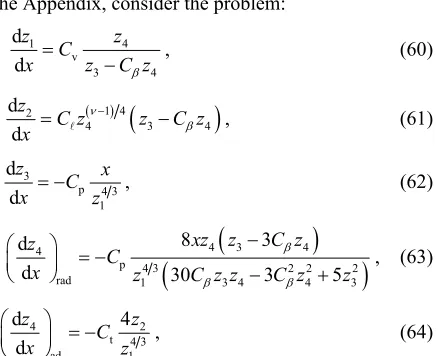
of the Appendix, consider the problem:
1 4
v
3 4
d d
z z
C
x z C z , (60)
1 4
2
4 3 4
d d
z
C z z C z
x
, (61)
3
p 4 3 1
d d
z x
C
x z , (62)
4 3 4
4
p 4 3 2 2 2
rad 1 3 4 4 3
8 3
d
d 30 3 5
xz z C z
z
C
x z C z z C z z
, (63)
4 2
t 4 3
ad 1
d 4
d
z z
C
x z
, (64) where is an index (see Appendix). Equation (63) or (64) obtains when
dz4 dx
rad is less or greater than
dz4 dx
ad, and positive dimensionless constantsv, , p, t
C C C C pertain to volume, luminosity, pressure
and temperature (see Appendix). Boundary conditions are:
1 0 2 0 3 1 4 1 0
z z z z . (65) Physical arguments require 0z3C z 41. With
foresight, and for present purposes, choose values
v, , p, t
C C C C that correspond to the converged solution
in order that unknown boundary values converge to:
1 1 2 1 3 0 4 0 1
z z z z . (66) The unit boundary values of Equation (66) across the normalized range of the independent variable may be used here because the intent of Section 6 of this paper is to investigate the relative efficacy of algorithms by com- paring trial values against the known solution. For the fourth-order system considered, the solution is charac- terized by four eigenvalues that correspond to four nor- malized ranges for the set
z z z z1, , ,2 3 4
. An auxiliary eigenvalue q marks the transition from one of Equations (63) and (64) to the other. Integration proceeds from each boundary to an arbitrarily chosen fitting point ξ, chosen throughout as 0.5. Integrations used the Odesolve (vector,x, b, npoints) routine of MATHCAD 14 [16], where vec- tor is the array of sought solutions, x is the independent variable, b its terminal value, and npoints is the integer number of points used to interpolate the solution func- tions. Odesolve dynamically detects whether a system is stiff or not, and uses BDF (backward differentiation for- mula) or AB (Adams-Bashforth) methods respectively. Both methods use non-uniform step sizes, adding more integration steps in domains of greater variation. Subrou- tine root with tolerance TOL = 10−9 determined the loca-
tion of the interface fraction q. The default precision is 17 significant figures.
Singular gradients at the boundaries require asymp-
totic developments, here limited to one significant term owing to the high precision of the calculations. Follow- ing Sections 3 and 4, lower and upper case variables dis- tinguish integrations from x = 0 and x = 1. For small δx,
δX, starting values are:
1 44
1 v
3 4
0
0 0
z
z x C x
z C z
, (67)
1 4
2 4 3 0 4 0
z x C z z C z x
, (68)
4 33 p 1
Z X C Z X, (69)
2
4 rad t 4 3 1
1 . 1
Z
Z X C X
Z
[image:5.595.71.290.90.268.2] (70)
Figure 1 shows the normalized solution. Its derived boundary values and the auxiliary eigenvalue q agree to 1% or less with the aforementioned 30 solar mass model, with discrepancies explained by fitting by interpolation or by hand used previously.
Section 6.1 applies the std and rPL formulations. Inte- gration proceeds through interfaces brought about by changes between Equations (63) and (64), and terminate at ξ = 0.5. To test the sensitivity of each independent variable to guesses in its unknown boundary value, we assign in turn the correct value 1 to all but one variable per Equation (65), to which we give values progressively farther from 1. Trial values are changed at intervals of ± 0.001 in the log, and convergence is considered continu- ous until the iteration fails to converge. Sometimes, con- vergence resumes for further changes in the guessed value, but it suffices for our purposes to apply the crite- rion of first failure uniformly across all cases. Execution ceases when one (or two) of the corrected guesses turns negative or when the number of iterations exceeds 20.
For the extra matching condition s(x), we require the continuity of a combination of variables unaccounted for by the original system. Consider the 6 products
, , 1, , 4;
i j
z x z x i j i j and require:
i j i j
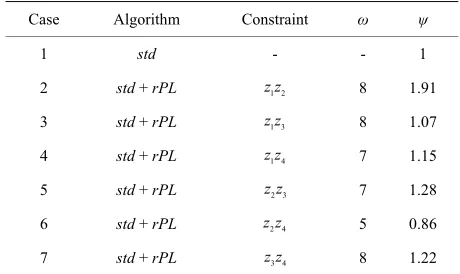
z z Z Z . (71) None of these conditions is explicitly required in the problem formulation. Table 1 compares results for the 6 cases that use these rPL constraints simultaneously with the standard std algorithm. Iterations ceased upon satis- faction of the convergence criteria:
1 1 105 iZ , (72)
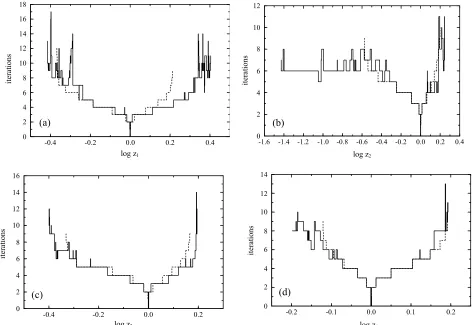
5z 0j 1 10 , (73) for i = 1,2 and j = 3,4. Results for entry 2 of Table 1 ap- pear in Figures 2(a)-(d).
0.0 0.2 0.4 0.6 0.8 1.0 0.0
0.2 0.4 0.6 0.8 1.0
x
z
i
(
x
)
i = 2
i = 1 i = 4
i = 3
x
[image:6.595.156.434.84.262.2]Zi(x)
Figure 1. Solution to the posed problem. Subscripts identify volume (i = 1), luminosity (i = 2), total pressure (i = 3), radiation pressure (i = 4), and x is the normalized mass fraction.
-0.4 -0.2 0.0 0.2 0.4
0 2 4 6 8 10 12 14 16 18
(a)
log
z
iterations
1
log z1
iter
at
io
ns
-1.6 -1.4 -1.2 -1.0 -0.8 -0.6 -0.4 -0.2 0.0 0.2 0.4 0
2 4 6 8 10 12
(b)
log
z
iterations
2
log z2
iter
at
io
ns
-0.4 -0.2 0.0 0.2
0 2 4 6 8 10 12 14 16
(c)
log
z
iterations
3
log z3
iter
at
io
ns
-0.2 -0.1 0.0 0.1 0.2
0 2 4 6 8 10 12 14
(d)
log
z
iterations
4 log z4
iter
at
io
ns
Figure 2. (a)-(d). Cases 1 and 2 of Table 1, showing the number of iterations to convergence by varying one unknown bound- ary value at a time, for the std algorithm alone (dashed line) and the std + rPL combined algorithm (solid line; see text). and negative values of log
z
i are of interest, hence thereis a total of 1, 2, ,8 for the four variables. Let ω
be the number of cases for which logzi max is wider
than that of the std algorithm, i.e. for which:
max, other max,
l ogz l ogz std. (74) Choose the other statistic as the relative rms measure:
8 2 8 2
max other max
1 1
log log
std
z z
[image:6.595.63.536.305.630.2]6. Discussion
The std algorithm sets the standard by which to judge the efficacy of the rPL algorithm. It appears as Case 1 in Ta- ble 1, for which by definition ψ = 1. When the rPL algo- rithm alone is applied, only in about half the cases there is there an improvement over the std; i.e. for the present experiment, there is not much to choose between the two. Little is gained by showing these cases.
However, strength of the rPL lies in the similarity of Equations (4) and (14), which allows application of the
rPL algorithm at little extra cost in computing time. We discover empirically (and counter-intuitively) that the better choice has the lesser value of Δ2 in Equation (59).
This appears to minimize the tendency for iterations to diverge by over-correcting. Under these conditions, when the std option is tested simultaneously with the rPL
(Cases 2-7 of Table 1), there is an improvement in con- vergence characteristics in all but one case. In Case 2, convergence occurs for as little as ≈3 × 10⁻² of the cor-
rect value. This phenomenon results from the fact that the model investigated is only a factor of 8 less than the Eddington luminosity limit at which stars are dynami- cally unstable (see Appendix), so that underestimates are computationally beneficial.
The excellent statistics of Case 2 in Table 1 attract at- tention. Figures 2(a)-(d) compare it to the std Case 1. Convergence in Case 2 is assisted by the extra rPL re- quirement of continuity in the product z z1 2, where z1
and z2 happen to be the two variables with the least
uniformly-changing traces, as seen in Figure 1. For the present experiment, the comparative pathologies turn out to be virtual double-mirror images of one another and the product is quite well-behaved. It would seem a priori that these two variables would benefit most from an inde- pendent condition of continuity that involves them.
[image:7.595.56.286.594.731.2]The chief result based on the problem definition and methodology here articulated, is that coordinate stretching
Table 1. Performance characteristics of the renormalized coordinate stretching (rPL) generalization of the standard (std) shooting and fitting algorithm, using the lesser value of Δ2 as the choice determinant (see text).
Case Algorithm Constraint ω ψ
1 std - - 1
2 std + rPL z z1 2 8 1.91
3 std + rPL z z1 3 8 1.07
4 std + rPL z z1 4 7 1.15
5 std + rPL z z2 3 7 1.28
6 std + rPL z z2 4 5 0.86
7 std + rPL z z3 4 8 1.22
applied to numerical analysis may render dependent variables more uniformly convergent, if the extra condi- tion is a simple function of variables with the least linear traces, provided this continuity condition is not otherwise part of the problem formulation. In a sense, this result for numerical analysis is analogous to the original intent of coordinate stretching, which is to render analytic series solutions uniformly convergent.
7. Acknowledgements
I thank Dr. Alan Stevens of the Institute for Mathemati- cal Analysis and its applications for critiquing the pro- grams used in this paper.
REFERENCES
[1] C. B. Haselgrove and F. Hoyle, “A Mathematical Discus- sion of the Problem of Stellar Evolution, with Reference to the Use of an Automatic Digital Computer,” Monthly Notices of the Royal Astronomical Society, Vol. 116, 1956, pp. 515-526.
[2] W. H., Press, S. A., Teukolsky, W. T. Vetterling and B. P. Flannery, “Numerical Recipes,” Cambridge University Press, Cambridge, 2007.
[3] S. M. Roberts and J. S. Shipman, “Two-Point Boundary Value Problems: Shooting Methods,” Elsevier, New York, 1972.
[4] A. Lindstedt, “Ueber Die Integration Einer Für Die Strö- rungstheorie Wichtigen Differentialgleichung,” Astrono- mische Nachrichten, Vol. 103, No. 14, 1882, pp. 211-220. [5] H. Poincaré, “Les Méthodes Nouvelles de la Méchanique
Céleste,” Gauthier-Villars, Paris, 1892.
[6] M. J. Lighthill, “A Technique for Rendering Approximate Solutions to Physical Problems Uniformly Convergent,”
Philosophical Magazine, Vol. 40, 1949, pp. 1179-1201. [7] A. S. Nayfeh, “Perturbation Methods,” Wiley, New York,
2000.
[8] J. Kevorkian and J. D. Cole, “Perturbation Methods in Applied Mathematics,” Springer Verlag, New York, 2010. [9] M. Pritulo, “On the Determination of Uniformly Accurate
Solutions of Differential Equations by the Method of Per- turbation of Coordinates,” Journal of Applied Mathemat- ics and Mechanics, Vol. 26, No. 3, 1962, pp. 661-667.
[10] P. D. Usher, “Some New Algorithms for Stellar Struc- ture,” Ph.D. Thesis, Harvard University, Harvard, 1966. [11] S. Dai, “Poincaré-Lighthill-Kuo Method and Symbolic Com-
putation,” Applied Mathematics and Mechanics, Vol. 22,
No. 3, 2001, pp.
[12] J. Reiter, R. Bulirsch and J. Pfleiderer, “A Multiple Shoot- ing Approach for the Numerical Treatment of Stellar Structure and Evolution,” Astronomische Nachrichten, Vol. 315, No. 3, 1994, pp. 205-234.
Stars,” Astrophysics and Space Science, Vol. 47, No. 1, 1977, pp. 61-78.
[14] M. Schwarzschild and R. Härm, “Evolution of Very Mas- sive Stars,” Astrophysical Journal, Vol. 128, 1958, pp. 348-360.
[15] R. Stothers, “Evolution of O Stars. I. Hydrogen-Burning,”
Astrophysical Journal, Vol. 138, 1963, pp. 1074-1084. [16] B. Maxfield, “Essential Mathcad,” Academic Press, Bur-
lington, 2007.
Appendix
Consider a non-rotating, radially symmetric star of mass
M = 6 × 1031 kg (30 solar masses) in quasi-hydrostatic
equilibrium. Suppose that it is chemically homogeneous and that thermonuclear conversion of hydrogen to helium has just begun and is in a steady state. Assume that the material is entirely ionized and that it obeys the ideal gas law throughout. Let the relative mass abundances of hy- drogen, helium and heavier elements be X = 0.70, Y = 0.27, and Z = 0.03, and let the mean molecular weight of the fully ionized gas in units of the proton mass H be
μ =
–1
3 1
2 0.61824
4 2
X Y Z
.
Constants are k (Boltzmann’s constant), c (the speed of light), a = 8π5k4/15c3h3 (the radiation density constant), h (Planck’s constant) and G (the gravitational constant). Variables are: v (volume), r (radius), ρ (material density),
ℓ (luminosity or power), p total pressure, equal to the sum of radiation pressure 4
r 13
p at and gas pressure
g
p k t H, where ρ is the material density, t tem- perature, and m mass fraction, i.e. the mass contained within volume v. In many applications, it is customary to choose m as the independent variable. Gradients are then:
dd ,
v kt
m Hp p t , (76)
CNOd
, dm p t
, (77)
1 3
4 3
d 4π
d 3 3
p Gm
m v
, (78)
1 34
2 4 3
rad
3 ,
d 4π
d 3 16π
p t t
m acv
, (79)
44
2
ad
4 1 1 ,
d d
d d
p t t
t p
m p m
, (80)
where
, g 1 43
p at
p t
p p
. (81)
Equations (79) and (80) pertain to radiative and adia- batic convective energy transport for which the lesser of |dt/dm| applies. Physical conditions set limits 0 < β < 1. The ratio of gas specific heats at constant pressure and volume is c cp v, which is
5
3 for an ideal gas. Γ2 is the second adiabatic exponent for a mixture of gas and radiation, for which
–1 2 2
1
4 4 2 8 2
1 1 2 4 3 32 24 3
6p p at 30apt a t 15p
for an ideal monatomic gas and, in the present case, is limited to the range 2
4 5
3 3. Assume the opacity
throughout is due to Thompson scattering by free elec- trons, κ = 0.02(1 + X) (kg–1·m2). Hydrogen fusion to he-
lium is by the carbon-nitrogen-oxygen (CNO) cycle for which we let the combined C, N and O abundance be
CNO 2
Z Z . Take the rate of energy generation to be
1
4
CNO p t, 0XZCNO H kpt 1 at 3p
Jkg–1·s–1,
where ν = 15 and 0 = 10–113.6Jm3·kg–2·s–1. Nomencla-
ture in this formulation is standard, and symbols ε, k, X,
Y, and Z are not to be confused with occurrences out of context.
During computation, starting values δx and δX were diminished until there were no further changes in the converged solution to a relative accuracy <10–6. For trial
integrations sufficiently close to the true solution, we discover through trial and error or otherwise that radia- tive equilibrium obtains in the envelope and convective equilibrium in the core. Near the center m0 and Equations (76) and (77) give
0 and 0
Near the surface mM, , L vV , where it suffices to let p and t vanish. Equations (78) and (79) give:
1 3
4 3
4π
3 3
GM
p M m
V
, (82)
1 3 4
4 3 4π
3 4π
L
t M m
acV
. (83) Thus, boundary conditions are:
0 0
1 1 0v p t . (84) The stretching functions x x1
0 , X X1
0 in Equa- tions (39) and (40) must be such as to cancel singularities at the boundaries. For the center, the terms of interest in Equation (35) both vary as m m 1 3m2 3, and condi-tion 2 of Section 4.1 is met. For the surface,
3 4
d dv mX ,
3 3 4rad
d dt m t X ,
1
X X .
Both relevant products in X X1
0 F Y0 0,X0
of Equa- tion (37) vary as X1 4 and condition 2 of Section 4.1 isagain met.
Define dimensionless variables:
1 2
4 4
3 4
, , ,
, .
x m M z v V z L
z p P z t T
(85)
For present purposes, it is convenient to proceed with foreknowledge of the converged solution so that the un- known boundary values are normalized. The factors are
29 3
4.0024 10 m
V , L5.1403 10 Jsec31 1,
15 1.9214 10 Pa
P and T 3.6519 10 K 7 . The transi-
tion between Equations (79) and (80) occurs at mass fraction q0.60566. Dimensionless constants are:
v
C kMT HVP, (86)
1 0 CNO
C XZ HMPT kL, (87)
1 3 2 4 34π3 3
p
C GM PV , (88)
4π3
1 3 16π 4 3 4t
C ML acV T , (89)
4 3
C aT P. (90) Since 0 1, by Equations (81)-(83) in the limit
mM, 1 L 4πcGM 1. The quantity
Edd
4πcGM L is the Eddington limit for the dy- namical stability of a star whose opacity κ is constant, as it is in the present case, for which 32 1
Edd 4.44 10 Jsec
L ,