Munich Personal RePEc Archive
Regulation, enforcement and informality:
an analysis based on selected countries
Roychowdhury, Punarjit and Dutta, Mousumi
Presidency University, Kolkata, Presidency University, Kolkata
9 May 2011
Online at
https://mpra.ub.uni-muenchen.de/30818/
REGULATION, ENFORCEMENT AND INFORMALITY:
AN ANALYSIS BASED ON SELECTED COUNTRIES
1. Introduction
The informal economy has been occupying a key position in the development-discourse
ever since it was ‘discovered’ in the Ghana in the second half of the 20th century. A good
deal of literature has grown up in the past forty years with efforts to ‘formalize’ the
concept of informality and to integrate it with mainstream development economic theory.
Unfortunately however, informal economy has not yet received the kind of treatment that
it was entitled to (Marjit and Kar, 2011) given the fact that the informal economy forms a
cushion to the otherwise unemployed workforce (more precisely those who do not
manage to secure formal employment) and allows for a much needed breathing space for
the majority of the workers in developing economies; in the past decade almost 60
percent of workers of the developing world found income opportunities in the informal
economy (ILO-WTO 2009). Traditionally, persistent informality can be found in
developing countries ranging between 25 percent to more than 90 percent. ILO figures
indicate that in recent years informal employment was around 90 percent in India and
around 96 percent in Mali. However, assuming all jobs in developed economies to be
formal would be fallacious. Even in developed nations informal employment accounts for
roughly 10 percent of the total employment.
While it is evident that the informal economy employs almost three-fourths of the labor
population in the developing world, it must also be pointed out that the informal
economy, by and large, comprises of economic units and workers that remain outside the
world of regulated activities and protected employment relationships (Chen, 2007).
According to Hart (2006), the label ‘informal’ may be popular because it is both positive
and negative. To act informally is to be free and flexible; but the term also says what
people are not doing—not wearing conventional dress, and not being regulated by the
state. According to Ray (1998), informal firms and businesses may not be illegal in the
strict sense, but there is a shadowy penumbra within which they live. It is difficult to
implement the rule that a peanut vendor pay his taxes, in part because it is impossible to
face the disadvantages of working outside the legal system. Maiti and Sen (2010) label
this aspect of the informal economy as ‘means of exploitation’—a site unfettered by the
regulations and social norms of fairness governing pay and work conditions that are more
at play in the formal sector. According to such a view, the inherently exploitative nature
of the informal sector stems directly out of the flexibility associated with the notion of
informality. The unregulated informal economy thus manifests itself in underpayment of
workers, violation of minimum wage laws, abysmal working conditions and lack of
mechanism of workers voicing their concerns to their employers. Marjit and Kar (2011)
claim that such violation of labor laws causes ‘informal’ production to be labeled
‘illegal’.
This dual nature of the informal economy (on one hand it serves as a buffer to the
workers who do not get absorbed in the formal economy and on the other hand it is a site
unfettered by law where injustice is rampant) is in fact the root of all controversies and
debate relating to the aspect of governance. What should be the appropriate policy
response to informality? Should it be left on its own or should the state intervene in the
functioning of the informal sector? If the state needs to regulate the informal sector, what
instruments of regulation can it possibly put to use? One view assumes informal economy
to be a ‘little people’s alternative’: in developing countries, it is opinionated that, in
absence of social welfare system and given the high incidence of poverty, a democratic
state may use the informal sector as a buffer for the poor people by channelizing informal
jobs as an effective redistributive mechanism which is often referred to as ‘development
through the backdoor’ (Marjit and Kar, 2011). An alternative theory, however, highlights
the unregulated aspect of the informal sector which point out the miserable plight of the
agents who operate in the ambit of informality and demand the government’s role to be
something more than a passive player. Given the fact that the informal economy is here to
stay (Chen 2007), what is needed is an appropriate policy response in form of
intervention of the government to a certain degree. Guha-Khasnobis et al. (2006)
however cautions against the over-reaction of the state. Since there exists a strong
association of irregularity with unstructured, the state often has a strong impetus for
interventions that often have adverse results. While ‘legalizing’ the ‘extra-legal’ (De
the degree of structuring must be specified and made précis since it is often observed that
regulations tend to impose rigidity and distort the incentives for factor reallocation,
capital accumulation, competition, and innovation (Loyaza et al., 2005).
Given that regulation aimed to check the levels of informality almost every time end up
yielding the adverse results (regulation often seems to boost informal employment), it is
often claimed that improving the quality of regulations and introducing more flexibility in
the system would help policy makers realize their goal. However, whether the
introducing flexibility in the regulation system by itself will act as an incentive to
formalize or whether its impact on informal employment is contingent upon some other
factors are open questions in the literature of informal economy; the exact dynamics
between governance, regulation, enforcement and informal economy yet remain
unexplored to a great extent.
Recent literature on informal labour market has focused on the impact of regulation on
informality. Kanbur (2009), Loyaza et al. (2006), Chen (2005), Schneider (2001) etc.
have discussed on this aspect from various angles and have concluded that the impact of
regulation is largely contingent upon institutional capacities and the desire and the
capability to enforce the same. This paper draws on these observations and provides a
formal econometric model of regulation and enforcement. Based on empirical data, the
paper tries to capture the dynamics between the level of governance and informal
employment
The purpose of the present study is to show that that regulation by itself has no role in
reducing or aggravating the level of informality in an economy. Regulation will only
affect levels of informality when it is enforced. Thus, a country might have flexible
labour, business and credit market regulations with the aim of arresting the size of the
informal sector (assuming the rigidity in regulation serves as a disincentive to formalize)
but may totally fail to do so if the enforcement authority is incapable in enforcing the
laws. For instance, regulations aimed at abandoning the licensing system (in which
corruption is inherent) will provide incentive to entrepreneurs to start business in the
replaced by corruption and bribery owing to biased legal system and judiciary. In other
words, we argue that regulations aimed at adding flexibility into the system (and thereby
containing informality) will only be meaningful if enforced properly. In addition, we also
claim that all types of regulation (when enforced) may not affect informal employment in
the same way. In fact some types of regulation may even turn out to be insignificant to
reduce informality, thus, revealing the policy instruments that the government can
enforce to tackle the problems of informality.
In this study, our objective is to explore the inter-relationship among regulation,
enforcement and the level of informal employment for different countries across the
world. Using secondary data collected for 46 countries from different sub-continents over
the period between 1980 and 2008 the dissertation establishes that regulations by
themselves have no significant impact on informal employment. However, in the
presence of interaction between enforcement and regulation, the same regulatory
variables which earlier were found to be insignificant turns out to be significant along
with the interaction variables. In addition, it is observed that while regulation itself may
be related to informal employment in a certain way, enforcement of the same regulation
alters the relationship.
The dissertation has been organized as follows: based on the existing literature, the
second section provides the theoretical foundations of the concept of informality. The
third section entails the research objective. This is followed by the theories on regulation
and enforcement and their relation to informal employment. The fifth section provides a
brief idea regarding data and research methodology. This is followed by two sections
based on empirical findings: summary statistics and regression analysis. Finally, the
study is concluded giving some policy implications.
2. Literature Review
The exact nature of the informal sector is not well documented. Different opinions on
conceptualizing the informal sector. A plethora of definitions used by academicians and
international agencies to characterize the informal economy has made the distinction
between the formal and informal economy rather hazy. This section presents a glimpse of
the existing literature that has grown up in the last fifty years, the concepts of formality
and informality as well as a brief documentation of the recent attempts made by
international agencies to formally define the concept of informality. In addition to
reviewing conceptual issues related to informality, this section also attempts to review the
literature that highlights the linkages between the informal economy and regulation with
special emphasis on the enforcement aspect.
2.1 Theoretical Foundations
The classical theory of development asserted that with the process of capitalist
development, economic agents operating in the backward sector of the two sector
economy would eventually get absorbed in the modern sector and hence over time the
traditional sector would disappear. The theory relied heavily on the twin assumptions of
the traditional sector holding a vast pool of surplus labour and that the modern sector was
capable of expanding relentless thereby absorbing the entire pool of this surplus labour
(Lewis, 1954). That this view was extremely over-optimistic was proved in the
mid-1960s, when it was evident that in many developing countries, planned economic
development did not create enough modern jobs to reduce unemployment or erode the
traditional sector. Optimisms about development facilitating a situation of full
employment gave way to concerns about persistent unemployment in developing nations.
This issue was brought into the framework of equilibrium economics more explicitly by
Harris and Todaro (1970). They recognized that the dynamics of rural-urban migration
would manifest itself in the form of a pool of unemployed workers but failed to recognize
that whether open unemployment for the poor was not at all a sustainable proposition—a
rickshaw puller or a porter cannot afford to remain unemployed for long (Marjit and Kar,
2011). A more realistic modeling of the economic dualism that Lewis (1954) and Harris
and Todaro (1970) would perhaps then demand the inclusion of a third sector in form of
The fact that the losers from the process of capitalistic development could not remain
unemployed for long and had do ‘something’ which would fetch them livelihood was
given formal recognition for the first time in development studies by Hart (1973) and
International Labour Office (ILO) Mission to Kenya (ILO, 1972) with the introduction of
the concept of informality. It was explicitly recognized that an economy—a rather
informal one—had been functioning beyond the ambit of the formal economy, almost
functioning as a survival mechanism for the poor having no formal jobs. Hart (2006) in a
recent view mentions that economic conditions that prevailed in the Third World cities
(very widespread formal unemployment was rampant) in 1970s were much different from
that perceived. ‘Their streets were teeming with life, a constantly shifting crowd of
hawkers, porters, taxi-drivers, beggars, pimps, pickpockets, hustlers—all of them getting
by without the benefit of a real job’ (Hart, 2006). On recounting his experience in Ghana
in 1971, Hart (2006) claims:
“The main message of the paper (Hart, 1973) was that the Accra’s
poor were not ‘unemployed’. They worked, often casually, for
erratic and generally low returns; but were definitely
working…Following Weber (1981)1 I argued that the ability to
stabilize economic activity within a bureaucratic form made
returns more calculable and regular for the workers as well as their
bosses. That stability was in turn guaranteed by the state’s laws,
which only extended so far into the depths of Ghana’s economy.
‘Formal’ incomes came from regulated economic activities and
‘informal’ incomes, both legal and illegal, lay beyond the scope of
regulation”.
Reflecting this concern, the International Labour Organization (ILO) mounted a series of
large multi-disciplinary “employment missions” to various countries. The first
comprehensive ILO employment Mission to Africa was to Kenya in 1972 (ILO 1972)2.
Through its field work, and in its Official report, the Kenya mission recognized that the
1
Weber, M. (1981), General Economic History, New Brunswick, NJ: Transaction Books. 2
traditional sector, what it called the informal sector, had not just persisted but expanded;
that the informal sector was not confined to marginally productive activities but included
profitable and efficient enterprises; and that informal sector activities were largely
ignored, rarely supported, often regulated, and sometimes actively discouraged by policy
makers and governments.
Kanbur (2009) notes that in the decades that followed, Hart’s term was taken up rapidly
by development studies and by international agencies, which began to codify the
definition of informality. Subsequent efforts aimed at formalizing the very concept of
informality led to a plethora of competing (and even conflicting in some cases)
definitions of the informal sector. That there is no clear definition of the concept of
informality that could be consistently applied across the whole range of theoretical,
empirical and policy analyses has ultimately added to the informal economy made the
concept of informality a fuzzy one (Blunch et al., 2001). Instead ‘the formal and informal
are better thought of as metaphors that conjure up a mental picture of whatever the user
has in mind at that particular time’ (Guha-Khasnobis et al., 2006, p. 3). Sindzingre (2006)
show that a wide range of terms including non-observed, irregular, unofficial, second,
hidden, shadow, parallel, subterranean, informal, cash economy, black market,
unmeasured, unrecorded, untaxed, non-structured, petty production and unorganized have
been used to describe the concept of informality. Mogensen at al. (1995, p. 5) posit that a
precise definition seems quite difficult, if not impossible, as “the informal economy
develops all the time according to the ‘principle of running water’: it adjusts to changes
in taxes, to sanctions from the tax authorities and to general moral attitudes”.
One commonly used working definition of the informal sector is: all currently
unregistered economic activities which contribute to the officially calculated (or
observed) Gross National Product (Schneider, 2001; Benjamin and MBAYE, 2010).
Loayza (1994) states that while the formal sector comprises of economic units that
comply with regulations and taxes, the informal sector, by and large, evades onerous
regulations but faces the disadvantage of working outside the legal system. Sindzingre
(2006) extends the working definition of informal sector to include ‘unregulated labour
that take place outside the state regulations.’ Following this populist classification, Ray
(1998) describes urban informal sector in the following lines:
“The urban informal sector is a loose amalgam of (usually
small-scale) organizations that escape the cover of many of these
regulations and do not receive access to privileged facilities. The
informal sector usually does not adhere to norms of minimum
wages, retirement plans, or unemployment compensation. They do
not pat taxes and receive little government support. These firms or
businesses are not illegal in the strict sense, but there is a shadowy
penumbra within which they live, and it is often convenient for the
government to look the other way. It is difficult to implement the
rule that a peanut vendor pay his taxes, in part because it is
impossible to ascertain how much he earns…Setup costs are
relatively low: the business or trade is usually small scale, and
license fees and advance tax payments are unnecessary (although
the occasional bribe may be needed).”
2.2 Defining Informality
As pointed out by Sindzingre, the fuzziness of the concept of informality was already
highlighted in the 1970s. Overtime, the vagueness of the formal-informal economy has
increased which has led Guha-Khasnobis et al. (2006) to refer to the concept as
‘increasingly heterogeneous phenomenon’. There is, thus, no single dichotomy between
the formal and informal economy. However attempts have been made time and again to
classify the competing ideas into broad groups. Following Chen (2005), Maiti and Sen
(2010), the different views on informality can be classified into the following categories.
2.2.1 DUALISTIC APPROACH
The dualist school of thought is primarily based on the work of Lewis (1954) and Harris
and Todaro (1970). The dualists view the informal sector as an inferior segment of the
labour market with no direct links with its formal counterpart. According to this
approach, the informal sector is primarily a residual sector—this sector existed because
sufficient jobs to a portion of labour force (Maiti and Sen, 2010). With economic growth
the informal sector is ultimately expected to be absorbed by the formal sector.
2.2.2 STRUCTURALIST APPROACH
The structuralist school of thought emphasizes the connections between the formal and
informal sector. According to Moser (1978) and Portes et al. (1989) the informal sector
comprises of micro firms and unregistered workers subordinated to large formal firms.
This approach stresses on the fact that the large capitalistic firms get cheap labour and
inputs from the informal sector which in turn increases the competitiveness of the large
firms. In contrast to the dualistic view, the structuralist view posits growth will not serve
to eliminate informal production relationships, which are intrinsically associated with
capitalist development. In this view modern enterprises react to globalization by
introducing more flexible productive systems and by outsourcing which allows them to
cut their costs.
2.2.3 LEGALISTIC APPROACH
The legalist or orthodox school of thought stresses on evasion of regulations as one of the
primary motives of operating informally. Epitomized by De Soto (1989), this approach
claims that in deciding whether to operate formally or informally, micro-entrepreneurs
will always perform a cost benefit analysis of the formalization. As long as costs of
registration and other government procedures exceed the benefits of operating formally,
these entrepreneurs will choose to operate informally. As such, informality could only be
arrested if regulatory reforms and reductions in tax burden could be introduced. This
approach thus highlights that growth will not necessarily eliminate the informal sector.
The size of informality rather critically depends on the conditions of regulation and
enforcement.
Empirical research on informal economy over the last forty years has confirmed the fact
that although the approaches cited above can explain the observed issues relating
informality partially but fails to uncover fully the true dynamics underlying the working
policy implementation what is thus need is a unifying approach that could integrate the
competing views of informality.
2.2.4 THE MULTI-SEGMENTED LABOUR MARKET APPROACH: VIEWING
INFORMALITY AS A CONTINUUM
Way back Bromley (1978) and Lipton (1984) had highlighted the fact that it would be
clearly oversimplification to assume the two sectors—formal and informal—to be
distinct, each placed in a watertight compartment rather ‘there is a continuum’. In line
with such arguments, an integrated approach is currently arising based on the idea of
multi-segmented labour markets (Chen, 2005; Fields 2005). This school of thought
combines the most appropriate elements of the dualist, legalist and structuralist
approaches to explain different segments of the informal labour market. According to this
theory the informal economy is segmented into three broad categories: a lower-tier
segment dominated by households engaged in ‘survival activities’ with few links to the
formal economy as suggested by the dualists; an upper-tier segment dominated by small
entrepreneurs who operate in the informal sector to avoid regulations and evade taxes as
the legalists suggests; and an intermediate segment with small firms workers
subordinated to larger firms, as suggested by the structuralists. The relative importance of
each sector may, however, vary depending on the countries, make a particular view more
relevant in explain the observed informality of that country.
That informality is best described as a continuum by a combination of various criteria is
also explicitly shown by Benjamin and MBAYE (2010). The criteria that they use to
define informality are, namely, the size of activity criterion (whether firms employ more
than five people or have sales of over 50 million CFA francs), the registration criterion
(whether firms are registered with at least one administration), the existence of honest
financial statements criterion (whether they are taxed through regular business income
access to bank credit criterion(whether they had access to bank credit within the past five
months)3. On the basis of these they distinguish between several levels of informality:
Level 0 of informality includes those firms that are completely informal. These firms
are completely unknown to fiscal authorities. ‘They are small, do not have access to
bank credit, are not subject to the regular business income tax, and are itinerant’. Level 1 of informality includes those who are satisfies at least one of the five criteria
defining formality. This level includes mainly those who are registered with an
administration dealing with enterprises; who have more than 5 employees or who
have gained access to bank credit within the previous 5 years.
Level 2 includes those economic entities that fulfill at least two of the five criteria
defining formality.
Level 3 includes formal firms who fulfill all the five criteria of formality.
These alternative representations of the informal economy improves upon the earlier and
more crude dual sector depictions by allowing intermediate categories and movements
along the overall continuum.
2.2.5 FORMAL DEFINITIONS OF INFORMALITY: MAKING THEORETICAL
CONCEPTS OPERATIONAL
The diversity of views on the informal economy gets reflected in the variety of competing
(and even conflicting in some cases) definitions that are put forward to explore its true
dynamics. Based on the different views, international organizations have time and again
tried to put forward a somewhat unified definition of the informal economy so as to
render the concept operational. This section presents a selection of such
conceptualizations that have been used by international bodies and traces the evolution of
the operational definitions over time.
In order to be consistent with the framework of the System of National Accounts and
provide for a separate accounting of Gross Domestic Production (GDP) in the informal
economy, in 1993, the 15th International Conference of Labour Statisticians (ICLS)
3
adopted a statistical definition of the informal sector in terms of economic/ production
units. According to ICLS definition, informal enterprises are:
“units engaged in the production of goods and services with the
primary objective of generating employment and incomes to the
persons concerned. These units typically operate at low level
organization, with little or no division of labour and capital as
factors of production and on small scale. Labour relations—where
they exist—are based mostly on casual employment, kinship or
personal and social relations rather than contractual arrangements
with formal guarantees”.4
Flodman Becker (2004) claims that unfortunately the 1993 ICLS definition of informality
fails to capture all dimensions of informality. Under this ICLS definition, individual
countries can decide what size of unregistered units should be included in the informal
sector and whether the agriculture sector and domestic workers should be included.
However the definition does not specify the threshold size below which an enterprise is
classified as informal and it leaves to each country’s discretion whether or not to include
the agricultural sector and domestic workers.
To fulfill the goal the ICLS had sought to, the International Expert Group on Informal
Sector Statistics (Delhi Group) introduced a more precise definition of the informal sector
in 1997 according to which the informal sector includes:
“private unincorporated enterprises (quasi unincorporated), which
produce at least some of their goods and services for sale or barter,
have less than 5 paid employees, are not registered, and are
engaged in non-agricultural activities”.5
The above definition implies that informality can be defined at worker level based on
employment relations. Informal Employment can include various categories of workers:
4
International Labor Office and World Trade Organization (2009), Globalization and Informal Jobs in Developing Countries, Geneva: International Institute of Labor Studies and Washington: Economic Research and Statistics Division
5
(a) the self employed, i.e., own accounts workers, heads of family businesses and unpaid
family workers, (b) wage workers, i.e, employees of informal enterprises, casual workers
without a fixed employer, home workers, paid domestic workers, temporary and part time
workers and unregistered workers and (c) employers, i.e. owners of informal enterprises.
In recent years, a group of informed activists and researchers, including members of the
global research policy network Women in Informal Employment: Globalizing and
Organizing (WIEGO), in conjunction with the International Labour Organization (ILO)
have come up with a broader definition of the informal sector. They extend the focus to
include not only enterprises that are not legally regulated but also employment
relationships that are not legally regulated or protected. In brief, the new definition of the
informal economy focuses on the nature of employment in addition to the characteristics
of employment. It also includes informal employment both within and outside
agriculture. According to this new definition, the informal sector—now called the
informal economy—is composed of:
Informal employment in informal enterprises (small unregistered or unincorporated)
including employers, employees, own account operators and unpaid family workers; Informal employment outside informal enterprises, i.e. in formal enterprises, for
households or with no fixed employer; this type of employment includes domestic
workers, casual or day labourers, temporary or part time workers, industrial
outworkers (including home workers) and unregistered or undeclared workers.6
Thus, according to this definition, informal employment includes all remunerative
work—both self employment and wage employment—that is not recognized, regulated or
protected by existing legal or regulatory frameworks and non-remunerative work
undertaken in an income-producing enterprise.7 The next two sections relate informality
with regulation as well as enforcement as it has been found in literature.
6
International Labour Office, 2002 7
2.3.Regulation and Informality
2.3.1 INFORMAL ECONOMY: WHY GOVERNMENTS SHOULD INTERVENE?
The exact dichotomy between the formal regulatory environment and the informal
economy is not clear even after forty years after the concept of informal economy gained
prominence in the development discourse. The question of government intervention to
regulate the ‘unregulated’ however demand serious attention when considered in
conjunction to the massive illegalities carried out in the ambit of informal sector. Chen et
al. (2001) summarizes three different schools of thought each explaining the reasons for
government intervention from different points of view. Based on equity principle it is
argued that the poor who are concentrated in the informal sector face uneven market
power and discrimination; have insufficient market information or skills; and have
inadequate insurance against risk (unemployment, illness, disability, old age). They argue
that current process of informalization threatens to do away with years of social progress.
They stress on strengthening the linkages between the various actors—state, business and
organized labour.
A somewhat different argument is advanced in favour of state intervention on the basis of
efficiency principles. In illustrating this view Chen et al. (2001) cite Weeks (1975)8
argument: the informal sector contributes to GDP; produces a large share of consumer
goods; represents a potential source of capital goods and provides a training ground for
entrepreneurs. It is also observed that informal sector employs more labour intensive
modes of production and hence it is more labour absorbing than the formal economy.
Hence it is logical for the government to intervene and promote productivity growth in
the informal economy minimizing the ills associated with the informal sector.
The last set of opinion in favour of government regulating the informal sector is based on
political economy principles. According to this idea, governments do intervene in
markets and in ways that are often biased towards the big players. It is asked, why should
8
Weeks, John. 1975. ‘Policies for Expanding Employment in the Urban Sector of Developing Economies’,
policies directed towards smaller businesses be singled out as distortionary? It is also
argued that most policies whether or not targeted, affect the informal sector.
2.3.2 EVADING REGULATIONS: RULE OF THE GAME?
Although there may be fairly a good number of reasons that require the informal
economy to be regulated and monitored, unfortunately however, informal economy by
and large goes unregulated and is observed to comprise of unregistered and unregulated
activities. Labour relations are based mostly on casual employment, kinship or personal
relations rather than contractual arrangements with formal guarantees. Marjit and Kar
(2011) summarize the recent ILO view on informality as follows:
“…different groups have been termed ‘informal’ because they share one
important characteristic: they are not recognized or protected under legal
and regulatory frameworks. This is not, however, the only defining feature
of informality. Informal workers and entrepreneurs are characterized by a
high degree of vulnerability. They are not recognized under the law and
therefore, receive little or no legal or social protection and are unable to
enforce contracts or have security of property rights (ILO 2002: 2).”
The pertinent question that arises in this context is that what accounts for this lack of
regulation? According to Chen (2005) it was previously held that it was simply the owner
operators desire to evade taxes that led them to operate in the informal sector. While this
may partially be true, ‘this is far from being the whole story’. She claims that in deciding
whether to operate formally or informally, what becomes most important is the
cost-benefit analysis of working in the regulated sector. She points out that, often, economic
agents operate informally not to evade taxes but may be because ‘the regulatory
environment is too punitive, too cumbersome or simply non-existent’ and also that agents
‘would be willing to pay registration fees and taxes if they were to receive the benefits of
formality’. De Soto (1989), in fact, argues that the whether to be formal or informal can
be presented as a rational decision—economic units weigh the costs and benefits that
That the nature of regulation itself leads to its evasion is also documented by Schneider
(2001): ‘The increase of the intensity of regulations is another important factor which
reduces the freedom for individuals engaged in the official economy….Regulations lead
to susbstantial increase in labour cost [and] these costs provide another incentive to work
in the informal economy’. Summarizing Johnson, Kaufman and Sheifer (1997),
Schneider argues that countries with burdensome regulation tend to have a higher share
of the unofficial economy in total GDP. It is empirically found that a one-point increase
of regulation index, ceteris paribus, is associated with 8.1 percentage point increase in
share of informal economy. Loyaza (1996) finds evidence that regulations entail a
substantial compliance costs in Latin America as well as Asia. That burdensome
regulation may perpetuate informality is also claimed by Marjit and Kar (2011). They
argue that it is possible that imposition of high tax burden may create more informality in
the system. They also point out ironically efforts to formalize the informal sector through
formal regulations often lead to ‘closure of many units, retrenchment of workers, loss of
entrepreneurship accentuating the number of the poor and son on’. That association of the
informal with unstructured has been a powerful impetus for government intervention
leading to major policy failures is well documented by Guha-Khasnobis et al. (2006).
They present an important case study of Nepal where government’s effort to nationalize
forests led to greater deforestation since the government regulatory body could not realize
that increasing power of small local communities that were already present and had better
structures to deal with the deforestation would have been a better measure of tackling
deforestation rather than replacing them by formal state structures. Chen (2005) thus
correctly summarize: ‘excessive regulation not only hurts one’s attempt to formalize but
also his/her effort to earn a livelihood in the informal economy’.
2.3.3 PROBLEMS WITH REGULATION: WAY OUT?
Given the fact the regulation often aggravates problems associated with informality rather
than mitigating them, two important suggestions are made:
De-regulation: Based on the classical principle that free markets maximize market
efficiency it is often argued that complete deregulation is rather a better alternative
passive player in the formal-informal economy discourse. However, the concept of
totally removing the presence of government from a particular sector and letting it
operate totally on its own seems to be utopian. Chen (2005) argues against that
de-regulation of labour markets is in fact associated with the rise of informalization. It is
claimed “workers are caught between two contradictory trends: rapid flexibilization
of the employment relationship (making it easy for employers to contract and expand
their workforce as needed) and slow liberalization of labour mobility.” Thus to
protect informal workers from the ‘economic risks’ and ‘uncertainty associated with
flexibility and informalization’ the policy of de-regulation seems to be inappropriate
and self-destructive.
Re-regulation: In order to mitigate the ills associated with regulation one school of
thought suggests that it is the task of the government to ensure that policies directed
to reduce informality will on one hand reduce the cost and on the other hand increase
the benefits of formalization. However, as existing literature points out, regulation
targeted to benefit the actors of the informal sector will only able to serve the purpose
if properly enforced. Thus, what in fact turns out to be crucial in the context of
improvement of regulation quality, is not regulation itself but the aspect of
enforcement of regulation, governance and the institutional set-up in which
enforcement of regulation is to be carried out which according to Kanbur (2009) is a
neglected topic in the conceptualisation of informality.
2.4 Enforcement and Informality
According to Kanbur (2009) the central determining factor behind the impact of
regulation on economic activity is the nature and the intensity of enforcement of
regulation. Marjit and Kar (2011) argue that contrary to general wisdom the informal
sector is not similar to an entity that necessarily stagnate in low level equilibrium trap—
“it is however contingent…on institutional capabilities to reformulate existing
regulation”. Thus the success or failure of formalization measures depends on the
measures themselves as much as on the specific political, economic, social or cultural
circumstances of their implementation. Schneider (2001) argues that a deterioration in the
often coupled with the consequence of even stronger incentives to participate in the
informal economy. He summarizes the results that Johnson et al. (1998)9 derives from a
simple model as follows:
“wealthier countries…find themselves in the ‘good equilibrium’ of
relatively low tax and regulatory burden,…, good rule of law and
corruption control, and [relatively] small unofficial economy. By contrast,
a number of countries in Latin America and the Former Soviet Union
exhibit characteristics consistent with ‘bad equilibrium’: tax and
regulatory discretion and burden on the firm is high, the rule of law is
weak,…, and a relatively high share of activities in the unofficial
economy”.
These findings demonstrate that lack of proper enforcement reinforces informality
(Dreher and Schneider, 2010) and thus government should put more emphasis on
improving enforcement of laws and regulation, rather than increasing their numbers
(Schneider, 2001). Kanbur (2009) argues that the government may formulate regulations
so as to regulate the informal economy which it wants to enforce and may even have
sufficient inspectors to enforce but if the inspectors “turn a blind eye” and are known to
turn a blind eye, the government’s effort to formalize the informal sector will be
meaningless. We, however, claim that whether an official will really “turn a blind eye”
will infact be contingent upon the state of law and the degree of unbiasedness with which
the judicial system operates. If the rule of law is strict enough, the officials turning a
blind eye may be easily apprehended which in turn reduces the incentive of the corrupt
officials to engage in mal-practices. Assuming that most of the poor operate outside the
formal sector, Marjit and Kar (2011) find “income level of a typical poor is positively
affected by weak governance” suggesting, again, that weak governance10 (and weak
enforcement) perpetuates the level of informality. Similar conclusions are reached by
9
Johnson S., D. Kaufman and P. Zoido-Lobaton (1998), Corruption, Public Finances and the unofficial economy, Washington D. C.: The World Bank, discussion paper.
10
Loayza et al. (2006). They develop a regression model which clearly points out that “high
levels of regulation are associated with lower growth…However, the quality of
regulation—as captured by the overall institutional framework—makes a big difference”.
Thus regulation with out enforcement becomes a ‘mockery, if not a self inflicted fraud’ is
expressed in the report of the Second National Labour Commission (Government of
India, 2002, paragraph 12.250) and is summarized by Basu, Chau and Kanbur (2002):
“We, therefore feel that we should legislate only what is capable of being put into
practice at the ground level…Any other course will breed disrespect, unconcern and
contempt for the law and law enforcing authorities”. Drawing on this enforcement aspect,
Kanbur (2009) claims that apart from the state of legal system and judiciary acting as
determinants to enforcement to the regulations legislated, the government also must
signal the market that it is really serious about enforcement. For instance, by setting a
higher minimum wage it can signal credibly its intention to enforce more and that is why
ground level legal activists like the Self Employed Women’s Association (SEWA) lobby
for higher official wages even in the face of non-enforcement, since, with a bigger gap
between official and actual wages, they can lobby for more enforcement effort, with a
resulting higher actual wage (Basu, Chau and Kanbur, forthcoming).
The relation between regulation and informal employment is not very clear. Whereas,
overall regulation perpetuates informality and hence acts as a disincentive against
formalization (Chen, 2005; Loyaza 1996; Guha-Khasnobis et al., 2006) may seem to be
an acceptable proposition, the effect of improvement in the quality of regulation (thereby
introducing more flexibility in the system) on the level of informal employment, is not
well documented in the existing literature. That is, imposing rigidity in regulation may be
bad alright, but does that in way suggest that introducing flexibility in the system is the
sufficient condition to arrest the level of informality? Unfortunately, this issue, although
extremely vital from policy point of view, remains largely under-exposed in the literature
of informality.
3.Research Objective
In the present study we argue that improving regulation quality with the motive of
2009) but is far from being a sufficient one. We claim that the effect of (improved or
flexible) regulation is contingent primarily upon the quality of governance and the
capability of the institutions to put the (improved or flexible) regulations into effect.
More specifically, we hypothesize that regulation will have no significant effect on
informality, and hence fail to serve as an efficient policy instrument, when it goes
un-enforced. The desired effect of regulation will only be achieved in an environment of
good governance and unbiased legal system. What, thus, becomes important, in the
context of curbing informal employment, is not the quality of regulation that theory
suggests, but the interaction between regulation and the governance.
In addition, we also seek to explore the exact relationship between informal employment
and different forms of regulation—credit market regulation, labour market regulation and
business regulation—separately with the dual objective of finding whether every category
of regulation affects informality in the same way or not. We are also interested to check
which form of regulation, when enforced, has a relatively greater influence on informal
employment.
4. Data and Research Methodology
4.1 Data
In the present analysis of the relation among informal employment, regulation and
enforcement, the data for 46 countries over the period 1980 to 2008 has been considered.
However, since reliable statistics on informal employment and regulation indices are not
readily available for all the countries included in our analysis for every year (and this
problem becomes more serious for the LDCs), number of observation corresponding to
each country seem to differ substantially. The number of observations per country varies
between 2 to 1311.
4.1.1 INFORMAL EMPLOYMENT
11
The study is based on the informal employment data readily available from World Bank
(Key Indicators of Labor Market [KILM])12 and International Institute of Labor Studies
(IILS)13. However, since deficiency of reliable informal employment statistics is
pronounced for a large number of countries and for large time periods, for incorporating
those countries in the analysis, proximate informality figures have been used. For
instances, for some countries Informal Employment (as a percentage of total
employment) is taken as the difference between total Employment (in percentage) and
total wage Employment (in percentage), to arrive at a proximate figure where total
Employment figures obtained from ILO and wage employment figures obtained from
KILM. And in other cases the vulnerable employment (as a percentage of total
employment) figures available from World Bank Data Bank have been used as proximate
estimates of informality.
4.1.2 REGULATION
Data on regulation has been primarily drawn from Economic Freedom of the World
Database (The Fraser Institute). In this study, scores have been assigned to 141 countries
over the period 1970-2008 based on the quality and extent of regulation. The overall
regulation is broken down into three categories, namely, credit market regulation, labour
market regulation and business regulation. Each category comprises of further
sub-components capturing different aspects of the credit market, labour market and business
operations. Scoring has been done using the following methodology. First, the various
sub-components under the three broad categories have been ranked separately. Second,
the average of these ranks or scores is computed for each of the three categories for each
country over time and these form the categorical-scores. And lastly, overall regulation
score is computed as the simple average of the scores of these three broad categories. For
12
The KILM indicator is a measure of employment in the informal sector as a percentage of total employment, i.e. the ratio between the number of persons in informal sector employment and the total number of employed persons. There are wide variations in definitions and methodology of data collection related to the informal sector and there are as many as five series of employment in the informal sector data based on five different definitions. While one country might have had available information on informal sector employment according to multiple series, only one series is shown in the KILM database; this is the series deemed to be best in terms of definition applied, geographic coverage and/or length of the time series.
13
our analysis, we have not considered the sub-component scores explicitly. Rather we
have considered overall regulation scores and scores of the three broad categories of
regulation.
(A) Credit Market Regulation
This category reflects the domestic credit market conditions. Scoring takes into account
the extent to which the banking industry is dominated by private firms, whether foreign
banks are permitted to compete in the market, the extent to which credit is supplied to the
private sector and whether controls on interest rates interfere with the market in credit.
Countries that use a private banking system to allocate credit to private parties and refrain
from controlling interest rates receive higher ratings for this regulatory component.
Following are the sub-components used to construct this index:
Ownership of Banks: Data on the percentage of bank deposits held in privately owned
banks were used to construct rating intervals. Countries with larger shares of privately
held deposits received higher ratings. When privately held deposits totaled between
95% and 100%, countries were given a rating of 10. A zero rating was assigned when
private deposits were 10% or less of the total.
Foreign Bank Competition: If a country approved all or most foreign bank
applications and if foreign banks had a large share of the banking sector assets, then
the country received a higher rating
Private Sector Credit: This sub-component measures the extent to which government
borrowing crowds out private borrowing. When data are available, this
sub-component is calculated as the government fiscal deficit as a share of gross savings.
Since the deficit is expressed as a negative value, higher numerical values result in
higher ratings. The formula used to derive the country ratings for this sub-component
was (−Vmax − Vi) / (Vmax + Vmin) multiplied by 10. Vi is the deficit to gross
investment ratio, and the values for Vmax and Vmin are set at 0 and −100%,
respectively. The formula allocates higher ratings as the deficit gets smaller (i.e.,
component is instead based on the share of private credit to total credit extended in
the banking sector. Higher values are indicative of greater economic freedom.
Interest rate controls/ negative real interest rates: Data on credit-market controls and
regulations were used to construct rating intervals. Countries with interest rates
determined by the market, stable monetary policy, and positive real deposit and
lending rates received higher ratings. When interest rates were determined primarily
by market forces and the real rates were positive, countries were given a rating of 10.
A zero rating was assigned when the deposit and lending rates were fixed by the
government and real rates were persistently negative by double-digit amounts or
hyperinflation had virtually eliminated the credit market.
(B) Labour Market Regulation
Many types of labor-market regulations infringe on the economic freedom of employees
and employers. Among the more prominent are minimum wages, dismissal regulations,
centralized wage setting, extension of union contracts to nonparticipating parties, and
conscription. The labor-market regulation category is designed to measure the extent to
which these restraints are operative. A country which allows market forces to determine
wages and establish the conditions of hiring and firing, and refrain from the use of
conscription have been given higher scores. The components upon which this category is
based are as follows:
Hiring Regulation and Minimum Wage: Zero-to-one score assigned based on
difficulty of hiring. Countries with hiring difficulties are given lower ratings
Hiring and Firing Regulations: 1-to-7 score is assigned for this subsection; score of 1
is assigned if hiring and firing of workers is impeded by regulation and score of 7 is
assigned if there is flexibility in hiring and firing.
Centralized Collective Bargaining: 1-to-7 score is assigned based on the question: “Wages in your country are set by centralized bargaining process (=1) or up to each
individual company (=7).”
Hours Regulation: This sub-component is based on the World Bank’s Doing
whether there are restrictions on night work; (ii) whether there are restrictions on
weekly holiday work; (iii) whether the work-week can consist of 5.5 days; (iv)
whether the work-week can extend to 50 hours or more (including overtime) for 2
months a year to respond to a seasonal increase in production; and (v) whether paid
annual vacation is 21 working days or fewer. For questions (i) and (ii), when
restrictions other than premiums apply, a score of 1 is given. If the only restriction is
a premium for night work and weekly holiday work, a score of 0, 0.33, 0.66, or 1 is
given according to the quartile in which the economy’s premium falls. If there are no
restrictions, the economy receives a score of zero. For questions (iii), (iv) and (v),
when the answer is no, a score of 1 is assigned; otherwise a score of 0 is assigned.”
Mandated Cost of Worker Dismissal: Rating of zero given if dismissal cost (cost of
the requirements for advance notice, severance payments, and penalties when
dismissing a redundant worker) is high in a country. Formula used to calculate
zero-to-10 rating is as follows: (Vmax-Vi)/(Vmax-Vmin) where Vmax and Vmin were set
at 108 weeks and zero weeks respectively.
Conscription: Data on the use and duration of military conscription were used to
construct rating intervals. Countries with longer conscription period received lower
ratings.
(C) Business Regulation
This regulation-category is made up of components designed to identify the extent to
which regulations and bureaucratic procedures restrain entry and reduce competition.
High scores have been allotted to countries which allow markets to determine prices and
refrain from regulatory activities that retard entry into business and increase the cost of
producing products. The components of Business Regulation are as follows:
Price Controls: The more widespread the price controls, the lower the rating. Countries were given a rating of 10 if no price controls were present and a rating of
Administrative Requirements: A score of zero was assigned if administrative
requirements (permits, regulation) were burdensome and a score of 7 was assigned if
requirements were not burdensome.
Bureaucracy Costs: Standards on product/service quality, energy and other
regulations in the country are given score of 1 if non-existent and a score of 7 if
among the world’s most stringent.
Starting a Business: Zero-to-10 ratings were given; countries where it takes longer or
is more costly to start a business are given lower ratings.
Extra payments / Bribes: This sub-component is based on the question: “In your industry, how commonly would you estimate the firms make undocumented
payments or bribes connected with: Import and export permits, public utilities, getting
favourable judicial decisions. Common (=1) Never Occur (=7).”
Licensing Restrictions: Zero-to-10 ratings were constructed for (1) the time cost and
(2) the monetary cost of obtaining the license. Lesser the restrictions, higher the
scores.
Cost of Tax Compliance: Zero-to-10 ratings were assigned based on time required per
year for a business to prepare file, and pay taxes on corporate income. Lesser the time
required higher the ranking.
(D) Overall Regulation
Scores on overall regulation is the simple average of credit market regulation, labour
market regulation and business regulation. Zero-to-10 rating scale; higher ratings
indicative of greater flexibility in the system or greater economic freedom, lower ratings
imply presence of rigidity in the system.
4.1.3 ENFORCEMENT OF REGULATIONS
Governance’s ability to enforce regulations is captured in our analysis as an interaction
between the quality of legal system and the level of regulation. Data on quality of legal
system has been derived from the Economic Freedom of the World Database (The Fraser
Institute). The data corresponding to the quality of legal system are in form of scoring/
protected property rights, easy enforcibility of contracts etc. Data on legal system for the
countries included in our analysis for different years are multiplied by corresponding
regulation-indices to arrive at the final value of government’s ability to enforce
regulations. Naturally, higher values indicate greater ability of government to enforce
regulations.
4.2 Research Methodology
The primary motive of this dissertation is to explore the linkages between informality,
regulation and enforcement. Hence we concentrate primarily on three variables, namely,
informal employment (as a percentage of total employment), regulation (overall as well
as sub-categories) and enforcement of regulations (as captured by the interaction between
quality of legal system and regulation). We begin our exploration on the basis of
descriptive statistics of variables of our interest and checking the relation among them
using scatter plots and correlation matrix. Then we move on to the regression section in
order to derive concrete and robust results.
5. Summary Statistics
5.1 Informality across the Countries
The importance of the informal economy primarily stems out of the fact that this sector
employs more than 60 percent of the labour-force in less developed countries. Not only is
informality a reality in the third world nations, it also is the means of livelihood of around
20 to 30 percent of the working population in the developed nations. Our sample reveals
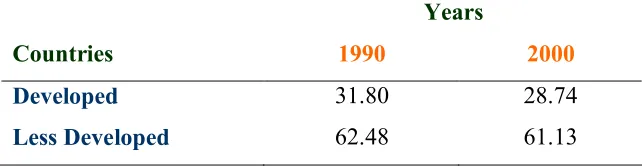
a somewhat similar picture. Table 1 shows the informal employment figures for the
developed and the less developed countries for the decade of 1990 followed by the
decade of 2000. Three observations are worth noting. One, for both the decades informal
employment in less developed countries is almost double than that of developed
countries, and two, informal employment exhibits a persistent nature, that is, for both—
the less developed and the developed—informal employment has remained almost stable
over both the decades and lastly, developed countries registers a 3% drop in the level of
Table 1: Mean Informal Employment in Developed and Less Developed Countries
(as Percentage of Total Employment)
Years
Countries 1990 2000
Developed 31.80 28.74
Less Developed 62.48 61.13
Source: KILM, IILS and own estimation.
Figure 1 shows informal employment for five regions, namely, Europe, Asia, Central
America, Africa, Latin America and Oceania. Further, we categorize Africa into two
groups: Africa including South Africa and Africa and excluding South Africa. For both,
1990s and 2000s, Africa (excluding South Africa) exhibits highest average informal
employment among all the geographical regions. However, highest variation in informal
employment is observed for Asia perhaps due to the fact that the nations from Asia
included in our sample come from both the ends of spectrum of informal employment,
that is, our sample includes developed Asian countries like Japan (which exhibits low
levels of employment in the informal sector) as well as developing Asian countries like
India and Bangladesh (having extremely high informal employment). Variation in case of
African nations are not however significant since the spread of informal employment is
almost same for all the African nations (excluding South Africa). The two Americas
(Central and Latin America) exhibit moderate levels of informality coupled with fairly
low variation for both the decades. Low mean and variation is persistently displayed by
Oceania followed by Europe. It is no surprise however since these regions house most of
the developed nations of the world.
24 60 49 60 66 47 16 20 55 48 44 78 47 15
Europe Asia Cental America
Africa Africa* Latin America Oceania Continent s M ea n I n fo rm al E m p ly m en t (a s a % o f T o ta l E m p lo y m en t) 1990 2000
Note: (*) indicates that in estimating mean and standard deviation for Africa we have not considered South Africa.
[image:29.612.130.481.73.299.2]Source: KILM, IILS and own estimation.
Figure 2: Mean Informal Employment for Selected Countries for 2000
A rg en ti n a A u st ra li a B an g la d es h B el g iu m B o li v
ia Bra
zi l C h il e C h in a C o lo m b ia C o st a R ic
a Cro
at ia Ec u ad o r F in la n d G re ec e H o n d u ra s In d ia In d o n es ia It al y Ja p an Lu x em b o u rg M al ay si a M al ta M ex ic o N et h er la n d
s New
Ze al an d N ic ar ag u a N o rw ay P ak is ta n P an am
a Par
ag u ay P er u P o la n d P o rt u g al S o u th A fr ic a S p ai
n Sw
it ze rl an d Th ai la n d U n it ed K in g d o m U ru g u ay V en ez u el a, B o li v ar ia n R ep u b li c o f Za m b ia Zi m b ab w e 0.00 10.00 20.00 30.00 40.00 50.00 60.00 70.00 80.00 90.00 100.00 Country In fo rm a l E m p lo y m en t (a s a % o f to ta l em p lo y m en t)
5.2 Relating Informality with Regulation and Enforcement
Although there may be a plethora of theories conceptualizing the structure of the informal
bodies, one aspect that almost all the economists agree to is that regulation more often
aggravates the problems of informality than solving it. Thus, it is often prescribed that the
correct path of tackling informality is to introduce flexibility in the system and improve
the quality of regulation so that it provides every incentive for informal agents to start
operating in the ambit of formal economy.
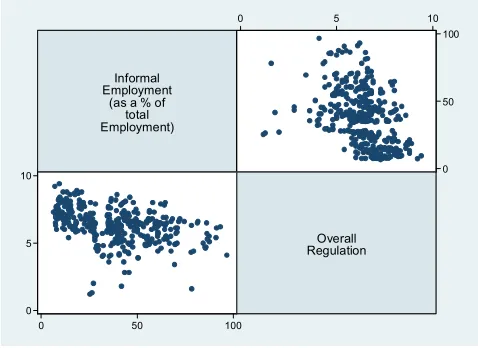
The scatter diagram plotted in Figure 3 examines the relation between overall regulation
and informal employment. It is found that there exists a negative relation between the two
variables. Since higher ratings for regulations indicates greater flexibility in the system
and lower ratings imply presence of rigidity in the system, the inverse relation indicates
that the more the flexibility is introduced in the system, lesser will be the volume of
informal employment. However, when the same exercise is carried out for the
sub-categories of overall regulation, viz., credit market regulation, labour market regulation
and business regulation as plotted in Figures 4 it is observed that while stringency in
credit market regulation adversely affect informal employment, the relation between
[image:30.612.186.425.447.621.2]labour market and business regulation and informal employment are not very robust.
Figure 3: Relation between Informal Employment and Overall Index of Regulation
Informal Employment
(as a % of total Employment)
Overall Regulation
0 50 100
0 50 100
0 5 10
0 5 10
Informal Employment
(as a % of total Employment) credit market regulation labor market regulation business regulation
0 50 100
0 5 10
0 5 10
2 4 6 8
2 4 6 8
0 5 10
Sharper positions are obtained using the data for selected countries for the year 2000 as
[image:31.612.146.466.71.304.2]plotted in Figures 5 to 8.
Figure 5: Informal Employment and Overall Index of Regulation for 2000
Argentina Australia Bangladesh Belgium Bolivia Brazil Chile China Colombia Costa Rica Croatia Ecuador Finland Greece Honduras India Indonesia Italy Japan Luxembourg Malaysia Malta Mexico Netherlands New Zealand Nicaragua Norway Pakistan Panama Paraguay Peru Poland Portugal South Africa Spain Switzerland Thailand United Kingdom Uruguay
Venezuela, Bolivarian Republic of Zambia
Zimbabwe
y = -14.281x + 131.64 R2 = 0.3393
-20.00 0.00 20.00 40.00 60.00 80.00 100.00
0.0 1.0 2.0 3.0 4.0 5.0 6.0 7.0 8.0 9.0 10.0
Index of Overall Regulation
Figure 4: Informal Employment and Index of Credit Market Regulation for 2000
Zimbabwe Zambia
Venezuela, Bolivarian Republic of Uruguay United Kingdom Thailand Switzerland Spain South Africa Portugal Poland Peru Paraguay Panama Pakistan Norway Nicaragua New Zealand Netherlands Mexico Malta Malaysia Luxembourg Japan Italy Indonesia India Honduras Greece Finland Ecuador Croatia Costa Rica Colombia China Chile Brazil Bolivia Belgium Bangladesh Australia Argentina
y = -11.172x + 124.57 R2 = 0.3885
0.00 10.00 20.00 30.00 40.00 50.00 60.00 70.00 80.00 90.00 100.00
0.0 2.0 4.0 6.0 8.0 10.0 12.0
Index of Credit Market Regulation
[image:32.612.103.516.417.661.2]In fo rm a l E m p lo y m en t
Figure 5: Informal Employment and Index of Labour Market Regulation for 2000
Zimbabwe Zambia
Venezuela, Bolivarian Republic of Uruguay United Kingdom Thailand Switzerland Spain South Africa Portugal Poland Peru Paraguay Panama Pakistan Norway Nicaragua New Zealand Netherlands Mexico Malaysia Japan Italy Indonesia India Honduras Greece Finland Ecuador Costa Rica Colombia China Chile Brazil Bolivia Belgium Bangladesh Australia Argentina
y = -0.1941x + 45.87 R2 = 0.009
0.00 10.00 20.00 30.00 40.00 50.00 60.00 70.00 80.00 90.00 100.00
0.0 5.0 10.0 15.0 20.0 25.0 30.0 35.0 40.0 45.0
Index of Labour Market Regulation
In fo rm a l E m p lo y m en t (a s a % o f T o ta l E m p lo y m en t)