ISSN Online: 2327-5227 ISSN Print: 2327-5219
The Credit Risk Assessment Model of Internet
Supply Chain Finance: Multi-Criteria
Decision-Making Model with the Principle of
Variable Weight
Yueliang Su, Baoyu Zhong
School of Business, South China University of Technology, Guangzhou, China
Abstract
The characteristics of the financing model are firstly analyzed when the e- commerce enterprises participate in the supply chain finance. Internet supply chain finance models are divided into three categories with the standard of whether the electronic commerce enterprises provide funds for small and me-dium enterprises instead of banks. And then we further study the financing process and the functions of the e-commerce platform with specific examples. Finally, combined with the characteristics of the supply chain finance model, we set up a small and medium enterprises credit evaluation model based on the principle of variable weight with its dynamic data. At the same time, a multi-time points and multi-indicators decision-making method based on the principle of variable weight is proposed and a specific example is presented. In this paper, the multi-criteria decision-making model with the principle of va-riable weight has been used two times. At last, a typical case has been analyzed based on this model with a higher accuracy rate of credit risk assessment.
Keywords
Credit Risk Assessment Model, Multi-Criteria Decision-Making Model, Variable Principle
1. Introduction
“Internet plus”, as a new model of the development of the Internet, is a new form of the social development. “Internet plus” means that Internet and tradi-tional industry mix together deeply and a new form of development is created using Internet information technology and the Internet platform, etc. [1]. On the How to cite this paper: Su, Y.L. and Zhong,
B.Y. (2017) The Credit Risk Assessment Model of Internet Supply Chain Finance: Multi-Criteria Decision-Making Model with the Principle of Variable Weight. Journal of Computer and Communications, 5, 20-30. http://dx.doi.org/10.4236/jcc.2017.51003
Received: November 10, 2016 Accepted: December 27, 2016 Published: December 30, 2016
Copyright © 2017 by authors and Scientific Research Publishing Inc. This work is licensed under the Creative Commons Attribution International License (CC BY 4.0).
http://creativecommons.org/licenses/by/4.0/
background of the Internet, based on the e-commerce platform, supply chain finance also has a new development form. On December 10th 2013, a Jingdong’s Internet financial product, “Jing Bao Bei”, sets off a wave of supply chain finance again [2][3]. Jing Bao Bei is a financing model based on the purchasing, sales, finance and other data of suppliers without a guarantee or collateral. Jingdong analyzes and determines a supplier’s loan capacity and credit risk according to the supplier’s registration information, purchasing data, sales data and network behavior data, etc. [4]. On the one hand, the Internet has brought more possibil-ities for the development of supply chain finance. On the other hand, the accu-racy of credit risk assessment of small- and medium-sized enterprises is also more and more important. Based on this, this paper analyzes the change of the financing mode of the supply chain finance based on the e-commerce platform on the background of the Internet. At the same time, standing in the perspective of the e-commerce platform, how to use dynamic network data to evaluate the credit risk of small and medium financing customers is proposed.
2. Internet Supply Chain Finance Mode
2.1. The First Supply Chain Finance Financing Mode Based on
E-Commerce Platform
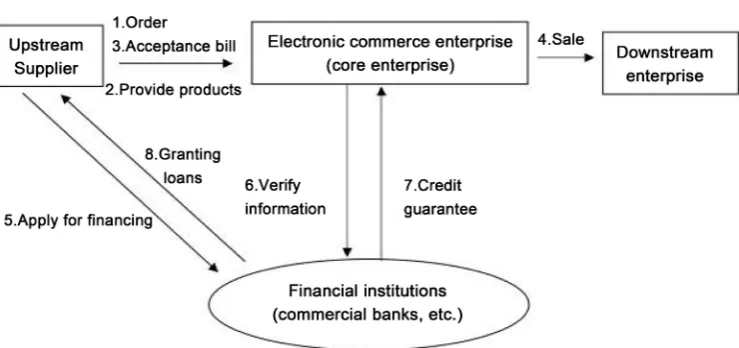
In the first mode of supply chain finance, the e-commerce platform not only provides trading platform, but also directly participates in the supply chain as the core enterprise of the supply chain. At the same time, e-commerce platform cooperates with the bank, providing guarantee credit for the small and medium enterprise of capital shortage [5].
The biggest difference between traditional and Internet supply chain finance is that the transaction and financing process of all enterprises in the whole supply chain are completed on line. The typical e-commerce platform of this model is the Jingdong Mall. First of all, the electronic commerce enterprise or-ders products from upstream supplier who will provide products according to the orders. Next, as the core enterprise with a more powerful position, such as Jingdong Mall, the e-commerce platform does not take direct payment but opens acceptance bill to the upstream supplier and promises to pay after a certain pe-riod. Then, the e-commerce platform sells the products online. Due to the shortage of funds, upstream supplier has to apply to the bank for financing loans, pledging order and acceptance bills from the electronic commerce enter-prise. After verifying the relevant order information, the e-commerce platform makes guarantees to the bank so that bank loans to upstream the supplier. After the entire sales season, the supplier repays the loan after receiving order recei-vables from the electronic commerce enterprise. Figure 1 shows the process of the first supply chain finance financing mode.
Figure 1. The first supply chain finance financing mode.
analyze the financial condition of financing enterprises, procurement, sales, etc. Considering the performance of the whole supply chain, including the compre-hensive ability of upstream and downstream companies, supply chain opera-tions, etc., banks can accurately and effectively determine the loan capacity and credit risk of financing enterprises, which effectively reduce the risk of bank loans [6].
2.2. The Second Supply Chain Finance Financing Mode Based on
E-Commerce Platform
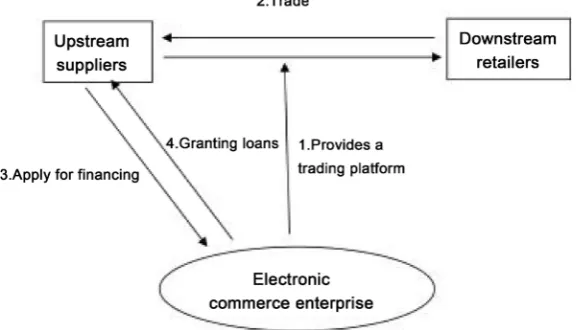
In the second mode of supply chain finance, the e-commerce platform does not directly participate in the supply chain, but provides a trading platform to the upstream suppliers and downstream retailers or customers. However, the e-commerce platform still grasps most of the information in the supply chain. Because of that, the e-commerce platform can provide financing services for small and medium sized enterprises by establishing a loan company or applying for a banking license [7].
lev-el. Enterprises with a lower level of credit risk can be offered unsecured financ-ing services with a lower interest rate. On the other hands, the electronic com-merce enterprise may offer financing services with some collateral for the enter-prise whose credit risk level is high. When facing the financing difficulties, the enterprise can apply for financing application to the electronic commerce enter-prise that can quickly provide the corresponding services. Figure 2 shows the process of the second supply chain finance financing mode.
In the second mode of supply chain finance, there is no bank, which is differ-ent from the first mode of supply chain finance. The electronic commerce en-terprise replaces the bank to provide the small and medium-sized enen-terprises with the financing service. The electronic commerce enterprise establishes a rich database and credit records of the enterprises on the e-commerce platform and provides financing services for customers with financing difficulties on the plat-form. In this kind of mode of supply chain, it is very important for electronic commerce enterprises to assess the credit risk level of the financing enterprises.
2.3. The Third Supply Chain Finance Financing Mode Based on
E-Commerce Platform
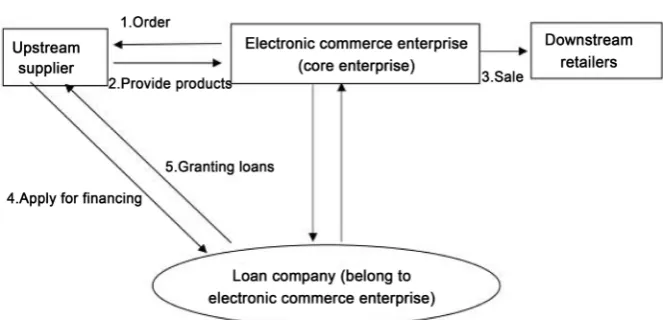
In this section, we analyze the third supply chain finance financing mode that is the combination of the two modes of supply chain finance analyzed above. But it is different from the two. In the third supply chain finance financing mode, the electronic commerce enterprise is the core enterprise in the supply chain, who orders products from the upstream supplier and sales to the downstream enter-prises. Besides, as a financial institution with a strong capital, the electronic commerce enterprise loans to the enterprises with a shortage of capital in the supply chain and earn the interest [8]. Figure 3 shows the process of the third supply chain finance financing mode.
3. The Model
[image:4.595.230.521.551.716.2]The credit risk of small and medium-sized financing enterprises is relatively high due to shortage of its own funds and weak comprehensive ability. So the
Figure 3. The third supply chain finance financing mode.
credit risk assessment is particularly important. In Section 2, we analyzed the three kinds of Internet supply chain finance mode based on the Internet. In this section, from the perspective of electronic business enterprise, we build the cre-dit risk assessment indicators combined with the characteristics of Internet supply chain financing mode and its platform data. When evaluating the credit risk of the financing enterprises in the supply chain, multi indicator decision problem arises. At the same time, due to the real-time nature of Internet data, the indicator state value will change with time. Based on this, this paper estab-lishes a Multi-criteria decision-making model based on variable weight [9][10].
3.1. A Variable Weight Model with Multiple Time Points of Any
Indicator
In the selection of the impact indicator of small and medium enterprises in supply chain financing credit evaluation, there are some indicator state values changing over time and the information value decaying. In order to determine the comprehensive function of the indicator in different time, we consider using the variable weight theory. Next, excited variable state vector is introduced [11].
Given mapping S
[ ]
0,1m[ ]
0,1m→
: such that
( )
(
1( ) ( )
, 2 , , m( )
)
X →S X = S X S X S X ,where S Xi
( )
=[ ]
0,1m →[ ]
0,1 .( )
(
1( )
, 2( )
, , m( )
)
S X = S X S X S X is called excited variable state vectors if S satisfies the following axioms
1)
S X
i( )
≥
S X
j( )
when
x x
i≥
j,
2)
S X
i( )
=
S x x
i(
1, , ,
2x
m)
is continuous on each xi3) For any constant weight vector,
w
0=
(
w w
1, , ,
2
w
m)
, there is a variablestate vector
( )
( )
( )
0
1 m
i i i w S X w X
w S X
= ∗ =
∑
(1)Assuming that there are N indicators,
f
=
(
f f
1, , ,
2
f
N)
, whose valueschanging over time. The values of M indicators fi in M time points are
(
1, , ,
2)
i i i iM
y
=
y y
y
, where yiM is the closest state value from the currentvector S yi
( )
i =(
S y S yi1( )
i , i2( )
i , , SiM( )
yi)
can be defined as(
1, , ,2)
ij 1 1,2, ,ij i i iM
y
S y y y j M
M j
= =
− +
(2)
It can be proved that the variable state vectors
S y y
ij(
i1, , ,
i2
y
iM)
satisfy thedefined conditions of excited variable state vectors. So the value of all variable state vectors in different time points wi can be defined
( )
( )
( )
( )
( )
( )
(
)
( )
1 1 2 2
0
1 1
, , ,
i i M M i
i i
i i M M
j ij i j ij i
j j
w S y w S y w S y
w S y w y
w S y w S y
= = ∗ = =
∑
∑
(3) Calculate the values of the comprehensive function of all indicators in differ-ent time points which are the Hadamard product of variable vectors and state values,( )
i i i i
y w y
′ =
y
(4) Finally, the state values of all evaluation indicators can be defined as
changes by time doesn t change by time i i i i i y y x y y
= ′ ′
(5)
3.2. A Variable Weight Model with Multiple Indicators
The state value of indicator is different, as well as the importance of different in-dicator. In traditional, constant weight variable is usually used to determine the importance of indicator. In this paper, the weight of indicator is also adopted to the variable weight theory in order to study the influence of the state value on the indicator. Satisfaction Principle is introduced [12].
For a multi criteria decision making problem, assuming a decision set U, an indicator set related decision making problem
f
=
(
f f
1, , ,
2
f
m)
and acon-stant weight vector of the indicators,
w w w
=
(
1, , ,
2
w
m)
. The value of theindi-cator f is
X
=
(
x x
1, , ,
2
x
m)
and m0 is the number of satisfaction. For any choice u U∈ , the choice u is the satisfaction choice if there are more than m0indicators who are satisfactory. Indicator xi is satisfactory if x ai> i where ai
is the basic number whose values is the standard given by decision makers. As-suming that there are many small and medium sized enterprises
(
1, , ,
2 m)
p
=
p p
p
and N indicators that measure the credit risk of small and medium sized enterprises. For any pt inp
=
(
p p
1, , ,
2
p
m)
, assuming thatthe value of N indicators is
x
t=
(
x x
t1, , ,
t2
x
tN)
and the number of satisfactionis m0. In order to determine the constant weight vector more objectively, this paper uses the analytic hierarchy process to determine the value of the constant weight vector
w
0′
=
(
w w
1′ ′
, , ,
2
w
N′
)
. The state value of all indicators arestan-dardized by Z-score method and then the basic number can be
a
=
(
0,0, ,0
)
. According to Liu Chang (2014, [13]), variable state vector( )
(
1( )
, 2( )
, ,( )
)
t t t t t t tN t
S x = S x S x S x can be defined as
(
1, , ,2)
e 01 0 tj x
tj tj t t tN
tj x
S x x x
x θ ≥ = <
where θ is the excited factor,
(
0)
( )
1 0 0 0
t t
m t
t
η
θ η µ ξ µ
ξ + ≥ = = − = <
, , , ξ
is the number of satisfaction indicators that the number of satisfied condition
0 tj
x ≥ and 1
( )
, .( )
1 00 0
N tj j t x t t
ξ = =ν ν = ≥
<
∑
It can be proved easily that
S x x
tj(
t1, , ,
t2
x
tN)
satisfies all conditions of thedefinition excited variable state vectors and then the value of the variable weight vector of all suppliers wt can be calculated
( )
( )
( )
( )
( )
( )
(
)
( )
1 1 2 2
0
1 1
, , ,
t t N N t
t t
t t N N
j tj t j tj t
j j
w S x w S x w S x
w S x w x
w S x w S x
= = ′ ′ ′ ′ ′ ∗ = ′ ′
∑
∑
(7)
Finally, calculating the values of the comprehensive function of all small and medium sized enterprises in different indicators which are the Hadamard prod-uct of variable vectors and state values,
( )
t t t t
x w x
′
=
′
x
(8) Equation (8) gives the final scores of all small and medium sized enterprises.
4. Case Analysis
4.1. Index Design and Data Description
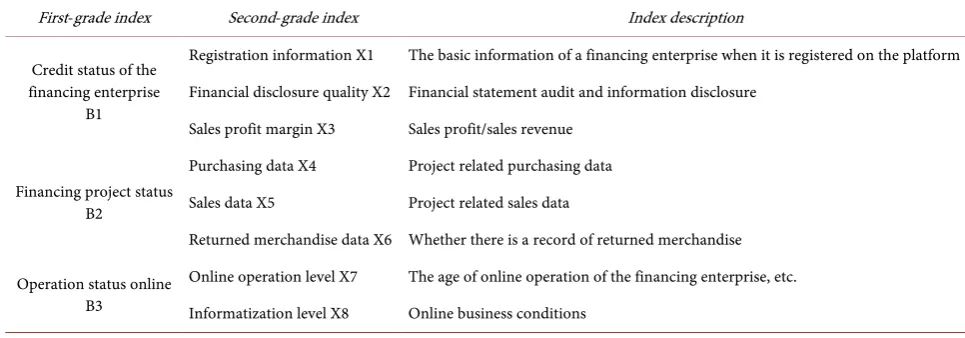
[image:7.595.54.537.569.738.2]Based on the characteristics of the supply chain on the electronic platform and the literature of supply chain, the credit risk assessment index is constructed as Table 1.
According to the credit risk assessment indexes, this paper collects the data through the questionnaire to the merchant and the electronic business platform. Qualitative indexes take 5 points system score, and quantitative indexes are from the electronic business platform history records. There were 13 valid question-naires returned. Therefore, a Multi-criteria decision-making model can be con-structed with 13 financing enterprises
p
=
(
p p
1, , ,
2
p
13)
and8 credit risk as-sessment indexesf
=
(
f f
1, , ,
2
f
8)
. Some indexes have three months of data(
1, ,
2 3)
i i i iy
=
y y y
.Table 1. The credit risk evaluation index of internet supply chain finance.
First-grade index Second-grade index Index description
Credit status of the financing enterprise
B1
Registration information X1 The basic information of a financing enterprise when it is registered on the platform Financial disclosure quality X2 Financial statement audit and information disclosure
Sales profit margin X3 Sales profit/sales revenue
Financing project status B2
Purchasing data X4 Project related purchasing data Sales data X5 Project related sales data
Returned merchandise data X6 Whether there is a record of returned merchandise
Operation status online B3
4.2. A Variable Weight Model with Multiple Time Points of Any
Indicator
In the collected data, some of them change with time. Sales profit margin X3, Purchasing data X4, Sales data X5 and Returned merchandise data X6 need to be calculated the values of the comprehensive function with three months record. Given a constant weight vector
w
0=
(
w w w
1, ,
2 3) (
=
0.2,0.3,0.5
)
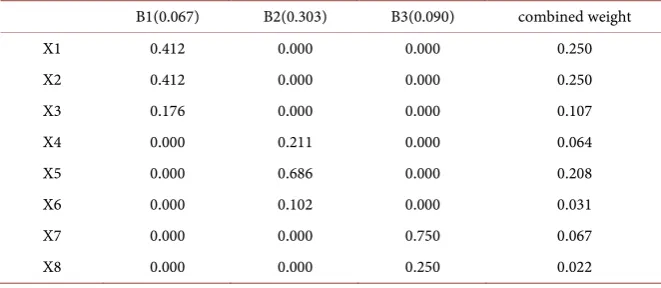
, the compre-hensive function value of any indicator in three months can be calculated by Equation (5).Besides, this paper uses the analytic hierarchy process to determine the value of the constant weight vector w0′. According to the relative importance of each index, the judgment matrix of the hierarchical structure is determined. The rela-tive importance between each other of the First-grade index can be expressed as a matrix A and the Second-grade index one can be expressed as a matrix B, C, D
1 3 5 1 1 3
1 5 1 3
1 1
1 0.2 3
1 3
1 5
1 1
= =
= =
A B
C D
The relative weight and combined weight of index can be determined by MATLAB according the judgment matrix. The relative weight and combination weight are shown as Table 2.
4.3. A Variable Weight Model with Multiple Indicators
According to variable weight theory, when an index meets the requirements of financial institutions, increase the weight of the index to indicate the impact of the index, or to reduce its weight. Constant weight vector
(
) (
)
0 1, , , , , , ,2 3 4 5 6 7 8 0.25,0.25,0.107,0.064,0.208,0.031,0.067,0.022 w′ = w w w w w w w w = , can
[image:8.595.207.538.594.738.2]be obtained from Table 2 by analytic hierarchy process. By Equation (6), the va-riable weight vectors of each index of the 13 financing enterprises can be ob-tained. Variable weight vector of each index of sample financing enterprise are shown as Table 3.
Table 2. The relative weight and combination weight of index by AHP.
Table 3. Variable weight vector of each index of sample financing enterprise.
Sample w x1( )t w x2( )t w x3( )t w x4( )t w x5( )t w x6( )t w x7( )t w x8( )t
P1 0.190 0.225 0.154 0.089 0.206 0.011 0.121 0.005 P2 0.250 0.250 0.107 0.064 0.208 0.031 0.067 0.022 P3 0.250 0.250 0.107 0.064 0.208 0.031 0.067 0.022 P4 0.252 0.298 0.087 0.028 0.273 0.014 0.040 0.007 P5 0.146 0.245 0.233 0.084 0.158 0.018 0.095 0.021 P6 0.188 0.315 0.098 0.048 0.204 0.055 0.064 0.027 P7 0.250 0.250 0.107 0.064 0.208 0.031 0.067 0.022 P8 0.250 0.250 0.107 0.064 0.208 0.031 0.067 0.022 P9 0.179 0.305 0.085 0.106 0.195 0.022 0.091 0.016 P10 0.250 0.250 0.107 0.064 0.208 0.031 0.067 0.022 P11 0.565 0.170 0.043 0.059 0.109 0.012 0.027 0.015 P12 0.163 0.270 0.151 0.092 0.175 0.047 0.080 0.023 P13 0.250 0.250 0.107 0.064 0.208 0.031 0.067 0.022
Table 4. The final score boundary value and risk degree.
P P≥1 0≤ ≤P 1 − ≤ ≤1 P 0 − ≤ ≤ −2 P 1 P≤ −2
Risk degree 1 2 3 4 5
By Equation (8), the final scores of 13 small and medium sized enterprises are calculated. Take P as a boundary value. When P is larger, the credit risk degree of the financing enterprise is lower; when P is smaller, the credit risk of the fi-nancing enterprise is higher. The values are given as Table 4.
The final score values and risk assessment degrees of the 13 financing enter-prises based on Multi-criteria decision-making(MID) model with the principle of variable weight and Analytic hierarchy process(AHP) model are shown as Table 5.
5. Conclusion
Table 5. The final score values and risk assessment degrees of the 13 financing enterprises.
The score based on
MID
Risk degree prediction based
on MID
The score based on
AHP
Risk degree prediction based
on AHP
Risk degree
P1 1.769 1 1.630 1 1
P2 −0.549 3 −0.721 3 3
P3 −1.557 4 −1.352 4 4
P4 1.392 1 1.384 1 1
P5 0.523 2 0.214 2 2
P6 0.256 2 0.022 2 3
P7 −0.615 3 −0.762 3 3
P8 −0.290 3 0.027 2 3
P9 0.043 2 −0.004 3 2
P10 −0.489 3 −0.679 3 3
P11 0.613 2 0.480 2 2
P12 0.454 2 0.181 2 2
P13 −0.238 3 −0.420 3 3
making model based on the principle of variable weight was established bined with the characteristics of internet supply chain financing model, com-plexity and dynamic of data and the credit risk assessment index. Finally, based on the case validation, through comparing with the results of the traditional analytic hierarchy process, it is proved that the multi-criteria decision-making model has higher accuracy rate of credit risk assessment for financing enterpris-es.
Acknowledgements
This research was supported by “the Fundamental Research Funds for the Cen-tral Universities” (2015ZKYJZX02) and Guangzhou Financial Services Innova-tion and Risk Management Research Base.
References
[1] Editorial Department of China Construction Information (2015) To Meet the
“In-ternet Plus” Era. China Construction Information, 6, 8-9.
[2] Editorial Department of Era of Financial Science and Technology (2014) Ricoh
(China) Color Management Expert Awarded “G7” Experts Certification. Financial
Technology Time, 1, 8.
[3] Min, W.W. and Luo, L. (2015) Innovation Is the Only Way Out—An Interview with
Yao Naisheng, Vice President of Jingdong Finance. Modern Bankers, 3, 90-93.
[4] Editorial Department of Era of Financial Science and Technology (2014) China’s
First Mobile Payment Block. Financial Technology Time, 1, 8.
[5] Wang, C. (2007) Research on Financing Model of Small and Medium Sized
[6] Pang, J. (2011) An Analysis of the Financing Mode of Pre-Payment Based on the Supply Chain Finance. Beijing Jiaotong University, Beijing.
[7] Sun, R.Y. (2012) Mobile Phone OEM J Supplier Management Strategy. Tianjin
University, Tianjin.
[8] Tang, S.D. (2014) Analysis on the Present Situation and Development Trend of
Supply Chain Finance in Commercial Banks. Rural Finance Research, 5, 5-7.
[9] Amid, A., Ghodsypour, S. and Obrien, C. (2006) Fuzzy Multi Objective Linear
Model for Supplier Selection in a Supply Chain. International Journal of Production Economics, 104, 394-407. https://doi.org/10.1016/j.ijpe.2005.04.012
[10] Amid, A., Ghodsypour, S. and O’Brien, C. (2011) A Weighted Max-Min Model for
Fuzzy Multi-Objective Supplier Selection in a Supply Chain. International Journal of Production Economics, 131, 139-145. https://doi.org/10.1016/j.ijpe.2010.04.044
[11] Wang, Y. (2005) Research on Supplier Selection Method Based on Variable Weight
Theory. University of Electronic Science and Technology, Chengdu.
[12] De, Q., Li, C.H.M. and Li, H.X. (2003) A Multifactor Decision Making Method
Based on Satisfaction Principle. Systems Engineering Theory and Practice, 23, 104- 109.
[13] Liu, C., Ouzrout, Y., Nongaillard, A., Bouras, A. and Zhou, J.L. (2014) Multi-Crite-
ria Decision Making Based on Trust and Reputation in Supply Chain. International
Journal of Production Economics, 147, 362-372.
https://doi.org/10.1016/j.ijpe.2013.04.014
Submit or recommend next manuscript to SCIRP and we will provide best service for you:
Accepting pre-submission inquiries through Email, Facebook, LinkedIn, Twitter, etc. A wide selection of journals (inclusive of 9 subjects, more than 200 journals)
Providing 24-hour high-quality service User-friendly online submission system Fair and swift peer-review system
Efficient typesetting and proofreading procedure
Display of the result of downloads and visits, as well as the number of cited articles Maximum dissemination of your research work