BIROn - Birkbeck Institutional Research Online
Tacon, Richard and Walters, Geoff and Cornforth, C. (2017) Accountability
in non-profit governance: a process-based study. Nonprofit and Voluntary
Sector Quarterly 46 (4), pp. 685-704. ISSN 0899-7640.
Downloaded from:
Usage Guidelines:
Please refer to usage guidelines at or alternatively
Accountability in non-profit governance: A process-based study
Author 1 (Corresponding author): Dr. Richard Tacon, Birkbeck, University of
London, Department of Management, Clore Management Centre, Torrington Square,
London, WC1E 7JL, UK
[email protected], +44 (0)20 76316563
Author 2: Dr. Geoff Walters, Birkbeck, University of London, Department of
Management, Clore Management Centre, Torrington Square, London, WC1E 7JL,
UK
[email protected], +44 (0)20 76316884
Author 3: Professor Chris Cornforth, Open University Business School, Open
University, Walton Hall, Milton Keynes, MK7 6AA, UK
[email protected], +44 (0)1908 655863
Authors’ Note
We would like to thank the three anonymous reviewers for their comments and
suggestions.
Keywords
Accountability, process research, nonprofit sport organisations, instrumental
Abstract
Accountability is a crucial element of governance. Non-profit organisations are
typically accountable to multiple stakeholders and often ‘do’ accountability in
multiple ways. But what happens when a non-profit organisation is highly dependent
on a single source of funding? This paper provides an empirical exploration of this
issue. It draws on a longitudinal case study of one non-profit organisation in the UK
that is highly dependent on a single funder to examine how accountability is
constructed and enacted, with a focus on the board. It critically examines
accountability processes through direct observation of board and committee meetings
and in-depth interviews with board members. The analysis shows how board
members work to construct broader forms of accountability beyond accountability to
the funder, but then struggle to enact them. This paper provides in-depth insight into
the challenges that non-profit board members face and offers a rare example of
Introduction
Accountability is a crucial element of governance. Indeed, ever since Berle and
Means (1932) identified the separation of ownership and control, much of the
prescriptive literature on governance has been concerned with how organisations can
be held accountable. Agency theory, which is still predominant in corporate
governance research, focuses on how boards of directors should act to monitor the
decision-making and performance of executive staff (Fama & Jansen, 1983); and
governance reforms, which often follow high-profile corporate failures, typically
stress internal and external accountability mechanisms (Roberts, McNulty, & Stiles,
2005).
In non-profit governance, accountability is particularly crucial. This is due to some
basic characteristics of non-profit organisations, including multiple organisational
objectives, multiple stakeholders and a diversified (i.e. voluntary and professional)
workforce (Alexander, Brudney, & Yang, 2010; Coule, 2015). But it is also due to
some more recent developments in many countries, including the rise of ‘new public
management’, which has led to the introduction of an ‘audit culture’ (Alexander et al.,
2010; Guo, 2007; Ospina, Diaz, & O’Sullivan, 2002), and the ‘hollowing out of the
state’, which has seen the awarding of public service contracts to non-profit
organisations (Ferlie & McGivern, 2013).
These more recent developments have meant that, in the UK and elsewhere,
government funding is now a significant source of income for many non-profit
voluntary sector. For example, in the UK, the Baring Foundation (2014) recently
reported that the independence of the voluntary sector was ‘undervalued and under
threat’. Such concerns echo those raised in the US in the 1990s, when it was claimed
that many non-profit organisations were moving from ‘agents of the community’ to
‘agents of government’ (Smith & Lipsky, 1993, p. 72).
In this context, it is particularly important to understand how non-profit organisations
deal with issues of accountability. Recent research has offered detailed typologies of
accountability (e.g. Christensen & Ebrahim, 2006; Ebrahim, 2010; Knutsen &
Brower, 2010), as well as critical analysis of the theoretical assumptions underpinning
different views of accountability (Coule, 2015) and discussion of possible managerial
strategies for balancing multiple accountabilities (Knutsen & Brower, 2010). This has
provided a solid foundation. However, there is more we need to know.
First, we need to know how non-profit organisations that are almost entirely
dependent on a single, public funder deal with accountability. Are they, as Smith and
Lipsky (1993) foretold, ‘agents of government’? Second, we need to know what is
happening at board level. How do board members, individually and collectively, deal
with issues of accountability on a day-to-day basis? Third, we need to better
understand the differences between constructing and enacting accountability. While
recent studies have used interviews to gain valuable insight into how organisational
members deal with accountability issues, there are always important differences
between what people say they do and what they actually do. We need to better
understand, through direct observation, how board members construct and enact
This article seeks to develop knowledge of these issues through a longitudinal case
study of a non-profit sport organisation in the UK that is highly dependent on a single,
public funder. In examining this case, the article seeks to contribute to the theory and
practice of accountability in non-profit organisations and to demonstrate the
importance of adopting a multi-level, process-based perspective on governance
(Cornforth, 2012). The article is structured as follows. The next section discusses key
issues in accountability research. Following this, we describe and justify our
methodological approach. Then, we present our findings, focusing on how board
members constructed and enacted (or failed to enact) different types of accountability.
We then examine the implications of the study and draw conclusions.
Accountability and governance research
Accountability is often defined simply as the way in which an organisation is held to
account for its actions. However, research has shown that it is much more complex
than this. Indeed, Dubnick and Yang (2011, p. 179) argue that ‘the promiscuity,
multifunctionality, polymorphism, and situatedness of accountability make it one of
the most elusive concepts in public administration’. Rather than talking about
accountability per se, researchers argue that we need to talk about multiple types of
accountability (Knutsen & Brower, 2010). In the non-profit governance literature,
therefore, a number of authors have offered typologies of accountability. For
example, Kearns (1994) identified four types of accountability, based on explicit or
implicit performance standards and proactive or reactive organisational responses;
stakeholder groups (Ebrahim, 2003); ‘upward’, ‘downward’, or ‘lateral’
accountability (Christensen & Ebrahim, 2006; Edwards & Hulme, 1996); and
‘instrumental’ and ‘expressive’ accountability (Knutsen & Brower, 2010).
Such typologies are useful, because they can help us to understand the nature of the
accountability challenges that non-profit organisations face. In particular, as the ‘audit
culture’ becomes more deeply embedded (Alexander et al., 2010), it is increasingly
important to understand whether, and if so, how, non-profit organisations ‘do’
accountability when they are very highly dependent on public funding. In this context,
Christensen and Ebrahim’s (2006) argument that upward accountability (to funders,
donors and oversight agencies) can often crowd out downward and lateral
accountability (to communities and staff) is particularly relevant. Likewise, Knutsen
and Brower’s (2010) argument that instrumental accountability, underpinned by
principal-agent relationships, mutual benefits, resource dependence and measurable
outcomes, can impinge on expressive accountability, based on values and beliefs and
a sense of shared ownership. Coule (2015) extends such arguments by examining how
the underlying assumptions of different theories of governance hold implications for
the theory and practice of accountability. Specifically, she identifies how the unitary
logic that underpins agency and stewardship theory emphasises a systems-control
approach that privileges instrumental accountability, whereas the pluralist logic that
underpins stakeholder and democratic theory emphasises a process-relational
approach that allows for forms of expressive accountability. In a very basic sense,
then, current research suggests a potential conflict between upward, instrumental
It is also important to examine the mechanisms through which non-profit
organisations enact (or might seek to enact) accountability. For example, Ebrahim
(2010) sets out five common accountability mechanisms, namely: reports and
disclosure statements; evaluations and performance assessments; industry
self-regulation; participation; and adaptive learning. While this serves as a useful
summary of common approaches, it looks at these mechanisms from quite a
‘distance’. That is, while the mechanisms imply micro-level interaction, they do not
specify clearly how organisational members actually construct and enact
accountability in ongoing processes of discussion and decision-making. As Roberts et
al. (2005) found, in their research on non-executive directors in FTSE 350 companies,
‘in practice, accountability is realized through a wide range of behaviours –
challenging, questioning, probing, discussing, testing, informing, debating and
exploring’ (Roberts et al., 2005, p. S12). The key implication here is that if we want
to understand how organisations actually ‘do’ accountability, we need to observe and
interpret ongoing processes of board discussion and decision-making.
In fact, this is part of a wider methodological debate within governance research,
concerning the way in which empirical work is carried out. Governance research has
traditionally been somewhat ‘distant’ from its objects of inquiry, relying on
quantitative analysis of cross-sectional data (Brennan and Solomon, 2008; Cornforth,
2012; Leblanc and Schwartz, 2007; Roberts et al., 2005). Yet if we understand
governance as, at least in part, the decisions of groups of board members, it is surely
important to understand how and why board members make those decisions. As
Leblanc and Schwartz (2007, p. 843) argue, we need to ‘open up the black box of
analysis, within an interpretive research paradigm, as potential ways of accessing an
‘insider perspective’ – an approach that some recent studies on non-profit
accountability have embraced (e.g. Coule, 2015; Knutsen and Brower, 2010).
We follow this interpretive approach, but seek to build on these studies in three ways.
First, given the recent developments within many countries’ non-profit sectors, we
seek to understand how organisations that are very highly dependent on a single,
public funder ‘do’ accountability. While previous research (e.g. Coule, 2015) has
involved organisations that had various levels of dependence on public funding, we
deliberately adopt a ‘critical case’ approach (Yin, 2014) by seeking to gain an
in-depth understanding of accountability within an organisation that is almost entirely
dependent on a single, public funder.
Second, we focus specifically on the board. As the board is the key decision-making
entity within a non-profit organisation (Herman and Renz, 2008), it is essential to
understand how board members deal with accountability. While Knutsen and Brower
(2010) examined mechanisms of accountability, they focused specifically on
managers and staff, and while Coule (2015) incorporated more of a focus on the
board, she did not report, from longitudinal observation, how board members dealt
with accountability issues within board discussions and decision-making processes.
We seek to do so through direct observation of board and committee meetings, in
order to try to trace how board members ‘do’ accountability over time.
Third, and related, we examine how board members both construct and enact
paradigm has tended to rely on interviews and documentary analysis (Coule, 2015;
Roberts et al., 2005). In this study, we observed board and committee meetings
directly, over a sustained period, as well as conducting in-depth interviews, in order to
understand not only how board members constructed accountability within
interviews, but also how they constructed and enacted (or did not enact)
accountability within ongoing processes of discussion and decision-making. In so
doing, we aim to contribute to the emerging ‘process perspective’ on governance,
which, among other things, seeks ‘narrative explanations of how change happens in
terms of the central actors involved’ (Cornforth, 2012: 1127).
Methodology
In seeking to address our main research question – how is accountability constructed
and enacted within boards of non-profit organisations that are very highly dependent
on a single, public funder? – we required a case study organisation that was funded in
this way and would provide access to board and committee meetings. At a launch
event for a survey of non-profit governance, we met one of the chief executive
officers (CEOs) of an organisation that met our ‘funding criteria’ and, following
various negotiations, the organisation generously granted us access.
The case
The case is a national governing body of sport (NGB) in England. It was formed in
2000 and acts as the development agency for two sports. It is legally constituted as a
sports, which had previously governed all aspects of their sports, instituted as the
owners (shareholders) of the focal organisation. However, the organisation is de facto
non-profit: the shareholders do not take any dividends from the focal organisation and
any revenue generated is used to meet its sporting objectives. The board of the
organisation has 12 members: an independent chair; six federation directors (each
federation elects three directors to the board); and five independent directors. In
addition, the organisation has two CEOs, who attend the board (technically as
non-voting members, but, in practice, as full board members).
The organisation receives funding through Sport England, which is the
non-departmental public body that distributes funding from central government and the
National Lottery to support community-level sport in England. Every four years, the
organisation, along with other NGBs in England, bid to Sport England for Whole
Sport Plan funding. Bid documents set out: (i) targets the organisation seeks to meet
(relating to numbers of participants in the sports, numbers of leagues, teams, coaches,
and so on); (ii) how the organisation seeks to meet these targets; and (iii) how much
funding the organisation is requesting. The organisation had successfully bid for
Whole Sport Plan funding in this way since 2005 (see Figure 1) and was very highly
dependent on this source of income.
[Figure 1 here]
Data Collection
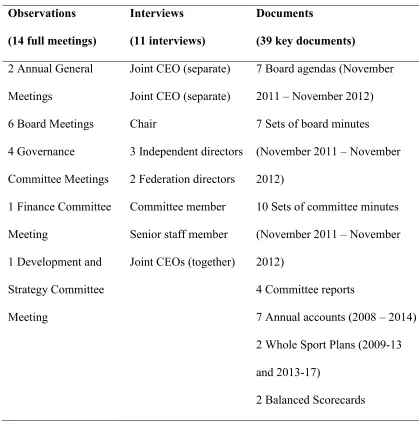
from a number of sources (see Table 1).
[Table 1 here]
Each meeting we observed lasted around two hours, except for two longer, six-hour
board meetings, so the total length of observation was around 36 hours. We wrote
field notes during and immediately after the meetings, seeking to preserve the ‘flow’
of conversation and interaction, and, where possible, we recorded phrases and
conversational exchanges verbatim. Interviews ranged from 60 to 115 minutes, with
an average length of 80 minutes. We digitally recorded them and then transcribed
them in full. We then imported these transcriptions, along with our written-up and
annotated field notes and the various board documents we were given, into NVivo.
We collected data in two main phases. During the initial data collection phase, we
first read all the organisational documents to develop our understanding of the history
of the organisation and then conducted a semi-structured interview with one of the
CEOs, in order to deepen our understanding of the organisation and to probe how (she
thought) the board and committees operated and how board members constructed and
enacted accountability. We then began our observations of board and committee
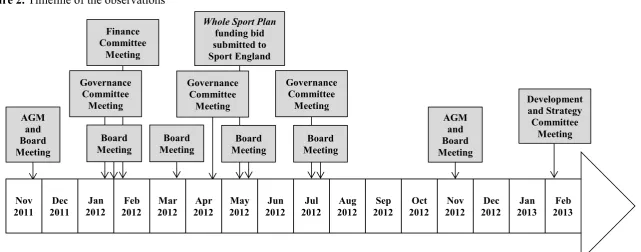
meetings in November 2011 and continued these until February 2013 (see Figure 2).
[Figure 2 here]
After gaining a good (provisional) understanding from our observations of how the
2012 onwards, conducted a further six interviews – with the chair, the other CEO, a
federation director, an independent director, a Governance Committee member and a
senior staff member – in order to probe how they perceived that they (and others)
constructed and enacted accountability. We used a basic interview guide (developed
through our reading of the literature on non-profit accountability discussed earlier)
and we also used the interviews to ‘test’ and refine our emerging interpretations from
our observations. We asked interviewees directly about how they responded to
different stakeholder groups (e.g. how did they interpret and seek to meet the
expectations of Sport England, the national federations, the wider members, staff, and
so on). We also asked them to reflect critically on the conversations held during board
meetings and the ways in which they and other board members talked and made
decisions. In this sense, we asked both directly and indirectly about accountability.
Together, the interviews and observations worked iteratively to focus our attention on
key accountability issues. For example, our early observations from meetings
indicated that all board members were constructing a shared sense of (expressive)
accountability to ‘the sports’, but, over time, the interviews and observations
suggested that different board members were constructing this accountability in subtly
divergent ways. As will be discussed below, this mainly involved certain board
members constructing ‘the sports’ as the national federations themselves (i.e. the
organisations and their official membership) and certain other board members
constructing ‘the sports’ in a more diffuse way that centred on the focal organisation’s
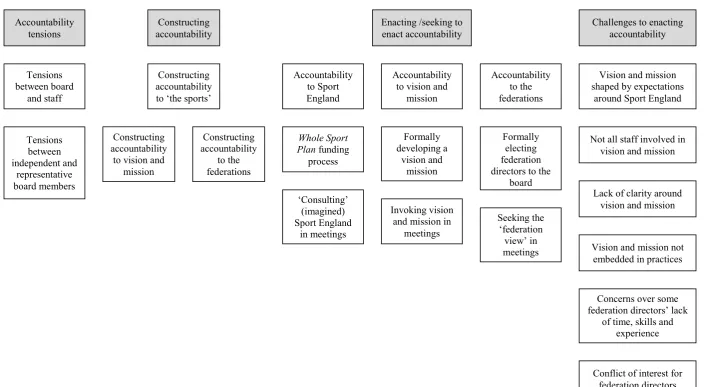
wider vision and mission. This is reflected in the coding scheme (Figure 3 below),
where ‘Constructing accountability to ‘the sports’’ is subdivided into ‘Constructing
federations’.
We then conducted a preliminary data analysis (see details below) and returned to the
field in January 2014 to undertake further interviews with the joint CEOs (together),
two independent directors and a federation director (these latter three for the first
time). The main purpose of these interviews was to ‘try out’ and refine our
understanding of accountability processes and to probe further the tensions and
contradictions our reading of the data indicated. For example, we had directly
observed the development of an organisational vision and mission, but it seemed, to
us, that the desire for tangible action around this had ebbed somewhat over time. Our
interviewees broadly confirmed this (and our other provisional interpretations), but
also provided further detail, which deepened our understanding of the case. After the
four interviews in this second phase, we felt confident in the ‘confirmability’ of our
findings and, as much as this is ever possible, we felt we had reached ‘data saturation’
around the main research issue.
Data analysis
We initially coded all the data according to a very basic, pre-specified coding scheme,
drawing on Cornforth’s (2001) list of typical non-profit board ‘processes’ and
‘functions’ to provide an overall picture of how the board operated. In doing so, we
predictably coded a significant amount of data to ‘Ensuring accountability to the
organisation's stakeholders’. We then developed a more refined coding scheme,
coding material initially to the broad categories of ‘Accountability tensions’,
outline of our narrative. Then, as we proceeded iteratively through the data collection
and analysis, we developed a more refined coding scheme. There is not sufficient
space here to explain the entire coding process, but we present a simplified version of
the coding scheme in Figure 3.
[Figure 3 here]
As is common in analysis of qualitative data, we also sought to examine the
inter-connections within the data. We seek to present these in the following narrative and to
capture them, as much as this is possible, in the process model that follows the
narrative.
Findings
Dependence on a single, public funder
The organisation was highly dependent on funding from Sport England. Between
2009 and 2013, it received £2.7 million through Whole Sport Plan funding, which
accounted for approximately 83% of total income. This high level of dependence
clearly shaped the ways in which board members constructed and enacted
accountability. For example, in the very first meeting we attended – the Annual
General Meeting in November 2011 – the outgoing chair started his final address by
declaring, ‘We’re thought of very well by Sport England’. He then identified the next
round of Whole Sport Plan funding as ‘the critical issue for the organisation going
on the organisation’s position, ‘It’s almost as if we’re an agency of Sport England’.
Accountability tensions
This dominant, upward accountability created certain tensions. As one of the CEOs
said in her interview, ‘we deliver Sport England targets’, and this meant that she and
other board members felt somewhat constrained in their ability to be accountable to
‘the sports’:
… you know…the message from Sport England is that you should first think about what
would be good for your sport. And then, you know, they should see what parts of that strategy
they would fund. …in truth, we can’t operate like that. We first think about what they’re
willing to fund and, you know,…and obviously, we’re not talking about things that are
diametrically opposed to what would be good for our sports, but yeah, we would probably do
things slightly differently if it was all about what we thought was best for [the sports].
These ‘accountability tensions’ also played out between the board and staff and
within the board itself. For example, the other CEO said in his interview:
There’s often a frustration among staff when they would like to be doing something, whether
it’s coaching in schools, “Our focus can’t be youths, it’s adults,” you know, that kind of thing,
or national team support, which we’re not funded for at all. And I know our staff are often
frustrated that that’s not what we’re doing. And I think our representative [board] members
are often frustrated that that’s not what we’re doing, whereas our independent [board]
members are very kind of clear on the fact that’s not what we’re paid to do [by Sport
So, how did the board deal with these accountability tensions?
Constructing a broader sense of accountability
Many board members, while recognising the organisation’s dependence on grant
funding, sought to construct a broader sense of accountability. For example, in the
November 2011 board meeting, the new chair encouraged all board members to think
about ‘what we want to achieve for our sports’ and then to think about how ‘we can
get Sport England on board with what we want to achieve’. He drew an analogy
between the organisation and a car, which, he said, they (the board) had designed and
should continue to design, he (the chair) should drive, and into which Sport England
should put the fuel. He made this argument persistently in board meetings. For
example, in a board meeting a year later, he said, ‘It has felt that we’re just an agency
for Sport England. But … this is now our opportunity…if Sport England want to
come and invest in what we’re doing, that’s what we should be aiming at…It’s a
different model for me mentally, and I think it’s important that people have this
different mental model.’
But what was this different ‘mental model’? Initially, it seemed there was a general
consensus, in which board members and the joint CEOs contrasted the upward,
instrumental accountability to Sport England with a broader sense of accountability to
‘the sports’. For example, in the November 2011 board meeting, the chair made the
point that, ‘Ultimately, all of this is about what works best for [the sports], not for any
one body’. Likewise, one of the independent directors, in the same board meeting,
‘sport owns the sport’. This accountability to ‘the sports’ appeared to align with what
Knutsen and Brower (2010) describe as expressive accountability to the community –
‘organizations’ self-perception of their community roles, often altruistic and value
driven’ (p. 597) and what Christensen and Ebrahim (2006) term ‘downward
accountability’ – a sense of ‘felt responsibility’ to clients, members, or the public.
Close observation, however, suggested that this accountability to ‘the sports’ was in
fact constructed in different ways by different people. Some – primarily the chair, the
other independent directors and the joint CEOs – tended to discuss it in terms of
accountability to the organisation’s vision and mission. For example, when discussing
how the board should account for its actions in the November 2011 board meeting,
one of the independent directors, said, ‘I want to say, “where’s the sport in 2017 or
2020?”’ In a later board meeting (November 2012), the chair discussed a ‘layered’
approach to thinking about the board and its accountability. He talked about a ‘top
layer, which is the organisation’s vision and mission’ and ‘another layer beneath that,
which is the Whole Sport Plan and the Development and Strategy Committee’. ‘We
have to remember,’ he said, ‘that the Whole Sport Plan is not all our work’ – an
explicit statement that upward, instrumental accountability ought to be balanced with
a broader sense of accountability to vision and mission.
Others – primarily the federations’ representative board members – emphasised
accountability towards the two federations. One of the federation directors sketched
out this basic position in the January 2012 Governance Committee meeting. He
explained that many people within the federations ‘see [the organisation] as their
personal position, he was nevertheless expressing a strong sense among a few board
members of accountability to the federations. In practice, this referred to the way in
which the organisation should consult with and/or justify its actions to the federations;
and this was a persistent source of conflict within board debate. Indeed, it was
discussed (or, sometimes, deliberately skirted around) in nearly every board and
committee meeting and in every interview. As one of the federation directors said in
the April 2012 Governance Committee meeting, referring to the relationship between
the focal organisation and the federations, ‘If you want to get an elephant and blow it
up, we can fill the room with it’.
Enacting, or seeking to enact, accountability
So, the process of constructing a broader sense of accountability constituted ongoing
‘work’ that board members did; and, where they constructed it in divergent ways, it
also constituted ongoing accountability tension. But how did board members actually
enact accountability? First, and most obviously, they enacted accountability to Sport
England through the Whole Sport Plan funding process. Every four years, the
organisation would submit a detailed funding bid to Sport England and then monitor
and periodically report their outcomes. The board monitored progress through a
‘balanced scorecard’ that they examined at each board meeting. For example, at the
November 2011 board meeting, one of the CEOs presented the most recent figures on
participation, drawn from the national ‘Active People’ survey. He noted that the
figures were ‘downward’. One of the independent directors immediately questioned
whether this was ‘a blip, or a trend’; and there followed a detailed, 25-minute
that Sport England placed real emphasis on these figures. As one of the independent
board members said, ‘It’s the only measure!’
The board also enacted accountability to Sport England in other ways that were not
immediately related to the Whole Sport Plan funding process. For example, in the
November 2011 board meeting, the chair asked one of the joint CEOs a series of
precise questions about a sum of money left over from a capital project that the CEO
had allocated to some sports clubs. The chair said he wanted to ‘demonstrate due
process’. ‘If Sport England are looking for an audit trail,’ he said, ‘is there a problem
with this being the fifth bullet point on a relatively insignificant looking report?’ The
tone of the questioning was not aggressive, but it was certainly robust. There were
countless examples like this of the board making decisions in the light of what board
members knew, or presumed, that Sport England would sanction.
But what of the broader forms of accountability that board members were working to
construct in ongoing board discussions? Here, close observation indicated that board
members certainly sought to enact these broader forms of accountability. For
example, between November 2011 and March 2012, the organisation developed and
agreed a vision and mission. This involved initial discussions at the November 2011
board meeting, the establishment of a small working group (comprising the chair, one
of the CEOs and one of the independent directors), feedback from board members to
this group in the six weeks after the meeting, the development of specific proposals
by the working group, discussion of these proposals at the February 2012 board
meeting, consultation with staff and eventual agreement at the March 2012 board
The process of decision-making here, as with other important issues, involved a series
of group discussions among all board members and the CEOs, in which they all
questioned, challenged, probed and informed one another. There were numerous
examples of this, but the discussion at the February 2012 board meeting illustrates it
as well as any:
Independent director 1 poses a series of clear, direct questions about the proposed mission. He
talks about ‘drivers of participation’ and gives specific examples from other non-profit sport
organisations that he works with.
Federation director 1 agrees. He worries that people are too internally focused.
Independent director 2: ‘Actually, maybe not that many people outside the organisation will
read this.’ He links the vision and mission to the Whole Sport Plan and argues for balance:
‘Although this is external, how external is it?’
CEO 1 stresses the importance of clarity around the main aim. Should it be to increase
participation or not?
A broader discussion takes place, involving the chair, both CEOs and the other directors. They
debate a number of relevant issues, including: who the vision/mission is for; what links there
are between different aspects (e.g., elite sport performance and general sports participation);
and different possible interpretations of the words in the vision and mission.
Once the vision and mission had been decided, the chair then periodically invoked it,
in board and committee meetings, as a means of ensuring a broader sense of
accountability. For example, in the November 2012 board meeting, one of the CEOs
brought up the issue of where the organisation’s priorities should lie. She said, ‘My
angst is getting an email saying, “We’re running this coaching clinic, how much can
more splintered…’ The chair replied, ‘It comes back to the vision and mission, really,
which we’ve drawn broadly enough…It allows us to hold something up to it and see
whether it helps us.’ In this sense, the board sought to enact accountability to its
vision and mission – a kind of downward and/or lateral form of accountability –
through formally developing a shared vision and mission and referencing it in
ongoing discussions.
The board also sought to enact accountability to the federations. It did this in two
main ways. First, as noted above, each federation had three director positions on the
board of the organisation. The original principle of this was to ensure accountability
to the federations through direct representation. Second, in a more informal, ongoing
way, the chair and other board members regularly sought the ‘federation view’ within
board discussions. For example, at the February 2012 board meeting, when one of the
joint CEOs was discussing the proposed timeline around the Whole Sport Plan
funding bid, the chair turned to one of the federation directors and said, ‘What’s the
federation perspective on all this?’ The federation director then discussed what ‘his’
federation members thought about the whole funding bid process, including the
proposed timeline. This pattern was common in board and committee meetings
throughout our observations.
Issues with seeking to enact a broader sense of accountability
So, the board sought to enact, in various ways, the broader forms of accountability it
constructed. However, a number of issues hampered, or subverted, these attempts.
periodically invoked vision and mission as an alternative to the upward, instrumental
accountability to Sport England, our observations showed that the very process of
developing and agreeing the vision and mission was closely intertwined with this
upward, instrumental accountability. For example, the timetable around developing an
organisational vision and mission (outlined above) was explicitly pegged to Sport
England’s four-year funding cycle. As the independent director who chaired the
Development and Strategy Committee told the other board members at the November
2011 board meeting, ‘We need this input [on vision and mission] by the next board,
because we need it for the Whole Sport Plan’. Even more fundamentally, the actual
process of decision-making was directly influenced by expectations about what Sport
England would support. As just one example, when introducing possible visions and
missions at the February 2012 board meeting, the joint CEO based his initial
discussion around ‘the three Ps – participation, performance and profile’. Both the
chair and one of the federation directors immediately asked whether this was
language used and understood by Sport England. ‘It helps,’ the federation director
said wryly, ‘if your main funder speaks your language.’
The second issue was that not all organisational members were involved in the
discussions around vision and mission, or happy about their outcome. One of the staff
members said: ‘It was a kind of fait accompli really, because the board had decided
pretty much this is our mission and vision. It was communicated to staff [and the]
staff [were] kind of like, “Why is that our mission and vision?” You know, “Why
should our organisation be just about what Sport England wants?”’In this sense, the
process of developing an organisational vision and mission, which was conceptualised
some staff members, as reinforcing the very upward, instrumental accountability it
was intended to balance. Third, it was apparent from later board and committee
meetings that board members and staff were not completely clear on what the vision
and mission actually were. For example, at the start of the May 2012 board meeting,
the chair pointed out that he had put the vision and mission on the wall of the
boardroom, but said, chuckling, ‘Even I couldn’t remember it the other day’. While
this is no doubt common in many organisations, it raises a clear issue about how
accountability to organisational vision and mission can really function as a
counter-weight to upward, instrumental accountability to a principal funder.
The fourth, more practical, but arguably more significant, issue was that the board had
not embedded its vision and mission into ongoing board practices – in particular, into
the formal process through which it assessed performance. The key evidence for this
was that vision and mission had not been incorporated into the ‘balanced scorecard’.
One of the independent directors discussed this in his interview; he said: ‘I feel that
[the vision and mission] was done, moved on and it doesn't feel like it's discussed
again, like we did that. And then, well…are we very focused on working towards that
vision in everything that we do? I don't think necessarily we are’.
There were also a number of issues with the board’s attempts to enact accountability
to the federations. First, in regard to electing federation directors, a number of board
members felt that many within the federations lacked the time, experience and/or
commitment to act as a director. For example, at the January 2012 Governance
Committee meeting, when mentioning that one of federations still had two of their
can we get people with appropriate skills?’ There followed a brief discussion about
the persistent lack of suitable candidates from the federations. The chair of the
committee joked (but seriously), ‘Usually, it’s the person out of the room at the time
that gets voted in’. The CEO picked this up in her interview. She said:
I think quite often, [the federation directors] have no sense of the commitment that’s being
asked of them. And when they do, it’s…it’s massive overkill from what they expected in a
sense, because they already have their six to eight board meetings a year as part of the
federation.
Second, many board members felt the common practice of seeking the ‘federation
view’ in board and committee meetings created a serious conflict of interest. As one
of the independent directors said in her interview, ‘It’s a bugbear of mine…there’s
tends to be an awful lot of sitting in a board meeting, going, “What does [the
federation] think?” I’m like, “Guys, you’re not here as a director for [the federation],
you’re here as a director for [the focal organisation].”’ This issue emerged repeatedly
in interviews. For example, one of the CEOs said:
I think there are points where it’s not clear to people who sit on the board as representative
members which hat they should be wearing, whether their first concern should be their sport
or whether they’re there for the good of [the organisation]. …. I mean, we can say right now
in this room you guys need to be concerned with [the organisation], but that’s not…it’s not
something people can necessarily easily do.
This constituted another significant accountability tension that the board collectively
struggled to deal with. Fundamentally, the norm of seeking the ‘federation view’ in
discussed earlier, i.e. to the focal organisation’s vision and mission, on the one hand,
and to the federations, on the other. And while the chair, the other independent
directors and the CEOs generally constructed accountability in the first way, they
nevertheless found it difficult to avoid the well-entrenched practice of seeking the
‘federation view’ in meetings, subverting their own attempts to enact the broader
sense of accountability (to vision and mission) they constructed. The federation
directors themselves noted this contradiction. As one said in his interview,
‘Sometimes, it feels like people talk about the independents and the [federation] reps,
rather than just talk about board members. So there’s a sort of divide…it’s not on
purpose, you know what I mean? But people refer to us as that.’
Summary of the case
So, as the narrative explains, a number of inter-related processes concerning
accountability occurred during our period of research. First, the very high level of
financial dependence on one main funder meant that the board had to spend a great
deal of time enacting upward, instrumental accountability to the funder. This triggered
certain accountability tensions within the organisation. In order to try to manage these
tensions, board members, led by the chair, sought to construct a broader sense of
lateral and downward accountability. While it seemed initially that all board members
were constructing a similar form of accountability to ‘the sports’, closer observation
suggested that different groups of board members were constructing this in subtly
divergent ways. This, in turn, created further accountability tensions. The board also
sought to enact these more expressive forms of accountability, alongside the upward,
were a number of issues that hampered, or subverted, their attempts to do so.
Fundamentally, this left the board continually constructing, but struggling to enact, a
broader sense of accountability.
Theoretical implications
The findings discussed above have a number of theoretical implications. First, they
provide empirical support for theoretical accounts that stress multiple types of
accountability (e.g., Christensen & Ebrahim, 2006; Ebrahim, 2003; Edwards &
Hulme, 1996; Kearns, 1994; Knutsen & Brower, 2010). Board members in the case
study organisation clearly enacted upward accountability to the main funder
instrumentally, through writing and submitting funding bid documents, monitoring
and reporting progress, and so on. However, they also constructed and sought to enact
other types of more expressive downward and lateral accountability.
Second, the findings show how processes of constructing accountability can differ
subtly and, moreover, how people can ‘use’ different constructions of accountability.
As discussed, board members all made regular appeals to ‘the sports’, which at first
glance appeared to be expressions of what Knutsen and Brower (2010) term
‘expressive accountability to the community’. However, close analysis revealed that
some board members used such appeals to emphasise accountability to the federations
– something much closer to what Knutsen and Brower (2010) term ‘expressive
accountability to patrons’, who ‘can be part of the community, but...are more
narrowly specified and direct beneficiaries of the organization’s services and
accountability the focal organisation ought to enact towards its wider vision and
mission – something closer to what Knutsen and Brower (2010) term ‘expressive
accountability to organisational mission’ (p. 599). In sum, then, while these particular
findings lend basic support to Knutsen and Brower’s (2010) typology of expressive
accountability – to (i) the community, (ii) organisational mission and (iii) patrons –
they suggest that, in practice, the second and third types are more specific ‘forms’ of
the first.
The third main implication concerns the challenges involved in enacting expressive
accountability. Previous research has noted that it can be difficult to enact expressive,
or downward, accountability when an organisation has a dominant funder that
imposes strong performance metrics (Christensen & Ebrahim, 2006; Knutsen &
Brower, 2010). Our findings extend this discussion by identifying the specific issues
board members face and examining how they seek to negotiate them. Two issues are
particularly noteworthy here. First, when board members sought to develop a vision
and mission for the organisation that could act as a counter-weight to the narrow,
upward accountability they enacted to the main funder, they actually framed their
discussions by reference to what they knew, or presumed, the main funder would
sanction. Current research suggests that non-profit organisations primarily enact
upward accountability through ‘tools’ such as disclosure statements, reports and
performance assessments and that ‘processes’ (e.g. participation and adaptive
learning), where they occur, tend to underpin downward and/or lateral accountability
(Ebrahim, 2010). While our study supported this, the findings also indicate that board
members can enact upward accountability in a more intangible, processual way by
discussions and decision-making processes by anticipating what the funder would
want or allow. Second, when board members sought to enact downward
accountability by regularly asking for the ‘federation view’ from federation directors,
they exacerbated the tension between the different forms of downward and lateral
accountability that different groups of board members constructed.
The fourth main implication concerns the multi-theoretical nature of non-profit
governance. In examining how board members constructed and sought to enact
accountability, our analysis focused on the micro-processes of interaction within
board meetings. This revealed that accountability was constructed and enacted
through: (i) board members questioning and challenging the CEOs; (ii) board
members (especially the independents) supporting and advising the CEOs; and (iii)
board members and the CEOs collectively discussing issues and exchanging expert
opinions. The first of these micro-processes reflects an agency conception of
accountability, whereas the second and third reflect a stewardship conception. As the
narrative above showed, while there was some evidence of the first, the second and
third were much more common. This is interesting, because it illustrates the
multi-level nature of accountability processes. As noted, the main way in which the
organisation enacted accountability was upward to the main funder – an agency
conception of accountability, with a ‘funder-as-principal-and-organisation-as-agent’
relationship. But this did not necessarily entail a
‘board-as-principal-and-management-as-agent’ relationship. Instead, as noted, the board performed a
predominantly stewardship role. This indicates not only that accountability is a
multi-level phenomenon, but also that understanding accountability (and governance more
it is also interesting to consider the way in which key funding bodies are themselves
accountable – most often, to governments – and how this, in turn, affects processes of
accountability. Such a discussion was beyond the scope of this article, but Houlihan
and Green (2009), for example, provide an interesting analysis of the way Sport
England has to demonstrate accountability to the Government and how this shapes
networks of relationships within the UK non-profit sport sector.
Methodological implications
The research also has a number of important methodological implications. First, quite
simply, it illustrates the importance of directly observing micro-processes of
interaction (i.e. questioning, supporting, advising, discussing, and so on), as this
allows for a better understanding of how accountability is actually constructed and
enacted in ongoing board behaviour. Second, it demonstrates how important it is to
pay close attention to ‘governance talk’. The in-depth, interpretive approach, based on
repeated observation over time, allowed us to tease apart the different meanings that
board members attached to identical rhetorical appeals. While typologies provide
useful frameworks for thinking about accountability, they, by their very nature,
de-emphasise the ambiguity inherent in ongoing processes of social construction. Close
observation of board behaviour sensitises us to that ambiguity and allows us to
understand how that ambiguity can shape how and why organisations enact (or do not
enact) accountability to certain groups.
Third, and related, the research demonstrated the importance of exploring the
discernible differences between how people constructand enactvarious types of
accountability and, even more specifically, between what people say they do to enact
accountability and what they do (or do not do) in practice. Previous interpretive
studies examining accountability (e.g. Coule, 2015; Roberts et al., 2005) have often
drawn heavily on interview data. While they have provided valuable insight, some of
the authors themselves have acknowledged ‘the partial and interested nature of the
rationalizations offered by directors of their experiences and conduct within boards’
(Roberts et al., 2005: S20). While we strongly support the methodological calls for
more in-depth interviews with board members, we also call for observational
approaches that allow a deep insight into board behaviour and the opportunity to
triangulate, or ‘crystallise’ (Richardson, 1994) research findings.
The fourth and final methodological implication is broader and encompasses each of
those above. It is that we need to adopt a more ‘processual’ approach to research on
non-profit governance. Governance is, first and foremost, a set of dynamic processes.
This means: (i) that governance needs to be conceptualised from a process
perspective; and (ii) that it needs to be empirically examined through processual
analysis. ‘Process research’ is becoming much more common in a number of
sub-fields within organisation studies, such as strategy, leadership and organisational
change (c.f. Langley, 2009; Pettigrew, 1997), but it is still rare in governance. We
argue that governance researchers need to embrace the philosophical insights and
methodological tools of process research and apply them, where relevant, to their own
References
Alexander, J., Brudney, J. L., & Yang, K. (2010). Introduction to the symposium:
Accountability and performance measurement: The evolving role of nonprofits in the
hollow state. Nonprofit and Voluntary Sector Quarterly, 39, 565-570.
The Baring Foundation (2014). Independence undervalued: The voluntary sector in
2014. London: The Baring Foundation.
Berle, A., & Means, G. (1932). The modern corporation and private property. New
York: Harcourt, Brace and World.
Brennan, N. M., & Solomon, J. (2008). Corporate governance, accountability and
mechanisms of accountability: An overview. Accounting, Auditing & Accountability
Journal, 21, 885-906.
Christensen, R.A., & Ebrahim, A. (2006). How does accountability affect mission?
The case of a nonprofit serving immigrants and refugees. Nonprofit Management and
Leadership, 17, 195-209.
Cornforth, C. (2001). What makes boards effective? An examination of the
relationships between board inputs, structures, processes and effectiveness in
nonprofit organizations, Corporate Governance: An International Review, 9,
Cornforth, C. (2012). Nonprofit governance research: limitations of the focus on
boards and suggestions for new directions. Nonprofit and Voluntary Sector Quarterly,
41, 1176-1135.
Coule, T. M. (2015). Nonprofit governance and accountability: Broadening the
theoretical perspective. Nonprofit and Voluntary Sector Quarterly, 44, 75-97.
Dubnick, M. J., & Yang, K. (2011). The pursuit of accountability: Promise, problems,
and prospects. In D. C. Menzel & H. L. White (Eds.), The state of public
administration: Issues, challenges, and opportunities (pp. 171-186). Armonk, NY: M.
E. Sharpe.
Ebrahim, A. (2003). Making sense of accountability: Conceptual perspectives for
northern and southern nonprofits. Nonprofit Management and Leadership, 14,
191-212.
Ebrahim, A. (2010). The many faces of nonprofit accountability. In D. Renz (Ed.),
The Jossy-Bass handbook of nonprofit leadership and management (3rd edition) (pp.
101-121). San Francisco, CA: Jossey-Bass.
Edwards, M., & Hulme, D. (1996). Beyond the magic bullet, West Bloomfield, Conn:
Kumarian Press.
Fama, E., & Jensen, M. (1983). Separation of ownership and control. Journal of Law
Ferlie, E., & McGivern, G. (2013). Bringing Anglo-Governmentality into public
management scholarship: The case of evidence-based medicine in UK health care.
Journal of Public Administration Research and Theory, 24, 59-83.
Guo, C. (2007). When government becomes the principal philanthropist: The effects
of public funding on patterns of nonprofit governance. Public Administration Review,
67, 458-473.
Herman, R. D., & Renz, D. O. (2008). Advancing nonprofit organizational
effectiveness research and theory: Nine theses. Nonprofit Management and
Leadership, 18, 399-415.
Houlihan, B. & Green, M. (2009). Modernization and sport: The reform of Sport
England and UK Sport. Public Administration, 87, 678-698.
Kearns, K. P. (1994). The strategic management of accountability in nonprofit
organizations: An analytical framework. Public Administration Review, 54, 185-192.
Knutsen, W. L., & Brower, R. S. (2010). Managing expressive and instrumental
accountabilities in nonprofit and voluntary organizations: A qualitative investigation.
Nonprofit and Voluntary Sector Quarterly, 39, 588-610.
Langley, A. (2009). Studying processes in and around organizations. In D. A.
(pp. 409-429). London: Sage.
LeBlanc, R. W., & Schwartz, M. S. (2007). The black box of board process: Gaining
access to a difficult subject. Corporate Governance: An International Review, 15,
843-851.
Ospina, S., Diaz, W., & O’Sullivan, J. F. (2002). Negotiating accountability:
Managerial lessons from identity-based nonprofit organizations. Nonprofit and
Voluntary Sector Quarterly,31, 5-31.
Pettigrew, A. M. (1997). What is a Processual Analysis? Scandinavian Management
Journal, 13, 337–348.
Richardson, L. (1994). Writing: A method of inquiry. In N. K. Denzin & Y. S.
Lincoln (Eds.), Handbook of qualitative research (pp. 516–529). Thousand Oaks, CA:
Sage.
Roberts, J., McNulty, T., & Stiles, P. (2005). Beyond agency conceptions of the work
of the non-executive director: Creating accountability in the boardroom. British
Journal of Management,16, S5-S26.
Smith, S. R., & Lipsky, M. (1993). Nonprofits for hire: The welfare state in the age of
contracting. Cambridge, MA: Harvard University Press.
Biographical paragraphs
Author 1: Dr. Tacon is a Lecturer in Management at Birkbeck, University of London.
His research focuses on non-profit organisations, social capital, governance, sport
management and organisational ethnography.
Author 2: Dr. Walters is a Senior Lecturer in Management at Birkbeck, University of
London. His research focuses on governance, including sport governance, non-profit
organisations and corporate social responsibility.
Author 3: Professor Cornforth is Emeritus Professor of Organisational Governance
and Management at the Open University. His research focuses on the governance and
management of non-profit organisations, such as charities, voluntary organisations,
Table 1. Data sources
Observations
(14 full meetings)
Interviews
(11 interviews)
Documents
(39 key documents)
2 Annual General
Meetings
6 Board Meetings
4 Governance
Committee Meetings
1 Finance Committee
Meeting
1 Development and
Strategy Committee
Meeting
Joint CEO (separate)
Joint CEO (separate)
Chair
3 Independent directors
2 Federation directors
Committee member
Senior staff member
Joint CEOs (together)
7 Board agendas (November
2011 – November 2012)
7 Sets of board minutes
(November 2011 – November
2012)
10 Sets of committee minutes
(November 2011 – November
2012)
4 Committee reports
7 Annual accounts (2008 – 2014)
2 Whole Sport Plans (2009-13
and 2013-17)
Figure 1. Timeline of the organisation and periods of research 2000 Founded 2004 First Whole Sport Plan funding bid submitted to Sport England 2008 Second Whole Sport Plan funding bid submitted to Sport England 2012 Third Whole Sport Plan funding bid submitted to Sport England 2007 Becomes limited company 2005-2009
First Whole Sport Plan funding period
2009-2013
Second Whole Sport Plan funding period
2013-2017
Third Whole Sport Plan funding period
November 2011 – February 2013 First research period, comprising all observations of board and committee meetings and seven interviews
January 2014 – June 2014
Second research period, comprising four
Figure 2. Timeline of the observations AGM and Board Meeting Board Meeting Governance Committee Meeting Finance Committee Meeting Board Meeting Governance Committee Meeting Board Meeting Governance Committee Meeting Board Meeting AGM and Board Meeting Development and Strategy Committee Meeting
Whole Sport Plan
funding bid submitted to Sport England Nov 2011 Dec 2011 Jan
2012 2012Feb
Figure 3. Coding scheme
Constructing accountability Accountability
tensions
Enacting /seeking to enact accountability
Challenges to enacting accountability
Constructing accountability to ‘the sports’ Tensions between board and staff Tensions between independent and representative board members Constructing accountability
to vision and mission Constructing accountability to the federations Accountability to Sport England Accountability to vision and
mission
Accountability to the federations
Vision and mission shaped by expectations
around Sport England
Not all staff involved in vision and mission
Lack of clarity around vision and mission
Vision and mission not embedded in practices
Concerns over some federation directors’ lack
of time, skills and experience
Conflict of interest for federation directors Formally developing a vision and mission Invoking vision and mission in
meetings
Formally electing federation directors to the