TO DISCRETE SIGNALS
Y. V. VENKATESH, S. KUMAR RAJA, AND G. VIDYASAGAR
Received 11 June 2005; Revised 24 October 2005; Accepted 28 November 2005
Given a continuous-time bandlimited signal, the Shannon sampling theorem provides an interpolation scheme for exactly reconstructing it from its discrete samples. We analyze the relationship between concentration (or compactness) in the temporal/spectral domains of the (i) continuous-time and (ii) discrete-time signals. The former is governed by the Heisenberg uncertainty inequality which prescribes a lower bound on the product of ef-fective temporal and spectral spreads of the signal. On the other hand, the discrete-time counterpart seems to exhibit some strange properties, and this provides motivation for the present paper. We consider the following problem: for a bandlimited signal, can the uncertainty inequality be expressed in terms of the samples, using the standard definitions of the temporal and spectral spreads of the signal? In contrast with the results of the literature, we present a new approach to solve this problem. We also present a comparison of the results obtained using the proposed definitions with those available in the literature.
Copyright © 2006 Hindawi Publishing Corporation. All rights reserved.
1. Introduction
We deal with real functions (signals) f of the real variablex∈R:{f(x) : f(x)∈L2}, that is, the class of square integrable functions, having unit energy and centered at the ori-gin. The independent variablexcan denote either time (for dealing with time-dependent phenomena) or space (for describing space-dependent functions like images). In what follows, we use the terms “space” and “time” interchangeably.
WithF(ω) denoting the Fourier transform off(x), we have, based on the assumptions made above, the following identities:
∞
−∞
f(x)2
dx=1= 1 2π
∞
−∞
F(ω)2
dω. (1.1)
The space localization of a signal is described by its “effective spatial width” (Δx):
Δx 2
= ∞
−∞ x2f2(x)dx ∞
−∞f2(x)dx =
∞
−∞x
2f2(x)dx. (1.2)
Hindawi Publishing Corporation
International Journal of Mathematics and Mathematical Sciences
Volume 2006, Article ID 48185, Pages1–22
Similarly, the frequency localization of a signal is described by its “effective spectral width” in terms ofF(ω) as follows:
Δω2= ∞
−∞ ω2F(ω)2dω ∞
−∞F(ω)2dω
= 1 2π
∞
−∞ω
2F(ω)2dω. (1.3)
One of the fundamental properties of continuous signals is that f(x) andF(ω) cannot both be of short duration. This is made explicit (i) qualitatively by the scaling theorem,
a f(ax)⇐⇒F ω
a
, (1.4)
and (ii) quantitatively by the uncertainty principle which places a lower bound on the prod-uct of effective spatial and spectral widths of continuous signals [15]:
Δx2Δω2≥1
4. (1.5)
The equality in (1.5) is satisfied only by the Gaussian function. For a survey on the un-certainty inequality, see [12]; and for related results as applied to wavelet transforms, and time-frequency representations, see [3–5].
The motivation for the work presented in this paper arose from the results obtained in [1,14] by applying the above inequality (with modifications to the definitions of effective spreads in the time and frequency domains) to discrete signals.
In the discrete case, the effective spatial widthDnand spectral widthDωare defined (along the lines of the counterparts of the continuous case) by [1,14] as follows:
Dn2=
∞
n=−∞
n2f[n]2; D2ω= π
−πω
2Fejω2
dω. (1.6)
We find that there are discrete signals for which there is no strict positive lower bound for the space-bandwidth product. For instance, the sequence
δ(n)= ⎧ ⎨ ⎩
0, ∀n=0,
1, n=0, (1.7)
has zero space-bandwidth product. (Recall that there is no continuous version of the sig-nal with such a property.)
In contrast, Donoho and Huo [8] describe an uncertainty principle that deals with sparse representation of discrete-time signals in multiple bases. However, their result does not refer to uncertainty in the sense we are using the term here (i.e., time-frequency localization).
Even though the sparsity inequality of [9] and other information-theoretic inequalities can be related to uncertainty (see [7]), it is found that the following problems deserve to be considered in their own right.
(1) Suppose we are given the appropriately sampled values of a bandlimited signal. Can we express the space-bandwidth product (SBP) (1.5) in terms of these sam-ples, using the standard definitions of the spatial and spectral spreads (meant for the continuous version) of the signal, unlike the results of [1,14]? A solution to this problem implies consistency in the applications of the definitions (of spa-tial and spectral widths) to continuous and discrete versions of the signal. By the word “consistent,” we mean the following. Suppose we define, in a certain fashion, the SBP of a continuous, bandlimited signal; and compute the SBP with reference to this signal. We then sample the signal, and, for the discrete signal, compute the discrete SBP, defined in a manner analogous to that of the contin-uous signal. The two definitions are consistent if the results of the two computa-tions are the same (except, possibly, for numerical errors).
(2) Does there exist an optimal bandlimited signal for which (1.5) is an equality? If the answer is affirmative, what is it?
In contrast with the results of the literature, we present a new approach to solve the first problem. A mathematical treatment of the second problem still seems to be open. However, we provide some experimental results that point towards a “filtered Gaussian” as the solution to the second problem. For more details, seeSection 5.
The outline of the paper is as follows.Section 2briefly surveys the results of Ishii and Furukawa [14], Calvez and Vible [1], DeBrunner et al. [6,16], and Doroslovaˇcki et al. [10,11]. Section 3contains our approach to compute spatial and spectral widths from discrete samples, followed bySection 4 which compares the new results with those of Doroslovaˇcki et al. [10,11].Section 5presents some experimental findings related to the discovery of an optimal bandlimited signal. Finally,Section 6concludes the paper.
2. Brief survey of existing results
As indicated above, some authors extend the uncertainty inequality to discrete signals by carrying over the definitions of the space- and the frequency-domain spreads, from the continuous to the discrete case [1,14], while others employ “specially defined second moments” [10,11]. Ishii and Furukawa [14] define the space and spectral spreads for a discrete-space signal using (1.6). Based on these definitions and the assumptions given below, they obtain an uncertainty inequality. Here is a brief summary of these results from the literature.
(iii) LetFd(ejΩ) denote the Fourier transform of f[n]:
FdejΩ=
∞
n=−∞
f[n]e−jΩn, (2.1)
from which
f[n]= 1 2π
π
−πFd
ejΩejΩndΩ. (2.2)
(iv) Total energy of the signal is one, that is,
∞
n=−∞
f[n]2 = 1
2π π
−π Fd
ejΩ2dΩ=1. (2.3)
(v)Ω=ωX.
For a proof of the following uncertainty inequality, see [14].
DnDΩ≥√12π πF2
d
ejπ−1 2
π
−πF 2 d
ejΩdΩ. (2.4)
Further, under the following assumptions, (a)F(ω)=0,ω= ±σ;
(b)Fd(ejΩ) is real,
the uncertainty inequality (2.4) simplifies to
DnDΩ>
π
2. (2.5)
Though the inequality (2.5) appears to be a satisfactory result, it holds only under the assumptions (a) and (b) mentioned above. On the other hand, though (2.4) holds for all finite-energy signals, the lower bound could be zero. For example, for the unit sample sequence (1.7), which is obtained by sampling the continuous function
sin(σπx)
σπx (2.6)
at Nyquist rate,Dnis zero. Therefore, in effect, the lower bound of the uncertainty product of any finite-energy signal is 0. In other words,
DnDΩ≥0. (2.7)
Definitions. (1) LetHNdenote the Hilbert space ofN-length sequences{u|u:{0, 1, 2,. . ., N−1} →C}with the norm defined byu2=N−1
n=0|u(n)|2. (2) Foru∈HN,u =1, define
H(u)= − N−1
n=0
u(n)2
lnu(n)2; (2.8)
H(u) is the measure of (lack of) concentration ofuin the domainn.
(3) Let F(u)=u(k) =(1/√N)Nn=−01u(n)WNkn, where WN =e−(j2π/N), denote the DFT ofu.
Define
HF(u)=Hu(k) = − N−1
k=0
u(k)2lnu(k)2; (2.9)
H(F(u)) is the measure of (lack of) concentration ofF(u) in the frequency domain. (4) Define
Hp(u)=pH(u) + (1−p)HF(u), u∈HN,u =1, 0≤p≤1; (2.10) Hp(u) is the measure of concentration of the signal in then−kplane.
Using the above concentration measures, Przebinda et al. [17] show that the following relation holds:
H1/2(u)≥1
2ln(N), (2.11)
which is the Hirschman uncertainty principle [7].
However, the entropy-based definitions of spatial and spectral spreads found in [6] are different from those used in this paper. In [6,16], the authors argue in favor of entropy-based concentration measures for discrete signals, and these measures may re-fer to localization in discrete-time and discrete-frequency spaces. We must emphasize that the discrete Hirschman uncertainty principle places a lower bound on the sum of the concentration measures, and not on the product. In contrast, we deal with the prod-uct of (variance-based) concentration measures (in the sense used in the Gabor uncer-tainty principle) which seems to be quite distinct from the summation of concentrations. Moreover, it is also not clear how the latter is related to the product of variance-based concentration measures.
In contrast to DeBrunner, Doroslovaˇcki [10] attempts to give a unified framework for defining the spatial and spectral spreads for the continuous- and discrete-space signals, in the sense that a generalized uncertainty inequality is derived for both.
Theorem 2.1. LetB(ω) be a complex-valued function, andA(ω) a real-valued function on [−p,p] such thatB(ω)F(ω) is absolutely continuous,
A(ω)= ω
ω0
1
B(ν)2dν, (2.12)
Also, define
m2= 1 2πEf
p
−p
B(ω)F(ω)2
dω, (2.14)
M2= 1 2πEf
p
−p
A(ω)B(ω)F(ω)2
dω. (2.15)
Then,
m2M2≥1
4. (2.16)
Moreover, the inequality becomes equality for
F(ω)=F
ω1Bω1
B(ω) exp
K
ω
ω1
A(ν)dν
, (2.17)
whereK∈R, and it is constrained by the finite-energy requirement. See [10] for its proof. Note that (2.14) is the generalized second moment of the signal in the time domain, and (2.15) is the generalized second moment in the frequency domain; and (2.16) is the generalized uncertainty inequality. For different choices ofp, the theorem is valid for both the continuous-time and the discrete-time signals. In other words, for continuous signals p= ∞, and for discrete signalsp=π. Also, the Gabor uncertainty relation for the point (0, 0) in the time-frequency plane is obtained by settingB(ω)=1 andω0=0. However, condition (2.13) and the uncertainty relation (2.16) are not satisfied, in general, in the discrete-time case, except when|F(±π)| =0. This particular result is similar to the one obtained in [1,14].
Even though there are many choices forB(ω) satisfying the given conditions, any spe-cific B(ω) is restricted by the requirement that the product of spectra of two optimal functions must be the spectrum of another optimal function. Since, in the spatial do-main, the product corresponds to the convolution of optimal functions, the set of opti-mal functions will be invariant under convolution. This requirement onB(ω) is termed as the convolution-invariance condition. In order to satisfy this condition, the following equation is to be solved:
B(ω)=GK(ω), (2.18)
whereG(ω) is the optimal function. Under this condition, Doroslovaˇcki [10] proves the following.
Proposition 2.2. The relations (2.16) and (2.18) are jointly satisfied for all finite-energy absolutely continuous functionsF(ω), only (a) in the continuous-time caseB(ω)=1, and (b) in the discrete-time caseB(ω)=cos(ω/2).
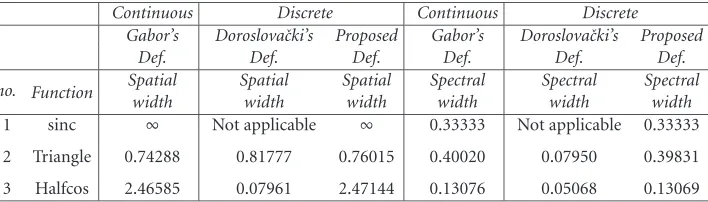
Table 2.1. Comparison of spatial and spectral widths.
Continuous Discrete Continuous Discrete Gabor’s Doroslovaˇcki’s Proposed Gabor’s Doroslovaˇcki’s Proposed
Def. Def. Def. Def. Def. Def.
no. Function Spatialwidth Spatialwidth Spatialwidth Spectralwidth Spectralwidth Spectralwidth
1 sinc ∞ Not applicable ∞ 0.33333 Not applicable 0.33333
2 Triangle 0.74288 0.81777 0.76015 0.40020 0.07950 0.39831
3 Halfcos 2.46585 0.07961 2.47144 0.13076 0.05068 0.13069
Uncertainty inequality—continuous version: 1
Ef ∞
−∞x
2f(x)2dx 1 2πEf
∞
−∞ω
2F(ω)2dω≥1
4. (2.19)
Uncertainty inequality—discrete version:
1 2πEf
π
−π cos
ω
2
F(ω)
2dω 1
2πEf π
−π4 sin 2ω
2
F(ω)2dω
≥1 4.
(2.20) See [10] for the proofs.
Remarks. (i) The choice ofB(ω) based on the convolution-invariance condition does not seem to be clear.
(ii) It is also not clear why the convolution-invariance property of the optimal func-tions is chosen while the optimal function in the continuous-space case (Gaussian) has other properties as well.
(iii) InTable 2.1, numerical values of effective widths computed for various bandlim-ited functions, using the definitions given in (2.14) and (2.15), have been given. It is found that the uncertainty inequalities for the continuous- and discrete-space cases are inconsistent in the sense described in the last sentence ofSection 1, item (1).
(iv) The restriction on the spectra of the continuous and discrete functions is that they should be absolutely continuous. However, the sinc-function (sin(πx)/πx) has a discon-tinuous spectrum, while the discreteδ[n] has a continuous spectrum. Therefore, in this case, it appears that Doroslovaˇcki’s definitions cannot be applied.
3. Proposed approach
Let{f[n]}n∈Zdenote the samples obtained by sampling uniformly a bandlimited signal
f(x) with the sampling intervalX. Also, let the Fourier transform F(ω) of the signal satisfy the condition
F(ω)=0, ∀|ω| ≥σ. (3.1)
Assuming that the sampling intervalXsatisfies the conditionX < π/σ, the original signal f(x) can be reconstructed from its samples using the standard interpolation formula
f(x)= n∈Z
f(nX)g(x−nX), g(x)=sin((π/X)x)
(π/X)x . (3.2)
When we try to express the Heisenberg inequality directly in terms of the samples of a bandlimited signal, it is found that the standard interpolating sinc-function is inappro-priate even though it does the job of interpolation perfectly. The difficulty in invoking the same function to achieve our goal (of computing the space-bandwidth product directly from the samples) arises from the nondifferentiability property of the spectrum (which is the ideal lowpass filter) of the sinc-function. Note that differentiability of the spectrum of the sinc-function is needed in expressing the effective spatial width of the signal. See (3.10) for the expression related to the effective spatial width of the signal in terms of its samples. The evaluation of the integral on the right-hand side of (3.10) leads to compu-tation of the derivative of the spectrum of the sinc-function.
The main contribution of the paper is the refinement of the sinc-function in order to compute the lower bound on the uncertainty of a bandlimited signal in terms of its dis-crete samples. It should be noted here that we have not altered the sampling definition. We have only modified the interpolating function, without affecting the reconstruction of the original signal. In what follows, we first compute the effective spectral width of the signal in terms of its samples, and then consider the problem of expressing its effective spatial width by refining the sinc-function.
3.1. Refinement of the sinc-function. Without any loss of generality, we assume that the signal has unit energy and is centered. The effective widths of the signal (continuous) in the spatial and frequency domains are defined by (1.2) and (1.3). Since the signal is bandlimited (σ < π/X), the lower and upper limits of the integrals in (1.3) can be replaced by−π/Xandπ/X, respectively.
The discrete-space Fourier transformFd(Ω) for the discrete samples{f[n]}n∈Zis
de-fined by (2.1). It can be shown thatFd(Ω) andF(ω) are related by
Fd(Ω)= 1
XF(ω), ∀|ω| ≤ π
X. (3.3)
Using the above relation, and substitutingΩ=ωXin (1.3), we get
Δω 2
= 1 2π
π
−π Ω
X 2
X2Fd(Ω)2dΩ X
= 1
2πX π
−πΩ 2F
d(Ω) 2
dΩ.
Using (2.1), we can express|Fd(Ω)|2in terms of the samples as
Fd(Ω)2 =
m∈Z
f[m] exp(−jΩm)
n∈Z
f[n] exp(−jΩn) ∗
= m∈Zn∈Z
f[m]f[n] expjΩ(m−n),
(3.5)
where the superscript∗denotes complex conjugate. Use (3.5) in (3.4) to get
Δω 2 = 1 2πX π
−πΩ 2
m∈Zn∈Z
f[m]f[n] expjΩ(m−n)dΩ. (3.6)
Assuming that the double summation inside the integral of (3.6) converges uniformly for allΩ, we rewrite (3.6) as
Δω 2
= 1
2πXm∈Zn∈Zf[m]f[n] π
−πΩ
2expjΩ(m−n)dΩ. (3.7)
It can be shown that the above expression for the effective spectral width of f(x) can be expressed in terms of its samples:
Δω 2 = π −π
ωF(ω)2
dω= 1 2πX
2π3
3 n∈Zf 2[n] +
m∈Zn∈Z
m=n
4π(−1)(m−n)
(m−n)2 f[m]f[n]
.
(3.8) The effective spatial width of the signal is defined in (1.2) from which, by using (3.2) in the general form (i.e., for a general interpolating function,g(x)), we get
Δx 2 = ∞ −∞ x m∈Z
f(mX)g(x−mX)
x n∈Z
f(nX)g(x−nX)
dx
= ∞
−∞m∈Zn∈Zx f(mX)g(x−mX)x f(nX)g(x−nX)dx.
(3.9)
Interchanging the order of summation and integration (assuming uniform conver-gence of the summation) in the above equation, we get
Δx 2
= m∈Zn∈Z
∞
−∞f(mX)xg(x−mX)f(nX)xg(x−nX)dx
= m∈Zn∈Z
f(mX)f(nX) ∞
−∞xg(x−mX)xg(x−nX)dx.
The integral (on the right-hand side of (3.10)) inside the summation can be evaluated as follows. LetG(ω) denote the Fourier transform ofg(x). The Fourier transform of (g− nX) is given byG(ω) exp(−jωnX). If we employ, as it is done in the standard literature, the sinc-function forg(x), the integral of (3.10) cannot be evaluated. Therefore, we impose the following restrictions onG(ω).
(1) It must be real and differentiable in the interval (−σ−,σ+), whereis a posi-tive number (as small as possible) such that< π/X−σ. Note that this condition onis mandatory for perfect reconstruction.
(2)G(σ)=X,G(σ+)=0,G(−σ)=X,G(−σ−)=0. (3) dG(ω)/dω|σ=0, dG(ω)/dω|−σ=0.
(4)G(ω)=X, a constant in the interval (−σ,σ).
We call the above four restrictions “smoothness conditions” onG. There are many ways of selectingG(ω), one of which is the following function:
G(ω)= ⎧ ⎪ ⎪ ⎪ ⎪ ⎪ ⎪ ⎪ ⎪ ⎪ ⎪ ⎨ ⎪ ⎪ ⎪ ⎪ ⎪ ⎪ ⎪ ⎪ ⎪ ⎪ ⎩ X 2 cos π(ω
+σ)
+ 1
, −σ−≤ω <−σ,
X, −σ≤ω≤σ,
X 2
cos
π(ω−σ)
+ 1
, σ < ω≤σ+,
0, elsewhere.
(3.11)
SeeFigure 3.1for a sketch ofG(ω). With respect to this choice of the interpolating function, we note the following.
(i) The signal is not modified by redefining the domain of the interpolating function. The extension of the domain (of the interpolating function) has been done in order to compute the integrals involving squares ofxg(x−nX) as the integrand. (ii) The modified interpolation function performs not only perfect reconstruction but also facilitates computation of effective space width. Therefore, we compute the effective space width of the original signal itself, and not of a modified signal. (iii) The tapered cosine (Tukey) window [13], which is used in the design of FIR fil-ters, also has a profile similar toG(ω) above. However, it is to be noted that we use G(ω) for an entirely different purpose—that of reconstructing the bandlimited signal from its samples.
And the other possibleGfunction is as follows:
G(ω)= ⎧ ⎪ ⎪ ⎪ ⎪ ⎪ ⎪ ⎪ ⎪ ⎪ ⎪ ⎨ ⎪ ⎪ ⎪ ⎪ ⎪ ⎪ ⎪ ⎪ ⎪ ⎪ ⎩ X 1− 2
2(ω+σ) 3− 3
2(ω+σ) 2
, −σ−≤ω <−σ,
X, −σ≤ω≤σ,
X
1 + 2
3(ω−σ) 3− 3
2(ω−σ) 2
, σ < ω≤σ+,
0, elsewhere.
G(ω)
−σ− −σ σ σ+
[image:11.468.135.334.74.193.2]ω
Figure 3.1. A (rough) sketch ofG(ω).
SinceG(ω) is now differentiable, the Fourier transformH1(ω) ofxg(x−nX) is given by
H1(ω)=j d dω
G(ω) exp(−jωnX)
=jdG(ω)
dω exp(−jωnX) +nXG(ω) exp(−jωnX).
(3.13)
Similarly,H2(ω), the Fourier transform ofxg(x−mX), is given by
H2(ω)=jdG(ω)
dω exp(−jωmX) +mXG(ω) exp(−jωmX). (3.14) Using (3.13) and (3.14), the integral (3.10) can be rewritten as
∞
−∞xg(x−mX)xg(x−nX)dx=
1 2π
∞
−∞H1(ω)H ∗
2(ω)dω. (3.15)
The integrand on the right-hand side of (3.15) can be written as
H1(ω)H2∗(ω)
=
j(m−n)XG(ω)dG(ω)
dω + (mX)(nX)G(ω) 2
+dG(ω) dω
2expjω(m−n)X
I1 I2 I3.
(3.16)
Let the integrals involving the first, second, and third terms above be denoted byI1,I2,I3, respectively. The first integral can be simplified (by using the method of integration by parts) to
I1=1 2
σ+
−σ−j(m−n)Xexp
Further simplification yields
I1=1
2j(m−n)X
G(ω)2expjω(m−n)Xσ−+σ−
− σ+
−σ−j(m−n)X
G(ω)2
expjω(m−n)Xdω
.
(3.18)
SinceG(−σ−) andG(σ+) are zero, the first term of (3.18) vanishes. The second term of (3.18) can be further reduced to obtain
I1=1 2(m−n)
2X2 σ+
−σ−
G(ω)2
expjω(m−n)Xdω. (3.19)
CombiningI1andI2, we get
I1+I2= σ+
−σ−
1 2(m−n)
2+mn
X2G(ω)2expjω(m−n)Xdω
=
m2+n2
2 X
2 σ+
−σ−
G(ω)2
expjω(m−n)Xdω.
(3.20)
The integral of (3.20) andI3(both together constituting (3.15)) involve the evaluation of integrals of the forms
A= σ+
−σ−
G(ω)2
expjω(m−n)Xdω,
B= σ+
−σ−
dG(ω)dω 2expjω(m−n)Xdω.
(3.21)
The left-hand side of (3.15) can be rewritten as ∞
−∞xg(x−mX)xg(x−nX)dx=
1 2π
m2+n2
2 X
2A+B
, (3.22)
whereAandBare as defined in (3.21).
From (3.11), the derivative ofG(ω) is given by
dG(ω) dω = ⎧ ⎪ ⎪ ⎪ ⎪ ⎪ ⎪ ⎪ ⎪ ⎨ ⎪ ⎪ ⎪ ⎪ ⎪ ⎪ ⎪ ⎪ ⎩ −Xπ 2 sin
π(ω+σ)
, −σ−≤ω <−σ,
−Xπ
2 sin
π(ω−σ)
, σ < ω≤σ+,
0, elsewhere.
The expression forAis given by A=2σX2δ
mn
+X
2(−1)(m−n) 2
sin
(m−n)X
(m−n)X +
sin(m−n)X 2
2(m−n)X
π/2−(m−n)2X2
+X
2(−1)(m−n) 2
⎛ ⎜ ⎝sin
(m−n)X (m−n)X
⎧ ⎪ ⎨ ⎪ ⎩1−
1/2 "
1−(m−n)X/2π2# ⎫ ⎪ ⎬ ⎪ ⎭ ⎞ ⎟ ⎠. (3.24)
The expression forBis given by
B= 1 4
sin(m−n)X (m−n)X
X2π2(−1)(m−n) "
1−(m−n)X/2π2#. (3.25)
The effective spatial width of f(x) in terms of its samples is then given by
Δx2= 1
2πm∈Zn∈Zf(mX)f(nX)
m2+n2
2 X
2A+B, (3.26)
whereAandBare to be obtained from (3.24) and (3.25), respectively. The square of the space-bandwidth product is then the product of the right-hand sides of (3.26) and (3.8) which in combination with (1.5) give the following version of the Heisenberg inequality of a bandlimited signal explicitly in terms of its samples:
Δω 2 Δx 2 = 1
4π2X
2π3 3 n∈Zf
2[n] + m∈Zn∈Z
m=n
4π(−1)(m−n)
(m−n)2 f[m]f[n]
×
m∈Zn∈Z
f[m]f[n]
m2+n2
2 X
2A+B
≥1 4.
(3.27)
3.2. General observations. We have dealt exclusively with the problem of expressing the standard uncertainty inequality for a continuous-time bandlimited (BL) signal in terms of its correctly sampled version. As explained in the introduction, the motivation for this work arose from some apparent paradoxes in the literature on the uncertainty inequal-ity for discrete sequences as applied to sampled BL signals. Moreover, most of the new definitions of discrete uncertainty (in the literature) seem to be ad hoc.
For BL signals whose correct samples are given, there is one-to-one relationship be-tween the discrete-time signal and the continuous version. That is, the standard uncer-tainty inequality (1.5), see page 2, can be recast in terms of the correct samples of the signal in the form (3.27) which is obtained by combining (3.8) with (3.26).
Interestingly, the discrete uncertainty inequality for BL signals has the following struc-ture: Δω 2 Δx 2
fᏭffᏮf≥1
where f is the infinite-dimensional vector of samples; prime denotes transpose; andᏭ, Ꮾare infinite-dimensional matrices. The diagonal elements ofᏭare constant, and the off-diagonal elements are proportional to (−1)(m−n)/(m−n)2 form=n. On the other hand, the diagonal elements ofᏮcontain a constant term and a term proportional to m2; and the off-diagonal elements contain a term proportional to (sinc(m−n)X) along with another proportional to (m2+n2) form=n. The contribution to the off-diagonal elements ofᏮfromAandB, see (3.24) and (3.25), depends on, and it tends to 0 as the number of terms tends to∞.
In this context, if we examine the definitions, in the literature, of discrete uncertainty as applied to general sequences, it is found that none of them possess the structure corre-sponding to matricesᏭandᏮ. This is perhaps one of the reasons for their not reducing to the standard uncertainty inequality as applied to sampled BL signals.
The above interpretation prompts casting of the uncertainty problem for general dis-crete sequences f[n] forn=0, 1,. . .,N−1 as follows.
Problem of uncertainty in discrete signals. Assuming that
N−1
n=0
f[n]2
=1, (3.29)
find the lower bound (if any) on
fᏭffᏮf, (3.30)
where theN-by-NmatricesᏭandᏮhave the following structure.
(1) The diagonal elements ofᏭare 1, and the off-diagonal elements are proportional to (−1)(m−n)/(m−n)2form=n.
(2) The diagonal elements of Ꮾcontain a constant term and a term proportional tom2; and the off-diagonal elements contain a term proportional to (sinc(m− n)X) (whereis a parameter) along with another proportional to (m2+n2) for m=n. The parameterfacilitates generalization of the result to the samples of continuous-time bandlimited signals.
Note that for perfect reconstruction of the bandlimited signal,can be any arbitrary value in the interval (0,π/X−σ) (see the last sentence ofSection 3.1, item (1)). In this structure, the off-diagonal elements ofᏮare to be the limit values (which in this case would be zero) obtained from allowing→0. In addition, a necessary condition for fi-nite spatial width is thatF(±σ)=0. Note that the discrete signal having finite samples still corresponds to a BL signal. If the above, newly defined, discrete uncertainty is to be applicabe to the samples of a general bandlimited signal, thenN→ ∞. A comparison of the result so obtained with the contents of the paper of Donoho and Huo [8] would be quite enlightening.
The choice of the (interpolating function)G does not affect the lower uncertainty bound. The G actually chosen in the paper is merely one out of many interpolating functions that ensure perfect reconstruction, while simultaneously having appropriate smoothness properties. For analytical tractability, some forms ofGseem to be more ad-vantageous than the others, that is, the continuous version of the uncertainty inequality can be easily expressed in terms of the (correct) samples of the BL function. The discrete spreads computed perfectly match with the corresponding continuous ones irrespective of the choice ofG. Note that the standard sinc-function cannot be used in this operation because its effective time- (or space-) spread is∞which is reflected in the nondiff eren-tiability of its transform.
Further, we do not (in this paper) examine the choice of an optimal G which can theoretically be determined by solving the following problem.
Optimal interpolating function. Find aGfunction which obeys the smoothness and ban-dlimitedness conditions on pages 9–10 such that the following product is minimized:
∞
−∞x
2g2(x)dx ∞
−∞ω
2G2(ω)dx
, (3.31)
subject to the constraint thatGis also an interpolating function.
A solution to this problem would give theGfunction with optimal localization prop-erties. However, the discrete version of the uncertainty inequality is still (3.27). There seems to be no need for invoking frame theory currently being used in the literature on wavelet transforms.
A byproduct of our approach (to discrete signal uncertainty as applied to BL signals) is that we can analyze the problem of lower uncertainty bound and the design of discrete-time signals with minimum space-bandwidth product. This work will appear in another paper. On the other hand, as explained above, we can formulate the problem of discrete uncertainty in such a way that when applied to the sampled BL signals, the computed value of the square of the space-bandwidth product, that is, the left-hand side of inequal-ity (3.27), is the same as the left-hand side of (1.5) of the continuous version. SinceGis bandlimited, we can express its effective (spatial and spectral) spreads using its discrete samples. Moreover,Gis an interpolating function for reconstruction of the signal from its discrete samples; and, as a consequence,Gis not merely an analyzing atom like the ones encountered in wavelet or Gabor representation of signals.
From yet another point of view, we can try to find the discrete signal by minimizing uncertainty defined in an appropriate manner (different from what has been presented above). We have also obtained some interesting results in this regard which will be pub-lished separately.
In the next section, we compare the results obtained from an application of (3.27) with those of the literature.
4. Computational results
−0.2
−0.1 0
0.1
0.2
0.3
0.4
M
ag
nitude
−10 −5 0 5 10
[image:16.468.115.351.72.431.2]Time
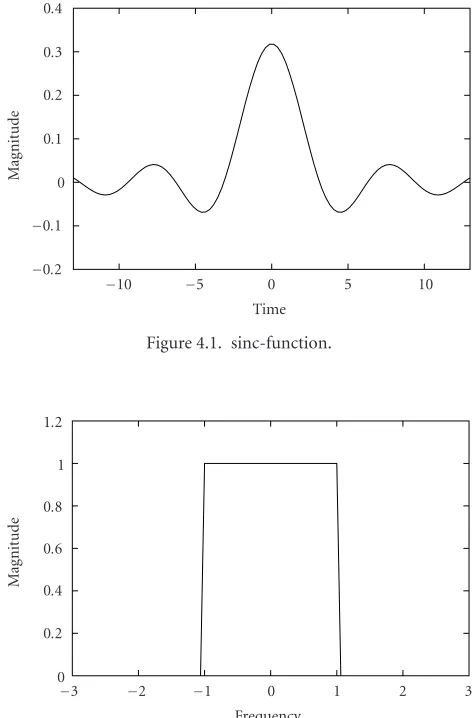
Figure 4.1. sinc-function.
0
0.2
0.4
0.6
0.8
1
1.2
M
ag
nitude
−3 −2 −1 0 1 2 3
Frequency
Figure 4.2. Spectrum of sinc-function.
continuous-space function; and, from the samples, by using (b) Doroslovaˇcki’s defini-tion; and (c) our definitions.
−0.05 0
0.05
0.1
0.15
0.2
0.25
0.3
0.35
M
ag
nitude
−10 −5 0 5 10
[image:17.468.116.355.71.232.2]Time
Figure 4.3. Samples of sinc-function.
−0.1 0
0.1
0.2
0.3
0.4
0.5
0.6
0.7
M
ag
nitude
−10 −5 0 5 10
Time
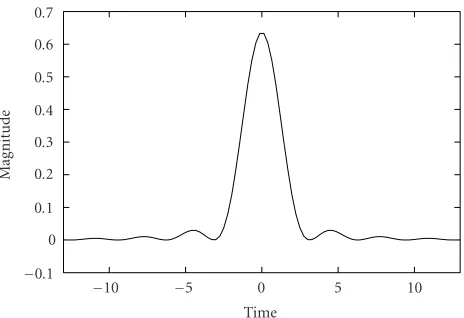
Figure 4.4. sinc-square function.
It is to be observed here that there is a discrepancy between the correct value of the effective spatial and spectral widths (directly computed from (1.2) and (1.3) for the orig-inal, bandlimited continuous signal) and the results of Doroslovaˇcki for the sampled ver-sion of the same signal. In contrast with this, the proposed technique gives exactly (except for numerical errors in digitization) the same effective spreads, and hence the same un-certainty product when the samples of the signals are used. Note that the products are greater than the lower limit 1/4 for normalized signals.
5. Optimal bandlimited signals
[image:17.468.120.352.278.437.2]0
0.5
1
1.5
2
M
ag
nitude
−3 −2 −1 0 1 2 3
[image:18.468.117.352.71.226.2]Frequency
Figure 4.5. Spectrum of sinc-square function.
0
0.1
0.2
0.3
0.4
0.5
0.6
0.7
M
ag
nitude
−20 −10 0 10 20
[image:18.468.118.350.269.449.2]Time
Figure 4.6. Samples of sinc-square function.
Table 4.1. Uncertainty product for various signals of unit energy.
Continuous Discrete
Gabor’s Def. Doroslovaˇcki’s Def. Proposed Def. no. Function Uncertainty product Uncertainty product Uncertainty product
1 sinc ∞ Not applicable ∞
2 Triangle 0.29730 0.06501 0.30278
3 Halfcos 0.32245 0.00403 0.32302
[image:18.468.52.419.511.580.2]−0.05 0
0.05
0.1
0.15
0.2
0.25
M
ag
nitude
−10 −5 0 5 10
[image:19.468.116.354.71.233.2]Time
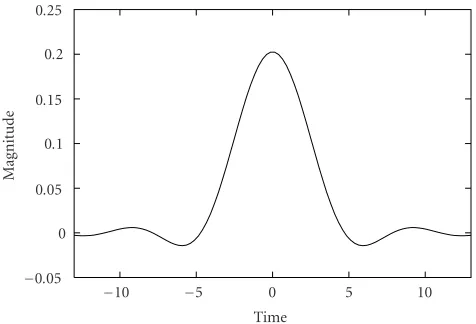
Figure 4.7. Halfcos continuous function.
0
0.2
0.4
0.6
0.8
1
1.2
M
ag
nitude
−3 −2 −1 0 1 2 3
[image:19.468.122.352.268.428.2]Frequency
Figure 4.8. Halfcos spectrum.
Using (1.2) and the properties of Fourier transform, it can be shown that the eff ec-tive spatial width is finite only if|dF(ω)/dω|is square integrable. Therefore, for f ∈Ꮾ, we require thatF(ω) have finite derivatives at ω=W andω= −W (i.e., at bandlimit points). We now provide a solution (to the above problem) based on a modification of the Gaussian function. Let
F(ω)=Φ(ω)G(ω), (5.1)
where
Φ(ω)=Cexp
−ω2 2σ2
, (5.2)
−0.05 0
0.05
0.1
0.15
0.2
0.25
0.3
0.35
M
ag
nitude
[image:20.468.116.353.71.234.2]−30 −20 −10 0 10 20 30 Time
Figure 4.9. Halfcos discrete function.
Table 5.1. Convergence of uncertainty product using cosine interpolation function with=0.1 and
W=π.
no. σ Product
1 2.0 1.19870
2 1.8 0.74649
3 1.7 0.57802
4 1.5 0.36008
5 1.3 0.27172
6 1.0 0.25026
7 0.9 0.25002
8 0.8 0.25000
9 0.7 0.25000
10 0.5 0.25000
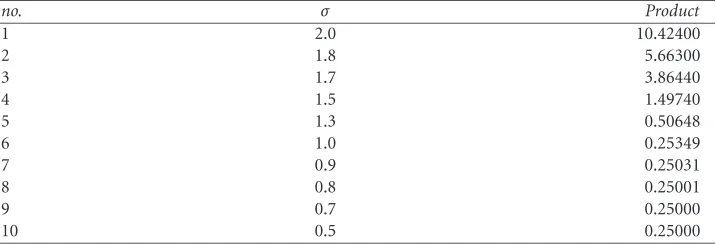
With this choice of the functions on the right-hand side of (5.1),F(ω) is a bandlim-ited function, with (a) the bandlimitW+; (b)F(ω)=0, for all|ω| =W+; and (c) F(ω) differentiable everywhere. Tables5.1 and5.2give the numerical values of SBP of f for various values ofσ. Note that there is a sequence of bandlimited functions whose SBP approaches the lower bound in (1.5) for a given bandwidthWand. It should be emphasized that these results are purely computational, and an analytical solution to the problem under consideration seems to be unknown.
Remarks. (1) The equality in (1.5) is attained only by the Gaussian function, which is not bandlimited. Therefore, any bandlimited function has an SBP strictly greater than 1/4.
[image:20.468.57.414.312.435.2]Table 5.2. Convergence of uncertainty product using cosine interpolation function with=0.01 and
W=π.
no. σ Product
1 2.0 10.42400
2 1.8 5.66300
3 1.7 3.86440
4 1.5 1.49740
5 1.3 0.50648
6 1.0 0.25349
7 0.9 0.25031
8 0.8 0.25001
9 0.7 0.25000
10 0.5 0.25000
6. Conclusions
We have described some of the existing definitions for the spatial and spectral spreads for discrete signals, and showed that for bandlimited signals, they do not correspond to the standard definitions of spatial and spectral widths in the continuous domain. A new approach has been proposed to overcome this limitation and to express the original Heisenberg inequality in terms of the samples of the bandlimited signal.
An unsolved problem is the determination of a bandlimited signal for which the SBP (obtained by multiplying the effective widths defined by (1.2) and (1.3)) is minimal. A possible approach to solve this problem is the representation of a general bandlimited signal as linear combination of prolate spheroidal functions as a basis [15, pages 205– 215].
Acknowledgment
The authors wish to express their grateful thanks to the reviewers and to the Editor-in-Chief for their valuable remarks, suggestions, and questions which have led to the present improved version.
References
[1] L. C. Calvez and P. Vilbe, On the uncertainty principle in discrete signals, IEEE Transactions on Circuits and SystemsPart II: Analog and Digital Signal Processing 6 (1992), no. 39, 394–395. [2] S. Dahlke and P. Maass, The affine uncertainty principle in one and two dimensions. Concrete
analysis, Computers & Mathematics with Applications 30 (1995), no. 3–6, 293–305.
[3] L. Debnath (ed.), Wavelet Transforms and Time-Frequency Signal Analysis, Applied and Numer-ical Harmonic Analysis, Birkh¨auser Boston, Massachusetts, 2001.
[4] L. Debnath, Wavelet Transforms and Their Applications, Birkh¨auser Boston, Massachusetts, 2002.
[5] L. Debnath (ed.), Wavelets and Signal Processing, Applied and Numerical Harmonic Analysis, Birkh¨auser Boston, Massachusetts, 2003.
[7] A. Dembo, T. M. Cover, and J. A. Thomas, Information-theoretic inequalities, IEEE Transactions on Information Theory 37 (1991), no. 6, 1501–1518.
[8] D. L. Donoho and X. Huo, Uncertainty principles and ideal atomic decomposition, IEEE Transac-tions on Information Theory 47 (2001), no. 7, 2845–2862.
[9] D. L. Donoho and P. B. Stark, Uncertainty principles and signal recovery, SIAM Journal on Ap-plied Mathematics 49 (1989), no. 3, 906–931.
[10] M. I. Doroslovaˇcki, Product of second moments in time and frequency for discrete-time signals and
the uncertainty limit, Signal Processing 67 (1998), no. 1, 59–76.
[11] M. I. Doroslovaˇcki, H. Fan, and P. M. Djuric, Time-frequency localization for sequences, Proceed-ings of the IEEE-SP International Symposium on Time-Frequency and Time-Scale Analysis, Victoria, British Columbia, 1992, pp. 159–162.
[12] G. B. Folland and A. Sitaram, The uncertainty principle: a mathematical survey, The Journal of Fourier Analysis and Applications 3 (1997), no. 3, 207–238.
[13] F. J. Harris, On the use of windows for harmonic analysis with the discrete Fourier transform, Pro-ceedins of IEEE 66 (1978), no. 1, 51–83.
[14] R. Ishii and K. Furukawa, The uncertainty principle in discrete signals, IEEE Transactions on Circuits and Systems 33 (1986), no. 10, 1032–1034.
[15] A. Papoulis, Signal Analysis, McGraw-Hill, New York, 1968.
[16] T. Przebinda, V. DeBrunner, and M. ¨Ozaydin, Using a new uncertainty measure to determine
opti-mal bases for signal representations, Proceedings of IEEE International Conference on Acoustics,
Speech, and Signal Processing, vol. 3, Arizona, 1999, pp. 1365–1368.
[17] , The optimal transform for the discrete Hirschman uncertainty principle, IEEE Transac-tions on Information Theory 47 (2001), no. 5, 2086–2090.
Y. V. Venkatesh: Computer Vision and Artificial Intelligence Laboratory,
Department of Electrical Engineering, Indian Institute of Science, Bangalore 560012, India
Current address: Department of Electrical and Computer Engineering, Faculty of Engineering,
National University of Singapore, Singapore 117576
E-mail address:[email protected]
S. Kumar Raja: Computer Vision and Artificial Intelligence Laboratory,
Department of Electrical Engineering, Indian Institute of Science, Bangalore 560012, India
E-mail address:[email protected]
G. Vidyasagar: Computer Vision and Artificial Intelligence Laboratory,
Department of Electrical Engineering, Indian Institute of Science, Bangalore 560012, India