TECHNOLOGICAL APPLICATIONS AND ITS FUNCTIONALITY ON
HCD PRACTICES
Sam Higginbottom Unive rsity of Agriculture, Technology and Sciences
BOOHENE David *- Research Scholar
MAXWELL Amita (PhD) ** - Assistant Professor
ABSTRACT
A common trend in organizations is the leveraging of technology in innovative ways to support
human capital development (Adayana, 2009). This paper examines in order of ranking, the
different technological elements used in supporting the functionality of HCD Practices in the
Indian IT Industry. To realize the above, a sample size of thirty (30) from different IT
corporations in five major IT hubs in India namely Bangalore, Chennai, Hyderabad, Delhi and
Mumbai were used for the study. The results of the study showed that Management information
system followed closely by Mobile communication and Web collaboration respectively appears
to be the most frequently technological application used in supporting the functionality of
Human Capital Development Practices in the IT Industry.
KEY WORDS: Technological applications, HCD Practices, Management information system
ABBREVIATIONS: HCD Practices- Human Capital Development Practices, LMS- Learning
management system.
International Research Journal of Human Resources and Social Sciences ISSN(O): (2349-4085) ISSN(P): (2394-4218)
Impact Factor- 5.414, Volume 4, Issue 7, July 2017
Website- www.aarf.asia, Email : [email protected] , [email protected]
INTRODUCTION
India is seen as a world class destination for Information Technology. According to (Singh,
2006), this scenario is mainly due to the success of India’s software industry and contributions of
people of Indian origin in the global IT revolution. The Indian IT Industry not only has the
potential of contributing to global economic outlook but also serves as a platform for
accelerating economic development in its domestic milieu. Information technology refers to the
digital processing, storage and communication of information of all kinds. According to
(Nirvikar, 2003), the role of IT in services i.e., IT-led services includes the following: Product
support, Process outsourcing, Hard and Software maintenance, Training & education, IT
outsourcing, System integration & application development. Thus IT can potentially be used in
every sector of the economy.
(Adayana, 2009) defines human capital developme nt as the active balancing of short and
long-term business requirements with the career and professional development needs. The interplay
and interdependence of technology is essential for any growing organization. This study looks at
the leveraging role of technological applications on the functionality of HCD Practices
PROBLEM STATEMENT
According to (Adayana, 2009) different technological components can be used alone or in
combination to support a wide variety of human development functionality. However the order
of significance with respect to the role played by different technological applications on human
development was not examined in detail. This paper examines in order of ranking, the different
technological elements used in supporting the functionality of HCD Practices in the Indian IT
Industry.
OBJECTIVE OF STUDY
1. To examine the different technological components used in supporting the functionality
of Human Capital Development Practices.
HYPOTHESIS
Ho: There is no significant difference in the type of technological applications used in the
H1: There is a significant difference in the type of technological applications used in the
functionality of HCD Practices in the Indian IT Industry.
REVIEW OF LITERATURE
According to (R. Indradevi, 2010), recruitment, training, counseling and mentoring,
empowerment, and performance appraisal are the perceived HCD Practices of Indian software
companies. His study also identified a significant difference in the perception of employees on
the human capital development practices among the selected organizations.
(Rastogi, 2000) focused on human capital as the ultimate resource for sustaining the competitive
performance of an organization over time. According to Rastogi, human capital organization is
characterized as a storehouse of business expertise; a growing pool of cutting edge competencies,
skills, best practices, techniques, and tools; a collaborative collectivity of autonomous and peak
performing employees; and exemplar of speed and brain power in all domains of its activity; an
agile player responding rapidly to market shifts; and a bearer of a culture of constant innovation
and value creation.
(Adayana, 2009) postulates that organizations use a combination of new and traditional
approaches in many different disciplines (eg., strategy, communications, instructional design,
and performance support.). They go further to say that, a common trend to many clients is the
leveraging of technology in innovative ways to support human capital development.
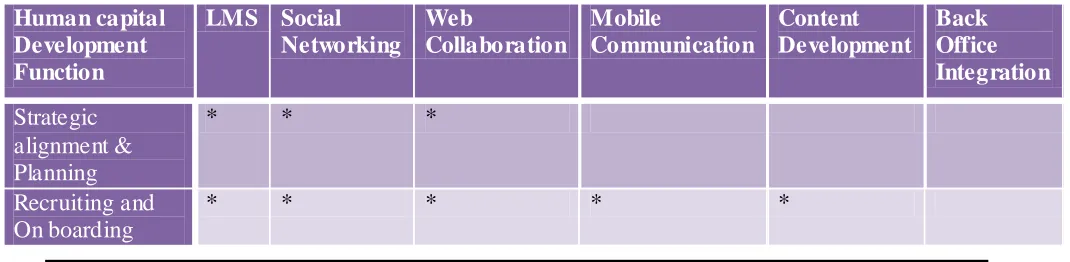
Below is an optimizing table showing the different technological components used in supporting
[image:3.612.48.583.563.694.2]the functionality of human capital development.
Table 1- Application of Technology to Human Capital Development
Human capital Development Function
LMS Social Networking
Web
Collaboration
Mobile
Communication
Content Development
Back Office Integration
Strategic alignment & Planning
* * *
Recruiting and On boarding
Performance management
* * * * *
Succession Planning
* * *
Competencies & Job Task
Analysis
* * *
Continuous learning
* * * * * *
Source: (Adayana, 2009)
METHODOLOGY
The study is mainly descriptive in nature. Primary data was collected from thirty (30) HR
personnels in different IT corporations from five major IT hubs in India. Seco ndary data was
relied on for a thorough literature review. Stratified sampling technique was used in collecting
data for the study.
FINDINGS
Test Statisticsa
N 30
Chi-Square 87.672
Df 5
Asymp.
Sig. .000
a. Friedman Test
The outcome of the Friedman test statistic point toward high significant differences in the
responses of employers from the thirty (30) IT firms on the technological applications used in
supporting the functionality of Human Capital Development Practices. Thus since the P-value
(0.000) is less than the significance level of (0.05) we cannot accept the null hypothesis,
consequently we conclude that there is a significant difference in the technological applications
Table.2
Descriptive Statistics
N Mean
Std.
Deviation Minimum Maximum
Learning management system 30 4.6333 .71840 4.00 6.00
Social networking 30 5.1667 .83391 4.00 6.00
Web collaboration 30 2.8667 1.50249 1.00 5.00
Mobile communication 30 2.6000 1.00344 1.00 4.00
Management information system 30 1.4333 .62606 1.00 3.00
Back office integration 30 4.2333 1.63335 2.00 6.00
From Table 2 above the Std Dev values shows how the individual responses for each
technological component are close to their corresponding mean values. From the statistical table
above management information system is closest to their corresponding mean values among the
six (6) technological applications. For instance comparing Std Dev for management information
system to its corresponding mean, the difference or deviation is (0.62606). Thus the Std. Dev for
management information system provides a more valuable descriptive measure in relation to its
corresponding mean as per the six (6) IT applications under study. Back office integration
appears to be the most openly distributed from the mean values among the six (6) technological
applications as individual respondents on average were (1.63335) point away from their
corresponding mean.
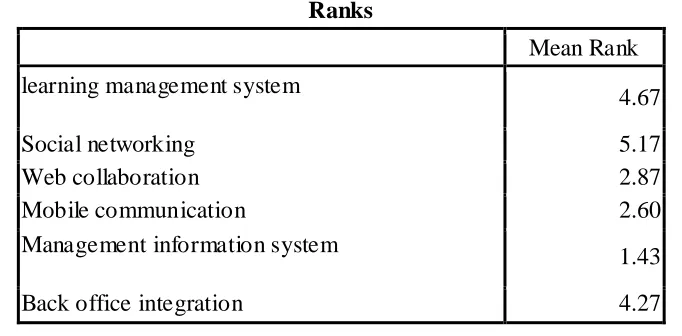
Table 3. Mean Rank (Technological applications)
Ranks
Mean Rank
learning management system
4.67
Social networking 5.17
Web collaboration 2.87
Mobile communication 2.60
Management information system
1.43
[image:5.612.126.467.485.653.2]From Table 3 above, Management information system followed closely by Mobile
communication and Web collaboration respectively appears to be the most frequent ly
technological application used in supporting the functionality of Human Capital Development
Practices in the IT Industry as per this study. This is seen from their low mean value of (1.43) for
management information system which is the most frequently used application for enhancing
HCD Practices. The average values are low for management information system as a result of
low numeric values for high scores; one (1) was interpreted as highest and five (5) is interpreted
as lowest on the Likert scale. The mean values for mobile communication and web collaboration
are (2.60) and (2.87) respectively.
Table 4. Application of Technology to functionality of Human Capital Development Practices
Source: Researchers survey (Boohene, D. & Maxwell, A., 2017)
Table 4 shows the different technological applications that are mainly used for the functionality
of HCD Practices in the Indian IT Industry as per the mean rank figures displayed in Table 3.
The number of stars (*) indicates the degree or extent to which a particular IT application is used
in enhancing the functionality of HCD Practices in the Indian IT sector. From Table 4,
Management information system has the highest number of stars (*) indicating that to a large
extent management information system is mostly used in the functionality of HCD Practices
where as Social networking has the least number of stars (*).
CONCLUSION
There is a significant difference in the technological applications used in the functionality of
HCD Practices in the Indian IT Industry. Again Management information system followed
Technological elements (Applications) Human Capital Development Practices
Learning management system * *
Social networking *
Web collaboration * * * *
Mobile communication * * * * *
Management information system * * * * * *
closely by Mobile communication and Web collaboration respectively appears to be the most
frequently technological application used in supporting the functionality of Human Capital
Development Practices in the IT Industry as per the findings of this study.
REFERENCES
R. Indradevi (2010), A study on human capital development practices and its impact on
employee capability, IJRJSM ISSN: 2010-457X
Singh Nirvikar (2002), “Information Technology as an Engine of broad based Growth in India” in edited book entitled the Knowledge Economy in India by Frank-Jurgen Richter
and Parthasarathi Banerjee.
Adayana (2009), Optimizing human capital development
Singh, S.K (2006), Information Technology in India: Present status and future prospects
for Economic Development.
Rostagi, P.N (2000). Sustaining enterprise competitiveness- is human capital the answer?