Citation:
Chang, V (2013) Brain Segmentation ? A Case study of Biomedical Cloud Computing for Education and Research. In: Learning Technologies Workshop, Higher Education Academy (HEA), University of Greenwich.
Link to Leeds Beckett Repository record: http://eprints.leedsbeckett.ac.uk/728/
Document Version:
Conference or Workshop Item
The aim of the Leeds Beckett Repository is to provide open access to our research, as required by funder policies and permitted by publishers and copyright law.
The Leeds Beckett repository holds a wide range of publications, each of which has been checked for copyright and the relevant embargo period has been applied by the Research Services team.
We operate on a standard take-down policy. If you are the author or publisher of an output and you would like it removed from the repository, please contact us and we will investigate on a case-by-case basis.
Brain Segmentation – A Case study of Biomedical
Cloud Computing for Education and Research
Victor Chang
Leeds Metropolitan University (and University of Southampton)
School of Computing and Creative Technologies, Leeds
Metropolitan University, Headingley, Leeds LS6 3QS [email protected] http://www.leedsmet.ac.uk/resea
rch/victor-chang.htm
Abstract
Medical imaging is widely adopted in Hospitals and medical institutes, and new ways to improve existing medical imaging services are regularly exploited. This paper describes the adoption of Cloud Computing is useful for medical education and research, and describes the methodology, results and lesson learned. A working Bioinformatics Cloud platform can demonstrate computation and visualisation of brain imaging. The aim is to study segmentation of brains, which divides the brain into ten major regions. The Cloud platform has these two functions: (i) it can highlight each region for ten different segments; and (ii) it can adjust intensity of segmentation to allow basic study of brain medicine. Two types of benefits are reported as follows. Firstly, all the medical student participants are reported to have 20% improvement in their learning satisfaction. Secondly, 100% of volunteer participants are reported to have positive learning experience.
Keywords
Brain Segmentation; Medical Cloud Computing Education (MCCE); Cloud Computing Brain Segmentation Technology (CCBST).
1.
Introduction
Cloud adoption. Chang et al (2011 a; 2011 b; 2011 c; 2012 a; 2012 b; 2013 a; 2013 b; 2013 c) have demonstrated case studies and successful deliveries for Healthcare, Finance and Education domains. Due to the fusion between Healthcare Cloud Computing and Education, it has become increasingly important for medical scientists and educators to use Cloud Computing (Chang et al., 2013 a; 2013 c). As a result, more universities have adopted Cloud Computing for education and research purposes, and there are case studies supported by NHS, King’s College’s London and the University of Oxford (Chang et al., 2013 b). Within medical Cloud Computing, there are interests for inter-disciplinary investigations between (a) learning satisfaction and brain response and (b) learning difficulties and brain response.
The advancement in technologies and improvements in learning strategies can greatly influence the way that medical education is moved forward. New and innovative ways for medical education is required to be continuously dynamic and forward-thinking. To fulfil this long-term vision, this paper presents an innovative case study for blending both medical research and education, with an emphasis in brain segmentation. The objective is to study how human brain responds while recapturing a skill that has been learned some time ago in an interactive and motivated environment offered by Cloud Computing. Data collection for medical students and volunteers are conducted and analysed for discussions.
2.
Medical Imaging
Medical imaging is widely adopted in Hospitals and medical institutes, and new ways to improve existing medical imaging services are regularly exploited. Chang et al (2012 a; 2013 b; 2013 c) report that pioneering biomedical Cloud platforms have been implemented and serviced at the NHS, which allows scientists to conduct advanced research, exchange thousands of data and backup securely at different sites through the use of private cloud technologies. There are positive impacts for several organisations that adopt Cloud Computing, and there are active scientists using Cloud services on daily basis. It is also reported that more work can be done and Cloud offers a collaborative platform for learning, research, backup and operational activities. Amongst all existing services, brain segmentation is a particular focus with rationale as follows. Firstly, it can enhance teaching, since complex theories can be facilitate with the aid of simulations. Students can understand their lectures much better than without the use of simulations. Secondly, the level of intensity in the brain activities can be presented easily and quickly with the aid of simulations. Each time when a new subject is introduced, the brain reacts differently. Simulations enabled by Cloud Computing can reduce the complexity of presenting brain activities in the learning process by introducing dynamic 3D Visualisation, which is an effective technique demonstrated by Chang et al (2012 a; 2012 b; 2013 b; 2013 c).
2.1 Cloud platform and applications
platform allows computation and visualisation, and currently brain imaging can be used for demonstration. The aim is to study segmentation of brains, which divides the brain into ten major regions. The Cloud platform has these two functions: (i) it can highlight each region for ten different segments; and (ii) it can adjust intensity of segmentation to allow basic study of brain medicine. This platform can be used by medical students to improve the quality of teaching and learning satisfaction amongst students.
2.2 Results of the two medical cohort group
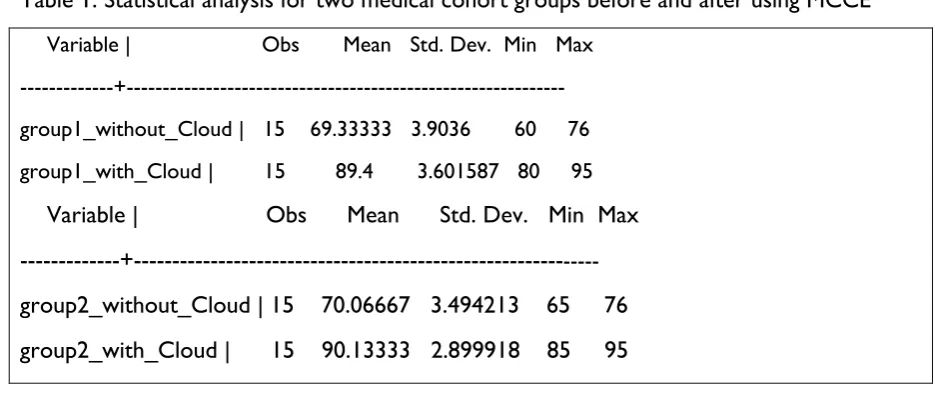
[image:4.595.62.530.424.627.2]There are two medical cohort groups with fifteen in each group. They were introduced the use of Cloud Computing for medical training, and surveys were taken before and after the adoption of Medical Cloud Computing Education (MCCE). Each student has used MCCE for at least three months. The focus of the study was to identify the rate of learning satisfaction before and after the introduction of MCCE. Survey questions were taken and an average score for learning satisfaction was recorded for each student. All the records are undertaken with statistical analysis presented in Table 1. The variable “group1_without_Cloud” indicates learning satisfaction for cohort group one before using MCCE and the variable “group1_with_Cloud” is the variable after using MCCE. Similarly, the variables “group2_without_Cloud” and ““group2_with_Cloud” are the same terminology for cohort group two. Mean is the percentage for learning satisfaction before and after using MCCE. There are 20% improvements in learning satisfaction, which include positive feedback from students taking this pilot study.
Table 1: Statistical analysis for two medical cohort groups before and after using MCCE Variable | Obs Mean Std. Dev. Min Max
---+--- group1_without_Cloud | 15 69.33333 3.9036 60 76 group1_with_Cloud | 15 89.4 3.601587 80 95
Variable | Obs Mean Std. Dev. Min Max ---+---
---group2_without_Cloud | 15 70.06667 3.494213 65 76 group2_with_Cloud | 15 90.13333 2.899918 85 95
3.
Brain segmentation for volunteers
identifying tumours. Often the detections of tumours require MRI scans to confirm, and any pioneering ways of discovery will help scientists to improve the quality of patients’ life in the long term, and reduce the possibility of making errors in the process of treatment and operations (Baillard et al., 2001).
3.1 Set up for Brain Segmentation
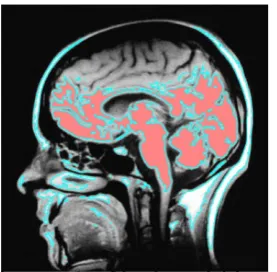
There is another initiative to study the intensity of our human brains while recapturing a skill that has not been used for two years. That skill would ideally involve with movements which needs a greater coverage of neurone activities and co-ordination in the brain so that it is easier to capture the brain activities. While using highly-sophisticated equipment is an expensive option, the use of Cloud Computing Brain Segmentation Technology (CCBST) offers cost-saving yet a dynamic, interactive and flexible option for research. Two groups of volunteers with eight in a group were asked to dance in this study and all of them did not dance for two years at least. Each person had attached an electronic device to record their brain activity. CCBST then collected all the data, calculated the average on brain segmentation and drew out the brain activities as a collective result. Results are presented in 3D Visualisation where the more intense the visualisation is, the more activities the brain have undertaken during the dance sessions. 100% of volunteers are reported to have positively increased in their brain activities while recapturing their dancing skills. Results are presented in the next section.
[image:5.595.172.311.432.568.2]3.2 Results and Discussions for Brain Segmentation
Figure 1: The collective result of brain activities while recapturing dancing skills
steady movements. The areas that represent the emotions are not so obvious but still can be seen with some activities.
4.
C
ONCLUSIONCloud Computing Brain Segmentation Technology (CCBST) and Medical Cloud Computing Education (MCCE) are extremely useful for the healthcare scientists to make pioneering research. Added values are presented as follows. Firstly, this improves the efficiency for teaching, as trainee doctors can fully understand their expectations and medical lessons. There are 20% improvements in learning satisfaction and MCCE is strategic and influential to medical education. Secondly, simulations can allow scientists to understand human organs such as brain segmentation. Scientists can understand how volunteers learn and their reactions to the brain, particularly the human brain activities while recapturing a skill such as dancing. 100% of volunteer participants are reported to have positive learning experience. Cloud Computing offers cost-effective and innovative way to deliver education and research while maintaining a high level of quality of work for education, research and technology as demonstrated in these two cases.
5.
References
Baillard, C., Hellier, P. and Barillot, C., Segmentation of brain 3D MR images using level sets and sense registration, Medical Image Analysis (5), page 185-194, 2001.
Chang, V., Bacigalupo, D., Wills, G. and De Roure, D. (2010) A Categorisation of Cloud Computing Business Models. In: CCGrid 2010, The 10th IEEE/ACM International Symposium on Cluster, Cloud and Grid Computing, May 17-20, Melbourne, Australia. pp. 509-512 (Chang et al., 2010 a).
Chang, V., Wills, G. and De Roure, D. (2010) A Review of Cloud Business Models and Sustainability. In: IEEE Cloud 2010, the third International Conference on Cloud Computing, 5-10 July, 2010, Miami, Florida, USA (Chang et al., 2010 b).
Chang, V., Li, C. S., De Roure, D., Wills, G., Walters, R. and Chee, C. (2011) “The Financial Clouds Review. International Journal of Cloud Applications and Computing”, 1 (2). pp. 41-63. ISSN 2156-1834, eISSN 2156-1826 (Chang et al., 2011 a)
Chang, V., De Roure, D., Wills, G., Walters, R. and Barry, T. (2011) “Organisational Sustainability Modelling for Return on Investment: Case Studies presented by a National Health Service (NHS) Trust UK”. Journal of Computing and Information Technology, 19 (3). ISSN Print ISSN 1330-1136 | Online ISSN 1846-3908 (Chang et al., 2011 b)
Chang, V., De Roure, D., Wills, G. and Walters, R. (2011) Case Studies and Organisational Sustainability Modelling presented by Cloud Computing Business Framework, International Journal of Web Services Research. ISSN 1545-7362 (Chang et al., 2011 c)
Chang, V., Wills, G., Walters, R. and Currie, W., edited by Hu, W.C and Kaabouch, N.,, “Towards a structured Cloud ROI: The University of Southampton cost-saving and user satisfaction case studies”, Sustainable Green Computing: Practices, Methodologies and Technologies (Chang et al., 2012 b).
Chang, V. and Wills, G. , edited by Graham, D., Manikas, I., and Folinas, D. K., (2013) A University of Greenwich Case Study of Cloud Computing – Education as a Service. In, E-Logistics and E-Supply Chain Management: Applications for Evolving Business, IGI Global (Chang et al., 2013 a).
Chang, V., Walters, R. J. and Wills, G. (2013), “The development that leads to the Cloud Computing Business Framework”, International Journal of Information Management, February, 2012 (Chang et al., 2013 b)