FRAMEWORK FOR EMERGENCY EVACUATION SAFETY TRAINING
USING 3D VIRTUAL SIMULATION
Sayli Bhide PhD student
Industrial Engineering and Management Systems University of Central Florida, 32816, USA
Dr. Luis Rabelo Associate Professor
Industrial Engineering and Management Systems University of Central Florida, 32816, USA
ABSTRACT
In light of the recent incidences of horrifying building fires that resulted in loss of not only property but also lives; this paper discusses need of virtual fire safety training for residents, workers and employees. With advancement in technology, building structures are becoming bigger and more complex. Emergency evacuation training can play an important role not only in cases of fire, explosion or chemical spill but also in natural calamities like flood and hurricane. Conventional safety training provided in industries mostly comprises of unidirectional flow of information. Due to this passive learning style, response of employees in real life emergency situations is known to be ineffective. This paper provides an overview on role of 3D virtual simulation based training in emergency evacuation. Further it discusses development of a framework for evacuation safety training to help residents and employees in identifying risks and mitigating them in such situations. Development of 3D virtual environment, perspective of trainee and evaluation of training are identified as three important dimensions that this framework will try to combine.
1. Introduction
On June 7, 2015 fire broke at 14th floor of 21 storied building in Mumbai, India. It claimed life of 7 residents and left 25 residents injured ("Mumbai: 2 fires in Bandra, Powai leave 7 dead, 28 injured ", 2015). Structural fires resulting in loss of life and property damage are reported worldwide every now and then. Some of the examples are - footwear factory in Philippines caught fire which killed 72 workers (Mullen, 2015), Rhode Island nightclub fire resulted in 96 deaths (CNN.com, 2003), fire in 28 story building of Shanghai killing 58 people and injured 70 residents ("Shanghai high-rise fire death toll rises to 58," 2010).
With advancement in technology building structures are becoming taller and more complex. Thus, evacuation of occupants of a building in case of emergency situations that involve not only fire but also natural disasters like flood, hurricane, etc. has become a global issue. Many civilian building residents lose their lives because they are not aware of the dos and don’ts of emergency situations. Residents as well as employees need to be trained on emergency evacuation. United Nations has urged global action to make workplaces safe after the factory accident in Philippines. ("In wake of deadly shoe factory fire in Manila, UN urges global action to make
workplaces safe," 2015)
Though safety training can help reduce rate of illness and injuries, many accidents and unfortunate events are observed to be the outcome of inadequate safety training. Inadequate safety training can be defined as the situation where a) safety training is not provided b) safety training is provided but is not internalized by people and thus not reflected in behavior at workplace environment c) safety training is provided but in ineffective manner (Blair & Seo, 2007). Burke et al. (2006) performed a meta-analysis study of research conducted between 1971 to 2003 in 15 different countries in order to determine relative effectiveness of 3 types of methods used in health and safety training – least engaging (lecture, video), moderately engaging (programmed instructions) and most engaging (hands on or behavior modeling). It was observed that the number of workplace injuries and accidents reduced as the method of training became more engaging.
knowledge that can be retrieved as and when required in future events (Bhide et al., 2015).
Lectures by expert, emails, pamphlets, newsletters and slides seen on personal computers are most common approaches to provide safety training. However, due to unidirectional flow of information, employees involved in such training are not learning actively. Hence, their response to understanding risks and mitigating them in real time workplace emergency situations is not as effective.
Simulation based training (SBT) provides 3 dimensional environment, customizable avatar, real time feedback, capability of interaction and immersion in a risk free manner. Also SBT helps to overcome language barrier and provides environment for practicing skills.
Researchers and industries have identified advantages and important role that virtual simulation based training can play in safety education. However, costs associated with development and implementation of virtual constructive simulation based training is one of the aspects that is affecting its ubiquitous presence in the safety training. Along with the virtual simulation environment and scenario development there are other aspects such as social interaction, evaluation, transfer of training that could play major role in shaping behavior of participants in
case of emergencies. Hence, there is a need for a framework for safety training development that can tie different aspects of simulation based training together to make it a viable option for training residents and workers on emergency evacuation in residential buildings, offices, factories, etc.
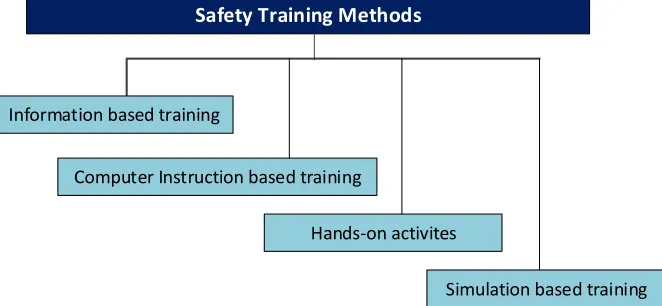
Section 2 describes various methods utilized in providing safety training. Section 3 explains emergency evacuation studies from the literature and next chapter underlines need for development of a framework for safety training using virtual simulations. The preliminary framework is elaborated in chapter 4, followed by conclusion and references.
2. Safety Training methods
Safety Training Methods
Information based training
Computer Instruction based training
Hands-on activites
[image:4.612.141.472.78.231.2]Simulation based training
Figure 1 Safety Training Methods
2.1 Information based training
Information based training is most commonly used method of training where trainer or a subject matter expert conveys information to trainees through lecture in classroom type setting. This
process involves unidirectional flow of information from trainer to trainee (Burke et al., 2006). This training is considered as least engaging mode of training. It is termed as passive learning as it emphasizes more on teaching process rather than leaning process. This safety training is cost effective as multiple people can be trained at one location and most of the cost is associated with trainer. Thus, information based training needs less infrastructure and resources but trainees may not be actively engaged in the learning process.
2.2 Computer instructions based training
This training includes mainly power point slides with some video and audio capabilities to present information in standardized format on desktop computer or personal computer. This training is popular due to convenience and portable nature of providing knowledge to employee. It allows employee to undergo safety training mere using a personal computer irrespective of constraints of time and location. This training method is cost effective but does not involve interaction and engagement. Thus, safety training received with computer based instruction becomes a passive leaning experience (Bhide et al., 2015).
2.3 Training with hands on activities
(Sinyai, Stafford, & Cpwr, 2013). This training encourages process of reflection or thinking with
respect to actions taken by trainee, thereby strengthening ability of understanding cause-effect relationship between events, developing strategies and making decisions in case of emergency situations (Burke et al., 2006). However, due to age or experience difference, experienced employees may not explain risks associated with job related tasks to new employees assuming some of the hazards are obvious to understand (Laberge et al., 2014). Also, the work related tasks are combination of dynamic and iterative events and employees need to learn multiple methods and apply them according to requirement of a task. However, there is a possibility that peer may make new employee understand only one way of dealing with the hazard.
2.4 Simulation based training
A virtual simulation provides environment for practice, interaction and immediate application of knowledge. SBT allows dynamic decision making, overcomes language barrier, and provides experiential learning in a risk free manner. This provides real time feedback on a specific choice of the learner as well as modifies environment as per all the choices made by the learner.
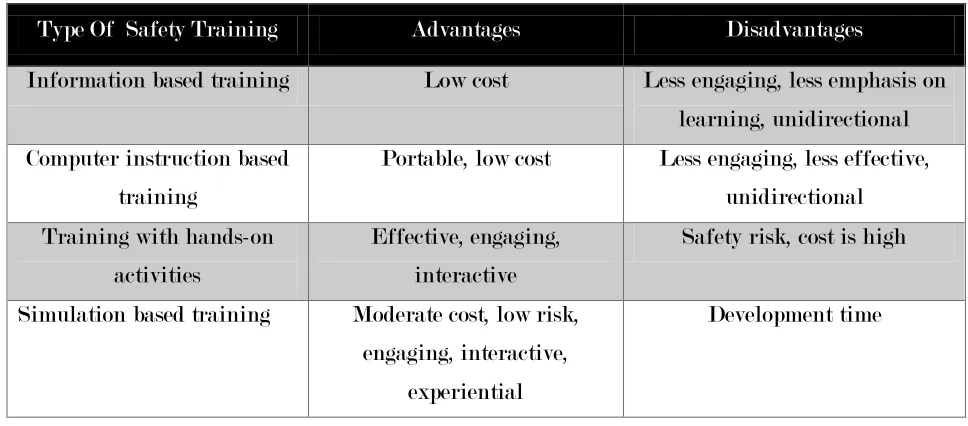
Table 1 Summary of advantages and disadvantages of safety training methods
3. Evacuation Studies
Evacuation simulators are being used to test safety conditions of building in case emergency situation occurs and all the occupants have to leave the building. Stairs, number of exits, width, and physical characteristics of occupants are some of the factors of concern for this simulator. Computational evacuation models do not take into consideration interaction between occupants, effects of fire on building structure and decision making process of individuals. Some simulators are freely available to public such as EVACNET, Simulex, EXODUS, etc.; while some are commercial software like STEPS, EGRESS used for consultancy (Kuligowski, Peacock, & Hoskins, 2010).
Literature review depicted that there are several case studies on emergency evacuation using
virtual simulation that have scenarios such as aircraft evacuation (Sharma & Otunba, 2012) , wildfire (Sherman, Penick, Su, Brown, & Harris, 2007), mining evacuation (Garrett & McMahon, 2013) and substation evacuation (Sharma, Jerripothula, Mackey, & Soumare, 2014). However, the focus of this research is on the emergency situations that are faced by residents of complex structures or buildings. Therefore, efforts were directed towards finding literature on evacuation simulation training for buildings. Again, there are different target audience for whom evacuation safety training is conducted, namely –1) firefighters, crew members and officers 2) residents of the building 3) building architects and engineers.
Type Of Safety Training Advantages Disadvantages
Information based training Low cost Less engaging, less emphasis on learning, unidirectional
Computer instruction based training
Portable, low cost Less engaging, less effective, unidirectional
Training with hands-on activities
Effective, engaging, interactive
Safety risk, cost is high
Simulation based training Moderate cost, low risk, engaging, interactive,
experiential
Most of the studies have focused on development of 3 dimensional model that replicates real
world and effort has been made to make it realistic by enhancing visualization of phenomenon such as smoke, flames of fire that are observed in real world emergency. Silva, Almeida, Rossetti, and Coelho (2013) introduced fire alarm sound in the study to improve it ecological validity (Krasuski et al., 2014). However, few studies have utilized floor map of the real world building (Chittaro & Ranon, 2009; Xu, Lu, Guan, Chen, & Ren, 2014) and some studies identified development of building model based on floor map/ CAD drawing as a future work (Ribeiro, Almeida, Rossetti, Coelho, & Coelho, 2013).
Effectiveness of the virtual training i.e. retention of concepts learnt from training or knowledge gain has been identified as a future work in most of the studies (Chittaro & Ranon, 2009; Xi & Smith, 2014). Pre-quiz and post-quiz was utilized as an instrument by Smith and Ericson (2009) to understand short – term learning gain. However, the results of the analysis of pre and post-quiz showed that short- term learning was not impacted in positive or negative way due to training.
Evacuation studies have not seem to apply physiological measurement or providing simulation sickness questionnaire to users.
Injecting intelligent agents for providing guidance has been identified by Smith and Ericson (2009). Need for adding computer controlled agents, NPCs or multiple players been identified to provide distraction, delay and social interaction. Ribeiro et al. (2013) have used computer controlled agents for clogging the passages and delaying player in finding exit during emergency.
Validation or confirmation about how learnings from simulated scenarios will affect behavior of participants in real world i.e. transfer of training is mentioned as one of the important weakness of virtual reality based training in SWOT analysis performed by Krasuski et al. (2014). It was found in literature review that rarely studies validated virtual simulation based training for transfer of training, where one study identified validating transfer as future need (Chittaro & Ranon, 2009).
4. The proposed framework for safety training
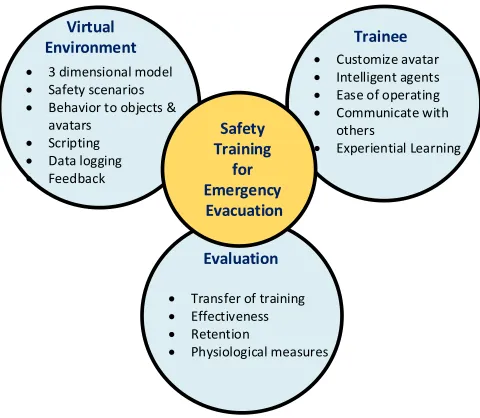
There are multiple dimension to development of safety training that educate personnel on risks involved in surroundings and train on mitigating those risks. Three dimensions are considered important for development of virtual environment that provides feel of real world, learning and knowledge building experience gained by trainees and evaluation & effectiveness of training as shown in figure 2.
Transfer of training Effectiveness
Retention
Physiological measures
3 dimensional model
Safety scenarios Behavior to objects &
avatars Scripting Data logging
Feedback
Customize avatar
Intelligent agents Ease of operating
Communicate with
others
Experiential Learning
Evaluation
Trainee Virtual
Environment
Safety Training
[image:8.612.186.426.209.418.2]for Emergency Evacuation
Figure 2 Dimensions of simulation based safety training
Literature review, interview experts and officials or use existing training
Baseline
Simulation Training Development
Develop a 3D model using building floor plan Provide behavior to objects
Development of scenarios Database connection to log data
Trainee Perspective
Navigation simplicity, interaction and immersion Intelligent avatars as guides, social aspect
Fidelity Real time Feedback
Data Analysis
Knowledge Test: Effectiveness Physiological measure: Engagement
SSQ, fidelity and physiological measure: simulation development Demographic information, knowledge test:Transfer
Training Evaluation
Demographic Information Knowledge test Simulator sickness questionnaire
[image:9.612.154.417.84.370.2]Fidelity questionnaire Physiological measurement
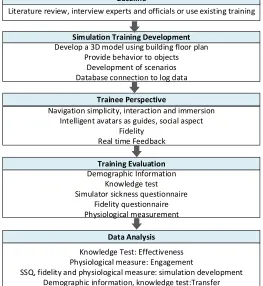
Figure 3 Preliminary framework
Content development is the first layer of the development of simulation training that will be one of the components which has multiple sub-components, namely - development of 3D model based on building floor map, programming behavior in objects and avatars, development of scenarios and data logging capability. Another component will consider aspects like fidelity, immersion, real time feedback, intelligent avatars or non- player characters that can facilitate training from point of view of trainees. Evaluating training is an equally important layer of the framework. For evaluation of training, simulation sickness questionnaire, fidelity questionnaire will be provided. Also, demographic information and knowledge test are sub-components for training evaluation. Physiological measurement such as EEG is an important subcomponent. The next identified layer is data analysis where combination of questionnaire, physiological measure, knowledge test and demographic information will be used to understand factors associated with
4.1 Training Contents
Most commonly used training techniques for evacuation safety are floor plans, “do not use elevator in case of emergency’ sign posted next to elevator, use of EXIT signs and fire drills. Apart from existing training techniques, literature describes use of interviews with experts or review of documents and reports published by agencies(Sacks et al., 2013) such as OSHA (Occupational Safety and Health Administration) or BLS (Bureau of Labor Statistics) to analyze most hazardous situations pertinent to the industry under study which can be used as a baseline for virtual simulation. For example, fabrication labs in the university utilize hydrogen gas in some processes. Leakage of hydrogen could result in a serious explosion. Understanding real work environment from point of view of participants is also important. Hence, interviewing some employees or safety personnel from the building could be helpful to get an insight. Contents developed using this process will be used to develop a power point slides based training that is employed popularly in companies. Also, same contents will be used to develop scenarios in the simulation based training. For example, power point slide will explain about which exits one should take in case of emergency and how to avoid use of elevator. While, simulation based
training will present a scenario where trainee will be asked to find nearest exit when she sees smoke in her office.
4.2 Simulation training development
There are multiple sub components in this layer of framework. Simulation training development includes selecting simulator software, building 3D model, developing scenarios, providing data logging capability, programming behaviors in objects and non- player characters.
4.2.1 Simulator software and virtual environment
Choosing a modeling tool, graphics interface and software to base the system are factors that play crucial role in determining if the final developed simulation would meet its requirements.
based training. After considering various factors and conclusions from numerous researches, it
was decided to use OpenSimulator as a tool for developing virtual constructive simulation.
It was observed that student participation rate increased from 10% to 33% in the online courses that offered virtual world activities using OpenSimulator at the Tulane University. Virtual world based learning was rated higher than traditional online course learning activities and classroom based learning in terms of engagement, interactivity and understanding of the course content by students (Maxwell & McLennan, 2012).
Second Life and MOSES (Military Open Simulator Enterprise Strategy) are two platforms based on OpenSimulator software that were considered for this research. It was observed that Second Life platform had a tremendous potential to be used for virtual simulation training purpose, however it lacked component of confidentiality and data security. Hence, MOSES has been developed as an open source initiative with features such as persistent simulation, stable virtual environment and content portability along with secured communication and data sharing capabilities (Maxwell, 2013). It allows researchers to upload their own content and create designs independent of designers, artists or modelers (Maxwell & McLennan, 2012).
[image:11.612.103.507.497.631.2]Apart from advantages such as high performance, lower cost, ease of programming and flexibility, MOSES has capability of providing multiple players and it is expected to allow from 30 to 300 simultaneous players (Dutton, 2013). Players can customize their avatar by choosing avatar’s clothes, shoes, etc. Also, OpenSimulator allows trainees to communicate with each other using voice calling, instant messaging and chat.
4.2.2 Three-Dimensional model development
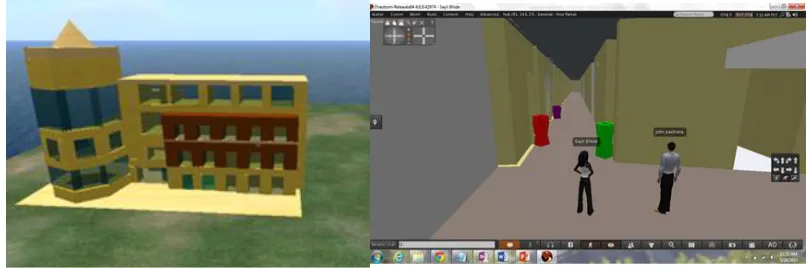
3 dimensional models can be built in OpenSimulator using basic building objects called primitives. OpenSimulator also allows to import models developed in Skethup or Maya. In proposed framework, realistic 3D building model will be accurately developed based on floor plan of the building along with various safety features such as fire extinguishers, EXIT signs, sprinklers, fire alarms, smoke detectors, etc.
4.2.3 Behavior to objects and non- player characters
OpenSimulator utilizes Linden Scripting Language (LSL) which follows structure similar to widely used programming languages C and Java that can be used for programming behavior in objects. For example, smoke dispersion or flames of fire can be established using scripting. One can attach specific set of actions in few avatars who can interact with trainee. These avatars are controlled by developer rather than player, thus they are known as non-player characters. This feature will be explored to see social behavior aspect of the trainees.
4.2.4 Data logging
Trainees will be presented with various questions in the scenarios and their responses will be logged in database for providing feedback as well as for analysis at the end of the study. In order to achieve persistent data storage, PHP (PHP: Hypertext Preprocessor) scripting language will be used. PHP will read and write data to MySQL database. As shown in Figure below, LSL communicates with PHP page which sends the data to a MySQL database. Similarly, PHP will send response from a database to the LSL program. (Bhide et al., 2015)
4.3 Trainee Perspective
Following are the aspects that will be considered while selecting software platform and developing virtual simulation training.
Simplicity of navigating in virtual environment using keyboard and mouse Developing virtual world as close as to real world
Ability to communicate with others just as of real life environment which is possible in case of multi-player approach or single player approach with non-player participants Capability to interact and immerse in virtual environment where one learns by trial and
error method or can practice skills from first person perspective
4.4 Training Evaluation
Training evaluation is a continual and systematic process of assessing the value or potential value of a training program. Results of training evaluation provide inputs in order to alter, continue or eliminate components of the training such as design or delivery.
4.4.1 Evaluation of Simulation training development
Evaluation of factors like fidelity and simulator sickness could help in providing insight on performance of virtual environment. Simulator sickness (SS) is a type of motion sickness that could be induced due to exposure to virtual environment (VE). It can lead to distraction, decrease in motivation, negative transfer of training, risk to health of participants and most importantly compromising effectiveness of simulation based training exercise, limiting its usage (McCauley, 1984). There are 16 items on a questionnaire that can be measured by administrating Simulator Sickness Questionnaire (SSQ). It is important to understand the degree to which trainee feels virtual world is reflection of real world objects. Likert scale based questionnaire can be used to measure fidelity.
4.4.2 Training Effectiveness
Training effectiveness is concerned with measuring why individual learnt or did not learn after conducting training program. Training effectiveness can be measured by utilizing knowledge test during various stages such as before training, after training, one month after training. Instead of providing paper based questionnaire, knowledge test can be accommodated in virtual training and responses of trainee can be saved into database. This data of knowledge test before, after and after one month can be compared to see how effective training is in short term and long term. Thus, effectiveness of virtual simulation based training over short time or long term can be measured.
4.4.3 Trainee Engagement
trainee’s response during virtual simulation based training and conventional training method. It will be analyzed later to understand engagement factor.
4.4.4 Transfer of training
Transfer of training measures how effectively and continuously employees apply skills learnt during training at the real world scenario. Questionnaire approach is commonly utilized to measure transfer of training. However, questionnaire alone will not be sufficient to understand how participants will behave or apply their learnings in case of real fire or explosion. Another approach that can be considered is after training, subjects can be asked to participate in emergency evacuation drill and time taken to evacuate building during simulation and drill can be compared. However, as participants will be aware that there is no real time emergency and they are participating in a drill, evaluation of transfer of training may not be realistic. Considering risk involved of exposing trainees to smoke or fire observed during emergency evacuation, indirect transfer of training could be the most suitable method of measuring transfer of training. 3 methods of indirect measure used in literature are:
1) Inverse transfer of training method (how experts perform in simulator, without practice) 2) Assessment fidelity (physical similarity between simulator and real world environment) 3) Trainee opinion (participant’s perceived training value of simulator) (Garrett & McMahon, 2013).
4.5 Data Analysis
Data obtained from pre-test, post-test and few weeks after training will be analyzed to understand training retention in both groups. Physiological signal records will be analyzed to understand engagement and alertness experienced by group who received SBT. Simulator sickness questionnaire, fidelity questionnaire and physiological signals will be analyzed to evaluate simulation based training and make modifications to its features accordingly.
5 Conclusion & Future Work
Different questionnaire will be provided to subjects. Data analysis will be performed to validate
the proposed framework and results will be re- applied to refine the framework. References
Berka, C., Levendowski, D. J., Lumicao, M. N., Yau, A., Davis, G., Zivkovic, V. T., . . . Craven, P. L. (2007). EEG correlates of task engagement and mental workload in vigilance,
learning, and memory tasks. AVIATION SPACE AND ENVIRONMENTAL MEDICINE, 78(5), B231-B244.
Bhide, S., Riad, R., Pastrana, J., Rabelo, L., Katsarsky, A., & Ford, C. (2015). Development of Virtual Reality Environment for Safety Training. Paper presented at the Industrial and Systems Engineering Research Conference, Nashville, Tennessee.
Blair, E., & Seo, D.-C. (2007). Safety Training: Making the connection to high performance. Professional Safety, 52(10), 42-48.
Burke, M. J., Sarpy, S. A., Smith-Crowe, K., Chan-Serafin, S., Salvador, R. O., & Islam, G. (2006). Relative effectiveness of worker safety and health training methods. American Journal of Public Health, 96(2), 315-324. doi: 10.2105/AJPH.2004.059840
Chittaro, L., & Ranon, R. (2009). Serious Games for Training Occupants of a Building in Personal Fire Safety Skills. 2009 Conference in Games & Virtual Worlds for Serious Applications, 76.
CNN.com. (2003). At least 96 killed in nightclub inferno. from
http://www.cnn.com/2003/US/Northeast/02/21/deadly.nightclub.fire/ Dutton, G. (2013). 3-D IN ACTION. Training, 50(5), 40-42.
Garrett, M., & McMahon, M. (2013). Indirect Measures of Learning Transfer between Real and Virtual Environments. Australasian Journal of Educational Technology, 29(6), 806-822. Hudock, S. D. (1994). The application of educational technology to occupational safety and
health training. Occupational Medicine: State of the Art Reviews, 9(2), 201-210. In wake of deadly shoe factory fire in Manila, UN urges global action to make workplaces safe.
(2015). Retrieved from
http://www.un.org/apps/news/story.asp?NewsID=50875#.VY8SV_lViko
Ku, K., & Mahabaleshwarkar, P. S. (2011). Building interactive modeling for construction education in virtual worlds. Journal of Information Technology in Construction, 16, 189-208.
Kuligowski, E. D., Peacock, R., & Hoskins, B. L. (2010). A Review of Building Evacuation Models , 2nd Edition. NIST, Technical Note 1680.
Laberge, M., MacEachen, E., & Calvet, B. (2014). Why are occupational health and safety training approaches not effective? Understanding young worker learning processes using an ergonomic lens. Safety Science, 68, 250-257. doi: 10.1016/j.ssci.2014.04.012
Maxwell, D. (2013). MOSES: A military virtual world environment. Science and Technology Innovations.
Maxwell, D., & McLennan, K. (2012). Case Study: Leveraging Government and Academic Partnerships in MOSES (Military Open Simulator Enterprise Strategy. ED-MEDIA World Conference on Educational Multimedia, Hypermedia, and Telecommunicaitons. McCauley, M. E. (1984). Research Issues in Simulator Sickness: Proceedings of a Workshop:
1984-10.
Mullen, J. (2015). 72 killed in fire at footwear factory in Philippines. from http://www.cnn.com/2015/05/14/asia/philippines-factory-fire/
Mumbai: 2 fires in Bandra, Powai leave 7 dead, 28 injured (2015). mid-day. Retrieved from http://www.mid-day.com/articles/mumbai-2-fires-in-bandra-powai-leave-7-dead-28-injured/16271152#sthash.9C4yYjp8.dpuf
Myers, E., & Francis, C. (2011). Simulation-based electrical safety training: An innovation in safety culture. 2011 IEEE IAS Electrical Safety Workshop, 1.
Ribeiro, J., Almeida, J. E., Rossetti, R. J. F., Coelho, A., & Coelho, A. L. (2013). Towards a serious games evacuation simulator.
Sacks, R., Perlman, A., & Barak, R. (2013). Construction safety training using immersive virtual reality. Construction Management & Economics, 31(9), 1005-1017. doi:
10.1080/01446193.2013.828844
Shanghai high-rise fire death toll rises to 58. (2010). Retrieved from
https://login.ezproxy.net.ucf.edu/login?auth=shibb&url=http://search.ebscohost.com/login.as px?direct=true&db=edsggo&AN=edsgcl.242406278&site=eds-live&scope=site
training. 2014 IEEE Symposium on Computational Intelligence for Human-like
Intelligence (CIHLI), 1.
Sharma, S., & Otunba, S. (2012). Collaborative virtual environment to study aircraft evacuation for training and education. 2012 International Conference on Collaboration Technologies & Systems (CTS), 569.
Sherman, W. R., Penick, M. A., Su, S., Brown, T. J., & Harris, F. C. (2007, 10-14 March 2007). VRFire: an Immersive Visualization Experience for Wildfire Spread Analysis. Paper presented at the Virtual Reality Conference, 2007. VR '07. IEEE.
Silva, J. F., Almeida, J. E., Rossetti, R. J. F., & Coelho, A. L. (2013). A serious game for EVAcuation training. 2013 IEEE 2nd International Conference on Serious Games & Applications for Health (SeGAH), 1.
Sinyai, C., Stafford, P., & Cpwr, C. T. (2013). Doing it old school: Peer-led occupational safety training in the U.S. construction industry. McGILL JOURNAL OF EDUCATION, VOL. 48 ( NO 3).
Smith, S., & Ericson, E. (2009). Using immersive game-based virtual reality to teach fire-safety skills to children. Virtual Reality(2), 87.
Xi, M., & Smith, S. P. (2014). Simulating cooperative fire evacuation training in a virtual
environment using gaming technology. Paper presented at the Virtual Reality (VR), 2014 iEEE.