Citation:
Wright, S and Poole, R (1982) TARGET Northwest. Manchester Free Press, Manchester.
Link to Leeds Beckett Repository record:
http://eprints.leedsbeckett.ac.uk/4727/
Document Version:
Other
The aim of the Leeds Beckett Repository is to provide open access to our research, as required by
funder policies and permitted by publishers and copyright law.
The Leeds Beckett repository holds a wide range of publications, each of which has been
checked for copyright and the relevant embargo period has been applied by the Research Services
team.
We operate on a standard take-down policy.
If you are the author or publisher of an output
and you would like it removed from the repository, please
contact us
and we will investigate on a
case-by-case basis.
Civil defence and nuclear
war in Region 10
By Robert Poole and Steve Wright
Civil Defence Study Group,
Richardson Institute for Peace and
Confiict Research, University of
Lancaster.
1982
ID.titute JOI" Policy Studi . .
AIm. R..ce aDd
NuclearWe~na
ProfeCt
1901 Q Street, N.W.WubinqtoD, D.C· 20009
2
©Robert Poole and Steve Wright 1982.
Permi ion to reproduce will be freely given to m vern nt pre provided full acknowledgement
is
made.We would like to thank all th se who cannot be named who helped with this research. We would particularly like to thank Dr C.H.W. Fairfax of the North West Regional Health Authority and Mr R.B. Batty and Mr C.H. Stannard of the North West Water Board for their lime and lheir specialised help. Thanks al 0 to Menard Press for permission to draw upon their excellent pamphlet. Crucible of Despair.
Published
by
the author at tht: Richard on In tilute for Peace and Conflict Research. University of Lancaster.Printed by Manchester Free Press, 59 Whilworth St. Manche. ler I.
CONTE
What Chance War?
Target North
West
The Effects of Nuclear Weapons
Attacks on Nuclear Installations
Emergency Government
in
the
North West
Communications
The Aftermath
The Health Service
Food
Water
Fire
Roads and Refugees
Law, Order and State Security
Altemative Defence
Appendices
References
Food hufter depots ROC posts
Home Office Relay Station Further reading .
s
35
6
10
13
17
21
27
30
33
36
38
39
40
47
51
4
W..!2ligure 9 on <:entre pag~
1) Fulwood Army Barracks. North-west Armed Forces HQ and Regional Seat of Government.
2) Sub-regional Control 101 (Lancashire and Cumbria). Basement of
Government/DHSS offices at Duke's House, Houghton St, Southport.
Partially flooded and probably useless at present.
3) Sub-regional Control 102. Ex-ROTOR station bunker, Hack Green, near Nantwich.
4) Cumbria County Control. Carlisle Castle.
5) Cumbria standby County Control. Not known, but possibly the district control, also used by the Navy, at Abbot's Wood, Mill Brow, Barrow.
Westleigh, showing aerial and
ventilation pipe emerging from the bunker at the back.
6) Lancashire County Control. Emergency planning HQ, Westleigh, Lea Rd, Preston.
7) Lancashire standby County Control. Town Hall basement, Lancaster.
8) Merseyside County Control. Walker Art Gallery extension, William
Brown st, Liverpool. ('Old civil defence building', perhaps dating from World War II).
9) Merseyside standby County Control. Basement, Technical College,
Mornington Rd, Southport (district education authority premises) .
10) Manchester County Control. Ex war room, Mill Lane, Cheadle.
11) Manchester Standby County Control. Basement, Bolton Town Hall. 12) Cheshire County Control. Basement, County Hall, Chester.
13) Cheshire standby County Control. Basement, Municipal Buildings, Earl St, Crewe.
14) Weeton. Home Office Supply and Transport Depot.
15) Pilling. Home Office Regional Wireless Depot.
16) Billinge. Home Office Wireless Depot (and relay station).
17) Burtonwood. Home Office Supply and Transport Depot (and US base).
18) Cumbria County Police HQ, Penrith.
19) Lancashire County Police HQ, Hutton, near Preston.
20) Merseyside County Police HQ, Liverpool.
21) Manchester County Police HQ, Chester St, l1anchester.
22) Cheshire County Police HQ, Chester.
23) UKWMO Western Sector Control, Langley Lane, Goosnargh.
24) ROC Group HQ, near RAF Carlisle.
WBATCBANCE
WAR?
"Deterrence is dead"
5
-us
strategist"According to a Brookings Institution Study, prepared in co-operation with the
Department of Defence, the U. S. government threatened the use of strategic nuclear
weapons no less than 18 times between 1946 and 1970."
-'Counter Spy' July/August 1982
The political decision to use nuclear weapons has already been made. They await only the opportunity.
There was once a time, not so long ago, when nuclear weapons existed in theory only to prevent wars, not to fight them. They were 'the ultimate deterrent' because if used by either side, there would be Mutually Assured Destruction'-MAD for short. eND flourished for the first time in the naive belief that this was the ultimate
in military horrors. Looking back, the early 1960s seems like a time of happy stability, for now the old theory of deterrence has gone, although it is still used by governments to justify their nuclear arsenals to their own peoples.
I n the last 20 years, the accuracy of nuclear weapons has increased enormously, most notably in the new cruise missiles, and strategists now plan to use their own nuclear weapons to knock out the other side's--a 'counterforce' strategy. This means striking first, while an enemy's weapons are still on the ground-in fact, it means striking before the enemy even realises there will be a nuclear war. As well as the new missiles, there now exist battlefield nuclear weapons for just about every purpose-bombs, rockets, shells, mortars, depth charges and so on. Britain has an estimated 1400 nuclear warheads; it seems likely that the Falklands task force carried some of them. In short: since nuclear weapons are now designed to fight and win wars, since every advantage is now to be had from striking first, and since NATO's idea that a nuclear war could be kept 'limited', the nuclear thre-shold has dropped alarmingly.
Nuclear alarms and threats have become staggeringly commonplace. During the 1962 missile crisis, reports Calder, 'American bombers were orbiting the Soviet Union, waiting for the order to go in'. President Nixon put NATO on a top-level nuclear alert during the 1973 Arab-Israeli war. In November 1979, a tape simulating a Russian nuclear attack was accidentally put into the US air defence computer, and large numbers of nuclear bomb,ers were scrambled into the air. If
such a thing were to happen once either side has one of the projected computer-ised 'launch on warning' defence systems, a simple scare could become an auto-mated holocaust. J
other as rapidJy as they can, while their missiles survive'. Some 15,000 weapons from both sides would then fall on Europe: 'in the course of an hour Europe can be turned from a garden continent thronged with admiring tourists, into a festering
ruin far worse than all the other hells Europeans have ever made-Verdun,
Auschwitz, Dresden .. .'
Second only to West Germany as a target, but far more densely packed with
bases and people, Britain would be the darkest comer of a dead continent. The
government proclaims that 'if we have the sort of nuclear attack which we think we
can expect', between 25 and 40 million people would die from the more immediate effects; 5% of the land area would suffer serious blast damage and 20% would
have some blast damage. This is rubbish. After re-working the government's own
figures, Open University scientist Philip Steadman accused it of 'a gross distortion of the evidence'. He found that 20% of the land surface of Britain would suffer serious blast damage, while at least 34% (containing 60% of the population) and
probably over 40% would have some blast damage. More generally, the
Guar-dian's science correspondent, Anthony Tucker, has (in Crucible of Despair) described the 'systematic and deliberate underplaying of nuclear weapons effects'
by the Home Office. 2
The sort of nuclear attack which the government thinks it can expect was shown in the imaginary target maps for the Operation Square Leg exercise in Autumn 1981; 200 megatons of nuclear explosive, with the power of 16,000 Hiroshima
bombs, fell on nearly 100 targets in England, Scotland and Wales. Using US
government assumptions, such an attack would kill 75% of the population out-right, regardless of future casualties from radiation illness and disease (which eventually doubled the death toli in Hiroshima), and wipe out virtually our entire
industrial resource base. In fact, the size of the Warsaw Pact arsenal available for
an attack on the UK suggests that we could expect a first strike of between 400 and
600 megatons, while the Secretary of State for the Air Force has admitted that an
attack of 'more than 1000 megatons' would be needed to make sure of destroying
our future share of cruise missiles. The main fire zone alone in this case would
cover most of England and Wales and extend well into the north-west. 3
TARGET
NORTH-WEST
Even this region, far from the main concentration of air bases, is an important target, either for a 'limited' strike against vital energy sources or from an attack
designed to eliminate long-term 'recovery capability' (industry, peopJe and cities).
The north-west also has some important military targets. The main targets in the region are shown in figure 1. Some of them were 'hit' by warheads of between a
half and three megatons in Operation Square Leg; a number also appeared on a
Soviet map of military potential targets in Britain, published in 19804
COMMUNICATIONS Perhaps the biggest risk is the VLF radi~ s.tati~n at
Anthorn near Carlisle, which 'relays reports from Fylingdales ballIstiC missile
• Possible Target
o
Airburst in 'Square Leg'o
Groundburst in 'Square Leg'Valley (Anglesey)
Leeds and
[image:6.613.388.798.29.588.2]Bradfon:I
/
8
radar back to the American Air Defence HQ are Cheyenne Mountain, Colorado', and also backs up similar stations at Rugby and Criggion in communicating with Polaris submarines. Criggion is in north Shropshire, while the most important US undersea monitoring facility in Europe is at Valley in Anglesey; large parts ofthe region would be at risk from the fallout from groundburst attacks on these, depending on the wind direction.
MILITARY BASES Burt()nwood, near Warrington, is the site of a truly gigantic US army store and helicopter base, one of only two in the country which stock the whole range of US Army equipment. It is also, according to Duncan Campbell,
'the probable site for the US Army's reserve stocks of theatre nuclear weapons',
and thus a very likely target. Fallout from another US arms base at Ditton Priors in North Shropshire also threatens the north-west. Liverpool docks house a big US troop and supply landing facility. The Polaris dockyard at Barrow would be at risk-Cumbria's emergency planning officer believes that it would only be attacked if there were actually submarines there, but concedes that it would be 'a
reasonable deduction' to suppose that, since the Russians may not know for sure, Barrow will be targeted anyway. The large, supersonic-capable airfield at Warton, near Preston, could be at risk, as well as those at Samlesbury, Blackpool, and
Ringway, and the RAF bases at Ternhill, Sealand, Woodvale and Carlisle,
(although none of these is of particular importance in a strike against the East). EN~GY FACILITIES Home Office circular ES5/1976 states that 'the risk of air
attaYon North Sea gas and oil offshore terminals and individual oil refineries and
electricity generating stations constitute the major threat' to the country in time of war. The north-west has several major energy facilities, and is Britain's main centre of nuclear activity. Although Heysham nuclear power station (which isn't working yet) was ignored in Operation Square Leg a similar reactor at Dungeness was probably the real target of the bomb which fell nearby on inoffensive East-bourne. Fallout for an attack on the nuclear power stations at Wylfa, on Anglesey, and Chapelcross, just across the Solway Firth, would also threaten the north-west. The region also contains the British Nuclear Fuels nuclear fuel manufacturing plant at Springfields, near Preston; the URENCO uranium enrichment plant at
Capenhurst, near Runcom; and the nuclear fuel reprocessing plant at Windscale
(earmarked for a groundburst in Square Leg). These three are all vital parts of the nuclear cycle in Britain, Europe and even the USA, both for providing reactor fuel and nuclear bomb material. There is no reason to suppose that nuclear installations would specially be spared.
Two of Britain's biggest oil refineries are at Stanlow and Ellesmere Port, on Merseyside; an attack on these would create an inferno that could engulf much of Liverpool. The projected terminal for the Morecambe Bay gas field will add to our
worries. '
INDUSTRY Industry and people concentrate in cities and, believes Peter Laurie.
'the crowded Liverpool-Manchester conurbation is almost certain to be a target in
either a counter-force or a counter-city war'. In Square Leg, Liverpool,
Manches-ter, Birkenhead and Salford were all considered to have been targets, mainly
because of their urban-industrial significance, and perhaps also because of the docks, airports and oil refineries. If the Soviet Union were determined to obliter-ate Manchester, they might use one of their many 25-megaton warheads which, exploded in the air on a clear day, can create a main fire zone 55 miles across--see figure 2.
• Yllrk
Hull
Sheffield
Nottingham
•
FLASHPOINT
MANCHESTER
9
THIS, experts predict, would be
the trail of death and destruction
from the fireball of a Russian 5·
IDeraton SS·19 explodin( in cent· nl Manchester.
L AT 3-4 MILES. ~Ietals vaporise as the &lr temperature soars to 10 million de,.
~U!;. ~:~~h iSsuf::StaaSnt~~:~~~. and Dids-I. AT 8 MILES. Metals melt. A bus In Bale would limply Iiquidise arouod its pUXDC'ers.
:~r I!~o ~~r!e~. !ir~~!ft :r!Ji~,:t!~ RiD""ay' Airport explode. Car lyres In towna as rar away as Stockport melt.
.. AT 20 MILES. Exposd woodwork In
places as distant as Blackburn and St. Helena I,nltes spontaneously.
I. AT 30 MILES. Clothes flare. In Brad-ford, Stoke, Chester and Liverpool peo-ple. cau,ht In tbe open are horribly bumed.
.. AT CO MILES. People In towns like libctneld, Leeds and BlackpooJ .utrer NCond-derree burns and .evere bli~
SerIDC' •
y:r!O
:n~E th~N N:~~re~:::~e;es!'~~r~e~1 [image:7.613.440.788.47.279.2]the explosion as a breath or bot alr~ tbou,h tbey had walked past the open 400r 01 • turn ace.
Figure 2. Heat effects of a 25-megaton bomb on Manchester.
Predi~tions, ofcour~e: can be futile; the Square Leg plan is not a target map but (accordmg to Cumbna s Emergency Planning Officer) a collection of 'useful
guesses'. Bombs miss their targets and fall randomly; the bomb on Fleetwood in Square Leg was probably a 'random', There are far more bombs than targets. Frank Barnaby, former director of the Stockholm International·Peace Research I nstitute, estimates that by 1990 there will be enough warheads available for Europe alone to hit every town of 20,000 people or more on the continent: 'pr~liferation ,and overkill have now go~e so far that the military hav:e run out of major targets. A top-secret US target lIst of nearly 20 years ago revealed that in E~rope, bridges, rai~way~ and ":I0torway intersections were targeted. (In
Lanca-shtr~, the M~/M61 JunctIOn, With the M55 and M61 joining nearby, would be leadmg candidate for destruction, especially since this would break the vital
'military road route' network). To the extreme embarrassment of the Pentagon,
many of the targets were in 'friendly countries' in western Europe and the middle east, doubtless to 'deny them to the enemy', The UK was not on that list, but the number of warheads to be targeted has grown enormously since then. Viewed as an 'unsinka.ble aircraft carrier' for the US, the UK could prove equally useful to the USSR; Its use may have to be denied them. s
THE EFFECTS OF
NUCLEAR WEAPONS
"Hiroshima does not look like a bombed city. It looks as if a giant steamroller had passed over it and squashed it out of existence. "
-Daily Express reporter, September 1945
Two British scientists who visited the ruins of Hiroshima suggested that to appre-ciate what had happened there, one should imagine a Lilliput-sized model village, inhabited by people six inches high, and then imagine what it would look like after a gigantic twelve ton bomb (twice as big as any conventional bomb then in existence) had exploded over it. The Hiroshima bomb was a tiddler by modem standards, with a power of 12 kilotons, or 12,000 tons of TNT. The typical modem nuclear bomb has an explosive power of one megaton, or one million tons of TNT. Although there is no reason to suppose that Lancaster will be a nuclear target, it is a typical modern town, and can serve as an example. What would happen if a typical modem town were hit by a typical modem bomb?6
Blast and fire effects
A one megaton bomb exploded on the ground will produce such a searing flash that people in the open eight miles away will have bums needing medical attention
if they are to survive. It will produce a fireball three miles across which will create
an expanding firestorm with hurricane-force winds, which will last for several
hours, suffocating everyone Within it, however well sheltered. It will dig a deep
crater a hundred yards across, sucking the material up into a mushroom cloud twelve miles across and depositing it as lethal fallout over a much wider area. The blast wave will create a zone of serious destruction, with most private housing more or less destroyed, covering 104 square miles. Cloudy weather could reduce the burning effects of the bomb; a fine day or night could double their range.
A diagram cannot tell us everything about these effects (a single photo can say
much more) but figure 3 shows the blast effects. If the bomb were an airburst,
there would be much less radioactive fallout, but a much larger zone of fire and
blast damage. Figures can only be approximate, and the circles marked will
roughly do for an airburst as well, except that the 'total destruction' ring, A for a
groundburst, is at B for an airburst, while 'irreparable damage' extends to ring C,
'serious damage' to ring D and there will be some damage and fires started as far as ring E, 13 miles away. All these neat figures will be ruined if there is a second nuclear burst, either sooner or later, near enough to affect this area; already weakened and damaged structures (and people) will collapse and burn much more easily.
Radiation effects
Radiation effects are of 3 sorts: prompt, short term, and long term. The Home Office believes that 'prompt' rays from the initial radioactive flash need not be
E
Hospital
Emergency Operating Theatre
Heysham Power Station
Bridge
Food Store
Microwave Tower
~ Radio Mast
X Town Hall
Health Ser:vice Control
[image:8.613.445.798.40.396.2]Chemical Works
Figure 3. Blast and fire effects of a 1 megaton bomb on Lancaster.
EFFECTS OF A 1 MEGATON BOMB-BLAST AND FIRE Distance in miles Max blast I.ounediate
from groWld zero pressure casualties AirburstGroundburst Obs/sq") Dead/Ser/inj
1,000'
2.5 1.7 A 11 98% 2% 4.3 2.7 B 5 50% 50% 8 4.7 ( 2 5% 40%
13E
7.40
few 25%Wind speed
of blast
(mph) Damage
Crater
300+ Total destruction
160 Irreparable damage
65 Most houses wrecked
12
considered, because everyone within their range will die from blast or fire anyway.
The 'short tenn' is mainly a matter of a couple of weeks, during which time 92%
of the radiation in nuclear fallout will have decayed. Radiation is measured in rads or rems (similar units for our purposes). One in ten people will develop anorexia at 40 rads, nausea at 50, vomiting at 60 and diarrhoea at 90. At 240 rads well over half those exposed have some or all of these symptoms, some very badly. At 350 rads there is a 50% probability of death without treatment; at 550 rads, 99%. Infants and the old are especially at risk; as little as 10 rads can abort a foetus. People who do not die recover within a few weeks, but may relapse and die. The Home Office claims that a person can absorb 220 rads within seven days and suffer 'no
deterior-ation', but admits that at 520 rads, mortality could be 100%. It also decrees that
'those with only radiation sickness should not be admitted to hospital', for there will be no resources to treat them.
Figure 4 shows the fallout effects from a 1 megaton bomb dropped on Birken-head, assuming a typical 15 mph south-westerly wind. After 14 days, once the
worst is over, 560 square miles have received a dose of 500 rads or more. Half of
that area has received 1000 rads, which may be lethal even to people who shelter for a month in patched-up houses with a relatively good protective factor of between 10 and 20. Again, this picture is idealised-idealised because in practice
bombs falling even long distances apart would create overlapping fallout zones,
combining to produce local 'hot spots' which make planning and mathematical
forecasting quite impossible, even without the complication of changing winds.
In the long tenn, even very low radiation doses can produce illnesses such as cancer and leukemia; the current limit for workers in nuclear industries is 5 rads a
year, still too high for the liking of many experts. These effects alone will produce
a long-term cancer epidemic far beyond the capacity of even the present fully-fit
health service. In Hiroshima alone, over 2,000 people a year are still dying from
the effects of the small and inefficient experiment conducted 37 years ago; some of these were not even born when the bomb went off.
(.50M~ ~
500 IVU)& . ,
M,'&s
t
'
"1.0,
,
•
I
,
t>\fkAnhe4CU
I
,
,
& •
.6 __ '
[image:9.613.48.362.352.555.2],--'
Figure 4. Accumulated radiation dose at 14 days from a 1 megaton groundburst (50% fission yield) on Birkenhead.
l
ATTACKS ON
NUCLEAR
I
TALLA
IONS
13
"Had nuclear power been in widespread use at the time of the last war it is likely that some areas of central Europe would still be uninhabitable because of ground contamination by caesium. "
-Royal Commission on Environmental Pollution, 1976
According to work done in the USA, 'centralised energy systems', of which
nuclear power is the best example, 'are not only vulnerable but fonn essential
industrial and hence valid military targets'; this is especially true of high power
reactors, like those at Heysham. The Home Office states that in a war, 'many
generating stations could be desttoyed or rendered inoperable,.7
Nuclear installations at Dungeness, Windscale and Dounreay were deemed to have been hit in Operation Square Leg, and maps showing the effects of nuclear attacks on Barrow's nuclear submarine yards, the Chapelcross nuclear power station and the Windscale/Calder Hall complex have been on view in Cumbria's
emergency planning HQ at Carlisle. The County emergency planning officer,
Group-Captain Matthews, talking to us about this subject, stressed that plans
made for exercises cannot be considered as targeting assumptions, and while agreeing that these installations would be more likely to be targeted than any town
in Cumbria, added emphatically: "Having said that, I don't know'1.
The official government view, echoed by the Emrgency Planning Officer to the North-West Regional Health Authority, Dr. Fairfax, is that the possibility is 'not
really a major consideration'; the additional radiation released 'from destroyed
reactors would be 'a little added problem ... minimal compared with the rest of the
damage that would be done'. This is wrong. Whereas 92% of the radioactivity
from a 1 megaton bomb will be decayed after 14 days, nuclear reactors contain a
large proportion of radioactive material which will take a generation (like stron
-tium-90 and caesium-137) or even many thousand years (like carbon-14 and
plutonium-239) to decay to even half their original radioactivity. A 1 megaton bomb which destroyed a 1000 megawatt reactor would produce an area of 23,600 square miles over which the radiation dose after a year was at least 100 rads---thirty times greater than that produced by a 1 megaton bomb exploding on its own. With all the shorter-lived radioactivity now gone, this area would diminish further only very slowly. 8
Heysham Nuclear Power Station
A nuclear power station can be destroyed in two ways: by damage of various sorts leading to a huge release of radiation or an uncontrollable meltdown ('The China
Syndrome'); or by a direct hit, which will vapourise the contents and tum them
Military planners expect that a nuclear attack on Europe would be preceded by a massive nuclear explosion high in the atmosphere whose electromagnetic pulse (EMP) would knock out communications over the entire continent and 'cause failure of the entire national grid, including destroying the sensitive control facilities at modern electric power plants' . More locally, the blast and flash from a 1 megaton bomb five miles away could damage the vital circuits and cooling systems of a US-type reactor, but 'most UK reactors including Heysham do not have the protective outer concrete shell that most US and European reactors possess. They would be more easily disabled by shelling, bombing or guided missile attack'. Even when shut down, nuclear power stations need constant monitoring, manning and power supply (even if only fuel for emergency gener-ators) to ensure that a meltdown is averted.9
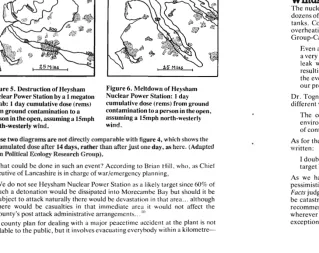
Figure 5. Destruction of Heysham Nuclear Power Station by a 1 megaton bomb: 1 day cumulative dose (rerns) from ground contamination to a person in the open, assuming a ISmph north-westerly wind.
Figure 6. Meltdown of Heysham Nuclear Power Station: 1 day cumulative dose (rems) from ground contamination to a person in the open, assuming a lSmph north-westerly wind.
These two diagrams are not directly comparable with figure 4, which shows the
accumulated dose after 14 days, rather than after just one day, as here. (Adapted from Political Ecology Research Group).
What could be done in such an event? According to Brian Hill, who, as Chief Executive of Lancashire is in charge of war/emergency planning,
We do not see Heysham Nuclear Power Station as a likely target since 60% of such a detonation would be dissipated into Morecambe Bay but should it be subject to attack naturally there would be devastation in that area ... although there would be casualties in that immediate area it would not affect the county's post attack administrative arrangements ... 10
The county plan for dealing with a major peacetime accident at the plant is not available to the public, but it involves evacuating everybody within a
kilometre-some 3,550 people-to 25 rest centres. (150,000 people live within five mIles.) The county's major emergency scheme could supplement this effort; it was successfully used to house the homeless during the 1977 floods and, believes Mr. Hill,
There is no reason to doubt why equally effective similar operations could not be mounted in a wartime setting.
Rubbish. In the first place, even in peacetime, evacuees would have to brave outdoor radiation and might well be safer at home. In the second place, after a
nuclear attack, no-one is supposed to move for at least 14 days--much longer, with that level of radiation about. In the third place, huge areas of the region would be destroyed, rest centres and their potential occupants alike. In the fourth place, the Home Office point out that,
Unfortunately, most buildings which are earmarked as rest centres in the event of a peacetime emergency, would provide poor protection in the event of fall out'. (ES7/1976)
The truth is that nothing will be done; nor could it be.
Windscale
The nuclear reprocessing plant at Windscale houses the highly active waste from dozens of nuclear power stations, in cooling ponds and in vulnerable surface waste tanks. Constant power and expert monitoring are needed to prevent both from overheating and releasing their contents into the environment. According to Group-Captain Matthews:
Even a major leak of radioactivity from the storage plant would be confined to a very small area. The damage to the population and environment which such a leak would cause would pale into insignificance when compared with that resulting from the detonation of the weapon itself. .. I really do believe that, in the event of a nuclear war, BNFL Windscale will prove to be the very least of our problems.
Dr. Tognarelli, the secretary to the Windscale Local Liason Committee, takes a different view:
The consequences of such an event (nuclear war) to the population and environment of West Cumbria would be of such significance that the problems of continuing to run the works would be overwhelmed.
As for the possibility of a direct hit on Windscale, Group-Captain Matthews has
written:
I doubt whether its strategic importance would justify its inclusion in an enemy target listY
As we have seen, this optimistic view has to be carefully qualified. On the pessimistic side, Peter Goodwin's carefully-researched book, Nuclear War: The
16
Windscale's many waste tanks, Londoners could still be receiving 50 rads a year (similar to rems) , having already absorbed far more.
The effects of attacks on nuclear installations are so catastrophic that a sort of Geneva Convention banning them has been suggested but, writes Prof Lindop, 'it
is unlikely to be honoured once a war has started,.12
Figure 7. Land uninhabitable after one year (at 50 rads per year) following
destruction of one nuclear waste storage tank at Windscale by a 1 megaton bomb.
(Adapted from Prof Lindop).
The Long Term
According to Group-Captain Matthews, the aim of civil defence (or 'civil
pre-paredness:, as he prefers to call it) is 'our survival and recovery to some semblance of normalIty after attack', but, he adds, 'it is impossible to define what one means
by normality'. Many eminent scientists have been trying to define 'normality' for
the post-nuclear world. Some of their conclusions are summarised in Jonathan
Schelfs recent book, which has already assumed historic importance, The Fate of
the Earth. An assembly of 800 Dutch doctors concluded in 1980 that:
17
Large parts of the world would remain contaminated by radioactive fallout for generations. The atmosphere would be so greatly disturbed that all life on earth
would be seriously affected. 13
The ozone layer, which shields all living things from lethal cosmic rays, would be seriously disrupted for a generation, and perhaps for ever; as a result, the entire ecosystem on which the human race depends for all its needs would collapse. Even
if you are in the perfect shelter, it may never be safe to come out.
EMERGENCY
GOVERNMENT IN
THE NORTH-WEST
(Information on the consequences of nuclear attack) "will be freely available except in the very rare cases where ... release might actually harm the security of the nation ... We shall be candid and we shall be outgoing. "
-Leon Brittain, Home Affairs Minister, to the Commons, 7.8.1980
"This is the work of a traitor."
-Home Secretary to the Commons on the disclosure by 'Spies for Peace' of details of the regional system of government, 14.4.1963
The recent publicity given to the nuclear war aspects of 'home defence' has ?bscured its prime purpose, which is 'to secure the United Kingdom against any Internal threat' (ES3/1973). The main preparations are made by police and the military; war recovery plans, the main concern of local authorities come second.
In 1968 the government disbanded the old Civil Defence Corps because it was deemed irrelevant to nuclear war. In the 1972-4 local government re-organisation, which conveniently brought together the boundaries of local authorities and the
various public and emergency services, 'civil defence', peacetime 'emergency
planning' and internal state security were brought together in a single hierarchical
system now called 'home defence' whose main concern is to counter all forms of
civil unrest, from strikes and rebellion to the mass resistance which may accom-pany any state attempt to risk nuclear war.
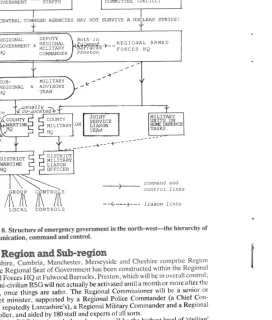
These plans involve replacing central government with a system of regional government, based round twelve regions and seventeen sub-regions, plus the usual counties and districts; a parallel military hierarchy takes precedence at every level, overseen, in theory, by the UK Commanders-in-Chief Committee (see fig 8). This system was tested in Operations Serum Hall (1978) and Square Leg (1980), but both were essentially military exercises, part of NATO manoeuvres; among the north-western counties, only Cumbria chose to test its local civil
defence to any great extent. 14 Operation Hard Rock, in Autumn 1982, will be the
first national test of civil defence, though with the military acting firmly, 'in
[image:11.613.68.288.130.432.2]CENTRAL d DEFENCE ... (- __ -7 _ UK COMMANDERS- IN-CHIEF
GOVERNMENT an STAFFS COMMITTEE (UKCICC)
I
I
(CENTRAL COMMAND AGENCIES MAY NOT SURVIVE A NUCLEAR STRIKE)
Both in
iJ.lW..9..9~_~ __ REGIONAL ARMED
p~~~~~)fls FORCES HQ
JOINT
SERVICE LIASON
'J:'EA1-1
MILITARY
UNITS ON
HClo1E DEFENCE
TASKS
---"=:---~----r---...::;~
)
--~---
-t---command and control links
[image:12.613.56.329.76.397.2]liason links
Figure 8. Structure of emergency government in the north·west-the hierarchy of communication, command and control.
The Region and Sub-region
Lancashire, Cumbria, Manchester, Mer eyside and Cheshire comprise Region
10
.
The Regional Seat of Government has been constructed within the Regional Armed Forces HQ at Fulwood Barracks, Preston, which will be in overall control; the semi-civilian RSG will not actually be activated until a month or more after the attack, once things are safer. The Regional Commissioner will be a senior or Cabinet minister, supported by a Regional Police Commander (a Chief Con -stable, reputedly Lancashire's), a Regional Military Commander and a RegionalController, and aided by 180 staff and experts of all sorts.
Until the RSG is activated, the sub-region will be the highest level of 'civilian' government, headed by a junior minister or perhaps a senior pennanent civil servant, supported again by a controller, a police and a military commander, and a
staff o~ s~m~ 200. Sub-regional control (SRC) 101, covering Lancashire and Cumbna, IS In the basement of the government offices in Duke's House South-port- just outside the Sub-region, and presently flooded and useless.
A~rials
on th~ roof comm~nicate with SRC 11 at Hexham (Northumberland), SRC 21 atShlpton-by-Bemngborough (North Yorkshire) and SRC 102. SRC 102, for Ma n-chester, Merseyside and Cheshire, is the old ROTOR station concrete bunker at
~ack Green.' near Nantwich (grid ref 644478). It is being secretively and exten-Sively refurbIshed. The authorities are saying nothing, but a call to the contractors, Seddon's of Stoke, brought the guarded reply that the work was 'modification to Crown property', while a site worker said they were 'building a shelter for the government' .
TheCoWlty
The R~gion a~d Sub-region are concerned with overall planning and resource
allocatIOn, while the small district authorities are concerned with mobilising local efforts. I n between, the County Controller and his staff have very wide emergency powers ~nd respons.ibilities. The Region's five county controls and their standbys, none of them partIcularly impregnable, are shown on the map. Manchester's Cheadle control, ~or example, could easily be disabled or destroyed by an attack in the area.' accordmg to the. emergency planning officer, Bernard Hayes.ls The Merseyslde county control IS an 'old civil defence building' under the Walker Art Gallery, possibly dating back to World War II. Lancashire's is in a semi-under-ground bunker at Westleigh, the existing emergency planning HQ and one of the three 'forward controls' under the old civil defence system (the others were at Rawtenstall Police HQ and Haydock Civil Hall). It was 'constructed at a modest cost in 1962.to house, in the main, communication equipment and associated st~ff', and will hold about 100 people, 'one third from county council and two thIrds from g?vernment departments, and other public authorities'. The county standby HQ, In the basement beneath committee room B in Lancaster Town Hall
was repor,tedly reinforced in 1980 and would hold 80 people, but 'the
protectio~
offered WIll be no greater than that to be found in a private house'- albeit a verylarg~. one. Although these are the only two shelters for staff (without their famIlies), the county emergency planning officer has suggested that County Hall in
Preston ~ould be used later if possible; an emergency electricity supply and a new electromc telephone exchange were installed in 1978-9.16
The. county chie~ .executive will normally be the county controller, working alongsld~ ~ounty mllttary and police commanders and supported, in order to ease the t:ansltlOn to unrepresentative government, by a committee of three council-lors 10 whom the full powers of the council will theoretically be vested. These will
normally be t~e three most senior chairmen-in Cumbria, for example, those of the fu~l councIl, the policy and resources committee and the public protection
co~mlttee. The county controller will have immense powers, relating particularly
to law and order'; at least two county controllers hav admitted the v will have the authority to kill people ('summary execution'). 17 J
20
hampered by darkness, which made accurate reconnaissance almost impossible.
The county surveyor's department had 'communications difficulties' with its emer-hampered by darkness, which made accurate reconnaissance almost impossible'-the county surveyor's department had 'communications difficulties' with its emer-gency centre, while the council found it had only one lorry big enough to rescue
cars from flood water. 18 Ina nuclear attack, the emergency planning office reckons
on the extra problem of there being some 560,000 dead out of a population of 1.4
million, but this is based only on the discredited government guideline that 2/3 of the country might survive given basic protection; the county, like every other, is 'not privy to government assumptions about target patterns'-a hopeless state of
affairs for local war planners to have to contend with. 19
District and below
Districts will be administered along similar lines to counties, but with smaller staffings and more immediate local problems in mind. The Chief Executive of each
district council is the 'District Controller (designate)' and will normally operate
from the safest part of the authority'S peacetime offices. Known district controls include Oldham Civic Centre, Swinton Town Hall, Bolton Town Hall and Lan-caster Town Hall, the latter two also designated as county standby HQs. Some districts, such as Lancaster, have not yet nominated their war officers, but Bolton Council's Management and Finance Committee led the way as early as June 1975, and came up with the following list:
District Controller-Chief Executive District Food Officer-Director of Education
District Food Distribution and Emergency Feeding Officers---Education Dept. officers, to be nominated by the Director of Education
Transport Officer-Director of Engineering
Intelligence and Information Officer-Public Relations Officer Communications Officer-Director of Administration Scientific Advisor-To be nominated by Director of Education
Officer for Health, Sanitation and Refuse-Director of Environmental Health Officer for Billeting and Care of the Homeless---Director of Housing Officer for Works of Repair and Demolition-Director of Architecture Officer for Rescue-Director of Engineering
Officer for Burial of the Dead-Director of Recreation
The school meals service makes the education department important for emer-gency feeding while, in the blackest of ironies, his responsibility for parks and cemeteries leaves the director of recreation in charge of the corpses. Other designations, where known, are similar. By way of variety, Stockport has desig-nated its Principal Electrical Engineer (Town Planning) as District Communi-cations Officer. Salford's Technical Services Officer becomes the Rescue Officer,
while the job of Information Officer goes to the Cultural Services Manager.2o
The district will keep in touch with its people by using the existing ward or parish organisation. In Lancaster, for example, the polling station in each of the 29 wards
will become a 'local control', while six schools become 'group controls' to link the
local controls with the Town Hall. In Cumbria, things are slightly different; in each of the six districts the group controls are replaced by several 'desks' within the district control, each dealing with a group of wards or parishes.
21
Although the district organisations of the various emergency services are best able to help people on the ground, they are only useful to the higher authorities in so far as they help maintain some sort of stability in the region. They are firmly at the bottom of the pecking order when it comes to vital services and supplies, and the answer to public anger, unrest and panic is more likelv to be repression than relief.
Finance
County emergency planning budgets in the north-west vary from 6p per head in Lancashire l£90,OOO) and 8p per head in Manchester (£216,000) to 25p per head in Cumbria (£117,000, of which £15,000 goes to the police). Per head comparisons can be misleading----Cumbria has high travel costs and a small population----but in no case does the money pay for significantly more than a planning staff and their various expenses. Counties find their way round this to some extent by relying on voluntary organisations and by recruiting volunteer scientific advisors from amongst local experts. These will man district and county controls to help monitor fallout, as well as giving various advice in peacetime; Cumbria has 29 advisors. Cheshire reportedly over 60. Cumbria also runs an ambitious programme to train 1 % of the adult population-some 2-3,000 people-as wartime Community Advisors. 480 have qualIfied to date and another 130 have followeo courses, but the council recently put a drastic brake on the programme. (A report in Municipal
Engineering that the community advisors would be used to 'identify pacifists and lefties' was later withdrawn by the magazine (5 May and 30 June 1981) and it is not county policy, but it must be admitted that they would be a potentially valuable source of such information in a crisis, whether officially or not).
In short, the civil defence budgets for the whole of the north-west can pay only for limited planning, training and advice, often constrained to rely on corrupt Home Office guidelines; there is no money for any public equipment, stores or sheltering.
COMMUNICATIONS
Public Infonnation
The state has already decided what we will be told in the period before a war. At first, 'the emphasis would be on assurances that everything possible was being done to prevent war and on references to the effectiveness of the nuclear deter-rent' (if you can't spot the difference with the present official line, start worrying). Later, t.he wartime broadcasting service, transmitted partly from sub-regional HQs, will broadcast protection information designed to make people stay put and occupy themselves calmly with shelter-building and other displacement activities. It is also suggested that local planners should 'identify, but not at this stage a,?proach' 'reliable' wartime public information officers---at county level, 'men
(SIC) of some standing ... press or public relations officers would be suitable', while
22
bureau staff ... Lancashire has not earmarked anyone yet, but other counties may have done, and you could be one of them. The while aim of official information policy is to avoid creating 'alarm and despondency'---one reason why the 1976 edition of the official pamphlet Protect and Survive was marked 'not to be distributed, sold or shown to the public in normal peacetime'. Part of the reason for its issue in 1980 may have been that the reduced warning period now expected-between two days and a week, as opposed to a month or more pr~vi ously- would not be long enough to distribute it. Cumbria's emergency plannmg
officer, who is committed to effective 'civil preparedness', has described Protect and Survive as 'inadequate' but he has warned the Public Protection Committee (ironically in a memo marked 'CONFIDENTIAL. For Members Only') that in giving out alternative information, 'great care should be exercised if we are to avoid spreading alarm and despondency unnecessarily' .21
In short, official information is designed to persuade people to 'stay put' and not to flee, riot or panic, even though following such advice would be a death sentence to those in likely target areas. It is perhaps not too cynical to suggest that this is deliberate; neither the system nor the food supply could cope with vast wandering bands of survivors.
Telephone Communications
Communications between emergency HQs rely heavily on the telephone trunk cable network, which in the early 1960s was
relaid away from the likely targets to guard against nuclear attack. A striking example is perhaps the underwater cable from Colwyn Bay to Heysham, bypassing the Liverpool-Manchester conurbation which is almost certain to be a target.
In a war or internal emergency, the Post Office Telephone Preference System can cut off 95% of subscribers, so that they can only receive calls, while giving priority to, on the first rank, lines 'vital to the prosecution of the war and to national survival' and, on the second, lines 'necessary to maintain the life of the community in a peacetime emergency'. Thus, the authorities gain secure communications while at the same time cutting off millions of potential 'subversives' from contact with one anotller as the state regroups itself. The role of restricted communi-cations in combatting subversion is also shown in the way in which the lines required to tap our telephone system are routed through the secret defence communications system to prevent Post Office engineers from recognising the system.22
Lancaster telephone exchange contains a semi-underground secret emergency switching room, apparently with considerable capacity; although it doesn't offici-ally exist, it is common knowledge amongst staff.
The telephone system is, of course, vulnerable to demage by EMP, but protec-tion is not always easy. Recently there was an exercise in protecting vital lines at Carnforth exchange with portable lead blocks; it was supposed to be an emergency procedure, but the blocks were so cumbersome it took two days.
Radio
Fortunately, the region's authorities have radio to fall back on. Emergency HOs have separate radio communications, as do the various emergency services and
t
'*
MOD Radar Station A~ ~:: ~:~:, HIM Top
i
UKWMO/ROC Group Control!2: Scotland; NATO early warning radar, Boulmer; Hunters Stone.
Two TopHillx
'JI:i x
,~ Scar Quarry
~ Hunters Stone. Via: Tlnahlll ~ Hunter. Stone. ~Emley Moor
[image:14.613.420.797.28.548.2]24
public utilities. These rely for,their wider coverage on the Home Office network of
hilltop radio stations which are recognisable by their two very tall masts, rising next to small brick and concrete control rooms with visible air filters. Those used in
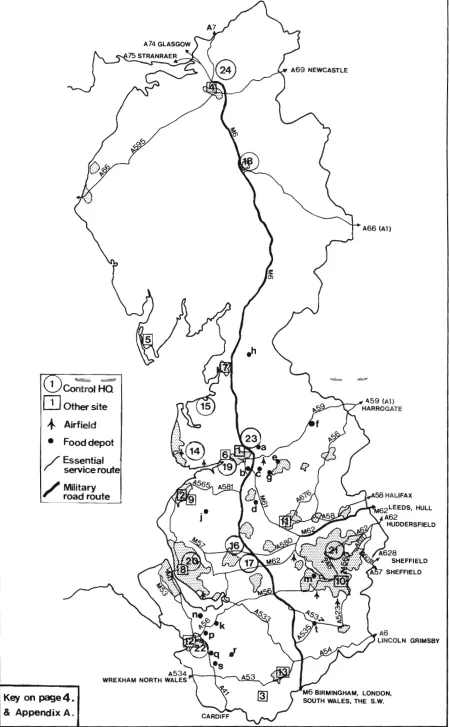
the Royal Observer Corps network are marked on figure
10 ;
the rest are listed inappendix
C.
Pye Telecommunications (who operate the back-up aerial forLancaster's fire, police and ambulance at Langthwaite) are currently wiring up the
new 'MOULD' system, which by the end of 1983 will give Regional Military
Commanders access to the. existing emergency services radio net to back up their
landline communications.23
The Microwave System
The Post Office supplements its cable network with a system of microwave towers which, double-routed away from likely targets, 'offers great capacity with high security'. The system carries 1V signals as well as thousands of telephone lines;
the network in the north-west is shown in figure
10 .
(Gas and electric boards, theUSAF and Air Traffic Control each have separate, smaller microwave systems; these are not shown).
The microwave system is more than just a secure system of emergency com-munications, for Britain is Europe's major centre of international communi-cations. A huge network of undersea cables and satellite stations feeds into the UK microwave system, which in turn carries a number of extra routes converging on the tower at Hunters Stones, near Harrogate, and from there by cable to the nearby secret US National Security Agency base at Menwith Hill---'America's big ear on Europe'. One of these special links, built in 1963, links Hunters Stones with Lancaster at Quernmore, via Proctor Heights and Thornton-in-Lonsdale (near Ingleton), and continues to the Isle of Man with possible links to Ireland and elsewhere. In 1977 Steve Wright, a researcher at Lancaster University, was arrested and questioned (but not charged) by the Special Branch because of his correspondence with Duncan Campbell---one of the journalists accused of
'spying' in the farcical ABC trial at the time-about the Quernmore microwave tower. The US/British system of international eavesdropping has enabled the two countries in the past to monitor the international activities of the anti-Vietnam war
movement and to make important interventions in international affairs. In a
pre-war 'period of rising tension' we can be sure that this monitoring system, including the Lancaster link, would be humming with activity to counter
diplo-matic and 'subversive' moves alike which threatened the prosecu tion of the war. 24
The U.K. Warning and Monitoring Organisation
(UKWMO)
The UKWMO exists to warn of, and to monitor, enemy attacks on Britain. On the one hand, It is connected with Strike Command. On the other hand, it is connected with Royal Observer Corps, whose volunteers monitor nuclear bursts and fallout from 873 underground monitoring posts in the UK. The information
from these is collated in 25 'group controls'. Two of these are in the north-west:
no. 22 next door to RAF Carlisle, and no. 21 at Langley Lane, Goosnargh, near Preston, which is also the UKWMO's Western Sector Control. The immense bunker here has recently been undergoing extensive renovation, as the photo-graphs show; site workers say it contains four floors and numerous beds. Nearby is
25
Top Centre: The massive UKWMO/ROC bunker, Langley
Lane, Goosnargh, with refurbishment
lagging)
going on one
Sunday in May, 1982.
.. n.rr~I~t'p to the
Mystery bunker, Lane, .
extensive tunnel network reported to centre on the massive UKWMO bunker at
the joint Ministry of Defence! Air Traffic Control radar station at Whittingham Lane, and further down the lane is another bunker of unknown purpose, equipped with heavy blast protection and a lift.
I (;roundZ..,:rulndICULI( ~ ~1I~(y Mctct Prob.,: Unit Lu ... .-r ) Bomb Power Il1dlGllur Bank Phi.") .. Ai, Vl,:nriJuor
} rn,:unulj, Arml (or R:lclu) ~;I
6 RlidioSct ? Bomb POW,-! Incl.c~lOr
. - I ROC h:l~·d Sl1rvry M,"h'r
9 FI..JIdioHnd Set )0 loud Spc-Ucr Tckpho,w
I I urricrRC'Ccivcr
11 Pump (or Pnl"\lm~ljc 1\,1'lal
I) 11VohB,mrry
14 Toilet
The group controls pass their information on to the military, to sub-regional HQs, and to 250 'carrier control points', mostly in police stations, which in turn alert 18,000 'warning points' (sirens) and 4,000 'warning recipients' (civil defence HQs, hospitals, public utilities etc.) Lancashire's sirens are activated from a control room in the country police HQ in Hutton. An officer at Menwith Hill, however, is on record as saying that he does not believe that either the four of the
thirty minute warn' will sound.
Royal Observer Corps monitoring post, Kendal. (See appendix B).
Although the ROC has been accused, with some justification, of complicity in war preparations, its volunteers' thankless task would be important even in a
27
Britain without nuclear weapons. Potential recruits from schools in the More-cam be area who are shown round a local monitoring post are sworn to secrecy about its location, and such information is often regarded as 'classified', but there
is no need for all this, since the ROC's official history contains a full list of its sites
(see appendix B).25
Electro
-
Magnetic Pulse
(EMP
)
There is every reason to believe that a Soviet attack on Europe would be preceded by an atmospheric nuclear explosion whose violent instantaneous EMP would knock out unprotected communications across the continent:
Present emergency services radio systems are all vulnerable, as are all boosted telephone lines (for example, the British system), all unprotected computers, all wide band width radio systems (these are especially vulnerable but are now being adopted by the emergency services) and virtually all equipment contain-ing sensitive electronics and wire circuitry. 26
British civil defence has only just woken up to this, and local planners (Bernard Hayes in Manchester, and the regional water board and health authority) now talk manfully about using 'runners' to carry messages and maroons to warn of fallout (though how the maroon operators get their information is not explained). The Regional Health Authority has a modest 'ongoing programme' to keep computers and other electrical equipment in tin boxes, behind cellar walls, or simply un-plugged when not in use but, doubtless like everyone else, has no money for any proper measures. The simple truth is that without the vulnerable electronic communications on which it so heavily relies, the region's civil defence will not function.
THE AFTERMATH
"Two or three weeks after the nuclear attack a situation might arise in which hundreds of thousands of people were living in grossLy overcrowded and often temporary accommodation, on a dull and largely inadequate diet, on an inadequate and potentially contaminated water suppLy and in insanitary conditions worse than those found in the poorest and most overcrowded areas of the under-developed countries. "
-DHSS circular HDC (77)1
"It would be unrealistic to think of extensive life-saving in the immediate aftermath of a nuclear attack. Present plans are based on a regime of minimum exposure to fallout and the need to ensure that essential workers are not exposed unnecessarily to the risk of radiation injury."
-Home Office circular ES3/1978
"We must recognise that people die in days or weeks: it takes months or years to restructure resources. "
+
Airfield • Food depot/ Essential service route
/ road route Military
Key on page
4.
& Appendix A.
[image:17.613.97.546.33.760.2]30
The second set of official instructions above applies to the 'hardest hit areas' which are defined in ES7/1973 as those where 60% of the people survive a fortnight after the attack; these would arguably be the lightest hit areas. Even the cautious approach shown in the second quote will prove disastrous. Official guidelines state that people can safely absorb up to 150 rads of radiation in two days and 10 rads a day thereafter, an assertion for which
there is no published scientific evidence ... it appears that emergency personnel in post-attack conditions will be expected to accumulate, as a matter of course, near lethal acute radiation exposures.
Furthermore, Home Office guidelines, on which all the emergency plans for the north-west which we have investigated appear to be based, do not seriously consider that an attack may occur in the depths of winter, or that it may be repeated over weeks or months, or that nuclear installations may be hit,. or that chemical and biological weapons may be used, or that EMP may wIpe out communications, or the devastating psychological effects which the experience will have on the survivors. This last is vital. Far from being animated by 'Dunkirk spirit', people at Hiroshima wandered aimlessly or fled blindly, often leaving friends and family behind; pre-arranged rescue teams did not form. Many sur-vivors were mentally 'destroyed' and have never recovered. Yet whereas in Hiroshima, outside rescue teams arrived and people began to return, in a widely devastated region, this would not happen. Probably, survivors would need to form armed bands and tribes and any remaining shreds of government would need to resort to totalitarian controls (though, as we shall see, what is actually being planned is not far different from this)Y
With these considerations in mind---or rather, temporarily forgetting them how would the emergency services in the north-west cope with a small local holocaust?
TBEBEALTB
SERVIC
E
"Hospitals should, initially, accept only those casualties who, after limited surgical procedures, would be likely to be alive after seven days, with a chance of eventual recovery ... people suffering from radiation sickness only should not be admitted."
-DHSS circular HDC(77)1
"All the dying would want is a bit of tender loving care. "
-Home Defence College war game organiser
The Region
In 1981 the government allocated £500,000 for the appointment of health service 'war planning officers' by the simple measure of wit holding part of each region's
I
31
normal budget unless this was done. In September, th~ North V:e~t ~egional Health Authority appointed Dr Charles Fairfax as 'Reglon~l Speclah~t In
Com-munity Medicine (Emergency Planning),.28 He freely admlt~ that thIS £35,000 budget is 'inadequate'; it will only support two or three staff w~th no money even for such basic tasks as surveying hospital buildings for blast resistance. Hence .the strategy is simply to organise a sort of b.asic sw:'i~abili~y into the health service, rather than to plan expensive protection. Wlthm thIS scheme, however, Dr Fairfax's approach is quite sophisticated. .
The computers which exist in each county control Will be used to keep tra.ck of surviving resources, such as hospital beds, and generally, remar.ks Dr FaIrfax, 'we're thinking of this degree of sophistication'. If these and their back-ups are destroyed by EMP (see above), local hi-fi shops could be looted to provide alternatives. The region has several dispersed printouts of doctors and their phone numbers----doctors are on the second rank of the telephone preference system, hospitals on the first-and to find a doctor, health officers would simply ring down the list until one answered. Although stocks of bandages, blood, plasma and drugs would rapidly be exhausted, there are no special stockpiles in the region, since 'there are no resources for that kind of expenditure'; in any case, drugs don't keep. Cambridge and East Anglia accordingly rely on 'cottage medicine', 'self-help' and herbal remedies (although East Anglia has reportedly since dropped the herbal side of this). As Dr Fairfax points out, herbs couldn't cure many nuclear casual-ties. In any case, they grow in seasons: 'you couldn't just go out and grow a crop of
digitalis (foxglove) if you needed it'. Such schemes are 'utter nonsense and totally unrealistic'. Instead, says Dr Fairfax, 'I look at chemical works with a greedy eye from the point of view of using them to revive civilisation'. The north-west has a large chemical industry (though how much would survive a nuclear attack is doubtful) and companies are being asked to earmark part of their stocks of certain chemicals for post-war use, since some basic drugs can be synthesised at bench-top level. Breweries, which grow yeast, could be used to grow penicillin. All in all, believes Dr Fairfax, 'we could cope if the bombs went off in different places, but we couldn't deal with it if a large number of bombs went off in one place'.
Lancaster-a local case
study
Lancaster's health plan was drawn up, without any financial aid, in 1980 and therefore has none of the vulnerable sophistications of more recent regional plans.
It became a model for the county's other five district health authorities--Preston,
Ormskirk, Blackpool, Blackburn and Burnley- although Lancaster has certain
special advantages. It is not a likely target, unless Heysham is hit, and as a major centre of health care it has three hospitals, two large mental hospitals and some
4,000 doctors, nurses, paramedics, care staff and administrators to draw upon.
How will Lancaster's unusually well-placed health service cope with a nuclear war?
32
anyone who is not frightened of blood'. They provide further treatment and s~lect
those to be admitted to hospitals. The district's 20 ambulances will ferry patIents between F APs, CCCs and hospitals if there is any petrol available. 'Doctors would be an absolute luxury' and would be confined to hospitals; they would work 8-hour shifts, considered the useful maximum, but would also do house calls---their work load will be tremendous. Hospital admissions will be based on the 'triage' system invented to cope with the unprecedented battlefield casualties of World War L only those who are likely to survive will be admitted. People who will probabl~ not die will be treated at F APs and CCCs and sent home, while the doomed will simply pile up. To enforce this system, hospitals will be guarded by the police and will only admit from CCCs, while CCCs will (in theory) admit only from FAPs, and be guarded by 'bouncers in all but name'. . .
In the pre-attack period, CCCs and F APs will be open to make people famIlIar with them. They will then close, along with the hospitals, and F APs will open first, followed by CCCs and finally, after a fortnight or more, the hospitals. Unfortun-ately, the local health service depends entirely on other authorities for radiation advice which, as has been shown, may not materialise and may in any case prove fatally misleading.
Before the attack, the hospitals will send patients home to make room for casualties; the DHSS recommends 70% of maternity cases, 60% of acute cases, 50% of non-active infections, 15% of psychiatric cases and all convalescents, whatever their condition. Only emergency cases and women needing caesarian sections will be admitted. In Lancaster, Beaumont and Queen Victoria hospitals will have to close completely for the attack, while the Infirmary and the Moor, both much older and with extensive tunnel and cellar accommodation, will remain open with a skeleton staff of volunteers---volunteers because staff cannot .be expected to leave their families. The Albert hospital, likewise old and extendmg underground, will become the centre for the city's mental patients, taking many from the Moor while its own 800 complement will have to be reduced by half-a measure which staff consider impossible, since most patients cannot look after themselves and have nowhere else to go. Mental patients, it seems, are a big unsolved problem.
The Moor Hospital, since it has cellars and the district emergency services radio transmitter (the back-up is at Langthwaite) provides a natural HQ for the locc:!
health service's war officers, who are as follows:
War designation
District Health Director
Senior Nurse
Administrator Treasurer
Works Officer
plus supporting staff"
Dietician Pharmacist Catering Officer Catering staff Telephonist
2-3 personal secretaries
Current civilian job
Community Health Officer
District Nursing Officer District Administrator
District Treasurer
District Works Officer
District Dietician District Pharmacist
Moor Hospital Catering Officer Moor Hospital catering staff
(Each officer has a designated deputy; details will vary between districts).
I
33
These officers will also run the Moor Hospital. The other hospitals will be run by a triumvirate of a director (an administrator), a senior doctor and a senior nurse, with similar supporting staff.
The standby health service HQ is at the Community Health Offices, Slyne Road, from where the district's 600-700 personal radios are controlled (or will be in 1983, when this system begins). Doctors and nurses, however, will stay at home, having been told where to report after attack through their computerised monthly pay slips, assuming a pay day can be arranged during the 'period of rising tension'. Such a move was reportedly considered after the 1980 Russian invasion of Afghan-istan, but was not implemented for fear of causing alarm. Lancaster has a modest stockpile of drugs, regularly turned over, believed to have been begun some ten years ago, perhaps at the time of the 1973 Arab-Israeli war. Stocks of vaccine, however, are limited; barely enough, for example, to immunise health service staff against typhoid and diptheria--some 4,000 shots at most. With disease likely to be rife from dead bodies, polluted water and plagues of vermin (which develop immunities and breed quickly in such uncontrolled conditions), the outlook even for initially healthy survivors looks bleak.
A Direct Bit
As figure 7 shows a one megaton bomb on Lancaster would destroy all five hospitals; one on Heysham would very probably do the same, regardless of the catastrophic radiation effects. In the event of a direct hit, five other casualty collecting centres might be established at Bailrigg, Galgate, Hornby, Silverdale and Borwick, and an emergency operating theatre may be set up at St John's Hospital, Silverdale, although damaged roads and bridges would seriously hamper the transport of survivors even if fuel and transport were still available. Official guidelines rule out help between districts; some districts may bravely ignore this.
The vulnerability of Lancaster's health service to a direct hit is not at all unusual, given the sheer power of modern weapons and the NHS's long-standing policy of centralisation, which war planning has done nothing to change. (The same goes for hospital design; Barrow's new hospital has been built, entirely above ground). In Birkenhead, as a local consultant in emergency care has pointed out, 'most of the hospitals would be completey demolished or seriously damaged by the attack. I can't see any way they could provide a useful service at all'. All nine of Sheffield's hospitals would be flattened by a single nuclear bomb.29
The ethical problems of planning for nuclear war, particularly of sorting casual-ties so as to condemn many potential survivors to death, have led many confer-ences of eminent physicians round the world to declare that nuclear war is medically untreatable, and that the only possible cure is prevention, in the form of disarmament. Comparing the best efforts being made in the under-financed, over-technological and over-centralised health service in the north west with the likely minimum of nuclear damage, one can only agree with them.
FOOD
"Most local authorities are incapable o/implementing the present procedures."
34
A government which can organise itself a near-monopoly on food supplies wields enormous power in a war or insurrection. The main effect of the current emer-gency feeding .system will be to give it this power; food will be supplied, but probably only m return for work or good behaviour. There are two sides to the system: supply, which will be mainly organised by Regions and Sub-Regions; and distribution, which will mainly be the concern of counties and districts.
S
u
ppl
y
In peacetime, the Ministry of Agriculture, Fisheries and Food (MAFF) oversees emergency planning. The north-west is covered by three regional offices (in Newcastle, Leeds and Wolverhampton); these will apparently be absorbed into Regional and Sub-regional government. MAFF already has a number of semi-secret food buffer depots in the region (see appendix A) which contain stocks of 'flo~r, yeast, sugar,. refined fat and special biscuits', plUS emergency feeding eqUIpment. These Will need to be supplemented by other stocks which MAFF will lay in nearer the time, using emergency powers to requisition farm and other supplies. Regional government will take control of MAFF flour mills