Citation:
Jarzabkowski, P and Giulietti, M and Oliveira, B and Amoo, NA (2011) Use or Value? Practical Adoption of Strategy Tools in Different Stages of the Strategy Process. In: The European Group for Organizational Studies (EGOS) 27th EGOS Colloquium on Reassembling Organizations, 06 July 2011 - 09 July 2011, Gothenburg, Sweden.
Link to Leeds Beckett Repository record: http://eprints.leedsbeckett.ac.uk/5796/
Document Version:
Conference or Workshop Item
The aim of the Leeds Beckett Repository is to provide open access to our research, as required by funder policies and permitted by publishers and copyright law.
The Leeds Beckett repository holds a wide range of publications, each of which has been checked for copyright and the relevant embargo period has been applied by the Research Services team.
We operate on a standard take-down policy. If you are the author or publisher of an output and you would like it removed from the repository, please contact us and we will investigate on a case-by-case basis.
‘Use or Value? Practical Adoption of Strategy Tools in Different Stages of the Strategy
Process
Abstract
Strategy tools such as scenario planning and Porter’s Five Forces are institutionalized strategy practices that have been developed in order to support the strategy work of practitioners and organizations. However, little research has been concerned with the practicalities of using strategy tools. This paper addresses this gap through a large scale survey of variation in the value that managers accord to different strategy tools in different stages of the strategy process. The findings show that: a) strategy tools use and value are not strongly correlated; and b) the correlation of use with value decreases progressively from the strategy analysis, to strategic choice, to strategy implementation phases of the strategy process. Essentially, despite high use of some strategy tools in all phases of the strategy process, these tools are not always accorded high practical value. This finding indicates the institutionalized nature of strategy practices, and identifies important avenues for future research into the use of strategy tools in practice.
Introduction
Strategy practices are an important part of the strategy work of practitioners (Jarzabkowski, 2004; Whittington, 2006). One important set of practices are strategy tools such as scenario planning and Porter’s Five Forces which have been shown to support both strategic decision making (Clark & Scott, 1999) and strategic planning activities (Grant, 2003). Indeed, managers invest considerable resources in terms of time, money and intellectual capital, in acquiring and using these kinds of tools (Rigby, 2001; Rigby & Gillies, 2000). Although these tools tend to be considered formal practices of strategy, some recent research has shown that they trigger informal strategizing activities (Jarratt & Stiles, 2010; Stenfors & Tanner, 2006). Despite this fact, little research has been concerned with the practicalities of using strategy tools. In fact, extant research on strategy tools has typically been grounded in instrumental principles about the way tools should be used (e.g. March, 2006), rather than examining their actual use in practice (Jarzabkowski & Spee, 2009). We therefore need further research to explain how strategy tools are incorporated in the practical, everyday strategy work of organizations (Jarzabkowski & Wilson, 2006; Whittington, 2003; Whittington, 2006).
This paper addresses this gap through a large scale survey of where in the strategy process managers use different strategy tools and what value they accord to that use in different phases. In so doing, this paper makes three main contributions. Firstly, it advances our knowledge about the use of strategy tools, providing descriptive information about the levels of use of 10 of the most popular strategy tools; and differentiating levels of use and value attributed to each tool in each stage of the strategy process. Secondly, it compares a representational and practice epistemology of knowledge utilization, suggesting that managers have an underlying practice perspective that emphasizes an informal and pragmatic use of strategy tools. Thirdly, it compares a rational view with a sociological view of strategy tools use, highlighting that other factors beyond rationality seem to be at play when managers actively use tools for their strategizing activities.
most popular tools are identified and compared, showing those tools that are statistically more valued for each stage.
Theoretical Background
Rational view versus social view of strategy tool use
The question of why practices (such as strategy tools) are adopted and used by managers has been widely debated in the literature. In most cases, this debate has been divided into rational and social motivations for adoption (Ansari, Fiss, & Zajac, 2010; Kennedy & Fiss, 2009; Sturdy, 2004; Tolbert & Zucker, 1983). The rational argument is rooted in the economic literature and assumes that a tool will be intentionally adopted because it offers some kind of economic benefit (Lovett, 2006). In other words, the decision to adopt a tool is based on technical issues and expectations about efficiency gains (Katz & Shapiro, 1987; Teece, 1980). This rational view of tool adoption embodies the dominant perspective in the strategy field (Mintzberg, Ahlstrand, & Lampel, 1998), which has mainly focused on rational choice and championed strategy as a formal, conscious and controlled process. From this perspective, rational managers will use the tools that they consider more valuable for their strategy work.
Proposition 1a: If managers use strategy tools rationally, tool use and value will be highly correlated for the different stages of the strategy process.
Proposition 1b: If non-rational motivations influence managers’ use of strategy tool, tool use and value will not be correlated in the different stages of the strategy process.
Representational epistemology versus practice epistemology of knowledge use
From a representational epistemology, strategy tools are designed to be used in a prescriptive fashion where thought precedes action and where managers use tools in the way they are taught (Clegg, Carter, & Kornberger, 2004; Jarzabkowski & Wilson, 2006; Tsoukas & Knudsen, 2002). In this view, the strategist is a rational actor capable of understanding the context and deciding whether to use certain tools or discard them (Jarzabkowski & Wilson, 2006). Managers would thus be expected to use strategy tools in specific phases of the strategy process, in line with their business education and training. The argument is supported by an institutionalized, normative perspective on knowledge use (DiMaggio & Powell, 1983; Mizruchi & Fein, 1999). According to a normative view, two forces would shape the way managers use knowledge and the tools derived from it. First, people in a given profession tend to receive the same kind of education and training which would reinforce a certain way of doing things. Secondly, members of a certain profession tend to actively interact with each other through professional associations, conferences or business meetings. These networking activities would then reinforce certain rules for using strategy tools (DiMaggio & Powell, 1983; Mizruchi & Fein, 1999)
Proposition 2a : A representational epistemology would predict that managers use strategy tools in specific stages of the strategy process prescribed by strategy theory.
Proposition 2b: A practice epistemology would predict that managers use strategy tools with little concern for their prescribed use in different stages of the strategy process.
Strategy process stages
Strategy researchers and theorist have long sought to develop frameworks that illustrate the nature of the strategy process (e.g. Ackoff, 1970; Andrews, 1971; Ansoff, 1965; Dyson & O'Brien, 1998), albeit with some disagreement. While some consider that it is possible to distinguish conceptually between stages in the strategy process (e.g. Ansoff, 1965; Ansoff, 1991), others consider that any identification of stages in strategy is artificial and therefore irrelevant (e.g. Mintzberg, 1990).
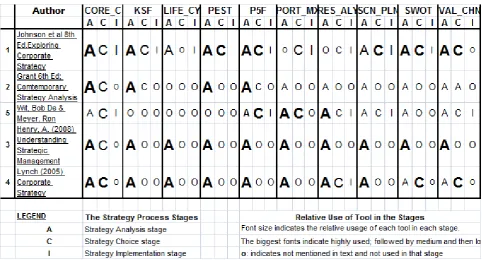
This paper takes the view that it is theoretically possible and analytically useful to identify different stages of the strategy process although, in practice, they may be intertwined. Understanding those stages of the strategy process in which different strategy tools are used will help us in our goal of providing greater detail about the actual use of strategy tools in organizations and enable us to examine the propositions we have identified. Therefore, this paper considers that the strategy process has three stages: strategy analysis, choice and implementation (Hopkins & Hopkins, 1997). This position was taken for three reasons. First, in our pilot interviews managers recognized these stages. Second, these stages cover the diverse activities involved in strategic management. Third, various strategy process frameworks proposed in the literature and in strategic management texts implicitly or explicitly identify these stages (e.g. Ansoff, 1965; Boyd & Reuning-Elliott, 1998; Dyson & O'Brien, 1998; Johnson, Scholes, & Whittington, 2008).
Table 1: Expected Use of Strategy Tools Based on Strategy Texts
Research Method
Sample and Data Collection
Data for this study was gathered through a survey of a population of domestic and international alumni, both undergraduate and postgraduate, from 12 of the top 30 UK business schools. In order to ensure informant quality and response validity, we took a number of informant competency steps that have been used in previous research (e.g. Katsikeas, Samiee, & Theodosiou, 2006; Tanriverdi & Venkatraman, 2005). First, we focused on higher-ranked schools because these schools have higher graduate employment, ensuring that respondents are employed in positions where they might reasonably have an opportunity or need to use strategy tools. Second, top business schools in the UK attract a diversified alumni population which gives us a cross-cultural base for our research. Third, we surveyed respondents’ who have had varying and considerable years of job experience, ensuring that they had wide opportunities to use tools in their work activities.
Falshaw, 1999; Hodgkinson, Whittington, Johnson, & Schwarz, 2006), suggesting that our study has captured those strategy tools typically taught and, therefore, more likely to be used. The survey was then administered online to a population of 20,108 domestic and international alumni in a sample of 12 out of the top 30 UK business schools. The specific response rate from our target population (business school alumni who have done a foundation strategy course) is difficult to ascertain, as we do not have figures for non-responsive email accounts However, the response rate from total numbers emailed, without excluding non-responsive emails or non-target population, is 14.2%. The survey was in 4 sections. For the section of the survey that we analyse in this paper, we gained 1407 usable responses.
Measures
We assessed respondents’ use of strategy tools by asking them to indicate which tools they are currently using from our list of top 20 tools. We then asked them to rank the tool that they use most frequently from that list. From analysing the frequency count, we conclude that only 10 of the tools are typically used by our respondents and therefore we focus only on these tools in subsequent analyses.
1. We assessed mangers’ use of the top tool by asking them to identify in which stages they applied it. We used the following three stages: a) Strategy analysis and formulation (e.g. Analysing internal and external environment and/or establishing a strategic direction); b) Strategic choice (e.g. Generating strategic options and/or evaluating these options and/or choosing a strategy); c) Strategy implementation (Developing detailed plans; implementing these plans; monitoring, controlling & reviewing strategic performance).
2. We assessed value of that tool for each of the three strategy stages by asking respondent to indicate on a 5 – point Likert scale (anchored between 1, adds little value to 5, adds much value) the extent to which the tool adds value to that stage.
Results (Full paper will show the tables mentioned below)
A Cross tabulation procedure was used to show how managers allocated each tool to the different stages of the strategy process.
Table 3 indicates that, in total, respondents use strategy tools more in the strategy analyses and formulation stage (77.9%) than in strategy choice (67,6%) or implementation (59,1%). The results show that particular tools are very prominent in their use during the strategy analysis activity (e.g. SWOT = 88.3%; PESTLE = 90.2%; and Porter 5 Forces = 87.3%), while others stand out in strategic choice (e.g. e.g. Portfolio Matrices = 86.8%; Core Competences = 78,4%; Scenario Planning = 77.3%) or strategy implementation (Resource Analysis= 83.3%; Critical Success Factors = 78.3%).
These results thus show that respondents select and use their top tools differently for different stages of the strategy process. We were thus interested to probe this further by examining how the value managers attribute to the tools is related with their levels of use in each stage.
Tables 4 to 6 show the results of the mean and standard deviation for each of the 10 tools in each stage of the strategy process (formulation, choice and implementation). For example, Table 4 indicates that PESTLE (4.47), Core Competences (4.20) and Portfolio Matrices (4.18) are the tools most valued for strategy analysis while Life Cycle (3.50), Resource Analysis (3.74) and Critical Success Factors (3.75) are the least valued tools. We did a one-way ANOVA Turkey Multiple Comparison test, which highlights significant statistical differences between the different tools in each stage of the strategy process. For example, scenario planning is significantly more valuable in strategy formulation stage than the life cycle model (mean difference 0.647; p=0.008) or key success factors (mean difference 0.399; p=0.008).
Table 5 highlights that Scenario Planning (4.13), Portfolio Matrices (4.11) and Core Competences (4.10) are the tools most valued for strategy choice while SWOT (3.66), Critical Success Factors (3.68) and PESTLE (3.75) are the least valued tools. One-way ANOVA tests show that, for example, scenario planning was found to be significantly more valued for strategy choice than SWOT (mean difference 0.474; p=0.000) or key success factors (mean difference 0.451; p=0.002). In general, the value attributed to strategy tools in the strategy choice stage is lower than in strategy analysis.
(3.04), PESTLE (3.19) and Portfolio Matrices (3.22) are the least valued tools. The one-way ANOVA highlights statistical differences, such as that the value chain is more valued for strategy implementation than SWOT (mean difference 0.543; p=0.002) and Porter five forces (mean difference 0.718; p=0.005). The value attributed to strategy tools in the strategy implementation stage is considerably lower than in strategy analysis or choice.
Table 7 shows a rank-order correlation which highlights the discrepancies between the level of use of strategy tools and the value attributed to them in the different stages of the strategy process.
Some results of individual tools are interesting to highlight. For example although SWOT is the most popular tool in terms of its percentage usage (ranked 1st), it is lowly ranked (7th or lower) in terms of the value it adds during the strategy stages and indeed it is ranked least (10th) in terms of the value it adds during the strategy choice activities. This suggests that some other features of the tool drive its use, as its popularity during the strategy stages is not due to the added value. Portfolio Matrices confirm this divergence between tool usage and tool value although in the opposite direction. While it is the lowest ranked tool (10th) in terms of use, it is highly valued for strategy analysis (2nd) and choice (3rd) (see Table 7).
However, this discrepancy between tool usage and tool value does not apply to all tools. For example, tools like Resource Analysis and Lifecycle Model are both more used in the strategy implementation stage (83.3% and 76.3% respectively) than in the other two strategy phases and also more highly valued, being ranked 2nd and 3rd respectively (see strategy implementation column of table 7).
Discussion and Conclusion
Matrices were mainly regarded an analysis tool in strategy texts (see Table 1) but mangers use them more for choice. These findings counter the dominant assumptions about representationalist epistemology of knowledge use and indicate that managers themselves hold a practice epistemology in their use of strategy tools.
Secondly, we found that strategy tools use and value are not strongly correlated. In fact, our results showed that some tools are highly used although managers clearly attribute less value to them (e.g. SWOT). This may be an indication that institutionalized norms drive the adoption of those strategy tools.
References
Ackoff, R. 1970. A concept of corporate planning. Long Range Planning, 3(1): 2-8.
Andrews, K. 1971. The Concept of Corporate Strategy. Homewood, Ill.: Irwin.
Ansari, S. M., Fiss, P. C., & Zajac, E. J. 2010. MADE TO FIT: HOW PRACTICES VARY AS THEY
DIFFUSE. Academy of Management Review, 35(1): 67-92.
Ansoff, I. 1965. Strategy and Structure: An Analytical Approach to Business Policy for Growth and
Expansion. New York: McGraw Hill.
Ansoff, I. 1991. CRITIQUE OF HENRY MINTZBERG'S 'THE DESIGN SCHOOL:
RECONSIDERING THE BASIC PREMISES OF STRATEGIC MANAGEMENT'. Strategic
Management Journal, 12: 449-461.
Boyd, B. K., & Reuning-Elliott, E. 1998. A measurement model of strategic planning. Strategic
Management Journal, 19(2): 181-192.
Clark, D. N., & Scott, J. L. 1999. Strategic level MS/OR tool usage in the United Kingdom and New
Zealand: A comparative survey. Asia-Pacific Journal of Operational Research, 16(1): 35.
Clegg, S., Carter, C., & Kornberger, M. 2004. Get up, I feel like being a strategy machine. European
Management Review, 1(1): 21-28.
Comtois, E., Denis, J.-L., & Langley, A. 2004. Rhetorics of Efficiency, Fashion and Politics: Hospital
Mergers in Quebec. Management Learning, 35(3): 303-320.
Cook, S. D. N., & Brown, J. S. 1999. Bridging Epistemologies: The Generative Dance between
Organizational Knowledge and Organizational Knowing. Organization Science, 10(4):
381-400.
DiMaggio, P. J., & Powell, W. W. 1983. The Iron Cage Revisited: Institutional Isomorphism and
Collective Rationality in Organizational Fields. American Sociological Review, 48(2):
147-160.
Dyson, R., & O'Brien, F. 1998. Strategic development: methods and models: John Wiley & Sons Inc.
Glaister, K. W., & Falshaw, J. R. 1999. Strategic Planning: Still Going Strong? Long Range
Planning, 32(1): 107-116.
Grant, R. 2003. Strategic planning in a turbulent environment: evidence from the oil majors. Strategic
Management Journal, 24(6): 491-517.
Green, S. E., Yuan, L. I., & Nohria, N. 2009. SUSPENDED IN SELF-SPUN WEBS OF
SIGNIFICANCE: A RHETORICAL MODEL OF INSTITUTIONALIZATION AND
INSTITUTIONALLY EMBEDDED AGENCY. Academy of Management Journal, 52(1):
11-36.
Hodgkinson, G. P., Whittington, R., Johnson, G., & Schwarz, M. 2006. The Role of Strategy
Workshops in Strategy Development Processes: Formality, Communication, Co-ordination
Hopkins, W. E., & Hopkins, S. A. 1997. Strategic planning-financial performance relationships in
banks: a causal examination. Strategic Management Journal, 18(8): 635-652.
Jarratt, D., & Stiles, D. 2010. How are Methodologies and Tools Framing Managers' Strategizing
Practice in Competitive Strategy Development? British Journal of Management,
Forthcoming.
Jarzabkowski, P. 2004. Strategy as Practice: Recursiveness, Adaptation, and Practices-in-Use.
Organization Studies, 25(4): 529-560.
Jarzabkowski, P., & Spee, P. 2009. Strategy-as-practice: A review and future directions for the field.
International Journal of Management Reviews, 11(1): 69-95.
Jarzabkowski, P., & Wilson, D. C. 2006. Actionable Strategy Knowledge:: A Practice Perspective.
European Management Journal, 24(5): 348-367.
Johnson, G., Prashantham, S., Floyd, S. W., & Bourque, N. 2010. The Ritualization of Strategy
Workshops. Organization Studies, 31(12): 1589-1618.
Johnson, G., Scholes, K., & Whittington, R. 2008. Exploring corporate strategy: text & cases, 8th ed.:
Financial Times/Prentice Hall.
Katsikeas, C. S., Samiee, S., & Theodosiou, M. 2006. Strategy fit and performance consequences of
international marketing standardization. Strategic Management Journal, 27(9): 867-890.
Katz, M. L., & Shapiro, C. 1987. R and D Rivalry with Licensing or Imitation. The American
Economic Review, 77(3): 402-420.
Kennedy, M. T., & Fiss, P. C. 2009. INSTITUTIONALIZATION, FRAMING, AND DIFFUSION:
THE LOGIC OF TQM ADOPTION AND IMPLEMENTATION DECISIONS AMONG U.S.
HOSPITALS. Academy of Management Journal, 52(5): 897-918.
Lovett, F. 2006. Rational Choice Theory and Explanation. Rationality and Society, 18(2): 237-272.
March, J. G. 2006. Rationality, foolishness, and adaptive intelligence. Strategic Management
Journal, 27(3): 201-214.
Miller, C., & Ireland, R. 2005. Intuition is strategic decision making: Friend of foe in the fast-paced
21st century. IEEE Engineering Management Review, 33(2): 30-30.
Mintzberg, H. 1990. THE DESIGN SCHOOL: RECONSIDERING THE BASIC PREMISES OF
STRATEGIC MANAGEMENT. Strategic Management Journal, 11: 171-195.
Mintzberg, H., Ahlstrand, B., & Lampel, J. 1998. Strategy Safari: The Complete Guide through the
Wilds of Strategic Management. London: Financial Times.
Mizruchi, M. S., & Fein, L. C. 1999. The Social Construction of Organizational Knowledge: A Study
of the Uses of Coercive, Mimetic, and Normative Isomorphism. Administrative Science
Quarterly, 44(4): 653-683.
Pentland, B. T., & Feldman, M. S. 2005. Organizational routines as a unit of analysis. Industrial and
Corporate Change, 14: 793-815.
Rigby, D. 2001. Management Tools and Techniques: A SURVEY. California Management Review,
Rigby, D., & Gillies, C. 2000. Making the most of management tools and techniques: a survey from
Bain & Company. Strategic Change, 9(5): 269-274.
Stenfors, S., & Tanner, L. 2006. High-level decision support in companies: where is the support for
creativity and innovation? In Adam F., P. Brezillon, S. Carlsson, & P. Humphreys (Eds.),
Creativity and Innovation in Decision Making and Decision Support, Vol. 1: 215-235.
London: Decision Support Press.
Sturdy, A. 2004. The Adoption of Management Ideas and Practices: Theoretical Perspectives and
Possibilities. Management Learning, 35(2): 155-179.
Tanriverdi, H., & Venkatraman, N. 2005. Knowledge relatedness and the performance of
multibusiness firms. Strategic Management Journal, 26(2): 97-119.
Teece, D. J. 1980. The Diffusion of an Administrative Innovation. Management Science, 26(5):
464-470.
Tolbert, P. S., & Zucker, L. G. 1983. Institutional Sources of Change in the Formal Structure of
Organizations: The Diffusion of Civil Service Reform, 1880-1935. Administrative Science
Quarterly, 28(1): 22-39.
Tsoukas, H., & Knudsen, C. 2002. The Conduct of Strategy Research. In A. Pettigrew, H. Thomas, &
R. Whittington (Eds.), Handbook of Strategy and Management: 411-435. London: Sage
Publications.
Whittington, R. 2003. The work of strategising and organising: for a practice perspective. Strategic
Organisation, 1(1): 56-65.
Whittington, R. 2006. Completing the Practice Turn in Strategy Research. Organization Studies
(01708406), 27(5): 613-634.
Zeitz, G., Mittal, V., & McAulay, B. 1999. Distinguishing Adoption and Entrenchment of