A Monthly Double-Blind Peer Reviewed Refereed Open Access International e-Journal - Included in the International Serial Directories.
International Research Journal of Human Resources and Social Sciences (IRJHRSS) 31 | P a g e International Research Journal of Human Resources and Social Sciences Impact Factor- 3.866
Vol. 3, Issue 4, April 2016 ISSN(O): (2349-4085) ISSN(P): (2394-4218)
© Associated Asia Research Foundation (AARF)
Website: www.aarf.asia Email : [email protected] , [email protected]PERFORMANCE OF HANDLOOM WEAVERS’ CO-OPERATIVE
SOCIETIES – A STUDY OF WARANGAL DISTRICT
Dr. B. Sadanandam,
Lecturer (P.T.), Department of Sociology
University Arts & Science College, Subedari, Warangal
ABSTRACT
The Handloom Sector occupies a distinct and unique place in the Indian economy,
besides being the largest generator of non-form rural employment. The available statistics
indicate that there is still an immense scope for expansion. Handloom Industry is the largest
cottage industry in India occupying a prominent place in the economy of the country and
scattered over the Indian villages. Nearly one third of the clothing requirement in the country
is provided by handloom sector Andhra Pradesh of India has much economic importance and
fabrics are being exported to various countries. The principal objective of this paper is to
analyze the profile of the sample Primary handloom Cooperative Societies in Andhra
Pradesh, with a view to identify their performance of Primary Handloom Cooperative
societies in three selected districts of Andhra Pradesh.
KEYWORDS: Handloom, Finance, share capital, cooperatives.
Introduction
The Handloom Sector occupies a distinct and unique place in the Indian economy,
besides being the largest generator of non-form rural employment. The available statistics
indicate that there is still an immense scope for expansion. Handloom Industry is the largest
cottage industry in India occupying a prominent place in the economy of the country and
scattered over the Indian villages. Nearly one third of the clothing requirement in the country
A Monthly Double-Blind Peer Reviewed Refereed Open Access International e-Journal - Included in the International Serial Directories.
International Research Journal of Human Resources and Social Sciences (IRJHRSS) 32 | P a g e On attaining Independence Government of India rightly recognized the important role
that the industry can play and a number of policies were formulated and executed to bring the
industry on a sound footing. Development of industry on cooperative lines was the cardinal
idea in all these plans. Cooperation has the advantage of bringing freedom and opportunity
for people with profits of large scale management and organization. Cooperative societies
are expected to perform functions of bulk purchase of raw material, raise capital by the issue
of shares, procure finished goods from members and market them. In the earlier days, the
weavers were organized into purchase and sale societies leading to malpractice of purchasing
cloth from others and arranging its disposal through the Apex society. Thus the very purpose
of organizing weavers co-operatives for providing work to weavers was defeated as the
members of the societies did not receive employment from the societies. At that stage, to ensure the cloth produced for sale by the apex society in its selling units, the “purchase and sale societies” were converted into “Production and sale societies”. These were made
obligatory to distribute yarn to the members, get cloth produced on their looms and take it
back for sale either in their selling units or in the selling units of apex society.
Handlooms constitute a timeless facet of the rich cultural heritage of India. As an
economic activity, the handlooms occupy a place second only to agriculture in providing
livelihood to the people. The element of art and craft present in Indian handlooms makes it a
potential sector for the upper segments of domestic and global market. However, the sector is
facing with many problems such as obsolete technologies, unorganized production system,
low productivity, inadequate working capital, conventional product range, weak marketing
link, overall stagnation of production and sales and, above all, competition from power looms
and mill sector. As a result of effective Government intervention through financial assistance
and implementation of various developmental and welfare schemes, the handloom sector, to
some extent, has been able to tide over these disadvantages. The production of handloom
fabrics has gone up to 6536 million sq. meters in 2006-07, from 500 million sq. meters in the
early fifties. During 2007-082 (upto Oct. 2007), the production of cloth is 4001 mn. sq. mtr.
and it is expected to reach 7,074mn. sq.mtr, by March 2008. The sector accounts for 13 per
cent of the total cloth produced in the country (excluding clothes made of Wool, silk and
A Monthly Double-Blind Peer Reviewed Refereed Open Access International e-Journal - Included in the International Serial Directories.
International Research Journal of Human Resources and Social Sciences (IRJHRSS) 33 | P a g e 2. Objectives of The Study
The main objective of this study is to appraise the profile and general working
conditions and assess the problems and performance of the Primary Handloom Weavers
Cooperative Societies in Warangal district.
3. Sample Design
The following methodology is adopted to achieve the above objectives. Both primary
and secondary data sources of information are used to carry out the present study. The
Primary data are collected by interacting with the Board of Directors and member Weavers of
various Primary Handloom Cooperative Societies. Proper care was taken to explain to the
cooperative societies all the aspects in the schedule to elicit truthful and unexaggerated
feedback from them. The samples are drawn in such a way as to reflect the characteristics of
the total cooperative societies. The secondary data were collected from 2004-13. The relevant
data are collected from the offices of the Development commissioner for Handloom
Government of Andhra Pradesh, the Director of Handlooms and Textiles Hyderabad,
Assistant Director of Handlooms of Warangal district.
4. Performance of Handloom Weavers’ Co-Operative Societies
Warangal District is one of the leading districts in handloom Industry in Telangana Region. There are 45 Weavers’ Co-operative Societies in the District at present providing
work to 74,905 members. The main products are Sarees, Dhoties, Lungies and Towels. In
addition to the above common varieties, export varieties of Shatranjies of Shatranji “Handloom Weavers” Co-operative Society Limited”, Mattewada, Warangal, Silk Sarees of
Jangaon area and Mercyrized Tie and Die variety Sarees and Mercyrized Dhoties of Ghanpur
area are unique and pride products of the District.
In order to ascertain the performance of Warangal District in regard to the performance of Handloom Cotton Weavers’ Co-operative Societies in terms of No. of
Societies, No. of weaver-members, value of production as well as sales and percentage of
sales to production, it is also necessary to know the performance of undivided Andhra
Pradesh in this regard. The comparative performance of Warangal District in relation to
undivided Andhra Pradesh is also necessary to assess the position of Warangal in Andhra
A Monthly Double-Blind Peer Reviewed Refereed Open Access International e-Journal - Included in the International Serial Directories.
International Research Journal of Human Resources and Social Sciences (IRJHRSS) 34 | P a g e It can be seen from Table –1 that the trends in the growth of No. of Societies in terms
of indices in undivided Andhra Pradesh as well as in Warangal District have shown a slight
rise upto 2005-06 and later on a steep fall to 39.32 for undivided Andhra Pradesh and 37.04
for Warangal in 2006-07. In the subsequent period, the trends in regard to this aspect for
undivided Andhra Pradesh has varied in a small range of 40.02 for undivided Andhra Pradesh
in 2007-08 and 42.03 in 2008-09 and for Warangal, it has remained constant for two years
i.e., 2008-09 and 2009-10 at 41.03. The data in regard to production as well as sales has
shown a rising trend till 2008-09 for Warangal, where it is higher than that undivided Andhra
Pradesh but afterwards the rising trend can be noticed for undivided Andhra Pradesh and
A Monthly Double-Blind Peer Reviewed Refereed Open Access International e-Journal - Included in the International Serial Directories.
International Research Journal of Human Resources and Social Sciences (IRJHRSS)
[image:5.842.23.819.133.406.2]35 | P a g e TABLE – 1 : TRENDS IN THE PERFORMANCE OF HANDLOOM COTTON WEAVERS’ CO-OPERATIVE SOCIETIES IN
UNDIVIDED ANDHRA PRADESH AND WARANGAL DISTRICT.
Sl. No.
Particulars 2003-04 2004-05 2005-06 2006-07 2007-08 2008-09 2009-10 2010-11 2011-12 2012-13
I. No. of Societies :
a) Andhra Pradesh 100.00 102.38 102.53 39.32 40.02 42.03 45.02 46.00 46.02 46.03 b) Warangal 100.00 103.26 102.71 37.04 36.02 41.03 41.03 44.01 44.01 45.00
II. No. of Weavers :
a) Andhra Pradesh 100.00 70.02 71.03 72.01 69.04 68.01 69.01 62.01 70.04 71.02 b) Warangal 72.62 73.21 72.52 76.30 74.92 75.51 74.39 76.53 75.71 77.28
III. Production :
a) Andhra Pradesh 100.00 102.10 113.10 121.85 95.89 115.75 217.30 165.82 156.49 161.88 b) Warangal 56.65 62.10 138.75 153.45 302.71 302.65 135.38 114.99 59.49 37.03
IV. Sales :
a) Andhra Pradesh 100.00 674.55 749.59 824.78 904.32 1096.64 263.92 1107.98 1081.04 1105.24 b) Warangal 100.00 774.55 1570.76 1237.66 473.28 789.45 827.38 679.96 652.02 651.63
Source : Annexure 3(a) and 3(b)
A Monthly Double-Blind Peer Reviewed Refereed Open Access International e-Journal - Included in the International Serial Directories.
International Research Journal of Human Resources and Social Sciences (IRJHRSS) 36 | P a g e During the year 2006-07, the cash credit limits for 22 Societies have been renewed to
the extent of Rs. 76.29 lakhs by the DCCB Limited (District Co-operative Central Bank),
Warangal. The remaining Societies are not eligible as per the norms laid down by the “NABARD”. The membership in Societies has been increased earlier mainly on account of
the share capital assistance provided by Government. But, later on the membership has gone
down due to the shortage of material and working capital. Consequently, the Societies are
unable to provide employment to all the members of the Society. Out of the total share capital
investment sanctioned to HWCS by the Government, 20 per cent of it was availed in
Warangal district.
The production of cloth by the Societies in the district has gone down due to the shortage of working capital, raw material and misappropriation of Society’s funds. The
production programme given by APCOs to the Societies was never achieved due to the
shortage of raw material and working capital, fixed capital per member is less in some of the
co-operative Societies when compared to other Societies, which is exclusively for women
weavers and managed by women only. This is because of nawar looms which would not
require high capital and own building. As such, 60% of Handloom Weavers co-operative
Societies are getting net losses and are unable to provide full work to their weavers due to the
shortage of raw materials.
70 per cent of the women weavers in the Cotton Handloom Weavers Co-operative
Societies are illiterates and 40-50 per cent of the male weavers are also illiterates. The
earnings of 80 per cent of the weavers is less than Rs. 200/- per month before joining the
Society and on the whole it did not exceed Rs. 600/- per month. As the current assets are
more that the fixed assets, the Societies depended more on long term liquidity rather than
short term liquidity.
Prior to the implementation of the re-organisation of Weavers Co-operative Societies
in the year 1983-84, there were 198 Handloom Weavers Co-operative Societies in the district.
After the implementation of the viability programme, 73 Societies were retained as nuclear
Societies, with merger of 82 non-viable Societies and 43 Societies were ordered for
liquidation. During the year 1992-93 the cash credit limits for 22 Societies had been renewed
A Monthly Double-Blind Peer Reviewed Refereed Open Access International e-Journal - Included in the International Serial Directories.
International Research Journal of Human Resources and Social Sciences (IRJHRSS) 37 | P a g e Warangal and the remaining Societies were not eligible as per the norms laid by the “NABARD”. The DCCB, Warangal has initiated action for recovery of the dues from the
ineligible weavers Co-operative Societies under the provision of the A.P.C.S. (Undivided
Andhra Pradesh Co-operative Societies) Act 7 of 1964.The Handloom and Textiles
Department is implementing the following welfare schemes for upliftment of the
socio-economic conditions of the poor weavers in the district under the overall supervision of the
Commissioner for Handloom and Director of Handloom and Textiles, Andhra Pradesh,
Hyderabad.
5. Plan Schemes:
The policy of the State and Central Governments is to bring more number of outside
weavers into Co-operative fold. The share capital loan assistance given to the members is
fixed at Rs. 270/- for each member. Later, the proposals have been submitted to the
Commissionerate for sanction of share capital loan to 212 members to the extent of Rs.
57,510/- sanction orders are awaited.
Under the scheme, contribution from the State and Central Governments on fifty-fifty
basis comprising of 2/3 as loan and 1/3 as grant for the purchase of frame looms and
appliances. The Government has introduced Marketing Development Assistance Scheme
(M.D.A.) in lieu of special rebate scheme. The scheme replaces not only the special rebate
but also the share capital contribution. The Weavers’ Co-operative Societies that availed 15
per cent of cash credit will be sanctioned as Marketing Development Assistance (M.D.A.).
During the year 1989-90 the Commissioner for handlooms and Director of Handlooms and
Textiles, Andhra Pradesh, Hyderabad has sanctioned M.D.A. to 16 Societies to the tune of
Rs. 5.40 lakhs only.
To conclude, the Handloom Weavers’ Co-operative Societies have a greater role in
the production of cloth in Warangal District. The trend in the growth of number of Weavers’
in Warangal is always lesser than that in Andhra Pradesh. The trend in terms of production
as well as sales in found functioning in Warangal whereas it is found rising in Andhra
Pradesh. The membership in societies has gone down in Warangal due to the shortage of
raw-material and working capital. As the current assets are more than the fixed assets, the
A Monthly Double-Blind Peer Reviewed Refereed Open Access International e-Journal - Included in the International Serial Directories.
International Research Journal of Human Resources and Social Sciences (IRJHRSS) 38 | P a g e The Government has introduced Marketing Development Assistance Scheme (MDA)
with effect from 1989 – 90 is lieu of special rebate scheme. The scheme replaces not only the special rebate scheme but also the share capital contribution. The Weaver’s Co-operative
Societies that availed 15 per cent of cash credit will be sanctioned as Marketing Development
Assistance (MDA). During the year 1989 – 90, the Commissioner for Handlooms and
Director of Handlooms and Textiles, Andhra Pradesh, Hyderabad has sanctioned M.D.A. to
16 Societies to the tune of Rs. 5.40 Lakhs.
The Revised Method of utilization of M.D.A., sanctioned to the Societies is given
below:
1) Not exceeding 75 per cent of M.D.A., to be utilized towards discount.
2) Not exceeding 10 per cent of Marketing Development Assistance to be utilized
towards production bonus to be adjusted to the share capital of the members and to be
utilized by the Society concerned to enable to strengthen the equity base to avail more cash credit accommodation under “NABARD” (National Agricultural Bank for Rural
Development) refinance scheme.
3) Not exceeding 10 per cent of Marketing Development Assistance to be distributed to
the weavers based on their wage earnings in the preceding year, through fixed
deposits.
4) Not exceeding 5 per cent of Marketing Development Assistance for welfare measures
(3 per cent Medical + 2 per cent Education) to the weavers.
The scheme of Thrift Fund-cum-Savings and Security Scheme has been introduced to
uplift the economic conditions of the weavers. As per the revised norms under this scheme,
the weaver members should contribute 8 paise towards Thrift Fund, out of every rupee of
wages earned by them. The Government should contribute 7 paise as marketing grant. Both
the contribution would be deposited in the Government Treasury. This fund will be regulated
for granting advances to the member subscribers recoverable in easy installments, in times of
need. Under this scheme, 650 members were enrolled covering 15 Societies. Out of the 15
Societies 4 Societies have discontinued since they have become dormant.
Group Insurance Scheme of weaver-members who have been admitted under Thrift
A Monthly Double-Blind Peer Reviewed Refereed Open Access International e-Journal - Included in the International Serial Directories.
International Research Journal of Human Resources and Social Sciences (IRJHRSS) 39 | P a g e with insurance coverage of Rs. 15,000/- The premium amount would be paid by the
Department to the Life Insurance Corporation of India. Under this scheme, 5 Societies have
enrolled 150 members and action is under process to enroll the weavers of remaining
Societies.
The Work Shed-cum-Housing Scheme is one of the important welfare schemes
implemented by the department to improve the economic conditions of weaver members.
Under this scheme, the weavers actually working for the Co-operative Societies and who
are not having houses are sanctioned Work shed-cum-Houses and those who are having
permanent houses for living purpose and do not have sufficient accommodation for
installation of their looms are sanctioned exclusive work sheds under centrally sponsored
Work shed-cum-Housing Scheme.
Under the scheme of Share Capital Investment, the Dormant Weavers’ Co-operative
Societies will be provided financial assistance to strengthen their economic base and thereby to become eligible for obtaining cash credit accommodation under “NABARD” refinance
scheme under revival of dorman Societies to avail and activise the Societies and to provide work to the poor weavers. Proposals of 17 Weavers’ Co-operative Societies of the District
for Rs. 19.05 lakhs have been submitted to the Commissioner for Handlooms and Textiles.
The District Co-operative Central Bank Limited, Warangal will charge 10 per cent interest on the cash credit accommodation availed by the Weavers’ Co-operative Societies under “NABARD” refinance scheme, under which 2.5 per cent interest will be reimbursed by
the State Government which is known as “Interest Subsidy Scheme” to the District
Co-operative Central Bank Limited, Warangal.
Since most of the weavers are not adequately covered by the Co-operatives, it has
been contemplated that these weavers be provided assistance under I.R.D.P. (Integrated Rural
Development Programme) scheme through D.R.D.A. (District Rural Development
Authority), Warangal.
1) Construction of Artisan complexes.
A Monthly Double-Blind Peer Reviewed Refereed Open Access International e-Journal - Included in the International Serial Directories.
International Research Journal of Human Resources and Social Sciences (IRJHRSS) 40 | P a g e The District Rural Development Authority has provided financial assistance of Rs. 6.15
lakhs for 5 Societies and provided assistance of Rs. 7.98 lakhs for manufacture of 266 frame
looms during the years 1987-88 and 1988-89.
6. Handloom Weavers Co-operative Society – I :
This has come into existence in 1949 with 1200 weaver members aiming at providing
employment to weaver-members, securing financial assistance from Government, acquiring
economies of large scale purchase of materials, aspiring export orders and providing
improved earnings to the members. Though it has 1200 members, only two of them have
taken initiative to mobilize the members and to bring the Society into existence. This is
located in Urban area of the selected District. This Society has both production and
household plants where the former indicates production at the work shed of the Society while
the latter denotes the production at their houses. The household plants emerge in view of the
deficiency of sufficient space in the work shed and sometime preferences of the
weaver-members to do work in their own houses. This Society produces a variety of carpets. They
differ in quality as well as in designs. In addition, it produces bet sheets also. Usually, bed
sheets are sold in local market and carpets are sold in International Market. It is heartening to
note that the Society has a market for carpets in Japan, England, Sweden and America.
This Society purchases 20 per cent of yarn from the undivided Andhra Pradesh State
Handloom Weavers Co-operative Society and remaining from the open-market, of course,
within the Society. The Society is of the opinion that the APCO supplies low quality yarn
but charges high prices. This Society did not experience any problem with regard to the
procurement of raw material. The Society has fixed less wages to the Shatranjis which are
meant for local market when compared to the shatranjis which are of exportable variety.
Therefore, weaver-members do not show any interest to weave former varieties. Further,
they used to purchase yarn from APCO as the organization comes to their rescue in regard to
sales. The management of the Society opines that the price charged by APCO is higher than
the open market price of yarn. The weaver-members revealed that on an average male weaver
member gets Rs. 800/- per month while female weaver member gets only in the range of Rs.
A Monthly Double-Blind Peer Reviewed Refereed Open Access International e-Journal - Included in the International Serial Directories.
International Research Journal of Human Resources and Social Sciences (IRJHRSS) 41 | P a g e Under M.D.A. scheme, the Government has sanctioned Rs. 1.48 Lakhs. Till 1990 –
91, the Society has provided employment to all the Weaver members. Later on, it is able to
provide employment only to 100 Weaver members for want of adequate demand particularly
for exportable varieties. Inspite of these favourable conditions in terms of the availability of
raw-material and their storage, finance, and marketing, the membership of the Society has
A Monthly Double-Blind Peer Reviewed Refereed Open Access International e-Journal - Included in the International Serial Directories.
International Research Journal of Human Resources and Social Sciences (IRJHRSS)
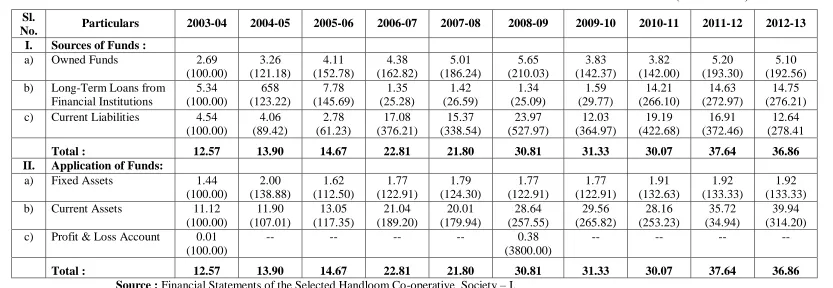
[image:12.842.7.840.119.407.2]42 | P a g e TABLE – 2 : COMPARATIVE BALANCE SHEET OF CO-OPERATIVE SOCIETY – I
(Rs. In Lakhs)
Sl.
No. Particulars 2003-04 2004-05 2005-06 2006-07 2007-08 2008-09 2009-10 2010-11 2011-12 2012-13
I. Sources of Funds :
a) Owned Funds 2.69 (100.00) 3.26 (121.18) 4.11 (152.78) 4.38 (162.82) 5.01 (186.24) 5.65 (210.03) 3.83 (142.37) 3.82 (142.00) 5.20 (193.30) 5.10 (192.56) b) Long-Term Loans from
Financial Institutions 5.34 (100.00) 658 (123.22) 7.78 (145.69) 1.35 (25.28) 1.42 (26.59) 1.34 (25.09) 1.59 (29.77) 14.21 (266.10) 14.63 (272.97) 14.75 (276.21) c) Current Liabilities 4.54
(100.00) 4.06 (89.42) 2.78 (61.23) 17.08 (376.21) 15.37 (338.54) 23.97 (527.97) 12.03 (364.97) 19.19 (422.68) 16.91 (372.46) 12.64 (278.41
Total : 12.57 13.90 14.67 22.81 21.80 30.81 31.33 30.07 37.64 36.86
II. Application of Funds:
a) Fixed Assets 1.44 (100.00) 2.00 (138.88) 1.62 (112.50) 1.77 (122.91) 1.79 (124.30) 1.77 (122.91) 1.77 (122.91) 1.91 (132.63) 1.92 (133.33) 1.92 (133.33) b) Current Assets 11.12
(100.00) 11.90 (107.01) 13.05 (117.35) 21.04 (189.20) 20.01 (179.94) 28.64 (257.55) 29.56 (265.82) 28.16 (253.23) 35.72 (34.94) 39.94 (314.20) c) Profit & Loss Account 0.01
(100.00)
-- -- -- -- 0.38 (3800.00)
-- -- -- --
Total : 12.57 13.90 14.67 22.81 21.80 30.81 31.33 30.07 37.64 36.86
Source : Financial Statements of the Selected Handloom Co-operative Society – I.
A Monthly Double-Blind Peer Reviewed Refereed Open Access International e-Journal - Included in the International Serial Directories.
International Research Journal of Human Resources and Social Sciences (IRJHRSS)
[image:13.842.72.770.118.502.2]43 | P a g e TABLE – 3 : COMPARATIVE PROFIT & LOSS ACCOUNT OF CO-OPERATIVE SOCIETY - I
(Rs. In Lakhs)
Sl. No. Particulars 2003-04 2004-05 2005-06 2006-07 2007-08 2008-09 2009-10 2010-11 2011-12 2012-13
I. INCOME :
Sale of Raw Material 10.11 13.67 16.72 19.77 24.00 39.92 21.67 51.48 51.04 54.84 Sale of Finished Goods 13.81 19.56 19.96 24.35 24.69 44.00 29.93 70.08 71.73 89.93 Other Income 0.09 0.10 0.06 0.13 0.35 0.41 0.30 0.73 1.40 1.67
Total :: 24.01 33.33 36.74 44.25 49.04 84.33 51.90 122.29 123.63 146.44
II. Expenses
a) Raw Materials Consumed
Opening Stock 0.68 0.72 1.21 0.81 3.36 1.44 3.18 4.00 2.01 5.87 Add: Purchases 8.68 13.74 1568 21.29 21.47 41.22 21.09 48.35 52.74 52.43
Total :: 9.36 14.46 16.89 22.10 24.83 42.66 24.27 52.35 54.75 58.30
Less: Closing Stock 0.71 1.20 0.81 0.36 1.44 3.18 4.00 2.01 5.87 8.74
8.65 13.26 16.08 18.74 23.39 39.48 20.27 50.34 48.88 49.56
b) Finished Goods Produced
Opening Stock 2.41 2.97 2.35 3.98 5.68 9.04 9.09 8.24 12.93 11.63
Add: Purchases 9.74 13.30 16.32 19.42 23.54 39.67 21.25 53.04 49.58 53.54
12.15 16.27 18.67 23.40 29.22 48.71 30.34 61.28 62.51 65.17
Less: Closing Stock 2.96 2.35 3.98 5.68 9.04 9.09 8.24 12.92 11.63 9.88
9.19 13.92 14.69 17.72 20.18 39.62 22.10 48.36 50.88 55.29
c) Production Express 4.76 4.74 4.45 6.14 3.27 3.00 6.49 18.32 19.64 34.45
III Cost of Sales (a+b+c) 22.60 31.92 35.22 42.60 46.84 82.10 48.86 117.02 119.40 139.30
Gross Profit (I-III) 1.41 1.41 1.52 1.65 2.20 2.23 3.04 5.27 4.23 7.14
Less: Administrative Express 1.41 1.15 1.29 1.42 1.97 2.61 2.95 4.37 3.44 4.87
IV Net Profit/Less (I-II) 0.26 0.23 0.23 0.23 -0.38 0.09 0.90 0.79 2.27
Source : Financial Statements of the Selected Handloom Co-operative Society – I.
A Monthly Double-Blind Peer Reviewed Refereed Open Access International e-Journal - Included in the International Serial Directories.
International Research Journal of Human Resources and Social Sciences (IRJHRSS) 44 | P a g e A close examination of Table 2 reveals that the trends in the growth of owned funds
has shown an increasing trend till 2009-10 and later on a fluctuating trend. However, the
owned funds are maximum at Rs. 5.77 lakhs in 2009-10. The data in regard to long-term
loans from financial institutions and current liabilities show a wide fluctuation where former
has varied between Rs. 1.34 lakhs in 2009-10 and Rs. 14.75 lakhs in 2012-13; while the
latter is ranging between 2.78 lakhs and Rs. 23.97 lakhs. Whenever there is a rise in the
amount of long term loans, the amount of current liabilities indicate a fall and vice-versa.
The owned funds were 2.69 Lakhs in 2003 – 04, Long-term loans from financial were
5.34 Lakhs and current liabilities were 4.54 Lakhs totaling to 12.57 Lakhs. Out of the 13.90
Lakhs in 2004 – 05 3.26 were from owned funds, 6.58 Lakhs from Long-term loans and 4.06
Lakhs from current liabilities. Among the 10 years under study, 2011-12 had a maximum of
funds. It amounted to 37.64 Lakhs, out of which 5.20 Lakhs were from owned funds, 14.63
lakhs from Long-term loans and 16.91 Lakhs from current liabilities. The next maximum
funds retained (36.86 Lakhs) was during 2012 – 13. In this year, 5.10 Lakhs were from
owned funds, 14.75 Lakhs from Long-term liabilities and 12.64 Lakhs from current
liabilities. A minimum of 12.57 Lakhs was during 2003 – 04. Out of which 2.69 Lakhs was
from owned funds, 5.34 Lakhs from Long-term loans and 4.54 Lakhs from current liabilities.
The table 2 shows the application of funds to different activities. 1.44 Lakhs were
applied for fixed assets, 11.12 Lakhs for current assets and 0.01 Lakhs for profit and loss
account during 2003 – 04 and it has risen upto 2005 – 06 which was 14.67 Lakhs to 22.81
Lakhs during 2006 – 07, and a fall of 1 Lakh in the next year i.e., 21.80 Lakhs which
comprises 1.79 lakhs for fixed assets, 11.12 Lakhs for current assets and none for profit &
loss account. After that, there was a gradual increase upto 36.86 Lakhs in 2012 – 13.
Table – 3 reveals the comparative profit and loss account of Handloom Weavers
Co-operative Society – I. The trends in the sales are showing a rising trend except in 2009-10.
Sales are at their maximum level in 2012-13 where the amount of sales is to the tune of Rs.
146.44 lakhs.
It is to e noticed that the gross as well as net profit is positive throughout the 10 year
period under study where the former has been varying between Rs. 1.41 lakhs in 2003-04 and
2004-05 and Rs. 7.14 lakhs in 2012-13 where the total income of the Society is at its
A Monthly Double-Blind Peer Reviewed Refereed Open Access International e-Journal - Included in the International Serial Directories.
International Research Journal of Human Resources and Social Sciences (IRJHRSS) 45 | P a g e amount of net profit during 2003-04 and could incur loss to the tune of – 0.38 lakhs in
2008-09. However, in the remaining period of 8 years, it could earn positive net profit where it did
not exceed Rs. 2.27 lakhs in 2012-13.
7. Profit of Co-operative Society – II :
The declaration of International Women’s Year (1975) has given an inspiration to
form a Handloom Co-operative Society exclusively for women weavers by women weavers.
The Assistant Director of Handlooms and Textiles of the District has taken initiative to bring
it into existence. Its main aim has been to provide employment to women weaver members.
This is also an urban based Society. The management of the Society identifies and enrolls
the members. Though the Society has begun with 50 members, it has been increased to 509
in 1985-86. From 1986-87 onwards the membership was to the tune of 513. However, in
1990-91, it has decreased to 275, while the Society could provide work only to 80 waver
members due to lack of raw material and finance.
The Society has 80 Nawar looms and it further requires frame looms to increase the
productive capacity of the Society. Usually, APCO supplies yarn and whenever it fails in this
regard, the Society purchases yarn from Rajasthan directly. There are no problems to this
Society regarding the procurement of raw material from APCO. This Society sells its
products to APCO in addition to its counter-sales. It does not have its own premises and
building and therefore operating in a rented building.
The discussions with the members have revealed that on an average they earn Rs.
300/- per month. The weaver produces nearly 100 metres of nawar in a day. It has
participated in trade fairs and exhibitions through APCO. The financial performance of the
Society is illustrated in Table – 4 and Table – 5 in terms of comparative balance sheet and
A Monthly Double-Blind Peer Reviewed Refereed Open Access International e-Journal - Included in the International Serial Directories.
International Research Journal of Human Resources and Social Sciences (IRJHRSS)
46 | P a g e TABLE – 4 : COMPARATIVE BALANCE SHEET OF CO-OPERATIVE SOCIETY - II
(Rs. In Lakhs)
Sl.
No. Particulars 2003-04 2004-05 2005-06 2006-07 2007-08 2008-09 2009-10 2010-11 2011-12 2012-13
I. Source of Funds
Owned Funds 0.82 1.02 1.61 1.69 2.72 1.68 1.05 1.05 1.05 0.99 (100.00) (124.39) (196.34) (220.73) (131.70) (128.04) (128.04) (128.04) (128.04) (120.73) Long Term
Loans from Financial Institutions
0.96 0.05 0.07 0.17 0.37 1.44 3.04 3.37 3.17 3.23 (100.00) (5.20) (7.29) (17.70) (38.54) (150.00) (316.66) (351.04) (330.20) (336.45)
Current Liabilities
0.16 2.09 2.04 2.21 4.04 2.85 1.60 2.23 2.28 4.25 (100.00) (1306.25) (1275.00) (1381.25) (2525.00) (1781.25) (1050.00) (1393.75) (1425.00) (2656.25)
Total 1.94 3.16 3.72 4.07 7.13 5.97 5.77 6.65 6.50 8.47
II. Application of Funds
Fixed Assets 0.81 0.29 0.33 0.35 0.38 0.37 0.31 0.32 0.32 0.32 (100.00) (35.80) (40.74) (43.20) (46.91) (45.67) (38.27) (39.50) (39.50) (39.50) Current Assets 1.13 2.87 3.39 3.72 6.75 5.32 5.20 5.97 5.67 5.99
(100.00) (253.98) (300.00) (329.20) (597.34) (470.79) (460.17) (528.31) (501.76) (533.08) Profit and Loss
Account - - - 0.28 0.26 0.36 0.51 2.16
Total 1.94 3.16 3.72 4.07 7.13 5.97 5.77 6.50 8.47 -
Source : Financial Statements of the Selected Handloom Co-operative Society – II.
A Monthly Double-Blind Peer Reviewed Refereed Open Access International e-Journal - Included in the International Serial Directories.
International Research Journal of Human Resources and Social Sciences (IRJHRSS)
47 | P a g e TABLE –5: COMPARATIVE PROFIT & LOSS ACCOUNT OF CO-OPERATIVE SOCIETY - II
(Rs. In Lakhs)
Sl.
No. Particulars 2003-04 2004-05 2005-06 2006-07 2007-08 2008-09 2009-10 2010-11 2011-12 2012-13
I. INCOME :
Sale of Raw Material 3.73 4.91 5.92 8.71 12.14 14.07 2.68 5.63 4.80 5.84
Sale of Finished Goods 4.30 5.55 6.72 12.20 13.78 17.11 5.14 6.24 6.40 5.78
Other Income 0.01 0.03 0.03 0.04 0.06 0.06 0.04 0.01 0.10 0.07
Total :: 8.04 10.49 12.67 10.95 25.98 31.24 7.86 11.88 11.90 11.69
II. Expenses
a) Raw Materials Consumed
Opening Stock 0.00 0.01 0.12 0.04 0.00 0.88 0.44 0.35 0.06 0.00
Add: Purchases 3.72 5.02 5.71 8.64 12.99 13.53 2.49 5.08 4.59 5.11
Total :: 3.72 5.03 5.82 8.68 12.99 14.41 2.93 5.43 4.65 5.11
Less: Closing Stock 0.01 0.13 0.03 0.00 0.87 0.44 0.35 0.06 0.00 0.01
3.71 4.90 5.82 8.68 12.12 13.97 2.58 5.17 4.65 5.10
b) Finished Goods Produced
Opening Stock 0.42 0.49 0.18 1.10 0.13 0.51 1.46 0.23 0.91 0.10
Add: Purchases 3.55 4.48 5.65 8.87 11.34 14.36 3.11 5.76 4.65 6.00
3.97 4.97 5.83 9.97 11.47 14.87 4.57 5.99 5.56 6.10
Less: Closing Stock 0.49 0.17 1.20 0.13 0.50 1.46 0.24 0.91 0.10 1.49
3.48 4.86 4.63 4.84 10.97 13.41 4.33 5.08 5.46 5.61
c) Production Express 0.57 0.64 1.22 1.78 1.81 1.16 0.71 1.04 0.76 1.44
III Cost of Sales (a+b+c) 7.76 10.34 11.65 20.30 24.54 7.64 11.49 10.87 11.15 10.41
Gross Profit (I-III) 0.28 0.15 1.02 0.65 1.08 1.72 0.22 0.34 0.63 0.54
Less: Administrative Express 0.27 0.14 0.68 0.59 0.95 0.89 0.50 0.85 0.99 1.05
IV Net Profit/Less (I-II) 0.01 0.01 0.14 0.09 0.11 0.71 -0.28 -0.24 -0.36 -0.51
Source : Financial Statements of the Selected Handloom Co-operative Society – II.
A Monthly Double-Blind Peer Reviewed Refereed Open Access International e-Journal - Included in the International Serial Directories.
International Research Journal of Human Resources and Social Sciences (IRJHRSS) 48 | P a g e It can be seen from Table – 4 that the amount of owned funds has increased upto
2007-08 and later on shown a continuous decline. The amount of owned funds did not
exceed Rs. 2.72 lakhs in 2007-08. The information in regard to both long term loans from
financial institutions and current liabilities has shown a fluctuation trend. Similarly, fixed
assets are fluctuating in a narrow range of Rs. 0.29 lakhs in 2004-05 and Rs. 0.01 lakhs in
2003-04. The current assets have increased upto 0.33 in 2005-06 and afterwards they have
fluctuated in between Rs. 1.13 lakhs in 2003-04 and Rs. 6.75 lakhs in 2007-08. It is to be
noticed that in the beginning year 2003-04, the fixed assets are at their maximum and the
current assets are at their minimum.
It can be observed from the Table – 5 that the total income has increased upto 17.11
lakhs in 2008-09 and reached the maximum to Rs. 31.24 lakhs in 2008-09 and then a sudden
decline to Rs. 7.86 lakhs in 2009-10. It has shown a fluctuating trend from 2010-11 onwards.
Whenever the income started a decline, from then onwards the net profit is negative inspite of
positive gross profit during this period. Thus, the amount of gross profit has ranged between
0.15 lakhs 2004-05 and Rs. 1.70 lakhs in 2007-08 while the Society could earn positive net
profit only upto 2007-08 and later on it could incur losses.
8. Conclusion:
The earnings of the Wool Weavers are better when compared to the cotton weavers, but less in relation to the earnings of cotton silk weavers. Though Wool Weavers’
Co-operative Societies are unable to give full work to the Wool weavers, they are producing
kambles with the help of hand spun yarn and they are selling these Kambles to the Society and also in the local markets. The production and sales of Wool Weavers’ Co-operative
Societies are least when compared to other categories of Societies while it is more in Cotton
Societies and same trend has been maintained in regard to average gross profits and net profits. Net profits of Wool Handloom Weavers’ co-operative Societies are negative while it
is positive in cotton and Cotton-Silk Societies. The cause for this negative net profits are the
low productivity, low sales and higher amount of administrative cost.
The women member-weavers are not actively engaged in weaving activity on account
of low wages offered by the Societies. They are engaged in beedi manufacturing which
A Monthly Double-Blind Peer Reviewed Refereed Open Access International e-Journal - Included in the International Serial Directories.
International Research Journal of Human Resources and Social Sciences (IRJHRSS) 49 | P a g e Society is affecting the post-weaving and pre-weaving operations in the Societies. Factors
like natural growth of weaver caste population, low-labour mobility and few employment
opportunities for them are the main causes for the continuous supply of labour when
compared to the demand for it. Inspite of old age and ill-health, the weavers prefer to
continue in the same profession, due to the lack of employment opportunities elsewhere.
The average size of the weavers family is 6 members. The large number of
dependents in the family has resulted in deterioriation of their financial position. Lack of
working capital and unemployment forced the individual weavers to take membership in
Societies. Due to poor economic conditions, the member weavers are not able to set up a loom for themselves and depending either on Society’s looms or on hired looms. The
non-studying children and even the school going children of member-weaver assist their parents
in weaving, warping, winding and calendaring operations. The number of looms operated in a
member-weaver’s family has been declining gradually on account of non-providing regular
work by societies, payment of poor wages and travelling a long distance on food in search of
work from the Society.
Addition to drink, lack of financial planning and improvidence have been responsible
for their high degree of indebtedness. Inspite of several programmes undertaken by the
Government, due to the lack of repayment capacity, the weavers are not availing even the
subsidized loans sanctioned by the government for construction of houses.
Membership drive is undertaken by the Societies mainly to avail of the concessions
given by the government. Most of the Societies were registered with bogus membership
including non-existent and died persons. Introduction of photo card system resulted in the
elimination of bogus membership to some extent and reduced the membership in Societies.
The merge of non-viable and viable societies weakened the economic position of the
A Monthly Double-Blind Peer Reviewed Refereed Open Access International e-Journal - Included in the International Serial Directories.
International Research Journal of Human Resources and Social Sciences (IRJHRSS) 50 | P a g e 9. References:
1. Approach and Strategy (Handloom Industry), Seventh Five Year Plan, Directorate of
Handlooms & Textiles, Government of Andhra Pradesh, Hyderabad, 1985, p. 1.
2. Crisis of Handloom Industry by CH Thandava Krishna M Laxmi Narasaiah
3. Abdul Noor Basha, Prof., “Comment on New Textile Policy”, Trade Trends,
November 27- December 3, 2005.
4. Anjaneyulu. G, Financial Management in the Cooperative Handloom Industry,
(Classical Publishing company, 2001 New Delhi.)
5. Chalam. G.V, “Problems and Prospects of Handloom Industry in Co-operative sector:
A study of handloom weavers co-operative societies in Krishna Dt. A.P”, India
Co-operative Review, Jan 2001.
6. Chandra Sekhar. C.P. and Sen Abhijit, (1996): “Statistical Truths: Economic Reforms and Poverty”, Frontline, Vol 13,No.3,February 10-23.
7. Dee.E.M., “Cotton Spinning Mills Treading a Rough Path”, Express Textiles
February 25th 2005.
8. Devendra Bijoy Mitra., Cotton Weavers of Bengal, Farma.K.L., Calcutta, 2004.
9. “Handloom Sector in India, The Current Status and Shape of things to come by 2015”
Dr. D. Narasimha Reddy.
10.“Kanakalatha Mukund Syam Sundari.B, “Doomed to Fail Handloom Weavers Cooperatives in Andhra Pradesh”, Economic and Political Weekly, December 26,