Citation:
Dobson, T (2015) Developing a Theoretical Framework for Response: Creative Writing as Response in the Year 6 Primary Classroom. English in Education. ISSN 1754-8845 DOI: https://doi.org/10.1111/eie.12075
Link to Leeds Beckett Repository record: http://eprints.leedsbeckett.ac.uk/1727/
Document Version: Article
The aim of the Leeds Beckett Repository is to provide open access to our research, as required by funder policies and permitted by publishers and copyright law.
The Leeds Beckett repository holds a wide range of publications, each of which has been checked for copyright and the relevant embargo period has been applied by the Research Services team.
We operate on a standard take-down policy. If you are the author or publisher of an output and you would like it removed from the repository, please contact us and we will investigate on a case-by-case basis.
Developing a Theoretical Framework for Response: Creative Writing as
Response in the Year 6 Primary Classroom
Introduction
Given the prescriptive nature of the new national curriculum (DfE 2013) for English
in terms of spelling, punctuation and grammar, there is an argument to be made that
English teaching is in danger of being characterised by strongly “framed” pedagogy
(Bernstein 2000). The national curriculum and, in particular, its accompanying
statutory testing, can be seen as symptomatic of a neoliberal ideology which
commodifies learning through increased accountability and distributes power and
money to those institutions which are deemed to be more successful (Ball 2012). In
this context of neoliberalism and a prescriptive national curriculum, creative writing
pedagogy is of crucial interest – the “creative” dimension to creative writing is under
threat from strong framing which could remove pupil choice from the writing process.
This paper arises from my PhD, which focused on boys’ identities and creative
writing. This saw me teaching creative writing to a Year 6 class every Friday
morning during 2010-11. The previous national curriculum was in place (DfES
2004), but my experience was, nevertheless, shaped by neoliberalism. At the start of
the project, the head teacher informed me that Year 6 would not be entered for
English SATs (national attainment tests) in June; under pressure from the local
education authority, by January he reversed his decision and the class teacher told me
to teach “text types” rather than the story writing I had been developing with the class.
Whilst neither the new national curriculum nor its predecessor particularly
emphasises the types of texts to be studied, the associated pedagogical approach has
(DfE 2003). Although genre theory emphasises social purpose (Martin, Christie and Rothery 1987), the, the “social” aspect of genre theory was dropped by the PNS for Literacy as (in line with a neoliberal perspective) a view of texts as belonging to
discrete and predictable genres allows for texts to be easily commodified. The
pedagogy is one that relies on predefined success criteria, presenting writing as a
formula to be absorbed by the pupils.
In contrast to this product-based approach, as a Teacher-Researcher in Year 6,
I adopted the role of Writer who lays bare the processes of writing. The effectiveness
of process writing for scaffolding has been highlighted in a recent global review of
writing pedagogy (Dombey 2013). Benefits include theinclude the Teacher-Writer's developing a productive “empathy” with their class (Smith and Wrigley 2012; Ings
2009) and a levelling of the traditional Teacher-Pupil hierarchy, achieved by building
a “community of writers” (Cremin and Myhill 2012). As a “community of writers”,
we discussed our story ideas and our stories became responses to each other’s ideas.
For this reason, I conceptualise creative writing as response.
From January onwards, as my teaching became more “text type” driven, I was
keen to maintain this “community” approach. This was compromised by the need to
cover technical aspects of writing through success criteria, but I was also able to
promote weaker framing through group work. Whilst the struggle between myself as
Teacher preparing for SATs and as Writer promoting process was perhaps not as
pronounced as elsewhere (Cremin and Baker 2010), I was still subject to this tension
and this is an aspect explored in this paper.
The two pieces of boys’ writing analysed in this paper – a play script and a
legend - were written post-January through pedagogies influenced by a text type
terms of what they say about the boys’ identities, and this paper presents a theoretical
model for thinking about the boys’ creative writing in terms of identity and response.
It is a model that could be applied to other cultural contexts to illuminate identity
construction in relation to creative response. Crucially, viewing creative writing as
identity work and response can help to disrupt the discourse of neoliberalism and
reposition the pupil themselves as the meaning maker in the creative writing process.
The research project
Building on research that highlights the ways in which transition to secondary school
challenges boys’ identities (Jackson and Warin 2000), my PhD uses discourse
analysis to analyse the writing undertaken by nine boys as they make the transition
from year 6 of primary school to year 7 of secondary school. Whilst the boys were in
year 6, I adopted the role of a Teacher-Researcher, working in a one-form entry
co-educational primary school where the proportion of pupils eligible for pupil premium
(funding to raise the attainment of disadvantaged pupils) was significantly higher than
the national average. There were 21 pupils in the Year 6 class (12 girls and 9 boys).
Every Friday morning over the academic year and for three one-week blocks around
Christmas, Easter and summer, I took on the role of Teacher. When they reached
secondary school, the boys dispersed into different classes and I could no longer adopt
the role of Teacher; instead I undertook four focus group discussions throughout the
academic year in order to allow the boys to reread their work from year 6. This
became a useful way of thinking about the temporal dimension of response.
As indicated above, in this paper I focus on two texts written by the boys in
year 6. The play script was written as a result of a one-week block of my own
In self-selected groups that happened to be divided by gender (the nine boys were
split into two groups), I adopted weaker framing in giving the class the opportunity to
discuss my opening to the script and create freeze frames to plan the rest of the story.
In line with the more strongly framed text type approach, I used success criteria to
model and indicate features I wanted to see in their resulting individual writing.
The legend was written as a result of a day-long drama workshop with an
external company focusing upon the character of Gawain. Compared with the play
script, the ideas that were generated for the legend were more strongly framed and led
by the drama company. At the end of the workshop, text type success criteria were
used by the class teacher to scaffold the pupils’ writing of the legend of Gawain.
The data collected throughout this two-year period included the boys’ creative
writing as well as my own detailed journal reflections upon the relationship between
their writing and their classroom interactions. Added to this, I audio-recorded and
transcribed focus group discussions with the boys. The discussions were a forum for
the boys to respond to each other’s and my own writing and enabled me to analyse
group dynamics (Barbour & Schostak 2005) in identity construction. All of this data was analysed using discourse analysis and this was underpinned by my theoretical understanding of identity as socially constructed through language.
Taken as a whole, my approach was ethnographic in that I developed a
“deepened” understanding of how the boys’ identities were constructed within the
classroom setting (Goldbart and Hustler 2005). Unlike traditional ethnography,
however, I was keen to recognise my own roles within the classroom and the ways I
as a “human instrument” (p.18) was part of the process of identity construction. My
journal reflections, therefore, necessarily included self-reflections and these are drawn
Creative writing as response
As I wanted to think about the boys’ identities and the ways in which their
participation in social contexts shaped their writing, Bakhtin became central to my thinking. Indeed, theoretically informed identity work on written texts has focused on non-fiction (Ivanic 1998). In contrast, studies of creative writing have not developed a theoretical framework for identity, instead focusing on “intertextuality” (Pantaleo 2007) or on students transcending their own fixed identities (Howell 2008). Bakhtin’s bridging of sociolinguistics and literary criticism gave me a means of conceptualising the boys’ writing as discourse; as Gee (2011) emphasises, identity is manifested through participation in discourse.
Bakhtin (1986) talks about discourse as three-dimensional
“utterances”belonging to the author in the present moment; to previous authors of the past; and to future respondents who will always interpret the utterance in different ways. In thinking about future respondents, much has been written by literary critics about reader response. What is clear is that reader response theories are variegated in terms of the degree of emphasis they place upon the reader as the significant
participant in the meaning making process. At one end of this spectrum, there is Barthes’ polemic dismissal of authorial intent in his claim that when “the author enters his own death, writing begins” (1992: 142).
Barthes, but also by the post-structuralist outlook encapsulated by Derrida (2001). Building on Saussure’s signifier-signified distinction (2001), Derrida’s concept of “of “différance” (ibid) demonstrates how meaning is always already deferred both synchronically through difference between signifiers in a system and diachronically through the deferral of meaning over time. To put it another way: when we read or hear words, the meaning of those words will always already be different from their intent; were we to return to those exact same words at a later date, the meaning of the utterance will have changed again because the context will have been altered by time and experience. .
Having said this, the notion of the superaddressee became useful to me to think about the extent to which I perceived the boys in the class as having responded to my perception of my superaddressee in the act of writing and the extent to which they perceived me to have responded to their superaddressees in my responses.
Bakhtin was also helpful in terms of thinking about the nature of creative writing as opposed to an everyday utterance. For Bakhtin (1986), literary works are “complex”, “secondary genre” utterances, which are influenced by everyday
discourse in the form of “simple”, “primary genre” utterances. More significantly, Bakhtin sees “secondary” genre utterances as being more permeable to “individual expression” than their “primary” counterparts. As discussed below, my theoretical understanding of identity replaces “expression” with “performance”, but the
importance of the distinction lies in the idea that secondary genre texts, like creative writing, can offer the writer agency.
To return to Bakhtin’s notion of the utterance as interpersonal, as well as considering the idea of future respondents to a creative writing text, I also wanted to think about the past dimension and the ways in which previous speakers in a social context influenced the language we were using. The creative text, which in turn is a response to other texts, needed to be considered in relation to the sociological debate around structure and agency.
The work of Beck (2005) reframes traditional Marxism by citing the erosion of the power of the State at the hands of global capitalism. According to Beck, global capitalism and the immanence of the internet gives individuals agency and the
opportunity to define their own identities through self-reflexivity in a “self-culture” (1992).
From a gender perspective, Beck has been adopted by feminists for the radical potential for change implicit in self-culture (Arnot and Mac an Ghaill 2006). That said, feminist studies of identities in educational settings have often highlighted the extent to which “hegemonic masculinity” (Connell 2005) where femininity is “othered” (Mac an Ghaill 1994) acts as a bounding principle. In these instances it is clear that agency as resistance to the structured discourses of masculinity is not so easily won.
In light of this tension between bounding structures operating within society and individual agency, Holland, Lachicotte, Skinner and Cain’s (1998) concept of “figured worlds” became a useful way of conceptualizing identity construction in school. Figured worlds are sites where individuals participate in cultural practice through discourse. In line with traditional Marxism, an individual’s participation in a figured world is both determined by the way they are positioned by discourse
In this sense, whilst figured worlds are bounded by wider social macro powers, they are also subject to local refiguring.
Figured worlds see cultural participation as fictional (figured) and this is in line with Derrida’s notion of “différance” whereby reality is seen to stand outside of the grasp of language – in figured worlds what may masquerade as reality is only ever a cultural story which exerts power but, in line with Marx, is always, therefore,
vulnerable to subversion.
In terms of thinking about our identities in the classroom and the ways in which they impacted upon the creative writing texts, I considered the extent to which creative writing pieces were figured by an apprehension of a future superaddressee as well as participation in figured words. For the sake of simplicity I see these
participations as occurring in two figured worlds: firstly, the boys participated as Pupils in the figured world of the Year 6 Literacy Classroom; and, secondly, the boys participated as Boys in the figured world of Friendship.
I see these figured worlds of the Year 6 Literacy Classroom and Friendship as co-existent, often overlapping and sometimes competing, bounded by wider social power structures. In the Year 6 Literacy Classroom, which positioned me as Mr D. and the boys as Pupils, our participations were figured by the ideology of
neoliberalism in the form of testing and accountability. As mentioned above, Mr D. experiences some of the “struggle” (Cremin and Baker 2010) between Teacher who was helping to prepare the pupils for their SATs and Writer who was interested in exploring the process of composition.
more interested in how the boys negotiated their friendships and identities as Boys within the classroom and through their writing. These observations of the boys, aligned with focus group discussions, brought to the surface the macro power of hegemonic masculinity within the figured world of Friendship and myself as Researcher remembering my own childhood.
A post-structuralist model for creative writing as response
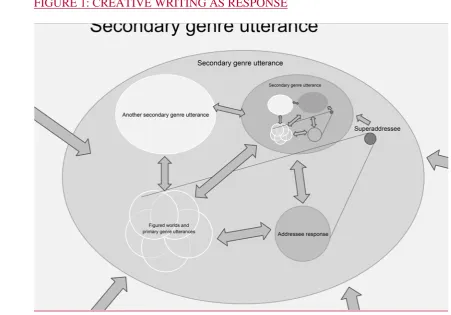
[INSERT FIGURE 1]
[image:10.595.56.508.380.695.2]Because of theof the theoretical position taken in this paper in relation to language functioning through “différance”, the model outlined in Figure 1 is underpinned by post-structuralism and is complex in nature.
FIGURE 1: CREATIVE WRITING AS RESPONSE
with the participants and from a post-structuralist perspective this means I was unable to locate myself “outside” the” the research context (Burman and MacLure 2005). These figured worlds and others in the diagram are accordingly delineated by porous lines which draw attention to the way they have been created by the Researcher. The spheres are also overlapping to indicate the ways in which figured worlds like the Year Literacy 6 Classroom and Friendship should be seen as co-existent.
To look at the addressee response to the primary genre utterances: in creating an utterance, there is a respondent (addressee) whose response is always already different from that of the superaddressee. In line with the possibility of agency in figured worlds, this response is seen as being both figured by and figuring of the primary genre utterance and bi-directional arrows are used here (and in other dimensions of the model) to represent the reciprocity of this relationship.
To look at the secondary genre utterance: in writing a creative text, the author is influenced by a range of factors. Firstly, the creative text is figured by and figuring of the writer’s primary genre participation in figured worlds. As indicated by
Bakhtin’s notion of the utterance as “interpersonal”, as well as being past facing, textual production is also future facing. The creative text is, therefore, also figured by the apprehension of a superaddressee, who at that moment in time is seen by the author to be able to perfectly understand the meaning of the text, as well as a real addressee who will always already see the text differently.
To look at the superaddressee: the superaddressee is represented as a black hole and is seen as a theoretical construct which, if enacted, would mark the end of the chain of communication itself as “différance” could no longer act as the
operational principle. The arrow, therefore, is one directional: while the idea of the superaddressee figures the creative writing text, the creative writing text itself cannot figure the superaddressee because the superaddressee does not actually exist. The lines between the addressee and the superaddressee indicate the extent to which, from the author’s temporal perspective, the actual response to the creative writing text at that moment in time accords with the desired response to the text. Again, complete alignment of the addressee and superaddressee is seen, from a post-structural perspective, as an impossibility, but, from an author’s contextual and temporal perspective, it is possible for that author to say how close or far away an addressee response is to that of their superaddressee.
To take another secondary genre utterance: in line with a view of texts as simulacra, another secondary genre utterance indicates the ways in which other secondary genre texts are figured by and figuring of primary utterances in figured worlds as well as the ways in which they are figuring of and figured by the secondary genre text which is under construction.
To take the model as a whole: in line with post-structuralism, which highlights the impossibility of the Researcher's locating an outside position, my model of
creative response is seen as being in itself a secondary genre text which is part of the complex nature of communication and response. For this reason, both inside and out, the diagram tends towards infinite regress.
The figured world of repression
As indicated above, I spent a week teaching the “text type” of play scripts. To balance the strong framing of the text type approach, I continued writing for the class and I presented them with the opening two scenes of a story about Lucy, who moves with her parents from London to Leeds, and who struggles to fit into her new school. At the same time she hears strange “whirring” noises coming from her attic.
Again, to counter strong framing, the pupils developed their own responses to my text by planning endings to the story in self-selected, gender divided groups. Their endings were performed as freeze-frames and then the pupils worked
individually on their play scripts. From a theoretical perspective, the movement from group work to individual work allowed me to think about how the boys responded to each other and how they would then assert their identities in their writing.
In my initial readings of all the boys’ stories, I felt that they had ignored the empathetic superaddressee as they prioritised the ‘Who’s in the attic?’ storyline over the ‘Will Lucy make friends?’ story line. One group had Lucy making friends with Gilbert, who was presented as a “Dork” “with big feet” from an American high school drama. In these scripts, Gilbert was marginalised and Lucy’s need for a friend was forgotten as the boys introduced “Billy”, a boy who had (without reason) been locked in Lucy’s attic since early childhood.
In my research journal I wrote about how the boys had distanced themselves from my superaddressee. At the time I chose to see their writing choices as
symptomatic of hegemonic masculinity figuring their participation in the world of Friendship: “The boys did not empathise with Lucy. They refused and in doing so they simplified their own experiences and denied their emotions. Repression and regression.”
At the same time, I used my research journal to reflect upon my own identities in the classroom and I was beginning to think about my writing as transforming my own childhood experiences:
I didn’t acknowledge that the play script is a refraction of my childhood and family: Lucy is me, struggling with transitions; [her parents] are that side of my parents I am just now coming to terms with (the selfish side that must be in us all)… The house move from London to Leeds is another of my transitions.
The reference to my parents alludes to their divorce during my early teenage years. At the same time that the boys’ were populating the attic with one-dimensional characters and neglecting the emotional needs of Lucy, I (aged 38) was asking my parents about the reasons behind their divorce. I used Samuel Beckett’s literary (non) character, The Unnamable (1973), as a symbol of our family’s silence. In my PhD, which takes the form of a play script with participants co-constructing ideas, as a researcher (PhD Student) I conceptualised the confronting of The Unnamable as Tom entering into the figured world of Repression and Therapy (Author, 2014: 67).
assumed and his friendship with Lucy is opened up as a possibility in a way that disrupts the discourse of hegemonic masculinity; the story of the genie can also be read as a sophisticated parody of the secondary genre of Fairy Tales and a way in which the Pupils subverted their positional identities in relation to the Teacher in the Year 6 Literacy classroom.
What this example illustrates, therefore, is the way in which my readings of the boys’ secondary genre texts were figured by my own participation in figured worlds that were outside of my classroom identities of Researcher, Teacher and Writer. Indeed, just as the opening scenes of my play script had been figured by my participations and understandings of my personal life, so had my reading of their texts. As a result, my initial readings of their texts had been simplified as a projection of my own feelings towards male repression.
Gawain and The Green Knight
About a month after the writing of the play script, a theatre company came into school to undertake a drama workshops based on the story of Gawain and the Green Knight. The story they constructed for the class was based on the idea that Gawain joins forces with another knight whom he calls Gareth but who is actually a girl in disguise (Gweneth). Despite the use of drama, the drama company kept close control over the development of the story ideas. This, as well the class teacher’s use of text type success criteria in setting the resulting individual writing task, meant that
The first point to make here is that most of the boys adopted a limited third person narrator, who focused on the actions of their chosen protagonist, Gawain. In this sense, the character of Gweneth was immediately relegated and seen to be of marginal interest.
For Jim Bob, this limited third person is so extreme that Gareth is quickly forgotten. Whilst Jim Bob’s story opens with, “Gawain and gareth set of to green chapel”, by paragraph two the appearance of an “8 legged Dragon” means that Gareth has all but disappeared from the story. Whilst there is some initial confusion as to who might try to overcome this obstacle (Jim Bob creates a hybrid character
“gawrath”), this is clarified by the end of the sentence as it is Gawain who “chop his hed off and was happy”. In the next paragraph, the green knight steps forward and the pronoun he is used in the place of the previously used proper nouns (“and he killed the green knight”). This indicates the complete erasure of Gareth from Jim Bob’s story of bloodshed and gore.
In Spurs606’s story, whilst Gawain is clearly the protagonist, Gareth is most definitely present as a Damsel in Distress. Indeed, Gareth takes on this role even before the first authentic obstacle has appeared: they are merely walking up a
mountain when Gareth slips and Gawain “throws his rope. And pulls Gareth back to the path.” When voices start shouting “FASTER FASTER GET THEM!” Gawain tells Gareth to go to the bottom of the mountain so that he can fight and kill “five soldiers”. Gawain does not, however, completely erase Gareth, but meets Gareth at the bottom of the mountain and Gareth is allowed to watch Gawain’s beheading The Green Knight.
Gweneth and is, therefore, openly feminine. At the end of the story this duplicity is pointed out to the reader in parenthesis: “Gweneth (or Gareth as he knew)”.
Interestingly, The Drawer’s explicit casting of Gweneth in the Damsel in Distress role seems to encourage him to allocate the limited third person point of view to Gweneth rather than Gawain. This shift in comparison to the other boys’ stories is perhaps a symptom of the desire to amplify the heroic actions of Gawain. The narrator follows Gweneth through the forest where she is caught by a creature and screams “Gawain! Gawain! Help me.” Gawain’s response is instantaneous: “As soon as the noise hits his ear drum he ran towards Gweneth” to find a troll holding her captive. Gawain’s instinct here is the same as it is in Spurs606’s story as he saves her and kills the troll: “he gets out his bow and arrow and shoots it in the eye so he drops Gweneth then Gawain draws his sword from his belt and stabs the troll in the head”.
Kay4559’s story is slightly different in that Gareth is given some agency. The first sign of danger in the forest is the sound of a twig snapping. It is Gareth who notices saying “What’s that?”, but “Gawain smiled and said 'it must be you’re imagination'.”. Gawain is made to look foolish as the next short sentence reveals: “Suddenly a tree fell in front of them.” However, the power balance of gender role-play is soon restored thanks to a “mythical beast with the head of a lion” snatching Gareth and allowing an injured Gawain to rescue Gareth and then defeat the beast.
Domanic Leon runs out of space on the page, he remembers the story of the Green Knight and finishes with both characters facing a “rusty door” from which “a green nite came out”.
In all of the boys’ stories, therefore, hegemonic masculinity was a figuring discourse. Even though Gweneth adopts the signifier for ‘male’ with the ‘Gareth’, the signified is continually feminised through the character’s words and actions.
Conclusion
Six months later in two focus groups in Year 7 of secondary school, I handed the boys all of their writing from Year 6 and allowed them to decide which they read first and which they commented on with their peers.
Alongside two other stories that resulted from weaker framing, the play script was one of the more popular texts, although when I asked them about the character of Lucy the boys in both groups professed not to be particularly interested. In one group, The Drawer mischievously replied: “Who’s Lucy?” Of course, the boys’ erasure of Lucy could have been due to the group dynamics and the othering of the feminine, which I felt was still figuring of their group participation. Whilst the character of Lucy held little interest for them, the characters in the attic did: boys in both groups spontaneously read out funny lines to one another. It is perhaps
significant that it was this with aspect of the story over which they had been given choice through weaker framing.
boys recalled as significant the idea that Gareth was a girl disguised as a boy – for all of the boys, six months on, Gareth was a male character.
What are the implications of this? Firstly, it seems - as demonstrated by Gawain and the Green Knight - that, even when strong framing restricts pupil choice in creative writing, pupils’ identities other than their positional identity of Pupils will permeate textual production. Secondly, as future addressees of their own writing, the boys claimed to be more interested by those texts which had been taught through weaker framing and they were more able in reading these texts to take on the position of a superaddressee. Thirdly, the writing of the play script demonstrates how Pupils’ apprehension of the Teacher-Writer’s superaddressee can serve to disrupt the
predictable figuring discourse of hegemonic masculinity in order to refigure their identity performances in the world of Friendship. And fourthly, this potential for refiguring is in itself complex, as the Teacher-Writer who reads the text will not be the superaddressee, but will have their own interpretation of the text based upon their own participation in figured worlds.
Of course, further exploration of the relationship between framing, identity performance and teachers’ and pupils’ writing would need to be undertaken to draw more definitive conclusions. What is suggested here, through the consideration of the two texts written by the boys, is that, where pupil choice is precluded through the stronger framing of a text type pedagogical approach, identity performance in creative writing can be more predictable and stereotyped. Of course, pedagogical framing was not the only factor at play in the production of these texts, but what can be
taking on the role of Writer as well as the pupils’ own participation in figured worlds, weaker framing, as demonstrated in the writing of the play scripts, can create a “hybrid” discourse (Bakhtin 1981) in which worlds are refigured and identities altered.
The theoretical model outlined in this paper, therefore, could be applied to creative textual production in other contexts to help think about creativity as the transformation of identities and the refiguring of worlds.
Reference List
Arnot, M., & Mac an Ghaill, M. (Eds.) (2006) The RoutledgeFalmer reader in gender and education. London: Routledge Falmer.
Bakhtin, M.M. (1981) The Dialogic Imagination: Four Essays. Austin: University of Texas Press.
Bakhtin, M. M. (1986) Speech Genres and Other Late Essays. Austin: University of Texas Press.
Ball, S.J. (2012) ‘Show Me the Money! Neoliberalism at Work in Education’, Forum, 54(1), 23-27.
Barbour, R. S., & Schostak, J. (2005) ‘Interviewing and focus groups’, Research Methods in the Social Sciences, edited by B. Somekh and C. Lewin, 41-49. London: Sage.
Barthes, R. (1992) ‘The Death of the Author’, Modern Literary Theory - A Reader, edited by P. Rice and P. Waugh, 118–122. London: Edward Arnold.
Beck, U. (2005) Power in the global age. Cambridge: Polity.
Beck, U. (1992) Risk Society: Towards a New Modernity. London: Sage. Beckett, S. (1973) Trilogy: Molly; Malone Dies; Unnamable. London: Calder. Bernstein, B. B. (2000) Pedagogy, Symbolic Control and Identity: Theory, Research, Critique. Lanham, MD: Oxford, Rowman & Littlefield Publishers.
Burman, E., and Maclure, M. (2005) ‘Deconstruction’, Research Methods in the Social Sciences, edited by B. Somekh and C. Lewin, 284–292. London: Sage.
Butler, J. (2000) ‘From Parody to Politics’, The Routledge Language and Cultural Theory Reader, edited by L. Burke, T. Crowley, and A. Girvin, 174–179. London: Routledge. Connell, R. (2005) Masculinities. Cambridge: Polity.
Cremin, T. and Baker, S. (2010) ‘Exploring teacher-writer identities in the classroom: Conceptualising the struggle,’ English Teaching: Practice and Critique, 9 (3), 8–25. Cremin, T. and Myhill, D. (2013) Writing Voices: Creating Communities of Writers. London: Routledge.
DfE (2013) The National Curriculum in England.
DfE (2003) The Primary National Strategy for English. Nottingham: DfE. DfES (2004) The National Curriculum.
www.webarchive.nationalarchives.gov.uk/20130401151715/http://www.education.gov.uk/pu blications/eOrderingDownload/QCA-04-1374.pdf (accessed 29.06.15)
Derrida, J. (2001) Writing and Difference. London: Routledge.
Dobson, T. , (2015) ‘The Mad Genie in the Attic: Performance of Identity in Year 6 Boys Creative Writing’, Gender and Education, 27(1), 37-52.
Dobson, T. (2014) Naming the Unnamable: Researching Identities through Creative Writing. Rotterdam: Sense.
Dombey, H. (2013) Teaching Writing: What the Evidence Says. London: UKLA. Gee, J. P. (2011) An Introduction to Discourse Analysis – Theory and Method. London: Routledge.
Goldbart, J., & Hustler, D. (2005) ‘Ethnography’, Research Methods in the Social Sciences, . edited by B. Somekh & C. Lewin, 16-24. London: Sage.
Holland, D., Lachicotte, W., Skinner, D., and Cain, C. (1998) Identity and Agency in Cultural Worlds. London: Harvard University Press.
Howell, B. (2008) ‘Literacy, Subjectivity and the Gender Divide: “the Freedom of
Writing Implies the Freedom of the Citizen” (Sartre, 1948),’ Gender and Education, 20(5), 511–525.
Ings, R. (2009) Writing is Primary: Action Research on the Teaching of Writing in PrimarySchools. London: Esmee Fairburn Trust.
Ivanic, R. (1998) Writing and Identity: The Discoursal Construction of Identity in Academic Writing. Amsterdam: John Benjamins.
Jackson, C., & Warin, J. (2000) ‘The importance of gender as an aspect of identity at key transition points in compulsory education,’ British Educational Research Journal, 26(3), 375-391.
Mac an Ghaill, M. (1994) The Making of Men. Buckingham: Open University Press. Martin, J. R., Christie, I. and Rothery, J. (1987) ‘Social Processes in Education: A Reply to Sawyer and Watson (and Others)’, The Place of Genre in Learning: Current Debates, edited by I. Reid, 35–45. Geelong: Deakin University.
Pantaleo, S. (2007) ‘Writing Texts with Radical Change Characteristics’, Literacy, 41(1), 16– 25.
Smith, J. and Wrigley, S. (2012) ‘What has writing ever done for us? The power of teachers’ writing groups’, English in Education, 46(1), 69-84.