ATTRIBUTES SANITIZATION IN OBJECT-ORIENTED DESIGN TO IMPROVE DATABASE STRUCTURE
MOHD ZAINURI BIN SARINGAT
A thesis submitted in
fulfillment of the requirement for the award of the Doctor of Philosophy in Information Technology
Faculty of Computer Science and Information Technology Universiti Tun Hussein Onn Malaysia
v
ABSTRACT
vi
ABSTRAK
vii
CONTENTS
TITLE i
DECLARATION ii
DEDICATION iii
ACKNOWLEDGEMENT iv
ABSTRACT v
ABSTRAK vi
CONTENTS vii
LIST OF PUBLICATIONS xiii
LIST OF TABLES xiv
LIST OF FIGURES xvi
LIST OF SYMBOLS AND ABBREVIATIONS xviii
LIST OF APPENDICES xx
CHAPTER 1 INTRODUCTION 1
1.1 Background of Study 1
1.2 Problem Statement 5
1.3 Aim 7
1.4 Objectives of study 8
1.5 Scope and Limitation 8
viii
CHAPTER 2 LITERATURE REVIEW 11
2.1 Introduction 11
2.2 Overview of Data 11
2.2.1 Data Sanitization 12
2.2.2 Attribute Sanitization 13
2.3 Structured Approach 16
2.3.1 Data Flow Diagram 16
2.3.2 Entity Relationship Diagram 16
2.4 Object-Oriented Approach 17
2.4.1 Class Diagram 19
2.4.2 User Interface 21
2.5 Normalization Technique 22
2.6 Database Design 23
2.6.1 Database Design Using Structured
Technique 24
2.6.2 Design Database using
Object-oriented Technique 26
2.6.3 Optimal Database 27
2.7 The Issues in Designing Database 28
2.8 Comparison Structure and Object-oriented
Techniques 31
2.9 Summary 33
CHAPTER 3 RESEARCH METHODOLOGY 34
3.1 Introduction 34
ix
3.3 The Flow Chart of Research 35
3.4 Attribute Sanitization Technique 37
3.5 Validation of Database Design 40
3.6 Summary 41
CHAPTER 4 FORMALIZATION OF RULES IN DESIGINING
OPTIMAL DATABASE 43
4.1 Introduction 43
4.2 Attribute Sanitization 43
4.2.1 Attribute Sanitization in Class
Diagram 44
4.2.2 Generating Schema Table 44
4.2.3 User Interface Normal Form (UINF) 45 4.2.4 Attribute Sanitization in User
Interface 45
4.2.5 Optimal Schema Table 46
4.3 Rules for Designing Database Using Attribute
Sanitization Technique 46
4.3.1 Rules of Attribute Sanitization in a
Class Diagram 46
4.3.2 Rules of Generating Schema Table 47 4.3.3 Rules of User Interface Normal Form
(UINF) 48
4.3.4 Rule of Attribute Sanitization in User
Interface Normal Form (UINF) 49
x 4.4.1 Algorithm for Attribute Sanitization
in Class Diagram 49
4.4.2 Algorithm for Generating Schema
Table 50
4.4.3 Algorithm for User Interface Normal
Form (UINF) 51
4.4.4 Algorithm for Attribute Sanitization in User Interface Normal Form
(UINF) 51
4.5 Formalization for Designing Database 52 4.5.1 Formal Model of Class Diagram 53
4.5.2 Formal Model in Schema Table 55
4.5.3 Formal Model in User Interface
Normal Form (UINF) 55
4.6 Consistency Rules for Designing Database
Using Attribute Sanitization 56
4.6.1 Consistency Rules between Class
Diagram and Schema Table 57
4.6.2 Consistency Rules between Schema
Table and User Interface 62
4.7 Summary 63
CHAPTER 5 IMPLEMENTATION OF UInData 64
5.1 Introduction 64
5.2 Environment for UInData Tool 64
[image:7.612.198.522.40.714.2]xi 5.4 Work Instruction of Create Optimal Schema
Table 70
5.5 Summary 75
CHAPTER 6 EVALUATION OF UInData 76
6.1 Introduction 76
6.2 Lecturer Assessment System (LAS) 79
6.2.1 Designing LAS Database Using
Object-oriented Technique 81
6.2.2 Designing LAS Database Using
UInData 81
6.2.3 Results Comparison on LAS
Database Design 88
6.3 Sistem Pengurusan Klinik Sejahtera (SPKS) 90 6.3.1 Designing SPKS Database Using
Object-oriented Technique 91
6.3.2 Designing SPKS Database Using
UInData 92
6.3.3 Results Comparison on SPKS
Database Design 99
6.4 Sistem Pengurusan Kompaun Majlis
Perbandaran Batu Pahat (MPBP) 101
6.4.1 Designing MPBP Database Using
Object-oriented Technique 102
6.4.2 Designing MPBP Database Using
[image:8.612.193.522.105.716.2]xii 6.4.3 Results Comparison on MPBP
Database Design 110
6.5 Summary 113
CHAPTER 7 CONCLUSIONS AND FUTURE WORKS 114
7.1 Introduction 114
7.2 Summary of Contributions 114
7.2.1 Attribute Sanitization Technique 115 7.2.2 Formalization of Rules for Attributes
Sanitization 116
7.2.3 UInData Tool 117
7.3 Future Work 117
7.4 Summary 118
REFERENCES 119
APPENDIX 127
xiii
LIST OF PUBLICATIONS
Journals:
1. Mohd Zainuri Saringat, Rosziati Ibrahim, Noraini Ibrahim and Tutut Herawan. On Data Sanitization in Designing Database From Class Diagram.
Journal of Computing, Vol. 3, Issue 4, April 2011.
2. Mohd Zainuri Saringat, Rosziati Ibrahim & Tutut Herawan. A Proposal for Constructing Relational Database from Class Diagram. Canadian Journal:
Computer and Information Science, Vol. 3, No. 2, pp. 38-46, 2010.
Proceedings:
1. Mohd Zainuri Saringat, Rosziati Ibrahim, Noraini Ibrahim and Adekunle Adeshina. Constructing Schema Table from Class Diagram. 2nd World Conference on Information Technology (WCIT 2011). AWERProcedia Information Technology and Computer Science, Vol. 1, May 2012, pp
699-708.
2. Mohd Zainuri Saringat, Rosziati Ibrahim, Noraini Ibrahim and Tutut Herawan. On Database Normalization using User Interface Normal Form.
2010 International Conference On Intelligent Computing, Changsha, China.
Lecture Notes in Computer Science, 2010, Springer Verlag Berlin
xiv
LIST OF TABLES
2.1 Current Designing Database Techniques 29
2.2 Comparisons of Structure and Object-oriented Techniques 32 4.1 Overview of Research Elements and Formal Logical
Specification 53
4.2 Mapping Between Consistency Rules and Formal Logical
Specification 57
6.1 LAS-OOT Schema Table 81
6.2 LAS-UInData Schema Table 82
6.3 UINF in Table lasStudentAttendance 83
6.4 UINF in Table lasSubjectMark 84
6.5 UINF in Table lasStudentMark 85
6.6 UINF in Table lasSubjectPercentage 86
6.7 Result on LAS Database Design 88
6.8 LAS Matrix Accessing Table 89
6.9 SPKS-OOT Schema Table 92
6.10 SPKS-UInData Schema Table 93
6.11 UINF in Table pekerja 94
6.12 UINF in Table temujanji 94
6.13 UINF in Table doktor 95
6.14 UINF in Table pesakit 96
6.15 UINF in Table ubat 96
6.16 UINF in Table stokUbat 97
6.17 UINF in Table rawatan 97
6.18 Result on SPKS Database Design 99
6.19 SPKS Matrix Accessing Table 100
xv
6.21 MPBP-UInData Schema Table 104
6.22 UINF in Table staf 105
6.23 UINF in Table letakKereta 106
6.24 UINF in Table jawatan 107
6.25 UINF in Table undangUndang 107
6.26 UINF in Table kesalahan 108
6.27 UINF in Table penguatkuasaan 109
6.28 Result on MPBP Database Design 110
xvi
LIST OF FIGURES
1.1 System Design: Specify How System Works 2
1.2 The System Design Components 3
2.1 UML Class Diagram 20
2.2 Structured Technique in Designing Database 25
2.3 Object-oriented Technique in Designing Database 27
3.1 The Flow Chart Research 36
3.2 Idea of the Research 38
3.3 The Research Framework 39
4.1 Attribute Sanitization in Class Diagram Algorithm 50
4.2 Relationships Algorithm 50
4.3 User Interface Normal Form Algorithm 51
4.4 Attribute Sanitization in User Interface Algorithm 52
5.1 First Page of Visual Studio 2010 65
5.2 The C# Code Editor 65
5.3 Implementing the LAS Class Diagram 67
5.4 Sample Error in Validate Process 68
5.5 Menu Options in Generate Schema Table 68
5.6 Text File for LAS Schema Table 69
5.7 Start Page 70
5.8 Opening Text File 70
5.9 Display Tables and Attributes 71
5.10 Marking Intersection between Tables and User Interfaces 71
5.11 Calculating Intersections 72
5.12 Designing Table Structure 73
5.13 Optimal Table Structure 73
5.14 Text File of Optimal Table Structure 74
xvii
6.1 LAS Class Diagram 80
6.2 LAS Optima Schema Table 87
6.3 SPKS Class Diagram 91
6.4 SPKS Optima Schema Table 98
6.5 MPBP Class Diagram 102
xviii
LIST OF SYMBOLS AND ABBREVIATIONS
1NF - First Normal Form
2NF - Second Normal Form
3NF - Third Normal Form
4NF - Fourth Normal Form
ANSI/IEEE - American National Standards Institute/ Institute of Electrical
and Electronics Engineers
AS - Attributes Sanitization
CD - Class Diagram
DBA - Database Administrator
DBMS - Database Management System
DFD - Data Flow Diagram
ERD - Entity Relationship Diagram GUI - Graphical User Interface
K - Primary Key
KDD - Knowledge Discovery in Database
LAS - Lecturer Accessing System
MPBP - Pengurusan Kompaun Majlis Perbandaran Batu Pahat
OCL - Object Constraint Language
OOD - Object-oriented Design
OOT - Object-oriented Technique
S - Sanitization
SMP - Student Information System
SPKS - Sistem Pengurusan Klinik Sejahtera
SRS - System Specification Document
SSADM - Structure System Analysis and Design
UInData - Attributes Sanitization in Object-oriented Design to Improve
xix
UML - Unified Modelling Language
UINF - User Interface Normal Form
xx
LIST OF APPENDICES
APPENDIX TITLE PAGE
A Listing A: Part of Source Code for 127
Generating Schema Table from Class Diagram
B Text File of Schema Table from Class 149
Diagram
C Listing B: Part of Source for Designing 151
1 CHAPTER 1
INTRODUCTION
1.1 Background of Study
2 Before the computer system was introduced, people used files to keep all records. The same thing happens with the filing systems; the data must be well-organised to avoid misplace, error, wasting of time and redundancy. Designing the database is closely related to user needs. It involves a long process and starting to identify when the user requests for the system.
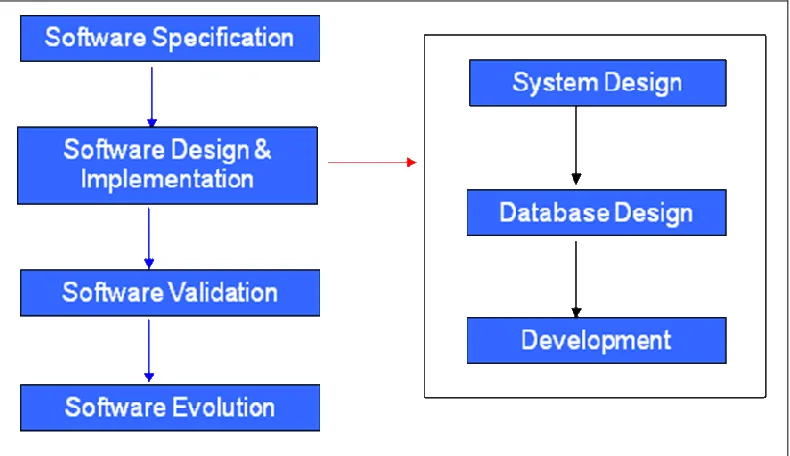
[image:19.612.130.525.453.681.2]In producing a system or software application, there are four fundamental process activities: software specification, software design and implementation, software validation and software evolution [1-3]. Software specification is a process of writing the user requirements to get system specification [4, 5]. People can use existing standards technique to write documents such as using the natural technique as proposed by Heninger [6], the US Department of Defence and the IEEE. Another technique in writing system documentation that has been discussed by Pohl and Rupp [5] includes the famous and widely used technique, IEEE/ANSI 830-1998. Normally, the System Specification Document (SRS) will be produced as the deliverable for this phase to verify the user requirements with the system developer. However, in an established company, they usually use their own form as the standard way to show the user requirements. These user requirements will be used in the next phase to the software design and implementation. The system design is part of the software fundamental process as illustrated in Figure 1.1.
3 After that, the process of collecting the requirements is completed. Modelling or designing a software application in software design and developing phase is an important part in order to make sure that the development is congruent with the specification. A model can specify, visualise and document models of software system including their structure and design. During system design, the software engineer is needed to complete three main tasks, which are designing the system logic, user interface and database. These system logic, user interface and database will be used to counter back with the users before starting the coding. The counter back process assures that business functionality is complete and correct, end-user needs are met and program design supports the requirements for scalability, robustness, security and extendibility. The components involved in system design are illustrated as in Figure 1.2.
Figure 1.2: The System Design Components
4 This thesis is a study that defines an alternative approach in designing optimal database system based on object-oriented concept. Optimal database means all defining attributes table in database are used. The discussion is made to present the technique on how attributes sanitization is applied in proposed technique which is not implemented in the current defining database technique, whether using the structure or object-oriented technique. The discussion includes process flow of the proposed technique, rules, example of implementation and the comparisons with current techniques to show that this technique is better than previous techniques.
Normally, in object-oriented approaches, Unified Modelling Language (UML) is used to represent the system requirements that consist of 13 notations such as use case, sequence diagram and class diagram [8-10]. This study has been done to consider all the features and the constraints in the class diagram to be used in producing the first schema table. Attributes sanitization is a technique to remove duplicated class or attributes in constructing the first schema table. Then, this schema table will be compared with the user interface to apply the second step which is to normalize the structure based on user interfaces. Upon completion of the process of normalization in the structure of schema table, the attributes sanitization technique is again applied to remove unused data in producing the final schema table. Then, the schema table is available to create the structure to implement the optimal database. This chapter presents the background of this study including the related issues, aim, research objectives, scope and the limitation of study and lastly the organization of the thesis.
5 1.2 Problem Statement
System application consists of software design and database design. Software design will show the business process of the system. Software design will do the system logical and sketch the user interface. Another activity is database design to describe the flow of data involving in the system [13]. We cannot deny that software design and database design are tightly coupled. However, until now, both these designs are not congruent. Furthermore, the practitioners have distinguished these two activities in many ways.
In universities, students learn different subjects. System analysis and design subject represents software design. Another subject is database system or database design. This phenomenon also happens in organizations. Most of the companies break up into two positions, which are software engineers or analyst programmers for developing the system and database administrators (DBA) for managing the database. This situation is supported with strong reasons such as for security or to focus on particular jobs that can increase the quality of tasks. However, to break the tasks into two groups, there must be mutual understanding in order to get high quality system.
6 The second approach is object-oriented. This technique, which uses Unified Modelling Language (UML), consists of various notations such as use case, sequence diagram and class diagram. Normally, during system analysis and design, the developer will produce use case diagram, state diagram and sequence diagram to confirm the understanding of the developer with the users regarding the system [5, 21, 22]. The class diagram is produced to show the interaction among the entities. In class diagram, it will show the behaviours of the class such as generalization, association and multiplicity. The class diagram also contains details about the class such as the attributes, name and data type [23]. PHP, C+, C# and Java are among the programming languages that support object-oriented concept. However, the UML does not have specific notation for database modelling. Normally, class diagram is used to design the database because these diagrams represent the semantic data [1]. In current practice for software development using object-oriented methodology, there are two famous ways on how people establish the database from designing the problem domain. The first technique is by transferring the class diagram to the appropriate tables after considering the class behaviour. Objects of the class are used without any translation between data structures in the design system and the program data structures [24]. This object-oriented approach seems to be a very attractive solution for modelling system based on object in system design and database design. It can be more meaningful especially if it is combined with the object-oriented programming technique and applied in programming language to manage persistence object. This technique gains its popularity when many references such as books and papers have been published. However, this system is not mature. In addition, it seems to lead to data redundancy in the object-oriented database design. Many researchers have given suggestions to consider the relationships principle in data model to avoid redundancy [25-28]. Since this technique is very young and not mature, further researches have to be done.
7 the repository [2, 16]. Developer will use normalisation technique to reduce redundancy. The developer combines the object-oriented technique in system design, while structured approach is used in database design. This object-oriented technique is workable to produce the system. However, there is lack of consistency checking from system design to database design. The consistency checking cannot be applied from design system to design database. Furthermore, the possibility to lose data while transferring diagram from object to ERD is very high. This technique is also lacking references because most of the references discuss structure technique or object-oriented technique.
Both structure technique and object-oriented technique are commonly used by the software developers. However, there was no consistency checking applied from system design to database design. Without consistency checking, it will lead to storing useless data in the database.
Therefore, in this research, an alternative technique to transfer the design system to database design based on object-oriented approach is identified. The class diagram produced in the system design will be used to create the schema table. This schema table will be compared with the user interface for normalization process. Lastly, attributes sanitization process will be applied to produce an optimal database structure. Optimal database structure referred to use of defining attributes in data model. This technique will apply continuous process from system design until the creation of database. Furthermore, the normalization technique using interface will ensure that only dedicated data are stored in database based on the user’s needs. The technique will remove the passive data to avoid the process of inserting and keeping the data. Furthermore, the technique will provide a platform to consistently check the system design and database design. On the other hand, this technique will provide better database compared to the current techniques. This technique will be compromised with both fundamental techniques to resolve the drawbacks.
1.3 Aim
8 when all defining attributes in schema table are used in displaying the user interface. The result must show the improvement in terms of design and storage consumption.
Well-designed technique will clearly show the flow in software development process. It starts from using defining class diagram until producing schema table. This research is primarily concerned with how efficiently the new alternative algorithms solve software development problem. It is hoped that this research would encourage the use of object-oriented technique in software development process including software specification and software design by using the Unified Modelling Language (UML) as a tool to draw notation to show that the class diagram produce in system design is harmonious with the database design.
1.4 Objectives of study
The objectives of this research are as follows:
i. To design the framework for producing an improved database structure based on attribute sanitization from class diagram.
ii. To formalize the rules for producing an improved database structure based on attribute sanitization from class diagram.
iii. To develop the tool based on (ii) in getting an improved database structure.
1.5 Scope and Limitation
The followings are the scope of this research:
i. Schema Table Focus on Class Diagram
The class diagram is used as the base diagram to produce optimal schema table. The class diagram was considered in designing database because it contained semantic rules and represents data model [1, 5, 21, 23, 24, 29-31].
ii. Optimal Database
9 used by the user interface are considered as not useful and should be removed [32-34].
iii. Formalization of the rules
The entire transferring of rules from class diagram to schema table and comparing schema table with user interface is specified using mathematics such as logic, sets, and quantifiers in order to prove the concept of the ideas [35, 36].
iv. Proving the consistency rules
Two ways will be used to prove the technique in producing schema table from class diagram. First is using the defining rules. The idea was transferred to the rules as will be described in Chapter 4. The rules are defined to prove it consistent. Then, the rules are implemented in the proposed tool. Developing an application is done to prove that the research idea is workable. The software is developed using Microsoft Visual Studio 2010 to apply the rules in producing the schema table and the detailed discussion about the tool is in Chapter 5. The second technique is by using a selective existing system, which is chosen to verify that the technique follows the defining rules as discussed in Chapter 6. The discussion compares the result between the research technique and object-oriented technique with normalize technique.
1.6 Report Organization
The next chapter deals with related work and discusses features of the existing system design algorithm.
10 produce structure of database. Chapter 2 elaborates further regarding the structured and object-oriented techniques.
Next, Chapter 3 illustrates the methodology used for the proposed Attributes Sanitization in Object-oriented Design for Relational Database System. This chapter will give clear picture about the research framework. The discussion details up the process involved in creating schema table from class diagram and in producing optimal schema table.
Then, the process flow is transferred to formalize the rule in Chapter 4. Four primary topics, which are the rules, algorithm, formalization and consistency rules, in creating optimal database schema from class diagram will be discussed.
It is followed by discussion on the tool in Chapter 5. To ensure that the defining process in Chapter 3 and defining rules in Chapter 4 are workable, the tool has been created using Visual Studio 2010 using C# language. Chapter 5 will give an example of Lecture Assessment System (LAS) to show the process in producing schema table using tools.
In Chapter 6, the manual implementation in the process of designing database design using object-oriented technique and the research techniquewill be discussed. Then, a comparison using LAS will be analysed and discussed. In Chapter 5 and Chapter 6, the application of the process of attributes sanitization in designing optimal database system will also be shown.
2 CHAPTER 2
LITERATURE REVIEW
2.1 Introduction
This chapter covers the related and pertinent issues to this research. The literature review will be discussing the spectrum of research done in this area for supporting the research, specifically to find the gaps in producing schema table or designing the database structure. There are two techniques in designing database: structured technique and object-oriented technique. Structured technique is defined as the database is based on two diagrams, which are data flow diagram and entity relationship diagram. On the other hand, object-oriented used class diagram to produce the structure of database. This chapter will start explaining the differences between the data and attribute as discussion is based in database design, before discussing the techniques of designing database.
2.2 Overview of Data
12 The next phase is design phase where data was analysed and organized as the system need.
In this phase, data model was established to show the conceptual structure [7, 41]. There are three basic elements used in the data modelling language which are entities, attributes and relationships. Class diagram or entity relationship diagram is an example of data model which is frequently used. In the design phase, each entity was described in detail. Entity is the basic symbol and depicted by a rectangle. Entity is a person, place, thing or event about which data is collected. A research done by Yangbo Xu et al. [42] showed how to extract table properties from the web to store as entity attributes. The entity name was taken from the table name. Each entity has name and details about what it is representing is called attribute. An attribute is a property of an entity and each entity may have many attributes. Each attribute will hold value and is called data. The data value can be changed but once the attribute is removed, the data value will be gone. In designing phase, Yuto Nakamura et al. [43] are suggested to use similarity words in giving the name for entity and attributes with the daily words used. Their research has shown that higher validity and understandability of the diagram if used same structure of class diagram.
2.2.1 Data Sanitization
Data sanitization is the process of making sensitive information in non-production database safe for wider visibility. The data should be sanitized or removed in order to protect valuable business information [44-46]. Data sanitization is also referred to as the process of removing resistant or worthless data. Some researchers use the terms data cleansing or data reduction [47]. The objectives of doing data sanitization are to get clean unused data and to produce quality data. Moreover, sometimes data sanitization is used to hide important data [46]. The technique can be applied before or after the data is stored in the database.
13 introduced normalization technique. Codd focused on data redundancy but ignored the usefulness of the data in the database.
The term data sanitization is formerly used in Knowledge Discovery in Database (KDD). Data mining is one of the activities in the process to discover previously ambiguous, duplicated and scattered data in database to define the technique to mine the data for gaining useful information. Many techniques have been proposed to mine the data including classification, clustering, association rule mining using rough set and neural network [47, 48]. Then rough set and neural network was improved by soft set theory that introduced by Molodtsov [49]. Other researchers have proposed the improvement techniques in soft set theory such as Herawan who proposes the alternative way to consider multi-value attributes reduction in information system [50].
Besides that, data sanitization concepts have also been introduced in other fields such as network data. Bishop et al [46] propose the idea of removing the selected information such as password and information that can be identified by individuals to hide sensitive data from passing through the network. Another research done by Defit [47] uses data cleansing technique to identify and fill the missing values in Jakarta Stock Exchange. Defit [47] combines several intelligent techniques, which are rough set, neural network, knowledge based and statistic to claim that the techniques offer better results in handling uncertain and missing value.
Literature study found that data sanitization or data cleansing was a very popular technique in removing the available data in the database but no research was done on attribute or column sanitization on the table structure in the database.
2.2.2 Attribute Sanitization
14 sanitization is not popular among the researchers but attribute reduction which has a similar meaning was used by many researchers in their areas of research.
Long Giang Nguyen [51] did a research on attribute reduction in decision table using metric technique. This research proposed a new method for attribute reduction in information system. It was based on the subset of attributes which determines the knowledge structure on the set of objects. A metric on knowledge structure will be defined on the attribute sets to measure the similarity of knowledge structures. The researcher has published the technique which proves this metric method is more effective based on Shannon entropy. A research done by Xu Qisheng et al. [52] used mapping matrix according to the mapping relation between an attribute value and a decision value from decision table. They claimed that by using this mapping matrix optimal reduction set can be obtained compared to other techniques such as discrimination matrix, decision matrix or heuristic reduction. Their paper provides a detailed technique to apply mapping matrix with an example to prove their idea is workable.
Mingquan Ye and Chanrong Wu [53] did a research on attribute reduction using discernability matrix. Both researchers have proposed a decision table decomposition model to solve the attribute reduction problem based on discensibility matrix for large decision table. In their technique, they have introduced attributes partition. The large decision table was divided into a number of decision sub-tables and transferred the computing discernibility matrix in original decision table into sub-tables. They have attached a complete algorithm and example in their paper for reviewers. Their paper shows how this technique is applied and they claimed that their technique is efficient.
15 the core attributes in information system and the cost of getting core attributes to identify whether a set contains the core or not. By using this technique, it takes less time and easier to achieve the smallest reduction.
Attribute reduction was also used by Xiongbin Wang et al. [56] in their area which was rough set theory. Their research was based on the relationship of many deferent attribute reduction definitions. It was known as relative attribute reduction. Their research paper established the algorithm of attribute reduction and the rules acquired from the decision table. They did a research to identify the relationship between attribute reduction based on the system entropy and on the database system.
Wang Yanbo et al. [57] have done a research on attribute reduction for network security. The research done is based on the network situation where the network equipment running status, network behaviour and user behaviour was saved in a log file. The information is very large, scrambled, repetitive and imperfect. There are some attributes in the log file which are useless. These researchers produced a paper that proposed a rough set reduction algorithm based on adaptive genetic algorithm. This algorithm was improved on cross probability, variation probability and fitness function. They claimed that their proposed technique has reduced time and enhanced the calculation far better than the traditional algorithm.
16 2.3 Structured Approach
Modelling of a system is an essential process in software development lifecycle to produce a system model. A system model can provide the structure for problem solving. It can also be used as an experiment to explore multiple solutions and abstractions to manage complexity. It is not just only to understand the requirements and business process, but more than that, which is to suggest improvement process when the system is implemented. The models used should have traceability links among them. In other words, a system model must be consistent.
Structured technique was introduced in 1970. The old technique for showing the flow of data in structure system analysis and design (SSADM) is known as data flow diagram (DFD) [15, 16]. Using the data flow diagram, users are able to show how the system operation and data involved are used as the input and output at each process. It was introduced by Edward Yourdon and Larry Constantine in 1974 based on Martin and Estrin data flow graph model of computation [58]. Then, in 1977, Gane and Sarson introduced different notation for data flow diagram, which is more efficient [15].
2.3.1 Data Flow Diagram
Data flow diagram is very popular and easy for end users to understand the physical idea of where the data they input has an effect to the process in the whole system. Data flow diagram can show the flow of data from external entities into the system and involvement of the data with the process. Data flow diagram has four notations: input/output, process, data flow and data storage [2, 15]. A data flow diagram mainly focuses on the processes or activities performing in the system. This diagram was established to represent the system process in a diagram.
2.3.2 Entity Relationship Diagram
17 represents a concept of data. The diagram contains entity and relationships between entities. Chan defines entity as a thing that can be a person, company or event, while relationship is an association among the entities. There are three types of association, which are one-to-one, one-to-many or many-to-one, and many-to-many. The ERD is a basic for advanced entity relationship as implemented in object-oriented concepts [2, 16].
2.4 Object-Oriented Approach
Using object-oriented for software development, the system model can be developed by using Unified Modelling Language (UML). Unified Modelling Language (UML) is a modelling language that contains notations to represent objects-oriented concepts. It was established in the works of Grady Booch, James Rumbaugh, Ivar Jacobson and Rational Software Company. Since 1995 until now, UML has passed through many evolution processes for improvement such as from UML 0.8 until UML 2.3, which was released in 2010 [21, 29]. UML has many diagrams in view of system modelling. However, Class Diagram is the backbone of a modelling system because it represents the structure of the system that shows the system classes, attributes and relationship between classes [9, 16]. Furthermore, the graphical notation in a class diagram can be used to produce database structure.
Dobing and Parsons [59] in their interviews-based research with almost 2,700 UML practitioners and clients through the web find that use case diagrams and class diagrams have the highest usage levels followed by sequence, state and activity diagrams. Most of the diagrams are used to present the requirements; however, the class diagram is one of the diagrams available to use in producing the database design. The research study is based on class diagram as the initial stage to produce schema table as the diagram contains semantic data [1]. Furthermore, class diagram is also used to show entities, element of analysis and design such as associations, aggregations and generalizations among entities [1, 21, 23] .
18 constructing, visualizing and documenting the software system and its components. It is an object modelling and specification language used in software engineering. It includes a set of graphical notation techniques to create abstract models of specific systems. Normally, during system analysis and design, the developer will produce use case diagram, state diagram, class diagram and sequence diagram to confirm the understanding of the developer with the users regarding the system [59]. When the users agreed with the design, the class diagram will be produced to show the interaction among the entities. In class diagram, it will show the behaviours of the class such as association, composition, aggregation and generalization [16, 60]. It also contains details about the class such as the attributes, name and data type [21, 29]. Association in object-oriented same as in structure technique was known as multiplicity. Multiplicity in object-oriented shows the relationship between two classes. Composition, aggregation and generalization are not defined in structured technique. Composition is shown as a class which is a whole of another class and has a strong relationship. Aggregation is described as a week relationship where a class is part of another class. Generalization is shown in a class diagram that one class shares the structure defined in one or more other classes. These four types of relationships were considered in this research as defined in the rules in Chapter 4.
Practitioners use class diagram for the development team member as their internal design [23, 29, 61]. This class diagram will be used as the initial part of designing the database system. The UML does not contain dedicated diagram for modelling database design. However, the class diagram is the only one which is the most suitable diagram to consider as the base for database conceptual modelling. A class diagram visually represents the semantic data [1, 23, 24].
19 application and designing database is a critical part. Even though it is hidden from the user, the database design must be fulfilled the user’s needs.
2.4.1 Class Diagram
A class in a class diagram [10, 65] represents a set of object with common features. A class graphically shows a rectangle that is divided into three parts: names, attributes and operations. The names for each class must be unique in the whole diagram and the other parts are optional. Among the classes, there are four types of relationships: associations, composition, aggregation and generalization. Association is shown as the relationship of the object among the classes. It is called multiplicity class diagram or cardinality on entity-relationship diagram. There are three types of multiplicities which are one-to-one, one-to-many and many-to-many. Composition and aggregation represent the whole and part relationships, when one class represents the whole object and other classes represent parts. The generalization is also known as inheritance, which is a concept in which the derived class can contain attributes and operation as based class. The derived class can also contain additional attributes and operations or less than the number of attributes or operations from based class. The class is defined based on the user requirements and classified based on persons, things, events or places. The class diagram is used to represent model data with ignoring the operations. The UML does not have specific notation for database modelling. However, the class diagram can be used to represent semantic data [1].
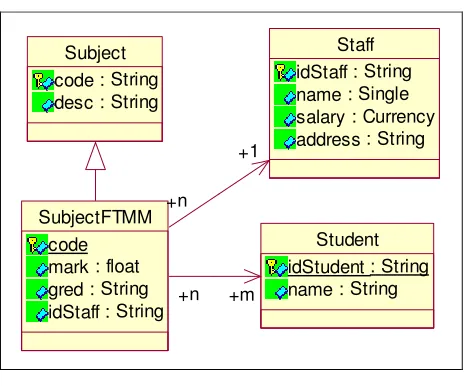
As shown in Figure 2.1, there are four (4) classes which are Subject,
Staff, SubjectFTMM and Student. The figure also shows two relationships
which are generalization and association. The generalization was shown between
SubjectFTMM and Staff. Meanwhile the associations between those classes are
20
Figure 2.1: UML Class Diagram
The class diagram will be the input for process generating schema table. The standard concept in the class diagram as class behaviour is described as follows:
i. Class diagram consists of classes and relationships.
• A class is defined as the set of shared attributes and behaviours in each object in the class.
• Relationships are associations between entities. They are referred to as data associations.
ii. A class consists of name, attributes and operations.
• Class name is used to distinguish the defining class from all other classes in a class diagram.
• Attributes are used to describe the class.
• Operation is defined as the process to invoke on the attributes based on system requirement. However, the operations are not used in designing the structure of table.
iii. Among the classes, there are four types of relationships namely associations, composition, aggregation and generalization.
• Associations show the relationship of the object among the classes. It is called as multiplicity class diagram or cardinality on entity-relationship
Subject code : String desc : String
Student idStudent : String name : String
Staff idStaff : String name : Single salary : Currency address : String
SubjectFTMM code mark : float gred : String
idStaff : String +n +m
+1
21 diagram. There are three types of multiplicities which are to-one, one-to-many and many-one-to-many.
• Composition relationship is when one class represents the whole object of other classes.
• Aggregation relationship is when one class represents the part object of other classes.
• Generalization is also known as inheritance, which is a concept where the derived class can contain the attributes and operations as based class. It can also contain additional attributes and operations or contain less than the number of attributes or operations from based class.
2.4.2 User Interface
An interface is defined as a point of interaction between two systems or work groups. It is very important as a reference point of interaction between human to system and system to human. There are many types of interface including natural language, question answer, menus, form fill, command language, graphical user interface (GUI) and a variety of web interfaces [16]. Users use the interface to supply data for store in the database and to retrieve it back. The information will be displayed after the system retrieves the data and processes it for the user’s needs. Most of the time, users are not familiar and do not concern with the structure in the database. They do not bother with the database design. However, users are really consent to have information in the interface to fulfil what they want. In other words, the interface helps users to get information they need in and out of the system [16, 66]. Generally, there are two purposes of the interface. Firstly, interface is used as presentation language, which is the computer to human part of transaction, and secondly, it is used as action language, which is the human to computer part of transaction.
22 object-oriented with the aim reducing time maintenance. Reducing the time in design database will significantly reduce the cost. Dzafic et al. has presented their work with an example and found that the technique proposed has increased the number of database table and increased the response time.
In this research, the attribute is referred to the data which is channelled through the interface to be utilized but does not consider the graphics such as colour. The user interface was an important input in this research because it was used to create the final database structure after making comparison among the schema table from the user requirement and the user interface. During the process of gathering user requirements, a lot of data are requested to be stored in the database. The users believed that these storing data will be used in the future. However, after the system was completed and delivered to the user, not all the dreams came true. There are many cases where the data stored in the database is never used. To avoid this, the proposed method as suggested in this research is by tuning the structure of the database through removal of the unused data in the database design. This method can reduce the storage and increase the database performance. It is based on the computer principle dealing with input and output concepts. This technique will be further described in Chapter 3.
2.5 Normalization Technique
23 the tables will increase the number of tables in displaying information, decrease accessing time and make the process of updating, accessing and programming much more complex.
2.6 Database Design
Database in general is known as allocation storage in computer to store data. Database is a shared collection of logically related data that contains description of the data defined according to the organization’s needs [2, 41, 69, 70]. Usually, database put in a computer act as a server and is accessible by other computers recognised as clients. Since a server is needed to serve many clients, all efforts must be made when designing the database during the system design phase. Normally, there are three stages in designing database, which are conceptual, logical and physical design. However, this research focuses on logical database design only.
Logical database design focuses on identifying the data flow during eliciting user’s requirements. Normally, the designer establishes the entity, attributes and relationship between the entities. Designing logical database requires the software engineer to comprehend thoroughly the overall business process. There are two main approaches in designing database that are referred as bottom-up and top-down. The bottom-up approach starts with identifying the attributes and relationships. This approach is quite suitable for a simple database with a limited number of attributes.
This research focused on top-down approach because this approach is appropriate for designing any type of database whether it’s simple or complex database [7]. This approach starts with designing data model that contains entities and relationships to show data semantic. In structured technique, the Entity Relationship Diagram is usually used to represent the entities, relationships and attributes. In UML technique, the data semantic can be derived from class diagram.
24 In this research, the schema table is constructed from class diagram with considering the semantic data. Attribute sanitization in class diagram will eliminate redundant of class name and redundant attributes in class diagram. Then the user interface is used as normalized process to structure the table as wanted by users. Finally, the fields in user interface will be compared with the schema table. If any attributes in the schema table are not accessible from user interfaces, then it was suggested for the schema table to be removed.
2.6.1 Database Design Using Structured Technique
In structured technique approach, the user defines the database based on two diagrams, which are data flow diagram (DFD) and entity relationship diagram (ERD). Data flow diagram is used to represent the user’s requirements. System analysts will attempt to understand the user’s needs and business process in both diagrams. Then, these diagrams are used to get confirmation from the users.
Through the structured analysis technique with the Data Flow Diagram, the four symbols which are process, data flow, data store and entity are used to create a pictorial depiction of process that will eventually provide system documentation. When the system documentation is accepted by the user, the next step is to collect the data stored in Data Flow Diagram to visualise in Entity Relationship Diagram. Then, the schema table will be produced based on the defined Entity Relationship Diagram.
REFERENCES
1. Sommerville, I. Software Engineering 9 (Ninth edition). Eighth. Harlow: Pearson Addison Wesley. 2010.
2. Roth, R. M., Dennis, A. and Wixom, B. H. System Analysis And Design. Singapore: John Wiley. 2013.
3. Stair, R. and Reynolds, G. Principles of Information System. Tenth Edition. Thomson. 2012.
4. Babu, P. A., Murali, N., Swaminathan, P. and Kumar, C. S. Making Formal Software Specification Easy. Proceeding of the 2nd International Conference
on Reliability, Safety & Hazard (ICRESH-2010). IEEE. 2010. pp 511-516.
5. Pohl, K. and Rupp, C. Requirements Engineering Fundamentals. First Edition. California: Library of Congress. 2011.
6. Heninger, K. L. Specifying Software Requirement for Complex Systems: New Techniques and Their Applications. Proceeding of the IEEE
Transaction on Software Engineering. 1980. pp 2-13.
7. Connolly, T. and Begg, C. Database Systems. Fifth Edition. Addison Wesley. 2010.
8. OMG. (2009). OMG Unified Modeling LanguageTM (OMG UML). Retrieved on April 2, 2014, from http://www.uml.org/#UMLProfiles.
9. Yan, W. and Du, Y. Research on Reverse Engineering from Formal Models to UML Models. Proceeding of the 3rd International Symposium on Parallel
Architectures, Algorithms and Programming. IEEE. 2010. pp 406-411.
10. Deenis, A., Wixom, B. H. and Tegarden, D. System Analysis Design UML
Version 2.0. Fourth Edition. John Willey & Sons. 2012.
11. Cadar, C. and Dadeau, F. Constraints in Software Testing, Verification and Analysis CSTVA 2013. Proceeding of the 2013 IEEE Sixth International
Conference on Software Testing, Verification and Validation Workshops.
2013. pp 208-209.
12. Software & Systems Engineering Standards Commitee (2012). IEEE
Standard for System and Software Verification and Validation. New York:
120 13. Elmasri, R. and Navathe, S. Fundamentals of Database Systems. Sixth
Edition. Singapore: Pearson. 2011.
14. Ganc, C. and Sarson, T. System Structured Analysis and Design Tools and
Techniques. New Jersey: Prentice Hall. 1979.
15. Ibrahim, R. and Yen, Y. S. Formalization of The Data Flow Diagram Rules for Consistency Check. International Journal of Software Engineering &
Application (IJSEA). 2010. 1(1). pp. 99-106.
16. Kendall, K. E. and Kendall, J. E. System Analysis and Design. Ninth Edition. New Jersey: Pearson. 2013.
17. Jiang, X. and Song, G. The Database Design for The Control Equipment Management System. Proceeding of the 2012 3rd International Conference On System Science, Engineering Design and Manufacturing Information
(ICSEM). IEEE. 2012. pp 261-264.
18. Codd, E. F. A Relational Model for Large Shared Data Banks.
Communication of ACM. 1970. 13(6). pp. 377-387.
19. Chen, P. P. The Entity Relationship Model - Toward a Unified View of Data.
ACM Transaction on Database System. 1976. 1 (1). pp. 9-36.
20. Codd, E. F. (1969). Derivability, Redundancy and Consistency of Relations in
Large Data Banks. IBM Research Report. Retrieved on 18 January, 2010,
from http://technology.amis.nl/ blogacc/blog/wp-content/images/RJ599.pdf. 21. Chonoles, M. J. and Schardt, J. A. UML 2 For Dummies. Wiley Publishing,
Inc. 2003.
22. Ha, I. and Kang, B. Cross Checking Rules to Improve Consistency between UML Static Diagram and Dynamic Diagram. In. Intelligent Data Engineering
and Automated Learning – IDEAL 2008 Springer Berlin/ Heidelberg. pp
436-443; 2008.
23. Alsaadi, A. Checking Data Integrity via the UML Class Diagram. Proceeding of the Proceeding of International Conference on Software Engineering
Advances (ICSEA 06). IEEE Press. 2006. pp 37-46.
24. Fitsilis, P., Gerogiannis, V., Kameas, A. and Pavlides, G. Producing Relation Database Schemata from an Object Oriented Design. Proceeding of the 20th
121 25. Grimes, S., Alkadi, G. and Beaubouef, T. Design and Implementation of The Rough Relational Database System. Journal of Computing in Colleges. 2009. 24(4). pp. 88-95.
26. Waseem, A. A., Hussain, S. J. and Shaikh, Z. A. An Extended Synthesis Algorithm for Relational Database Schema Design. Proceeding of the International Conference on Information Systems and Design of
Communication. Lisboa, Portugal: ACM. 2013. pp 94-100.
27. Kolahi, S. and Libkin, L. An Information-Theoretic Analysis of Worst-Case Redundancy in Database Design. ACM Tansactions on Database System. 2010. 35(1). pp. 1-32.
28. Heimel, M. Designing a Database System for Modern Processing Architectures. Proceeding of the SIGMOD'13 PhD Symposium. New York, USA: ACM. 2013. pp 13-17.
29. Jason, T. R. UML: A Beginner Guide. Califonia: McGraw-Hill. 2003.
30. Boufares, F. and Bennaceur, H. Consistency Problem in ER-Schemas for Database Systems. Information Sciences. 2004. 163(4). pp. 263-274.
31. Ali, A. B. H., Boufares, F. and Abdellatif, A. Checking Constraints Consistency in UML class diagrams. Proceeding of the International
Conference ICTTA '06. 2006. pp 3599-3604.
32. Lubcke, A., Koppen, V. and Saake, G. A Decision Model to Select the Optimal Storage Architecture for Relational Databases. Proceeding of the 2011 Fifth International Conference on Research Challenges in Information
Science (RCIS). IEEE Conference Publication. 2011. pp 1-11.
33. Sheng, C., Zhang, N., Tao, Y. and Jin, X. Optimal Algorithms for Crawing a Hidden Database in The Web. Proceedings of The VLDB Endowment. 2012.
5(11). pp. 1112-1123.
34. Al-Zubaidy, H., Lambadaris, L. and Talim, J. Optimal Scheduling in High-Speed Downlink Packet Access Networks. Transactions on Modeling and
Computer Simulation (TOMACS). 2010. 21(1). pp. 1-27.
35. Rosen, K. H. Discrete Mathmatics and Its Applications. Fouth Edition. New York: McGraw Hill. 1999.
122 37. Khaswneh, A. A., Saraureh, K. T. A. and Meridji, K. Early Identification, Specification and Measurement for Data Definition and Database Requirements. Proceeding of the International Conference on Computer
Information and Telecomunication Systems (CITS). IEEE. 2012. pp 1-5.
38. Rainer, R. K. and Cegielski, C. G. Introduction to Information Systems. Third Edition. New York: John Wiley. 2010.
39. Chen, Z., Gua, T., Qien, Z. and Xiao, C. Research on The Method of Data Extraction Based on Category. Proceeding of the 12th International
Conference on Computer and Information Science (ICIS). 2013. pp 365-369.
40. Ismail, S., Shaari, M. S., Saip, M. A. and Shaari, N. Module Information
Technology for Management. Selangor: Pearson. 2010.
41. Coronel, C., Morris, S. and Rob, P. Database Principles. Tenth Edition. China: Course Technology Cengage Learning. 2013.
42. Xu, Y., Yu, Z., Mao, C., Wang, Y. and Guo, J. Entity Answer Extraction of Web Table. Proceeding of the 2010 Seventh International on Fuzzy Systems
and Knowledge Discovery (FSKD 2010). 2010. pp 2465-2468.
43. Nakamura, Y., Sakamoto, K., Inoue, K., Washizaki, H. and Fukazawa, Y. Evaluation of Understanability of UML Class Diagrams by Using Word Similarity. Proceeding of the International Workshop on Software Measurement and The 6th International Conference on Software Process and
Product Measurement. 2011. pp 178-187.
44. Ltd, A. N. (2005). Data Sanitization Techniques. White Paper. Retrieved on July 7, 2012, from http://www.qaguild.com/upload/ Datasanitization_Whitepaper.pdf.
45. Bishop, M., Bhumiratana, B., Crawford, R. and Levitt, K. How to sanitize data? Proceeding of the Enabling Technologies: Infrastructure for Collaborative Enterprises, 2004. WET ICE 2004. 13th IEEE International
Workshops on. 14-16 June 2004. 2004. pp 217-222.
46. Bishop, M., Crawford, R., Bhumiratana, B., Clark, L. and Levitt, K. Some Problems in Sanitizing Network Data. Proceeding of the Enabling Technologies: Infrastructure for Collaborative Enterprises, 2006. WETICE
'06. 15th IEEE International Workshops on. 26-28 June 2006. 2006. pp
123 47. Devit, S. Intelligent Data Cleaning Based on Knowledge Based. Proceeding
of the Information and Multimedi Technology (ICIMT 09). Jeju Island: IEEE
Press. 2009. pp 393-398.
48. Amiri, A. Dare to Share: Protecting Sensentivi Knowledge with Data Sanitization. Science Direct: Decision Support Systems. 2006. 43. pp. 181-191.
49. Molodtsov, D. Soft Set Theory First Results. Computer and Mathmatics with
Applications. 1999. pp. 19-13.
50. Herawan, T., Rose, A. N. M. and Deris, M. M. Soft Set Theoretic for Dimensionality Reduction. Communication in Computer and Information
Science. 2009. pp. 171-178.
51. Nguyen, L. G. Metric Based Attribute Reduction in Decision Tables. Proceeding of the Proceedings of The Federated Conference on Computer
Science and Information Systems. 2012. pp 311-316.
52. Qisheng, X., Zeyin, X., Yang, Z. and Houchang, X. Study on Attribute Reduction Based on Mapping Matrix. Proceeding of the 2nd International
Confrence on Signal Processing Systems (ICSPS). 2010. pp 722-726.
53. Ye, M. and Wu, C. Decision Table Decomposition Using Core Attributes Partition for Attribute Reduction. Proceeding of the The 5th International
Conference on Computer Science and Eduction. Hefei, China: 2010. pp
23-26.
54. Zhou, J., E, X., Li, Y., Liu, Z., Bai, X., Huang, X. and Yang, D. A New Reduction Algorithm Dealing With The Incomplete Information System. Proceeding of the International Conference on Cyber-Enabled Distributed
Computing and Knowledge Discovery. 2009. pp 12-19.
55. Ke-yong, Y., Xiao-guang, H. and Fang-qiao, X. An Algorithm for Attribute Reduction Based on Database Technology. Proceeding of the 2009 International Conference on Artificial Intelligence and Computational
Intelligence. 2009. pp 53-57.
56. Wang, X., Zheng, X. and Xu, Z. Comparative Research of Attribute Reduction Based on The System Entropy and on The Database System. Proceeding of the International Symposium on Computational Intelligence
124 57. Yanbo, W., Huiqiang, W., Xiufeng, W. and Ming, Y. Research on Data Attribute Reduction for Network Security Situation. Proceeding of the 2012
International Conference on Computer Science and Service System (CSSS).
2012. pp 589-593.
58. Yourdon, E. and Constantine, L. L. Structured Design. New Jersey: Prentice Hall. 1979.
59. Dobing, B. and Parsons, J. Dimensions of UML Diagram Use: A Survey of Practitioners. Journal of Database Management. 2008. 19(1). pp. 1-18. 60. Maciaszek, L. A. Requirements Analysis and System Design. Third Edition.
England: Pearson. 2007.
61. Saringat, M. Z., Ibrahim, R. and Ibrahim, N. A Proposal for Constructing Relational Database from Class Diagram. Computer and Information Science. 2010. 3(2). pp. 38-46.
62. Castro, T. R. d., Souza, S. N. A. d. and Souza, L. S. d. CASE Tool for Object-Relational Database Designs. Proceeding of the Conference on Information
Systems and Technologies (CISTI). 2012. pp 1-6.
63. Felsinger, R. and Pleasant, M. (2001). Using Rational UML Case Tool. Retrieved on 16 MAY 2011, from http://www.uml.org.cn/ umltools/psf/ UsingRationalRose.pdf.
64. Sybase. (2011). Object-oriented Modeling. Retrieved on 16 May 2014, from http://infocenter.sybase.com/help/topic/com.sybase.infocenter.dc38086.1610/ doc/pdf/ object_oriented_modeling.pdf.
65. Ali, N. H., Shukur, Z. and Idris, S. A Design of an Assessment System for UML Class Diagram. Proceeding of the Fifth International Conference on
Computational Science and Applications IEEE Press. 2007. pp 539-546.
66. Kieffer, S., Coyette, A. and Vanderdanckt, J. User Interface Design by Sketching: A Complexity Analysis of Widget Representations. Proceeding of the EICS'10: Proceedings of the 2nd ACM SIGCHI Symposium on
Engineering Interactive Computing Systems. New York: ACM. 2010. pp
57-66.
125 68. Dzafic, I., Soto, J., Halilovic, E., Lecek, N. and Music, M. Object-oriented Database and User Interface Design. Proceeding of the EuroCon 2013. Croatia: IEEE. 2013. pp 558-563.
69. Ramez, E. Database System. Sixth Edition. Boston: Pearson. 2011. 70. Kumar, V. 101 Design Methods. New Jersey: John Wiley. 2013.
71. Attraran, H. and Far, A. H. The 2011 10th IEEE International Conference.
Proceeding of the Cybernatic Intelligent Systems (CIS). London: IEEE. 2011.
pp 128-132.
72. Date, C. J. An Introduction to Database System. Eighth Edition. Singapore: Pearson. 2004.
73. Dzafic, I., Soto, J., Halilovic, E., Lecek, N. and Music, M. Object-oriented Database and User Interface Design. Proceeding of the EuroCom 2013. Croatia: 2013. pp 558-563.
74. Jagannatha, S., Reddy, S. V. P., Kumar, T. V. S. and Kanth, K. R. Simulation and Analysis of Performance Predicition In Distributed Database Using OO Approach. Proceeding of the 2013 3rd IEEE International Advance
Computing Conference (IACC). IEEE. 2013. pp 1324-1329.
75. Osman, R., Awan, I. and Woodward, M. E. Performance Evaluation of Database Designs. Proceeding of the 2010 24th IEEE International
Conference on Advanced Information Networking and Applications. 2010. pp
42-49.
76. Boufares, F. and Bennaceur, H. Consistency Problem in ER-schemas for Database Systems. Information Sciences: an International Journal. 2003. pp. 263-274.
77. Ibrahim, N. and Ibrahim, R. Checking Inconsistencies in UML Diagrams. Proceeding of the Software Engineering Postgraduate Workshop (SEPoW
2009). Penang, Malaysia: 2009. pp
78. Ibrahim, N., Ibrahim, R. and Mansor, D. Well-Formedness Rules for UML Use Case Diagram. Proceeding of the Proceeding of International Industrial
Informatics Seminar 2009. Yogyakarta, Indonesia: 2009. pp 169-173.
79. Ahmad, M. A. and Nadem, A. Consistency Checking of UML Models Using Description Logics. Proceeding of the 2010 6th International Conference on
126 80. University of Namur. Towards a Unifying Conceptual Framework for
Inconsistency Management Approaches. 2009.
81. Snell, M. and Powers, L. Microsoft Visual Studio 2010. First Edition. Indiana: Pearson. 2011.
82. Saringat, M. Z. Lecture Assessment System (LAS): Module Manage Marks
and Module Manage Attendance. Master of Computer Science (Real Time
Software Engineering). Universiti Teknologi Malaysia (UTM). 2003.
83. Zakaria, Z. Sistem Pengurusan Klinik Sejahtera. Bachelor Degree in Information Technology. Universiti Tun Hussein Onn Malaysia. 2013.
84. Jamaluddin, M. A. W. Sistem Pengurusan Kompaun Majlis Perbandaran
Batu Pahat (MPBP). Bachelor Degree of Information Technology. Universiti
Tun Hussein Onn Malaysia. 2013.