Journal of Chemical and Pharmaceutical Research, 2015, 7(6):534-542
Research Article
CODEN(USA) : JCPRC5
ISSN : 0975-7384
Synthesis, characterization, biological evaluation and docking studies of
organo phosphorous pyrazole-5-one derivatives of 1,3,4-oxadiazole derivatives
of sortase A staphylococcus inhibitors
1
N. Sandhya Rani,
1G. V. Subbareddy
*,
1K. N. Jayaveeera and
2L. K. Ravindranath
1Department of Chemistry, Jawaharlal Nehru Technological University College of Engineering, Pulivendula,
Andrapradesh, India
2Department of Chemistry, S. K. University, Anantapur, Andrapradesh, India
_____________________________________________________________________________________________
ABSTRACT
New novel derivatives of diethyl (1-(4acetyl-5-methyl-5-phenyl-4, 5-dihydro-1,3, 4-oxadiazole-2-yl)methyl)-5-oxo-3-(triflouromethyl)-4,5-dihydro-1h-pyrazol-4-yl)(phenyl/4-methoxy/4-triflouromethyl/4-nitrophenyl amino) methyl phosphate4(a-d) containing various heterocyclic substituent’s were synthesized, characterized by elemental analysis,IR,1HNMR, 13CNMR,31PNMR spectra and evaluated for in antimicrobial and antifungal activity. Molecular docking studies were performed to calculate docking scores and to propose the binding mode of 1,3,4-oxadiazole.
Keywords: pyrazole 5-one, 1,3,4-oxadiazole, Antimicrobial and Antifungal activity, docking studies of sortase A
Staphylococcus inhibitors.
_____________________________________________________________________________________________
INTRODUCTION
The chemistry of phosphorous heterocyclic compounds containing nitrogen plays an important role in the development of new pharmaceutical materials with novel properties [1,2]. the organo phosphorous compounds and their derivatives were found to be the high light of study in lead compound discovery and biological screening and study of their various biological activities including its application in the field of agricultural, medicinal and industry [3,4]. Organophosporous compounds occupied a unique position in biological activity such as anti bacterial [5], herbicides, insecticides, pesticides [6,7], antifungal agents [8], HIV[9], cancer [10], viral and anti-inflammatory[11].
Heterocyclic compounds represents an important class of biologically active molecules specifically, those containing the pyrazolone nucleus have been shown to posses high biological activities such as tranquillizing, muscle relaxant, psychoanaleptic, anticonvulsant, antihypertensive, antidepressant activities. The derivatives of pyrazolone are important class of antipyretic and analgesic compounds [12-21].
Some substituted pyrazolones and their derivatives are used as antitumor [22], antibacterial [23], antifungal, antiviral, antiparasitic, anti-tubercular and insecticidal agents [23-28], some of these compounds have also anti inflammatory [29], anti-diabetic [30], and anesthetic [31] properties.
______________________________________________________________________________
synthesized pyrazole 5-one possessing 1,3,4-oxadiazole and screening for possible biological, pharmacological activities and docking sortase A staphylococus inhibitory activity by silico methods.
EXPERIMENTAL SECTION
All the chemicals used in the present investigation were purchased from sigma-Aldrich chemicals company, Inc.
USA. And used without further purification. TLC was performed on aluminum sheet of silica gel 60F254, E-Merk,
Germany using iodine as visualizing agent. Melting points were determined in open capillary tubes on Mel –temp apparatus and are uncorrected. Column chromatography was performed on silica gel with different solvent systems as eluents to afford the pure compounds. The IR Spectra were recorded as KBr pellets on Perkin –Elmer 1000units,
instruments. All 1H-NMR and 13C-NMR spectra were recorded on a Varian XL-300 Spectrometer operating at
400MHz for 1H-NMR and 75 MHz for 13C-NMR. 31P-NMR spectra were recorded on a Varian XL-spectrometer
operating at 161.89 MHz The compounds were dissolved in DMSO-d6and chemical shifts were referenced to TMS
(H and C-NMR) and 85% H3PO4(31P-NMR). Mass spectral data was recorded on a Carlo Erba 1108 elemental
analyser, Central drug Research Institute, Lucknow, India.
Docking method
Docking was carried out using GOLD (Genetic Optimization of Ligand Docking) software which is based on genetic algorithm (GA). This method allows as partial flexibility of protein and full flexibility of ligand. The compounds are docked to the active site of the Sortase A. The interaction of these compounds with the active site residues are thoroughly studied using molecular mechanics calculations. The parameters used for GA were population size (100), selection pressure (1.1), number of operations (10,000), number of island (1) and niche size (2). Operator parameters for crossover, mutation and migration were set to 100, 100 and 10 respectively. Default cutoff values of 3.0 A° (dH-X) for hydrogen bonds and 6.0 A° for vanderwaals were employed. During docking, the default algorithm speed was selected and the ligand binding site in the Sortase A was defined within a 10 A° radius with the centroid as CE atom of PHE136. The number of poses for each inhibitor was set 100, and early termination was allowed if the top three bound conformations of a ligand were within 1.5A° RMSD. After docking, the individual binding poses of each ligand were observed and their interactions with the protein were studied. The best and most energetically favorable conformation of each ligand was selected.
RESULTS AND DISCUSSION
Typical procedure of the Synthesis of 2-(5-oxo-4- (phenyl/ 4-methoxy/ 4-nitro/ triflouro
methylphenylamino)methyl)-3-(triflouromethyl)-4,5-dihydro-1H-pyrazol-1-yl)-N-(1-phenylethylidene)acetohydrazide 2(a-d).
A mixture of (R) -2-(5-oxo-4-(phenylimino) methyl)-3-(triflouromethyl)-4,
5-dihydro-1H-Pyrazole-yl)acetohydrazide(1a) and Acetophenone was refluxed in methanol containing a catalytic amount of glacial acetic acid for 4hours.After usual work up the hydrazone
2-(5-oxo-4-(phenylamino)methyl)-3-(triflouromethyl)-4,5-dihydro-1H-pyrazol-1-yl)-N-(1phenylethylidene) acetohydrazide 2(a) was obtained in 70% yield, m.p 139-1420c.
The structure of these newly synthesized compounds 2(a-d) were based on the characterized by their elemental
analysis and spectral data ( 1H NMR, IR and Mass).
Typical procedure of the Synthesis of (1-(4acetyl-5-methyl-5-phenyl-4,5-dihydro-1,3,4-oxadiazole-2- yl)methyl)-4-(phenyl/4-methoxy/4-nitro/4-triflouromethylphenylamino)methyl-3-(triflouromethyl)-1H-pyrazol-5(4H)-one3(a-d).
A mixture of hydrazones of 2-(5-oxo-4-(phenylamino) methyl)-3-(triflouromethyl)-4,5-dihydro-1H-pyrazol-1-yl)-N-(1phenylethylidene)acetohydrazide 2(a) and excess of acetic anhydride was refluxed for 2hours. The acetic anhydride was distilled off, and the reaction mass was poured on to crushed Ice. The solid thus obtained was filtered and recrystallized from aqueous DMF to give
(1-(4acetyl-5-methyl-5-phenyl-4,5-dihydro-1,3,4-oxadiazole-2-yl)methyl)-4-(phenylamino)methyl-3-(triflouromethyl)-1H-pyrazol-5(4H)-one3(a)in yield 70% m.p 151-1530c.
The procedure was adopted to synthesize (3b-d) by the reaction between 2(a-d) with acetic anhydride. The structure
of these newly synthesized compounds 3(a-d) were characterized by their elemental analysis and spectral data (1
Typical procedure of the Synthesis of diethyl (1-(4acetyl-5-methyl-5-phenyl-4,5-dihydro-1,3,4-oxadiazole-2-yl)methyl)-5-oxo-3-(triflouromethyl)-4,5-dihydro-1H-pyrazol-4-yl)(phenyl/4-methoxy/4-nitro/4-triflouro methylphenylamino) methylposphate4(a-d):
A mixture of (1-(4acetyl-5-methyl-5-phenyl-4,5-dihydro-1,3,4-oxadiazole-2-yl)methyl)-4-(phenylamino)methyl-3-(triflouromethyl)-1H-pyrazol-5(4H)-one3(a) and diethyl phosphate(0.50ml,0.004 mol)in an hydrous toluene(15ml) was added drop wise. Stirring was continued at room temperature for another 0.5 hour, after which the mixture was heated under reflux for 4-6 hours. The reaction was monitored by TLC on silica gel using petroleum ether-ethyl acetate(1:2v/v).After completion of the reaction, the solvent was removed by rota evaporator and the resulting residue was purified by column chromatography on silicagel(100-200 mesh)and ethyl acetate-hexane,(3:7 ratio) as an eluent afforded pure,diethyl(1-(4acetyl-5-methyl-5-phenyl-4,5-dihydro-1,3,4-oxadiazole-2-yl)methyl)-5-oxo-3-(triflouromethyl)-4,5-dihydro-1H-pyrazol-4-yl)(phenyl amino)methylphosphate 4(a)was purified from aqueous
dimethyl formamide. Yield 70%, mp 173-1750C.
The similar procedure was adapted to synthesis (4a-d) by the reaction between (3b-d) with diethyl phosphate. The
structures of these newly synthesized compounds of (4a-d) were established by IR, 1H-NMR, 13C-NMR, 13P-NMR,
mass data and elemental analysis.
N N O H N O NH2
F3C N R
H3C
O N N O H N O N
F3C N R
C CH3
AC2O
N N O F3C
N R
N N O CH3
H3C
O 3(a-d) 2(a-d) 1(a-d) N N O
F3C
H
N R
N N O CH3
H3C
O P O
OC2H5
OC2H5
Anhydrous Toluene
4(a-d) HP
O OC2H5
OC2H5
ACOH
Scheme.1: synthesis of diethyl(1-(4acetyl-5-methyl-5-phenyl-4,5-dihydro-1,3,4-oxadiazole-2-yl)methyl)-5-oxo-3-(triflouromethyl)-4,5-dihydro-1h-pyrazol-4-yl)(phenyl/4-methoxy/4-nitro /4-triflouromethyl phenyl amino)methylphosphate 4(a-d)
COMPOUND NUMBER
1a 1b 1c 1d 2a 2b 2c 2d 3a 3b 3c 3d 4a 4b 4c 4d R H OCH3 NO2 CF3
Physical, analytical and spectral data of compounds (2a-d)
Synthesis of 2-(5-oxo-4-(phenylamino) methyl)-3-(triflouromethyl)-4,5-dihydro-1H-pyrazol-1-yl)-N-(1-phenylethylidene) aceto hydrazide 2(a):
Yield (70%); m.p (139-142); IR (KBr, cm-1) 3210(N-H), 3040(Ar-H), 1698(C=O), 1620(C=N); 1HNMR(400MHz,
DMSO-d6): 2.45(s, 3H, -CH3group), 3.32(d,1H,-CH of pyrazole ring), 4.20(s,2H,-N-CH2-C=O) 7.50(d,1H,-CH=N),
6.98-7.52(m,10H,2(C6H5)groups), 8.61(s,1H,(O=C-NH);Anal.calcd(%) for C21H20F3N5O2: C 58.74%,H 4.23% and
______________________________________________________________________________
Synthesis of 2-(5-oxo-4-(4-methoxyphenylamino) methyl)-3-(triflouromethyl)-4,5-dihydro-1H-pyrazol-1-yl)-N-(1-phenylethylidene) aceto hydrazide 2(b):
Yield(70%);m.p(121-122); IR(KBr,cm-1)3218(N-H), 3040(Ar-H), 1692(C=O), 1621(C=N); 1HNMR(400MHz,
DMSO-d6):2.45(s,3H,-CH3group), 3.32(d,1H,-CH of pyrazole ring),3.83(s,3H,-O-CH3),4.20(s,2H,-N-CH2-C=O),
7.50 (d,1H,-CH=N),6.99-7.94(m,9H, C6H4&C6H5), 8.61(s,1H,(O=C-NH);Anal.calcd(%) for C22H22F3N5O3: C
57.51%,H 4.39% and N 15.24% . Found: C 57.41%, H 4.09% and N 14.84%.
Synthesis of 2-(5-oxo-4-(4-nitrophenylamino) methyl)-3-(triflouromethyl)-4,5-dihydro-1H-pyrazol-1-yl)-N-(1-phenylethylidene) aceto hydrazide 2(c):
Yield (70%); m.p (138-140); IR (KBr,cm-1) 3221(N-H),3042(Ar-H),1696(C=O), 1615(C=N); 1HNMR(400MHz,
DMSO-d6):2.45(s,3H,-CH3group),3.32(d,1H,-CH of pyrazole ring),4.20(s,2H,-N-CH2-C=O)7.50(d,1H,-CH=N),
6.91-8.10(m, 9H, C6H4&C6H5),8.61(s,1H,(O=C-NH);Anal.calcd(%) for C21H19F3N6O4: C 53.17%,H 3.61% and N
17.72% . Found: C 52.87%, H 3.61% and N 17.32%.
Synthesis of 2-(5-oxo-4-(4-triflourophenylamino) methyl)-3-(triflouromethyl)-4,5-dihydro-1H-pyrazol-1-yl)-N-(1-phenylethylidene) aceto hydrazide 2(d):
Yield (70%); m.p (159-160); IR (KBr,cm-1)3213(N-H),3040(Ar-H),1692(C=O), 1617(C=N); 1HNMR(400MHz,
DMSO-d6): 2.45(s,3H,-CH3group),3.32(d,1H,-CH of pyrazole ring),4.20(s,2H,-N-CH2-C=O)7.50(d,1H,-CH=N),
7.26-7.94(m,9H,C6H4&C6H5)groups),8.61(s,1H,(O=C-NH);Anal.calcd(%) for C22H22F3N5O3: C 57.51%,H 4.39%
and N 15.24% . Found: C 57.41%, H 4.09% and N 14.84%.
Physical, analytical and spectral data of compounds (3a-d)
Synthesis of (1-(4acetyl-5-methyl-5-phenyl-4, 5-dihydro-1,3,4-oxadiazole-2-yl)methylphenylamino)methyl-3-(triflouromethyl)-1H-pyrazol-5(4H)-one3(a):
Yield(70%);m.p(151-153);IR(KBr,cm-1)3040(Ar-H),1698(C=O),1620(C=N);1HNMR(400MHz,DMSO-d6): 1.83(s,
3H, -CH3 group attached to oxadiazole),2.04(s,3H,-CO-CH3),3.30(d,1H,-CH of pyrazole ring), 4.20(s,2H,-N-CH2-),
6.98-7.45(m,10H,2(C6H5)groups);Anal.calcd(%) for C23H22F3N5O3: C 58.60%,H 4.28% and N 14.86% . Found: C
58.20%, H 3.88% and N 14.86%.
Synthesis of (1-(4acetyl-5-methyl-5-phenyl-4, 5-dihydro-1,3,4-oxadiazole-2-yl)methyl (4-methoxyphenyl amino)methyl-3-(triflouromethyl)-1H-pyrazol-5(4H)-one3(b):
Yield(70%);m.p(167-169);IR(KBr,cm-1)3040(Ar-H),1692(C=O),1621(C=N); 1HNMR(400MHz, DMSO-d6): 1.83(s,
3H,-CH3 group attached to oxadiazole),2.04(s,3H,-CO-CH3),3.30(d,1H,-CH of pyrazole ring), 4.20(s,2H,-N-CH2-),
6.85-7.45(m,9H,Ar-H of C6H5&C6H4groups) ;Anal.calcd(%) for C24H24F3N5O4: C 57.48%,H 4.42% and N 13.97% .
Found: C 57.08%, H 4.02% and N 13.57%.
Synthesis of (1-(4acetyl-5-methyl-5-phenyl-4, 5-dihydro-1,3,4-oxadiazole-2-yl)methyl (4-nitrophenyl amino) methyl-3-(triflouromethyl)-1H-pyrazol-5(4H)-one3(c):
Yield(65%);m.p(187-189);IR(KBr,cm-1)3042(Ar-H),1696(C=O),1615(C=N); 1HNMR(400MHz, DMSO-d6): 1.83(s,
3H, -CH3 group attached to oxadiazole),2.04(s,3H,-CO-CH3),3.30(d,1H,-CH ofpyrazolering),4.20(s,2H,-N-CH2
-),6.72-7.45(m,9H,Ar-HofC6H5&C6H4groups).;Anal.calcd(%) for C23H21F3N6O5: C 53.49%,H 3.71% and N 16.27% .
Found: C 53.19%, H 3.31% and N 15.19%.
Synthesis of (1-(4acetyl-5-methyl-5-phenyl-4, 5-dihydro-1,3,4-oxadiazole-2-yl)methyl (4-triflourophenyl amino) methyl-3-(triflouromethyl)-1H-pyrazol-5(4H)-one3(d):
Yield(65%); m.p(165-167); IR(KBr,cm-1)3040(Ar-H),1692(C=O),1617(C=N); 1HNMR(400MHz, DMSO-d6):
1.83(s,3H,-CH3 group attached to oxadiazole),2.04(s,3H,-CO-CH3),3.30(d,1H,-CH of pyrazole ring),
4.20(s,2H,-N-CH2-), 6.53-7.45(m,9H,Ar-H of C6H5&C6H4groups);Anal.calcd(%) for C24H21F6N5O3: C 53.44%,H 3.55% and N
12.98% . Found: C 53.14%, H 3.15% and N 12.58%.
Physical, analytical and spectral data of compounds (4a-d)
Synthesis of diethyl (1-(4acetyl-5-methyl-5-phenyl-4, 5-dihydro-1,3, 4-oxadiazole-2-yl) methyl)-5-oxo-3-(triflouromethyl)-4,5-dihydro-1H-pyrazol-4-yl)(phenylamino)methylphosphate 4(a):
Yield(70%); m.p(173-175);IR(KBr,cm-1)3040(Ar-H),1698(C=O),1620(C=N),1245(P=O), 1053 (O-C),743(P-O);
1HNMR (400 MHz, DMSO-d
6): 1.29 (t, 6H ,-CH3 groups),1.83(s,3H,-CH3of oxadiazole ring),
-groups),4.20(s,2H,-N-CH2-),6.83-7.38(m,10H, Ar-H,2(C6H5)groups);13CNMR 75MHz, DMSO-d6 δppm):115.6,
13.3,176.6,125.5,57.5,62.2,16.3, 52.5,158.2,90.2,27.9,142.6,126.9,128.5,128.7,168.5,23.7,147.6,113.5,129.5,120.8
and these signals are due to C1 , C2 , C3, C4, C5 C6&C8 ,C7,&C9, C10, C11, C12, C13 C14,C15 & C19,C16&C18,
C17,,C20,C21,C22,C23 &C27,C24 &C26,and C25 Carbon atoms ;31P-NMR (161.89MHz, DMSO-d6): 17.5; Anal.calcd(%)
for C27H31F3N5O6P: C 53.20%,H 5.13% and N 11.49% . Found: C 52.80%, H 4.73% and N 11.19%.
Synthesis of diethyl (1-(4acetyl-5-methyl-5-phenyl-4, 5-dihydro-1,3, 4-oxadiazole-2-yl) methyl)-5-oxo-3-(triflouromethyl)-4,5-dihydro-1H-pyrazol-4-yl)(4-methoxyphenylamino) methyl phosphate 4(b):
Yield(70%);m.p(139-141);IR(KBr,cm-1)3040(Ar-H),1692(C=O),1621(C=N),1253(P=O),1047 (O-C), 743(P-O);
1HNMR (400 MHz, DMSO-d
6): 1.29(t,6H,-CH3 groups),1.83(s,3H,-CH3 of oxadiazole
ring),2.05(s,3H,-CO-CH3),2.7(d,1H,-CH of pyrazole ring),2.9(d,1H,-CH attached to pyrazole),3.83(s,3H,-O-CH3),4.0(s,1H,Ar-NH), 4.10
(q,4H, 2(O-CH2- groups),4.20(s,2H,-N-CH2-),6.83-7.38((m,9H,of C6H5&C6H4groups); 13CNMR 75MHz,
DMSO-d6δppm): 115.6,13.3,176.6,125.5,57.5,62.2,16.3,52.5,158.2,90.2,27.9,142.6,126.9,128.5,128.7,168.5,23.7, 139.9,
115.8, 115.1, 151.7,55.8 and these signals are due to C1 , C2 , C3, C4, C5 C6&C8 ,C7,&C9, C10, C11, C12, C13
C14,C15&C19,C16&C18,C17,,C20, C21,C22,C23 &C27,C24 &C26,and C25,C28 Carbon atoms: Anal.calcd(%) for
C28H33F3N5O7P: C 52.58%,H 5.20% and N 10.95% . Found: C 52.18%, H 4.90% and N 10.55%.
Synthesis of diethyl (1-(4acetyl-5-methyl-5-phenyl-4, 5-dihydro-1,3, 4-oxadiazole-2-yl) methyl)-5-oxo-3-(triflouromethyl)-4,5-dihydro-1h-pyrazol-4-yl)(4-nitrophenylamino) methyl phosphate 4(c):
Yield(70%);m.p(121-122);I R(KBr,cm-1) 3042(Ar-H), 1696(C=O), 1615(C=N), 1248(P=O), 1038 (O-C),749(P-O);
1
HNMR (400 MHz, DMSO-d6): 1.29(t,6H,-CH3groups),1.83(s,3H,-CH3of oxadiazole
ring),2.05(s,3H,-CO-CH3),2.7(d,1H,-CH of pyrazole ring),2.9(d,1H,-CH attached to pyrazole),4.0(s,1H,Ar-NH),4.10(q,4H,2(O-CH2
-groups),4.20(s,2H,-N-CH2-),6.72-8.04(m,9H,Ar-H of C6H5&C6H4groups);13CNMR 75MHz,DMSO-d6
δppm):115.6,13.3,176.6,125.5,57.5,62.2,16.3,52.5,158.2,90.2,27.9,142.6,126.9,128.5,128.7,168.5, 23.7,153.7,114.4,
127.5, 136.3 and these signals are due to C1 , C2 , C3, C4, C5 C6&C8 ,C7,&C9, C10, C11, C12, C13 C14,C15&C19, C16&C18,
C17,,C20, C21,C22,C23 &C27,C24 &C26,and C25 Carbon atoms 31P-NMR (161.89MHz, DMSO-d6):20.9 Anal.calcd(%) for
C27H30F3N6O8P: C 49.55%,H 4.62% and N 12.84% . Found: C 49.25%, H 4.22% and N 12.54%.
Synthesis of diethyl (1-(4acetyl-5-methyl-5-phenyl-4, 5-dihydro-1, 3, 4-oxadiazole-2-yl) methyl)-5-oxo-3-(triflouromethyl)-4,5-dihydro-1h-pyrazol-4-yl)(4-triflouromethylphenyl amino) methyl phosphate 4(d):
Yield(68%);m.p(151-153);IR(KBr,cm-1)3040(Ar-H),1692(C=O),1617(C=N),1241(P=O),1042 (O-C), 750(P-O);
1HNMR (400 MHz, DMSO-d
6): 1.29(t,6H,-CH3 groups),1.83(s,3H,-CH3 of oxadiazole
ring),2.05(s,3H,-CO-CH3),2.7(d,1H,-CH of pyrazole ring),2.9(d,1H,-CH attached to pyrazole),4.0(s,1H,Ar-NH),4.10(q,4H,2(O-CH2
-groups),4.20(s,2H,-N-CH2-),6.53-7.40((m,9H, Ar-H of C6H5&C6H4groups);13CNMR 75MHz, DMSO-d6
δppm):115.6,13.3,176.6,125.5,57.5, 62.2,16.3,52.5,158.2,90.2,27.9,142.6,126.9,128.5,128.7,168.5, 23.7, 150.9,
113.8, 125.9, 124.9,124.1 and these signals are due to C1 , C2 , C3, C4, C5 C6&C8 ,C7,&C9, C10, C11, C12, C13
C14,C15&C19,C16&C18,C17,,C20, C21,C22,C23 &C27,C24 &C26,and C25,C28 Carbon atoms 31P-NMR (161.89MHz,
DMSO-d6): 19.6Anal.calcd(%) for C28H30F6N5O6P: C 49.64%,H 4.46% and N 10.34% . Found: C 49.44%, H 4.06% and N
10.04%.
Biological activity:
Antimicrobial activity of these newly synthesized compounds was performed according to disc diffusion method, as recommended by the national committee of clinical laboratory. The synthesized compounds were used at the concentration of 250 µg/ml DMF as a solvent.
Antimicrobial activity: Antibacterial activity
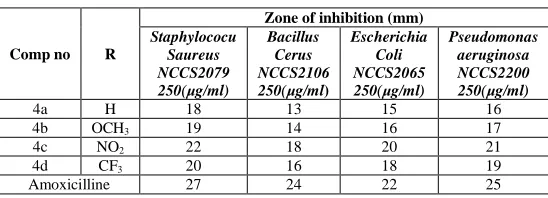
Antibacterial activity Organo phosphorus pyrazole 1,3,4-oxadiazoles (4a-d) reported in the exhibit moderate antibacterial activity against the Staphylococcus aureus NCCS 2079, Bacillus Cerus NCCS 2106, Escherichia coli
NCCS 2065 and Pseudomonas aeruginosa NCCS 2200 at the concentration of 250µg/disc. In this series structures
______________________________________________________________________________
Table 1: Antibacterial activity of newly synthesized compounds 4a-d
Comp no R
Zone of inhibition (mm)
Staphylococu Saureus NCCS2079 250(µg/ml)
Bacillus Cerus NCCS2106 250(µg/ml)
Escherichia Coli NCCS2065 250(µg/ml)
Pseudomonas aeruginosa NCCS2200 250(µg/ml)
4a H 18 13 15 16
4b OCH3 19 14 16 17
4c NO2 22 18 20 21
4d CF3 20 16 18 19
Amoxicilline 27 24 22 25
Antifungal activity
Antifungal activity Organo phosphorus pyrazole 1,3,4-oxadiazoles (4a-d)reported in the exhibited moderate antifungal activity against the Aspergillus nigerNCCS1196 and Candida albicans NCCS 3471 at the concentration
of 250µg/disc In this series structures consisting of 4c and have shown increased effect on their antifungal activity.
[image:6.595.161.435.120.219.2]The decreasing Oder of antifungal activity of (4a-d) is as follows “4c>4d>4a>4b”.
Table 2: Antifungal activity of newly synthesized compounds (4a-d)
Com no R
Zone of inhibition (mm)
Aspergillus niger NCCS1196 250(µg/ml)
Canadidaalbicans NCCS 3471
250(µg/ml)
4a -H 13 12
4b -OCH3 11 9
4c -NO2 18 16
4d -CF3 15 13
Ketoconazole 22 25
Docking studies of Organo Phosphorus Pyrazole5-one 1,3,4-oxadiazole (4a-d)
Synthesis and characterization of (1-(4acetyl-5-methyl-5-phenyl-4,5-dihydro-1,3,4-oxadiazole-2-yl)methyl)-5-oxo-3-(triflouromethyl)-4,5-dihydro-1h-pyrazol-4-yl)(Phenyl/4-methoxy/4-triflouro/4-nitrophenylamino)methyl
posphate 4(a-d),
Table.3 Docking results of 4(a-d) on sortase A staphylococcus
Com no R Fittness S(hb-ext) S(vdw-ext) S(hb-int) S(int) 4a H 19.02 1.00 29.08 0.00 -21.96 4b -OCH3 24.84 1.96 30.77 0.00 -19.43 4c -NO2 37.45 0.55 37.77 0.00 -15.02 4d -CF3 28.27 0.18 32.20 0.00 -16.18
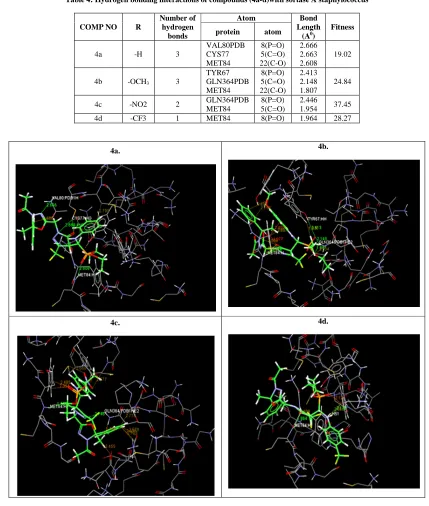
The docking studies of 4(a-d) were carried out on sortase A staphylococcus (PDB ID: 1T2P). The docking ligands were found to have some interactions between an oxygen atom of the ligands and sortase A staphylococcus protein. Moreover, these docked conformations formed hydrogen bond interactions with the active site of the protein. Bind pocket, common hydrogen bonding interactions were for formed between all the docked ligands and TYR89,CYS77,GLY82PDB, MET84, GLN364PDB, VAL80PDB.The order of protein-ligand hydrogen bond score is 4b>4a>4c>4d.
[image:6.595.193.403.308.398.2]Table 4: Hydrogen bonding interactions of compounds (4a-d)with sortase A staphylococcus
COMP NO R
Number of hydrogen
bonds
Atom Bond Length
(A0) Fitness
protein atom
4a -H 3
VAL80PDB CYS77 MET84
8(P=O) 5(C=O) 22(C-O)
2.666 2.663 2.608
19.02
4b -OCH3 3
TYR67 GLN364PDB MET84
8(P=O) 5(C=O) 22(C-O)
2.413 2.148 1.807
24.84
4c -NO2 2 GLN364PDB MET84
8(P=O) 5(C=O)
2.446
1.954 37.45 4d -CF3 1 MET84 8(P=O) 1.964 28.27
4a. 4b.
4c. 4d.
______________________________________________________________________________
.
Comparative Gold score fitness values for compounds 4(a-d)
CONCLUSION
The newly synthesized compounds Organo phosphorous pyrazole 5-one containing 1,3,4-Oxadiazole 4(a-d) were found to be active in the study of anti-bacterial and anti-fungal activity. It can be concluded that this class of compounds certainly holds great promise to discover novel classes of antimicrobial agents.
Acknowledgements
The authors are grateful to Prof. L. K. Ravindranath professor in deportment of chemistry, S. K. University, Anantapur for providing necessary facilities for this work. They are also thanks to IICT Hyderabad and CDRI Lucknow for spectral and analytical data.
REFERENCES
[1]ZiyaErdemKoc ,; Journal of Hazardous Materials., 2010, 183, 251–255.
[2]OzdenOzelGuuven et al; Bioorganic & Medicinal ChemistryLetters., 2007, 17, 2233-2236.
[3]Gummadi et al,; Der Pharma Chemica., 2(3), 2010, 196-204.
[4]MalleshappaNoolvi et al; Arab. J.Chem.2011.
[5]K.F. Ansari et al; European J. Med.Chem.2009, 44, 4028–4033.
[6]A.K.Tiwari et al; Indian Journal of Chemistry.,2006, 45-B, 489-493.
[7]A.Anton Smith, K.Seiyadu Ibrahim, S.Parimalakrishnan, A.KottaiMuthu,P.Muthumani; j. ofapplied chem.,2008
1(4), 7-12.
[8]Mukesh C. Sharma, Dharm V. Kohli, SmitaSharma;International. J. Drug Del.,2010 2, 265-277.
[9]Mishra et al; J. of Pharmacy Research., 2010,3(2), 371-37.
[10]Yusuf Ozkay et al; Eur. J. Med. Chem., 2010,45, 3293-3297.
[11]Swastika Ganguly, AvinashPatil, and Sanjay Surana; RasayanJ. Chem., 2008, 1(3), 447-460.
[12]Sartori.G, Maggi.R; Science Synthesis.2005, 18, 665.
[13]J.G. Atkinson, Y.Guindon, C.K Lau, US Patent, 1990,4, 351.
[14]KhiangteVanladinpuia.;Ghanashyam Bez* Tetrahedron Letters 52 (2011) 3759-3764.
[15]IlkayYildiz-Oren,; Ismail Yalcin, Esin Aki-Sener*, ;Nejat Ucarturk; European Journal ofMedicinal
Chemistry2004,39 ,291-298.
[16]NobbaVenkata Siva , Kumar , Sanjay DashrathViadya , Ramanatham Vinod Kumar , Shekhar Bhaskar Bhiruda
,RamchandraBhimrao mane ; European Journal of Medicinal Chemistry2006, 41,599-604.
[17]1K Rubtsova and R D Zhilina, ZhurPriklad Khim,1956, 32, 604.
(b) AV kirsanov and ES Levchenko, J Genchem, USSR, 26, 1977, 2555.
[18](a)CD Reddy ,; RSN Reddy ,; CN Raju ,; M Elmasri ,; KD Berlin and S Subramanian ,;MagnResonChem ,
1991, 29,1140,
(b)CDReddy , D Berlin , RSN Reddy , CN Raju , M ElmasriandS Subramanian phosphorus , Sulfurand Silicon ,
1993, 81, 61.
[19]L W Daash and SC Smith, Anal Chem, 1956.23, 853, 1661,
[20]DEC Corbridge, J ApplChem,1956. 6, 456,
0 10 20 30 40
4a 4b 4c 4d
G
o
ld
S
co
re
F
it
n
e
ss
V
a
lu
e
[21]LC Thomas and RA Chittenden, ChemInd(London)1961, 1913,.
[22]F W Bennet, H J Emeleus and RN Haszeldine, J Chemsoc, 1954. 3598,
[23]L J Bellamy and LJ Beecher , J Chemsoc , 1953. 475,1951;1701,1951:728,
[24]H J Emeleus, R N Haszeldine and R C Paul, J Chemsoc, 1955.563,
[25]RM Silverstein, GC Bassler and TC Morril, Spectrometric Identification of Organic Compounds, John Wiely
and Sons, New York, 1981.361
[26]NB Colthup, N H Daly and S E Wiberly, Introduction to Infrared and Raman Spectroscopy,Academic Press,
New York, 1964, 305,
[27]JR Van Wazer , CF Calis , JN Shoolery and RC Jones J Am ChemSoc,1956. , 78,5715.