MUHAMMAD AMIR BIN MAT SHAH
A project report submitted in partial
fulfillment of the requirement for the award of the Master’s Degree of Mechanical Engineering
Faculty of Mechanical and Manufacturing Engineering Universiti Tun Hussein Onn Malaysia
v
ABSTRACT
ABSTRAK
vii
CONTENTS
TITLE i
DECLARATION ii
DEDICATION iii
ACKNOWLEDGEMENT iv
ABSTRACT v
ABSTRAK vi
CONTENTS vii
LIST OF TABLES xi
LIST OF FIGURES xiv
LIST OF SYMBOLS AND ABBREVIATION xvii
LIST OF APPENDIXES vii
CHAPTER 1 INTRODUCTION
1.1 Research Background 1.2 Problem Statement 1.3 Objectives
1.4 Importance of the Study 1.5 Scope of the Study
1 2 4 4 5
1.6 Flowchart of research 6
CHAPTER 2 LITERATURE REVIEW
2.1 Introduction
2.2 Introduction to Prawn 2.3 Dissolved Oxygen 2.4 Aeration
2.4.1 How Aerator Work
2.4.2 Common type of existing aerator 2.4.2.1 Paddlewheel.
2.4.2.2 Diffuser Air and Air Lift 2.4.2.3 Propeller Aspirator Pump 2.4.2.4 Submersible Pumps 2.5 Flexible link
2.6 Open Loop Controller 2.7 Research Gap
8 9 11 14 15 15 16 16 17 18 20 21 22
CHAPTER 3 METHODOLOGY
3.1 Introduction 3.2 Flow chart
3.3 Concept of movement 3.4 System design
3.5 Development of mathematical model 3.6 Aeration theory
3.7 SIMULINK model 3.8 Validation Test 3.9 Fabrication Design
3.10 Apparatus setting for real test
3.11 Procedure to use dissolved oxygen meter
iv
CHAPTER 4 RESULT AND DISCUSSION
4.1 Introduction
4.2 Selecting suitable flexible link length 4.3 Result of Simulations
4.3.1 Simulation of aerator at different speed by controlling the input voltage
4.3.1.1 Validation test for simulation the aerator at different speed by controlling the input voltage 4.3.2 Simulation of aerator with different length of
flexible link
4.3.2.1 Validation test for simulation of aerator with different length of flexible link
4.3.3 Simulation result of running the aerator at different immerse percentage of flexible link width.
4.3.3.1 Validation test for simulation result of running the aerator at different immerse percentage of flexible link width.
4.4 Results of actual aerator experiment.
4.4.1 Experiment result of running the aerator at different speed by controlling the input voltage. 4.4.1.1 Running the aerator by using 12V
4.4.1.2 Running the aerator by using 9V 4.4.1.3 Running the aerator by using 6V
4.4.1.4 Summary result experiments of running the aerator using various speeds by controlling the voltage.
4.4.2 Experiment result running the aerator running with different flexible link length.
4.4.2.1 Running the aerator using 0.45m flexible link
4.4.2.2 Running the aerator using 0.65m flexible link 4.4.2.3 Summary of result experiment running the
aerator using different length of flexible link
85 88
4.4.3 Experiment of aerator running at different immerses level of flexible link
4.4.3.1 Running the aerator by immerse the flexible link at 50% from its width in water.
4.4.3.2 Summary result of running the aerator at different level immerse the flexible link in water 4.5 Standard Oxygen Transfer Rate
4.6 Summary of analysis optimum parameter of flexible link aerator
89
89
93
94 95
CHAPTER 5 CONCLUSION AND RECOMMENDATIONS
5.1 Conclusion 5.2 Recommendation
97 98
REFERENCES
100
APPENDIX A APPENDIX B
107 109
xi
LIST OF TABLES
Table 2.1 Summary of Aerator Performance 20 Table 3.1 Parameters for flexible link aerator 33 Table 3.2 Description of block under the mask block of Flexible
Link Aerator
43
Table 4.1 Data taken by operating the aerator with 12V at 9.00 a.m. 69 Table 4.2 Data taken by operating the aerator with 12V at 12.30 p.m. 70 Table 4.3 Data taken by operating the aerator with 12V at 4.00 p.m. 70 Table 4.4 Data taken by operating the aerator with 12V at 8.00 p.m. 71 Table 4.5 Average Data taken by operating the aerator with 12V. 71 Table 4.6 Data taken by operating the aerator with 9V at 7.30 a.m. 73 Table 4.7 Data taken by operating the aerator with 9V at 12.30 p.m. 74 Table 4.8 Data taken by operating the aerator with 9V at 4.30 p.m 74 Table 4.9 Data taken by operating the aerator with 9V at 9.30 p.m. 75 Table 4.10 Average data taken by operating the aerator with 9V. 75 Table 4.11 Data taken by operating the aerator with 6V at 7.30 a.m. 77 Table 4.12 Data taken by operating the aerator with 6V at 12.30 p.m. 78 Table 4.13 Data taken by operating the aerator with 6V at 4.30 p.m. 78 Table 4.14 Data taken by operating the aerator with 6V at 9.30 p.m. 79 Table 4.15 Average data running the aerator using 6V. 79 Table 4.16 Summary of result for various speeds aerator 80 Table 4.17 Data operating the aerator using flexible link length 0.45m
at 7.45 a.m
Table 4.18 Data operating the aerator using flexible link length 0.45m at 11.45 a.m
82
Table 4.19 Data operating the aerator using flexible link length 0.45m at 5.30 p.m
83
Table 4.20 Data operating the aerator using flexible link length 0.45m at 8.15 p.m
83
Table 4.21 Average data running the aerator using 0.45m length of flexible link
84
Table 4.22 Data of operating the aerator using flexible link length 0.65m at 9.00 a.m
85
Table 4.23 Data operating the aerator using flexible link length 0.65m at 12.00 p.m
85
Table 4.24 Data operating the aerator using flexible link length 0.65m at 5.00 p.m
86
Table 4.25 Data operating the aerator using flexible link length 0.65m at 9.00 p.m
86
Table 4.26 Average data running the aerator using 0.65m length of flexible link
87
Table 4.27 Summary of result running the aerator with different length.
88
Table 4.28 Data immersing the flexible link at 50% in water at 8.00 a.m.
89
Table 4.29 Data immersing the flexible link at 50% in water at 12.00 p.m.
90
Table 4.30 Data immersing the flexible link at 50% in water at 4.00 p.m.
90
Table 4.31 Data immersing the flexible link at 50% in water at 8.00 p.m.
xiii
Table 4.32 Average data immersing the flexible link at 50% in water 92 Table 4.33 Summary result running the aerator at different level of
immersing the flexible link in water.
93
LIST OF FIGURES
Figure 1.1 Project phases 6
Figure 2.1 Global aquaculture production of Penaeus monodon (Food and Agriculture Organization of the United Nations)
10
Figure 2.2 Oxygen behaviour transfer into water 13
Figure 2.3 Paddlewheel (Boyd, 1995). 16
Figure 2.4 Diffuser Air (Boyd, 1995). 17 Figure 2.5 Propeller Aspirator Pump (Boyd, 1995). 17 Figure 2.6 Submersible Pumps (Boyd, 1995). 18 Figure 3.1 Overview of Research Methodology 26 Figure 3.2 Illustration concept of horizontal movement 27 Figure 3.3 Above view of flexible link aerator 28 Figure 3.4 Block diagram of the flexible link aerator system 28 Figure 3.5 Schematic of the Flexible link (Md Zain, 2010) 30 Figure 3.6 Common value for drag coefficient (Benson, 2010). 32 Figure 3.7 Outline of the flexible link aerator 33 Figure 3.8 Finite Difference discretisation in time and space variables 36 Figure 3.9 SIMULINK block for Flexible Link Discreate State Space 41 Figure 3.10 The overall view of simulation of SIMULINK model. 42 Figure 3.11 Detail under block diagram for Flexible Link Aerator 43 Figure 3.12 Exploded drawing view of conceptual of flexible link
aerator
46
xv
Figure 3.15 Placing the aerator at the middle of reservoir 48 Figure 3.16 Procedure to fill electrolyte in probe 50 Figure 3.17 Dissolved Oxygen meter and Probe 50 Figure 3.18 Location to place the D.O meter probe 51 Figure 4.1 Oscillation of angular displacement when used a maximum
length of flexible link
55
Figure 4.2 Simulation of aerator at different voltage using flexible link length 0.55m
57
Figure 4.3 Estimated maximum Dissolved Oxygen at different voltage of simulate aerator by using flexible link length 0.55m.
58
Figure 4.4 Auto and Cross correlation test using simulation parameter flexible link length 0.55m, immerse at 25% in water and operating at 12V.
59
Figure 4.5 Simulation of aerator with different length of flexible link 61 Figure 4.6 Estimated maximum Dissolved Oxygen with different
lengths of flexible link
62
Figure 4.7 Auto and Cross correlation test using simulation parameter flexible link length 0.65m, immerse at 25% in water and operating at 12V
63
Figure 4.8 Simulation running of the aerator at different percentage of immersing the flexible link in water
65
Figure 4.9 Estimated maximum Dissolved Oxygen with different level of immerse flexible link in water.
66
Figure 4.10 Auto and Cross correlation test using simulation parameter flexible link length 0.65m, immerse at 50% in water and operating at 12V.
Figure 4.11 Graph of dissolved oxygen reading using 12V at different session
72
Figure 4.12 Graph of dissolved oxygen reading for each period operating the aerator using 9V
76
Figure 4.13 Graph of dissolved oxygen reading for each period operating the aerator using 6V
80
Figure 4.14 Graph of dissolved oxygen reading for each period operating the aerator using flexible link length 0.45m
84
Figure 4.15 Graph of dissolved oxygen reading for each period operating the aerator using flexible link length 0.65m
88
Figure 4.16 Graph of dissolved oxygen reading for each period operating the aerator by immersing the flexible link 50% in water
xvii
LIST OF SYMBOLS AND ABBREVIATION
SAE - Standard Aerator Efficiency SDTR - Standard Oxygen Transfer Rate N/A - Not Available
kgO2 - Kilo gram oxygen kW - Kilo Watts
kWh - Kilo Watts hour V - Voltage
- Mass transfer rate
- Coefficient of the gas in square centimeters per second (cm2/sec)
A - Area
- Concentration gradient of the gas
mg/l - Milli gram per liter τ - Torque
E - Young’s modulus
I - second moment of inertia ρ - Density
- Length δ - Deflection θ(t) - Radian angle
Fd - Drag force
Cd - Drag force coefficient ν - Velocity
DC - Direct current Nm - Newton Meter m - Meter
ω - Angular velocity
b - Width
d - Thickness % - Percentage
D.O - Dissolved Oxygen o
C - Temperature in Celcius i - Current
KLa20 - The Oxygen Transfer Coefficient At 20oC
Cs20 - Dissolved oxygen (DO) concentration at saturation, 20oC (mg/L)
V - water volume in m3
Cm - Measured DO concentration
rad/s2 - Angular acceleration in Radian per second square a.m - Ante meridiem mean before midday
p.m - Post meridiem mean after midday Hr - Hours
xix
LIST OF APPENDICES
APPENDIX TITLE PAGE
A Gantt Chart for Master’s Project 108 B1 Dissolved oxygen meter DO-5519 features 110
B2 Specifications 111
B3 Panel Description 113
C Calculation of Standard Oxygen Transfer Rate (SOTR) and Standard Aerator Efficiency (SAE).
CHAPTER 1
INTRODUCTION
1.1 Research Background
This research is about the new aerator concept that is suitable for shallow pond which can perform as well as common aerator. The concept that was used by this aerator has not been practice yet. It will overcome the limitation of popular mechanical aerator, which is the paddlewheel. Paddlewheel is not suitable to use in shallow pond, where the downward water force movement can disturb the bottom of the pond and make the pond muddy. Meanwhile, other aerators such as diffuser type aerators are inefficient as compared to paddlewheel because it consumes more power to operate.
Dissolved oxygen level increases as wider water surface were exposed to the atmosphere. By implementing the mechanical contact along the water surface, it will increase the area of water exposed to the atmosphere and simultaneously increase the absorption of oxygen. Currently, only the paddlewheel use this concept. However, it has some limitation as mentioned above.
2
Flexible link aerators were chosen based on length to weight ratio factor. It is commonly used to improve the speed of operation and handling larger payloads compared to rigid link aerators. Longer plate allows the aerator to cover wider water surface area to generate dissolved oxygen and circulate the water. As mention by Vidoni et al. (2013) in their research, the heaviness of flexible link will decrease speed and the system required more energy to operate. The demand for better performances and higher speed make it necessary to consider lightweight manipulators because they required less energy to move and have more maneuverability. At the same time, the weight will not burden the driver motor and can increase the speed of movement of the aerator. These characteristics could lengthen the durability and lifetime of the driver motor.
The existing mathematical model of flexible link had been synchronized with the new boundary condition, where the flexible link now implements at water surface. The finite different method was used to develop mathematical model for flexible link aerator. The mathematical model was then simulated using Matlab SIMULINK. Observation was made on the effects of deflection behavior of flexible link aerators towards the level of estimated dissolved oxygen. Simultaneously from this simulation, the optimum parameters were defined such as the length of flexible link aerator plate, voltage to control motor speed, and the percentage of immerse flexible link in water.
All parameters obtained from the simulation were used on actual model which were designed and fabricated. The actual model were used on clean water reservoir to find out the level of dissolved oxygen generated and the efficiency were calculated and compared to other types of aerator.
1.2 Problem Statement
Bugbee and Blonquist (2006) stated that, about 20.95% oxygen can be found in the atmosphere. Oxygen can also be found in water molecule. Aquatic animals require oxygen in water to survive just like land animals. Oxygen in water is called dissolved oxygen. Even though oxygen can be found in water molecule, these aquatic lives are unable to separate the oxygen gases. Due to that, they require pure oxygen gases. Shortage of dissolved oxygen indicates existence of pollution and can be harmful to the aquatic animals.
In aquaculture industry, dissolved oxygen is one of the major parameters need to be monitored seriously. Aerator is normally used to increase the level of dissolved oxygen in water. The function is to circulate or mix the water from top to bottom to ensure that the oxygen content is uniform within the entire pond. Aerator also helps to expose the water surface to absorb more oxygen from the atmosphere.
Paddlewheel is one of the most popular aerator machines to generate dissolve oxygen. The latest improvement of existing adjustable impeller is water breaking impeller, designed for power saving and high aeration. It contributes to lower power consumption due to the professional water breaking and parabolic design. However, it is not suitable to use in shallow pond. Due to the rotation force of water that created from the movement of the paddlewheel, the bottom of pond is disturbed and causes the pond to become muddy.
4
1.3 Objectives
A study proposed in this research is to developing a new concept of aerator using flexible link to generate dissolved oxygen. The specific objectives of this study are carried out are described below:
i. To investigate new concept of aerator with lower initial and operating cost with better performance compared to existing aerator.
ii. To develop model with finite different simulation algorithm of the flexible link aerator
iii. To test and evaluate the performance of actual model.
1.4 Importance of the Study
This research is important to encourage the tiger prawn agriculture industry as the aquaculture industry in Malaysia and give opportunity to choose a suitable mechanical aerator. Level of dissolved oxygen is one of the most influential factors to be considered in term of the technical aspect in aquaculture farming. It will determine the quality of water. Water quality plays an important role in hatchery, farming and distributing activity especially in intensive farming. However, cost in operating the aerator become the burden and reduce the profit. Thus, aerator with lower operating cost, easy to maintain and good durability is highly recommended. Basically, it combines several engineering disciplines such as engineering control, material science and fluid engineering to handle a problem in design and control system in those activities.
1.5 Scope of Study
Scope of study in this research is within the limited range of the engineering field area. It limited to find suitable design concept which is suitable to use in shallow pond such as tiger prawn pond. The concept of aerator movement was implementation from the flexible link movement. The flexible link aerator model developed using the existing mathematical model with water boundary condition. The mathematical model was developed using partial differential equation and was then transfer into a block model in Matlab SIMULINK.
The simulation model is limited to find the optimum parameters and to observe the end point angular overshoot effect to the estimated dissolved oxygen level. The optimum parameters that need to be clarified in this research are the voltage used which it related to the speed of the movement, the suitable length, and the percentage immerse of flexible link in water. These parameters are important because it will affect the amount of dissolved oxygen generated.
In this research, the simulation model is important for future research, where it can be altered or modified to be used in other related experiment. Dissolved oxygen level can be estimated without consuming time and money on fabricating new aerator machine for the experiment. Since current flexible link aerator machine uses only basic aerator design, a lot of part can be upgraded in future as cited in the recommendation section later in this thesis.
6
1.6 Flowchart of research
There are 4 phases had been through to perform this research. Figure 1.1 shows a brief phase of research that encountered in this research. It starts with finding a suitable design concept and translated into engineering design drawings. The next phase was simulating the developed mathematical model of flexible link in boundary condition of water. The simulation result were use to prepare the actual flexible link. Actual flexible link aerator machine then fabricated according to the drawing concept made in the first phase. Experimental have been conducted to verify the simulation result. Finally, the parameters used by the flexible link aerator have been analysed and aerator efficiency was calculated to compare its performance with other aeration.
Design Concept
Simulation Model
Experimental Actual Model
Analysis Performance
Figure 1.1 : Research Phases
1.7 Organisation of the thesis
A brief outline of the contents of the rest of the thesis is given below:
Chapter 3 present the methodology and the process of developing a mathematical model of a flexible link aerator. It starts with making the design concept. Then developed the existing flexible link mathematical model by considering water as the new boundary conditions. It followed by simulated using MATLAB SIMULINK. This chapter also describes the procedures for using the dissolved oxygen meter and way to conduct an experiment for actual flexible link. It also shows the formula that used to calculate the efficiency of aerator.
Chapter 4 present the results of simulation and experimental results. It started by do a simulation of an appropriate length of flexible links that do not burden the aerator motor There are three types of simulations and experiments have been done which is running an aerator at different speeds by control the input voltage by operate ventilators by different lengths of flexible links and operate an aerator by sink the flexible link at a different level. At the end of this chapter, it shown the flexible link aerator efficiency compared to other aerator.
8
CHAPTER 2
LITERATURE REVIEW
2.1 Introduction
The structure of the literature review for this research is consists of four main topics; there are introduction to tiger prawns characteristics, dissolved oxygen generated, how aeration functioning and about the flexible link. These topics are important to get more information about the background of the research and to achieve the objectives. The first topic is related to the ideas for this research. In order to design a new concept aerator, it needs to understand the behavior and habitat of tiger prawn in farming industry.
To design an aerator, it is necessary to understand how aerator works. It also relates to how dissolved oxygen can be generated by aerator. These two topics are the most important key need to understand in order to design the aerator. The only option for use in a shallow pond aerator is to use air diffuser aeration. This type of aerator is working by inject a bubbles of air from the bottom of the pond and do not damage the bottom of the pond. Unfortunately this type of aerator is inefficient and less water circulation. It makes it not suitable for large ponds.
especially mechanical surface aerator type. Mechanical aerator type can offer a good aerator efficiency compare to diffuser air type. Tiger prawn production is increasing drastically from 1990 to 2010. Due to the constraint of aerators choices, agricultural industries have to choose paddlewheel aerators and design the pond with unnecessary depth just to prevent the bottom of the pond damage. This can cause a risk to tiger prawn if paddlewheel suddenly can’t operate. Tiger prawn hard to go to the pond surface to breathe because it can’t swim like a fish. By creating this new concept of mechanical aerators that can be used in a shallow pond, now the pond depth can design according the tiger prawn can breed. Besides, it also can reduce operational costs and contribute to profits.
2.2 Introduction to Tiger Prawn
Tiger prawn or giant tiger prawn also known as Penaeus Monodon is a marine crustacean that is widely reared for food. It inhabits the coasts of Australia, South East Asia, South Asia and East Africa. It shape is similar as other prawn. Adults may reach 33 cm in length and females are commonly larger than males. Research done by Holthuis (1980), found that the tiger prawn can grow-up to a large size with a weight up to 130 gram. The highest weight of tiger prawn will become more high value and demands in the international market.
Penaeus monodon mature and breed only in tropical marine habitats and spend their larval, juvenile, adolescent and sub-adult stages in coastal estuaries, lagoons or mangrove areas. Under natural conditions, the giant tiger prawn is more of a predator than an omnivorous scavenger or detritus feeder than other prawn. After moulting, the new shell is still soft which causes prawns to become vulnerable and they may subsequently be eaten by their predators or companions.
Fishery statistics from the Food and Agriculture Organization (FAO) of the United Nations (2006) shown more than a century, the prawn farming has been practiced for food and livelihood of coastal people in some Asian countries, such as Indonesia, the Philippines, Malaysia, Thailand and Vietnam. Originally the Penaeus monodon was harvested together with other shrimp species.
10
Since then, production has been quite variable, ranging from a low of 480 000 tones in 1997 to a high of 676 000 tones in 2001. The major producers of Penaeus monodon include Thailand, Vietnam, Indonesia, India, the Philippines, Malaysia and Myanmar (FAO Fishery Statistic, 2011).
Figure 2.1: Global aquaculture production of Penaeus monodon (Food and Agriculture Organization of the United Nations)
Apud (1984) stated in his research, the breeding method can be categorized into three: extensive, semi-intensive and intensive. The extensive method commonly practiced for shallow pond between 40 to 70 cm designed with single gate to serve and supply and drain facilities. Capacities of tiger prawn under this method are limited for 2 to 3 prawn per square meter. Water management is totally depended on tidal fluctuation.
The semi-intensive culture method is highest method practiced breeding tiger prawn. This method can breed with capacity 10 to 30 prawns per square meter with the depth of pond are between 70 to 100 cm. To maintain the desired water quality and depth, the water pump is always used to operate especially during neap tide.
Intensive culture method basically practiced for larger scale for breeding tiger prawn. This method required higher capital investment and technology. Aeration device is fully dependent to generate dissolved oxygen, release toxic gases and mix water 24 hours a day. Even though the stocking density can rise between 100 to 200 prawns per square meter, it also contributes a high risk.
In aquaculture farming, poor dissolved oxygen control could become major factor of loss to the farmer. According to Pruder (1983), low levels of dissolved oxygen are commonly encountered in aquaculture ponds and result in instability, low productivity and some time mass mortality. Yuquan Li et al. (2006) indicated that dissolved oxygen below 2mg/L significantly reduce the growth rate of Penaeus vannamei and Penaeus Monodon. D’Abramo et al. (2003) reported that dissolved oxygen at 3 parts per million (ppm) are stressful, and lower oxygen concentrations can be lethal. De Bnath et al. (2013) in his research stated the dissolved oxygen is very important to aquatic farmer to enhance good prawn growth. Common dissolved oxygen level is varied between 4 to 9 ppm in semi intensive ponds and 4 to7 ppm in traditional ponds.
2.3 Dissolved Oxygen
micro-12
organisms including bacteria and phytoplankton. In many cases, dissolved oxygen must be controlled to ensure the proper breathing living thing continues. Dissolved oxygen concentrations are most often reported in units of milligrams of gas per liter of water - mg/L or parts per million – ppm.
Tchobanoglous et al. (2001) in their research stated that the important part of wastewater treatment process is oxygen transfer. It is the process by which oxygen is transferred from the gas to the liquid phase. To move a large quantity of oxygen required, additional interfaces are created using the aeration process to overcome the low solubility of oxygen and low oxygen transfer rate problems. To provide the required amount of dissolved oxygen, aerator system is always required. Janssen and Albrecht (2011) stated the aerator is the largest single cost in waste water treatment system. Concentration of dissolved oxygen is one of the most important quality parameters that affect the quality of the waste water.
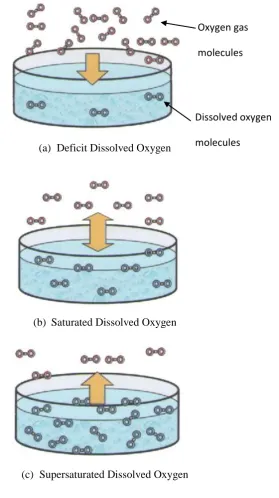
Oxygen is continuously moving between the water and the surrounding air. The behavior of oxygen gas is it tends to travel from high pressure volume to the low pressure volume. According Floyd (2011), there is three main sources of oxygen in the aquatic environment which are direct diffusion from the atmosphere, wind wave action and photosynthesis by aquatic plant. Oxygen molecules easy penetrate into the water until equilibrium of oxygen volume achieved when quality of water is good. The same thing might happen but in the opposite direction if the pressure of dissolved oxygen inside the water is higher than the atmosphere, it tends to disperse in the atmosphere. Boyd (1998) revealed that this equilibrium of oxygen volume is known as saturated concentration. Figure 2.2 shows the movement of high pressure oxygen molecules from atmosphere into an amount of water until equal value is reached. Boyd (1998) also reported that dissolved oxygen concentration in water at saturation varies with water temperature, salinity and barometric pressure.
Murphy (2012) stated that the colder the water, the more oxygen can be dissolved in the water. In YSI Aquaculture (2010) application note informing that the water with temperature 32.C can hold up to 7.3mg/l of oxygen, while 7.C water can hold 12.1mg/l. When the water temperatures rise, oxygen levels will decrease. This is the reason why the dissolved oxygen concentrations at one location are usually higher in the winter than in the summer
(a) Deficit Dissolved Oxygen
(b) Saturated Dissolved Oxygen
[image:29.595.223.503.220.719.2](c) Supersaturated Dissolved Oxygen
Figure 2.2: Oxygen behaviour transfer into water
Oxygen gas molecules
14
Dissolved oxygen in earthen prawn pond comes from two processes, physically and chemically. Physically, these oxygen molecules are entrapped in water with certain mechanism. For examples, through water fall, turbulence water flow and waves. Wave action and splashing allows more oxygen to be absorbed into the water. More of the water’s surface area is exposed to the air; it will absorb more oxygen from the atmosphere than a calm, smooth body of water. This statement strongly informs by Pedersen (2000) in his paper where the gas such as oxygen are easily absorption into moving water Extensive prawn farming which has big surface pond area has the advantages for natural aeration. Boyd (1998) in his research found that the wind consumes 20.95 % of oxygen gas enter to water surface through waves. This is the idea behind aerators; by creating waves and expose more water surface area more oxygen can enter into water.
Meanwhile dissolved oxygen exists chemically as the result of photosynthesis process by aquatic plants. Pruder (1983) had revealed that algal photosynthesis and bacterial respiration are the major oxygen source and sink respectively. In the other hand, prawn respiration and atmospheric diffusion were found to play minor roles in the oxygen balance in the prawn pond.
2.4 Aeration
2.4.1 How Aerator Work
Aeration and circulation of the water is one of the most essential issues in intensive and semi-intensive aquaculture. Good aerator must capable to aerate and circulate water at the same time. Circulation of water encourages other harmful gases and excess nitrogen and carbon dioxide to escape from water to the atmosphere. In ponds, a number of functions are performed by a good aerator:
1. Directly adds oxygen to water (oxygenates).
2. Ensure the dissolved oxygen uniformly throughout the pond, circulates and mixes of water top to bottom. This important aspect when a bottom dwelling animal which cannot come to the surface.
3. Capable to moves aerated water away from the immediate area around the aerator, so that it not retreating the same water while dragging in unaerated water.
2.4.2 Common type of existing aerator
Various types of aerator systems have been developed over the years as an effort to improve energy efficiency of oxygen mass transfer process and to maintain the desired level of dissolved oxygen in wastewater. The types of aerator method can categories in three types (Thakre et al., 2008): -
1. Surface of mechanical aeration method, which increase interfacial area by spraying water droplet into the air.
2. Diffuser aeration method, which release bubble beneath surface of water. 3. Combine and turbine aeration method, which introduced larger air bubble
16
2.4.2.1 Paddlewheel.
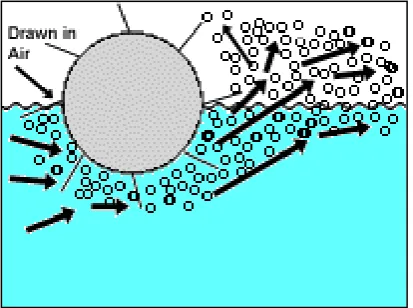
[image:32.595.217.424.278.432.2]Paddlewheel aerators are the most widely used method of aeration. Currently paddlewheel is the most efficient aerator due to the combined way it rapidly decertifies a pond through strong water circulation and aeration by spraying water into the air as well as dragging air into the water creating larger surface areas of air-water interface allowing efficient gaseous exchange for oxygen and release harmful gas to out. The combined effect of strong circulation and aeration allows the formation of the important oxidized surface sediment layer (Boyd, 1995).
Figure 2.3: Paddlewheel (Boyd, 1995).
2.4.2.2 Diffuser Air and Air Lift
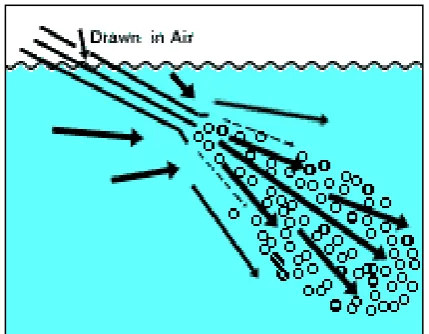
Figure 2.4: Diffuser Air (Boyd, 1995).
2.4.2.3 Propeller Aspirator Pump
Propeller aspirator pumps are good circulators and aerators in pond but the designed more for deeper water (1-5 meter). When used in shallow ponds, it have tendency to scour hollows where the water stream collides with the pond bottom so consideration must be taken when it installed as mention by Boyd (1995). These types of aerators would be more suitable for farm dam or harvesting operations that wish to increase production by providing additional feed although the cost of connecting main power is usually prohibitive.
[image:33.595.212.427.474.641.2]18
2.4.2.4 Submersible Pumps
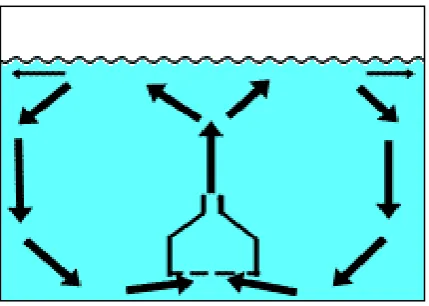
[image:34.595.213.428.310.463.2]The use of submersible pumps near the bottom of a pond with the outlet pointed at the surface, depending on the size of the pump, provides some circulation and mixing of the pond water but like air diffusers this can be localized. It does not however add any oxygen directly to the water except through diffusion by exposing poorer quality water to the surface. If use this type of device it would be better to extend the outlet above the surface and provide a spray bar to spray the water back into the pond but this is an inefficient way to aerate a pond. This type of aeration is not recommended for large grow out ponds 1000m2 but with the spray bar it is suitable in small broodstock and nursery ponds between 100 to 200m2, (Boyd, 1995).
Figure 2.6: Submersible Pumps (Boyd, 1995).
According Rao and Kumar (2007), mechanical surface aerator is widely used from all these categories. This aerator offers a better efficiency and convenience operation and maintenance. Further the oxygen rate transfer from gas to liquid phase is dependent on various factors for given method of aeration such as dynamic variable like speed, mixing intensity and turbulence, geometrical parameters like size and number of blade, depth of flow and physicochemical properties of the liquid.
diffuser air are typical aerators nowadays. Aerator got it name based on how it looks like and how it function.
Boyd (1990 & 1998) in his report also clarified the mechanical aeration method such as paddlewheel is more efficient compare the other aerator method. Fast et al. (1999) stated that paddlewheel aerators are the most common mechanical aeration device used in pond aquaculture today. Strengthen the statement, Peterson et al. (2001) in their report also stated the paddlewheel was the dominant aerator type in Australia. Rosso and Stenstrom (2006) in their research found the high turbulence associated with course-bubble aerators make them behave more like surface aerators that fine bubble aerators. But to create high turbulence aerators expense of greater energy density, and lower aeration efficiency.
The Department of Fisheries, Australia, (2001) stated the advantage of the mechanical aerator system is it can rapidly decertify a pond through strong water circulation and aeration by spraying water into the air and dragging the air into the water. This mechanism is totally providing large surface area of air contact with water.
20
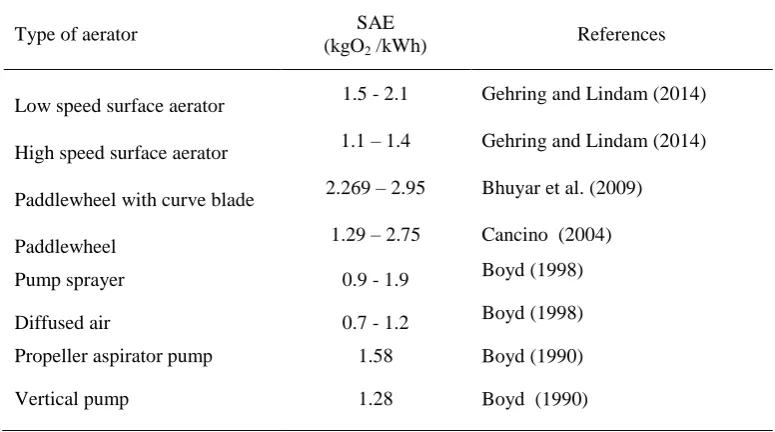
Table 2.1: Summary of Aerator Performance
Type of aerator SAE
(kgO2 /kWh)
References
Low speed surface aerator 1.5 - 2.1 Gehring and Lindam (2014)
High speed surface aerator 1.1 – 1.4 Gehring and Lindam (2014)
Paddlewheel with curve blade 2.269 – 2.95 Bhuyar et al. (2009)
Paddlewheel 1.29 – 2.75 Cancino (2004)
Pump sprayer 0.9 - 1.9 Boyd (1998)
Diffused air 0.7 - 1.2 Boyd (1998)
Propeller aspirator pump 1.58 Boyd (1990)
Vertical pump 1.28 Boyd (1990)
2.5 Flexible link
Flexible link is one of the important parts in robotic manipulator research study. According Mansour et al. (2010), the flexible link has the advantages to lower cost due to weight of material used, larger work volume, higher operational speed, greater payload-to-manipulator weight ratio, smaller actuators, lower energy consumption, better maneuverability, better transportability and safer operation due to reduced inertia. Ismail (2006) stated that the flexible plate structures are used now in diverse applications lead to the demand of having reliable, light and efficient flexible structures.
According the Gümüşel and Özmen (2011), there are few researches done on underwater flexible manipulators. They do a research in this area since most of the deep undersea cannot be reached by human divers and because of inconvenient, dangerous deep sea environments, the use underwater manipulators has become vital tools for underwater remotely operated vehicle (ROV) operations. They mention, there are four different forces acting on the manipulator under the water which are buoyant force, drag force, lift force and the gravity force. The drag and lift forces are defined according to the moving object’s velocity vector. The values of force depend on the geometry of the object. Followed by Nguyen et al. (2013) also do a research implement the flexible link as flexible tail fin for fish robot. They mention the other capability of flexible tail where it able to changing the body of fish robot shapes to generates propulsion forces which enable to move forward and backward. This advantage of movement only can be achieved by using flexible link.
According the Faria and Inman (2014), when a mechanical structural component is immersed in a fluid and it vibrates, the reasonable assumption is that part of the energy is transmitted to the adjacent media. They also mention, flexible link can be implementing as a fish like pulsating mechanism. By using a control algorithm, the elastic deformations of the endpoint of the link can be controlled thus the vibration of the flexible link can also be controlled. In this flexible link aerator research, the benefit of vibration that was produced by the flexible link has the potential to create waves and bubbles in the water. Thus, it can be manipulate to generate dissolved oxygen in water.
2.6 Open Loop Controller
22
and less complex then the closed loop control system, while the controlling efficiency of this system is nearly zero.
Lima et al. (2014) stated that, the open-loop control is useful for well-defined systems where the relationship between input and the resultant state can be modeled by a mathematical formula. For example determining the voltage to be fed to an electric motor that drives a constant load, in order to achieve a desired speed would be a good application of open-loop control. If the load were not predictable, on the other hand, the motor's speed might vary as a function of the load as well as of the voltage, and an open-loop controller would therefore be insufficient to ensure repeatable control of the velocity.
2.7 Research Gap
The tiger prawn can be breeding in shallow pond’s water with a 40 cm of depth. However not many aerator are suitable to use for the shallow water. Aerator research only focus on how to increase aerator efficiency without consider the suitability of the aerator, especially aerator for shallow pond. Since research in implement the flexible link in water is not widely done, this gives a good opportunity to optimize the advantages and capabilities of flexible link to become new concept aerator. In previous mention, the mechanical aerator such as paddlewheel is more efficient in transfer oxygen rate into water rather than other aerator. The flexible link is suitable to become a new mechanical aerator.
Many researches also emphasize that, more water surface area contact to air and good water circulation will helping oxygen through into the water. These major factors exist in paddlewheel aerator system and made it the most efficient aerator and popular aerator device used. These determine that this factors need to be concern to develop a new aerator model; the aerator must capable to let more water surface area contact with atmosphere and at the same time it can circulate the water.
24
CHAPTER 3
METHODOLOGY
3.1 Introduction
Simulation and testing the actual aerator were carried out in order to achieve the goals of this research. Methodology works were emphasized further on system design, its functionality and reliability. In designing a new concept of aerator, it consists of construction of mathematical model, simulation and fabrication of actual model. The next page shows the description and overview the methodology in this research.
REFERENCES
Abd Rahman, I., Mat Suboh, S. and Arshad, M.R. (2007). Theory and design Issues of underwater manipulator. International Conference on Control, Instrumentation and Mechatronics Engineering (CIM’07), Johor Bahru, Johor, Malaysia, May 28-29, 2007
Apud, F.D. (1984). Extensive and semi-intensive culture of sugpo (Penaeus Monodon) in the Philippines. Proceedings of the National Prawn Industry Development Workshop, 10-13 April 1984, Iloilo City, Philippines. (pp. 55-73). Tigbauan, Iloilo,Philippines: Southeast Asian Fisheries Development Center, Aquaculture Department.
Ata A.A, Fares W.F and Sa’adeh M.Y (2012), Dynamic analysis of two-link flexible manipulator subject to different sets of conditions. International Symposium on Robotics and Intelligent Sensors 2012 (IRIS 2012). Procedia Engineering 41 (2012) 1253-1260
Azad A.K.M., Tokhi, M.O., Mohamed, Z., Mahil, S. and Poerwanto, H. (1994). Finite Different and finite element simulation of flexible manipulators. Chapter 5, Flexible Robot Manipulators Modelling Simulation and Control. Published by The Institution of Engineering and Technology, London, United Kingdom 2008. Banks, R.B. and Herrera Of (1977). Effect of wind and rain on surface reaeration,
Journal of the Environmental Engineering Division, Vol. 103, No. 3, May/June 1977, pp. 489-504
101
Billings, S.A and Voon, W.S.F. (1985). Correlation based model validity tests for non-linear models. Research report no. 285, Department of Automatic Control and System Engineering. University of Sheffield, U.K. International Journal of Control Volume 44, Issue 1, 1986.
Boyd, C.E. (1990). Water Quality in Ponds for Aquaculture. Birmingham Publishing Company, Birmingham, Alabama.
Boyd, C.E. (1995). Deep water installation of a diffused-air aeration system in a shallow pond. Journal of Applied Aquaculture. Volume 5, Issue 1, 1995.
Boyd, C.E. (1998). Pond Water Aeration System. Aquacultural Engineering 18, 9-40 Bugbee, B. and Blonquist, M. (2006). Absolute and Relative Gas Concentration:
Understanding Oxygen in Air. Apogee Instruments, Inc.
Bhuyar L.B, Thakre S.B and Ingole N.W (2009), Design characteristics of curved blade aerator w.r.t aeration efficiency and overall oxygen transfer coefficient and comparison with CFD modeling. International Journal of engineering, science and technology Vol 1, no. 1, 2009, pp.1-15
Cancino, B., Pedro Roth, Manfred Reub, (2004). Design of high efficiency surface aerator, Part 1. Development of new rotor for surface aerators. Aquacultural Engineering 31, 83-98
Crank, J.and Nicolson, P. (1947). "A practical method for numerical evaluation of solutions of partial differential equations of the heat conduction type". Proc. Camb. Phil. Soc. 43 (1): 50–67
D'Abramo, L.R., Brunson, M.W and Daniels, W.H, (2003). Freshwater Prawns Pond Production and Grow-Out, Mississippi State University Coordinated Access to the Research and Extension System.
Department of Fisheries, Government of Western Australia. Published on Feb 2001. Retrieved on June 2012 from http://www.fish.wa.gov.au. Last Update 2004 Deyzen, A.V. (2008). A Nonlinear mathematical model of motions of planing monohull
in head seas. Delft University of Technology, The Netherlands.
Faria, C.T. and Inman, D.J. (2014), Modeling energy transport in a cantilevered Euler-Bernoulli beam actively vibrating in Newtonian fluid. Mechanical System and Signal Processing 45 (2014) 317-329
Fast, A.W., Tan, C.E., Stevens, F.D., Olson, C.J., Jianguang Qin, Barclay, D.K. (1999). Paddlewheel aerator oxygen transfer efficiency at three salinities, Aquacultural Engineering 19, pg 99-103
Fishery statistics from the Food and Agriculture Organization (FAO) of the United Nations (2006, 2011). Retrieved on October 2012, from http://www.fao.org. Floyd, R.F. (2011). Dissolved Oxygen for fish production, Fisheries and aquatic
sciences department, Florida Cooperative Service, Institute of Food and Agricultural Sciences, University of Florida October 2011
Gehring M and Lindam J (2013), Energy-efficiency showdown: A comparison of aeration technologies. Water Online Digital Magazines December 2013 wateronline. epubxp.com/i/212760/26. Access on April 2014
Gümüşel, L. and Özmen, N.G. (2011). Modelling and control of manipulators with flexible links working on land and underwater environments. Robotica (2011) volume 29, pp, 461-470
Gresch, M., Armbruster, M., Braun, D. and Gujer W (2011). Effect of aeration patterns on the flow field in wastewater aeration tanks. Water Research 45 (2011) 810-818
103
Ismail, R. (2006). Neuro Modelling and vibration control of flexible rectangular plate structure. Master thesis, Faculty of mechanical engineering, University Teknologi Malaysia. May 2006
Janssen, B. and Albrecht, T. (2011). Saving aeration costs. Water and wasterwater. Sulzer Techical Review 3/2011. Pg 6-10
Jensen, G.L., Joseph, D.B. and John, W.J. (1989). Pond aeration, types and uses of aeration equipment. Oklahoma Cooperative Extension Service, Oklahoma State University.
Kirke, B. and Gezawy, A.E, (1996), Design and Model Test for an Efficient Mechanical Circulator Aerator for Lakes and Reservoirs, Water Resource, Volume 31 pg 1283-1290
Kirke, B. and Gezawy, A.E, (1997), Mechanical circulator/aerator for lakes and reservoirs. Water Research Vol. 31, No. 6, pp. 1283-1290, 1997
Kumar, A., Pathak, P.M. and Sukavanam, N. (2013). Trajectory control of two DOF rigid-Flexible space robots by a virtual space vehicle. Robotics and autonomous System 61 (2013) 473-482
Lima, F., Kaiser, W., Da Silva, I.N., Azauri A.A. and de Oliveira Jr. (2014). Open-loop neuro-fuzzy speed estimator applied to vector and scalar induction motor drives. Applied Soft Computing 21 (2014) 469–480
Mansour, T., Konno, A. and Uchiyama, M. (2010). Vibration Based Control for Flexible Link Manipulator. Tohoku University, Japan
Martinez F., Herrero, C.L and, Pablo, S.D. (2013). Open loop wind turbine emulator. Renewable Energy 63 (2013) 212-221
Murphy, S. (2012). General Information on Dissolved Oxygen. Retrieved on May 2014 from http://bcn.boulder.co.us /basin/data/BACT/info/DO.html.
Nguyen, P.L., Do, V.P. and Lee, B.R. (2013). Dynamic modeling and experiment of a fish robot with a flexible tail fin. Journal of bionic engineering 10(2013) 39-45 Nikolaskopoulos, G. and Tzes ,A. (2010). Application of adaptive lattice filter for modal
parameter tracking of a single flexible link carrying a shifting payload. Mechanical System and Signal Processing 24 (2010) 1338-1348
Payo, I., Feliu, V. and Cortazar, O.D. (2009). Fibre Bragg rating (FBG), sensor system for highly flexible single link robots. Sensors and actuators 150 (2009) 24-39 Pedersen, T. (2000). Oxygen absorption into moving water and tenside solutions. Water
Research Vol 34. No. 9, pp 2569-2581, 2000
Petersen E.L., Walker M.B, (2002), Effect of speed on Taiwanese Paddlewheel aeration, Aquacultural Engineering 26, 129-147.
Peterson, E. L., Wadhwa L.C. and Harris, J.A. (2001), Arrangement of aerators in an intensive shrimp growout pond having a rectangular shape, Aquacultural Engineering 24, pg 51-65
Pruder, G.D. (1983). Biological Control of Gas Exchange in Extensive Aquatic Production System, IEEE, OCEANS. Volume 15, August 1983, pg 1002-1004 Rao, A.R. and Kumar, B. (2007). Neural Modeling of Square Surface Aerators, Journal
of Environmental Engineering, 133 (4). pp. 411-418
Rogers, L.G. (2001). Aeration Offers Dealers More Than They May Realize, Vol 43 No. 6, June 2001
105
Rubinstein, D. (1999). Dynamics of a flexible beam and a system of rigid rods, with fully inverse (one-sided) boundary conditions. Computer Methods Application Mechanical Engineering, 175 (1999) 87-97
Salleh, M.Y. (2007). Finite Difference simulation of a flexible rectangular plate structure. Master thesis, Faculty of mechanical engineering, University Technical Malaysia Malacca, April 2007.
Shultz, A.D., Murchie, K.J., Griffith, C., Cooke, S.J., Danylchuk, A.J., Goldberg, T.L. and Suski, C.D (2011). Impacts of dissolved oxygen on the behavior and physiology of bonefish: Impications for live-release angling tournaments. Journal of Experimental Marine Biology and Ecology 402 (2011), 19-26.
Tchobanoglous, G., Burton, F.L. and Stensel, H.D (2003). Wastewater Engineering; Treatment disposal and reuse. Metcalf and Eddy Inc..Published by McGraw-Hill Education, 2003 - Technology & Engineering.
Tokhi, M.O. and Azad, A.K.M. (2008). Flexible Robot Manipulators Modelling Simulation and Control. Published by The Institution of Engineering and Technology, London, United Kingdom 2008. ISBN 978-0-86341-448-0 Thakre, S.B., Bhuyar, L.B. and Deshmukh, S.J. (2008). Effect of different
configurations of mechanical aerators on oxygen transfer and aeration efficiency with respect to power consumption. International Journal of Aerospace and Mechanical Engineering 2:2 2008.
Vidoni, R., Gasparetto, A. and Giovagnoni, M. (2013). Design and implementation of an ERLS-based 3-D dynamic formulation for flexible-link robots. Robot and computer-Intergrated Manufacturing 29 (2013) 273-282
World Bank, NACA, WWF and FOA (2002). Shrimp Farming and the Environment "Can Shrimp Farming Be Undertaken Sustainably?" A discussion paper design to assist in the development of sustainable shrimp aquaculture
YSI Aquaculture (2010). Dissolved oxygen management and related costs in pond aquaculture. Retrieved on May 2014 from http://www.ysi.com/media/pdfs/A564-DO-Costs-in-Aquaculture.pdf