Engineeringcentric BIM
Wilkins, C and Kiviniemi, A
Title
Engineeringcentric BIM
Authors
Wilkins, C and Kiviniemi, A
Type
Article
URL
This version is available at: http://usir.salford.ac.uk/28380/
Published Date
2008
USIR is a digital collection of the research output of the University of Salford. Where copyright
permits, full text material held in the repository is made freely available online and can be read,
downloaded and copied for noncommercial private study or research purposes. Please check the
manuscript for any further copyright restrictions.
By Chris Wilkins, P.E., Member ASHRAE; and Arto Kiviniemi, Ph.D.
a model view) and how this relates to interoperability. The architect is the origi-nator or author of much of the building’s physical data. In creating the data that represents the building, the architect has
Chris Wilkins, P.E., is director of engineering at Hallam-ICS, S. Burlington, Vt., and is chair of TC 7.1, Integrated Building Design. Arto Kiviniemi, Ph.D., is vice president of innovation and develop-ment at Olof Granlund Ltd., Finland.
About the Authors
Engineering-Centric
B
uilding information modeling (BIM) is the next generation of computer-automated building design. The theory is that all building data would bemaintained in a single data format that allows all applications to share data
with all other applications. This includes intradiscipline and interdiscipline data
sharing. One example of interdiscipline data sharing is the ability to exchange
data directly between the architect’s physical model and the engineer’s load/
energy model. Another multidisciplinary application is automated interference
checking (sometimes referred to as clash detection). Many readers may believe
these types of applications are already in use. In reality, significant technical
and process limitations exist, which are preventing full implementation of these
and other BIM applications.
To understand why interdisciplinary BIM implementation is being limited from a technical and a process standpoint, it is necessary to discuss the concept of a data view (sometimes referred to as
specific needs in mind. The focus is on accurately representing the building as it will physically appear. The architect may also be interested in tallying program space areas of the building or in determin-ing quantities of finishes or furnishdetermin-ings that facilitate automated cost estimating. The data or model view required by an energy model (for example) is different from a typical architectural data view. If an energy model tried to work with the architect’s “view” of the data, the soft-ware would choke on the large amount of unnecessary detail provided and then if it got past that, it would starve because of missing data.
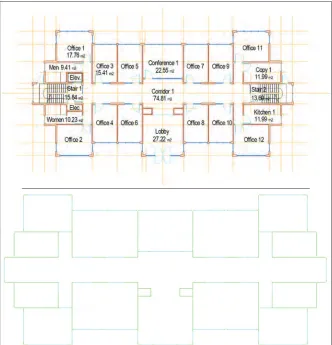
Figures 1 and 21 illustrate the
differ-ence between the architect’s view of the building floor plan and the view that must be created or defined if an energy model is going to work with the architectural data as input data. The simplified view
D e c e m b e r 2 0 0 8 A S H R A E J o u r n a l 4 5 allows the energy model to directly
deter-mine space areas (for example) without having to sort out wall thicknesses or other elements. The key is in the way that a space must be defined and recognizing that the architect’s definition of a space is much different than an energy model’s definition. For an energy model, the space must be defined in three dimensions, it must have direct association to compo-nents such as windows, it must be ori-ented to a compass direction, and it must know occupancy expectations, etc. An energy model has difficulty when there is not enough information or it must sort through extra information. This is diffi-cult for simple, single-story spaces, but it is significantly more difficult for complex or multistory (e.g., atria) spaces.
The required energy model space defi-nition can be created as a subset of the architect’s view using available tools or features in most architectural CAD pack-ages but it is by no means automatic. An architect could create all of the space defi-nitions prior to exporting to a transferable file, but to do so requires a level of exper-tise in the details of energy modeling. In the near future, it is likely that architects will become more accustomed to creating a space model view that better facilities architectural space management. It may
Middleware performs an interpretation of the exported data and manipulates the data into a form that can be read more easily by the energy modeling program. In some cases, even after the data is converted by a middleware tool, it will require conversion again. In the case of Energy Plus, the steps would be to export an IFC file, interpret the IFC file with middleware, and then redefine the data into Input Data File (IDF) format.3
The objective of this example was to show that implementa-tion of BIM or interoperability has two key aspects that must be considered. The first and perhaps more obvious aspect is that a certain level of technology development must exist in the tools that are used. Everyone recognizes that a multidisciplinary 3D object based CAD tool must be used but most don’t recognize the important role that middleware tools play or in a broader sense, what tools beyond the CAD are required. The second aspect of BIM implementation that must be considered is the manner in which team roles and responsibilities are defined or assigned.
The current roles of engineers and architects on a convention-ally produced project are well established. Integrated design approaches (whether involving BIM or not) have forced the reexamination of these roles to some extent but here in North America, the architect assumes a well defined leadership role on most building projects. With roles defined in this way as the become a standard part of design. The U.S. General Services
Administration (GSA) has created a space model view definition (MVD)2 and will require this on future GSA projects. Architects
may be creating model views for factors such as energy code compliance of building envelopes, which is a BIM feature under development by the International Code Council. Either of these would bring the architect’s “standard” model view that much closer to something that would completely meet the needs of an energy model application.
At some point, there may be enough cases done by the ar-chitect where data exchange would be seamless. In the ideal world, this data, if based on a fully defined view, could be ex-ported as an IFC or gbXML file and used directly by an energy modeling program. In reality, use of data extracted from an architectural file, even one that is fully defined, still requires a level of conversion before it can be used directly by an energy modeling program. This conversion is done with tools called middleware.1 In the future, the energy modeling tools could
be redesigned to be configured to accept BIM data directly or architectural software could be designed to export data in the proper format. For now, it appears it is easier to develop the middleware tools than to reconfigure the entire energy model data format or architectural data.
Figure 1 (top): Architect’s model view of a building floor plan.1 Figure 2 (bottom): Energy
[image:3.590.222.554.77.422.2]starting point, the implementation of BIM in North America has been focused on the architect with the result that the 3D aspect of BIM is the primary aspect that you see and hear about. In Europe, the role of the architect and engineer on typical build-ing design projects is not as hierarchical as in North America. The architect is responsible for the aesthetics of the building, but owners do not view the architect as in charge of the design team in the same way as it has evolved in North America. The architect’s expertise is still recognized and valued as architec-tural design is held in high regard, but the overall team rela-tionship is different. With the starting point for roles different in Europe, implementation of BIM has had the opportunity to take a somewhat different course.
Creating a multidisciplinary 3D integrated model of a build-ing is a valuable tool in the design and construction process, but if it does not enable interoperability (such as in the case of data sharing with an energy model), then it is not truly BIM. To go from 3D integrated design to a BIM/Interoperable de-sign, additional effort is required. This effort is focused on the creation of the total BIM database or file so that it can be used in an interoperable way. The effort to create the BIM model hopefully will result in less effort downstream or more value added overall, but it must be recognized that there is a signifi-cant effort involved in creating and maintaining the building physical model in a manner in which it can support all of the
necessary downstream applications (such as energy modeling). BIM may not always need to be implemented as a single data file, it can be developed as federated data models (separate linked or coordinated data models). However, the same type of effort is required to enable interoperability.
There have been some projects completed in Europe where in-teroperability between the building model and the energy model have been achieved. Through discussions with participants and review of the results, some differences in approach that have led to these successes can be identified. In those more successful projects, the mechanical/electrical/plumbing (MEP) consultant on the project took a central role in terms of interoperability. The architect developed the design of the building using a 3D object-based tool. Then, the MEP engineer took the architect’s building files and did the necessary additional work that allowed the creation of a data view suitable for input into their propri-etary middleware tool and energy model. The MEP consultant did not attempt to send the building file back to the architect, instead they retained the responsibility of maintaining that por-tion of the overall project BIM/IFC file. Updates to the building file were carefully coordinated between the architect and the engineer, and were managed through the MEP engineer.
This engineering-centric approach to BIM puts the responsi-bility of maintaining a significant portion of the overall BIM/ IFC file with the team member that had the best expertise to execute the task. There is more to interoperability than data exchange between the building physical data and the energy model, but this particular aspect of interoperability is an ap-plication that is very encompassing. Once the physical data of the building is defined and organized in the manner necessary for the energy model, it is relatively easy to extract other forms of this same data for use in other applications. Examples of this would be space lists, area summaries, window take-offs, etc. The MEP engineer is not attempting to usurp any other team member’s role, but can become a central player in many interop-erability aspects of the overall BIM application with this type of approach. In this example, the MEP consultant was able to
[image:4.590.295.542.80.268.2]Advertisement formerly in this space.
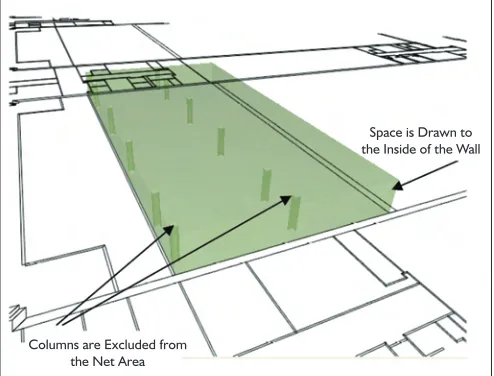
Figure 3: GSA model view definition for spatial program validation.2
Space is Drawn to the Inside of the Wall
D e c e m b e r 2 0 0 8 A S H R A E J o u r n a l 4 7 do this because of their expertise with the
interoperability aspects of MEP related building data, and further leveraged this knowledge to enhance the BIM deliver-able in other areas beyond MEP data.
This type of integrated design team approach could be done on any project. When considered in the context of a “typ-ical” architect-centric team, both the ar-chitect and the engineer must be prepared to reexamine their roles and expertise. In the case of the architect, they must have enough trust in the engineer’s expertise to let go of the control over some aspects of the project that they would retain if the team worked within the existing project hierarchy. The engineer must also adjust his approach and be willing to develop the expertise necessary to take on this added responsibility on the project. Implemen-tation of BIM will create new challenges for all building design and construction team members but also opportunities will be created. The engineer has an opportu-nity to step up and deliver a high value service but must be prepared to develop a broader level of expertise in the area of BIM/interoperability.
This article has focused on interoper-ability between a building model and an energy model as an example. Another area of potential automation that is germane to the MEP engineer is the ability to perform interference checking or clash detection by creating an integrated multidisciplinary 3D building model. To enable interference checking, the architect’s 3D building mod-el must be merged with a compatible 3D structural model and ultimately merged with a 3D model of MEP systems. One of the three primary team members will need to take the lead on merging these models and managing potential interferences. Any one of these three primary team members could take the lead but it is the author’s belief that the MEP engineer is in the best position to orchestrate interference check-ing (or perhaps a better way to say this is interference management).
Interference checking is nothing new, engineers and architects have been work-ing this out for years; it is usually called coordination. In my experience, the MEP engineer is the last one to the table in this area because the architect and structural
en-Advertisement formerly in this space.
gineer have nearly completed their tasks when the engineer begins the final stages of detailed systems layouts. Some level of planning to reserve space for ductwork and piping will have been done, but the final layout of MEP systems requires careful consideration of other disciplines. The MEP engineer must collect the latest floor plans and sections from the architect and framing plans from the structural engineer before trying to fit all the ductwork and pip-ing in the available space (whether they are uspip-ing a pencil or a 3D model). This general design order is simply a non-negotiable element of the design process no matter how integrated the design approach is or how much preplanning is done.
In the 3D object-based building model world, this design order is not going to change. The MEP is still the last one to the table and has to ensure that everything fits in the end. They need to collect architectural and structural information and then work out the engineering systems design based on these constraints. Interference checking, coordination, or whatever you want to call it, is simply an integral part of MEP system layout. This is not a new way of thinking for the MEP engineer. I mean no disrespect to the architects and structural engineers of the world, but I think it is fair to say that interference with MEP systems is not their primary concern as they finalize their design. With this in mind, who better to manage the process of collecting and merging the building physical data and then integrating MEP systems into this overall building model? The result of this process will be the avoidance of interferences, which is better than finding and fixing them later.
BIM is a rapidly evolving tool, but there are still technical bar-riers that limit implementation of BIM and fully using interoper-ability. Solutions to these technical barriers are being developed but it is a daunting task (for example, development of GST and IDF Generator have stalled). There is no doubt that our industry will overcome these technical barriers as we move forward, but it is going to take time. A second barrier to actualization of BIM is the limitations that are a by-product of our existing mind-set regarding team roles. Even within the framework of the existing technical limitations, there are opportunities to do more with what is available if team roles are carefully examined. The MEP engineer has a tremendous challenge and a tremendous opportu-nity in this arena. To seize it, they must have a clear understanding of what this opportunity means and what expertise is needed to carry it out. The greatest success will come to those MEP firms that are proactive in the BIM arena, challenge existing mind-sets, and bring value and expertise to the table.
References
Bazjanac, V., A. Kiviniemi. 2007. “Reduction, simplification, 1.
translation and interpretation in the exchange of model data,” in D. Rebolj (ed), Bringing ITC Knowledge to Work, Proceedings of CIB
24th W78 Conference. http://tinyurl.com/5osbal.
U.S. General Services Administration (GSA). 2007.
2. BIM Guide
Series 2— Spatial Program Validation. http://tinyurl.com/bimspatial.
Maile, T., M. Fischer, V. Bazjanac. 2007. “Building energy perfor-3.
mance simulation tools—a life-cycle and interoperable perspective.” Working Paper WP107. Center for Integrated Facility Engineering (CIFE). http://tinyurl.com/wp107.