International Journal of Emerging Technology and Advanced Engineering
Website: www.ijetae.com (ISSN 2250-2459,ISO 9001:2008 Certified Journal, Volume 3, Issue 5, May 2013)
713
A New Trustworthy and Co-operative Nodes Based MIMO
Route Discovery Algorithm for WSN
Madhurya B Eshwar
1, Dr. P. C. Srikanth
21,2
Department of Electronics and Communication, Malnad College of Engineering, Hassan, India.
Abstract—Wireless sensor network requires robust and energy efficient routing protocols to minimize the energy consumption as much as possible. Channel fading, interference and radio irregularity create a big challenge in the design of energy efficient communication. To mitigate the fading effects in wireless channel, Multi-Input Multi Output (MIMO) scheme is utilized for sensor network. A new trustworthy and co-operative nodes based MIMO route discovery algorithm is proposed in which unlike LEACH algorithm where the cluster head is elected randomly for each round. Selection of cluster head for such rotation greatly affects the energy efficiency of the network. In order to achieve energy efficiency we include a set of nodes known as co-operative nodes. These co-operative nodes have preemptive sharing mechanism so that when communication occurs the energy consumed is less. Trust is also included as a parameter at each node level so that the algorithm is secure and the packets are sent through the most trusted route.
Keywords— cluster head, co-operative nodes, route discovery, wireless sensor network.
I. INTRODUCTION
A wireless sensor network is an autonomous system of numerous tiny sensor nodes equipped with integrated sensing and data processing capabilities [1]. Sensor networks are distinguished from other wireless networks by the fundamental constraints under which they operate, that is sensors have limited power resources making energy management a critical issue in wireless sensor networks. Therefore sensors must utilize their limited energy as efficiently as possible. A significant amount of research has been done on hierarchical sensor nets. A hierarchical sensor net such as LEACH partitions the nodes into clusters and in each cluster a dedicated node, the cluster head, is responsible for creating and
maintaining a TDMA schedule; all the other nodes of a
cluster are member nodes [2,3]. The cluster head aggregates the data of its members and transmits it to the sink node or to other nodes for further relaying. The cluster heads role is energy consuming since it is always switched on and is responsible for the long-range transmissions. If a fixed node has this role, it would quickly drain its energy, and all its members would be "headless" and therefore useless [4].
Game theoretical techniques have recently become rampant in many engineering applications, particularly in wireless communications [5].
Of the various game theoretical formulations, coalitional games prove to be a very powerful tool for designing fair, robust, practical and efficient cooperation
strategies in communication networks. In this paper
coalition formation game is adopted to choose the co-operative nodes for transmission and reception. The game is modeled such that, the co-operative sensors are dynamically selected based on the residual energy, geographical location of the sensors and sensor distance in a cluster, to reduce the overall energy consumption [6]. Wireless sensor network requires robust and energy efficient routing protocols to minimize the energy consumption as much as possible. It is also necessary to
provide an automated environment with multi agents.
Channel fading, interference and radio irregularity pose a
big challenge in the design of energy efficient
communication and to route the data in wireless network [7].
To mitigate the fading effects in wireless channel, multi-input multi-output (MIMO) scheme is utilized for sensor network. The MIMO technology has the potential to enhance channel capacity and reduce transmission energy consumption particularly in fading channels. This is done by exploiting array gain, multiplexing gain and diversity gain. However, direct application of multi-antennas to sensor nodes is not viable due to the restricted physical dimension of a sensor node which typically can only prop up a single antenna. If individual nodes cooperate for transmission and/or reception, a co-operative MIMO system can be build such that energy efficient MIMO schemes can be employed in wireless sensor network [8,9]. Cooperation among sensor nodes has the capability to reduce the total power consumed for data transmission in the sensor network. In case of multiple inputs and multiple outputs, there are always options to choose the co-operative nodes among the active sensors. One method of forming small group within the whole set of nodes and to select the head node is to use game-theoretic tools [10].
II. SYSTEM MODEL
International Journal of Emerging Technology and Advanced Engineering
Website: www.ijetae.com (ISSN 2250-2459,ISO 9001:2008 Certified Journal, Volume 3, Issue 5, May 2013)
714
Route discovery process is performed to find multiple routes from source node to destination node. Trust computation is performed on the available route.
Fig.1 System overview
III. COOPERATIVE NODE FORMULATION AND TRUST
EVALUATION
A.Node Deployment Algorithm
The key points of the research on node deployment algorithm are to increase the coverage area, enhance network connectivity, prolong the network lifetime, make the load balance, improve the accuracy of the data transmission and strengthen the tolerance of nodes. Node deployment algorithm is the algorithm which is responsible for positioning the mobile stations and the base stations in each zone. In this paper this algorithm is responsible for deploying the nodes in the network in the four respective clusters. It is also responsible for placement of the nodes in each cluster in an area bounded by the limits xmin, xmax, ymin, ymax.
B. Cluster Formation
The cluster formation algorithm divides the entire area into multiple clusters. Each cluster has a set of nodes in its area. In this paper the entire area is divided into four clusters with each cluster bounded with the limits of x region with some xmin and xmax. The y region is bounded within the limits ymin and ymax. Each cluster is allocated a set of nodes.
C.Cooperative Node Game Formulation
Game theory can be used to analyze behavior in decentralized and self-organizing networks. Game theory typically models the nodes as players and choice of strategies of self-interested players, in order to capture the interaction of players in an environment such as a communication network.
Coalitional game theory mainly deals with the formation of co-operative groups, i.e., coalitions that allow the cooperating players to strengthen their positions in a given game. The selection of co-operative nodes which take part in MIMO communication is modeled as a coalitional game and coalition is done based on the residual energy of the nodes. The sensor nodes are the players and the game is choosing the set of nodes for co-operative transmission and reception. The purpose of this grouping is to reduce the total power consumption and increase the energy efficiency. The set of nodes having the minimum energy form co-operative group, the advantage of this approach is the energy consumption is reduced as communication between the operative nodes does not require more energy. In co-operative games, groups of players are formed, called coalitions. Players trying to find a coalition, to strengthen their position in the game and they make an agreement to act as a simple entity. Coalitional games have proved useful to design fair, robust, and efficient cooperation strategies in communication networks. In a coalitional game (N,v) with N players, the coalition value or utility of a coalition is determined by a characteristic function
v:2N→R which applies to coalitions of players. The core
of the coalitional game (N,v) guarantees that no player has an incentive to leave N to form another coalition. Coalitional game theory allows a reduction of power consumption in WSN by forming coalitions.
D.Cluster Head Election
This algorithm is used to elect the cluster head by computing π value .The π value is computed for each cluster and whichever node has maximum value of π becomes the cluster head.
(1)
Where
α is the weight parameter of node’s residual energy level β is the weight parameter of node’s trust level
γ is the weight parameter corresponding to average path loss
Einit is node’s initial energy level
Et is node’s current residual energy level
Ri is node’s trust level
E. Trustworthy Route Discovery
This is used to find multiple routes from source node to destination node and make a choice of the best route among the set of routes which is having maximum trust level. Fig 2 shows the route discovery algorithm.
International Journal of Emerging Technology and Advanced Engineering
Website: www.ijetae.com (ISSN 2250-2459,ISO 9001:2008 Certified Journal, Volume 3, Issue 5, May 2013)
715
[image:3.595.387.518.240.431.2]If they belong to different clusters then the source node delegates the RREQ packet to source node cluster head (CH). Source CH will send RREQ packet to destination CH. If the destination CH is the destination, then routing process stops otherwise the destination CH broadcast packets to co-operative nodes of the destination cluster and then the co-operative nodes delegate it to destination.
Fig.2 Route discovery algorithm
IV. RESULTS AND DISCUSSIONS
The analysis of the proposed routing scheme is evaluated using MATLAB 11. The results are obtained for N=5 nodes in each cluster randomly deployed in the region and the total clusters considered in this paper are four. The simulation parameters are as shown in table 1.
TABLE I
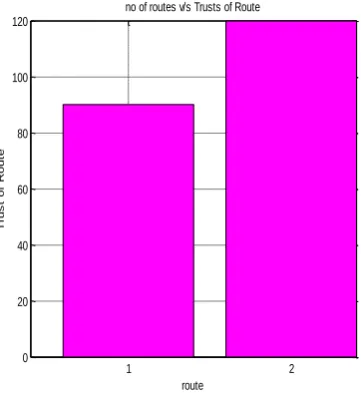
The number of co-operative nodes formed is 2. They are the nodes with ids 17 and 18. The node with id 2 is source node and 19 is the destination node. There are 2 routes discovered. The power consumed and trust evaluated for both the routes are shown in fig 3 and 4. Based on the maximum trust and less power consumption
[image:3.595.338.519.464.661.2]the best route is discovered which is as shown in the fig 5.
Fig.3 Power consumed for both the routes
Fig.4 Trust evaluated for both the routes
1 2
0 20 40 60 80 100 120
route
T
ru
s
t
o
f
R
o
u
te
no of routes v/s Trusts of Route
Simulation parameters Description
Carrier frequency 2.5GHz
Network area(m2) 100x100
Different types of nodes Source node, sink node,
cluster head,
co-operative nodes
Number of clusters 4
Number of CH per cluster 1
Measurement parameters No of hops, power
consumption Weight parameter of node’s
residual energy(α) 0.5
Weight parameter of node’s trust
level(β) 0.4
Weight parameter of node’s average path loss(γ)
[image:3.595.65.277.596.775.2]International Journal of Emerging Technology and Advanced Engineering
Website: www.ijetae.com (ISSN 2250-2459,ISO 9001:2008 Certified Journal, Volume 3, Issue 5, May 2013)
716
Fig.5 Best route discovered from source to sink nodeThe performance analysis of the LEACH and new trustworthy and co-operative nodes based routing scheme is portrayed from figures 6 to 8.
The route discovery time and power consumed is less for the proposed new trustworthy and co-operative nodes based MIMO routing scheme as compared to LEACH and as shown in figures 6 and 7. From the fig 8 the number of hops is 5 for the proposed scheme and 40 for LEACH.
Fig.6 Comparison of route discovery time of proposed scheme and LEACH
Fig.7 Comparison of power consumed of proposed scheme and LEACH
Fig.8 Comparison of number of hops of proposed scheme and LEACH
V. CONCLUSION
The new trustworthy and co-operative nodes based MIMO route discovery algorithm designed for wireless sensor network is introduced in this paper and the performance of the system is evaluated to minimize the energy consumption and increase the lifetime of sensor nodes. The proposed route discovery scheme is compared with LEACH clustering algorithm. The game theory is used to select the co-operative nodes for communication and also used to elect healthier cluster heads. These cluster heads have sufficient residual energy and high trust level during the cluster head election.
0 10 20 30 40 50 60 70 80 90 0 10 20 30 40 50 60 70 80 90 x-cordinate y -c o rd in a te
Best Route Discovery Algorithm
1 2 3 4 5 6 7 8 9 10 11 12 13 14 15 16 17 18 19 20 1 0 5 10 15 20 25 30 35 40 Index Number R o u te D is c o v e ry T im e
Index versus RDT
NEWOLD 1 0 5 10 15 20 25 30 35 40 45 50 Index Number P O w e r C o n s u m e d
Index versus Power Consumed
NEWOLD 1 0 5 10 15 20 25 30 35 40 Index Number N u m b e r o f H o p s
Index versus No Of Hops
International Journal of Emerging Technology and Advanced Engineering
Website: www.ijetae.com (ISSN 2250-2459,ISO 9001:2008 Certified Journal, Volume 3, Issue 5, May 2013)
717
The simulation results show the effective route discovery from source node to destination node and further show that the effectiveness of new trustworthy and co-operative nodes based MIMO route discovery is better than LEACH in terms of route discovery time, number of hops and power consumption. This is due to the exploitation of diversity gain of MIMO systems.
REFERENCES
[1] Akyildiz, W. Su, Y. Sankarasubramaniam and E. Cayirci, "A survey on sensor networks", IEEE Communications Magazine, vo1.40, no.8,pp.1 02-114, August 2002.
[2] Xue Wang, Liang Ding, and Sheng Wang, 'Trust Evaluation Sensing for Wireless Sensor Networks," IEEE Transactions on Instrumentation and Measurement, vol. 60, no. 6, June 2011. [3] Haiming Yang and BiplabSikdar, "Optimal cluster head selection
in the LEACH architecture", Froc. IEEE international Conference on Performance, Computing and Communications, New Orleans, LA,pp.93-100, April 2007.
[4] Kiran Maraiya, Kamal Kant and Nitin Gupta, “Efficient cluster head selection scheme for data aggregation in wireless sensor networks”, International Journal of Computer Applications, Volume 23– No.9, June 2011
[5] Fatemeh Kazemeyni, Einar Broch Johnsen, Olaf Owe and Ilangko
Balasingham, “Group selection by nodes in wireless sensor networks using coalitional game theory”, International Journal of Computer Science & Engineering Survey (IJCSES), June 2010. [6] Saad, W.; Zhu, H.; Debbah, M.; Hjorungnes, A.; Basar, T.,
“Coalitional game theory for communication networks: A tutorial”, IEEE Sign. Process. Mag. 2009, 26, 77–97.
[7] Jamal N. Al-Karaki and Ahmed E. Kamal, “Routing techniques in
wireless sensor networks: a survey”, ICUBE initiative of Iowa State University, Ames, IA 50011.
[8] Curt Schurgers and Mani B. Srivastava, “Energy efficient routing in wireless sensor networks”, International Journal of Computer Applications, May 2010.
[9] Cui S., Goldsmith A. J., Bahai A., “Energy-efficiency of MIMO and co-operative MIMO techniques in sensor networks”, IEEE Journal on Selected Areas in Communications, 2004; vol 22, no.6, pp. 1089-1098