Title
Dealing with blast loading on brickwork
Authors
Haynes, BJ and Beg, MF
Type
Article
URL
This version is available at: http://usir.salford.ac.uk/10966/
Published Date
2007
USIR is a digital collection of the research output of the University of Salford. Where copyright
permits, full text material held in the repository is made freely available online and can be read,
downloaded and copied for noncommercial private study or research purposes. Please check the
manuscript for any further copyright restrictions.
Synopsis
Much effort is being deployed in maintaining electricity generation from the UK’s fleet of nuclear power stations with safety being a prime consideration. Up-to-date safety standards demand resistance to hazards which normally include seismic and blast loading, yet many stations were built before such considerations became mandatory. To extend the generating life of older nuclear power stations, a demonstration of conformity to modern safety standards is now required.
This paper will discuss the structural problems associated with assessing and strengthening masonry panels subjected to blast loadings as generated by a postulated accident of hot gas release from fracture of a reactor pressure vessel’s cooling circuit.
The paper will provide background on masonry strength and assessment techniques, including the use of dynamic amplification which permits static design principles to be used under dynamic loading conditions. An account of the strengthening options and the problems associated with their implementation will be presented.
Notation
DAF Dynamic Amplification Factor Estatic Static elastic modulus of masonry
Edynamic Dynamic elastic modulus of masonry
F Frequency of structure
H Height of masonry panel
L Length of masonry panel
M Applied bending moment
Plat Applied lateral pressure
r Arch rise
t Thickness of masonry leaf
Z Elastic modulus of masonry in direction of bending fk Masonry characteristic design stress in
compression
fkxII Masonry characteristic design stress in flexure
(failure plane parallel to bedjoints)
fkxL Masonry characteristic design stress in flexure
(failure plane perpendicular to bedjoints)
δ Arch deflection
λ2 Mode shape factor
γ Mass per unit area of masonry panel
γm Material partial safety factor
γf Load partial safety factor
µ Poisson’s ratio of masonry
Introduction
The UK has a significant fleet of nuclear power stations which currently provide around 20% of the nation’s electricity. Decommissioning of many early reactors is underway but for others, favourable economics, combined with the need to main-tain base load capacity, has made life extension desirable.
To extend a generating licence, an operator must demon-strate his system conforms to modern standards. In the case of nuclear stations this necessitates structural qualification for seismic events and qualification against a range of accidental loadings that may be derived from postulated plant failures. Of these, rupture of pressurised pipe work in the reactor cooling circuit is one of the more severe. This event would lead to pres-surisation of the building’s internal compartments and poten-tial failure of safety critical components.
The design target after such an accident is to vent gas along defined routes permitting the plant to be safely shut down. But this is not an easy task since the pressure circuit runs at over 10 atmospheres with escaping gas at several hundred degrees, thus the heat exchange medium (in this case CO2) escapes with
blast force. The studies associated with such failures are known generically as ‘hot gas release’ studies.
The heat transfer medium from reactor to boiler is in this case pressurised CO2gas carried along pipe work designed to
high levels of integrity. The safety case seeks to assure the integrity of such circuits against every conceivable operating condition. But it also considers the possibilities of failure and seeks to assure that the failure effects are mitigated, always with the target of safe reactor shut down. In the buildings under consideration, a number of pipe failure locations were identified and then routes defined along which gas had to flow prior to its vent to atmosphere. Structures along this route had to be qualified to contain the gas in the manner of a duct.
Reactor buildings dating from the 1960s often have struc-tures made up of substantial concrete frames including columns, slabs and beams. Unfortunately they also often have brickwork panels forming the dividing walls. In hot gas release projects such masonry panels lining the duct route must sustain the blast and gas pressure loadings. This paper will describe the assessment and strengthening of masonry elements to sustain the extraordinary forces involved.
The brickwork panels
The masonry panels considered for assessment were all division walls within older nuclear power stations. As such, they were generally not designed for any specific lateral load and certainly not dynamically rated. The panels were often constructed from common bricks produced by the London Brick Company (now part of Hanson). Several important factors must be stated concerning the brickwork’s physical construction:
• the panels are of two stretcher bonded leaves with no cross bonding in the 10mm cavity, giving 215mm thickness overall, • some panels contain cross-cavity mesh reinforcement but no
cavity fill mortar,
• the orientation of the brick frog is not uniform but generally bricks were laid frog-down,
• there are no ties between the masonry panel and surround-ing buildsurround-ing frame.
The masonry panels are therefore in possibly the worst struc-tural condition they could be to resist lateral load. Moreover their capability is modified by the attachment of many services, which are often of significant weight. Some of these services are ‘safety related’, so from that standpoint alone, the panels cannot be allowed to fail under hot gas release loading. A robust design requires them to survive.
Dynamic loading
In general any loading may be categorised as static, quasi-static or dynamic, the difference depending on the duration of load application and the corresponding structural response. So all types of ‘dynamic loading’ are associated with variations of load intensity with time. If the loading is very rapid or impul-sive, the structure simply has no time to respond and the instantaneous application of high impulsive load may be of little significance. On the other hand, in time varying motion such as seismic loading where the period of the motion is similar to the structural period, the structure may effectively
experi-Dealing with blast loading on brickwork
B. Jonathan
Haynes
B.Eng(Hons), MSc, PgCertHE, C.Eng, FIStructE, MICE, FHEAUniversity of Salford (formerly Jacobs)
M. Faisal Beg
B.Eng(Hons) Mouchel Parkman (formerly Jacobs) Received: 03/07 Modified: 06/07 Accepted: 07/07 Keywords:Blast loading, Brickwork, Masonry, Panels, Nuclear power stations, Dynamic loads, Gas, Appraising, Strengthening© B. Jonathan Haynes & M. Faisal Beg
ence amplification of the applied loading. The interdependence between the nature of the applied loading and the structure is the subject of dynamic analysis. Key parameters are duration of the load application and the rela-tionship between the natural frequency of the structure and the frequency (or duration) of the input motion. Classically, and in the extreme, if the frequency of input motion equals the natural frequency of the structure, a condition of resonance exists and the dynamic amplification of the loading is potentially huge, limited only by damping. Blast loading is of a dynamic type described by a pressure impulse (i.e. very short time of application) but it is non-periodic. Generally the loading period is much shorter than the structure’s period. To derive an equivalent static loading there must be knowledge of the pressure – time loading history and knowledge of the responding structure’s dynamic characteristics.
Blast loadings are highly variable in nature and much of our subject knowledge stems from theory over a century old combined with experimen-tal back up from the nuclear weapons testing programme conducted during the 1950s1. When explosives detonate, a near instantaneous expansion of
gaseous material occurs which generates a shock wave. Damage due to explosions is largely due to the incidence of this shock wave on the structure. This wave moves out from the explosion source with a very rapid increase in pressure. This is then followed by a drop to a pressure known as the bulk overpressure. Thereafter, the blast pressure drops below the background pressure so that at some distance behind the shock wave there is a suction phase, this is depicted in Fig 1. Fig 2 depicts the effects of suction passing a point. In open air blasts caused by explosives, the shock wave radiates out hemispherically from the source and the pressure dissipates with distance. But within buildings or in confined areas such as streets, wave reflection can occur which causes local amplification.
The mechanics of gas explosion are very similar to those of explosive chemical blast but the explosive period is much longer and the pressure increases are generally confined within a structure. Consequently the effects of drag and turbulence from pressure waves moving over structural obsta-cles are much more important but also more complex to assess. For example, reflection of blast waves can significantly increase the effective pressure where incident and reflected waves interact.
In hot gas release studies, the postulated blast loads impart lateral pres-sure on the brick panels that line vent routes. Unfortunately such prespres-sures act across the panel’s weakest axis, creating flexure. Moreover, brickwork is essentially brittle and as such appears a naturally poor medium to resist the
violent shock of a blast. Little test evidence exists to provide information on brickwork’s ability to sustain such loads. However, following the Ronan Point disaster in the1960s, the British Ceramic Research Association2undertook
limited gas explosion testing on several arrangements of brickwork panels to investigate the capability of masonry to sustain the introduction of ‘acci-dental load’ considerations. Their work suggested, perhaps surprisingly, that un-reinforced solid, one brick thick, masonry panels could sustain dynamic blast loads of around 50kN/m2without ‘collapse’ albeit with considerable
damage. Compare this to the normal assumption that panels are weak against wind loads of around 2.0kN/m2. An explanation of the difference
stems from the different pulse durations. Blast loads are high but instanta-neous and die away quickly. For wind loads, the gust duration is relatively long and may be periodic. Brickwork crack patterns in the blast tests demon-strated a strong correlation with yield-line assumptions normally witnessed in reinforced concrete slab failures.
British Energy3commissioned a series of tests at Bristol University
Earthquake Engineering Research Centre, comprising seismic tests on solid, one brick thick, vertically spanning masonry panels. These tests demon-strated that such panels could sustain cycling lateral accelerations of up to 1.0g without collapse. Given the mass of wall as approximately 1.9kN/m2this
is the sort of value that might be expected from experience of wind resist-ance.
Recently, Du Pont4commissioned blast testing of bi-directionally Kevlar®
coated masonry panels (the Kevlar®being intended as reinforcement) and
these survived blast loadings of up to 175kN/m2(50mS to peak loading)
without damage.
Hot gas loading
Obviously, undertaking load tests to model or define the loading pulses for hot gas release would not be feasible inside an active nuclear power station. Hence computer models are substituted to generate pressure transients for blast load definition. This involves creation of a simplified model of the reactor building defining its sub-divided space and any links between the spaces (such as ducts, doorways and service risers). Pressure vessel pipe work instantaneous rupture is then simulated at predetermined locations and from this, fluid dynamic principles can be used to generate time-history transients of temperature and pressure within each of the sub-divided spaces. An example of such a pressure transient is shown in Fig 3.
Shock wave and blast overpressure characteristics are described by the
1
2
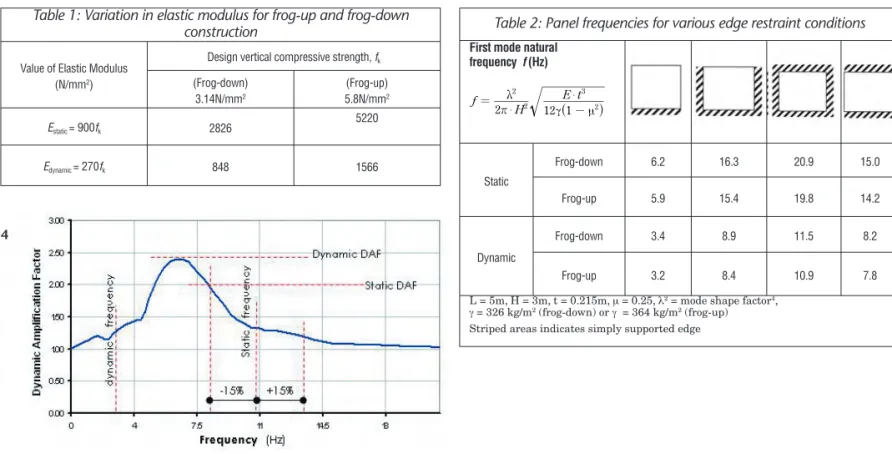
Fig 4. A DAF plot, derived from the pressure transient in Fig 3
principles of fluid dynamics and may be assessed using Computational Fluid Dynamics software named FLUENT and HOTJET respectively.
The majority of postulated hot gas releases are dynamic in nature, so for this reason it is important to establish the extent of structure response which in turn is dependant upon blast characteristics and structure frequency.
Only static design methods are available for masonry, so to allow for the dynamic loading we introduced the dynamic amplification factor concept, which is the ratio of dynamic to static deflection and is applied in the manner of a load factor on the blast load. The general mathematical solution for the DAF is based upon the Duhamel integral (see Equation 1), this requires a numerical integration of the blast transient, which may conveniently be undertaken using a spreadsheet.
...(1)
where ν(t) is the displacement acting at time t, p(τ) is the load acting at time t= τ, mis the mass of the panel, ωis the natural circular frequency, which for low damping may be taken as the undamped frequency (2 πf, where f= natural frequency), ξis the proportion of critical damping.
It is evident from the range of elastic moduli computed, that the frequency of structure response to dynamic loading is not accurately predictable. This is compounded by the fact that in reality boundary conditions will not reflect the analysis assumptions of free, pinned or fixed edges and this is a poten-tial change in stiffness. To complicate matters further, assessment methods being considered relied upon the formation of plastic ‘hinges’ within the structure whose existence implies significant displacement and hence some further relaxation (loss of stiffness) against the blast load. The presence of plastic hinges automatically affects panel stiffness which in turn affects the DAF.
Natural frequency
The main point about blast loads, as shown in Fig 3, is that the load is applied in a very short period of time, often around 0.1s in the example of hot gas release. Conversely, wind load would be considered as a 3s gust. Because of this, the frequency of the structure must be known to assess if the structure will ‘respond’ to the loading.
A structure’s natural frequency is a key parameter in any dynamic
eval-sin
t m1 p e t d
. .t
t
0
: : :
o] g= ~
#
]xg -p~]-xg ^~] -xgh xuation. If the natural frequency of the masonry panel is close to the peak of the blast frequency, then exaggerated response to loading will occur. Calculation of the natural frequency is therefore of great practical importance but cannot be undertaken with certainty in brick panels for several reasons to do with variable mass and potential variable stiffness (frequency being a function of both mass and stiffness). Firstly, the orientation of brick laying, either frog down or frog up, means that two extremes of panel density must be considered, frog-down brickwork will contain voids and hence have lower mass. Additionally when bricks are laid frog down they have a reduced verti-cal allowable nominal strength (the brickwork contains voids) and the elastic modulus is derived from this, i.e. the stiffness is also affected. The dynamic modulus is derived from testing by Bristol University Earthquake Engineering Research Centre3, undertaken on a vertically spanning wall
subject to 1.0g lateral acceleration and results are shown in Table 1. It will be seen that significant differences exist.
Panel out-of-plane frequency may be established by several methods but generally standard flat plate formulae5were used. The general formula is
dependent on edge boundary conditions, and values are shown in Table 2 for four common edge conditions.
The Dynamic Amplification Factor (DAF)
To obtain a reliable estimate of the DAF, it is necessary to undertake rigor-ous calculations utilising standard methods6. Such methods should make full
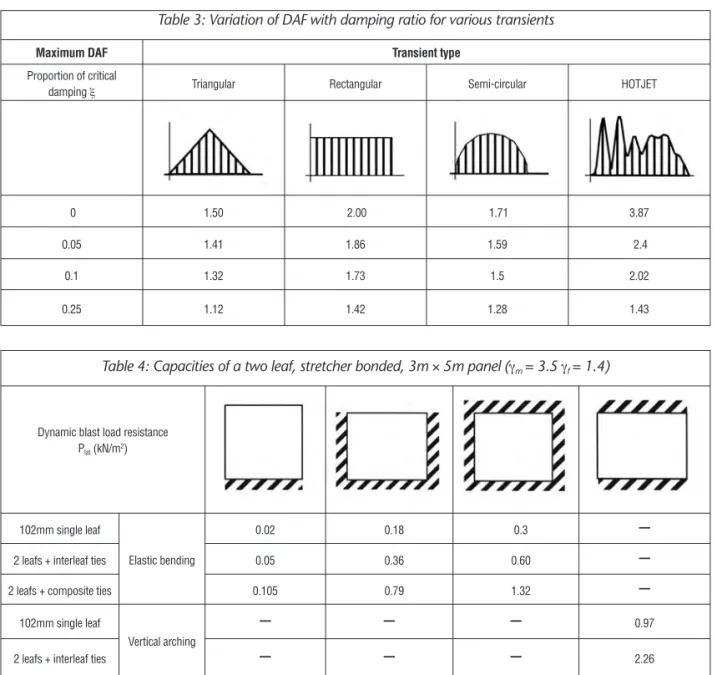
allowance for damping (the ability of a material to dissipate energy and stop vibrating), which can be taken as 5% of critical damping for brickwork masonry. The results of these calculations give a DAF of unity for static loading but some different value for dynamic transients. At the frequencies of the brick panels encountered, this factor was usually greater than unity, however, for high frequency loading it could be less than unity. The shape of the DAF v frequency plot will generally reflect the input transient shape (load v time) of the applied loading. A summary of maximum DAF’s for standard cases is given in Table 3 for varying damping ratios. It can be seen that for the worst case loading encountered, applied loading could be amplified by a factor approaching four.
It is desirable to understand the variability of the DAF for a broad range of frequency values, especially when a hot gas release boundary may contain over 100 masonry panels. Therefore, for each blast transient, the DAF was evaluated over the possible frequency range of all panels to be assessed. A DAF v frequency plot may then be constructed, as depicted in Fig 4.
4
Table 1: Variation in elastic modulus for frog-up and frog-down construction
Value of Elastic Modulus (N/mm2)
Design vertical compressive strength, fk
(Frog-down) 3.14N/mm2
(Frog-up) 5.8N/mm2
Estatic = 900fk 2826
5220
Edynamic = 270fk 848 1566
Table 2: Panel frequencies for various edge restraint conditions
First mode natural frequency f (Hz)
f H
E t
2 2 12 1
2 2 3 $ $ r m c n = -_ i Static
Frog-down 6.2 16.3 20.9 15.0
Frog-up 5.9 15.4 19.8 14.2
Dynamic
Frog-down 3.4 8.9 11.5 8.2
Frog-up 3.2 8.4 10.9 7.8
L = 5m, H = 3m, t = 0.215m, µ= 0.25, λ2= mode shape factor4,
γ = 326 kg/m2(frog-down) or γ = 364 kg/m2(frog-up)
To account for the uncertainty of panel frequency calculation, the follow-ing procedure was adopted to select a DAF from the plot:
• Static DAF – computed using static material properties and appropriate to elastic conditions. The frequency was broadened by ±15% and the most onerous DAF selected from this range,
• Dynamic DAF – computed using dynamic material properties and appro-priate to plastic conditions. The most onerous DAF was selected from a frequency range between the static and dynamic frequencies.
Methods of assessment
It was possible that existing brick panels were adequate to withstand hot gas blast loads. So, before undertaking any (undesirable) strengthening, two methods of lateral load capacity assessment were adopted. Both these methods are listed in BS 56287.
Elastic bending assessment
The elastic bending method is based on yield-line theory. Standard solutions for a range of edge conditions and aspect ratios (H / L) are available via a bending moment coefficient (α). The general equality to be satisfied is:
...(2)
where µ= fkxll / fkxL is the orthogonal ratio (Poisson’s ratio of masonry) and
Zis the section modulus of the brickwork resisting the blast. The product, Plat×DAF may be viewed as an equivalent static load.
P DAF L f Z
f lat
m kx
2
$ $ $ $ $ #
n a c ^ h c
Further assessments may be made using the same method and assuming new edge restraint conditions until the panel is deemed satisfactory.
This method generally predicted the panels to be unacceptable. The alter-native approach, using arching, proved much more useful since it suggests significantly greater capacities.
Arching assessment
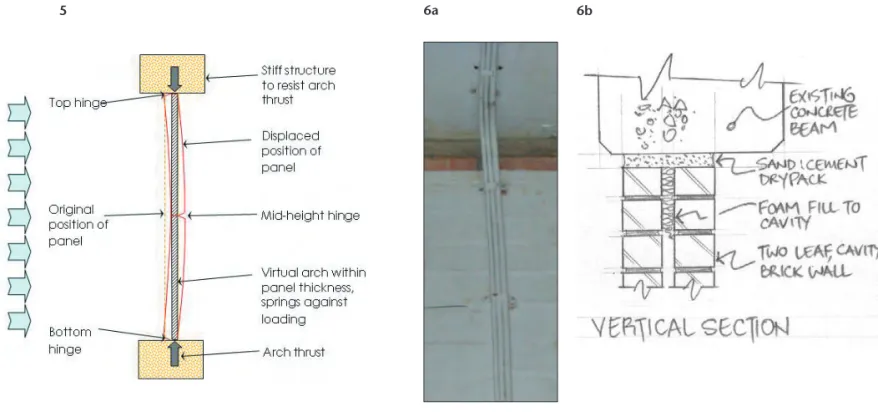
Arching in flat panels, as opposed to vaulted arches, assumes a ‘virtual arch’ is set up within the masonry thickness. The virtual arch thickness is taken as 10% of the masonry thickness (t). As deflection takes place, a three-pinned arch develops in the panel and hence a statically determinate failure mech-anism exists. Although the panel is deflecting with the load, the virtual arch is springing against the load and a resistance mechanism is developed, this is shown in Fig 5. This is deemed to be a plastic approach and so the dynamic modulus is used in deflection calculation rather than the elastic modulus.
Arching is a compression system and is dependant upon resistance of the thrust generated by arch displacement. Consideration of edge conditions is therefore of paramount importance. BS 56287currently refers only to
hori-zontal arching but the principles are equally applicable to vertical arching. Nuclear power station structures are generously sized, usually offering sufficient floor beam dead weight to resist thrust from vertical arching. However, where horizontal arching was used, the column at the end of a row of panels must provide sufficient stiffness to resist arching thrust. Significantly lower blast loads were predicted in the upper storeys of the building where resistance could be easily justified, however a rigorous capac-ity and deflection check was required in the lower storeys.
BS 56287outlines this approach for panels of slenderness up to 25 (see Table 3: Variation of DAF with damping ratio for various transients
Maximum DAF Transient type
Proportion of critical
damping ξ Triangular Rectangular Semi-circular HOTJET
0 1.50 2.00 1.71 3.87
0.05 1.41 1.86 1.59 2.4
0.1 1.32 1.73 1.5 2.02
0.25 1.12 1.42 1.28 1.43
Table 4: Capacities of a two leaf, stretcher bonded, 3m × 5m panel (γm = 3.5 γf = 1.4)
Dynamic blast load resistance Plat(kN/m2)
102mm single leaf
Elastic bending
0.02 0.18 0.3
–
2 leafs + interleaf ties 0.05 0.36 0.60
–
2 leafs + composite ties 0.105 0.79 1.32
–
102mm single leaf
Vertical arching
–
–
–
0.97Equation 3). Where a greater slenderness was encountered, the arch deflec-tion and rise (r) were calculated and a reduced capacity results (see Equation 4).
Two-way arching is not used but could potentially offer a considerable increase in panel capacity, if a code compliant method were available. It is believed that such a method would predict capacities similar to those observed in the British Ceramic Research Association test2.
...(3)
...(4)
Table 4 gives indicative dynamic overpressure capacities for brickwork panels of various boundary conditions and assessment methods. Clearly, arching methods predict significantly higher capacities than elastic bending methods but greater deflections occur.
The use of cavity grouting, to create a composite wall section was not pursued as previous work had highlighted the difficulty of successfully grout-ing whole panels without burstgrout-ing the brickwork.
Remedial measures
When panels are deemed inadequate, many remedial solutions are available, some more utilitarian than others. However, since the majority of panels considered were within industrial plant, there was little consideration of aesthetics. The major consideration when selecting a strengthening solution was minimisation of disruption to plant and process.
In nuclear facilities, a HAZOP (HAZard And OPerability study) is routinely undertaken in conjunction with the plant operation team, to ensure that the implications of any proposed modifications are fully understood and to ensure any residual risks involved are ALARP (As Low As Reasonably Practicable).
Solution optioneering was used extensively on this project. This involved identifying every possible solution for every panel, the team could then iden-tify the safest solution to implement. The selection would typically centre upon considerations of possible live plant damage (nuclear safety), access availability and difficulty, radiological exposure and knock-on effects for plant operation. Once this process was completed a written Safety Case was submitted for rigorous Independent Nuclear Safety Assessment, upon
.
t
H P DAF f
L t r
25 lat f 1 2
m k
2
$ $ $
2 ^ h c # c
t
H P DAF f
L t
25
100 108
lat f
m
k 2
$ $ $ $
# ^ h c # c b l
approval implementation could begin.
The design process for panels requiring modification is cyclical. Firstly, the assessment of capacity is dependant upon the boundary conditions to estab-lish panel frequency and hence the DAF. But thereafter should the panel fail its capacity assessment, any modification will change the boundary condi-tions and hence frequency and hence the dynamic blast load that must be resisted. Thus the design process is iterative.
It is important to observe the relationship between structure stiffness and response frequency for each blast transient. A panel may be rendered accept-able simply by increasing its stiffness (without altering its mass) so signifi-cantly increasing its frequency and hence reducing its DAF. Conversely, since frequency is a function of (stiffness / mass), adding mass may have little benefit. It may even worsen response.
Arching
Creating conditions to permit arching offers the solution with potentially the least intervention since providing solid packing between the panel masonry and the surrounding structure may be the only modification required.
Several simple measures may be taken when arching provides an accept-able assessment:
• When vertical arching is acceptable, the gap between the top of the masonry and the building frame was dry-packed with non-shrink sand : cement grout. This ensures a load path for arch thrust. Where the gap was less than 2mm, no modification was required as the panel locks itself in as it bodily rotates under blast load3,
• When horizontal arching is acceptable, vertical edge restraints, usually angles, were fitted to the building frame by bolting or bonding to the concrete frame. This prevents bodily movement of the panel until the arch is developed.
These solutions are materially cheap but often access and labour inten-sive. Figs 6a & 6b and Fig 7a & 7b respectively depict modifications under-taken for vertical and horizontal arching.
Panel sub-division
When arching was not an acceptable solution, usually due to the presence of significant panel openings or service penetrations, a fully elastic solution was required to provide the panel with sufficient resistance.
Introducing vertical posts to sub divide the masonry panel was often chosen. Choosing a post spacing which forced a sub-panel aspect ratio (H/L) greater than 1.75 increased the strength of the panel by a factor of three since the masonry was then forced to span horizontally rather than vertically.
6a 6b
5
9a
9b
7a 7b
Figs 10a,b. A 10mm diameter CINTEC anchor, following grout injection / Fig 11. Flowchart depicting panel assessment and strengthening options
Vertical steel posts were fixed top and bottom with base and head plates respectively, into the surrounding structure. These posts were generally universal beam or column sections. To ensure the strengthening responds under blast load, it must be stiffer than the masonry panel being supported and this was achieved using tight deflection limits (span / 500) for post selec-tion.
Dependant upon the direction of loading and post position, ties were needed between the masonry and posts to transfer blast loading out of the masonry and to complete the load path. Using posts was an expensive and unsightly solution, but often the only effective one.
Figs 8a & 8b and Fig 9a & 9b depict a panel strengthened by sub-division and the connection details used at the top and bottom of the post.
Cavity wall ties
Since the majority of wall panels in this project were of two separate stretcher bonded leaves, an obvious consideration was to introduce cross-cavity ties as strengtheners. Remedial ties may be used to force multiple leaves to share load, so resisting the blast load more effectively. Ties were often introduced in conjunction with the other modifications discussed earlier in this text. They may be installed from either one, or both sides of a wall to avoid wall mounted plant. Off the shelf products such as Helifix screw-in ties were used at very
modest cost.
Where interleaf ties did not provide an adequate solution, a more substan-tial tie was used. The object was to bind the separate leaves more effectively so as to develop composite action rather than just dispersing load between the leaves. A proprietary masonry tie manufactured by CINTEC was found to be effective. Site testing was used to establish wall capacity since the composite action was dependant upon limitation of slip between the sepa-rate brick skins. Using 12mm diameter CINTEC anchors, grouted into 30mm core drilled holes, achieved around 80 % composite action. Although these anchors provide a significant increase in wall strength they are also consid-erably more expensive than simple interleaf ties. Fig 10a &10b shows an installed CINTEC tie.
The options for assessment of masonry panels, and subsequent strength-ening are summarised in Fig 11.
Implementation works
The importance of safety in a nuclear installation cannot be underestimated. Although conventional site health and safety will not be discussed here, there are a number of nuclear related safety issues which are worth mention-ing.
Restricted access – often requiring multistorey access systems to be
10a 10b
13 14
threaded between safety critical plant, which makes this a slow and metic-ulous process. An example of this is shown in Fig 12.
Safe systems of work – designed plant protection was often needed since damage to on-line plant could have created the hot gas release that the work was intended to prevent. This is shown in Fig 13, which shows the two stage protection to a safety release valve in order to strengthen the adjacent masonry wall with steel plates. Notwithstanding this, when considering the question of a hot gas release during implementation works it is rather sober-ing to consider that the short time at risk is an adequate justification for the risk to personnel.
The need to avoid damage to existing concrete reinforcing bars often meant that the use of anchor bolts was impossible. Many connections between strengthening and the building frame were therefore made using structural adhesive.
To complete the strengthening of a masonry panel, it was often necessary to seal penetrations where services passed through. In many cases this involved complex details of steel plating, Fig 14 shows such a case. To minimise the effect of service penetrations in masonry, a proprietary fire proof sealant was specified whose characteristic compressive strength exceeded that of class I mortar.
Nuclear power stations are well engineered, so restrictions on working adja-cent to hot or noisy plant had already been dealt with by plant operators.
Radioactivity exposure is inevitable in a nuclear installation but use of environmental and personal monitoring combined with limited time working ensured that stringent exposure levels were never breached. No work was undertaken in contamination controlled areas.
Conclusion
Dealing with blast loading on masonry panels is a formidable technical chal-lenge requiring knowledge of blast transients and the loading pressure time pulse plus a knowledge of effective pressure as determined by a panel’s dynamic characteristics. Since these characteristics are sensitive to design assumptions, a bounded approached to design is required. Techniques are available to calculate the applied dynamic loading in terms of an amplified static response.
These techniques require knowledge of the natural frequency of the masonry panels. This frequency is difficult to establish with confidence, hence due allowance for the variability of actual edge conditions and construction must be made.
The available experimental evidence suggests that masonry panels can resist seemingly very high blast loads and this is explainable by the
impul-sive nature of the loading. To assess panel strength theoretically is more diffi-cult but the arching method given in BS 5628 is a useful technique. It also highlights that in remedial work, resistance is best achieved by providing the boundary conditions that will facilitate arching action being realised. Moreover, where arching can be substantiated, this will generally lead to the most economical solution for panel ‘strengthening’. It does however require a substantial surrounding structure to deal with the reaction thrust.
When arching action cannot be justified, panel flexural strength can be increased by bonding leaves together using externally inserted anchors. Test evidence shows there is a limit to the degree of composite action that can be developed and this is governed by the amount of slip that occurs on the anchor brick interface and the span of the panel.
Acknowledgments
The assessment and strengthening of nuclear power station structures to withstand hot gas release requires a large, specialist, integrated team of engi-neers. The work of BNFL Magnox Reactor Services Organisation and the Strategic Alliance, of which Jacobs is a member, is acknowledged here.
1. United States Atomic Energy Commission, The Effects of Nuclear Weapons. 3rd edition, February 1962
2. Astbury, N. F., West, N. W. H. & Hodgkinson, H. R.: Experimental Gas Explosions: Report of Further Tests at Potters Marston. British Ceramic Research Association Special Publication No 74 , 1972
3. Taylor, C. A.: Seismic Performance of Masonry Panels, for British Energy plc, Final Report. University of Bristol Earthquake Engineering Research Centre, 2000
4. Oswald, C. J.: Shock Tube Testing on Masonry Walls Strengthened with Kevlar, Final Report. WBE Project No.070-001, for E.I. Du Pont de Nemours & Co., July 1999
5. Blevins, R. D.: Formulas for Natural Frequency and Mode Shape. 3rd edition, Malabar, Krieger Publishing Co., 1995
6. Clough, R. W. and Penzien, J.: Dynamics of Structures.Tokyo, McGraw-Hill, 1975
7. BS 5628-1:1992. Code of practice for use of masonry – Part 1 : Structural use of unreinforced masonry.British Standards Institute, 1992