Journal of Chemical and Pharmaceutical Research, 2014, 6(4):874-879
Research Article
CODEN(USA) : JCPRC5
ISSN : 0975-7384
Selective dissolution for the components of lignocellulose with ionic liquids
Zhen Liu*, Hang Xu and Airong Xu
College of Chemical Engineering and Pharmaceutics, Henan University of Science and Technology, Henan Luoyang, P.R. China
____________________________________________________________________________________________
ABSTRACT
Lignocellulose is the most abundant renewable resource in the earth. The main components of lignocellulose are cellulose, hemicellulose and lignin. In order to separate lignocellulose, the selective dissolition performance for corn stalk using four ionic liquids(ILs) of 1-butyl-3-methylimidazolium formate ([BMIM][Fo]), 1-butyl-3-methylimidazolium acetate ([BMIM][Ac]), 1-butyl-3-methylimidazolium propionate ([BMIM][Pr]) and 1-butyl-3-methylimidazolium dicyanamide ([BMIM][DCA]), was studied in this paper with temperature from 20oC to 140oC. The results show that the dissolution rate of corn stalk using different ILs increases with rise of temperature. At 140oC, [BMIM][Pr] has the strongest solubility for the cellulose and hemicellulose from corn stalk, up to 74.04% and 79.22%, respectively. [BMIM][DCA] has the strongest dissolving ability for lignin from corn stalk, up to 75.15%. Although the cellulose and hemicellules in corn stalk both have relatively low selectivity of dissolution in all the ILs, the coefficient of selective dissolution for the lignin from corn stalk is about 2.03 and shown a good separation performance in [BMIM][DCA] at 140oC.
Key words: cellulose; hemicellulose; ionic liquid; lignin; lignocellulose
____________________________________________________________________________________________
INTRODUCTION
Every year, there are about 700 million tons of crop straw produced in china. So, liqnocellulose is extremely abundant. Lignocellulose mainly contains three components, namely cellulose, hemicellulose and lignin, which form complex crystal structures by hydrogen bonding, covalent bonding, etc and are difficult to dissolve and separate. Efficient separation of the components of lignocellulose is of great significance for the production of bioethanol, paper, etc and is the key to comprehensive utilization of lignocellulose.
At present, the pretreatment technologies of lignocellulose commonly used industrially, namely treatment with acid, alkali, organic solvent, etc[1]have drawbacks such as high energy consumption, heavy pollution, low utilization rate of raw materials. Since Swatloski et al[2] discovered that the ionic liquid [BMIM]Cl can dissolve cellulose, the research on dissolution of cellulose in ionic liquids gradually became a hot spot. Then, Zhang et al[3] synthesized the ionic liquid [AMIM]Cl, which had lower melting point and viscosity compared to [BMIM]Cl and had higher dissolving capacity for cellulose. Pu et al[4] found that lignin can be dissolved by [HMIM][CF3SO3],
[MMIM][MeSO4], [BMIM][MeSO4] and other ionic liquids. Tan et al[5] used the ionic liquid [EMIM][ABS] to
extract the lignin from sugarcane bagasse, with an extraction rate of 93% at 170~190 . Zavrel et al[6] compared the solubilities of 96 kinds of ionic liquids and found that [EMIM][Ac] had the highest dissolving capacity for cellulose while [AMIM]Cl showed the highest dissolving capacity for wood. The study conducted by Labbé et al[7] found that [BMIM][Ac], [BMIM]Cl and [EMIM][Ac] can activate lignocellulose and reduce its degree of polymerization(DP). Among these solvents, [EMIM][Ac] was the most effective in breaking the crystallinity of lignocellulose.
assisting in separation of lignocellulose have also appeared recently[9]. In order to use ionic liquids for separating lignocellulose, firstly, the differences in dissolving capacity of the ionic liquids for lignocellulose components must be researched, namely the selective dissolution of the components. The dissolution selectivity is researched; the effect of differences in structures of ionic liquids on solubility of lignocellulose components is investigated; and the potentially designable advantage of structural performance of ionic liquids is combined. This is expected to develop new approaches for separation of components of lignocellulose. Therefore, this study selected commonly used ionic liquids composed of four different anions to investigate the selective dissolution of the component of corn stalk and to provide reference for the separation of lignocellulose components by ionic liquids.
EXPERIMENTAL SECTION
2.1 Materials
The corn stalk was obtained from the suburbs of Luoyang. It was pretreated by washing, drying, crushing, passing through a 40-mesh sieve and drying at 105oC. The clean corn stalk was analyzed and it contains 36.57% of cellulose, 20.7% of hemicellulose, 17.15% of lignin and 1.03% of ash content.
This work utilized a commercial ionic liquids: 1-butyl-3-methylimidazolium formate ([BMIM][Fo]), 1-butyl-3-methylimidazolium acetate ([BMIM][Ac]), 1-butyl-3-methylimidazolium propionate [BMIM][Pr] and 1-butyl-3-methylimidazolium dicyanamide ([BMIM][DCA])(purchased from Shanghai Chengjie Chemical Co., Ltd). All ionic liquids were used as received with purities of at least 95%.
2.2 Dissolution of corn stalk in ionic liquids
Three-neck round-bottom flask containing a certain amount of ionic liquid was placed in an oil bath; magnetic stirring, vacuum and nitrogen protection devices were then started. The corn stalk powder with a mass ratio of 1:20 was added and allowed to dissolve at a certain temperature for 24h. Then, the mixture was filtered using a Buchner funnel; the filtration residue was thoroughly washed, dried and weighed, and it was saved for later use.
2.3 Analytical methods
Cellulose, hemicellulose, lignin and ash were determined by National Renewable Energy Laboratory’s (NREL) Laboratory Analytical Procedures[10-11]. The sugar concentrations were determined by high performance liquid chromatography (HPLC) (Agilent 1200 series). The HPLC was equipped with a Carbomix Ca-NP10 column (column temperature at 78℃) and refractive index detector. The mobile phase used was HPLC grade water at a flow rate of 0.6mL/min. All experimental data were the average of triplicate result, with variation smaller than ±5%.
2.4 Data processing
The dissolution rate φ of corn stalk was calculated as follows:
0 0
100%
sm
m
m
ϕ
=
−
×
(1)Where, m0 denotes the amount of corn stalk raw material and ms is the amount of residue obtained after dissolution
of corn stalk.
The dissolution rate φA of component A of corn stalk is calculated as follows:
0 0
A
0 0
=
A s As100%
A
m
C
m
C
m
C
ϕ
×
−
×
×
×
(2)Where, CA0 and CAs denote the mass percentages of component A in the raw material and the residue obtained after
dissolution, respectively.
To study the differences of the effect of ionic liquids on the solubility of three components including cellulose, hemicellulose and lignin in corn stalk, the coefficient of selective dissolution α was defined with reference to the degree of separation[12]. The coefficient of selective dissolution for component A by the ionic liquid is calculated as follows: 0 0
(1
)
(1
)
AS AS A A AC
C
C
C
α
=
−
RESULTS AND DISCUSSION
[image:3.595.210.387.126.268.2]3.1 Dissolving capacity of ionic liquids for each corn stalk component
Figure 1 The dissolution rate of corn stalk in the ILs at different temperatures
Figure 1 shows the dissolution rate of corn stalk in different ionic liquids at varying temperatures. The figure 1 illustrates that the dissolution rate of corn stalk in ionic liquids increases with temperature. The carboxylate ionic liquids shows higher dissolving capacity for corn stalk as compared to [DCA]- ionic liquid. The dissolving capacity of ionic liquids for corn stalk did not change significantly with temperature in the low-temperature region; however, the dissolution rate increased rapidly with temperature above 80℃. Of all the ionic liquids, the dissolution rate of corn stalk in [BMIM][Pr] at 140℃ was the highest, reaching up to 71.1%, with solubility of 3.56% (wt). However, studies conducted by Xu et al[13] showed that the solubility of microcrystalline cellulose in [BMIM][Ac] at 80℃ reached up to 19.0% (wt). This indicated that there was a huge difference between microcrystalline cellulose and actual biomass; the latter was more difficult to be dissolved by ionic liquids. As temperature increased further, the corn stalk became black, probably due to oxidative degradation. Whether the lignocellulose in ionic liquids undergoes degradation at 140℃ or not, different research groups have obtained dissimilar results, owing to the use of varying types of lignocellulose materials and the ionic liquids. The experiments for material balance and enzymatic hydrolysis were carried out by regenerating the corn stalk dissolved in ionic liquid by adding water. The results shows that there are no significant degradation of corn stalk in ionic liquid at 140℃ and were similar to results of experiments conducted by Shill et al[14].
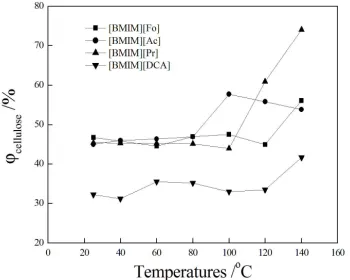
Figure 2 The dissolution rate of cellulose of corn stalk in the ILs at different temperatures
[image:3.595.214.389.492.632.2]Figure 3 The dissolution rate of hemicellulose of corn stalk in the ILs at different temperatures
Figure 4 The dissolution rate of lignin of corn stalk in the ILs at different temperatures
Due to the complex structure of lignin, there has been no final conclusion about the mechanism of dissolution of lignin in ionic liquids. Separation of lignin is of great significance in the bioethanol and paper industry. Ideal pretreatment method of the feedstock involves removing lignin from the raw material and retaining the sugars (i.e. the sum of cellulose and hemicellulose). Figure 4 shows the dissolution rate of lignin in ionic liquids at different temperatures. The trend for lignin is clearly different from that of cellulose and hemicellulose; as the temperature increases, the dissolution rate for lignin in the three kinds of carboxylate ionic liquids initially increases and then decreased. However, the dissolution rate for lignin in [BMIM][DCA] increases with temperature, particularly rise rapidly above 100℃ and reaches up to 71.5% at 140℃, which is significantly higher than the dissolution rate of lignin in the three kinds of carboxylate ionic liquids at the same temperature. The trend of dissolution rate of lignin in carboxylic ionic liquids increasing with temperature is different than expected, which shows that as for the dissolution of the biomass system by ionic liquids, the dissolution rate of the total biomass increased with temperature (Figure 1) but the preferential dissolution of biomass components varies widely in various ionic liquids at different temperatures.
3.2 Selective dissolution of each corn stalk component by ionic liquids
further study.
Figure 5 The selectivity of dissolution for cellulose at different temperature
Figure 6 The selectivity of dissolution for hemicellulose at different temperature
[image:5.595.202.392.288.449.2]The selective dissolution of carboxylate ionic liquids for hemicellulose is different as compared to that for cellulose; its α generally increases with temperature. Of all the ionic liquids, the α of [BMIM][Pr] for hemicellulose was 1.45 at 140℃, which showed some separation ability (Figure 6).
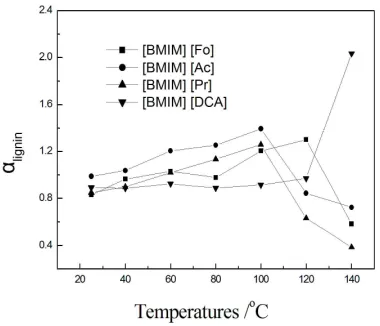
Figure 7 The selectivity of dissolution for lignin at different temperature
[image:5.595.203.393.524.687.2]highly suitable for ethanol fermentation or paper production.
The ionic liquids at varying temperatures showes significantly different dissolving capacities for each corn stalk component. The selective dissolution of corn stalk components in the ionic liquids is affected by complex influencing factors. Studies have shown that the ionic liquids used in this study have low performance in the dissolution-separation procedure for cellulose and hemicellulose from corn stalk; however, [BMIM][DCA] has a selective dissolution coefficient of up to 2.03 for corn stalk lignin at 140℃, which shows good separation performance. This suggested that further research must be conducted to investigate the selective dissolution of ionic liquids in relation to their structure, physical properties, etc, to design appropriate ionic liquid structures and dissolution-separation conditions; these were expected to achieve successful component separation from the lignocellulose raw material.
Acknowledgements
This work was supported by the National Natural Science Foundation of China (No. 21373078), the Key R & D Program of Henan Province(No. 112102310393)and the Foundation for University Key Young Teacher of He’nan (No.2009GGJS-052).
REFERENCES
[1]J Liao; X Luo, J. Cell. Sci. Technol. 2003, 11, 60-64.
[2]RP Swatloski; SK Spear; JD Holbrey; RD Rogers, J. Am. Chem. Soc. 2002, 124, 4974-4975. [3]H Zhang; J Wu; J Zhang; J He, Macromolecules,2005, 38, 8272–8277.
[4]YQ Pu; N Jiang; AJ Ragauskas, J. Wood Chem. Technol. 2007,27, 23-33.
[5]S Tan; DR Macfarlane; J Upfal; LA Edye; W Doherty; AF Patti; JM Pringle; JL Scott, Green Chem. 2009, 11, 339–345.
[6]M Zavrel; D Bross; M Funke; J Büchs; AC Spiess, Bioresour. Technol. 2009, 100, 2580-2587. [7]N Labbé; LM Kline; L Moens; K Kim; PC Kim; DG Hayes, Bioresour. Technol. 2012, 104, 701-707. [8]CZ Liu; F Wang; AR Stiles; C Guo, Appl. Energ. 2012, 92, 406–414.
[9]D Yang; LX Zhong; TQ Yuan; XW Peng; RC Sun, Ind. Crop. Prod. 2013, 43, 141-149.
[10]A Sluiter; B Hames; R Ruiz; C Scarlata; J Sluiter; D Templeton, Laboratory Analytical Procedure(LAP),2008, NREL/TP-510-42623.
[11]A Sluiter; B Hames; R Ruiz; C Scarlata; J Sluiter; D Templeton; D Crocker, Laboratory Analytical
Procedure(LAP),2011, NREL/TP-510-42618.
[12]S Jin; H Chen, Process Biochem. 2007, 42, 188-192. [13]A Xu; J Wang; H Wang, Green Chem. 2010, 12, 268-275.