Supporting construction decisionmaking
with IT some multidisciplinary
collaboration problems
MarshallPonting, AJ, Aouad, GF and Curwell, SR
Title Supporting construction decisionmaking with IT some multidisciplinary
collaboration problems
Authors MarshallPonting, AJ, Aouad, GF and Curwell, SR
Type Conference or Workshop Item
URL This version is available at: http://usir.salford.ac.uk/id/eprint/15786/
Published Date 2003
USIR is a digital collection of the research output of the University of Salford. Where copyright permits, full text material held in the repository is made freely available online and can be read, downloaded and copied for noncommercial private study or research purposes. Please check the manuscript for any further copyright restrictions.
SUPPORTING CONSTRUCTION DECISION-MAKING WITH I.T. –
SOME MULTI-DISCIPLINARY COLLABORATION PROBLEMS
Amanda Jane Marshall-Ponting, Ghassan Aouad & Steve Curwell
School of Construction & Property Management, University of Salford, Salford, M7 1NU, UK.
ABSTRACT: The ever increasing number and diversity of professionals and researchers involved in the construction industry can make effective collaboration difficult. This paper looks at some of the problems which these groups may face by making the distinction between multi- and inter-disciplinary research more apparent. The themes which it raises have important implications for education and collaboration within academia and with industrial partners. Two research projects are used as case studies to illustrate some of the issues and to try to prove the concept and usefulness of inter-disciplinary or mode 2 research for application to the built environment field. These projects are From 3D to nD
Modelling an EPSRC-funded platform grant implementing integrated computer construction models and BEQUEST an EU-funded concerted action investigating the assessment of sustainable urban development. The output of the two From 3D
to nD Modelling workshops demonstrates that the conflicts inherent in
multi-disciplinary collaborative working need to be considered and managed, but that presently, there is little available information on how to do this.
Keywords – Inter-disciplinary research; multi criteria decision-making; ‘new’ knowledge production; IT for construction; nD modelling.
INTRODUCTION
The number and diversity of stakeholder and professional interests involved in the construction industry and its processes can make collaboration, in practice and within research, somewhat problematic. The professional will have to satisfy a great number and variety of potentially conflicting client requirements which themselves will be constrained by social, economic and legislative factors. Even before the representation of end-user needs, the epistemological backgrounds and methods of the professionals or researchers who are now necessarily involved in the numerous aspects of construction can often cause conflicts and difficulties for team-working. In order to maximise the effectiveness of these teams, it is important to understand what some of these problems are and how they may be resolved. Education is one means by which these findings can be disseminated and there are direct implications for the industry.
these design, construction and maintenance dimensions explicit and aims to integrate the knowledge and improvements made in each discrete area into a holistic decision-making tool. The large volume, detail and technical nature of the information involved in design may make it hard, for non-professionals in particular, to understand how their interests have been represented in the design or any subsequent changes made to it. For this reason, it was decided that the chosen dimensions would be represented in a computer model which would allow ‘what-if’ analyses to be performed. It is believed that 3D visualisation enables better understanding of the proposed designs and any changes than traditional 2D plans. Currently, the design process works in an incremental way with designs being forwarded to the relevant experts for up-dating. For an nD model to be holistic, this incremental way of working needs to be replaced with something more integrated and collaborative. Whilst ICTs can be used to enable this, for the model to be useful it is essential that the theoretical approach underpinning any computer model allows the problem to be framed and solved in a holistic or interdisciplinary way.
Another research ‘project’ which struggled in its attempts to integrate knowledge from numerous, discrete areas within the built environment field was BEQUEST. This network, an EU concerted action with fourteen partners from six European countries, provides an example of some of the problems of carrying out multi-disciplinary research and so there are a number of valuable lessons nD modelling
could learn. Its aim was to develop a shared platform for assessing sustainable urban development (SUD) by bridging the discipline-based differences held by those working in this field. Although it is not concerned with the issues of SUD, nD modelling is facing some very similar challenges to BEQUEST: like BEQUEST, nD’s project partners are attempting to understand a concept which encapsulates issues which are jointly far greater than the knowledge which one discipline alone can provide and there are different discipline boundaries which need to be transcended in the process.
The Research Approach
Within nD modelling there has been a great emphasis upon the importance of the role of ICTs in facilitating a solution. Superficially at least, the project appears to be predominantly technical in nature and there is an implicit assumption that the solution will take the form of a complex computer model. From this viewpoint, the ultimate measure of the project’s success is quantitative and involves measuring efficiency and effectiveness improvements and the implicit monetary savings that these may have for the industry.
Secondly, the findings from two visioning workshops will be presented as an illustration of the bottle-necks for management and as evidence in support of the concepts of mode 2 research and inter-disciplinary working.
CASE STUDY 1: AN INTERDISCIPLINARY EU-FUNDED RESEARCH NETWORK
From BEQUEST’s inception, its aims and the methods by which it should achieve them provided the network with a triple challenge, Cooper argues (2002, p117), because:
(1) There is no consensus of the meaning of SUD (Palmer et al 1997) or how it should be implemented;
(2) There is no agreement and little advice (Epton et al 1983) on how interdisciplinary research should be conducted, despite expressed needs to support this activity in the UK (e.g. HEFCE 2001);
(3) There is little shared experience on how to design and run effective virtual organisations, despite the rapid recognition of their appearance after the rise of the Internet
(a) Multi- and inter-disciplinary working
The terms multi- an inter-disciplinary are often mistakenly confused for one another and are used generically to describe collaboration with mixed discipline groups. Cooper (2002 p118) makes the distinction between the two and argues that the former term applies when two or more disciplines work together without stepping outside their own traditional discipline boundaries. In contrast, the latter emphasises the development of a shared perspective which transcends the original, traditional boundaries. Newell and Swan (2000) use the analogies of jigsaws and kaleidoscopes: in multi-disciplinary work, the individual pieces of the jigsaw do not change their identities as a result of being combined with other pieces, whereas the individual’s characteristics cannot be determined from looking at the inter-disciplinary kaleidoscope. Cooper argues that BEQUEST is an example of the latter as the emergent conceptual frameworks created by the members transcended those owned by any one of the disciplines (p121).
(b) Examining and building consensus
network and the collectively created shared conceptual space was still being developed.
Eclipse Research Consultants’ (1996) self-assessment technique, PICABUE, was developed to gauge potential partners’ individual and collective commitment to the principles underpinning sustainability (Curwell et al, 1998). Through the use of a mapping technique, it was found that not only were the different disciplines committed to different aspects and to greatly varying degrees, but that the partner averages increased and became more uniform between the aspects over time. The technique also allowed the ‘common platform’ to be established. This value represented the minimum amount of agreement between members and increased from 25% in 1996 to 45% in 2001.
(c) The production of old and new knowledge
One of the BEQUEST project deliverables was “an effective, multi-professional, international interactive networked community” to be mediated electronically over the Internet (BEQUEST 2001 p5). Cooper argues (2002 p117) that “…the concerted action displayed some of the characteristics of a new approach to conducting global collaborative research that, in the UK at least, has very recently been given the very grand title of ‘e-science’”. Two of its defining characteristics are the spatial distribution of those participating and the infrastructure which enables it, usually in the form of ICTs. ‘E-science’s’ purpose is to achieve “world beating science through the effective use of the latest information technologies” by conducting cross-disciplinary research “at the intersection of many scientific disciplines”, and as a result, it “will change the dynamic of the way science is undertaken” (Boyd, 2001, cited in Cooper 2002 p120).
E-science is one example of the trend towards the ‘new’ production of knowledge. Gibbons et al (1994) argue that the way in which knowledge is being produced is changing. They describe this knowledge (p 3-8) as being produced through ‘mode 2 research’. Some of its defining attributes include:
Knowledge produced in the context of application, as opposed to problem solving using the codes of practice or a particular discipline; Trans-disciplinarity;
Heterogeneity and organisational diversity, in terms of the skills and experiences brought to it;
Social accountability and reflexivity; Quality control.
‘New’ knowledge may not show all of these characteristics, and it may not even be new: the description by Gibbons et al argues that innovation can occur through the reconfiguration of existing knowledge, so that it can be used in new contexts or by new users.
the numbers and kinds of configurations are at the core of the diffusion process resulting from increasing density of communication and that this process has been greatly aided by information technologies which not only speed up the rate of communication, but also create more new linkages. The development of communication linkages has played an important part in allowing this to occur, and this underlines the importance of the growth of the Internet and other computer-mediated communication and collaboration tools as enablers.
One of the most important conclusions Cooper (2002 p126) draws is that, as the BEQUEST concerted action has demonstrated, it is not necessary for all research project team members to agree absolutely and at all times for true progress to be made. What is important, however, is that they are willing to negotiate openly about what they are trying to jointly achieve. The test of the validity of any group agreement will be in the reaction from other, wider stakeholders. With so little guidance on how to work effectively in inter-disciplinary groups, Cooper suggests (2002 p126) making explicit the amount of time and effort required to develop a shared perspective and that this should necessarily include trust and consensus building techniques and methods for identifying and resolving conflicts.
RESULTS: INTER-DISCIPLINARY APPROACHES IN 3D TO nD MODELLING Visioning Workshop 1
Taking note of the above discussion, attempts have been made to develop a shared perspective for working through the development of the project vision. A workshop was conducted in February 2002 with the whole research team to start defining the theoretical and ontological approaches for a vision for the nD tool. An electronic voting tool was used during the workshop to determine the level of participant consensus. In order to define a vision, the workshop participants explored several existing visions governing ‘the future of construction IT’.
Although aspects of existing project visions can be placed within the context of this project, the majority of workshop participants, 88%, wanted to develop a new collective vision. The type of approach favoured by the group is fundamental as it will dictate the type of technology that would be used and the subsequent implementation issues of that chosen technology. The majority voted for a mixture of application and blue sky aspects and the two most popular responses were for a 50:50 split (28%) but also 20:80 (27%). The implementation timeframe for industry was most popularly agreed at 25 years, but this question provoked the least consensus of all; a quarter of the group thought that some sort of implementation should be possible within 3 years, the minimum possible timeframe. It was generally concluded that more work would be needed to develop group consensus and a shared view around the vision.
Visioning Workshop 2 The building scenario
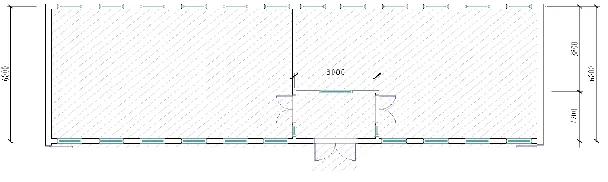
was of a new, networked building to be used as office space for ten researchers. The provisional plan – figure 1 below – was circulated with the instruction that improvements and developments should be made to it based on the individual’s specialism. Additionally, they should also consider acceptable alternatives and minimum standards that should be adhered to. Example features to be considered included size and location of doors and windows and the materials of these.
Figure 1: Scenario for the new research space
Short presentations were given of the diagrams and from these, a simple frequency table was produced matching the design feature to the construction specialism. The design features were grouped under the sub-headings of ‘general design’, ‘decoration/furniture’, ‘windows’, ‘security’, ‘doors/access’, and ‘social/organisational’ – see table 1 below. A total of 46 design features were identified altogether, although the total number mentioned by each specialist ranged from 6 to 17, with an average of 10 features. The diagrams varied also in their level of detail.
The most frequently used design features were those in the original brief – an open plan design with a maximum of two rooms, the inclusion of a porch area and internal doors. However, a couple of designs rejected the scenario design. 3 of the 9 plans favoured more, smaller sized rooms. Other quite frequently mentioned features included the provision of natural light (4 respondents), level and size of windows (4 and 3 respectively) and provision of a walkway (3 respondents). Infrequent features – mentioned only once – were often concerned with less tangible aspects such as supporting new ways of working, management of space and flexibility of usage but also included security equipment such as CCTV, provision of meeting rooms and window materials.
doorway step, and large sized windows. Although a number of other specialists included a porch area and internal doors, the case for their inclusion is not as immediately apparent as the accessibility expert’s need for them to be excluded. Further discussion would establish just how plausible it would be to omit them from a final design.
Table 1: Table of design feature frequencies identified by specialism
General Walkway * * *
design Wheelchair widths * Key
Design for use * * 1=crime
Open plan * * * * * * 2=FM
Individual rooms * * * 3=tech transfer
Meeting rooms * 4=accessibility
Coffee room * 5=thermal comfort
Communic. board * 6=visual comfort
Constr’n material * * 7=researcher 1
Above ground/stilts * 8=researcher 2
WC * 9=Anon
Fire escape *
Decor’n/ Colour * * *=design feature identified
furniture Hearing loop/acous * as positive (should be present)
Lighting * 0=design feature identified
Blinds * * * as negative (should be absent)
A/C / temp control * * *
Secure for PCs * Empty cells mean that the feature Lockers/storage * * was not mentioned at all by the specialist ICTs (beyond PCs) *
Music *
Windows Low positioning 0 * * *
Large in size * 0 * *
Material *
Natural light * * *
Internal windows *
Fresh air circulation * *
CCTV *
Internal window * Panic buttons *
Controlled entrance *
Doors/ Porch area * * 0 * * * * *
access To access walkway * * *
Internal doors * * 0 * * * * *
Step 0
Social/ Changing trends/time * * org'nal Meet all requirements * *
Flexibility of use * Offender type * Problems eg bullying * Space mgmt * attract/maximise staff capabilities
Absorption capacity * *
New ways working * Support collab’n *
Privacy * *
8 9
Security
*
4 5 6 7
Scenario 1 2 3
A more problematic clash however, is the issue of window size and level. From a thermal comfort point of view, it is important to minimise the size of the windows in order to maintain a favourable balance of heat and cold. However, for reasons of visual comfort and accessibility it would be preferable to maximise the size of the windows, although other individuals also emphasised the importance of large windows directly or indirectly via the provision of natural light. Also, the majority wanted windows at a low level so individuals could see out of them from their desks or so that they could be opened by someone in a wheelchair: the crime perspective favoured a higher level for them.
Participants’ Personal Visions
describing how their own discipline could benefit. Figure 2 provides an overview of the issues mentioned in these visions and illustrates the popularity of each issue.
The most popular theme amongst the visions was the decision-making capacity of an nD tool, with almost 80% of visions including issues of this type. This meant it should be able to develop and test scenarios, perform ‘what-if’ analyses on these scenarios and even rate or assess the alternatives developed. The model may even suggest services or facilities for inclusion in a design, as triggered by some of the parameters entered into it, which raised the idea of it being able to deal with legacy as well as emerging design issues. This would mean that existing designs could be checked or rated.
0 10 20 30 40 50 60 70 80 90 100
Theme
Pe
rc
en
ta
ge
Design issues
Decision-making/analysis capacity
Value-added
Social/user focus
Collaboration
Other (technological)
[image:9.612.222.452.218.348.2]Other
Figure 2: Histogram showing the percentage of visions considering issues of each classified nature
The other popular theme was concerned with collaboration and who the tool was for. Three of the nine scenarios stated that a tool should support collaborative design or design professionals and 55% of the visions mentioned issues of this type. Three visions argued that the tool should be user-oriented, whilst an additional one stated that it should fulfil all users’ needs. Only two visions explicitly stated that the tool should be a computer model, although there could have been an assumption by other individuals that this would be the form it would take.
DISCUSSION OF THE nD MODELLING WORKSHOPS
The initial reaction after the first workshop was one of concern over solving the consensus issue which was so apparently lacking. However, this situation wasn’t as dire as first thought as the platform grant’s nature allows for a range of scenarios to be developed. This would allow accommodation of most of the approaches favoured: the different ratios of application to blue sky research and the three quite different timeframes. This way of working would actually be more beneficial: A three year implementation timeframe would allow the current, available technologies to be tested and by being able to demonstrate their potential through the development of prototypes, the support of industry is more likely, thus providing support for the longer-term, more blue sky approaches.
popular design features were those which were already included in the example. However, even these provoked discussion as the accessibility design rejected the use of a porch and internal doors. This shows how even the most accepted of general design features can provide problems for some groups and cannot therefore be used without some further thought. The open plan style was also another popular feature, although three designs rejected this in favour of smaller, more individual rooms. The only other feature which proved contentious was the windows, both the proposed size and their level above the ground.
However, the value of the clashes lies, not in minute details of how things should be designed, but in the exercise’s ability to get the relevant individuals thinking about the limitations of their own discipline and about the problems from another perspective. By being aware of such different approaches, it is hoped that we can be more critical in our thinking about the assumptions that we make. In this respect, the exercise is far from finished. 46 design features were highlighted in total, although the average per design was 10. As the issues and conflicts were not as apparent at the workshop as they are now, discussion of this nature did not take place at that time. The best way to develop the designs would be to re-visit the exercise at a future workshop by providing the list of design features and allowing each specialist to rate the importance of each one and either positively or negatively, i.e. that it should be omitted. The large number of empty boxes would be expected to yield more clashes but also some of the issues which are currently unpopular might be omittable entirely.
Only when the table becomes more populated with data will the discussion of the tradeoffs be of greater use as it is currently too vague. This discussion should also start to highlight how the tradeoffs are made or establish some sort of hierarchy of issue importance. There are some trends for this at the moment, but this will be quite likely to change with more data. Currently, the accessibility requirements are most likely to be prioritised for the doors and access issues. However, within the context of Salford and the crime levels there, it may be essential to have a porch and internal doors as a means of multiple defence. Discussion will establish this beyond doubt and will also allow concessions to be made, for example for the porch to remain but be extended in size for full wheelchair manoeuvring. This highlights the effect that external or environmental context will undoubtedly have on the trade-off mechanism and the hierarchy of importance for design features: In other, less crime-prone areas such a multiple defence device may be unnecessary.
The personal visions show more consensus in general than the design scenarios. This is illustrated by the percentage histogram and the popularity of the themes mentioned in the visions. The most popular theme was for a design tool to have decision-making or an analysis capacity and this theme was contained in almost 80% of the visions. Social themes were important also with almost 60% and over 40% of visions mentioning collaboration and social or user focus respectively.
the wheel of cognate disciplines may not prove too useful in predicting the ease with which consensus could be reached due to discipline differences. It would be expected that, if anything, it would be even more difficult for the nD team to reach any agreements due to the wider dispersion of discipline groups – art and design, psychology and other ‘soft’ perspectives as well as the engineering and technical approaches. However, unlike BEQUEST which had language, cultural and spatial barriers to overcome, the nD team are all based within one institution and most members have worked together before in their various sub-teams.
Part of this problem is that there are few ways of measuring inter- and multi-disciplinarity, beyond a gut feeling of how the group and their visions for a solution ‘look’. From the visions and work completed in the workshops so far, it doesn’t ‘look’ like the inter-disciplinary kaleidoscope which Newell and Swan (2000) talk about. Rather, the outputs and approaches resemble the multi-disciplinary jigsaw.
CONCLUSIONS
The aim of this paper was to identify some of the potential sources of conflict inherent in the nD modelling project due to its multi-disciplinary nature and to try to establish the worth of the inter-disciplinary concept as seen in the two example case studies. The BEQUEST network has been a useful starting point in this process by providing illustrations and examples of the concepts, in an area which currently has a dearth of information on the underpinning principles and how they can be measured.
Currently, nD modelling is multi-disciplinary in nature as individuals are only inputting knowledge from their own areas of expertise whilst failing to show collective agreement on the issues relevant to the vision. This can be seen most clearly in the outputs from the first workshop. For an holistic tool to be developed successfully for decision-making, these discipline barriers and issues of conflict, as seen in the second workshop, will need to be broken down, or at least conceptually risen above. The nature of the project means that the resulting knowledge will have mode 2 characteristics. This is because knowledge developments from discrete disciplines will be combined and in many cases re-applied to a discipline less characteristically similar to their own e.g. the use of crime data in a mathematical, 3D visualisation model. This knowledge will be obtained from experts from around the world and the project outputs disseminated back to them via the internet and other electronic communication methods for validation against their own work. The project web-site will be linked to others dealing with both the discrete aspects which make up its whole and the current attempts to do similar work e.g. at VTT in Finland and Stanford University. This form of electronic networking can reasonably be expected to have exponential growth.
interests of the nD team members to be satisfied and provide something for all the team to buy in to, thus providing more support for the project overall.
The second workshop started to clearly identify where some of the problematic trade-off areas exist. As discussed above, further discussion would be needed with the group to establish where the mutually acceptable middle ground may lie. The personal visions are valuable as they show the issues on which there is greatest agreement within the group on what the nD output should enable or facilitate. This covers both the users during the process and well as the stakeholders involved with the final product. From an inter-disciplinary point of view, this is important as it shows how some issues cut across disciplinary boundaries. The most pertinent features included allowing ‘what-if’ scenarios, the consideration of legacy and emerging issues and collaboration and decision-support with a use focus, this term being open enough to include both professional and other stakeholder groups.
However, there were a number of problems, the most important one being the failure to use the individual scenarios to maximum effect with the whole group by stimulating the discussion further to identify the conflicts more definitely. If the instructions had been more explicit regarding the use of zeros for identifying design omissions, more conflicts might have been seen at this stage. Again, resolving this is simple.
At this stage it is difficult to show the value of the concept of inter-disciplinary working for teaching purposes within construction. The subject nature of the nD modelling project and the BEQUEST network dictated that multi-disciplinary approaches would not be enough to tackle the issues that they were dealing with and the methods they employed. However, from the nD workshops here it is not possible to argue that an inter-disciplinary approach to the problem is being taken yet. Even if there were literature to ensure the use of this, it seems that this approach is tied up with the development of the solution and only by being a part of the process to develop this does the group start to work in this way. That is not to say that the ideas discussed here have no relevance for construction education. Barriers to effective collaboration are of relevance to each and every discipline, but in a field where so many disciplines are required to work together, the issues become more magnified. The task now is to take these findings and move them forward by providing validity for them. This will be done by discussing the outputs with the academic group to try to resolve the trade-off problems, but then by taking them to the project’s international collaborators at the next workshop.
REFERENCES
Barrett, P.S. (2000) Construction Management Pull for 4D CAD. American Society of Civil Engineers (ASCE) Construction Congress VI “Building Together”. Orlando, Florida, Feb. 20-22, 2000. Published proceedings, 977-983.
BEQUEST (2001) Final Report 2000-1, Contract No. ENV 4 CT/97-607, EC Environment and Climate Programme (1994-1998), Research Theme 4,
Human Dimensions of Environmental Change, University of Salford, UK.
Cooper, I. (2002) Transgressing discipline boundaries: Is BEQUEST an example of the ‘new production of knowledge’? Building Research & Information, 30:2,
116-129.
Curwell, S., Hamilton, A. & Cooper, I. (1998) The BEQUEST network: towards sustainable development. Building Research and Information, 26:1, 56-65. Eclipse Research Consultants (1996) PICABUE: Mapping Commitment to
Sustainable Development - A Self-assessment Technique for Policy-Makers
and Practitioners, ERC, Cambridge.
Eclipse Research Consultants (1997) Support for Inter-disciplinary Research, workshop prepared for the Research and Graduate College, University of
Salford, and for the Committee for Inter-disciplinary Environmental Studies,
University of Cambridge, ERC, Cambridge.
Egan, J. (1998) Rethinking construction : the report of the Construction Task Force to the Deputy Prime Minister, John Prescott, on the scope for improving
the quality and efficiency of UK construction. Department of the Environment,
Transport and the Regions, London.
Epton, S., Payne, R. & Pearson, A. (eds.) (1983) Managing Interdisciplinary
Research, John Wiley & Sons, Chichester.
Gibbons, M., Limoges, C., Nowotny, H., Schwartzman, S., Scott, P. & Trow, M. (1994) The new production of knowledge. Sage, London.
HEFCE (2001) Interdisciplinary Research and the RAE (Research Assessment
Exercise), Briefing Note 14, Higher Education Funding Council (England),
Bristol.
Lave, J. & Wenger, E. (1991) Situated Learning: Legitimate Peripheral Learning, Cambridge University Press, Cambridge.
Lee, A., Betts, M., Aouad, G. & Cooper, R. (2002) Developing a Vision for a nD Modelling Tool. Keynote paper in Proceedings for the CIB W78 Conference
Distributing Knowledge in Building, vol 2, pp141-148. Åarhus, Denmark,
12-14th June 2002.
Marshall-Ponting, A., Lee, A., Betts, M., Aouad, G., Cooper, R. & Sexton, M. (2002) Information Technology Support to Improved Construction Processes: Inter-Disciplinarity in Research and Practice. Paper presented at the
Advances in Building Technology conference, Hong Kong, 4th-6th December
2002.
Newell, S. (2002) Managing knowledge in project teams - some lessons from some failed projects. Seminar held at Information Systems Institute, Salford University, April 24th 2002.
Newell, S. & Swan, J. (2000) Trust and inter-organizational networking. Human
Relations, 53 (10) pp 1287-1328.
Palmer, J., Cooper, I. & van der Vorst, R. (1997) Mapping out fuzzy buzz words – who sits where on sustainability and sustainable development. Sustainable
Development, 5:2, 87-93.
Swan, J., Newell, S., Scarbrough, H. & Hislop, D. (1999) Knowledge management and innovation: networks and networking, Journal of Knowledge Management,