A computational study of
photoisomerization in Al3O3 clusters
Cui, XY, Morrison, I and Han, JG
http://dx.doi.org/10.1063/1.1484387
Title
A computational study of photoisomerization in Al3O3 clusters
Authors
Cui, XY, Morrison, I and Han, JG
Type
Article
URL
This version is available at: http://usir.salford.ac.uk/322/
Published Date
2002
USIR is a digital collection of the research output of the University of Salford. Where copyright
permits, full text material held in the repository is made freely available online and can be read,
downloaded and copied for noncommercial private study or research purposes. Please check the
manuscript for any further copyright restrictions.
A computational study of photoisomerization in Al
3O
3Àclusters
X.-Y. Cui and I. Morrisona)
Institute for Materials Research, University of Salford, M5, 4WT, United Kingdom
J.-G. Han
National Synchrotron Radiation Laboratory, University of Science and Technology of China, Hefei, Anhui, 230026, People’s Republic of China
共Received 1 March 2002; accepted 19 April 2002兲
Ab initio calculations are employed to understand the photoisomerization process in small Al3O3⫺ clusters. This process is the first example of a photoinduced isomerization observed in an anion cluster gas-phase system. Potential energy surfaces for the ground state and the excited state共S1and T1兲are explored by means of B3LYP, MP2, CI-singles, and CASSCF methods. We demonstrate that the isomerization process occurs between the global minimum singlet state Book structure (C2v,1A1) and the triplet state Ring structure (C2v,3B2). The calculated vertical excitation energy
is 3.62 eV at the CASSCF level of approximation, in good agreement with the experimental value
共3.49 eV兲. A nonplanar conical intersection, which hosts the intersystem crossing between the S1
and T1 surfaces is identified at the region of around R(1,6)⫽2.4 Å. Beyond the experimental
results, we predict, that this isomerization is reversible upon absorption of a phonon with energy of 1.92 eV. Our results describe a unique system, whose structure depends on its spin multiplicity; it exists as the Book structure on singlet states and as the Ring structure on triplet states. © 2002 American Institute of Physics. 关DOI: 10.1063/1.1484387兴
I. INTRODUCTION
Photoisomerization is an important field in photochem-istry involving chemical change brought about by the action of visible or ultraviolet radiation. These processes generally involve the direct participation of electronically excited states of a molecule.1,2 Some of these processes are vital to the understanding of some topics in the life sciences and some are used for novel single molecule electronic devices.3– 6In the past decade, great efforts have been made to study the mechanism of photoisomerization both experi-mentally and theoretically.7–9 From a theoretical point of view, the central issue to understanding the photoisomeriza-tion mechanism lies in the exploraphotoisomeriza-tion of the potential energy surfaces共PES兲for both ground states and excited states. This is due to the fact that the general feature of this type of reaction is the presence of the low-lying intersections共 cross-ings兲between the relevant excited state and ground state sur-faces that play a fundamental role in the process. Such cross-ings, conical intersections in the case of two singlet 共or two triplet兲surfaces, or singlet–triplet surface intersections, pro-vide a very efficient funnel for controlling the evolution of a photoexcited molecule from the Franck–Condon region to the photoproduct valleys.10,11
Compared with ample cases found and studied in or-ganic species, for example, the well-known cis–trans isomerization, few such cases have been reported in inor-ganic systems. Chaquin et al.12performed experimental and theoretical studies of the XYO (X, Y⫽Cl, Br) light-induced interconversion in an argon matrix. They reported that visible
irradiation between 633–700 nm transforms ClBrO into BrClO and above 700 nm the transformation continues into BrOCl. Optimal control of the photoisomerization of Li2Na
via an electronically excited state from the stable acute to the obtuse triangular configuration was simulated by Manz et al.13Very recently, Hartmann et al.14reported that a small Na3F2cluster could change into its isomer by the breaking of
one metallic and one ionic bond upon absorption of light. This reaction represents the first example of a five-atom clus-ter gas phase system exhibiting a conical inclus-tersection be-tween the ground state and the first excited state.15
Photoisomerization in the Al3O3⫺represents the first
ex-ample that such photoinduced reactions happen in anion cluster gas-phase systems, and was first observed in photo-electron spectroscopy in 1998 by Wu et al.16 Soon after, Ghanty and Davidson17made a theoretical study on this sys-tem to interpret the photoelectron spectra and reported some equilibrium geometries of the ground states. However, no attempt has been made to understand the photoisomerization process. For this photoinduced reaction there are two funda-mental questions that still remain unsolved. First, which two isomers are responsible for this reaction, i.e., which isomers are the reactant and product? Second, how does this process happen, i.e., what is reaction mechanism? These questions represent a challenge for both theorists and experimentalists. Computational chemistry has already secured its position as an indispensable tool for rationalizing and understanding many features of photoisomerization reactions. In this paper we employ quantum chemistry techniques to provide an un-derstanding of this photoisomerization process and compare our theoretical results with the experimental data. To the best
a兲Author to whom correspondence should be addressed. Electronic mail:
1077
of our knowledge, this present work is the first attempt to understand this novel process.
The paper is structured as follows: In Sec. II, we outline the details of computational methods used in this study. The main results are presented in Sec. III. First, full optimization calculations are performed to obtain the geometrical and electronic structure of all possible candidate isomers in this reaction. Calculated electronic affinities共EA兲and vibrational frequencies are compared with the experimental data and po-tential energy surfaces for the ground singlet and triplet states are mapped. The agreement between our calculated results and experimental data indicates the relevant isomers in the reaction. Population analysis is also employed to un-derstand the charge distribution and charge transfer. Second, an excited states共S1 and T1兲study is performed to obtain the excited state topology and a conical intersection point is identified. The calculated vertical excitation energy is in good agreement with the experimental value. Based on the exploration of the potential energy surfaces, we then provide a simple model to interpret the photoisomerization reaction mechanism in Al3O3⫺ clusters. Beyond the experimental
re-sults, we predict that such isomerization process is, in prin-ciple, reversible upon absorption a phonon with energy of 1.9 eV. A discussion is presented in Sec. IV, and Sec. V contains brief conclusive remarks.
II. COMPUTATIONAL DETAILS
Small aluminum oxide clusters present a challenge to theory, as both covalent and ionic bonding is present.18 Ground state calculations were performed at two levels of approximation: one is the Møller–Plesset second order MP2 method,19 the other is the hybrid density functional theory incorporating Becke’s three parameter exchange functional with gradient correlations provided by the LYP correlation functional共the B3LYP method20,21兲. We demonstrate, as will be shown later, that the semilocal B3LYP approximation of-fers a better description of these species, so the general con-clusions are drawn from B3LYP results. For the excited states calculations, two methods were employed in this study: one is the single-excitation configuration interactions
共CI-singles兲,22and the other one is the complete active space multiconfiguration self-consistent field共CASSCF兲.23The CI-singles method was used for numerical calculations along the reaction pathway and to obtain the potential energy surfaces, while the CASSCF method was used to refine the key points and calculate the vertical excitation energy. More impor-tantly, CASSCF ground and excited states calculations serve as the bridges, which link the ground energy surface and the excited energy surface. In CASSCF calculations, the active
spaces were constructed with fourorbitals/four active elec-trons for singlet states, and with six orbitals/six active electrons for triplet states.
Geometry optimization is a particularly important issue in this work. Full optimization is performed to locate the stationary point on the potential surface using Cartesian co-ordinates. Partial optimization is performed to obtain the in-formation along the reaction pathway using internal coordi-nates. Harmonic vibrational frequency analysis was performed for both ground states and excited states to deter-mine the nature of the stationary points. If an imaginary fre-quency mode appeared, further relaxation was carried to lo-cate to the minimum.
The prediction of properties is usually sensitive to the choice of basis set, particularly for the excited states, hence all the final results reported in this study were provided by employing the large standard basis set 6-31⫹⫹G( p,d). All the calculations were done by using the GAUSSIAN 98 program.24
III. RESULTS
A. Isomers responsible for the photoisomerization process: A ground states study
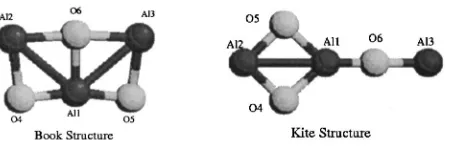
To determine which isomers are involved in the photo-electron spectroscopy experiment and hence interpret the photoisomerization process, it is necessary to check all pos-sible candidate isomers. We have made an extensive explo-ration for the equilibrium geometries of the ground state for the neutral and anionic Al3O3 clusters and we find the con-formations for these species are of rich diversity.25 For the anions, 12 stable stationary points have been found. This indicates that the bonding in the species is rather flexible and potential energy surfaces are quite complex. The photoelec-tron spectroscopy experiments clearly show that small anion aluminum oxide isomers coexist. According to Boltzmann statistics, only the most energetically favorable structures are expected to be detached and are attributed to the observed spectra. Therefore, we focus on the three most stable struc-tures of the Al3O3⫺ species, as shown in Fig. 1. The
geo-metrical and energetic information is listed in Tables I and II, respectively.
The three most stable isomers for Al3O3⫺are all of
pla-nar form with C2v symmetry. The Book structure1A1 is the
global minimum and the Kite structure lies higher in energy by 1.32 and 3.60 kcal/mol above using the B3LYP and MP2 methods, respectively. For the triplet Ring structure, we find that full optimization using both methods leads to the perfect D3h symmetry being distorted into the C2v symmetry. The
[image:3.612.56.284.64.138.2]Ring structure is 14.9 and 17.5 kcal/mol higher in energy FIG. 1. Structures of the three most stable Al3O3⫺isomers共see Table I for
parameters兲.
than the Kite structure using B3LYP and MP2 methods re-spectively. We note that energy differences may be overesti-mated due to the different techniques used to describe these two states共i.e., the closed-shell restricted wave functions for singlet and open-shell unrestricted wave functions for the triplet state兲.
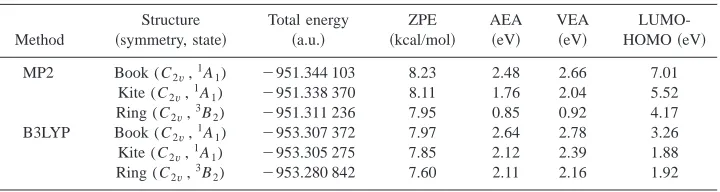
Electron affinities共EAs兲, defined as the difference in to-tal energies between the neutral and the anion species, cor-respond to the position of the band in the photoelectron spec-tra associated with the given molecule. The difference between adiabatic EA and vertical EA correspond to the bandwidth.26Our EAs results as listed in Table II, show that B3LYP results are in better agreement with the experimental data than MP2 results. The latter method underestimates the EA values consistently. Our calculated EAs for the Book structure are in good agreement with the experimental data, suggesting that most energetically favorable Book structure is responsible for the strongest peak X in the photoelectron spectra. However, the Kite and the Ring structures provide very similar EA values. This means that the X
⬘
peak can be either attributed to the Kite structure or the Ring structure or both. So EA calculations alone cannot exclude the possibility of the existence of the Ring structure in the photoelectron spectroscopy experiment.To resolve this dilemma, vibrational frequency analysis was performed, as it often serves as a direct tool for molecu-lar recognition. IR absorption spectra and Raman scattering spectra are both common techniques for this purpose. The calculated frequencies with the symmetry group, the IR in-tensity, and Raman activity are complied in Table III.
Experi-ment shows two active modes for the X band; one is centered at ⬃610(60) cm⫺1, and the other one is centered at
⬃325(60) cm⫺1. These two frequencies can be assigned to our calculated two modes at 575.5 cm⫺1and 360.3 cm⫺1for the Book structure since they have large IR intensity and Raman activity. Both of them have B2symmetry and vibrate
on the molecular plane. This fact strengthens the evidence that the X band originals from the Book structure. So we conclude that the Book structure serves as the reactant for the photoisomerization process in photoelectron spectra. The other observed vibrational frequency for the X
⬘
band is cen-tered at⬃720(60) cm⫺1. There is no vibrational frequency in this region for the Kite structure. The most easily observed vibrational frequency for the Kite structure is either 1044 cm⫺1 (A1) or 539 cm⫺1 (A1). This mode can beat-tributed to the 761.7 cm⫺1 (A1) or 762.1 cm⫺1 (B2) of the
triplet Ring structure, since both have very large Raman ac-tivity and large IR intensity. This agreement shows that the triplet Ring structure is involved in the photoelectron spec-troscopy experiment and indicates that the inclusion of the Ring structure is necessary for understanding the photoelec-tron spectra change under hotter source conditions and sphotoelec-tron- stron-ger laser fluence.
Details of the electronic configuration are useful in the analysis of the electronic transition, and can help us to un-derstand the photoisomerization process. MP2 and B3LYP methods give the same electronic configuration for each of the isomers. For the Book singlet state the configuration is
[image:4.612.125.487.75.166.2]关core兴(2B1)2(1A2)2(6A1)2(5B2)2; for the Kite singlet state the configuration is 关core兴(2B1)2(1A2)2(7A1)2(4B2)2; TABLE I. Geometries 共angstrom, degree兲 of the three most stable isomers calculated at the
B3LYP/6-31⫹⫹G( p,d) level.
Method Structure State R(1,6) R(1,4) R(2,4) R(3,6) 共416兲 共163兲
MP2 Book 1A
1 1.809 1.714 1.901 1.956 96.65 86.41
Kite 1A
1 1.747 1.738 1.892 1.706 87.48 97.62
Ring 3B
2 ¯ 1.7661 1.7663 1.7657 57.77 62.26
B3LYP Book 1A
1 1.796 1.703 1.886 1.948 96.19 86.76
Kite 1A
1 1.738 1.723 1.877 1.699 87.98 97.09
Ring 3B
2 ¯ 1.7541 1.7545 1.7538 57.21 63.08
TABLE II. Calculated total energies, zero-point energies共ZPE兲, electron affinities,aand HOMO-LUMO gaps
for the three most stable isomers of Al3O3⫺.
Method
Structure 共symmetry, state兲
Total energy 共a.u.兲
ZPE 共kcal/mol兲
AEA 共eV兲
VEA 共eV兲
LUMO-HOMO共eV兲
MP2 Book (C2v,
1
A1) ⫺951.344 103 8.23 2.48 2.66 7.01
Kite (C2v,1A1) ⫺951.338 370 8.11 1.76 2.04 5.52
Ring (C2v,3B2) ⫺951.311 236 7.95 0.85 0.92 4.17
B3LYP Book (C2v,1A1) ⫺953.307 372 7.97 2.64 2.78 3.26
Kite (C2v,1A1) ⫺953.305 275 7.85 2.12 2.39 1.88
Ring (C2v,3B2) ⫺953.280 842 7.60 2.11 2.16 1.92
aAdiabatic electron affinity共AEA兲, is defined as the difference in total energy between the optimized neutral and
optimized anion; vertical electron affinity共VEA兲is the energy difference between optimized anion and neutral at optimized geometry of the anion共Ref. 26兲. The photoelectron spectroscopy experimental values for electron affinities: one is AEA⫽2.80(2) eV, VEA⫽2.96(2) eV, corresponding to the strongest bond and most stable structure, can be well assigned to the singlet Book isomer. Another one is: AEA⫽2.07(2) eV, VEA ⫽2.25(2) eV, can be assigned either to the singlet Kite isomer or triplet Ring isomer.
[image:4.612.127.487.603.699.2]and for the Ring triplet state the configuration is
关core兴(2B1)2(1A2)2(6A1)2(4B2)2(7A1)1(5B2)1, where
the core electronic configuration is
(2B1)2(1A2)2(9A1)2(6B2)2. The electronic configuration
for the Ring structure is obtained by promoting one electron form the B2 orbital of the Book structure into A1 orbital
accompanied with a spin flip. However, it is unlikely to change the electronic configuration of Book structure into that of the Kite structure due to large difference between them.
The electronic frontier orbitals are active during the pho-tochemical reaction. To a first level of approximation, the excited state arises by promoting an electron from the high-est occupied molecular orbital共HOMO兲to the lowest unoc-cupied molecular orbital共LUMO兲. And the energy difference between the HOMO and LUMO roughly matches the first photon excitation energy.2 Our calculated HOMO-LUMO energy gaps are listed in Table II. Again, B3LYP provides more reliable values than MP2 for the Al3O3⫺ clusters
com-pared with the experimental excitation energy. The LUMO-HOMO value共from B2to A1兲for the singlet Book structure,
3.29 eV, compares well with the experimental photon energy 355 nm共3.49 eV兲.
A particularly interesting feature here is that for the Ring structure, the triplet3B
2 state is more stable than the singlet 1A
1 state by 2.62 eV and 2.83 eV using B3LYP and MP2,
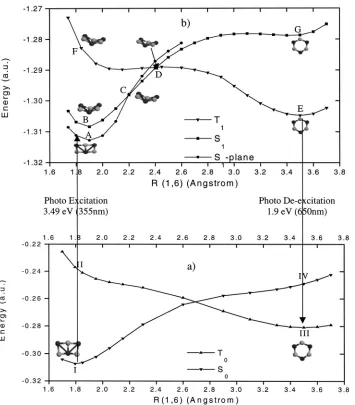
respectively. Note this is the only case of a stable triplet in all of the 12 isomers of the Al3O3⫺ cluster. More interesting, both B3LYP and MP2 methods show that rerelaxation of the converged Ring structure on the singlet energy surface leads gradually into the Book structure and rerelaxation of the con-verged Book structure on the triplet energy surface leads gradually into the Ring structure. This important behavior can be more clearly demonstrated by mapping the local trip-let and singtrip-let potential energy surface along the distance of Al共1兲and O共6兲via partial relaxation employing the internal coordinates technique as shown in Fig. 2. For each structure point, only R(1,6) is fixed, while all other geometric param-eters are fully relaxed. It clearly shows that on the ground state, this system can be regarded as a bistable system; in the
singlet ground state, the system exists as the Book structure, while in the triplet ground state, it changes into the Ring structure.
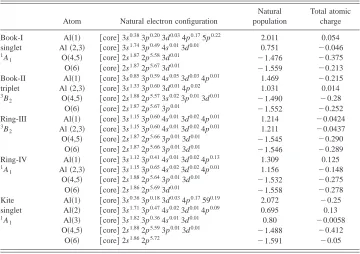
[image:5.612.60.561.74.253.2]To understand this unique behavior, we performed natu-ral population analysis to check the charge distribution and charge transfer during the process. Four states are studied: optimized singlet Book I, triplet Book II, optimized triplet Ring III and singlet Ring IV. II has the exactly same geom-etry as I but with different spin multiplicity. The same is true for III and IV. The natural electronic configuration and natu-ral charge are compiled in Table IV, along with the Mulliken total atomic charge. Consistently we find the value of the natural population on Al is positive and on the O atom is negative. This not surprisingly shows that the charge is trans-ferred from Al atoms to O atoms. While the values of natural population on O atoms remain nearly unchanged, the values on Al vary depending on the coordination and state. In I, the natural population value on Al共1兲 is much larger than the ones on Al共2兲 and Al共3兲. This is because the Al共1兲 atom is attached to three O atoms while Al共2兲 and Al共3兲 atom are both attached by two O atoms respectively. This difference is significantly decreased in II. The natural electron configura-tions show that in II, the number of the electrons in the 3s and 3 p shell of Al共1兲have increased while the number in 3s shell of Al共2兲 and Al共3兲 have decreased compared with I. Force analysis on the constrained structure II shows that there is strong repulsive force on Al共1兲 and O共6兲along the R(1,6), as well as a strong trend for O共4兲and O共5兲to move away from Al共1兲. These results agree with the Mulliken atomic charge analysis. Note that the Mulliken atomic charge on Al共1兲in II is negative due to charge transfer from Al共2兲 and Al共3兲. We are not surprised at above result, i.e., that upon removal of the constraint the geometry may be driven into structure III, along with a decrease in energy. Similar analy-sis can be applied to the Ring structure III and IV. We find that the electronic charge distributes nearly evenly on the three Al atoms in III. This suggests that the added stability of the triplet III over the singlet IV is due to the resonance or delocalization of the electrons in the bonding network over the six atoms.27
TABLE III. Calculated vibrational frequencies (cm⫺1) and infrared共IR兲intensities共km/mol兲and Raman scattering activities (A4/amu) for the most stable
anion Al3O3isomers at the B3LYP/6-31⫹⫹G( p,d) level. Entries in bold are referred to directly in the text.
Symmetry B1 A2 A1 B1 B2 A1 B2 A1 B2 A1 A1 B2
Frequency 118.9 162.5 211.8 335.7 360.3 413.7 454.9 530.6 575.5 683.3 734.8 994.7 Book
Structure
1 A1
IR Intensity 20.7 0 1.62 15.4 100.4 0.98 3.4 165.5 302.3 77.1 5.3 209.1
Raman Activity 5.63 2.77 43.2 7.03 29.1 24.8 0.6 418.7 162.3 250.4 86.6 35.0
Symmetry B1 A2 A1 A1 B2 A1 A1 A1 B2 A1 B2 B2
Frequency 114.5 116.4 198.3 198.4 200.2 390.4 540.0 604.2 605.2 761.7 762.1 822 Ring
Structure
3B 2
IR Intensity 0 0 7 0.01 8.1 0 0.01 142.7 146.5 18.2 19.8 0
Raman Activity 99.4 101.7 648.4 0.09 653.4 55.4 181.9 647.4 656.9 2376 2339 0.02
Symmetry B2 B1 B1 B2 A1 B1 B2 A1 A1 B2 A1 A1
Frequency 57.5 69.4 162.9 229.6 320.8 338.8 483.3 539.4 587.4 818.8 840.7 1044 Kite
Structure
1A 1
IR Intensity 0.6 4.9 5.4 5.3 2.4 32.1 71.3 72.7 102.3 118.7 7.3 827.8
Raman Activity 2.6 9.0 13.5 14.5 54.7 17.8 3.9 1172 477.2 2.9 269.6 237.0
From the above results, we see that the ground state calculations strongly suggest that the photoisomerization process observed in the photoelectron spectra experiment oc-curs between the singlet Book structure and the triplet Ring structure. Moreover, our ground state results indicate such a process may be reversible. However, before drawing such a conclusion, an excited state study must be performed since such photoinduced processes can only happen in the elec-tronic excited states.
B. Photoisomerization mechanism in the Al3O3À: An
excited states study
While the ground states studies above provide insight into the reaction starting point, an excited state study is nec-essary for a description of the reaction process. Two excited state theoretical methods, CI-singles and CASSCF are em-ployed here. From the ground state study, both the singlet and triplet excited states for the Book and Ring structure are believed to be involved in the photoisomerization process, hence we only consider the two low-lying excited states, S1
and T1. To understand the nature of the process, partial
op-timization was performed to describe the energy surface in the local region along the reaction pathway. The S1 and T1
electronic excited state geometries have been optimized at the 20-fixed R(1,6) distances, corresponding to 20 steps of 0.1 Å from the Book to Ring structure. For each point, vi-brational frequency analysis is used to guide the reoptimiza-tion if an imaginary frequency exists. We have obtained some nonplanar intermediate structures on these two excited energy surfaces. The importance of the utilization of the fre-quency analysis here is to expand the one-dimensional map-ping into two-dimensional energy surface explorations. Due to the well known intrinsic convergence difficulties in the CASSCF method, this formidable mapping task was achieved by the computationally less-expensive CI-singles method. However, for the most important structures and the vertical excitation energy, more accurate CASSCF calcula-tions were performed. The calculated PES mapping for the singlet and triplet ground states and the low-lying excited states is illustrated in Fig. 2. The optimized geometric data for the key structures are given in Table V. For the Book structure, CASSCF gives a very similar ground state geom-etry as those from B3LYP and MP2 and similar S1geometry
as that from CI-singles. However, for the Ring structure, a large discrepancy exists between the two methods.
[image:6.612.57.412.50.455.2]Similar to the ground state potential energy surface, the FIG. 2. Potential energy curves along R(1,6) for 共a兲 the electronic ground states and共b兲the T1/S1excited states.
It demonstrates the photoisomerization from the Book structure to the Ring structure. Energies for ground states by B3LYP are relative to⫺953 a.u. and the energies for excited states by CI-singles are relative to ⫺950 a.u. Vertical excitation and de-excitation energies are calculated by CASSCF.
S1 surface has a valley that accommodates the singlet Book structure while the T1 surface has a valley that accommo-dates the triplet Ring structure. Both the S1 and T1 curves change monotonically along the reaction pathway. In fact, full relaxation starting from the Book structure on T1surface leads to the Ring structure and full relaxation from Ring structure 共with little initial distortion兲on S1 surface leads to
the Book structure.
On the S1 surface, in the vicinity of R(1,6)⫽1.9 Å,
CI-singles shows the planar structure A has one imaginary fre-quency, and reoptimization lead to a bent structure B. How-ever, B structure lies higher in energy by 0.14 eV over the A structure by CI-singles. Moreover, CASSCF vibrational fre-quency shows that A is a true minimum on the S1 surface.
The A structure is very similar to the I structure. According to the Franck–Condon principle, the nuclei remain
essen-tially frozen at the equilibrium configuration of the ground state molecule during the transition. Thus we conclude that upon absorption of a photon, the ground state I will be pro-moted to the region near the A point共the so-called Franck– Condon region兲rather than the B point. Our CASSCF calcu-lated vertical excitation energy from S0to S1is 3.62 eV. This
value is in good agreement with the photoelectron photon energy 共355 nm, 3.49 eV兲, it is also roughly in line with the HOMO-LUMO energy gap for the ground state of the Book structure.
Near the C point with R(1,6)⫽2.2 Å, the bent structure is found to be energetically more favorable. So at this region, the planar reactant changes into nonplanar form accompa-nied by a state change from1A1 to1A
⬘
. A nonplanar conicalintersection of S1/T1 was found in the vicinity with R(1,6)
[image:7.612.126.486.72.326.2]⫽2.4 Å. This conical intersection occurs at a geometry TABLE IV. Natural population and natural electron configurations of the relative Al3O3⫺ isomers at the
B3LYP/6-31⫹⫹G( p,d) level.
Atom Natural electron configuration
Natural population
Total atomic charge
Book-I singlet
1A 1
Al共1兲 关core兴3s0.383p0.203d0.034p0.175p0.22 2.011 0.054
Al共2,3兲 关core兴3s1.743p0.494s0.013d0.01 0.751 ⫺0.046
O共4,5兲 关core兴2s1.872p5.583d0.01 ⫺
1.476 ⫺0.375 O共6兲 关core兴2s1.872p5.673d0.01 ⫺1.559 ⫺0.213 Book-II
triplet
3B 2
Al共1兲 关core兴3s0.853p0.594s0.053d0.034p0.01 1.469 ⫺0.215
Al共2,3兲 关core兴3s1.333p0.603d0.014p0.02 1.031 0.014
O共4,5兲 关core兴2s1.882p5.573s0.023p0.013d0.01 ⫺
1.490 ⫺0.28 O共6兲 关core兴2s1.872p5.673p0.01
⫺1.552 ⫺0.252 Ring-III
3B 2
Al共1兲 关core兴3s1.153p0.604s0.013d0.024p0.01 1.214 ⫺0.0424
Al共2,3兲 关core兴3s1.153p0.604s0.013d0.024p0.01 1.211 ⫺0.0437
O共4,5兲 关core兴2s1.872p5.663p0.013d0.01 ⫺1.545 ⫺0.290
O共6兲 关core兴2s1.872p5.663p0.013d0.01
⫺1.546 ⫺0.289 Ring-IV
1A 1
Al共1兲 关core兴3s1.123p0.414s0.013d0.024p0.13 1.309 0.125
Al共2,3兲 关core兴3s1.153p0.654s0.023d0.024p0.01 1.156 ⫺0.148
O共4,5兲 关core兴2s1.882p5.643p0.013d0.01 ⫺1.532 ⫺0.275
O共6兲 关core兴2s1.862p5.693d0.01
⫺1.558 ⫺0.278 Kite
singlet
1A 1
Al共1兲 关core兴3s0.363p0.183d0.034p0.17590.19 2.072 ⫺0.25
Al共2兲 关core兴3s1.713p0.474s0.023d0.014p0.09 0.695 0.13
Al共3兲 关core兴3s1.823p0.364s0.013d0.01 0.80 ⫺0.0058
O共4,5兲 关core兴2s1.882p5.593p0.013d0.01 ⫺1.488 ⫺0.412
O共6兲 关core兴2s1.862p5.72
⫺1.591 ⫺0.05
TABLE V. Geometries 共angstrom, degree兲 of relative isomers by different approaches employing the 6-31⫹⫹G( p,d) basis set.
Isomer
共state兲 Method R(1,6) R(1,4) R(3,6) 共416兲 共163兲 D(5162)a
I (1A
1) B3LYP 1.796 1.703 1.948 96.19 86.76 180
CAS 1.767 1.677 1.926 95.91 87.45 180 A (1A
1) CIS 1.90 1.739 1.819 87.20 89.33 180
CAS 1.883 1.728 1.808 86.43 90.36 180 B (1A⬘) CIS 1.90 1.729 1.828 88.01 87.10 133.23
C (1A⬘) CIS 2.20 1.702 1.794 82.99 82.82 141.80
D (1A⬘) CIS 2.41 1.687 1.773 79.01 80.01 148.79
E (3B
2) CIS 3.50 1.687 1.754 58.34 62.07 180
CAS 3.731 1.892 1.732 51.34 67.67 180 III (3B
2) CAS 3.742 1.922 1.725 47.89 80.33 180
B3LYP 3.496 1.7541 1.7538 57.21 63.08 180 F (3A⬙) CIS 1.84 1.776 1.823 86.87 89.31 135.62
G (1A
1) CIS 3.3 1.673 1.749 61.92 65.92 180
aDihedral angles, 180° means planar form.
[image:7.612.126.487.580.749.2]which is characterized with R(1,4)⫽1.69 Å, R(3,6) ⫽1.77 Å and, D(4163)⫽149°. This point is important to the photoinduced process because it serves as a bottleneck controlling the reaction direction. At this point, the two elec-tronic states share same energy and very similar geometries. This twisted conical intersection point serves as a funnel ge-ometry for spin inversion, and it is believed that such geom-etry is responsible for an efficient S1/T1transition.
10
Around this turning point, the reactant will migrate from the S1 共1A⬘
state兲surface to the T1 surface共3A⬙ state兲. This intersystem
crossing is a nonradiative process. The CI-singles calculated energy barrier height from A to D is about 0.6 eV. This barrier separates intermediate A on the excited state S1from
the S1/T1 conical intersection point D. This energy barrier can be overcome by thermal energy in the cluster. This value may be not quantitatively accurate, unfortunately, as we failed to refine this value due to difficulties characterizing the D point at the CASSCF level. The T1 state surface is quite
flat in the region with R(1,6) varying from 2.2 to 2.6 Å and the cluster is very flexible. After passing the turning point D, the dihedral angle continues to become larger, and at about R(1,6)⫽2.7 Å, the bent structure changes back into the pla-nar structure accompanied by the electronic state changing from 3A
⬙
into 3B2 simultaneously. On the T1 surface, no
barrier is found, so the reactant can readily reach the mini-mum Ring intermediate E point with R(1,6)⫽3.52 Å. The E point is on the first triplet excited state for the Ring structure and has a very similar geometry compared to III. This state is energetically unstable with respect to the ground state. It has a strong tendency to undergo a radiative transition to the ground state. Such emission is referred to as fluorescence. Since there is no change of spin multiplicity, the transition is spin-allowed. This deexcitation process is an internal conver-sion 共IC兲 and is strongly allowed and occurs on relatively short timescales with a high efficiency. Our CASSCF calcu-lated vertical excitation energy from III to T1 is 1.92 eV,
again, it is roughly in line with the HOMO-LUMO energy gap for the ground state triplet Ring structure 共1.9 eV兲. Therefore the radiated phonon frequency is predicted at about 645 nm. This important feature is expected to be con-firmed by further experiment.
Based on the above model, one can readily understand the fact that such a photoinduced process will be signifi-cantly enhanced under hot source conditions in the photo-electron spectra experiment. First, a higher temperature will increase the population of the energetically unfavourable species. In the present case, it will increase the concentration of the reactant triplet Ring isomer. Furthermore, a hot con-dition will increase the amount of thermal energy in the clus-ter available to overcome the energy barrier. Also, a stronger laser beam will intensify this process because it will increase the possibility of this photoinduced process.
So far, based on our results, we can understand the pho-toisomerization observed in experiment. A particularly inter-esting question concerns the possibility of the reversibility of this photochemical reaction. Based on our study of the ground state and excited state PES, we see the reverse isomerization is possible and can be described as follows: Upon absorption a photon with wavelength at 645 nm, the
ground triplet Ring III will be levered to the side of the E point on the T1 surface. After overcoming an energy barrier
of 0.42 eV 共at CI-singles level兲, it will reach the nonplanar conical intersection D point and cross into the singlet S1
surface. From there it can readily reach the minimum A point. This electronic excited state will release the extra en-ergy by emitting a photon at about 350 nm and terminate at the ground state I.
IV. DISCUSSION
The photoexcitation dramatically changes the electron distribution and the excited state has very different properties compared to the ground state. In fact, in our exploration of all the possible stationary points, no nonplanar structure was found in the electronic ground state. Reoptimization of the nonplanar form found in the excited state all lead to the planar structures predicted by B3LYP.
Although B3LYP and MP2 provide very similar opti-mized structures and the same electronic configurations for the species studied here, our ground state calculations reveal that the B3LYP-DFT method offers a better description for the small aluminum oxide species by comparison with ex-periment. It is perhaps not surprising that B3LYP predicts reasonable values for properties obtained from electronic ground states 共ZPE, AEA, and VEA兲 as the functional is semiempirical in nature with 3 adjustable parameters chosen to reproduce electronic ground state properties of a wide range of simple molecular structures.28As found previously, the DFT approach is quite robust against spin contamination of the wave function when dealing with systems of different spin multiplicity.29Furthermore, as already mentioned, Table II also shows the LUMO-HOMO gaps predicted with B3LYP to be much closer to experimental excitation energies com-pared to MP2. The MP2 LUMO-HOMO gaps are very close to the HF values共6.95, 5.43, and 5.10 eV for the Book, Kite, and Ring structures, respectively兲 that consistently overesti-mate the electron excitation energies. The B3LYP functional consists of a mixture of the exact exchange functional and a GGA functional, the former overestimates single electron ex-citation energies while the latter is known to underestimate them. It is then perhaps not surprising that a mixture of the two produces LUMO-HOMO gaps in reasonable agreement with experimentally observed excitation energies. From our present study, it seems that B3LYP takes into account most of the important dynamical and nondynamical correlation ef-fects. Another advantage of the B3LYP method is that it reduces the computational time and memory requirements.
The CI-singles method is a first-level method for mod-eling excited states and is regarded as zeroth-order treatment for the excited states. The CI-singles method uses SCF-HF orbitals for the excited state while CASSCF calculation uses optimized orbitals 共the active space兲appropriate for the ex-cited state. Thus CASSCF provides better description for the electronic excited state. Although CI-singles is regarded as quite crude, it is qualitatively correct here and it yields much insight into the photoisomerization process in the Al3O3⫺
cluster system. We also note that the newly proposed im-proved virtual orbital-complete active space configuration
interaction method共IVO-CASCI兲 共Ref. 30兲could be an ideal approach to improve quantitatively the excited state study here.
Interestingly, our study suggests that one can regard the Book structure and Ring structure as a unique system whose structure is strongly dependent on its spin multiplicity. Such a system, in both the ground state and excited states共S1 and
T1兲, can only exist as the Book structure in a singlet state,
and as the Ring structures in a triplet state. A most interesting feature of this system is that these two conformations, in principle, can be exchanged upon absorption or emitting ra-diation. This novel property may inspire applications by uti-lizing alternation of the chemical structure in terms of pho-toswitching and photon-mode high-density information storage devices.5
Structurally, the most prominent difference between the Book Structure and the Ring structure lies at the bond length R(1,6). The isomerization can be regarded as a process by first stretching then breaking of Al共1兲–O共6兲 bonds. This is another example where bond cleavage happens upon irradia-tion.
V. CONCLUSION
We have presented a quantitative picture for understand-ing the photoisomerization process in Al3O3⫺ clusters by
means of quantum chemistry calculations. Possible intersys-tem crossing pathways have been outlined by geometry op-timization on the relevant potential energy surfaces. Combin-ing the results for both ground states and low-lyCombin-ing excited states, we summarize our main results as follows:
共1兲 The photoinduced process occurs between the singlet Book structure (C2v,1A1) and the triplet Ring structure (C2v,3B2). Another energetically favorite Kite isomer
(C2v,1A1) may coexist in the photoelectron
spectros-copy experiment, but it is not involved in this photoin-duced reaction. Our electron affinity values, the vibra-tional frequency analysis, and electronic structure results support this conclusion.
共2兲 We have mapped in detail the local ground state and triplet state potential energy surfaces along the bonding length R(1,6), spanning from 1.8 Å to 3.6 Å by utilizing the partial relaxation technique. A nonplanar conical in-tersection between S1 and T1 occurs with R(1,6) at
about 2.4 Å. This point controls the reactant transfer from the S1surface to T1surface. The calculated vertical
excitation energy is 3.62 eV at CASSCF level, in good agreement with the experimental value 共3.49 eV兲 and roughly in accordance with the HOMO-LUMO energy gap of the singlet Book structure共3.29 eV兲.
共3兲 Beyond the experimental results, we predict, in prin-ciple, this photoisomerization process is reversible. Upon absorption a phonon of 1.92 eV energy, the triplet Ring structure is expected to change back into the singlet Book structure.
共4兲 The singlet Book structure and the triplet Ring structure can be regarded as a unique bistable system. Such
sys-tem has the very interesting property that in both the ground state and excited states共S1and T1兲, such system
can only exist as the Book conformation on singlet state energy surfaces, and as the Ring conformation on triplet state energy surfaces.
ACKNOWLEDGMENTS
X.Y.C. gratefully acknowledges the financial support of ORS scheme. All calculations were performed at the Univer-sity of Salford using the High Performance Computing fa-cilities supported by HEFCE 共U.K.兲and IBM Ltd.
1
J. A. Barltrop and J. D. Coyle, Excited States in Organic Chemistry 共Wiley, New York, 1975兲.
2A. Gilbert and J. Baggott, Essentials of Molecular Photochemistry共
Black-well Scientific, Oxford, 1991兲.
3V. Molina, M. Merchan, B. O. Roos, and P. Malmqvist, Phys. Chem.
Chem. Phys. 2, 2211共2000兲.
4M. Woeller, S. Grimme, S. D. Peyerimhoff, D. Danovich, M. Filatov, and
S. Shaik, J. Phys. Chem. A 104, 5366共2000兲.
5J. K. Agyin, L. D. Timberlake, and H. Morrison, J. Am. Chem. Soc. 119,
7945 共1997兲; M. Kurihara, T. Matsuda, A. Hirooka, T. Yutaka, and H. Nishihara, ibid. 122, 12373共2000兲, and references therein.
6Z. F. Liu, K. Hashimoto, and A. Hujishima, Nature 共London兲347, 658
共1990兲; T. Ikeda and O. Tsutsumi, Science 268, 1873共1995兲; F. Kulzer, S. Kummer, R. Matzke, C. Brauchle, and T. Basche, Nature共London兲387,
688共1997兲.
7
M. J. Bearpark, M. Olivucci, S. Wilsey, F. Bernard, and M. A. Robb, J. Am. Chem. Soc. 117, 6944共1995兲.
8W. Fuss, S. Lochbrunner, M. Muller, T. Schikarski, W. E. Schmid, and S.
A. Trushin, Chem. Phys. 232, 161共1998兲.
9
P. Weber, J. R. Reimers, J. Phys. Chem. A 103, 9830共1999兲.
10F. Bernardi, M. Olivucci, and M. A. Robb, Chem. Soc. Rev. 25, 321
共1996兲.
11M. Klessinger, Angew. Chem. Int. Ed. Engl. 34, 549共1995兲. 12
P. Chaquin, M. E. Alikhani, M. Bahou, L. S. Mazzuoli, and A. Schriver, J. Phys. Chem. A 102, 8222共1998兲.
13J. Manz, K. Sundermann, and R. de. Vivie-Riedle, Chem. Phys. Lett. 290,
415共1998兲.
14M. Hartmann, J. Pitter, and V. B. Koutecky, J. Chem. Phys. 114, 2123
共2001兲.
15V. B. Koutecky, M. Hartmann, J. Pitter, and H. D. Van, Int. J. Quantum
Chem. 84, 714共2001兲.
16H. Wu, X. Li, X. B. Wang, C. F. Ding, and L. S. Wang, J. Chem. Phys. 109, 449共1998兲.
17
T. K. Ghanty and E. R. Davidson, J. Phys. Chem. A 103, 8985共1999兲.
18A. V. Nemukhin and F. Weinhold, J. Chem. Phys. 97, 3420共1992兲. 19C. Møller and M. S. Plesset, Phys. Rev. 46, 618共1934兲.
20A. D. Becke, Phys. Rev. A 38, 3098共1988兲. 21
C. Lee, W. Yang, and R. G. Parr, Phys. Rev. B 37, 785共1988兲.
22
J. B. Foresman, M. Head-Gordon, J. A. Pople, and M. J. Frisch, J. Phys. Chem. 96, 135共1992兲.
23P. E. Seigbahn, A. Heiberg, B. O. Roos, and B. Levy, Phys. Scr. 21, 323
共1980兲; B. O. Roos, P. R. Taylor, and P. E. Seigbahn, Chem. Phys. 48, 157 共1980兲; N. Yamamoto, T. Vreven, M. A. Robb, M. J. Frisch, and H. B. Schlegel, Chem. Phys. Lett. 250, 373共1996兲.
24M. J. Frisch, G. W. Trucks, H. B. Schlegel et al.,
GAUSSIAN 98Gaussian, Inc., Pittsburgh, PA, 1998.
25
X. Y. Cui, and I. Morrison共unpublished兲.
26
L. S. Wang, J. B. Nicholas, M. Dupuis, H. Wu, and S. D. Colson, Phys. Rev. Lett. 78, 4450共1997兲.
27R. L. Dekock and H. B. Gray, Chemical Structure and Bonding共
Univer-sity Science, New York, 1989兲.
28
A. D. Becke, J. Chem. Phys. 107, 8554共1997兲, and references therein.
29S. Grimme, M. Woeller, S. D. Peyerimhoff, D. Dannovich, and S. Shaik,
Chem. Phys. Lett. 287, 601共1998兲.
30D. M. Potts, C. M. Taylor, R. K. Chaudhuri, and K. F. Freed, J. Chem.
Phys. 114, 2592共2001兲.