An information framework for a merchant
trust agent in electronic commerce
Kasiran, MK and Meziane, F
http://dx.doi.org/10.1007/3540456759
Title
An information framework for a merchant trust agent in electronic
commerce
Authors
Kasiran, MK and Meziane, F
Type
Book Section
URL
This version is available at: http://usir.salford.ac.uk/1731/
Published Date
2002
USIR is a digital collection of the research output of the University of Salford. Where copyright
permits, full text material held in the repository is made freely available online and can be read,
downloaded and copied for noncommercial private study or research purposes. Please check the
manuscript for any further copyright restrictions.
An Information Framework for a Merchant Trust Agent in
Electronic Commerce
Mohd Khairudin Kasiran
Farid Meziane
Computer Science, School of Sciences,
University of Salford, Salford M5 4WT, UK
[email protected]
[email protected]
Abstract
eCommerce is a faceless business arrangement where the process of creating trust towards merchants, hereby referred to as “merchant trust”, is still a big challenge. Merchant trust framework can be created by using several factors such as existence (people, physical, and registration), affiliation (third party endorsement, membership, and portal), performance (delivery, payment and community comment) and policy (customer care policy, privacy statement and warranty). Providing an architecture for a software agent to help consumers gather this information is the first step in helping consumers creating merchant trust in eCommerce setting.
Keywords: Commerce, Intelligent Agent, eCommerce trust
1. Introduction
ECommerce is a faceless business arrangement, where merchants are placing their business images in the cyber world through web technology. These images can travel around the world in a few seconds and be viewed by consumers anywhere at the comfort of their own places. This new business channel depends heavily on information exchanged between the parties involved in the transaction due to its meeting place which is the digital world. It was argued that electronic commerce could only become a success if the general public trust the virtual environment (Yao-Huan and Theon, 2001). However lack of trust seems to be on both sides. A recent survey by the US Congress of major US corporations has shown, 75% of the executives responding indicated that they lacked confidence in the Internet as a vehicle for electronic commerce because of its vulnerabilities that arise from trust (Ratnasingham, 1998). It has also been reported that in 1999, consumers lost over US$3.2 million to internet fraud and this is increasing every year. This has affected consumers trust towards online business (Ba, 2001)
There has been a lot of research on trust in electronic commerce, however most of it takes a descriptive approach as reported by Ba (2001). Few have taken a more formal approach and tried to define
a formal model for electronic commerce trust. Yao-Hua and Theon (2000, 2001) have defined a generic model for electronic commerce trust and they have identified two trust determoinant, trust in the other party and trust in electronic mechanisms. Lee and Turban (2001) have developed a trust model based on the trustworthiness of the internet merchant, internet shopping medium and the context factors.
Since consumers are the party who initiates eCommerce transactions, the merchant should provide enough information about themselves on their websites. Based on this information, the consumer should be able to evaluate and choose the trustworthiest of the merchant they want to do business with. Thus, in this paper we propose a framework for creating a merchant trust. We also provide the initial architecture for the implementation of this framework as a Web agent which role is to help the consumer gather information on the merchant web and on the Web. In the next sections, we describe the framework and the proposed architecture.
2. The Basic Framework
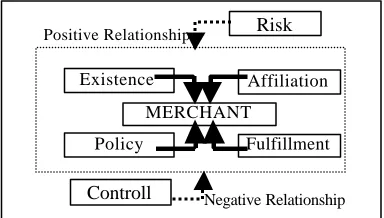
Figure 1: The Basic Trust Framework
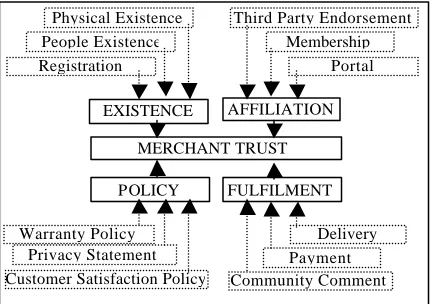
After the relationship between trust and risk as well as control has been identified, the basic framework can be expended to include factors that can affect trust or specifically merchant trust. In general the trust toward merchant will be based on the following four factors: existence, affiliation, policy and performance as shown in Figure 2.
Figure 2: General factors for Merchant Trust Framework
2.1 Existence
Trust is a relationship between two or more parties. Therefore, in a trust relationship the existence of the parties involved need to be first established before trust can be developed between them. Since consumers are the initiator of eCommerce transaction, merchants need to communicate that they really exist behind their website. There are several methods for merchants to communicate their real existence to the consumers from their websites.
According to Zimmerman (2000), providing information about the companies in their eCommerce websites can generate merchant trust by factor of existence. Physical information and people information can be used to achieve the above objective. Providing information about the company’s physical existence such as address as well as telephone number can convey the message that the company is reachable from outside the cyber world. And, providing information about people ’s existence such as customer service department can also establish merchant trust. In short, by providing consumers with physical and people information, the merchant indirectly gives more power and alternative to the user to initiate communication when needed.
In addition, providing information regarding registration with certain governmental body can also help establish merchant trust based on existence factor. Information such as the company’s registration number and the registering body help the consumer to verify the merchant validity such as Verified Internet Pharmacy Practical registration where only legal and legitimate pharmacies can register to this body before they can give prescription to the consumer especially through cyber world (U.S. Food and Drug Administration, 2001).
2.2 Affiliation
A strong trust relationship can be established between two parties if it is being developed through direct experience. As stated in the Cheskin/Archtype research (1999), “trustworthiness is about experience over time where the process of creating trust between two parties is dynamic and continuous”. A series of successful trust relationships will deepen the relationship but it can also be easily destroyed by one unsuccessful trust relationship.
The future of eCommerce depends on its acceptance by more consumers. ECommerce needs to strengthen its strategy on building the initial trust between consumers and merchants . The fight is more on creating trust on new consumers who have no direct experience dealing with cyber merchants than those who already have had a lot of experience in this digital market space. Therefore, another method of creating indirect merchant trust needs to be used such as looking to other parties who the merchants are affiliated with. According to Abdul-Rahman (cited from (McCullagh, 1998) trust can be in a form of direct trust or recommended trust. Direct trust is the trust that originates from a trustee to a trustor and based on experience through time. While direct trust is based on time and experience, recommended trust is created based on other party recommendation. Several possible methods of affiliation that can be looked at closely in eCommerce environment are third party endorsement, membership registration and portal linkages.
Several studies on third party endorsement have been conducted in the past (Noteberg, 1999 and Noteberg et al., 1999). They concluded that third party endorsement has some impact on influencing consumers to proceed with the digital transaction. The influences of third party endorsement on creating trust toward merchant become more significant especially to unknown merchants where the perceived risk is higher than well-known merchant like Amazon.com. In addition, third party assurances can also be very useful especially if they involve endorsement on expertise and skill.
Membership registration to certain body or organization can also be used to create recommended trust especially in the area where skill and expertise is Risk
TRUST
Control
Negative Relationship Positive Relationship
Existence Affiliation MERCHANT
TRUST
Fulfillment Policy
Risk Positive Relationship
[image:3.596.69.261.288.397.2]important. This transfer of trust works well in the same way as referral systems or recommendation systems work. Consumers are willing to put certain level of trust to unknown merchants in the digital world when they are being referred to or recommended by a trusted website. Based on the same discussion, merchant trust can also be sparked through the digital entrance affiliation or portal. Well-trusted portals usually gather trusted merchants in their digital supermarket.
2.3 Policy
Merchant policy is also important in creating merchant trust in consumers since it sets the guidelines for method and procedure in running the business. In eCommerce domain, policies such as privacy policy, customer satisfaction policy and guarantee policy can help consumer to evaluate the trustworthin ess of a merchant.
As stated in many researches, one of the main factors that hindered consumer from being involved actively in digital market place is related to consumer privacy (Hoffman 1999, Zimmerman, 2000) Consumers are afraid that their personal data will be sold to other parties or being used in marketing databases . It is important for eCommerce websites to specify their privacy policy or privacy statement and currently the availability of this policy on the website is generally good. However, they still lack standardisation in term of what are the basic protection needs to be there. Several guidelines for privacy policy implementation created by OECD such as Guidelines for Consumer Protection in the Context of Electronic Commerce, Guidelines on the Protection of Privacy and Transborder Flows of Personal Data can be used as a basis for creating a policy [10]. OECD have also produced software that can generate privacy policy statements called OECD Privacy Guidelines.
Consumer satisfaction policies and guarantee policies are very important since they can influence the level of risk involved in the transaction. Policy such as money back guarantee can lower the consumers’ risk by giving more control to the user towards the output of the transaction since they can return the product without total loss if they are not satisfied with their quality.
2.4 Fulfilment
The ability to perform expected tasks for other parties is a basic definition being used for trust relationship between two parties in this research. Therefore, it is important for merchant websites to communicate their ability to fulfil their duties to complete the business cycle especially in delivery and payment method to consumers.
Since cyber world does not provide means of transferring non-digital goods instantaneously, cyber merchants need to give to consumer information about
delivery method. Since the consumers have fulfilled or partially fulfilled their duty to pay for the goods in the transaction instantly when completing the online transaction by providing credit card details for example, merchants need to tell the consumers how they will deliver the product. The information that needs to be included is delivery method, company’s name and order tracking method.
In addition, information about method of payment is also important to create merchant trust. Consumers usually prefer a method that will still allow them the control of cancelling the payment for unfulfilled transactions. Paying by cash should be least preferable since consumer loses control over the money once it is on its way to merchants. Paying by cheque or credit card can give some control and security to the consumer since they still can cancel the cheque or credit card payment.
Meanwhile, Jarvenpaa [4] has pointed out that the reputation of a merchant could be considered as antecedent toward establishing trust environment toward the merchant. Reputation conveys some information about the merchants’ performance as well as behaviour in the past. A positive reputation can create basic building block of merchant trust and carry some assumption that the merchant will perform and behave in the same manner in the future.
[image:4.596.319.537.481.633.2]The establishment of a reputation is generated from past consumer experience which takes a long time to establish and requires persistence performance. Based on above elaboration, the general merchant trust framework can be further developed as in Figure 3.
Figure 3 : Extended merchant trust framework.
3. Agent Framework
Searching and evaluating information in the website can be tedious and a frustrating task. Asking consumers to find information for establishing merchant trust based on the suggested framework can create negative shopping experience to the consumers.
EXISTENCE AFFILIATION
MERCHANT TRUST
FULFILMENT POLICY
Customer Satisfaction Policy Registration
Privacy Statement Physical Existence People Existence
Payment Delivery Third Party Endorsement
Membership Portal
Warranty Policy
Therefore, the proposed merchant trust framework should be accompanied with tool that can help consumer finding and evaluating information required automatically. A personal software agent should be able to help consumers to perform the task. In this paper, we propose an agent based architecture to implement the framework. The agent overall objective is to help consumers to find and established trust toward merchants while they are on-line shopping on the Internet. The proposed agent will be running at the back of the on-line shopping activities.
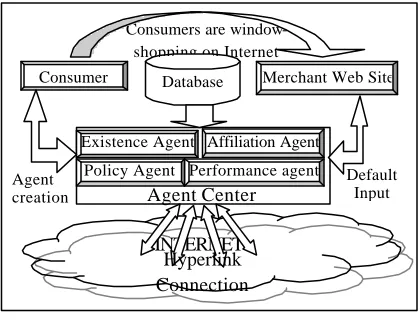
[image:5.596.66.276.473.633.2]The overall development will be based on the architecture given in Figure 4. The main component of the system will be an agent center, which has sub components of existence, affiliation, policy and fulfillment agents and a database to store all required information for future use. The agent center will have the facility to bring into the system the relevant information. This information, probably a set of web pages, would be evaluated to identify their content. The agent center should be able to collect all hyper-tags to establish all possible linkages within the merchant website as well as linkages to the other relevant website. The agent center will identify relevant linkages to the framework and distribute all of these linkages to the respective sub-agents based on its information requirement. The sub agent will access all information required to establish merchant trust score. The score will be maintained in a database to make it available for future use.
Figure 4: Overall architecture of the trust framework.
The proposed agent is a semi -autonomous personal agent that requires minimal intervention from the user to start its operation. The overall function of the agent created in this paper has specific constrain that purposely embedded in its functions. The agent is only using the information provided by the merchant’s website and other sites that have direct linkages with
the merchant’s website. This functional constraint is purposely embedded because the objective of the agent is to evaluate the trust factors based on the information provided by the merchants in their websites.
The agent will undergo several processes in order to complete its operation. The processes are activation by the consumer, checking existing evaluation on the database by the agent center, setting the agent proprieties by the consumer, taking initial input by the agent center from merchant website, filtering initial input from merchant website by the agent center, passing relevant information to sub-agents, accessing further information by sub-agents from hyper linkages sites, calculating trust score by agent center and finally report to the user.
The process of evaluating information for merchant trust is initiated by a consumer’s request. When a consumer is online doing his/her window-shopping, and wish to know more about the merchant he is currently visiting, he can initiate the agent. The initiation can be done at the beginning or at the middle of the consumers’ shopping period. The consumer will send a message to the agent centre requesting the launch of the merchant trust agent. When the agent centre gets this message, it will take the current address and check the local database to determine if there is any previous evaluation of the requested merchant. If there is any, the consumer will be informed and will have the choice to proceed with the current process.
The next process to follow is to set the agent properties by the consumer. Through the agent setting interface, the user is required to determine the weight of each factor to reflect his preferences of trust on each factor. This option is important since different users may have different perception on the importance of each factor. For example, existence factor may be important to certain user and may not be important to others. Therefore we can reflect these differences by assigning different weight for each factor. The sub-agents will take this weight factors and used them to calculate merchant trust score for each factor.
The agent center will take the weight factors in order to determine which sub-agents to be launched. Four different possible sub-agents can be activated by the agent center: these are existence agent, affiliation agent, performance agent and policy agent. These sub-agents are designed to find and evaluate any information as specified in the framework in order to establish merchant trust score provided by the merchant in their website. The 0.00 weight factor will be interpreted by the agent center as a message not to activate that particular sub-agent.
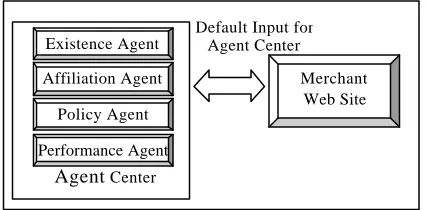
As stated before, the information trust agent is running at the back while the consumer/user is shopping online. Therefore, activation of the agents will take current website visited by consumer/user as an input to the agent center to do their works as shown in figure 5.
Consumer Merchant Web Site Consumers are
window-shopping on Internet
Existence Agent
Performance agent Policy Agent
Affiliation Agent
Agent Center Agent
creation
Database
INTERNET
Default Input
Figure 5: Input Source of Agent Centre.
By using the current address provided by the merchant web pages, the agent center will go to the main page of merchant web site. Then the agent center will bring in the content of the main page to the center. Since the input file will be in a HTML format, the agent center can distinguish between plain text and hyper tags. These hyper tags will be collected by agent center and distributed to relevant sub-agents based on information required in the merchant trust framework. For example, sub agent existence will try to find information about merchant existence in the main page such as address, telephone number and others as specified in the information trust framework. If the information is not available in the main page, the existence agent will look at the linkages provided by agent center to be explored. Linkage to the section such as “company background”, “contact information” or “about us” will be explored by the existence agent in order to find the information required to establish the score. Other sub-agents will perform similar processes. They will be accessing relevant hyper linkages provided by the agent center in order to establish their trust score.
Each information found from the website that has been identified as merchant trust information factor as suggested in the framework will score certain points. These points will be summed for total sub agent score and then will be divided by possible maximum score for that agent to get its proportional score. Finally this proportional score will be multiplied with the weight factor allocated to this particular sub agent. The summation of all for sub agent scores will establish merchant trust score and this summary of score will be reported back to consumers.
4. References
Ba Sulin (2001), Establishing Online trust through a community Responsibility System, Decision Support Systems 13(2001)323-336.
Hoffman, D.L., Novak, T.P., and Peralta, M. (1999), “Building Consumer Trust Online”, CACM, 42(4).
Jarvenpaa, S., Tractinsky, N., and Vitale, M. (2000), “Consumer Trust in an Internet Store”. Information Technology & Management Journal, 1(1-2):45-7,
Konrad, K., Fuchs, G., and Barthel, J., (1999), “Trust and Electronic Commerce – More Than a Technical Problem”. Proceeding of the 18th IEEE Symposium on Reliable Distributed Systems, Lausanne, Switzerland, pp 360-365.
Mayer, R.C., Davis, J.H., and Schoorman, F.D.,(1995), “An integrative model of organizational trust”, Academy of Management Review, 20(3):709-734.
McCullagh (1998), A. “The establishment of TRUST in the electronic commerce environment”. Proceeding of the Information Industry Outlook Conference, Canbera, Australia.
Noteberg, A. (1999), “Web Assurance Seals for an improved Electronic Commerce Environment”. Master Thesis, University of Amsterdam.
Noteberg, A., Christiaanse, E., and Wallage, P. (1999), “The Role of Trust and assurance service in electronic channels: An Exploratory Study”, Proceedings of the International Conference on Information Systems, pp 472-478, Charlotte, North Carolina.
[10] (OEDC) Organisation for Economic Co-operation and Development. “Progress Report on the OECD Action Plan for Electronic Commerce.” 29/06/2000. Available at: http://www.oecd.org/subject/ecommerce/ ecprogrep. htm. 03 March 2001.
Ratnasingham P., (1998), The Importance of trust in Electronic Commerce, Internet Research: Electronic Networking Applications and Policy, 8(4):313-321.
Tao-Huan T. and Theon W., (2000), “Formal Aspects of a Generic Model of Trust for Electronic Commerce”, Proceeding of the 33rd Hawaii International Conference on System Sciences pp. 1-8
Tao-Huan T. and Theon W., (2001), Towards a Generic Model of Trust in Electronic Commerce, International Journal of Electronic Commerce, 5(2):61-74
[12] Zimmerman, E.. “The five Secrets to Winning Consumer Trust on the Web”. 2000. Available at: http://www.fsb.com/fortunesb/articles/0,2227,
5840,00.htm. 29/01/2001. Existence Agent
Performance Agent Policy Agent Affiliation Agent
Agent Center
Merchant Web Site Default Input for