Journal of Chemical and Pharmaceutical Research, 2018, 10(1):180-184
Review Article
CODEN(USA) : JCPRC5
ISSN : 0975-7384
180
Off Label Use of Drug in Pediatrics: A Systematic Review
Sandna Larissa Freitas dos Santos
*, Romênio Nogueira Borges, Edilson Martins Rodrigues
Neto, Cinara Vidal Pessoa and Karla Bruna Nogueira Torres Barros
University Center, Catholic University of Quixadá, Brazil
_____________________________________________________________________________
ABSTRACT
Objective: The research aims to present the off-label use of drugs in pediatrics.
Methods: A systematic review of the databases: LILACS, SciELO, MEDLINE and BVS, with keywords in Portuguese and selected in consultation with the English (DeCS) of Bireme: Off label, drug prescriptions, pediatrics. They included articles published between 2010 and 2016 in national and international journals on the study of the subject so it was selected 7 items to compose the study.
Results and discussion: Among the drugs prescribed for off-label use was observed salbutamol in above recommended by the bull doses, Loratadine and dexclorfeniramina for infants, the age at which these drugs are not recommended, Dimethicone, in overdose, dipyrone not approved FDA due to severe cases of agranulocytosis, among others. It was reported no negative reaction to the patients in the studies associated with off-label use, but for reasons connected with the safety of children, does not seem acceptable that can be used in an uncontrolled manner a drug in situations that are not indicated.
Conclusion: Therefore, the physician must be attentive to the details of pharmacologic therapy in children, avoiding reactions and ensuring the effectiveness of treatment.
Keywords: Off label; Drug prescriptions; Pediatrics
_____________________________________________________________________________
INTRODUCTION
When there are no adequate scientific basis, such as drug indication differently from that authorized by the regulatory organ of drugs happens off-label use of drugs. This indication is not described on the label or drug description leaflet, and may also be related to use in a different age range of which is labeled, and another route of administration, dose and frequency of use, and the World Health Organization (OMS) includes also contraindications [1].
181
However, most of the drugs used in children has not been subjected to clinical trials, except for certain therapeutic classes and, in general, vaccines, as there are important challenges related to the difficulties of testing, either for ethical reasons, the high cost or even the long period that a pediatric study may require [5].
The lack of approval for pediatric use does not imply that the product is contraindicated, only that there is insufficient evidence to inform about risks and ensure benefits of its use in this age group. Although there is no prohibition on use, caution is required, it is recommended that the medication is not preferred in the prescription of pediatrician [6]. Security is crucial when choosing a therapy, should not the expected benefit in off label use compromising security when there are safer alternatives and studied in the same indications. In any situation, the use of off label drugs should always obey the parameters that reduce the risks and be determined by factors that preserve patient safety. Must be based on a scientific basis, should be restricted to cases where the benefit is considerable and there is no approved therapeutic alternative to manifest effective and should provide for adequate monitoring of the patient [7]. When the drug is prescribed for a different age group approved, the doctor usually extrapolates, indicating the recommended dose for adult patients for pediatric based on the proportional weight, but such conduct does not guarantee safety and efficacy of treatment and may lead to serious consequences [4].
Considering the above, this paper presents a systematic review of the off-label use of drugs in pediatrics, analyzing the therapeutic indication for which the drugs are prescribed, and the occurrences of cases described in this situation, aiming the minimization of harmful reactions and the importance of effective participation in the monitoring of patients.
METHODOLOGY
This research is a systematic review of the off-label use of drugs in pediatrics. For developing this review was to defined the guiding question, it evidenced the criteria for inclusion, exclusion and the search for publications, and thus presented the results [8]. Search sources used in the selection of the articles were health databases: LILACS – Latin-american and Caribbean Health Sciences, SCIELO - Scientific Eletronic Library online, MEDLINE - Medical Literature Analysis and Retrieval Sistem online and BVS – Helath Virtual Library. For search of articles were used keywords in Portuguese and English selected in consultation on Descriptors in Health Sciences (DeCS) by Bireme: Off label, drug prescriptions, pediatrics. The research was guided by the following question: What medications are used for alternative off-label in pediatric?
Original articles were included, published between 2010 and 2016 in national and international journals and presented information on off-label use of drugs in clinical practice of pediatrics. Articles that do not fit the theme of the study were excluded, published in previous years and showed duplicity. For selection of articles was made the read of abstracts in order to refine the sample by means of inclusion and exclusion criteria. The productions that fit the inclusion criteria were analyzed in full.
RESULTS AND DISCUSSION
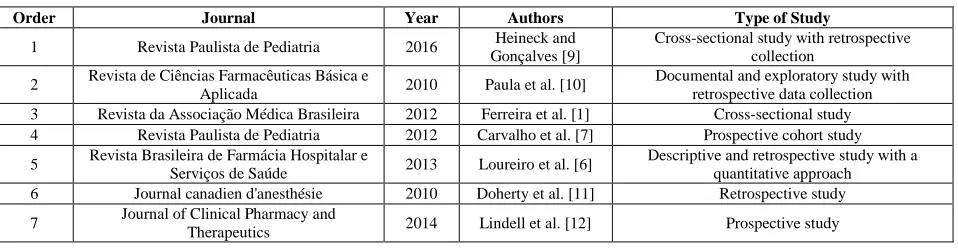
[image:2.612.69.548.552.676.2]The 07 articles in the sample of this study, showed in general the use of off-label pediatric medicines, presenting the occurrence and the main drugs that actualize this use. Among them, two were of english origin, one in Spanish and four in portuguese, two of these were published in 2010 and 2012 and only one in the year 2016 (Table 1).
Table 1: Distribution of selected articles containing journal, year of publication, authors and type of study
Order Journal Year Authors Type of Study
1 Revista Paulista de Pediatria 2016 Heineck and
Gonçalves [9]
Cross-sectional study with retrospective collection
2 Revista de Ciências Farmacêuticas Básica e
Aplicada 2010 Paula et al. [10]
Documental and exploratory study with retrospective data collection 3 Revista da Associação Médica Brasileira 2012 Ferreira et al. [1] Cross-sectional study
4 Revista Paulista de Pediatria 2012 Carvalho et al. [7] Prospective cohort study
5 Revista Brasileira de Farmácia Hospitalar e
Serviços de Saúde 2013 Loureiro et al. [6]
Descriptive and retrospective study with a quantitative approach
6 Journal canadien d'anesthésie 2010 Doherty et al. [11] Retrospective study
7 Journal of Clinical Pharmacy and
Therapeutics 2014 Lindell et al. [12] Prospective study
Discussion
182
responsible for assessing the safety and efficacy of medicines. In Brazil, a drug is authorized for marketing after registration with the Ministry of Health (MS), with scientific proof of safety and efficacy for the use that is designed, thus, the studies that are derived from preclinical and clinical studies [2-13].
The information related to the medication should be presented in the drug description leaflet, as a legal sanitary document containing technical and scientific information for health professionals and the patient. Concluded studies following the granting of the registration may extend the indication to another age, another disease or even restrict which was approved initially, in this case it is necessary for the industry forward documentation again to ANVISA for evaluation and approval, and subsequently changes in leaflet if authorized. However before this occurs it is possible that, in clinical practice the medicine be indicated for a situation not referred in bulla, where believe can benefit the patient [2-6]. It is observed that some laboratories launched on the market products the use of which is limited and later expanding to other purposes. The marketing disguised as research based below the FDA requirements standards is the main methodology to persuade the prescription, dodging this way from legislation that banning them to do promotion of use for an indication not approved. The pharmaceutical industry is allowed to promote products only for use and indications specified in the marketing authorization, with it, the off label prescription drug is generally legal, but promotion made by the manufacturer is not permitted [7].
According to the literature review conducted by Ferreira et al. [1], studies to determine the prevalence of prescribing off-label drugs or unlicensed for the pediatric population are still scarce in Brazil, in spite of its importance for determining the profile of drug use in the country's health institutions and making decisions that promote the safer use of drugs for this population. Table 2 presents the results of the studies selected for this study.
Table 2:Description of the results of selected journals
Order Casuistry Results
1
Analysis of prescriptions for 326 patients until 12
years
During the study period there were 731 prescription drugs and was often 31.7% of drugs prescribed off label, especially antihistamines and anti-asthmatics (32.3% and 31.5%, respectively). The main
type of off-label prescribed was dose (38.8%), followed by age (31.5%) and frequency of administration (29.3%). Regarding off label dose prescription, it was the most frequent overdose
(93.3%) than underdosing (6.7%). Unlicensed drug prescriptions were not found.
2
254 requests for different indication of the recommended medicines or off label, patients in
0-15 years
Of requests analyzed, 142 (15.20%) were related to different indication of the recommended or off label compared to the FDA information and 112 (12%) compared with the ANVISA information. The number of off-label prescriptions for age found involves children aged 0 to 5 years of age, representing 37.5% of the total. The age range of 6 to 10 years is 31.25% of off-label prescriptions,
followed by the age group of 11 to 15 years, in which 28.13% were prescribed different from the approved form.
3
73 hospitalized children. It was recorded 1,054
prescription items, involving 117 different
medications, with an average of 14 items per
patient
The most frequently prescribed medicine was dipyrone (73 times) that in 35 cases (47.9%), was prescribed in an approved manner and in 38 episodes (52.1%) of off-label mode. According to the reasons for the use of off-label rating, the more frequent was the dose, followed by age and route of administration. For unlicensed, the most common reason was "the safety and efficacy have not been established", followed by drugs not marketed in Brazil and contraindicated medicines for children. The therapeutic groups with the largest number of off-label prescriptions were analgesics (33%) and
antibiotics for systemic use (25%). And the most frequently prescribed unlicensed were the analgesics and antacids (29%), followed by drugs used to treat flatulence (21%).
4
129 newborns, and recorded 318 prescription
items
The prevalence for prescription drugs appropriately based on the FDA drug description leaflet, was 64.8%, thereof, 7.5% unlicensed and 27.7% drugs for off-label. The off-label use was more prevalent
in the age group (19.5%). Forty-eight patients received some nonstandard or unlicensed medication, corresponding to 78.7% of those newborns whose prescription contained only valid items.
Unlicensed drugs were dipyrone, chloral hydrate and caffeine.
5 107 patients were admitted to the pediatric unit
45.8% of patients received at some time of hospitalization, prescribed pharmaceutical specialty off-label mode in relation to the indication prescribed and 23.3% received some specialty not licensed for
pediatric use. The prevalence of off-label drugs or unlicensed according to ANVISA was 3.7% and 5.2%, respectively, lower than those obtained by the FDA base that were 11.5% and 6.0%. According
to ANVISA, acetylsalicylic acid (21.3%) was the most prescribed drug among those used off-label mode and captopril (43.1%) among unlicensed. Regarding the FDA base, was obtained
metoclopramide (46.4%) and captopril (37.1%), respectively.
6 180 hospitalized patients Among the three clinical units, 59.7% of prescriptions were identified as off-label.
7 123 patients
The proportion of patients with at least one prescription for the off-label use or unauthorized drug was 79% (n = 97) in 2011 as compared to 58% in 2001.For newborns, significantly more
prescriptions were for off-label use in 2011 (51%) than in 2001 (22%). The proportion of unauthorized prescription drug was significantly higher in children under 2 years of age than in older
children in the two years (21% vs. 5% in 2011 and 24% vs. 3% in 2001) .
183
in their study that most children received drugs in off label mode (considering more than one criterion, for example, route of administration, dosage form, indication, among others) or unlicensed.
According to Ferreira et al. [1], the off label drug prescriptions have very different proportions occurring variations in studies from 3.2 to 78.7% and for the unlicensed 5.5 to 24.0%, illustrating that there are still disagreements in relation to prescription drugs in children, which is often grounded in clinical practice. The possibility of occurrence of adverse drug reactions (RAM) is raised by up to 2.4 times when associated to the use of medicines off label or unlicensed in children. A comparison of the prevalence of drugs off label made between the results obtained in reference drug description by ANVISA and MICROMEDEX (Micromedex Drug Information) / FDA (Food and Drug Administration) was performed in the study of Paula et al. [10], which is perceived that the obtained values grounded on the FDA basis are superior. This difference results identified in each treated separately database suggests that there are variables in the degree of complexity of the process of evaluation of health technologies, including medicines, before the approval of the use. According to analyzes conducted in ANVISA's drug description leaflet and the FDA, the indications most related to label use are in agreement with the most prescribed drug off-label mode and also with the results obtained in other studies, such as Carvalho et al. [7] and Lindell et al. [12]. Did observe a high percentage of metoclopramide as off-label in the search Loureiro et al. [6], this is explained by the fact that the MICROMEDEX base / FDA, this drug is indicated for cases of prophylaxis of nausea and vomiting only in patients undergoing chemotherapy or after surgery. Restrictions not observed in the ANVISA's drug description data. Carneiro and Costa [13] affirm that the prescription of metoclopramide should be carried out with caution by pediatricians because the interval between therapeutic doses and toxic is very narrow and can be seen with relative frequency the occurrence of side effects related to the central nervous system as, for example, drowsiness, irritability, dystonic reactions and extrapyramidal symptoms.
The drugs used for cardiovascular disorders were also among the most related to off-label use / Unlicensed that evidenced the need to prioritize clinical studies in the pediatric area, mainly involving cardiovascular drugs [13]. In research of Heineck and Gonçalves [9] the loratadine was the third most prescribed drug and had an off label prescription rate of 85.3%, 53.1% by frequency of administration, 25% lower than recommended age and 21.9% of overdosage. The Salbutamol, whose frequency of prescription was 7.3% (53) was prescribed off label in 100% of prescriptions in a statement to the recommended lower age group in 27 (50.9%) and for use in higher than recommended doses in drug description leaflet in 26 (49.1%) cases.
In the analysis of drugs prescribed off label by age group, draws attention the prescription of Loratadine and dexclorfeniramina for infants, the age at which these drugs are not recommended. In the group of preschool children, there are the prescriptions of Salbutamol and Amoxicillin in doses higher than recommended. In the age groups corresponding to school children and adolescents, highlighting overdose Salbutamol [9].
Lindell et al. [12] in his research was presented to Dimethicone, prescribed on 17 occasions, 16 of them (94.1%) off-label, 14 by above the recommended dosing frequency and twice by overdosing. In both cases of overdosage, there was also prescribing of incorrect administration frequency.
It was observed prevalence of off-label prescriptions for the treatment of respiratory diseases of 31.5% in the study by Doherty et al. [11], where the most prescribed off label drugs were antiasthmatic and antihistamines for systemic use, highlighting the spray Salbutamol and fenoterol nebuliser solution, which are administered in the higher doses than usual. There is a wide variation in regulations on the dose / frequency indicated for each pediatric population subgroup, underscoring the need for consensus among countries. Some examples are the fenoterol which is not licensed in the UK and in Brazil is authorized for children over two years in the treatment of asthma, another example is dipyrone, not approved by the FDA due to severe cases of agranulocytosis occurred in the 1970s, but widely used and licensed in Brazil and other parts of the world. Furthermore, there are differences between the pharmaceutical forms and commercially available doses, as is the case paracetamol in injectable form, not available in Brazil, and hydrochlorothiazide, captopril and lorazepam not available in low doses or in oral liquid pharmaceutical forms [11,12]. The ranitidine hydrochloride, drug indicated for the treatment of gastroesophageal reflux in children, is an antagonist of the histamine H2 receptor, endowed with high selectivity and fast onset of action, which inhibits basal secretion and stimulated acid, reducing both the volume and the content acid and pepsin secretion, and is commercially available in injectable form, tablets and syrups. It was observed in the research Ferreira et al. [1] that the injectable form has been prescribed for children a year, however, the author asserts that for these, only the syrup form has no contraindication on the age group.
184
CONCLUSION
The difficulty imposed on research with children gives opportunity of prescribing off label drugs. This practice, although not illegal, creates uncertainty regarding the possible side effects in a population with specific characteristics such as pediatric. Clinical practice of this use can only be justified by evidence of equivalent effectiveness, without compromising security, provided that the cost-benefit ratio is favorable.
In the investigation of justification grounded in high quality for a prescription off label, the health professional must reconcile clinical experience from careful clinical observations and external evidence. It is essential, therefore, discern reliable sources of research, ethical and free from conflicts of interest, which excludes any information from the producer of medicines that have commercial interests in the product that often outshines the duty to inform correctly and scientifically. With the analysis of the articles that composed the present work clearly shows the high prevalence of off-label use and unlicesed of drugs in our midst, showing different prescribing habits in pediatrics and show classes of drugs that require regulation and incentives for research to guarantee safety and efficacy, thereby contributing to the promotion of rational use of medicines.
It is expected that the results can contribute to the planning of actions to support prescribers and provide greater security in the use of medicines for pediatric patients, and also make visible the knowledge that when you performing this use the professional must do appropriate monitoring of therapy, minimizing the harmful reactions that can result, and reducing hospitalization of pediatric patients.
REFRENCES
[1] LA Ferreira; CC Ibiapina; EDT Fagundes; MGP Machado. Rev Eletr Farm. 2011, 8(3), 114-126.
[2] Anvisa. National Health Surveillance Agency. Ministry of Health. Brazil. Bulário 2012. [3] PG O'malley. Arch Intern Med. 2012, 172, 759-760.
[4] P Baiardi; A Ceci; M Felisi; L Cantarutti; S Girotto; M Sturkenboom; E Baraldi. Acta Paediatr. 2010, 99(4), 544-549.
[5] A Wertheimer. Curr Drug Saf. 2011, 6(1), 46-48.
[6] CV Loureiro; EDR Néri; HI Dias; MBJ Mascarenhas; MMF Fonteles. Rev Bras Farm Hosp. 2013, 4(1), 17-21.
[7] CG Carvalho; MR Ribeiro; MM Bonilha; MJ Fernandes; RS Procianoy; RC Silveira. Paulista J Pediatr.
2012, 52(3), 212-213.
[8] KDD Mendes, RCCP Silveira, CM Galvão. Integrative review: a research method to incorporate evidence
in health and nursing. Text & Context Nursing, 2008.
[9] I Heineck; MG Gonçalves. Paulista J Pediatr. 2016, 34(1), 11-17.
[10] CS Paula; MN Souza; MD Miguel; OG Miguel. Rev Ciênc Farm Basic Apl. 2011, 32(2), 217-223.
[11] DR Doherty; E Pascuet; A Ni; P Stewart; W Splinter; R Vaillancourt. Can J Anaesth. 2010, 57, 1078-1088.
[12] OL Lindell; M Hakkarainen; K Sepponen; K Vainio; T Naaranlahti; H Kokki. J Clin Pharm Ther. 2014,
39(2), 144-153.