Lo g gi n g t h e r a p y s e s si o n d a t a vi a
a n u p p e r li m b F E S r e h a b ilit a ti o n
s y s t e m
S u n , M , Ke n n ey, LPJ, H o w a r d , D, S m i t h , C, Wa ri n g , K a n d L u c ki e,
H M
T i t l e
Lo g gi n g t h e r a p y s e s si o n d a t a vi a a n u p p e r li m b F E S
r e h a b ili t a tio n s y s t e m
A u t h o r s
S u n , M , Ke n n ey, LPJ, H o w a r d , D, S m i t h , C, Wa ri n g , K a n d
L u c ki e, H M
Typ e
C o nf e r e n c e o r Wo r k s h o p I t e m
U RL
T hi s v e r si o n is a v ail a bl e a t :
h t t p :// u sir. s alfo r d . a c . u k /i d/ e p ri n t/ 4 8 1 4 6 /
P u b l i s h e d D a t e
2 0 1 8
U S IR is a d i gi t al c oll e c ti o n of t h e r e s e a r c h o u t p u t of t h e U n iv e r si ty of S alfo r d .
W h e r e c o p y ri g h t p e r m i t s , f ull t e x t m a t e r i al h el d i n t h e r e p o si t o r y is m a d e
f r e ely a v ail a bl e o nli n e a n d c a n b e r e a d , d o w nl o a d e d a n d c o pi e d fo r n o
n-c o m m e r n-ci al p r iv a t e s t u d y o r r e s e a r n-c h p u r p o s e s . Pl e a s e n-c h e n-c k t h e m a n u s n-c ri p t
fo r a n y f u r t h e r c o p y ri g h t r e s t r i c ti o n s .
LOGGING THERAPY SESSION DATA VIA AN UPPER LIMB FES
RE-HABILITATION SYSTEM
Mingxu Sun
1, Laurence Kenney
1, David Howard
1,2, Christine Smith
3, Karen Waring
1, Helen Luckie
1 1Centre for Health Sciences Research, University of Salford, UK
2
School of Computing, Science and Engineering, University of Salford, UK
3Department of Allied Health Professions, Sheffield Hallam University, UK
[email protected]
Abstract: This paper reports on an approach to capturing
real-time therapy session data using an upper limb func-tional electrical stimulation (FES) system to support our understanding of its usability in clinical environments and to record therapy delivered. The recently developed ad-vanced FES system, FES-UPP, which is allowed clini-cians to quickly and easily set up controllers to deliver FES-support for patient-specific upper limb functional task practice. One stroke patient participant carried out 7 therapy sessions in clinical environments. Some example information has been summarized from the logged data and shows a noticeable increase in the efficiency of ther-apy delivery with using FES-UPP system.
Keywords: Upper limb, Rehabilitation, Functional elec-trical stimulation, Therapy session data
Introduction
FES technology is showing promise as a tool to promote upper limb recovery following a stroke [1, 2]. However, the small number of commercial FES systems are insuffi-ciently flexible to support the varied, yet challenging functional task practice that the literature suggests may be needed to promote motor re-learning. For example, most systems provide a small number of stimulation channels, with some systems are restricted by design to stimulation of the particular body anatomy. To address this problem, the University of Salford and Odstock Medical have de-veloped an advanced FES system, FES-UPP, which al-lows clinicians to quickly and easily set up controllers to deliver FES-support for patient-specific upper limb func-tional task practice.
Hochstenbach-Waelen and Seelen [3] report the low up-take of rehabilitation technologies for the upper limb in routine clinical practice and summarized in their paper the potential factors that may be behind this finding. Of par-ticular note, any rehabilitation technology should be quick and easy to setup. Therefore, techniques to capture the usability of our new system were required. Further, the ability to capture data on the therapy delivered (as op-posed to simple therapy contact time, which is often re-ported as a proxy measure of therapy input) would be of great value in future clinical studies of the new system. Previously, we used direct observation of an earlier proto-type of the FES-UPP system [4] but this approach is time consuming and always required input from the research-ers and/or therapists. Here we describe the design and
implementation of a system to log data reflecting use of the FES-UPP system. We illustrate its application with data collected as part of a clinical evaluation of the sys-tem in three clinical settings.
Methods
Design of the FES-UPP system
The FES-UPP system has been reported in detail by Sun et al. [5, 6]. In summary, the FES-UPP system consists of a 5-channel stimulator running an FES finite state ma-chine (FSM) controller, the FES-UPP software installed on a tablet PC, body-worn sensors and an instrumented object. The FSM controller represents a functional task as a sequence of movement phases. The output for each phase implements the stimulation to one or more muscles. Progression between movement phases is governed by the therapist-defined rules, which may be based on data from body-worn sensors, the instrumented object, button press-ing signals, or clock time for timeout. The instrumented object detects when a patient grasps, releases, or replaces the object onto a surface.
The FES-UPP software guides clinicians through the setup of a FSM for a given patient and task. The software concept is to break the setup of a FSM for a particular upper limb functional task into five stages:
1) Create, modify and select tasks;
2) Don electrodes and sensors, and initial channel setup;
3) Set up stimulation parameters for each phase and capture manual transitions data;
4) Set up transition conditions; and 5) Set up task instructions and feedback.
Once the five stages have been completed for each of the selected tasks, the therapy session manager guides the patient in repeated attempts at the task(s). In addition, it also provides feedback on task performance to the patient and clinician.
Design of the therapy session data logging
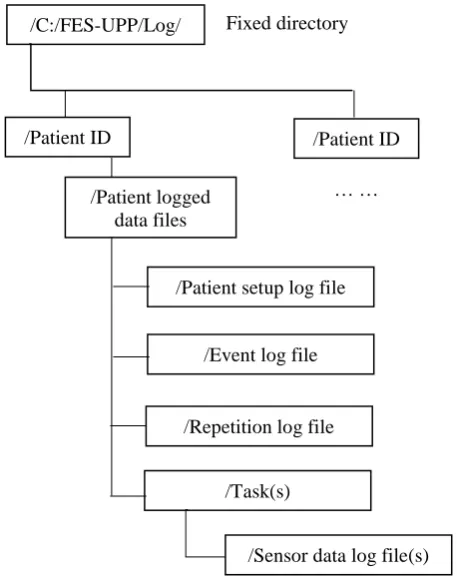
Figure 1: Directory design
The patient logged data files include patient setup file for each functional task, key interaction events between the therapist and software, information corresponding to each repetition of task and Quaternion angle data from sensor used for tracking body segment movement (see Fig. 1 and Tab. 1).
Table 1: Patient logged data files.
Item Ext Number
of files
Example file
name
Patient setup log file .xml 1 Z04_03-02-2017_13.00.xm l
Event log file .txt 1 Event log.txt Repetition log file .txt 1 Repetition
log.txt Sensor data log file (s) .txt / Rep 1.txt
Patient logged data files
The Patient setup log file contains the core setup infor-mation, including FSM parameters (e.g. number of movement phases, phase name(s), muscles to be stimulat-ed during each phase), stimulation parameters that de-fined stimulation profiles (targets, ramp time, delay time and motor threshold), and transition rules etc. The Patient setup log file could be reloaded from the tablet hard drive for use in a new therapy session.
The Event log file contains the key software interaction events that occurred during the FES-UPP session. The timestamped and logged events include when the user
logged on/off the software, and entered different setup stages and session manager.
The Repetition log file contains information correspond-ing to each repetition of a task included the task name, repetition number, time spent in each movement phase, reason(s) for leaving each movement phase, and whether a repetition was successful. A successful repetition was deemed to have occurred when the FSM had progressed through each movement phase and returned to the neutral phase.
A Sensor data log file was automatically created for each repetition of a task while in therapy session manager. It logs the continuous quaternion data from those sensors assigned to a body segment and associates the data with a movement phase number and computer time.
The software uses “appointment date and time” to name a unique directory for each therapy session.
Experiment demonstration
[image:3.595.305.537.465.561.2]To illustrate the application of the approach, below we report on case study data gathered as part of a clinical evaluation of the system. Following ethical approval (REC ref 16/YH/0258), the study aimed to evaluate the system in three different clinical settings. In each case, the system was used by trained therapists without on-site technical support. In this paper we report on use of the system in very early post-stroke rehabilitation (less than 1 week) with 1 participant who had severely impaired up-per-limbs. The patient participant was treated by three therapists using the FES-UPP system during 7 therapy sessions, spread over approximately 4 weeks.
Table 2: Therapist participants
Therapist participants PT1 OT2 TA3
Clinical experience on treating stroke patients
(years)
6 15 1
FES experience Yes, lower limb only
No No
No of session completed 2 2 3
1PT = physiotherapist;
2OT = occupational therapist;
3TA = rehabilitation therapy assistant;
One PT, an OT and a TA, none of whom had prior clini-cal experience of upper limb FES treated the patient par-ticipant reported here (see Tab. 2). All three therapists completed a two-day training session to learn how to use the FES-UPP system and to follow the study protocol. A clinical manual and on-line training materials for the system were available to the therapists during the study. In each therapy session, the participant was asked to carry out one or two functional tasks assisted by electrical stim-ulation . The tasks were imported by the therapist from a standard hand-arm activity library in the FES-UPP setup software.
/C:/FES-UPP/Log/ Fixed directory
/Patient ID
/Patient logged data files
/Patient setup log file
/Event log file
/Repetition log file
/Task(s)
/Sensor data log file(s) /Patient ID
[image:3.595.57.290.497.603.2]Table 3: The therapy session information for patient participant.
Therapy No
Performed task(s)
Total Reps No
Success rate1 (%) Total practicing
time (mins)
Total therapy time (mins)
Efficiency2
(%)
1 Reach to Target 8 100% 2.2 35.8 6.1
2 Sweeping coins 10 40% 3.8 50.2 7.6
3 Reach to Target 7 85.7% 2.8 48.7 5.7
4 Reach to Target 7 71.4% 9.9 76 15.1
Sweeping coins 3 100% 1.6
5 Sweeping coins 67 100% 23.8 50.3 47.3
6 Sweeping coins 56 98.2% 14.1 34.6 40.8
7 Sweeping coins 98 100% 19.4 25.8 75.2
Mean 36.6 96.1 11.1 45.9 24.2
1Successful rate (for a task) = (number of successful repetitions of this task/ the total number of attempts at the
task)×100%;
2Efficiency (for a session) = (total practicing time of this session/ total therapy time at the session)×100%
Results
Two different functional tasks, tailored to suit the im-pairment level of this particular stroke participant were set up across the 7 therapy sessions (see Tab. 3). The two tasks were “Reach to target” and “Sweep coins”. On one occasion, the participant managed to complete two func-tional tasks.
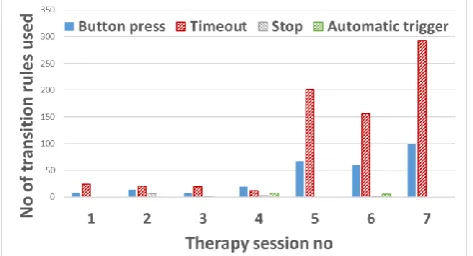
All 7 therapy session data were successfully logged. Some example outcomes were extracted from the patient logged data files, and summarized in Tab. 3 and Fig. 2. They include the performed tasks, total repetition number of each task, success rate, total practicing time, total therapy time, the efficiency in each therapy session and the thera-pist-defined rules. The total practice time was extracted from the Repetition log file and defined as the sum of time period when the FSM had progressed through each movement phase and returned to the neutral phase in the session manager. The total therapy time of a session was extracted from the Event log file and defined as follow:
[image:4.595.56.293.567.695.2]Total therapy time = Software log off time –log on time
Figure 2: Transition rules used for the participant
Fig. 2 illustrates the type of therapist-defined rules used in movement phase transitions for each task within each session. In all cases, therapists used a single rule. The automatic trigger defines a transition between two
succes-sive phases, based on data from body-worn sensors or the instrumented object.
Discussion
In this paper, we have reported an approach to recording real-time therapy session data each time the FES-UPP system was used. Redundant information was logged for each therapy session. Useful outcomes have been extract-ed from the patient loggextract-ed data files. On average, the participant achieved 36.6 repetitions within 11.1 minutes practice time per session across the study. The participant achieved a very high success rate (96.1%) Part of the reason for this was that all three therapists almost always chose to use simple transition rules, such as timeout or a button press (Fig. 2). It will be interesting to explore whether, as therapists gain confidence in the use of the FES-UPP they will exploit the opportunity to use motion sensor or object-based rules, which offer greater potential for patient engagement in the practiced activity. Tab. 3 illustrated a significant increase in the efficiency deliv-ered in the last three therapy sessions. The number of repetitions and amount of practice time during the last three sessions increased, while the total therapy session time decreased. The outcomes extracted from the patient logged data files demonstrated the potential of FES-UPP system to be used in busy clinical environments.
Conclusions
infor-mation was logged for each therapy session to support our understanding of its usability in clinical environments and to record therapy delivered. Some example information has been summarized from the logged data and shows a noticeable increase in the efficiency of therapy delivery with using FES-UPP system.
Nevertheless, future work to extract more information from the redundant logged data files is still required. The logged data files has potential to provide the feedback about the patient performance to the therapists during each therapy session.
Acknowledgement
This is a summary of independent research funded by the National Institute for Health Research i4i programme. The views expressed are those of the author(s) and not necessarily those of the NHS, the NIHR or the Depart-ment of Health.
References
[1]Howlett, O.A., Lannin, N. A. et al.: Functional electri-cal stimulation improves activity after stroke: a sys-tematic review with meta-analysis. Archives of Physi-cal Medicine and Rehabilitation, vol. 96, pp. 934-43, May 2015.
[2] Lynch, C. L., Popovic, M. R. et. al.: Functional electrical stimulation, IEEE Control Systems Magazine, vol. 28, pp. 40-50, April 2008.
[3] Hochstenbach-Waelen, A., & Seelen, H. A.: Embrac-ing change: practical and theoretical considerations for successful implementation of technology assisting upper limb training in stroke, Journal of neuroengi-neering and rehabilitation, vol. 9, pp. 1-12, Au-gust 2012.
[4] Smith, C.: Usability engineering in the design and evaluation of a functional electrical stimulation sys-tem for upper limb rehabilitation [Doctoral Thesis], University of Salford, November 2015.
[5] Sun, M., Smith, C. et. al.: FES-UPP: a flexible functional electrical stimulation system to support upper limb functional activity practice. Submitted to Frontiers in Neuroscience, 2018.