International Journal of Emerging Technology and Advanced Engineering
Website: www.ijetae.com (ISSN 2250-2459,ISO 9001:2008 Certified Journal, Volume 5, Issue 4, April 2015)
317
A New Approach in Computing Shortest Path for Road
Networks
A. Deepthi
1,
Dr. P. Srinivas Rao
2, S. Jayaprada
3, Ch. Ujjwala Roopa
41M.Tech (C.S.T)2nd Year, Department of Computer Science & System Engineering, Andhra University, India 2Professor, Department of computer science & System Engineering, Andhra University, India 3Sr. Assistant professor, Department of Computer Science and Engineering, Anil Neerukonda Institute of
Technology and Sciences, India
4M.Tech-CN, Department of Computer Science & System Engineering, Andhra University, India
Abstract—Live Traffic Updates is a prime need of the day. Based on live traffic updates the system aims at providing shortest path. This system has two challenges to focus on that effect its performance and scalability. The first challenge is that the conventional client-server architecture poorly scales with number of clients, because of non-scalable bandwidth issues. Thus in this paper we propose wireless broadcast as an alternative. And to facilitate frequent and accurate traffic updates in this paper, We designed a new system SG-LTS (Sub Graph based Live Traffic Share) system. I also have extended this system to include predictable traffic jams and supply updates accordingly.
Keywords—Shortest Path, Live Traffic Updates, Sharing System, Sub-Graph.
I. INTRODUCTION
Live Traffic updates on vehicle navigation systems have become a major need of the day. This system is based on shortest path computation module [1],[2],[3]. This module plays an important role in guiding the driver to his destination with the shortest path possible, helping him to reach the destination is n=the minimum optimal possible duration. Apart from detecting the shortest path in the initial phase of journey, it is important to keep the driver with the live updates of the traffic densities, which effect the travel time and are very uncertain. Based on the continuously changing traffic state, the system also should recompute the shortest path periodically and keep the driver posted with this updated information.
One main challenge in this kind of system is that the conventional server/client architecture shortfalls on bandwidth thus performs very poor on increase in number of clients. As an alternative I propose to use wireless broadcasting system for live traffic updates, where the server broadcasts the live traffic updates and the required clients shall tune to it and receive those signals.
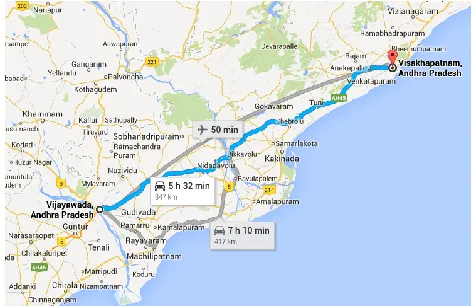
[image:1.612.325.562.375.528.2]We have several online services providers like Google- Map [4], Navteq [5], INRIX Information Provider [6], TomTom NV [7], etc which provides use with the route maps for a selected source and destinations. An image taken from Google Maps is shown in fig1. The disadvantage found in this architecture is a road map is provided without the traffic updates. I took traffic updates as a main challenge and proposed a new system called SG-LTS (Sub graph based Live Traffic Sharing).
Fig 1: Road Map Snap Shot From Google Maps.
The next challenge in this system is that, updating the entire road map of a locality and computing all possible shortest paths and then distributing or sharing them to all clients. Thus I designed the SG-LTS (Sub graph based Live Traffic Sharing).
International Journal of Emerging Technology and Advanced Engineering
Website: www.ijetae.com (ISSN 2250-2459,ISO 9001:2008 Certified Journal, Volume 5, Issue 4, April 2015)
318
The driving principle of Subdue’s approach is the use of the minimum description length (MDL) principle to evaluate the interestingness of a substructure. The use of MDL rather than frequency to evaluate a substructure distinguishes Subdue from all other frequent sub graph discovery systems. Subdue typically produces a fewer number of substructures which best compress the graph dataset. These few substructures which compress the input dataset can provide important insights about the domain than a large number of substructures, each of which is frequent, in the graph dataset.
As the client queries for a path, the respective sub-graph is downloaded to the client on the initial phase of the journey and periodically the client tunes into the servers channel and receives the set of required updates only and computing the shortest path is done on the client side which saves a lot of server side processing and improves the performance admirably.
The rest of the paper is organized as Section II presents the sub-graph algorithm, Section III presents a detailed project of the algorithm SG-LTS. Section IV discusses the experimental results followed by Conclusion.
II. THE SUB DUE ALGORITHM.
Subdue is a graph-based relational learning system. The work on Subdue is one of the pioneering works in the field of graph-based data mining. Inputs to the Subdue system can be a single graph or a set of graphs. The graphs can be labelled or unlabeled. Subdue outputs substructures that best compress the input dataset according to the Minimum Description Length (MDL) [8] principle.
SubDue(Graph, BeamWidth, MaxBest, MaxSubSize, Limit)
1. ParentList=NULL;
2. ChildList=Null;
3. BestList=NULL;
4. ProcessedSubs=0;
5. Create a substructure from each unique vertex label and its single-vertex instances;
6. Insert the resulting substructure in ParentList; 7. while ProcessedSubs less than or equal to Limit
and ParentList not empty 8. do
9. while ParentList is not empty 10. do
11. Parent = RemoveHead(ParentList);
12. Extend each instance of Parent in all possible ways;
13. Group the extended instances into Child substructure; 14. for each Child
15. do
16. if SizeOf(Child) less than
MaxSubSize 17. then
18. Evaluate the Child; 19. Insert Child in ChildList in
order by value;
20. if BeamWidth less than Length(ChildList) 21. then
22. Destroy substructure at the end of ChildList; 23. Increment ProcessedSubs;
24. Insert Parent in BestList inorder by value; 25. if MaxBest less than Lenght(BestList) 26. then
27. Destroy substructure at the end of BestList;
28. switch ParentList and ChildList; 29. return BestList;
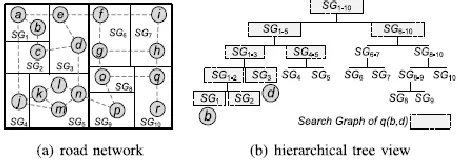
Subdue performs a computationally-constrained beam search which begins from substructures consisting of all vertices with unique labels. The substructure are extended by one vertex and one edge or one edge in all possible ways, as shown in fig 2, and generates hierarchical tree view of a given road network. Subdue maintains the instances of substructures in the examples and uses graph isomorphism to determine the instances of the candidate substructure in the examples. Substructures are then evaluated according to how well they compress the Description Length (DL) of the dataset.
The DL of the input dataset G using substructure S can be calculated using the following formula,
I(S) + I(G|S),
International Journal of Emerging Technology and Advanced Engineering
Website: www.ijetae.com (ISSN 2250-2459,ISO 9001:2008 Certified Journal, Volume 5, Issue 4, April 2015)
319
Fig 2: Road Map partitioning using sub graph.
In fig 2(a) a graph G=(VG,EG) (i.e., road network) is
taken and partitioned into set of small sub-graphs SGi, as
shown in fig 2(b). These SGi are organised in a hierarchical
fashion (i.e., tree).The hierarchical tree view enables clients to compute the shortest path on a portion of entire road network and reduces the tune-in cost. In Fig. 2(b), the graph is been partitioned into 10 sub graphs (SG1, SG2; . . . ; SG10) every leaf entry in a hierarchical structure
represents a sub graph SGi that consists of the
corresponding nodes and edges from the original graph.
III. THE SG-LTSSYSTEM
Live Traffic updates on vehicle navigation systems have become a major need of the day. As an alternative to a main challenge in this kind of system is that the conventional server/client architecture, which shortfalls on bandwidth thus performs very poor on increase in number of clients, I propose to use wireless broadcasting system for live traffic updates.
Here the server broadcasts the live traffic updates and the required clients shall tune to it and receive those signals.
The next challenge in this system is that, updating the entire road map of a locality and computing all possible shortest paths and then distributing or sharing them to all clients. Thus I designed the SG-LTS (Sub graph based Live Traffic Sharing).
The new architectural diagram for SG-LTS is given in fig 3. The traffic provider collects the live traffic circumstances from the traffic monitors via techniques like road sensors and traffic video analysis. The service provider periodically receives live traffic updates from the traffic provider and broadcasts the live traffic index on radio or wireless network (e.g., 3G, LTE, Mobile WiMAX, etc.). When a mobile client wishes to compute and monitor a shortest path, it listens to the live traffic index and reads the relevant portion of the index for computing the shortest path. Here, we focus on handling traffic updates but not graph structure updates.
For real road networks, it is infrequent to have graph structure updates unless there are new road constructions when compared to edge weight updates.
The system setup
G: The locality graph.
SG: The requested sub graph as connected forest
rooted at s till t, where s is the source node of the journey and t is the destination of that path.
v: The vertex, each junction of the map
e(v1,v2) The edge, path connecting any two verticies v1 and v2.
P The set of possible paths
SPt The shortest path available at a given time
instance t. wei
t These weight (the time required to cross) a edge ei
[image:3.612.52.281.137.217.2]at a time instance t
Fig 3: SG-LTS Architecture.
SG-LTS - a step by step approach
1. Pre- Processing Phase on Server
a. G: Input Locality Map as a Graph
b. SubDue(Locality Graph G)
2. On Client Side
a. Query for a source s and target t
b. Download the respective Sub-Graph SG
3. On Server Side
a. Broadcast the live traffic update
4. On Client Side
a. Receive the required edge updates
b. Compute the shortest path
5. Repeat step 3 & 4 until t is reached. Client Algorithm
[image:3.612.314.563.159.738.2]International Journal of Emerging Technology and Advanced Engineering
Website: www.ijetae.com (ISSN 2250-2459,ISO 9001:2008 Certified Journal, Volume 5, Issue 4, April 2015)
320
2. listen to the channel for a header segment 3. read the header segment
4. decide the necessary segment to be read
5. wait for those segments, read them to update the weight
6. compute the shortest path(from s to t) on gq
Server Algorithm Server (G:Graph)
1. Construct BestList I and {SGi}based on G
2. for each broadcast cycle do
3. collect traffic updates from the traffic provider 4. update the subgraphs {SGi}
5. broadcast the subgraphs {SGi}
In this system the server comprises the locality map. This graph is fed to the SubDue procedure and the resultant sub-graphs are populated t=with initial traffic statistics and are cached on the server side.
When a client queries the server, the server posts the respective sub-graph SG on to the client and the client computes the shortest path.
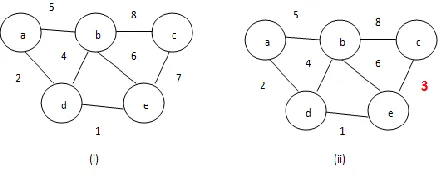
Fig 4 (i): Initial sub graph, (ii) Subgraph after Live Traffic Update
Once the journey starts, the client tunes into the server broadcast channel periodically and receives the update traffic data, updates the sub graph and recomputes the shortest path.
Example
Once the hierarchical tree view is been constructed as shown in fig 2(b), if the client requests for a road map and its traffic updates periodically then the required sub graph which routes from source node to target node is considered with its initial weights (hours taken to travel from one node to the other which is named as traffic) as shown in fig 4(i) and starts moving to its target node.
Periodically when the traffic updates are requested by the client new updated weights are posted as shown in fig 4(ii).
IV. THE EXPERIMENTAL SETUP AND RESULTS The above designed system is implemented using Java 6 SE. We could simulate the wireless broadcast due to limitations in technical resource unteachability to our level.
[image:4.612.323.565.276.425.2]And this system is extensively tested with varied datasets and recorded the experimental results and devised them as graphs as below.
Fig 5: Graph projecting correctness of the system across different datasets.
Fig 6: Graph projecting computational responsive time of the system across different datasets.
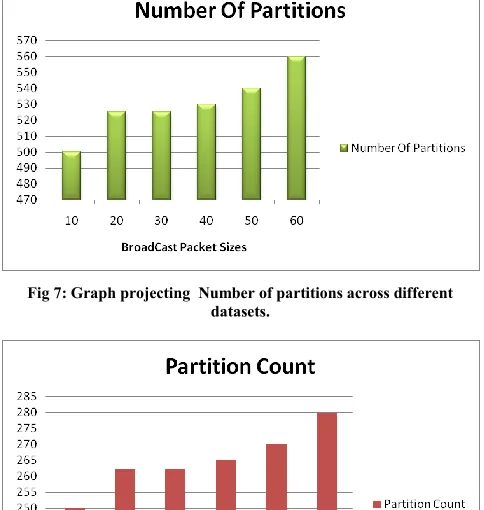
The system is tested against different data set sizes, broad cast packet sizes, tune - in times and the resultant results are tabulated for analysis.
[image:4.612.57.281.419.508.2] [image:4.612.323.565.447.594.2]International Journal of Emerging Technology and Advanced Engineering
Website: www.ijetae.com (ISSN 2250-2459,ISO 9001:2008 Certified Journal, Volume 5, Issue 4, April 2015)
[image:5.612.48.290.143.398.2]321
Fig 7: Graph projecting Number of partitions across different datasets.
Fig 7: Graph projecting Number of partitions across Tune - in Size
V. CONCLUSION
Using the architecture we designed the shortest path result is computed/updated based on the live traffic circumstances.
We carefully analyse the existing work and discuss their inapplicability to the problem (due to their prohibitive maintenance time and large transmission overhead). To address the problem, we suggest a promising architecture that broadcasts the index on the air, SG-LTS Sub Graph Live Traffic Sharing. This developed system is implemented against a set of varied datasets and varying tune-in sizes. Tune-in size is the number of clients tuning in to the server at a given window of time. Finally, predictive traffic circumstances are also considered because decision of a shortest path depends not only on current traffic data but based on the predicted traffic circumstances. The experimental results are very promising and supportive to the proposed system design.
REFERENCES
[1] H. Bast, S. Funke, D. Matijevic, P. Sanders, and D. Schultes, “In Transit to Constant Time Shortest-Path Queries in Road Networks,”
Proc. orkshop Algorithm Eng. and Experiments (ALENEX),
2007.
[2] P. Sanders and D. Schultes, “Engineering Highway Hierarchies,” Proc. 14th Conf. Ann. European Symp. (ESA), pp. 804-816, 2006. [3] G. Dantzig, Linear Programming and Extensions, series Rand
Corporation Research Study Princeton Univ. Press, 1963.
[4] R.J. Gutman, “Reach-Based Routing: A New Approach to Shortest Path Algorithms Optimized for Road Networks,” Proc. Sixth Workshop Algorithm Eng. and Experiments and the First Workshop Analytic Algorithmics and Combinatorics (ALENEX/ANALC), pp. 100-111, 2004.
[5] “Google Maps,” http://maps.google.com, 2014.
[6] “NAVTEQ Maps and Traffic,” http://www.navteq.com, 2014. [7] “INRIX Inc. Traffic Information Provider,” http://www.inrix.com,
2014.
[8] “TomTom NV,” http://www.tomtom.com, 2014.