G r a vi t a ti o n al t h e o r e ti c al
d e v elo p m e n t s u p p o r ti n g M O N D
C h a d wi c k, EA, H o d g ki n s o n , T F a n d M c D o n al d , G S
h t t p :// dx. d oi.o r g / 1 0 . 1 1 0 3 / P h y s R e vD. 8 8 . 0 2 4 0 3 6
T i t l e
G r a vi t a ti o n al t h e o r e ti c al d e v elo p m e n t s u p p o r ti n g M O N D
A u t h o r s
C h a d wi c k , EA, H o d g ki n s o n , T F a n d M c D o n al d , G S
Typ e
Ar ticl e
U RL
T hi s v e r si o n is a v ail a bl e a t :
h t t p :// u sir. s alfo r d . a c . u k /i d/ e p ri n t/ 3 2 0 8 6 /
P u b l i s h e d D a t e
2 0 1 3
U S IR is a d i gi t al c oll e c ti o n of t h e r e s e a r c h o u t p u t of t h e U n iv e r si ty of S alfo r d .
W h e r e c o p y ri g h t p e r m i t s , f ull t e x t m a t e r i al h el d i n t h e r e p o si t o r y is m a d e
f r e ely a v ail a bl e o nli n e a n d c a n b e r e a d , d o w nl o a d e d a n d c o pi e d fo r n o
n-c o m m e r n-ci al p r iv a t e s t u d y o r r e s e a r n-c h p u r p o s e s . Pl e a s e n-c h e n-c k t h e m a n u s n-c ri p t
fo r a n y f u r t h e r c o p y ri g h t r e s t r i c ti o n s .
arXiv:1307.3937v1 [gr-qc] 15 Jul 2013
A gravitational theoretical development supporting MOND
Edmund A. Chadwick, Timothy F. Hodgkinson and Graham S. McDonald
School of Computing, Science and Engineering ,University of Salford Salford M5 4WT, UK
E.A.C. and T.F.H. contributed equally to the formulation, analyses and interpretation. The authors are thus listed in alphabetic order. G.S.M.’s contribution was help with the point-source solutions.
Abstract
Conformal geometry is considered within a general relativistic framework. An in-variant distant for proper time is defined and a parallel displacement is applied in the distorted space-time, modifying Einstein’s equation appropriately. A particular solution is introduced for the covariant acceleration potential that matches the observed velocity distribution at large distances from the galactic centre, i.e. Modified Newtonian Dynam-ics (MOND). This explicit solution, of a general framework that allows both curvature
and explicit local expansion of space-time, thus reproduces the observed flattening of galaxys’ rotation curves without the need to assume the existence of dark matter. The large distance expansion rate is found to match the speed of a spherical shock wave.
1
Introduction
such that the line element remains invariant [10] [11]. Similarly, the formulation presented here can equivalently be viewed as a gauge re-scaling together with a length re-scaling to ensure that for weak distortion of space-time the invariant (line element) proper time is the atomic time and so does not vary as it does in Weyl theory. Defining an invariant distance for proper time and applying parallel displacement in the distorted space-time leads to a formulation that fits MOND for the dynamics of galaxies by introducing a particular solution for the covariant acceleration potential.
2
The distortion of space-time
The notation and arguments as laid out by Dirac [19] are followed. Assume that there exists a higher N-dimensional space described by rectilinear contravariant coordinate points
z′n(n= 1,2, ....N), such that there is a distance measureds′between two neighbouring points
given by
ds′2=dz′
ndz′n=hnmdz′mdz′n, (1)
where dz′
n and dz′n are the covariant and contravariant infinitesimal changes in position
respectively, and the tensor hnm is constant. In the presence of matter, assume that this
space is distorted by both local expansions and curvature.
Consider local expansions first. Allowing explicit expansions that are isotropic at point
zm such thatdz′m =√αdzm, then (1) becomes
ds′2
=αhnmdzmdzn, (2)
where the factor 1/αis a function of position.
Now consider curvature. In particular, consider a lower-dimensional curved ‘surface’ lying in the higher dimensional plane. The lower-dimensional 4-space xµ, (µ = 0,1,2,3) is
defined, wherex0 denotes the time coordinate, and (x1, x2, x3) denote the spatial coordinates.
Follow the convention where Greek symbols denote indices summed from 0 to 3, and Roman symbols denote indices summed from 1. Let the pointyn(x) in the higher dimensional plane
correspond to a point xµ in four-dimensional space-time. Then from (2) we get
ds′2
= αhnmyn,µym,νdxµdxν
= αyn,µyn,νdxµdxν
= gµνdxµdxν (3)
where the comma denotes a differentiation, and the convention for inner product is aµb µ= a0b
0−a1b1−a2b2−a3b3. The metric is therefore defined as
gµν =αyn,µyn,ν. (4)
Hence, the components of the metric tensor are determined by both local expansion and curvature, from the α factor and from theyn,
µyn,ν factor respectively.
3
Invariant distance and parallel displacement
Requiring an invariant distance means that
ds2=yn,
where ds is the invariant infinitesimal distance (line element or proper time) between two infinitesimally close points. For weak curvature (5) becomesds=dx0, so proper time becomes
atomic time without a scaling factor present; in Weyl theory, the distance measure is chosen as the rescaled gauge, and so for weak curvature the scaling factor is present, leading to Einstein’s objection. Equating this with (3) gives
αds2=ds′2 =αyn,
µyn,νdxµdxν, (6)
which is equivalent to a gauge rescaling together with a counterbalancing length rescaling on the left-hand-side and right-hand-side of (6) respectively.
The change in vector length due to parallel displacement is
dAν = (Aµαyn,µyn,νσ+Aν(lnα),σ)dxσ. (7)
Note that whenα= 1 there is no expansion and the standard result for parallel displacement is recovered.
4
Expansion symbols and covariant differentiation
This analysis works on the metric and its re-scaling, so produces the same formulations obtained by Weyl for gauge invariance [15] [16] [17], and give rise to expansion symbolsEµνσ
and Christoffel symbols Γµνσ. The standard Christoffel symbol is,
Γµνσ= 1/2(gµν,σ−gσν,µ+gµσ,ν),
and the expansion symbol given by
Eµνσ = 1/2(gµν(lnα),σ−gσν(lnα),µ+gµσ(lnα),ν) (8)
are introduced. So, the change in the covariant vector Aν given by (7) can be rewritten as
dAν = Aµ(Γµνσ−Eµνσ+gµν(lnα),σ)dxσ
= AµΓ∗µνσdxσ, (9)
where the Christoffel symbol has been modified to
Γ∗µνσ = Γµνσ−Eµνσ+gµν(lnα),σ
= Γµνσ+Eνµσ (10)
The infinitesimal change in the covariant vector is now used to define covariant differenti-ation. Noting thatAµ(x) + Γα∗µνAαdxν is a parallel displaced tensor so is also a tensor (where gαβΓα∗µν = Γ∗βµν), then define a modified covariant derivative
Aµ;ν =Aµ,ν−Γα∗µνAα, (11)
as opposed to the standard covariant derivative given by Aµ:ν = Aµ,ν−ΓαµνAα. So the
modified curvature tensor is
Rβ∗νρσ = Γβ∗νσ,ρ−Γβ∗νρ,σ+ Γ∗ανσΓβ∗αρ−Γα∗νρΓβ∗ασ.
For weak curvature, dropping quadratics, this becomes
R∗µν = Γα∗µα,ν−Γα∗µν,α
5
Change in vector length and contravariant change
The change in the dot product of two vectors is
d(AνBν) = d(gµνAµBµ)
= gµνAµdBν +gµνBνdAµ+AµBνgµν,σdxσ.
Substituting in for the covariant change (9), and using the fact that Γµνσ+ Γνµσ=gµν,σ and Eµνσ+Eνµσ =gµν(lnα),σ, gives
d(AνBν) = [AνBµgµν,σ−AνBµgµν(lnα),σ
+2AνBν(lnα),σ+AαBβgαβ,σ
i
dxσ.
Noting thatAαBβgαβ,σ=−AνBµgµν,σ, then gives
d(AνBν) = AνBν(lnα),σdxσ
= AνBνd(lnα). (13)
Therefore, d(AνB ν
α ) = 0 and so letting A
ν =Bν gives a change in vector length
d((1/α)(AνAν)) = 0,
so the length of a vector changes by the factor 1/α from point to point. Letting Aν =dxν,
thend((1/α)(dxνdx
ν)) =d(ds′2/α) = 0, giving d(ds) = 0,
and sods is an invariant distance as expected from (5) for consistency. From (13),d(AνBν) =AνBνd(lnα) =AνdBν+dAνBν, this gives
AνBν = d(AνBν)−AνBµΓν∗µσdxσ
= AνBνd(lnα)−AνBµΓν∗µσdxσ.
This holds for anyAν, and so cancelling the repeated term gives
dBν =−BµΓ∗ν
µσdxσ, (14)
where Γ∗ν
µσ= Γνµσ−gµν(lnα),σ, and so
Γ∗
αµσ = Γαµσ−Eαµσ.
6
Geodesic acceleration
Letting
dxσ = dx
σ
ds ds=V σds,
where ds is the invariant distance, then from (14) the contravariant velocity Vµ in weak
distorted space is
dVµ
ds = −Γ
∗µ νσVνVσ dVm
ds = −Γ
∗m νσVνVσ
= −Γ∗m
00V
0
V0
= −gmnΓ∗
n00V
For a static gravitational field, gµν,0=α,0= 0 and alsogn0 = 0. So, Γn00= (−1/2)g00,n and En00= (−1/2)g00(lnα),n. Furthermore, from (3)αdx2 =gµνdxµdxν, and so for a static field
(such that gm0 =g0m = 0) and for velocities small compared with light such that quadratics VmVn can be dropped, thenα=g
00V0V0. Substituting these results into (15) gives
dVm ds =−g
mnΓ∗
n00V 0
V0 = (1/2)gmng00,nV0V0−g00(lnα),nV0V0
= (1/2)(αgmn) (ln(g00/α)),n
= (αgmn)φ,n,
where
φ= ln
r
g00
α ≈
r
g00
α −1≈(1/2)
g
00
α −1
(16)
is the covariant acceleration, since in the weak distortion limit αgmn =−1 form =n. It is noted that when α= 1, the standard result for geodesic acceleration is obtained.
7
Einstein’s field equations and the gravitational force
In empty space, Einstein’s field equations then become
R∗µν−(1/2)gµνR∗= 0.
In the presence of matter, a material energy tensor Tµν is required such that Tµν
;µ = 0,
for the modified covariant differentiation given by (11). Defining a velocity V∗µ given by differentiating distance with respect to the higher dimensional distance measure s′, then
V∗µ=dxµ/ds′ = (1/√α)Vµ and sog
µνV∗µV∗ν = 1, leading toV∗µV∗ν;σ = 0. Together with the
condition for conservation of matter (ρV∗µ);µ, then givesT;µσµ = (ρV µ
∗ V∗ν);µ = 0. So, consider
generalising Einstein’s field in the presence of matter by
R∗µν−(1/2)gµνR∗ =−8πρV∗µV∗ν. (17)
For α = 1, R∗ = R and V∗µ = Vµ, and the standard law is recovered. Rearranging in the
usual way to incorporate the term R∗ into the right hand side of (17), substituting forR∗µν
given by (12) and neglecting quadratic quantities in Γ and E for weak distortion, gives when
µ=ν = 0
αgαβ(Γβ0α,0−Γβ00,α) +αgαβ(E0βα,0−E0β0,α) =−4πρV0V0.
A static field such that gαβ,0= (lnα),0= 0 gives Γβ0α,0= 0, Γβ00,α= (−1/2)g00,βα,E0βα,0=
0 and E0β0,α= (1/2)[g00(lnα),β]α. So
(1/2)gmn(g00,mn−[g00(lnα),n],m) =−4πρV0V0.
For a weak field
ynµyn,ν≈
1 forµ=ν = 0
−1 forµ=ν 6= 0 0 otherwise,
and so
gµν =αyµnyn,ν=
α 0 0 0
0 −α 0 0
0 0 −α 0
0 0 0 −α
, gµν =
1/α 0 0 0
0 −1/α 0 0
0 0 −1/α 0
0 0 0 −1/α
For a static and weak field g00V
0V0= 1/α, so V0 = 1 and
g00,mm−[g00(lnα),m]m= 8πρ. (18)
From (16) the covariant potential φ is such that (1/2)[(lng00),n−(lnα),n] = φ,n, and so
substituting this into (18) gives
(g00φ,m),m= 4πρ, (19)
and rearranging (16) gives
g00
α = 1 + 2φ.
It is seen that althoughg00/αmust be close to unity for weak distortion,g00 is unrestricted.
So g00 can be equated to the MOND function, retrieving MOND dynamics in a simple and
straightforward way.
For a point source, following the same arguments as [20], from (19) we get Newton’s second law given explicitly as
M g00a=F (20)
assuming no curl vector field present, where M is the point mass, a the acceleration and F
the force, which is the standard MOND modification but with g00 identified as the MOND
interpolation functionµ.
8
Point source and general solution
Using (16) and substitutingg00=αe2φ into (19) yields after integration that
αe2φ= D
r2|▽˜φ| (21)
for point source of massM,ρ=M δ(r), whereDis an integration constant,r=qx2
1+x22+x23
and δ(r) is the Dirac delta function. Matching this solution to the observed flattening of galaxys’ rotation curves imposes that |▽˜φ| → D/r2 when
|▽˜φ| ≫ a0 and that |▽˜φ| →
√
a0D/r when |▽˜φ| ≪a0, where a0 is the acceleration parameter of MOND theory. Thus a
consistent solution for the potential is derived to be
φ=−M/r+pa0Mlnr, (22)
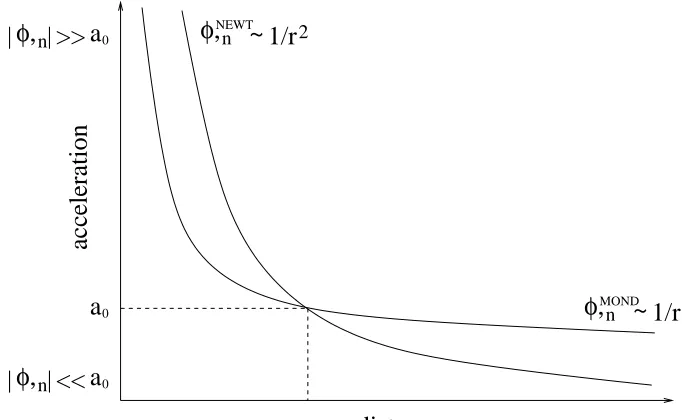
where D has been identified as the point source mass. This empirical derivation allows interpretation of the rate of expansion, suggesting a physical context and thus an alternative derivation (see later). The first term is the Newtonian potential due to the curvatureφN EW T,
and the second term is the MOND potential due to local expansions φM ON D, see figure 1. Then, (g00φ,m),m= 4πρ means thatg00φ,m= (M/r2)~r. So
g00=
M/r2
M/r2+√a
0M /r
, (23)
and g00/α= 1−2M/r+ 2√aoMlnr. Two limits can now be considered.
For small r such that the curvature termM/r2 dominates the expansion term√a
0M /r,
then this equates to a dominant solution of the Newtonian potentialφN EW T where the
accel-erations are such that |φN,
m|/a0 >>1. Then (22) becomes φN EW T =−M/r,φN EW T,m=
(M/r2)~r, and (23) becomesg
00= 1−
qa
0
Mr ≈1,g00/α= 1−2M/r. So, the Newtonian point
φ,
NEWTn
~ 1/r
2a
0a
0φ,
n<<
|
|
a
0acceleration
distance
n
~
φ,
MOND1/r
φ,
n [image:8.612.147.488.109.319.2]|
| >>
Figure 1: The change in acceleration with distance
For large r such that the expansion term √a0M /r dominates the curvature term M/r2,
then this equates to a dominant solution of the MOND potential φM ON D where the
ac-celerations are such that |φM,
m|/a0 << 1. Then (22) becomes φM ON D =
√
a0Mlnr,
φM ON D,m= (√a0M /r)~r, and (23) becomesg00=
q
M a0
1
r.
Substituting into (19), gives [qMa01r(√a0Mlnr),m],m= [Mr2~r],m= 4πM δ(x) = 4πρ as expected.
Also if limits are introduced directly into (21) such that for the Newtonian case asr→0,
α = 1 and 2φ≪1, this gives
r2(1 + 2φ) ˜
▽φ=M. (24)
After integration and |φ2
| ≪ |φ|yields φ=−M/r as expected. In the MOND limit |φ2
| ≫ |φ3
| and α = α(r). After integration this gives φ(r) ∝
√
a0Mlnr, where
α(r) = 1 2a0rlnr
. (25)
Interestingly, the 1/rlnr dependence for α (the space-time expansion) is identical to the large r radial velocity of a spherical shock wave [21] [22] [23]. So, if one assumed this physical origin for expansion one can directly derive the second term in (22) without fitting MOND characteristics to the solution.
It is noted that the factor g00 is approximately unity in the Newtonian approximation,
meaning that (19) is linear and so a system of point sources can be considered as a summation of separate point source solutions. However, in the MOND approximation, g00 is a varying
function, and so (19) is non-linear and cannot be broken down in this way. Furthermore, the mass term on the right hand side of (19) is split into a factor √M with the potential and a factor √M withg00. So, the momentum equation of Newton’s second law only makes sense
if it is modified to include the factorg00. Furthermore, because of the nonlinearity this factor
The point source solution suggests a general solution given by
φ = φN EW T +φM ON D
g00 =
∇φN EW T ∇φN EW T +∇φM ON D
α = 1−2φ
N EW T −2φM ON D
1 +|∇φM ON D/∇φN EW T| g00/α = 1 + 2φN EW T + 2φM ON D
where ∇ is the differential operator (∂x∂1,∂x∂2,∂x∂3) for Cartesian co-ordinate system vector representation (x1, x2, x3). φN EW T and φM ON D are connected in the sense that they can
be seen as limiting values of the same general potential φ, such that the first is the limit of small relative radius for solar systems, and the second is the limit of large relative radius for galaxies. So this choice of φhas a certain degree of physical justification in that it gives the expected physics in these limits. The two limits are then as follows.
When |φ,n|/a0 >>1, then curvature dominates so|∇φN EW T|>>|∇φM ON D|, and
φ = φN EW T
g00 = 1
α = 1−2φN EW T g00/α = 1 + 2φN EW T,
and soφN EW T,
mm= 4πρ, and the Newtonian gravitational representation is recovered. Such
accelerations feature in solar system dynamics.
However, when |φ,n|/a0 << 1, then expansion dominates |∇φM ON D| >> |∇φN EW T|,
and
φ = φM ON D
g00 =
∇φM ON D a0 α =
∇φM ON D a0
(1−2φM ON D)
g00/α = 1 + 2φM ON D,
and so (19) becomes
(g00φ,m),m= (|∇
φM ON D| a0
φM ON D,m),m= 4πρ,
which is the MOND representation for the potential acceleration. Such accelerations feature in the motions of galaxies.
Acknowledgments This work was undertaken through an STFC studentship grant at
the University of Salford. We are grateful for the helpful comments of the referees.
References
[2] The LHCb collaboration, “First evidence for the decayB0
s →µ+µ−,”European
Organi-zation for Nuclear Research (CERN), pp. CERN–PH–EP–2012–335, 2012.
[3] M. Markevitz, A. Gonzalez, D. Clowe, A. Vikhlinin, L. David, W. Forman, C. Jones, S. Murray, and W. Tucker, “Direct constraints on the dark matter self-interaction cross-section from the merging galaxy cluster 1e0657-56,” Astrophysical Journal, vol. 606(2), pp. 819–824, 2003.
[4] M. Milgrom, “Milgrom’s perspective on the Bullet Cluster,” The MOND pages, p. http://www.astro.umd.edu/∼ssm/mond/moti bullet.html, 2012.
[5] R. Tully and J. Fisher, “A New Method of Determining Distances to Galaxies,” Astron-omy and Astrophysics, vol. 54, pp. 661–673, 1977.
[6] M. Milgrom, “A modification of the Newtonian dynamics as a possible alternative to the hidden mass hypothesis,”Astrophysical Journal, vol. 270, pp. 365–370, 1983.
[7] S. McGaugh, “A Novel Test of the Modified Newtonian Dynamics with Gas Rich Galax-ies,” Phys. Rev. Lett., vol. 106, p. 121303, 2011.
[8] J. Bekenstein, “Relativistic gravitation theory for the modified Newtonian dynamics paradigm,” Phys. Rev. D., vol. 70, no. 8, p. 083509, 2004.
[9] M. Seifert, “Stability of spherically symmetric solutions in modified theories of gravity,”
Phys. Rev. D., vol. 76, no. 6, p. 064002, 2007.
[10] P. Mannheim and D. Kazanas, “Exact vacuum solution to conformal Weyl gravity and galactic rotation curves,” Astrophysical Journal, vol. 342, pp. 635–638, 1989.
[11] P. Mannheim, “Alternatives to dark matter and dark energy,” Progress in Particle and Nuclear Physics, vol. 56, pp. 340–445, 2006.
[12] C. Masreliez, “Expanding spacetime theory - on the shape of spiral galaxies and their flat rotation curves,” http://www.estfound.org/galaxy.htm, 2012.
[13] S. Capozziello, V. Cardone, and A. Troissi, “Dark energy and dark matter as curvature effects,” Journal of Cosmology and Astroparticle Physics, vol. JCAP08(2006)001, 2006.
[14] T. Ma and S. Wang, “Gravitational field equations and theory of dark matter and dark energy,” arXiv:1206.5078, 2012.
[15] H. Weyl, Gravitation and Electricity. Sitz. Berichte d. Preuss. Akad. d. Wissenschaften, 465, 1918.
[16] A. Einstein, H. Lorentz, H. Weyl, and H. Minkowski, The principle of relativity. New York: Dover (originally published by Methuen 1923), 1952.
[17] A. Eddington,The mathematical theory of relativity, 2nd edition. Cambridge University Press, Cambridge, 1924.
[18] R. Schulman, A. Kox, M. Janssen, and J. Illy, Einsteins Collected Papers, Vol. 8A-8B: The Berlin Years: Correspondence, 1914-1918. Princeton, New Jersey: Princeton University Press, 1997.
[20] J. Bekenstein and M. Milgrom, “Does the missing mass problem signal the breakdown of newtonian gravity?” Astrophysical Journal, vol. 286, pp. 7–14, 1984.
[21] L. Landau, “On shock waves at large distances from the place of their origin,” U.S.S.R. J.Phys, vol. 9, pp. 496–503, 1945.
[22] G. B. Whitham,Linear and Nonlinear Waves,. New York: John Wiley and sons, Chap. 9, p.p. 330, 1974.