Explaining Cost Overruns in Highway Projects: A
Geo-Spatial Regression Modelling and Cognitive Mapping of
Latent Pathogens and Contextual Drivers
Amadi Alolote Ibim
Explaining Cost Overruns in Highway Projects: A Geo-Spatial Regression
Modelling and Cognitive Mapping of Latent Pathogens and Contextual Drivers
Amadi Alolote Ibim
School of the Built Environment
College of Science and Technology
University of Salford, UK.
Table of
Contents
List of Figures ... xiv
List of Tables ... xviii
Acknowledgement ... xxi
Dedication ... xxii
Declaration ... xxiii
Publications and Presentations ... xxiv
List of Abbreviations ... xxv
Abstract ... xxviii
Chapter 1 ... 1
Introduction ... 1
1.1 Background to the Study ... 1
1.2 Statement of the Problem ... 5
1.2.1 The Facts and Figures ... 6
1.2.2 The Perceived Underlying Issues/ Need for the Study... 9
1.3 Suspected Gaps in the Practices of the Highway Agencies ... 11
1.4 Aim and Objectives of the Study ... 12
1.5 Research Questions ... 13
1.6 Methods, Research Design, and Outline Structure of the Thesis ... 14
1.7 Study Scope ... 17
1.8 Limitations, Exclusions, Constraints and Reservations ... 17
Chapter 2 ... 19
Administrative Background to Highway Development in the Niger Delta Region of Nigeria ... 19
2.0 Introduction... 19
2.1 Road Infrastructure Investment in Developing Countries: The Context of Nigeria ... 19
2.2 Historical Perspective to Highway Development Investment in Nigeria ... 22
2.4 Geographic Setting of Highway Development in Nigeria ... 27
2.5 Geo-Political versus Geologic Definitions of the Niger Delta Region ... 30
2.6 Past and Present Regional Highways Development Frameworks in the Niger Delta ... 32
2.7 Present State of Highway Development in the Niger Delta Region ... 33
2.8 Highway Project Delivery in the Niger Delta: Delays and Abandonment ... 36
2.9 Causes of Delays and Abandonment in Developing Countries: The Nigerian Context ... 38
2.10 What Underlying Factors Specific to Highway Projects in the Niger Delta? ... 41
2.11 Chapter Summary ... 42
CHAPTER 3 ... 44
Establishing the Explanatory Roots of Cost Overruns in Highway Projects: A Critical Theoretical Analysis ... 44
3.0 Introduction... 44
3.1 Cost Overruns Statistics in Construction Projects ... 45
3.2 Cost Overruns in Highway Projects: What Critical Reference Phase? ... 47
3.3 Explanations to Cost Overruns Rooted in the Conceptual Phase of Public Projects ... 52
3.4 Technical Explanations ... 54
3.5 Theoretical Explanations ... 57
3.5.1 Psychological Explanations ... 58
3.5.2 Strategic Misrepresentation ... 60
3.6 Critical Empirical Review of Studies Providing Cost Overrun Explanations ... 62
3.6.1 Empirical Review of Technical Explanations ... 63
3.6.2 Technical Studies Analysing of Cause-Effect Relationships Based on Project Data ... 66
3.6.3 Empirical Review of Theoretical Explanations ... 70
3.7 Contextual Case Study Narratives Explaining Cost Overruns... 74
3.7.1 Theory of Lock-in and Path Dependency by Cantarelli et al. (2010) ... 74
3.7.2 Latent Pathogens Framework by Love et al. (2012) ... 76
3.7.4 Core and Periphery Hybrid Meta-Organisation Theory by Lundriganm and Gill (2013) .. 81
3.7.5 Project Uncertainty Framework by Johansen (2015) ... 83
3.7.6 The ‘Vicious Cycle of Short-Funding and Delays' Narrative by Morris (1990) ... 85
3.8 Critical Literature Synthesis: Moving Beyond Abstract Postulations/Superficiality to Context Specific Studies, with In-depth Qualitative Narratives and Quantitative Outcomes ... 87
3.9 Theoretical Framework ... 91
3.10 Chapter Summary ... 92
CHAPTER FOUR ... 93
The Research Methodology ... 93
4.0 Introduction... 93
4.1 Research Philosophy ... 94
4.2 Elements of the Research Philosophy ... 95
4.2.1 Ontology ... 96
4.2.2 Epistemology ... 96
4.2.3 Axiology ... 97
4.3 Research Philosophies ... 98
4.3.1 Positivist/ Post-Positivist Philosophical Stance... 98
4.3.2 Interpretivism ... 99
4.4 Positioning Construction Management Research within the Philosophical Debate ... 106
4.5 Adopted Research Philosophical Stance in this Study: Critical Realism ... 109
4.6 Research Type ... 114
4.8 Research Method ... 118
4.9 Research Strategies ... 123
4.9.1 Experiments ... 125
4.9.2 Surveys ... 126
4.9.3 Grounded Theory ... 127
4.9.5 Selected Research Strategy: Case Study ... 132
4.10 Adopting the Case Study Research Strategy: Measures of Reliability and Validity ... 134
4.10.1 Construct Validity: Research Variables, Design and Approach to Theory Construction ... 138
4.10.2 Internal and External Validity: Operationalising the Case Study from Data to Theory 140 4.10.3 Reliability of Data used as Evidence in this Case Study ... 143
4.11 Data Types ... 144
4.12 Reliability of Secondary Data Sources in this Case Study ... 144
4.13 Primary Data Collection ... 145
4.13.1 Structure of Interviews ... 146
4.13.2 Conditions of Entry: Ethical Conduct and Mode of Participant Recruitment ... 148
4.13.4 Mode of Interview Conduct ... 150
4.14 Reliability of Qualitative Data from Interviews ……… 152
4.14.1 Piloting of Draft Interview Questions ... 152
4.14.3 Appropriateness of Professional Demographics ... 153
4.15 Data Protection ... 153
4.16 Data Analysis ... 154
4.16.2 Descriptive Qualitative Analysis (Deductive) ... 155
4.16.3 Descriptive Qualitative Analysis (Inductive) ... 155
4.16.4 Explanatory Regression Modelling and Cognitive Mapping ... 155
4.17 Chapter Summary ... 156
CHAPTER 5 ... 158
Exploratory Geo-Statistical Analysis of Latent Geologic Cost Overrun Drivers ... 158
5.0 Introduction... 158
5.1 Geomorphology: Heterogeneous Geologic Configuration ... 158
5.2 Highway Projects Cost Overrun Levels in the Niger Delta: Project Data ... 159
5.4 Difficult Expansive Soils of the Niger Delta (The ‘Chikoko’ Clay) ... 164
5.5 Inferential Analytic Procedure ... 166
5.5.1 Hypothesis 1 and 2: ANOVA Test and Turkey-Kramer Multiple Comparisons ... 166
5.5.2 Geo-Classifications of the Niger Delta Region in the Literature... 169
5.5.3 ANOVA Groupings: Synthesized Geo-classification of the Niger Delta ... 175
5.5.4 The One-way ANOVA Testing for Significant Differences in Cost Overruns between the Geo-Zones ... 179
5.5.5 Testing of Statistical Assumptions ... 180
5.5.6 Inference ... 183
5.5.7 Tukey Krammer-Multiple Comparison ... 183
5.6 What Latent Geotechnical Variables Account for the Significant Differences in Cost Overruns Experienced Between the Geo-zones? ... 184
5.6.1 Descriptive Geotechnical Parameters of Sub-grade soils: Grain Size Distribution ... 186
5.6.2 Quantitative Parameters: Index Properties ... 189
5.7 Hypothesis 3: Correlation Analysis of Geotechnical versus Project Cost overrun Data ... 192
5.7 Chapter Summary ... 193
Chapter 6 ... 195
Geotechnical Best Practices: Exploratory Literature Review of Geotechnical Triggers to Cost Overruns in Highway Project Estimates ... 195
6.0 Conceptual Approach to the Literature ... 195
6.1 Ground Related Risk in Highway Projects: The Need for Geotechnical Input ... 196
6.2 Empirical Literature on Cost Overruns Identifying Ground Related Risk Factors ... 197
6.3 Technical Literature Statistics on the Impact of Ground Risks ... 199
6.4 Nomenclature of Highway Project Phases ... 201
6.5 Geotechnical Pathogens in Conceptual Cost Estimates... 203
6.6 Geotechnical Pathogens in Detailed Designs and Estimates ... 209
6.6.1 Desk Study ... 212
6.6.3 Detailed Ground Exploration... 213
6.7 Geotechnical Input as a Financial Risk Containment Strategy in Tender Estimates ... 216
6.7.1 Geotechnical Pathogens in Traditionally Procured Highway Projects ... 217
6.7.2 The ‘Differing Site Condition’(DSC) Clause Debate, as a Geotechnical Trigger to Cost Overruns ... 219
6.7.3 Geotechnical Pathogens in Design and Build Contracts ... 222
6.7.4 Geotechnical Pathogens in Contractor Selection ... 224
6.8 Post-Contract Implications of Triggering Geotechnical Pathogens ... 226
6.8.1 Variations ... 226
6.8.2 Claims ... 228
6.9 Conceptual Model ... 231
6.10 Chapter Summary ... 232
CHAPTER 7 ... 233
Background to Interview Analysis: Organisational Context, Respondent Demographics and Qualitative Analytic Procedure ... 233
7.0 Introduction... 233
7.1 Background Reports on Highway Agencies ... 233
7.2 The Niger Delta Development Commission (NDDC) ... 234
7.2.1 Institutional Background ... 234
7.2.2 Organisational Structure ... 236
7.3 The Rivers State Ministry of Works and Transport (RMWT) ... 238
7.3.1 Institutional Background ... 238
7.3.2 Organisational Structure ... 241
7.4 Bayelsa State Ministry of Works and Infrastructure (BMWI)... 242
7.4.1 Institutional Background ... 242
7.4.2 Organisational Structure ... 245
7.5 Interview Participants ... 247
7.5.2 Demographics outside the Organisational Structure of the Agencies ... 248
7.6 Interview Data ... 249
7.6.1 Mode of Data Analysis ... 250
7.6.2 Respondents Anonymous Reference Codes ... 252
7.7 Themes. Coding and Analytical Procedure ... 253
7.7.1 Conceptual Projection of Template Coding Structure ... 254
7.7.2 Air Brush Reading of the interview Notes ... 255
7.7.3 Deductive Apriori Coding ... 256
7.7.4 Deductive Axial Coding ... 257
7.7.5 Second Read Through ... 257
7.7.5 Inductive Air Brush Micro Coding ... 258
7.7.7 Inductive Cluster Coding: ... 259
7.7.8 Content Analysis of Induced Themes ... 263
7.7.9 Cognitive Mapping... 263
7.8 Chapter Summary ... 264
Chapter 8 ... 265
Latent Geotechnical Pathogens in Practice: Interview/Documentary Analysis ... 265
8.0 Introduction... 265
8.1 Nomenclature of the Development Phases in Relation to Pre-Contract Preparation ... 265
8.2 Geotechnical Input in Preliminary Project Phases ... 268
8.2.1 Geotechnical Input in Planning ... 268
8.2.2 Geotechnical Input at the Conceptual Costing Phase ... 269
8.2.3 Theme Summary: Level of Geotechnical Input in Preliminary phase ... 272
8.3 Geotechnical Input at Design Phase... 274
8.3.1 Community Projects: Adequacy of In-house Designs ... 275
8.3.3 Major Projects: Adequacy of External Consultants GI ... 277
8.3.4 Adherence of Designs in Relation to GI Requirements of TRRL (1993) ... 279
8.3.5 Adequacy of Contractors GI in DB Designs ... 281
8.3.6 Theme Summary: Level of Geotechnical Input in Design Phase ... 282
8.4 Geotechnical Input at the Contractual Phase: Clients Vs Contractors ... 284
8.4.1 Clients: Adequacy of GI in Contract Documentation ... 284
8.4.2 Contractors: Bid Price in Relation to Contract Documentation ... 286
8.4.3 Contractors: Bid Price in relation to Geologic Uncertainty ... 287
8.4.4 Clients: Adequacy of GI in Contractor Selection Criteria ... 289
8.4.5 Theme Summary: Level of Geotechnical Input at the Contractual Phase... 291
8.5 Post Contract Impact of Geotechnical Risk ... 293
8.5.1 Variations and Claims Due to Differing Site Conditions ... 294
8.5.2 Delays: Project Timeline Shifts due to DSC... 295
8.5.3 Delays and Abandonment: Post-Contract Protocol for Approval of DSC Claims ... 296
8.5.5 Theme Summary: Level of Post-Contract Impact due to Geotechnical Risk ... 301
8.6 Chapter Summary ... 301
Chapter 9 ... 304
Contextual Cost Overrun Drivers: Emergent Social Constructs as Barriers to Geotechnical Input (GI) ... 304
9.0 Introduction... 304
9.1 Adequacy of the Organisational Environments for Ensuring GI ... 305
9.1.1 Non-Progressive Flow of External GI in Project Phases ... 305
9.1.2 Absence of In-house Geotechnical Professional ... 306
9.1.3 Clarity and Adequacy of Professional Roles responsible for Highway Designs and Costing ... 307
9.1.4 Contractual Porosity ... 309
9.1.5 Theme Summary: Adequacy of Organisational Environment for Ensuring GI ... 311
9.2.1 In-house Knowledge Deficiencies Relating to Current Design Practices ... 311
9.2.2 In-house Knowledge Deficiencies Relating to Geo-Risk Containment in Procurement 313 9.2.3 Theme Summary Knowledge and Skills Gap ... 314
9.3 External Socio-Cultural Pressures Impacting on Professional Roles ... 314
9.3.1 Political Pressure ... 314
9.3.2 Local Community Pressure ... 316
9.3.3 Theme Summary: External Socio-Cultural Pressures impacting on Professional Roles ... 317
9.4 Psychologic Factors impacting on GI... 317
9.4.1 Adversarial Contractual Relationship ... 317
9.4.2 GI in relation to Risk Perception ... 319
9.4.3 De-Motivation of Professionals ... 320
9.4.4 Theme Summary: Psychologic Factors impacting on GI ... 321
9.5 GI Dichotomies... 322
9.5.1 Major Versus Community Projects Dichotomy ... 322
9.5.2 Upland Vs Riverine Dichotomy ... 324
9.5.2 Theme Summary: GI Dichotomies ... 326
9.6 Unethical Professional Practices ... 327
9.6.1 Unethical Consultancy Practices ... 327
9.6.2 Unethical Contractor’s Practices ... 328
9.6.3 Unethical GI Verification Practices ... 329
9.6.4 Theme Summary: Unethical Professional Practices ... 330
9.7 Procurement Irregularities ... 331
9.7.1 Hushed and Unrealistic Bidding Timelines ... 331
9.7.2 Subjective Procurement ... 332
9.7.3 Multiple Contract Re-Award ... 333
9.8 Summary of Findings from the Interview Analysis ... 334
9.9 Chapter Summary ... 336
Chapter 10 ... 338
Geo-Spatial Regression Modelling, Content Analysis, and Cognitive Mapping of Geotechnical and Contextual Cost Overrun Drivers ... 338
10.0 Introduction... 338
10.1 Regression Modelling ... 339
10.2 Regression Analytic Procedure for Model Optimisation ... 339
10.2.1 Development of Initial Multiple Regression Model... 341
10.2.2 Residual Analysis: Test for Fitness of the initial Cost Model and Potential Violations of Regression Assumptions... 343
10.2.3 Collinearity Diagnostics: Principal Component Analysis ... 348
10.2.4 Selection of Optimal Model ... 351
10.2.5 Introduction of a 3-Level Categorical Dummy Variable: Geo-Zonation of Projects ... 353
10.2.6 Introduction of 2-Level Categorical Dummy Variables: Levels of Geotechnical Input . 355 10.2.7 Overall Model Fitness and Significance ... 358
10.2.8 Explanatory Power of the Final Model: Coefficients of Multiple and Partial Determination ... 360
10.3 Content Analysis and Cognitive Mapping of Emergent Cost Overrun Drivers... 363
10.4 Chapter Summary: Explaining Cost Overruns in Highway Projects in the Niger Delta ... 368
Chapter 11 ... 373
Discussion, Conclusion and Recommendations ... 373
11.0 Introduction... 373
11.1 Review of the Research Process in Achieving the Study’s Objectives ... 373
11.2 Extent of Achievement of the Study Aim ... 384
11.3 Main Findings of the Research ... 384
11.5 Broader Implications/Contributions of the Study ... 388
11.5.1 Contributions to Theory: Analytic Generalizability ... 388
11.5.2 Contribution to Academe: Originality of the Research ... 393
11.5.3 Contribution to Practice... 397
11.5.4 Contribution to Policy ... 399
11.6 Recommendations of the Study ... 400
11.6.1 Planning Phase ... 401
11.6.2 Design Phase ... 403
11.6.3 Costing Phase ... 407
11.6.4 Contractual Phase ... 409
11.7 Conclusion... 410
11. 9 Scope for Further Research ... 412
Appendix A: Pilot and Final Drafts of Interviews ... 414
Appendix A1: Civil Engineers Initial Interview Guide... 414
Appendix A2: Final Interview Civil Engineers Guide (AA- DIG1-Nov’ 14) ... 415
Appendix A3: Initial Draft Quantity Surveyors Interview Guide ... 416
Appendix A4: Quantity Surveyors Final Interview Guide (AA- DIG1-Nov’ 14) ... 417
Appendix A5: Road Contractors Initial Draft Interview Questions ... 418
Appendix A6: Final Road Contractors Interview Guide ... 419
Appendix A7: Initial Draft of Consultants Interview Guide (AA-FIG1- Feb’ 15) ... 420
Appendix A8: Final Consultants Interview Guide (AA-FIG1- Feb’ 15) ... 421
Appendix B: Organisation Management Consent/Agreement Letter (AA- OMC1-Nov’14) ... 422
Appendix C: Consent Form ... 423
Appendix D: Participant Invitation/information Sheet ... 424
Appendix E: Ethical Approval ... 426
List of Figures
Figure 1.1: Map of Niger Delta Showing Heterogeneous Terrain ... 2
Figure 1.2: Typical Transportation Mode in the Meander Belts of the Niger Delta ... 6
Figure 1.3: Degenerating Uncompleted and Abandoned Road Projects in the Niger Delta ... 7
Figure 1.5: Thesis Structure ... 16
Figure 2.1: Average Annual Expenditure as a percentage of GDP in Sub-Saharan Africa ... 20
Figure 2.2 Trends in Transport Sector Contribution to GDP ... 22
Figure 2.3: Nigeria’s Road Network ... 24
Figure 2.4: Analysis of Cargo Delivered at Nigerian Seaports (1991-2002) ... 24
Figure 2.5: Road Ownership in Nigeria ... 25
Figure 2.6 Federal Road Network in Nigeria ... 26
Figure. 2.7 Map of Nigeria showing Geographic Boundaries ... 27
Figure 2.8 Vegetation Map of Nigeria ... 28
Figure 2.9 Map of Nigeria showing Land Form and Relief ... 28
Figure 2.10: Aerial photograph of the Niger Delta Lowlands, Southern Nigeria... 29
Figure 2.11 Geologic Definition of the Niger Delta ... 30
Figure 2.12 Political Definition of the Niger Delta ... 31
Figure 2.13: Transportation in the Niger Delta ... 33
Figure 2.14: Proposed Intra-Regional Road Network in the Niger Delta ... 35
Figure 2.15: Resumption of Construction Work after over Five Decades of Abandonment .... 36
Figure 2.16 Flooded Abandoned Community Roads in the Niger Delta ... 37
Figure 2.17: Community Protest over the Abandonment of the Opume-Okoro Road Project .. 37
Figure. 3.1. Typical Bounds of Estimate Accuracy in Project Development Phases ... 48
Figure 3.2: Freiman Curve Showing Estimating Scenarios ... 51
Figure 3.3. Budgetary Implementation Phases ... 51
Figure 3.4 Circle of Concern for Ground conditions ... 57
Figure 3.5 Explanatory Model of Cost overruns ... 60
Figure 3.6: Theoretical Framework of Lock-in ... 74
Figure 3.7: Decision level Time Line... 75
Figure 3.9: Explanatory Framework for cost overruns by Love et al. (2012) ... 76
Figure 3.12: Core and Periphery Framework ... 82
Figure 3.14: Counterfactual Causal Chains/Case Histories Leading to Cost Overruns ... 88
Figure 3.15: Generic Model of Ideal Explanation to Cost Overruns ... 89
Figure 4.1: Research Methodology of this Study ... 94
Figure 4.2: Research Philosophical Position ... 112
Figure 4.3: Deductive/Inductive Based Research Reasoning in this Study ... 116
Figure 4.5: Approach to Theory generation in this Research ... 118
Figure 4.6: Methods of Study in this Research ... 123
Figure 4.7: Researcher’s Conceptualisation of Study Phenomena ... 138
Figure 4.8: Embedded Single Case Study Design showing Elements of the Case ... 139
Figure 4.9: Practical Approach to Theory Construction in this Study ... 141
Figure 4.10: Interview Structure used for Collecting Primary Data ... 146
Figure 4.11: Overall Case Study Research Design ... 157
Figure 5.1: Mangrove/Freshwater Swamps in the Niger Delta... 158
Figure 5.2: Tropical Rainforest in the Niger Delta ... 159
Figure 5.3: Data Filtration Criteria for Analysis ... 160
Figure 5.4: Frequency Distribution and Box-plot of Cost Overrun Data ... 162
Figure 5.5: Cost Implication of Road Construction in the Niger Delta... 163
Figure 5.7: Highway Construction in the Niger Delta Mangrove Swamp Forest ... 165
Figure 5.8: Geologic Classification of the Niger Delta (Allen, 1965) ... 170
Figure 5.10: Geotechnical Zones of the Niger Delta after Akpokodje (1987). ... 172
Figure 5.11: Geomorphic Units of the Niger Delta after IGST (1996) ... 173
Figure 5.12: Geomorphic Units of the Niger Delta after Ngah and Youdeowei (2013) ... 174
Figure 5.13: Map of Disaggregated Niger Delta Showing Rivers and Bayelsa State ... 176
Figure 5.14: Engineering Classification of Niger Delta Sub-Grade Soils ... 177
Figure 5.16: Niger Delta Showing LGA’s in the Adopted Basis of Geo-Classification ... 178
Figure 5.17: Error Bar Chart and Mean Plot of Group Samples... 180
Figure 5.18 (a and b): Normality Plots of Project Data before and after Transformation ... 181
Figure 5.19: Box-plots showing Cost Overrun and Log-transformed Cost Overrun Values .... 182
Figure 5.20: Hierarchical Array of Pair-wise comparisons... 184
Figure 5.21: The USCS Soil Classification Designation Symbols ... 187
Figure 5.22 Engineering Behaviour of Fine Grained Soils with Increasing Water Content ... 191
Figure 6.1: Conceptual Approach to the Literature ... 195
Figure 6.2: Ground Related Risk and its Impact on Construction ... 196
Figure 6.5: Typical Bounds of Estimate Accuracy ... 210
Figure 6.6: Association between Expenditure on Site investigations and Cost overruns ... 215
Figure 6.7: Geotechnical Information Flow for Traditional/Design and Build ... 222
Figure 6.8 Impact of Geotechnical Information on Designs in Highway Project Phases ... 223
Figure 6.9: Cost Impact of Variations in Projects with Project Advancement ... 227
Figure 6.9: Contractual Impact of Lack of GI on Highway Project Delivery ... 229
Figure 6.1: Organisational Structure (NDDC) ... 236
Figure 7.2: Map of Rivers State ... 238
Figure 7.3: Map of Rivers State Showing Relief ………..239
Figure 7.4: LGAs in Rivers State ... 240
Figure 7.5: Organisational Structure- RMW ... 242
Figure 7.6: Map of Bayelsa State... 243
Figure 7.7: Bayelsa State showing Relief ... 243
Figure 7.8: Human Settlement in Bayelsa State ... 244
Figure 7.9: Map of Bayelsa State Showing LGA’s ... 245
Figure 7.10: Organisational Structure – BMWI ... 246
Figure 7.11: Conceptual Template of A Priori Themes highlighting the flow of (GI) ... 255
Figure 6.12: Snapshot of NVivo Coding ... 259
Figure 7.13: Clusters of Emergent Sub-Themes and Themes ... 260
Figure 7.14: Hierarchical Structure of the Themes ... 262
Figure 8.1: Configuration of Pre-Contract Phases for HA1 ... 266
Figure 8.2: Coding Structure for Geotechnical Input in Preliminary Phases ... 268
Figure 8.3: Coding Structure for Geotechnical Input in designs ... 274
Figure 8.4: Design Configurations ... 279
Figure 8.5: Coding Structure for GI in Contracts ... 284
Figure 8.6: Contract Documentation provided by Clients to Contractors in Bidding ... 285
Figure 8.7: Post contract Impact of Geotechnical Risk ... 293
Figure 8.8: Calls in the Literature for a Step Change in Geotechnical Practice ... 303
Figure 9.1: Word Cloud Showing Frequently Discussed Issues ... 304
Figure 9.2: Organisational Structure HA3 ... 308
Figure 10.1: Complexity of Interaction and Contexts in Highway Projects in the Niger Delta . 338 Figure 10.2: Flow Chart Depicting a Step-Wise Multiple Regression Explanatory Modelling.. 340
Figure 10.3: Histogram and Normality Plots of Residuals ... 344
Figure 10.5: Histogram of Residuals before and after Log-Transformation ... 345
Figure 10.6 Normality P-P Plots before and after Log Transformation ... 345
Figure 10.7: Residual Plots before and after Transformation ... 346
Figure 10.8: Normality of Distribution of Residuals, after Transformation/Outlier Omission.... 347
Figure 10.9 Residual Plots showing Improvement in Non-autocorrelation ... 347
Figure 10. 10: Scatter Plot of Free Swell Vs Plasticity Index ... 349
Figure 10.11: Scree Plot of Principal Components ... 350
Figure10.12: Component Plot in Rotated Space... 351
Figure 10.13: Assessment Criteria for Comparison of Level of GI ... 356
Figure 10.14: Residual Plots ... 359
Figure 10.15: Partial Regression Plots of Cost overrun Vs geotechnical indices... 361
Figure 10.16: Partial Regression Plots of Cost Overrun Vs Geo-Zone ... 362
Figure 10.17: Partial Regression Plots for Levels of GI in Project Phases ... 362
Figure 10.18: Bar Chart of Nodes Compared by Frequency of Coded References... 365
Figure10.19: Cognitive Map of Geotechnical and Emergent Themes as Cost Drivers ... 367
Figure 10.20 Conceptual Approach to Managing Ground Conditions ... 370
Figure 11.1: Summary of the Research Process ... 374
List of Tables
Table 1.1 Infrastructure Backlog of Uncompleted Projects in the Niger Delta ... 7
Table1.3: Abandoned and Uncompleted Road Projects in the Niger Delta ... 8
Table 1.4: Identified Cost Drivers/Potentials for Added Value in Highway Investment ... 11
Table1.5: Approach to Achieving Research Objectives/Answer Research Questions ... 14
Table2.1:TotalNationalRoadNetwork ... 25
Table 2.2 Delay and Abandonment Causes in Developing Countries ... 39
Table 2.3: Delay and Abandonment Causes for Public Projects in Nigeria ... 40
Table 3.1: Cost Estimation Scenarios ... 44
Table 3.2: Historic Cases of Cost Overrun in Construction Projects ... 45
Table 3.3: Perspectives on Critical Cost overrun phase ... 50
Table 3.4: Dichotomous Explanations of Cost Overruns in Highway Projects ... 62
Table 4.3: Five Axioms of Quantitative vs. Qualitative Research Methods ... 119
Table 4.4: Typical Characteristic of Qualitative Research identified in this Study... 119
Table 4.5: Attributes of Qualitative and Quantitative Research Methods ... 120
Table 4.6: Characteristics of this Research ... 121
Table 4.7: Research Strategies in Qualitative and Quantitative Methods ... 124
Table 4.8: Measures of Reliability and Validity in Case Study Research ... 137
Table 4.9: Measures of Validity and Reliability adopted in this Case Study ... 137
Table 5.1: Project Cost Overrun Data for Completed Highway Projects ... 160
Table 5.2: Descriptive Summary Measures ... 161
Table 5.3: Hypotheses and Statistical Tests used in the inferential Quantitative Analysis ... 166
Table 5.4: ANOVA Table ... 168
Table 5.5: Classifications of the Niger Delta Soils ... 175
Table 5.6: Geotechnical Regions of the Niger Delta as adopted in the Study ... 178
Table 5.7: Geo-Classification of LGA’s in the Niger Delta ... 178
Table 5.8: Percentage Cost Overruns in the Geo-Zones ... 179
Table 5.9: Test of Homogeneity of Variances ... 180
Table 5.10: Descriptives for Cost Overruns in Geo-Zones ... 181
Table 5.11: Descriptive Summary Measures before and after Log Transformation ... 182
Table 5.12: ANOVA Analysis Output for Log Cost overrun ... 182
Table 5.13: Multiple Comparisons of Log-cost overrun using Tukey HSD ... 183
Table 5.16: The AASHTO Classification System ... 187
Table 5. 17: AASHTO and USC Description of Subgrade Soils at Project Locations ... 188
Table 5.18: Geotechnical Index Properties of Soils at Project Locations ... 190
Table 5.19: Correlation Geotechnical Variables versus Cost Overrun ... 192
Table 6.1: Empirical Studies Identifying Ground Related Cost Overrun factors ... 198
Table 6.2: Geotechnically induced Cost Overrun Drivers in Highway Projects ... 203
Table 6.3: Conceptual Costing Trends in Highway Agencies ... 205
Table 6.4: AACE Best Practice Cost Estimation Standard ... 207
Table 6.4: Risk Allocation Matrix for Highway Projects ... 217
Table 6.5: Geotechnical Input Approaches in DB Contractor Selection ... 225
Table 7.1: NDDC States and Volume of Infrastructure executed from 2000-2005 ... 235
Table 7.2: Local Government Areas in Rivers State ... 241
Table 7.3: Interview Response Rate... 248
Table 7.4: Respondents’ Affiliations,Years of Experience and Qualfications ... 248
Table 7.5: Anonymous Reference Codes for Respondents ... 252
Table 7.6: Qualitative Analytic Procedure used in this Thesis ... 254
Table 6.6: Structure of A priori Themes in Template as linked to Interview Questions ... 257
Table 8.1: An Extract of Community Projects Currently Delayed and Abandoned by HA1 ... 297
Table 8.2: Highway Projects Executed by HA2... 298
Table 8.3: Extract of Completed and Ongoing Road Projects Awarded by HA3 in 2012 ... 299
Table 8.4: Assessment of Level of Geotechnical Input in Highway Projects ... 302
Table 9.1: Levels of GI in Major and Community Projects Executed by HA1... 322
Table 9.2: Levels of GI in Major and Community Projects executed by HA2 ... 323
Table 9.3: Levels of GI in Major and Community Projects executed by HA3 ... 324
Table 9.4: Projects Executed by HA2 in Different Upland and Riverine Locations ... 324
Table 9.5: Cost Overrun Drivers inferred from the Deductive and Inductive Analysis ... 335
Table 10.1: Variables Entered/Removed... 342
Table 10.2: Collinearity Diagnostic for Geotechnical Index Variables ... 342
Table 10.3: Model Summary ... 342
Table 10.4: ANOVAOutput ... 343
Table 10.5: Residuals Statisticsa ... 343
Table 10.6: Model Summary Regression Re-run ... 344
Table 10.7: Residual Statistics ... 345
Table 10.8: Studentized Deleted Residuals Statistics ... 346
Table 10.9: Initial and Fitted Regression Model ... 348
Table 10.10: Correlation Matrix of Geotechnical Variables. ... 348
Table 10.11: PCA output for Total Variance Explained ... 350
Table 10.12: Loadings of Principal Components ... 350
Table 10.14: Rotated Component Matrix... 351
Table 10.15: Alternative Regression Models after Collinearity Diagnostic ... 352
Table 10.16: Unfitted and Fitted Initial Models ... 352
Table 10.17: ANOVAa ... 352
Table 10.18: Regression Coefficients ... 353
Table 10.18: Regression of Cost overrun Vs Geo-zone ... 354
Table 10.18: ANOVAOutput for Regression of Cost overrun Vs Geo-zone... 354
Table 10.19: Regression Coefficients ... 354
Table 10.20: Regression Coefficients ... 354
Table 10.21: Model Summary for Cost Overrun Vs Geotechnical Variables... 355
Table 10.22: Levels of GI in Sampled Highway Projects ... 356
Table 10.23: Regression Coefficients for Final Regression Model ... 358
Table 10.24: Final Model Summary ... 359
Table 10.25: ANOVA Output for Final Model ... 359
Table 10: 26: Optimised Explanatory Power of the Cost Overrun Model ... 360
Table 10.27: Zero Order and Partial Correlation Coefficients ... 361
Table 10.28: Barriers to Geotechnical Input as Complementary Cost Overrun Drivers ... 364
Table 10.29: Content Analysis of Emergent Themes ... 365
Table 10.30: Colour Coded List of Emergent Themes as Barriers to Geotechnical Input. ... 366
Acknowledgement
I would like to acknowledge all persons who have directly and indirectly contributed to the successful completion of this study.
I would like to acknowledge the effort of my supervisor, Dr Anthony Higham, for his academic guidance and moral support, throughout the writing of this thesis. His critical and articulate guidance during the past year and half, has contributed immensely to developing my skills as a researcher. I would also like to express my sincere gratitude to Professor D. Eaton, for his tireless effort at initially moulding my research skills, during the first year of conducting this study.
I would also like to thank all those who have aided in the data collection process during the field work, and the School of the Built Environment, for providing a conducive learning environment for the conduct of this study. I also acknowledge the Rivers State University of Science and Technology, Port Harcourt, on whose platform, I was granted leave to pursue this degree.
Dedication
Declaration
The work presented in this thesis titled "Explaining Cost Overruns in Highway Projects: A Geo-Spatial Regression Modelling and Cognitive Mapping of Latent Pathogens and Contextual Drivers", is to the best of the researcher’s knowledge and belief, original. I hereby faithfully declare that this thesis is my own work and effort, and has never been previously written by another person, published or submitted for the award of any academic degree, excluding where due acknowledgements has been made in this thesis text.
Publications and Presentations
Amadi, A.I. and Eaton, D. (2015). Accuracy of Estimates in the Development Phases of Highway Projects: What Critical Cost Overrun Phase? Proceedings of the 12th International Postgraduate Research Conference (IPGRC15), School of the Built Environment, at the University of Salford, Media City, UK.
Amadi, A.I. and Eaton, D. (2015). Potentials for Added Value in Highway Investments Predicated on Ground Condition in the Niger Delta. What Critical Cost Overrun Phase? Proceedings of the 12th International Postgraduate Research Conference (IPGRC15), School of the Built Environment, at the University of Salford, Media City, UK.
Amadi, A.I. and Higham, A. (2015). Current State of Conceptual Estimating Practice: A proposed Alternative Methodology predicated on Geotechnical Input. 8th Manchester Metropolitan University. Postgraduate Research Conference. MMU Business School, UK.
A
madi, A.I. (2016). Proposing an Engineering Geologic Mapping Based Costing Prototype: Towards a Change from Traditional Highway Costing Practices. Salford Postgraduate Annual Research Conference .14-16 June 2016. Media City. UK.Amadi, A.I. (2016). Exploring Geologic-Cost factors in flood prone Housing construction in Coastal Communities of the Niger Delta. Proceedings of the CHOBE/ARCOM Doctoral Workshop.
Going North for Sustainability Doctoral Workshop. 30th June 2016. London South Bank
University, London.
Amadi, A. I and Higham, A. (2016) Geotechnical Characterization of Cost Overrun Drivers in Highway Projects: Predicated on Heterogeneous Ground Conditions in the Niger Delta Region of Nigeria. In: PW Chan and C J Neilson (Eds.) Proceedings of the 32nd Annual ARCOM
List of Abbreviations
AACE Association for the Advancement of Cost Engineering ACEC American Council of Engineering Companies
ADB African Development Bank
AICD African Infrastructure Country Diagnostic ADOT Alabama State Department of Transportation ASCE American Society of Civil Engineers Institute
AASHTO American Association of State Highway and Transportation Officials BBC British Broadcasting Corporation
BMWT Bayelsa State Ministry of Works and Transport BSCL Brown Sandy Clay Loam
CAQDAS Computer Aided Qualitative Data Analysis Software CBN Central Bank of Nigeria
CEVP Cost Estimate Validation Process CIOB Chartered Institute of Building CBR California Bearing Ratio CBR Case based reasoning
CDOT California Department of Transport DSC Differing Site Condition Clause DBB Design-Bid-Build
DB Design and Build
DFID Department for International Development DOT Department of Transportation
DOE Department of Energy DOPC Dark Organic Peaty Clay
DETR Department of the Environment, Transport and the Regions DMRB Design Manual for Roads and Bridges
EDF Executive Director Finance EDP Executive Director Projects
EJCDC Engineers Joint Contract Documents Committee FHWA Federal Highway Administration
FIDIC International Federation of Consulting Engineers FS Free Swell
GAO Government Accountability Office GI Geotechnical Input
GIR Ground Investigation Report
GCC Government General Conditions of Contract JCT Joint Contract Tribunal
IDOT Illinois Department of Transportation IRG Infrastructure Risk Group
IGST Institute of Geosciences and Space Technology. ICE Institution of Civil Engineers
LL Liquid Limit
LGFSC Light Grey Fine Sand and Clay MDD Maximum Dry Density
NAO National Audit Office
NEDO National Economic Development Office
NHCRP National Highway Cooperative Research Program NBRRI Nigerian Building and Road Research Institute NDES Niger Delta Environmental Survey.
NRDMP Niger Delta Regional Development Master Plan NCE New Civil Engineer
NDDC Niger Delta Development Commission OMC Optimum Moisture Content
NSE Nigeria Society of Engineers
PPAC Presidential Projects Assessment Committee RMW Rivers State: Ministry of Works
TRL Transport Research Laboratory
TRRL Transportation and Road Research laboratory UNDP United Nations Development Programme. USDOT United States Department of Transportation USIP United States Institute of Peace
GDP Gross Domestic Product
OMPADEC Oil Mineral Producing Areas Development Commission PI Plasticity Index
PL Plastic Limit
PTF Presidential Task Force
SPDC Shell Petroleum Development Company UAE United Arab Emirates
RBSCL Reddish Brown Sandy Clay Loam USCS Unified Soil Classification System WisDOT Wisconsin Department of Transportation VDOT Virginia Department of Transport LWD Length Width Depth
WBS Work Breakdown Structure NEC New Engineering Contract
Abstract
Chapter 1
Introduction
1.1 Background to the Study
The cost performance of construction projects is emphasized by Baccarani (2004), as a key success criterion for project sponsors, against the background that construction projects are known for running over budget estimates. Inaccuracy in projected cost estimates, under conditions of uncertainty, typically expressed as cost overruns, is an issue of primary concern for clients, project managers, contractors, and all other stakeholders in construction works (National Highway Cooperative Research Program, 2004; Georgia Department of Transportation, 2007). Cost overrun is measured as actual out-turn costs, minus estimated costs, as a percentage of estimated costs (Cantarelli et al., 2010:6). The negative consequences of cost overruns in highway projects has led some to question the efficiency of public highway commissioners, through the developed and developing world, leading to questions about the ability of such organisations to initiate and deliver highway infrastructure projects. The phenomenon of cost overruns in highway projects has consequently attracted profuse scholarly attention over time, from researchers: Wachs (1989); Mackie and Preston (1998); Bruzelius et al. (2002); Flyvbjerg et al. (2002); Anderson et al. (2006), as well as numerous other recent works, who have led the discussion of the factors accounting for cost overruns in transportation projects.
Figure 1.1: Map of Niger Delta Showing Heterogeneous Terrain
(Niger Delta Home Page, 2015)
This implies that any form of construction work in this heterogeneous terrain will invariably encounter distinct technical and financial connotations (Oguara, 2002; Youdoewei, 2013; Ngerebara et al., 2014). Consequently, Oguara (2002) stressed that road development in some areas would require expensive specification, designs and specialized construction methods to account for this environmental configuration. Cost projection for road development by highway agencies in the region, implies a need to reflect these ground related factors during estimate preparation (Youdoewei, 2013; Ngerebara et al., 2014).
potential avenues of avoidable cost overruns due to ground conditions, from a scholarly perspective, to close this gap in existing knowledge, whilst also contributing to existing practice in the region by providing a road map to improvements in the financial management of highway infrastructure projects.
The need for the study is evident, against the backdrop of the literature on geotechnical best practices, which shows that geotechnical input should form a fundamental basis on which highway project designs and estimates, be predicated throughout the phases of project development, in order to minimise cost overruns (Nicholson, et al., 1976; ICE, 1999; Venmans, 2006). The Institution of Civil Engineers (1999) advised that project developers should assess ‘what is known and unknown about a site’, and ‘what needs to be known’, via ground investigations, before initiating highway projects to avert cost overruns due to unforeseen ground conditions. Empirical studies, evaluating cost overrun trends and variation orders in completed highway projects, are convergent in stating that ground conditions, ranks high amongst the technical risk leading to underestimation/cost overruns in highway projects (NEDO, 1983; ICE, 1991; Peacock, and Whyte, 1992; NAO, 1994; Isakson, 2002).
overcome. This is necessary if these organisations are to generate conceptual estimates that are better aligned with later detailed estimates, tender estimates and final accounts for projects.
At the detailed design phase, comprehensive and adequate ground investigations have been recommended as best practice by the ICE (1999). With the ICE (1999), asserting that ground investigations must be conducted as operations of discovery, which are a fundamental prerequisite, to ensuring subsoil conditions are fully reflected in designs and contract cost predictions. Literature abounds which covers a wide range of the links between lack of site investigation, and unexpected costs that can occur thereof (Clark, 1998; Peacock, and Whyte, 1992; Clayton, 1996; Ashton and Gidado, 2002; Isakson, 2002; Gransberg and Gad, 2014). Clark (1998) used case histories to investigate how construction works commencing in the absence of desk studies, and based on minimal ground investigation can lead to costs that could be saved if ground conditions had been properly investigated and formed the basis for both engineering designs and cost analysis. This assertion was also reinforced by Clayton (1996), who used project data to show a very high degree of correlation, between expenditure on ground investigations and cost overruns. Finally, Oguara (2002) opined that inherent to recognising the significant geotechnical challenges in the terrain of the Niger Delta, it would be logical that emphasis be placed on adequately investigating ground conditions, prior to designs, by highway agencies in the region. This was suggested as a primary step in resolving the issues associated with the infrastructure backlog, project abandonments and incessant road failures.
As best practice, documented in the literature evidences, it can be deduced that various potential avenues for ensuring geotechnical input, necessary to minimise cost overruns, and as mechanisms of adding value for money invested on highway development in the Niger Delta, exists at:
The preliminary estimating phase (conceptual cost forecasts); The design stage (appropriate designs);
The tendering and contracting phase (in terms of risk containment).
Yet, the literature continues to report inadequate use of geotechnical risk containment in highway projects, resulting in considerable post-contract cost overruns. As a result of this confusion within the existing literature, and the lack of a robust empirical analysis to this effect, this study resolved to explore the statistical validity of these geotechnical risk factors in explaining cost overruns in highway projects, contextualised in the geologic setting of the Niger Delta region of Nigeria. It is the researcher’s belief that the Niger Delta region of Nigeria, by virtue of its terrain, is an embodiment of a geologic setting representative of the intricacies of geotechnical risk, and what it foreshadows for the financial management of highway projects. The Niger Delta is thus used as a test bed for empirical verification in this study. The ultimate cost efficiency of highway project delivery in the Niger Delta, is thus hypothesized to be highly predicated on the approach adopted to managing the financial risks inherent in the deltaic ground conditions of the region.
1.2 Statement of the Problem
Figure 1.2: Typical Transportation Mode in the Meander Belts of the Niger Delta
(Africa Check Home Page, 2014)
However, despite the environmental handicaps of the region, in recent times there has been a renewed drive to open up and link these remote areas of the Niger Delta to foster their economic development (NDDC, 2013). Consequently, a multiplicity of roads is being constructed concurrently across the Niger Delta by the various highway agencies in the region.
1.2.1 The Facts and Figures
Figure 1.3: Degenerating Uncompleted and Abandoned Road Projects in the Niger Delta
Onokola (2012), noted the tedium associated with the disruption of economic activities, as the mobility of products and services such as farm produce from rural to urban centres, are stalled. The Central Bank of Nigeria (2013), estimated the annual financial loss due to the incompletion and abandonment of road projects, at approximately N80 billion ($533 million), with resultant additional vehicle operating costs of a further N53.8 billion ($360 million), cumulating in an approximate total loss per annum of N133.8 billion ($893 million). This figure, according to the CBN (2013) is exclusive of the associated man-hour losses in traffic, psychological and physical trauma undergone in plying such roads, and other multiplier negative impacts on economic productivity.
Okon (2009) determined the total length of roads, along with the number of other infrastructure projects initiated by the Niger Delta Development Commission’s (NDDC), a regional highway development agency in the region, between 2001 – 2008. Additionally, Okon (2009) established the actual number of projects or kilometres of road completed over this time period. This data, presented in Table 1.1, illustrates the failure of highway agencies, such as the NDDC, to deliver these major infrastructure projects. For instance, the data evidences that only 28% of commissioned water supply and 42% of electrification projects actually achieved completion between 2001 and 2008.
Table 1.1 Infrastructure Backlog of Uncompleted Projects in the Niger Delta (2001 – 2008) Infrastructure type Total no. Initiated Completed Percentage
Completed Roads 156 (3,000Km) 780 Km 26
Bridges 47 - 0
Water Supply 283 78 28
Electrification 316 137 42
A different study by Goddey (2011), also reported the number of infrastructure projects executed by the NDDC over the same time frame, as shown in Table 1.2.
Table 1.2: Number of Physical Projects Executed by the NDDC (2001 – 2008)
(Source: Goddey, 2011)
The researcher notes that there are discrepancies in the number of completed projects reported in the two studies, for similar types of work, with by Goddey (2011) reporting lower completion rates that those determined by Okon (2009). Yet it is also worthy of note that Goddey (2011) did not show the number of roads initiated relative to those completed, which has prevented the researcher determining the overall accuracy of Goddey’s figures. However, from Okon’s analysis it is clear, only 26% of the commissioned roads in this period have been completed. This dismal completion rate, further reinforced in a recent independent European Union (2011) evaluation of infrastructure projects in the Niger Delta region, again revealed a significant number of road projects in the region remain incomplete and abandoned by various tiers of government (Federal, State, and Local Government). An extract from the EU report is shown in Table 1.3.
Table1.3: Abandoned and Uncompleted Road Projects in the Niger Delta (2000-2011) Communities Assessed Federal Govt NDDC State Govt Local Govt BAYELSA STATE Kolokuma / LGA
(10 communities) 14 0 16 1
BAYELSA STATE / Sagbama LGA
(10 communities) 12 4 18 3
RIVERS STATE / Obio-Akpor LGA
(6 communities) 3 7 13 1
RIVERS STATE / Ahoada East LGA (9 communities)
2 0 9 3
TOTAL 31 13 56 8
(Source: EU Report, 2011)
Despite the abysmal completion rates for road construction projects in the Niger Delta region, as Falade (2016) discovered, completion does not always indicate success. With most, if not all, completed highway projects recording exceedingly high cost overrun figures, a concern currently
Projects Number Completed
Water 22
Electrification 12
Jetties 6
Road/Bridges 37
Canalisation 1
Shore protection 2
being investigated by the Nigerian Senate. In 2012, a Presidential Projects Assessment Committee (PPAC) was set up, which showed that between 2005 and 2011, 609 projects were initiated in the region of which 222 (37%) have been completed, 102 (16%) are on-going and 285 (47%) have been abandoned. The report thus showed the abysmal performance of the Niger Delta Development Commission (NDDC) since inception in 2001. The report further highlighted: “…the unjustifiable introduction of astronomical variations on the contracts sum of most projects over short periods of time, with some of these variations effected prior to project commencement” (PPAC, 2012:13).
1.2.2 The Perceived Underlying Issues/ Need for the Study
Whilst these statistics may be giving an impression of complacency or corruption on the part of the highway agencies in the Niger Delta, adverse ground conditions in the region have been repeatedly identified by the highway agencies as the explanation behind these extreme cost escalations. Okon (2009) had quoted cost overrun figures as high as 500% associated with some of the completed highway projects in the Niger Delta region, and attributed this to the various geologic environments in the region, which bears significantly higher risks than other parts of Nigeria. Joseph (2012), as well as Ihuah and Benibo (2014) have equally corroborated this stance in empirical studies investigating the causes of project cost overruns, delays and abandonments in the Niger Delta region. Vulnerability to ravaging environmental (flood and erosion) related disaster; adverse weather conditions; inaccessible and geo-hazardous impassable wetland terrain, were some of the distinct attributes of the region, cited as responsible for the current state of highway project delivery.
However, several other empirical studies in the local literature (Mansfield et al., 1994; Okpala and Aniekwu, 1998; Ajibade and Odeyinka, 2006), have consistently identified issues related to lack of geotechnical best practices, such as: weak and insufficient technical studies and preliminary engineering, design and specification deficiencies as well as inaccurate budgetary and engineering design estimates as contributing to the high spate of project delays and abandonment in Nigeria.
failure in the region (Ajayi, 1987; Abam, 2005; Aigbedion, 2007; Emujakporue, 2012), although beyond the scope of this research. Sunjka and Jacob (2013), in a study investigating the causes of project delays in the Niger Delta, revealed changes in specifications and designs which were not considered originally, have impeded the time effective delivery of road works in the region, further reinforcing the researcher’s perception. It was suggested:
“Improper design stalls project execution in the Niger Delta because of the time it takes for such design to be reviewed, amended and accepted for construction works” (Sunjka and Jacob, 2013: 641).
Validation of this assertion will thus be inferred in relation to the stipulated highway standard, recommended by the Federal Government for the construction of highways in Nigeria. The Transportation and Road Research Laboratory (TRRL, 1993) Overseas Road Note 31 guide, sets out a catalogue of design configurations suitable for the various subgrade soils inherent in the tropical setting of Nigeria. The application and level of adherence to this standard by highway agencies in the Niger Delta, which should logically be based on adequate ground investigation as a pre-requisite for detailed designs and costing for proposed roads, however is not known. This is therefore investigated as part of the field work.
Claims and variations arising during construction phase for road works in the Niger Delta region have also been mostly linked to ground conditions in the literature, which have invariably negatively impacted on both project duration and cost (Dlakwa and Culpin, 1990; Sunjka and Jacob, 2013). This is particularly the case in the coastal and meander zones of the Niger Delta which currently has a significant infrastructure backlog (EU Report, 2011; Ngerebara et al., 2014). Literature and physical evidence show that there exists a rather significant spate of extensive project delays and abandonment in these areas, which has retarded the economic development of the local riverine communities to be serviced by such roads (Ossai, 2012).
This was further reinforced by the World Bank’s (2000), in a Country Procurement Assessment Report (CPAR) for Nigeria. Collectively these studies assert that there exists a need to align best practice into highway project delivery in the region.
As a result of the extensive local literature supporting the link between geology, the lack of geotechnical best practices, and cost and time overruns, it can be argued that in the context of the Niger Delta, the prevalence of the outlined ground related issues in practice, would culminate in a significant disparity between initial budgeted estimates, design estimates, and tender estimates in relation to final cost. As the ICE (1991:12) succinctly enunciates: “The ground is a place where things are likely to go wrong, the worst the ground, the higher the risk”
1.3 Suspected Gaps in the Practices of the Highway Agencies
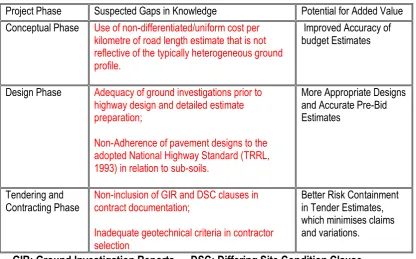
[image:39.595.109.526.503.762.2]Based on the perceived discrepancies in the theoretical and practical approach to the containment of associated ground related risks in cost estimates, several “geotechnical cost drivers” have been identified, and constitutes the rationale of the study. The researcher has thus identified the following gaps in knowledge, suspected as existing in the practice of the highway agencies that need to be verified and addressed, as the primary cost overrun drivers contributing significantly to spate of project delays and abandonment in the geologic context of the Niger Delta.
Table 1.4: Identified Cost Drivers/Potentials for Added Value in Highway Investment
Project Phase Suspected Gaps in Knowledge Potential for Added Value
Conceptual Phase Use of non-differentiated/uniform cost per kilometre of road length estimate that is not reflective of the typically heterogeneous ground profile.
Improved Accuracy of budget Estimates
Design Phase Adequacy of ground investigations prior to highway design and detailed estimate preparation;
Non-Adherence of pavement designs to the adopted National Highway Standard (TRRL, 1993) in relation to sub-soils.
More Appropriate Designs and Accurate Pre-Bid Estimates
Tendering and
Contracting Phase Non-inclusion of GIR and DSC clauses in contract documentation;
Inadequate geotechnical criteria in contractor selection
Better Risk Containment in Tender Estimates, which minimises claims and variations.
Verification of these suspected gaps in knowledge, summarised in Table 1.4, which principally revolve around subsoil conditions of the Niger Delta region and relevant geotechnical practices, constitute the rationale of the study. In view of the current state of highway project delivery in the Niger Delta, these are thus presupposed as being the more profound technical factors, underlying the significant cost escalations, that need to be investigated. Scrutinising the practises of the highway agencies, therefore constitutes a first step, towards understanding the propagation of significant cost overruns in the Niger Delta, against the backdrop of the virtually non-existent literature, on the estimating and design practices specific to these highway agencies. Filling this identified gap in the local literature, thus establishes the central theme of the subsequent field work, necessary to provide a descriptive account of current practice, relative to the dictates of geotechnical best practice, to serve as a platform to evaluate the need for improvement.
1.4 Aim and Objectives of the Study
The aim of the study is to explain the propagation of cost overruns in highway projects using a geotechnical narrative predicated on the financial risk implications of the heterogeneous geology of the Niger Delta wetland. Specifically, the study has the following objectives:
1. To synthesize the background literature on investment in highway development in Nigeria, and the prevalence of delays and abandonment in project delivery, with emphasis on the Niger Delta region due to its peculiar geologic setting.
2. To critically evaluate the theoretical and methodological lenses that have been used in previous studies, to explain the propagation of cost overruns in highway projects, as a platform for highlighting significant gaps which have implications for this study.
3. To critically evaluate and select an adequate philosophical/methodological orientation relevant to provide rich insights into the phenomena of cost overruns in highway projects executed in the Niger Delta.
4. To analyse the geotechnical characteristics of the heterogeneous configuration of the Niger Delta terrain, to highlight its inherent peculiarity for triggering cost overruns.
6. To examine the level of adherence/deviations in the practices of highway agencies in the Niger Delta, in line with the precepts of geotechnical best practice.
7. To develop a statistically valid model and cognitive map of deduced geotechnical pathogens, predicted on the heterogeneous geologic configuration of the Niger Delta region, to account for the level of variance induced in cost overruns.
1.5 Research Questions
1. What is the background to Nigeria’s investment in highway development, and what are the peculiarities associated with the geologic setting of the Niger Delta region, that account for the prevalence of delays and abandonment in project delivery?
2. What theoretical and methodological lenses have been used to explain the propagation of cost overruns in highway projects in previous studies, to serve as a platform for highlighting significant gaps, which have implications for this study.
3. What philosophical/methodological orientation is relevant to provide rich insights into the phenomena of cost overruns in highway projects executed in the Niger Delta?
4. What peculiar geotechnical characteristics of the heterogeneous Niger Delta terrain inherently compounds the propensity of highway projects to run over budget?
5. What shortcomings in geotechnical practice, can potentially trigger cost overruns in highway projects?
6. To what extent have the highway agencies in the Niger Delta region adhered to /deviated from relevant geotechnical best practices?
1.6 Methods, Research Design, and Outline Structure of the Thesis
The research objectives, designed to provide answers to the research questions are achieved using a multi-method mix of geo-spatial, qualitative and quantitative methods/approaches outlined in Table 1.5.
Table1.5: Approach to Achieving Research Objectives/Answer Research Questions Research Objectives/Questions Method/Approach
To synthesize the background literature on investment in highway development in Nigeria and the prevalence of delays and abandonment in project delivery with emphasis on the Niger Delta region due to its peculiar geologic setting. (Q1)
Literature Review (Descriptive/Explanatory)
To critically evaluate the theoretical and methodological lenses that have been used in previous studies to explain the propagation of cost overruns in highway projects, as a platform for highlighting significant gaps which have implications for this study. (Q2)
Theoretical Literature Review (Critical Analysis)
To critically evaluate and select an adequate philosophical/methodological orientation relevant to provide rich insights into the phenomena of cost overruns in highway projects executed in the Niger Delta. (Q3)
Review of literature on Methodology (Critical Evaluation)
To analyse the heterogeneous configuration of the Niger Delta terrain, and the peculiar practicalities necessary for highway construction, as a case study justification of its inherent geologic distinctiveness for triggering cost overruns. (Q4)
Geologic Literature Vs Field Work Analysis:
(Geo-spatial Statistical Analysis)
To identify the specific mediums of financial risk containment of geologic risks, from best practice, which emphasize the need for adequate geotechnical input in highway projects, as potential triggers to cost overruns (Q5).
Literature on Best Practices (Exploratory)
To examine the level of adherence/deviations in the design/costing practices of highway agencies in the Niger Delta, in line with the precepts of the identified geotechnical best practices, as a basis of ascertaining the suspected gaps in knowledge presupposed as the underlying cost overrun drivers. (Q6)
(Deductive) Interview Analysis (Thematic Analysis)
To develop a statistically valid model and cognitive map of geotechnical best practice based drivers to cost overruns, predicted on the heterogeneous geologic configuration of the Niger Delta region, as basis of accounting for the level of variance induced by geotechnical triggers. Q7)
Regression Analysis, Content Analysis and Cognitive Mapping
(Data Triangulation)
Figure1.4: Conceptual Mind Map of the Research Design
Le ad out Le ad in C or e
Background literature on highway Investment in the study area
Theoretical and Technical Literature Explanations on Cost Overrun
Exploratory Geostatistical Analysis: Geo-spatial Vs Cost-overrun Data for highway projects in the Niger Delta
Levels of Geotechnical Input (GI)
Latent Geologic Cost Overrun Drivers
Interplay of Latent Geologic/Geotechnical Pathogens with Emergent Organisational, Socio-Cultural, Skills Gap and Psychological
Barriers to Geotechnical Input
Historical Antecedents to Highway Investment Failures in Nigeria, and Technical Peculiarities to Cost Overruns in the Niger Delta Region
Dialectical Debates in the Literature outlined, and Methodological Shortcomings Identified
Geologic Triggers to Cost Overruns in Highway Projects executed in the Heterogeneous Ground Conditions of the Niger Delta Statistically Explained
Explained Variation: Regression Modelling of Levels of GI
in projects and Latent Geologic Cost-Overrun Drivers in the Niger
Delta Theoretical Framework/Gaps in the Literature Explanations to Cost-Overruns D at a Tr ian gu lat io n
Unexplained Variation:
Content Analysis of Contextual Triggers to Cost Overruns in Highway
Projects Latent Geologically Induced Cost Overrun Drivers Optimised Explanatory Model
of Cost Overruns Drivers
Cognitive Map of Variables Inducing
Cost Growth in Highway Projects in
the Niger Delta
Best Practice Based Geotechnical Triggers to Cost Overruns in Highway Projects identified and used to develop interview template
Conceptual Model of Geotechnical
Drivers to Cost Overruns
Exploratory Geotechnical Literature Review: Identify Geotechnical Best
Practices
Deductive Interview Analysis: Cost Overrun Drivers in Geotechnical Practice
Levels of Geotechnical Input in Project Designs and Costing deduced from Practices of Highway Organisations.
Thematic Analysis of Levels of Geotechnical Input
in Project Phases
Reflexive Inductive Interview Analysis: Emergent Barriers to
Geotechnical Input
Emergent Organisational, Socio-Cultural, Skills and Psychological Barriers to geotechnical Input
Thematic Analysis of Emergent Barriers to Geotechnical Input
Emergent Contextual Barriers
Background Rationale of the
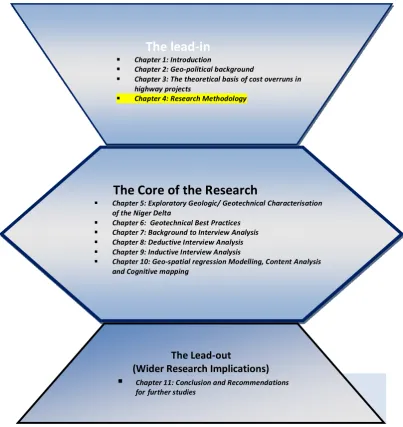
An inductive thematic analysis of emergent barriers, beyond the initial aim of the study, was thus carried out to incorporate the unanticipated social constructs, as part of the research findings. As shown in the research design, the findings from the initial analysis: the exploratory geo-statistical analysis of cost overrun data versus geotechnical index variables, and the deductive thematic analysis of geotechnical themes from the interviews were triangulated using regression analysis to explain the variance in cost overruns explained. The unexplained variation due to the emergent themes were further analysed using content analysis to proportionally assign weightings, as basis of cognitive mapping. The outcomes of the study, were a log-linear regression model of geotechnical pathogens, and a visual conceptual projection of the interplay between the geotechnical and emergent socio-constructs, through the pre and post contract phases of highway projects in the Niger Delta. The chapters of the thesis as shown in Figure 1.5 were thus structured in response to this reflexive adaptation of the research design.
Figure 1.5: Thesis Structure
The Core of the Research
Chapter 5: Exploratory Geologic/ Geotechnical Characterisation of the Niger Delta
Chapter 6: Geotechnical Best Practices
Chapter 7: Background to Interview Analysis
Chapter 8: Deductive Interview Analysis
Chapter 9: Inductive Interview Analysis
Chapter 10: Geo-spatial regression Modelling, Content Analysis and Cognitive mapping
The Lead-out
(Wider Research Implications) Chapter 11: Conclusion and Recommendations
forfurther studies
The lead-in
Chapter 1: Introduction
Chapter 2: Geo-political background
Chapter 3: The theoretical basis of cost overruns in highway projects