International Journal of Emerging Technology and Advanced Engineering
Website: www.ijetae.com (ISSN 2250-2459,ISO 9001:2008 Certified Journal, Volume 3, Issue 9, September 2013)
446
A Survey on Text categorization in Online Social
Networks
K. Nirmala
1,
S. Satheesh kumar
2, Dr. J. Vellingiri
3 1M.E- Student, 2Assistant Professor, 3Associate Professor, Department of CSE, Kongunadu College of Engineering and Technology, Tamil Nadu, India.
Abstract— Online social networks are used to share the
information among the different kind of people. There is a major task of online social network is information filtering. An online social network provides the little support for allowing sharing the information on the user walls. Using, machine learning algorithms text classification is to be done. Text categorization is applied to the set of pre classified documents. In this paper, we discuss about the different kinds of classifiers and their effectiveness.
Key Terms—Online social networks, information
filtering, text classification, machine learning
I. INTRODUCTION
Online social networking sites like Orkut, YouTube, and Facebook are among the most popular sites on the Internet.Users of these sites forms a social network, which provides a powerful means of sharing, organizing, and finding useful information .Unlike web content , the Online social networks (OSN) are organized around more number of users joins the network, shares their information and create the links to communicate with other users. The resulting social network provides a basis for maintaining social relationships, for finding users with similar interests, and for locating content and knowledge that has been contributed or endorsed by other users. In online social networks information filtering can be used for avoiding the undesired messages sharing or commenting on the user Walls. Various machine learning methods are used for classification. The development of social networking among the people, it allows users to customize their own privacy settings. Our main aim is to survey the OSN for filtering the undesired messages.
In this paper Section 2 explains the related work, section 3 explains the main approaches used for learn the machine learning methods section 4 discuss about the feature selection and text representation section 5 explains the evaluation metrics.
II. RELATED WORK
Recommenders systems are used to suggest and improve the access to the relevant products like music, books and movies. Based on the user preferences, items are selected.
A recommender system mostly uses the content based filtering and collaborative filtering systems. By applying the several different text categorization methods used for extracting the text from the online social networks. The system allows to uniquely classifying the users interests by learning the information given in the profiles. Collaborative filtering technique works as filtering the information by collecting the user’s preferences.
2.1 Content Based Filtering
In this content based filtering, each user acts independently and selects the content of information based on the correlation between the two items. LIBRA is one of the content based books recommending system. A set of training books are collected and ratings are calculated according to the information present in the training books. Then the system learns information collected from the users profile, the most recommending book should be ranked by applying the Bayesian classification technique .Another example of the content based recommendation is PRES. It produces the ranked list of items by comparing the information available in the user’s profiles. PRES uses the relevance feedback method it should be introduced by Rocchio.
Relevance feedback method was applied to the information filtering. The major issue present in the content based filtering is, it should learns the user preferences from the user’s actions regarding one content source and use them across other content types. The recommendation system is limited to recommending the content of the same type as the user is already. It should have the less value when compared to other recommendation system services.
2.2 Collabrative Based Filtering
International Journal of Emerging Technology and Advanced Engineering
Website: www.ijetae.com (ISSN 2250-2459,ISO 9001:2008 Certified Journal, Volume 3, Issue 9, September 2013)
447
Item based approach employs the item matrix to determine the similarity of items.
CollabNet is the recommendation technique which combines the model based and memory based approaches with learning to rank techniques. Memory based approaches can be more efficient compared to Model based approaches. When comparing the both approaches collaborative method is well suited for popular items ,but effective content information is not available, content based filtering is well suited for unpopular items and effective content information is easy to obtain.
2.3 Text Representation And Feature Selection
Text representation is the crucial task in the classification. It should be represented by extracting the set of features. Bag of words, document properties and contextual features are the types of features used. Text representation is underlying model of Vector Space Model (VSM) .
Bag of words are represented as the set of words presents in the documents and their associated frequency of weights. Feature selection methods include the following:
Gini index
Information gain
Mutual information measures
Chi-square statistics
Feature selection is used to reducing the high dimensional data space. Feature transformation methods include the latent semantic indexing. The features which are selected from the linear classifiers yields effective results. Also, useful for the naïve bayes method and support vector machines.
III. MACHINE LEARNING TECHNIQUES
Machine learning approach is used for classify the set of training data and automatically create the classifiers for the training data. Text classification is the task of automatically assign the texts into the predefined categories. In these text classification accomplished on the basis of endogenous collection of data. Text categorization mostly depends on the information retrieval technique such as indexing, inductive construction of classifiers and evaluation technique. In this machine learning, classifier learns how to classify the categories of documents based on the features extracted from the set of training data.
Some of the key methods, which are commonly used for text classification, are as follows: neural network classifiers, support vector machines, Bayesian classifiers, boosting bagging classifiers.
These methods are applied to the text classification and predicting the accuracy of the classifiers.
3.1 Bayesian Classifier
The simple Bayesian classifier is mainly used for classification purpose. Using this, learn the profiles through the feedback collected from various websites. Based on the Bayesian classifier, the rank order of the pages will be rated. Learning the profile like LIBRA recommending system also uses the Bayesian classifier for the classification task. Text classification is based on calculating the posterior probability of the documents present in the different classes. Naive bayes also a simple probabilistic classifier based on applying bayes theorem with independence feature selection. Naïve Bayesian classification is used for anti spam filtering technique. It has two different phases. The first phase has been applied for training set of data and the second phase employs the classification phase.
Bayesian filter can also be used for classification of text. The result obtained by using this technique explains Bayesian approach is not sufficient for anti-spam filtering. Bayesian classifier can be applied on the reuters-21578, it improves the performance of the system.
3.2 Neural Network Classifier
Neural network classifiers are most important for the classification. The neural networks have the advantages of self adaptive method. It means adjusting the weight themselves to the data without any specification and also it should be have the arbitrary accuracy. There are several types of neural networks are used for the classification task. There are feed forward multilayer networks and multilayer perceptrons are mostly used for neural network classifiers.
Multilayer perceptrons have been applied successfully to solve many problems using the algorithm called Error back propagation algorithm. It has two passes. There are forward and backward pass. Feed forward back propagation neural network have the signal flow through the forward direction. Neural networks are very competitive to traditional classifiers for solving the classification problems. The basic unit of the neural network layer is neuron (or) unit. Each unit receives a set of inputs called Xi and associated set of weights W,
corresponding to the term frequencies in the ith document. The linear function is denoted as
Pi=W. Xi
Pi is the prediction function. The simplest form of neural network is perceptron. It is the linearly separable for classification in the neural network.
International Journal of Emerging Technology and Advanced Engineering
Website: www.ijetae.com (ISSN 2250-2459,ISO 9001:2008 Certified Journal, Volume 3, Issue 9, September 2013)
448
W
0W
1W
2.
.
. W
nthreshold
[image:3.595.315.555.134.330.2]Fig 3.2.1 Perceptron.
3.3 Support Vector Machines
The support vector machine method has been introduced in text classification by Joachim. Support vector Machines were used for separate the different classes. Linear support vector machines have the advantages of simplicity and interpretability. Normally, Text data which are correlated with one another and organized into the linearly separable categories. Support vector machines can be applied to the Email data classification. The performance of support vector machine is compared to the other classification techniques like decision trees, the rule based classifier and rocchio method it should provides the more robust and flexible performance.
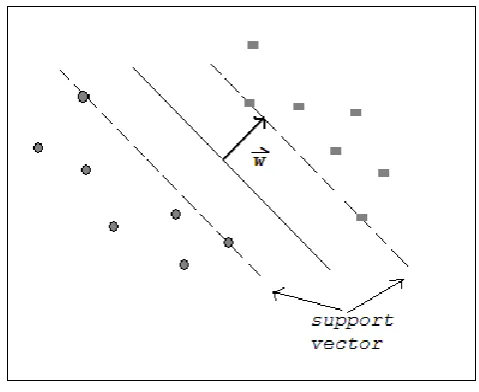
[image:3.595.77.254.137.324.2]The support vector machine classifier has been well suited for large amount of unlabeled data and small amount of labeled data. To solve the quadratic programming problem and two-class pattern recognition problem, support vector machine can be applied. Hyper planes are chosen for the separator for high dimensional surfaces. It should classify the positive and negative margins in the high dimensional surface. This method should not need any human and machines help for tuning on a validation set of parameters, default choices are available in the support vector machines. There are error-estimating formulas are helpful for predicting the classification and eliminating the need of cross validation on the test and training set of data. It is very easy to select the features from the high dimensional space.
Fig 3.3.1 Example of SVM hyper plane pattern
The equation of the hyper plane for linearly separable space is
WX+B=0 X is an arbitrary objects W is a vector
B is constant learned from the set of linearly separable objects in the training documents. Vapnik proposed Classification algorithms for Support vector machines. Hyper planes are used to separate the two different classes of data.SVM can be operated on the pre classified documents. According to Joachim’s Why should SVMs work well for Text categorization means the following reasons:
High dimensional input space
Irrelevant features
Document vectors are Sparse
Text classification mostly linearly separable
3.4 Decision Trees
Decision trees are designed essentially for a hierarchical decomposition of the data space. Based on the attribute value it determines the predicate or a condition. In this decision trees, class labels in the leaf node used for classification purpose. In order to reduce the over fitting data, pruning is to be done. There are several different kinds of splits in the decision trees are available. The listed splits are
Single attribute split
Similarity-based multi-attribute split
Dimensional- based multi-attribute split
X
11
X
2X
nInternational Journal of Emerging Technology and Advanced Engineering
Website: www.ijetae.com (ISSN 2250-2459,ISO 9001:2008 Certified Journal, Volume 3, Issue 9, September 2013)
449
Decision tree implementations in the text context tend to be small variations compared to ID3, C4.5 for the purpose of adapting the text classification.
IV. EXPERIMENTAL ANALYSIS
Support vector machines can be applied on the two real world classifications named newsgroups, Reuters data collections. Reuters are mostly used experimental work for text categorization. Experiments used on the test sets, training sets. There are five major versions of benchmarks are available for the Reuters collections. Active learning for classification includes support vector machines, naïve bayes classifiers.
Comparing both methods support vector machine is well suited for the text classification. Support vector machines have the three main methods for active learning classification.
Index server
Feature selection
[image:4.595.51.301.343.630.2]
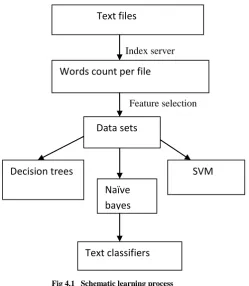
Fig 4.1 Schematic learning process
There are simple method, max min and ratio methods. Max min and ratio methods could be efficient methods for active learning classification. By analyzing the reuters-21578 dataset test files are processed using the index server.
In these, the tf *Idf are calculated along with the features. Reducing the feature space by selecting the k words with the highest mutual information. For support vector machines and decision trees have the k value of 300 other other words having the 50.
Training time, classification accuracy, speed is calculated for the classifiers. Support vector machines yields better performance results compared than the other methods.
V. EVALUATION METRICS
By comparing the different classifiers, based on the performance results best classifier should be selected. The performance is calculated using the following measures:
True positive, true negative, false positive, false negative should denoted as TP, TN, FP, FN.
PRECISION:
Precision is denoted as the percentage of predicted documents for the given topic that are correctly classified.
P = TP
( TP + FP )
RECALL: recall denotes the percentage of total documents for the given topic that are correctly classified.
R = TP
(TP + FN )
BREAK EVEN POINT: Breakeven point is denoted as when the precision and recall values are equals at some point of Time.
F-MEASURE: It should be denoted as the 2.P.R
( P + R )
ACCURACY: It should be denoted as the
TP + TN
( TP + FP + FN + TN )
Then macro average and micro average should be calculated.
VI. CONCLUSION
Classification is the major task in machine learning and data mining. Our work surveys the various kinds of machine learning methods like decision trees, naïve bayes, support vector machines and neural networks . Using, these techniques classification is efficiently done. In this survey paper, provides the comparative study of classifiers particularly in recent trends support vector machines and neural networks well suited for the classification and characteristics of text data.
Text files
Words count per file
Decision trees
Naïve
bayes
SVM
International Journal of Emerging Technology and Advanced Engineering
Website: www.ijetae.com (ISSN 2250-2459,ISO 9001:2008 Certified Journal, Volume 3, Issue 9, September 2013)
450
Also our work surveys the collaborative and content based filtering can be applied on the LIBRA recommending systems .It provides the complementary capabilities. In future, integrating the content based and collaborative filtering techniques are useful for machine learning research. Using these classifiers in online social networks, content based filtering can be done. Even though these text filtering methods provides the best results in online social networks, additional challenge is focused on short classification .Using machine learning, filtering rules, black list management it should be effectively implemented.
REFERENCES
[1] Adomavicius and G. Tuzhilin, “Toward the Next Generation of Recommender Systems: A Survey of the State-of-the-Art and Possible Extensions,” IEEE Trans. Knowledge and Data Eng., vol. 17,no. 6, pp. 734-749, June 2005
[2] R.J. Mooney and L.Roy, “Content-based book recommending using learning for text categorization, ” proc.fifth ACM conf. Digital Libraries pp.195-204,2000.
[3] F.Sebastiani, “ Machine learning in automated text categorization,” ACM computing surveys,vol.34,no.1,pp.1-47,2002.
[4] M.J. Pazzani and D.Billsus, “ Learning and revising user profiles: The Identification of interesting web sites,” machine learning ,vol.27,no.3,pp.313-331,1997.
[5] C.Apte, F.Damerau, S.M.Weiss, D.Sholom,and M.weiss, “Automated learning of decision rules for text categorization,” trans.Information systems,vol.12,no.3,pp.233-251,1994. [6] S.Dumais, J.Platt, D.Heckerman and M.Sahani, “Inductive
learning algorithms and representation for text categorization,” proc.seventh Int’l conf.Information and knowledge management (CIKM’98),pp.148-155,1988.
[7] T.Joachims, “Text categorization with SVM: Learning with many relevant features,” proc.European conf.Machine learning,pp.137-142,1988
[8] Thorsten Joachims , “A statistical learning model of text classification for support vector machines”
[9] Yiming Yang, Jan O.Pedersen , “A comparative study of feature selection in text categorization”.
[10] Thorsten Joachims, “ Text categorization with support vector machines: Learning with Many relevant features” .
[11] Kian Ming Adam Chai , Hwee Tou Ng and Hai Leong Chieu “ Bayesian online classifiers for text classification and filtering”. [12] Robin van Meteren and Maarten van Someren, “Using content
based filtering for recommendation”.
[13] Jennifer Ann Golbeck, “ Computing and applying in web based social networks,” 2005.